

A Re-conceptualization of Access for 21st Century Healthcare
Open accessThe DOI matches its Crossref record; 60 of the 60 references it cites were found in a registry or an index.
Abstract
Many e-health technologies are available to promote virtual patient-provider communication outside the context of face-to-face clinical encounters. Current digital communication modalities include cell phones, smartphones, interactive voice response, text messages, e-mails, clinic-based interactive video, home-based web-cams, mobile smartphone two-way cameras, personal monitoring devices, kiosks, dashboards, personal health records, web-based portals, social networking sites, secure chat rooms, and on-line forums. Improvements in digital access could drastically diminish the geographical, temporal, and cultural access problems faced by many patients. Conversely, a growing digital divide could create greater access disparities for some populations. As the paradigm of healthcare delivery evolves towards greater reliance on non-encounter-based digital communications between patients and their care teams, it is critical that our theoretical conceptualization of access undergoes a concurrent paradigm shift to make it more relevant for the digital age. The traditional conceptualizations and indicators of access are not well adapted to measure access to health services that are delivered digitally outside the context of face-to-face encounters with providers. This paper provides an overview of digital "encounterless" utilization, discusses the weaknesses of traditional conceptual frameworks of access, presents a new access framework, provides recommendations for how to measure access in the new framework, and discusses future directions for research on access.
Overview
The claims and statistics of this paper haven’t been checked yet.
Free: it reads the open-access text and checks the first 5 claims that cite a source we can check. Create a free account to check every claim.
Integrity signals
Registry
Cites
Statistics
Figures
Verification
Claims the paper makes
The claims and statistics of this paper haven’t been checked yet.
Free: it reads the open-access text and checks the first 5 claims that cite a source we can check. Create a free account to check every claim.
Claims other papers make about this one
Each is checked against this paper’s own text: does it say what the citing paper says it does?
The cited source says what the claim attributes to it.
In the citing paper
“As described by Fortney et. al., access is a multidimensional concept including geographic, temporal, financial, digital, and cultural domains, and barriers to care can be considered within these areas.42”
From Receipt of Glucagon-Like Peptide-1 Receptor Agonists Among Rural Patients with Obstructive Sleep Apnea and Excess Weight (2026) · cites this paper as [42]
Self-check
Percentages, sums and reported differences re-computed from the paper’s own numbers.
The self-check needs the paper’s full text.
Citations
Cites
The theory of planned behavior
Ajzen, I. (1991) · Organizational Behavior and Human Decision Processes · doi:10.1016/0749-5978(91)90020-t · Cited by 134,657
Self-efficacy mechanism in human agency
Bandura, A. (1982) · American Psychologist · doi:10.1037/0003-066x.37.2.122 · Cited by 15,975
Evaluating the quality of medical care
DONABEDIAN, A. (2005) · The Milbank Quarterly · doi:10.1111/j.1468-0009.2005.00397.x · Cited by 6,102
Social Learning Theory and the Health Belief Model
Rosenstock, I. M., Strecher, V. J., & Becker, M. H. (1988) · Health Education Quarterly · doi:10.1177/109019818801500203 · Cited by 5,564 · cited 1×
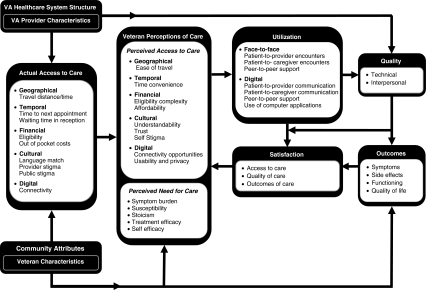
“18 Perceived need is broadly conceptualized here as perceptions about symptom burden, susceptibility, stoicism, self efficacy, and treatment efficacy.”
BackgroundThe Concept of Access: Definition and Relationship to Consumer Satisfaction
Penchansky, R., & Thomas, J. W. (1981) · Medical Care · doi:10.1097/00005650-198102000-00001 · Cited by 3,437 · cited 1×
“5 As described in Figure 1, we propose the following dimensions of access: geographical, temporal, financial, cultural and digital.”
BackgroundThe definition of quality and approaches to its assessment
Donabedian, A. (1980) · Health Administration Press eBooks · Cited by 2,618
Internet-based cognitive behaviour therapy for symptoms of depression and anxiety: A meta-analysis
SPEK, V., CUIJPERS, P., NYKLÍČEK, I., RIPER, H., KEYZER, J., & POP, V. (2007) · Psychological Medicine · doi:10.1017/s0033291706008944 · Cited by 1,586
Healthcare via Cell Phones: A Systematic Review
Krishna, S., Boren, S. A., & Balas, E. A. (2009) · Telemedicine and e-Health · doi:10.1089/tmj.2008.0099 · Cited by 882 · cited 1×
“46 Another important type of asynchronous digital patient-to-provider encounter includes remote monitoring involving the entering/forwarding of clinical information by the patient to their provider via smartphones, kiosks, web-based portals hosted by the healthcare organization (e.g., MyHealtheVet…”
BackgroundBerwick, D. M. (2009) · Health Affairs · doi:10.1377/hlthaff.28.4.w555 · Cited by 869
Bethell, C. D., Read, D., Stein, R. E. K., Blumberg, S. J., Wells, N., & Newacheck, P. W. (2002) · Ambulatory Pediatrics · doi:10.1367/1539-4409(2002)002<0038:icwshc>2.0.co;2 · Cited by 698
Access to Health Care in America
(1993) · National Academies Press eBooks · doi:10.17226/2009 · Cited by 646
Darkins, A., Ryan, P., Kobb, R., Foster, L., Edmonson, E., Wakefield, B., & Lancaster, A. E. (2008) · Telemedicine and e-Health · doi:10.1089/tmj.2008.0021 · Cited by 597 · cited 2×
“…monitoring involving the entering/forwarding of clinical information by the patient to their provider via smartphones, kiosks, web-based portals hosted by the healthcare organization (e.g., MyHealtheVet 47,48 ) or personal electronic medical devices (e.g., HealthBuddy®, 49,50 Intel® Health Guide).”
BackgroundProudfoot, J., Ryden, C., Everitt, B., Shapiro, D. A., Goldberg, D., Mann, A., Tylee, A., Marks, I., & Gray, J. A. (2004) · British Journal of Psychiatry · doi:10.1192/bjp.185.1.46 · Cited by 516 · cited 1×
“There are also a growing number of web-based 58,59 and personal computer-based applications 60 that deliver therapeutic treatment to patients like cognitive behavioral therapy that have been shown to be clinically effective in randomized trials.”
BackgroundThe Medical Home: Growing Evidence to Support a New Approach to Primary Care
Rosenthal, T. C. (2008) · The Journal of the American Board of Family Medicine · doi:10.3122/jabfm.2008.05.070287 · Cited by 506 · cited 1×
“One example is the Patient Centered Medical Home, a model of care that emphasizes, among other things, enhanced patient access through digital channels of communication.(3) As the paradigm of healthcare delivery evolves, it is imperative that our theoretical conceptualization of access undergoes a concurrent paradigm…”
BackgroundAccess to Medical Care in the U.S.: Realized and Potential
Andersen, R., & Aday, L. A. (1978) · Medical Care · doi:10.1097/00005650-197807000-00001 · Cited by 483
Shea, S., Weinstock, R. S., Teresi, J. A., Palmas, W., Starren, J., Cimino, J. J., Lai, A. M., Field, L., Morin, P. C., Goland, R., et al. (2009) · Journal of the American Medical Informatics Association · doi:10.1197/jamia.m3157 · Cited by 379 · cited 1×
“Audiovisual technologies include clinic-based interactive video units, 39 home-based web-cams 40,41 and mobile smartphone two-way cameras.”
BackgroundRacial and Ethnic Disparities in the VA Health Care System: A Systematic Review
Saha, S., Freeman, M., Toure, J., Tippens, K. M., Weeks, C., & Ibrahim, S. (2008) · Journal of General Internal Medicine · doi:10.1007/s11606-008-0521-4 · Cited by 302 · cited 1×
“Technology-based interventions will also need to be tailored to the cultural needs of the target populations (e.g., rural veterans 35 , minority veterans 36 , women veterans 37 ) to ensure they are acceptable and user-friendly.”
BackgroundAccess in health services research: The battle of the frameworks
Ricketts, T. C., & Goldsmith, L. J. (2005) · Nursing Outlook · doi:10.1016/j.outlook.2005.06.007 · Cited by 269 · cited 1×
“28 However, this is not to imply that improvements in access should be measured from the perspective of the healthcare system (e.g., number of new clinic locations).”
BackgroundComputerised cognitive-behavioural therapy for depression: systematic review
Kaltenthaler, E., Parry, G., Beverley, C., & Ferriter, M. (2008) · British Journal of Psychiatry · doi:10.1192/bjp.bp.106.025981 · Cited by 206 · cited 1×
“61 As the functionality of smartphones increases, a growing number of health applications are likely to be developed for this platform. satisfaction with quality and outcomes influences the patient ’ s perceived need for care.”
BackgroundNational Telemedicine Initiatives: Essential to Healthcare Reform
Bashshur, R. L., Shannon, G. W., Krupinski, E. A., Grigsby, J., Kvedar, J. C., Weinstein, R. S., Sanders, J. H., Rheuban, K. S., Nesbitt, T. S., Alverson, D. C., et al. (2009) · Telemedicine and e-Health · doi:10.1089/tmj.2009.9960 · Cited by 200 · cited 1×
“Yet, our current healthcare system is fragmented, delivering episodic face-to-face treatment with negligible communication between encounters, and minimal care coordination over time.(2) Given the current level of innovation in e-health technologies and recent legislation to reform the U.”
BackgroundComparing Alternative Methods of Measuring Geographic Access to Health Services
Fortney, J., Rost, K., & Warren, J. (2000) · Health Services and Outcomes Research Methodology · doi:10.1023/a:1012545106828 · Cited by 189
Self-citationCuevas, C. D. L., Arredondo, M. T., Cabrera, M. F., Sulzenbacher, H., & Meise, U. (2006) · Telemedicine and e-Health · doi:10.1089/tmj.2006.12.341 · Cited by 173
To use or not to use: What influences why women veterans choose VA health care
Washington, D. L., Yano, E. M., Simon, B. F., & Sun, S. (2006) · Journal of General Internal Medicine · doi:10.1111/j.1525-1497.2006.00369.x · Cited by 168
Clarke, G., Kelleher, C., Hornbrook, M., DeBar, L., Dickerson, J., & Gullion, C. (2009) · Cognitive Behaviour Therapy · doi:10.1080/16506070802675353 · Cited by 154 · cited 1×
“There are also a growing number of web-based 58,59 and personal computer-based applications 60 that deliver therapeutic treatment to patients like cognitive behavioral therapy that have been shown to be clinically effective in randomized trials.”
BackgroundRacial and Income Disparities in Childhood Asthma in the United States
Akinbami, L. J., LaFleur, B., & Schoendorf, K. C. (2002) · Ambulatory Pediatrics · doi:10.1367/1539-4409(2002)002<0382:raidic>2.0.co;2 · Cited by 150 · cited 1×
“11 However, utilization is distinct from access because it depends on both access to and need for services.”
BackgroundWallace, A. E., Weeks, W. B., Wang, S., Lee, A. F., & Kazis, L. E. (2006) · Psychiatric Services · doi:10.1176/appi.ps.57.6.851 · Cited by 135
Patient satisfaction of female and male users of veterans health administration services
Wright, S. M., Craig, T., Campbell, S. L., Schaefer, J., & Humble, C. G. (2006) · Journal of General Internal Medicine · doi:10.1111/j.1525-1497.2006.00371.x · Cited by 135 · cited 1×
“38 Performance measures for actual and perceived access should be used by the VA to evaluate the impact of policies pertaining to eligibility and purchased care (i.e., contracting with private sector providers) and programs such as the expansion of community-based outpatient clinics, deployment of…”
MethodAccess to medical care in the U.S
Aday, L. A. (1984) · Cited by 133
Access to Health Care for the Poor: Does the Gap Remain?
Davis, K. C., Gold, M., & Makuc, D. M. (1981) · Annual Review of Public Health · doi:10.1146/annurev.pu.02.050181.001111 · Cited by 120 · cited 1×
“10 Quality.”
Cultural aspects of telepsychiatry
Shore, J. H., Savin, D. M., Novins, D., & Manson, S. M. (2006) · Journal of Telemedicine and Telecare · doi:10.1258/135763306776738602 · Cited by 108 · cited 1×
“Moreover, patients from some cultures, as well as those with lower education levels may have lower comfort levels with e-health technologies, 30,31 and experience greater usability problems if they lack the skills to engage digitally with their provider and to interface with computer health…”
BackgroundMartínez-Ramos, C., Cerdán, M. T., & López, R. S. (2009) · Telemedicine and e-Health · doi:10.1089/tmj.2009.0003 · Cited by 98
Using e-Health to Enable Culturally Appropriate Mental Healthcare in Rural Areas
Yellowlees, P., Marks, S., Hilty, D., & Shore, J. H. (2008) · Telemedicine and e-Health · doi:10.1089/tmj.2007.0070 · Cited by 96 · cited 1×
“Moreover, patients from some cultures, as well as those with lower education levels may have lower comfort levels with e-health technologies, 30,31 and experience greater usability problems if they lack the skills to engage digitally with their provider and to interface with computer health…”
BackgroundA Feasibility Study of the Use of Asynchronous Telepsychiatry for Psychiatric Consultations
Yellowlees, P. M., Odor, A., Parish, M. B., Iosif, A.-M., Haught, K., & Hilty, D. (2010) · Psychiatric Services · doi:10.1176/ps.2010.61.8.838 · Cited by 93
Nazi, K. M., Hogan, T. P., Wagner, T. H., McInnes, D. K., Smith, B., Haggstrom, D. A., Chumbler, N. R., Gifford, A. L., Charters, K. G., Saleem, J. J., et al. (2010) · Journal of General Internal Medicine · doi:10.1007/s11606-009-1114-6 · Cited by 85 · cited 1×
“…monitoring involving the entering/forwarding of clinical information by the patient to their provider via smartphones, kiosks, web-based portals hosted by the healthcare organization (e.g., MyHealtheVet 47,48 ) or personal electronic medical devices (e.g., HealthBuddy®, 49,50 Intel® Health Guide).”
BackgroundManaging Asthma with Mobile Phones: A Feasibility Study
Holtz, B., & Whitten, P. (2009) · Telemedicine and e-Health · doi:10.1089/tmj.2009.0048 · Cited by 78 · cited 1×
“Asynchronous digital patient-to-provider communication Include interactive video, 42 interactive voice response, 43 text messaging, 44,45 e-mails, and secure chat rooms hosted by healthcare organizations in which there is a time lag in communication between the patient and the provider.”
BackgroundExploring Technology Impacts of Healthcare 2.0 Initiatives
Randeree, E. (2009) · Telemedicine and e-Health · doi:10.1089/tmj.2008.0093 · Cited by 69 · cited 1×
“32 Thus, although e-health has the potential to improve access, a potentially growing digital divide could create greater access disparities for some patient populations.”
BackgroundThe Definition of Quality and Approaches to Its Assessment
Brook, R. H., & Lohr, K. N. (1981) · PubMed Central · Cited by 57
Access to Substance Abuse Services in Rural Areas
Fortney, J. C., & Booth, B. M. (2002) · Springer eBooks · doi:10.1007/978-0-306-47193-3_10 · Cited by 57
Self-citationText Messaging in Healthcare: The Elephant Knocking at the Door
Terry, M. (2008) · Telemedicine and e-Health · doi:10.1089/tmj.2008.8495 · Cited by 57
Health services research: an anthology
Vaughan, J. P. (1993) · Transactions of the Royal Society of Tropical Medicine and Hygiene · doi:10.1016/0035-9203(93)90316-i · Cited by 56
Chumbler, N. R., Haggstrom, D., & Saleem, J. J. (2011) · Medical Care · doi:10.1097/mlr.0b013e3181d558f9 · Cited by 52 · cited 2×
“…monitoring involving the entering/forwarding of clinical information by the patient to their provider via smartphones, kiosks, web-based portals hosted by the healthcare organization (e.g., MyHealtheVet 47,48 ) or personal electronic medical devices (e.g., HealthBuddy®, 49,50 Intel® Health Guide).”
BackgroundHealth Services Research : an Anthology
White, K. L., Frenk, J. M., & Ordonez, C. (1992) · Medical Entomology and Zoology · Cited by 51
Ayotte, B. J., Allaire, J. C., & Bosworth, H. (2009) · Aging, Neuropsychology, and Cognition · doi:10.1080/13825580902741336 · Cited by 50 · cited 1×
“Bothpatient health literacy andprovider cultural competencyare critical factors impacting understandability.(25) The mode of communication (e.”
BackgroundSelf-citationChumbler, N. R., Neugaard, B., Ryan, P., Qin, H., & Joo, Y. (2005) · Journal of Telemedicine and Telecare · doi:10.1258/1357633053688723 · Cited by 48
Toward the Design of a Wearable System for Fall-Risk Detection in Telerehabilitation
Giansanti, D., Morelli, S., Maccioni, G., & Costantini, G. (2009) · Telemedicine Journal and e-Health · doi:10.1089/tmj.2008.0106 · Cited by 39 · cited 1×
“…TM ), and sensors integrated into automobiles or homes that can collect clinical information such as vital signs, blood glucose, weight, falls, 54 problems with gait, 55 andautomaticallyuploaddatatotheproviderviawireless(e.g.,Bluetoothdevicessuch as MedApps® HealthPAL) or wired technologies.”
Automating Standard Alcohol Use Assessment Instruments Via Interactive Voice Response Technology
Mundt, J. C., Bohn, M. J., King, M., & Hartley, M. T. (2002) · Alcoholism: Clinical & Experimental Research · doi:10.1097/00000374-200202000-00007 · Cited by 37
Low-income persons' access to health care: NMCUES Medicaid data.
Howell, E. M. (1988) · Public Health Reports · Cited by 36
Volume, Quality, and the Regionalization of Health Care Services
Donabedian, A. (1984) · Medical Care · doi:10.1097/00005650-198402000-00001 · Cited by 29 · cited 1×
“12 For example, due to the positive correlation between volume and quality in surgery, 13 surgical programs are often regionalized, which reduces geographical access, but improves quality for those who receive it.”
BackgroundGeographic market areas for psychiatric and medical outpatient treatment
Fortney, J. C., Lancaster, A. E., Owen, R. R., & Zhang, M. (1998) · The Journal of Behavioral Health Services & Research · doi:10.1007/bf02287506 · Cited by 25 · cited 1×
“21 For illnesses associated with low levels of perceived need (e.g., substance use disorders), individuals often make a proverbial “ mountain out of a mole hill ” when it comes to seeking services.”
BackgroundSelf-citationProvider Choice and Utility Loss due to Selective Contracting in Rural and Urban Areas
Fortney, J. C., Thill, J., Zhang, M., Duan, N., & ROST, K. M. (2001) · Medical Care Research and Review · doi:10.1177/107755870105800104 · Cited by 22 · cited 1×
“, number of providers within 30 minutes) may also be an important dimension of actual geographical access.(24) Community Attributes”
BackgroundSelf-citationFortney, J. C., Maciejewski, M. L., Warren, J. J., & Burgess, J. F. (2005) · INQUIRY The Journal of Health Care Organization Provision and Financing · doi:10.5034/inquiryjrnl_42.1.29 · Cited by 19 · cited 1×
“, average travel distance before and after opening new clinics).(29) A complicating factor is that we have also argued that access depends on the characteristics and treatment preferences of the individual.”
BackgroundSelf-citationCigarette smoking and subsequent hospitalization in a cohort of young U.S. Navy female recruits
Woodruff, S. I., Conway, T. L., Shillington, A. M., Clapp, J. D., Lemus, H., & Reed, M. B. (2010) · Nicotine & Tobacco Research · doi:10.1093/ntr/ntq007 · Cited by 19 · cited 1×
“Audiovisual technologies include clinic-based interactive video units, 39 home-based web-cams 40,41 and mobile smartphone two-way cameras.”
BackgroundPatterns of Substance Abuse Treatment Seeking Following Cocaine-Related Emergency Department Visits
Fortney, J. C., Tripathi, S. P., Walton, M. A., Cunningham, R. M., & Booth, B. M. (2010) · The Journal of Behavioral Health Services & Research · doi:10.1007/s11414-010-9224-9 · Cited by 17
Self-citationTelemedicine at the VA: VistA, MyHealtheVet, and Other VA Programs
Naditz, A. (2008) · Telemedicine Journal and e-Health · doi:10.1089/tmj.2008.9973 · Cited by 16 · cited 1×
“…TM ), and sensors integrated into automobiles or homes that can collect clinical information such as vital signs, blood glucose, weight, falls, 54 problems with gait, 55 andautomaticallyuploaddatatotheproviderviawireless(e.g.,Bluetoothdevicessuch as MedApps® HealthPAL) or wired technologies.”
A Feasibility Study of the Use of Asynchronous Telepsychiatry for Psychiatric Consultations
Yellowlees, P., Odor, A., Parish, M. B., Iosif, A., Haught, K., & Hilty, D. M. (2010) · Psychiatric Services · doi:10.1176/appi.ps.61.8.838 · Cited by 15
Measuring Depression and Pain with Home Health Monitors
Dobscha, S. K., Corson, K., Pruitt, S., Crutchfield, M., & Gerrity, M. (2006) · Telemedicine Journal and e-Health · doi:10.1089/tmj.2006.12.702 · Cited by 11 · cited 1×
“Clinical information might include vital signs (e.g., weight, blood pressure), photographs (e.g., wounds 51 , rashes, swelling, etc), self-reported symptoms (e.g., depressionandpainseverity 52 )ormedicationside-effectsfortheprovidertoreviewinorderto assess treatment tolerability and response.”
BackgroundShannon, G. W., & Buker, C. M. (2010) · Telemedicine Journal and e-Health · doi:10.1089/tmj.2010.0002 · Cited by 11 · cited 1×
“23 The degree of local provider choice (e.g., number of providers within 30 minutes) may also be an important dimension of actual geographical access.”
BackgroundAccessibility to medical care among urban American Indians in a large metropolitan area
Shannon, G. W., & Bashshur, R. L. (1982) · Social Science & Medicine · doi:10.1016/0277-9536(82)90310-0 · Cited by 8 · cited 1×
“27 While we argued earlier that measuring access using quality indicators is inadvisable, that is not to say that one should not take quality into consideration when measuring access.”
BackgroundKvedar, J. C., Herzlinger, R. E., Holt, M., & Sanders, J. H. (2009) · Telemedicine Journal and e-Health · doi:10.1089/tmj.2009.9972 · Cited by 8 · cited 1×
“It has been argued that the most important ingredient to effectively managing chronic illnesses is communication between patients and providers.(1) Yet, our current healthcare system is fragmented, delivering episodic face-to-face treatment with negligible communication between encounters, and minimal care coordinatio…”
BackgroundNew Frontiers: The Virtual Reality of Telemedicine
Naditz, A. (2009) · Telemedicine Journal and e-Health · doi:10.1089/tmj.2009.9995 · Cited by 1 · cited 1×
“Personal monitoring devices including wearable monitoring devices 53 (e.g., the Corventis PiiX cardiac monitor), portable monitoring devices (e.g., AreoTel® Heartview TM ), and sensors integrated into automobiles or homes that can collect clinical information such as vital signs, blood glucose,…”
Research works printed but not linked: 5
- Rosenstock IM Strecher VJ Becker MH Social learning theory and the Health Belief Model Health Educ Q 1988 15 2 175 183 10.1177/109019818801500203 3378902 · DOI · Paper page
- Ricketts TC Goldsmith LJ Access in health services research: The battle of the frameworks Nurs Outlook 2005 53 6 274 280 10.1016/j.outlook.2005.06.007 16360698 · DOI · Paper page
- Ricketts TC Goldsmith LJ Access in health services research: The battle of the frameworks Nurs Outlook 2005 53 6 274 280 10.1016/j.outlook.2005.06.007 16360698 · DOI · Paper page
- Sarasohn-Kahn J How Smartphones are Changing Health Care for Consumers and Providers 2010 CA Oakland
- Sarasohn-Kahn J How Smartphones are Changing Health Care for Consumers and Providers 2010 CA Oakland
Cited by
Glasgow, R. E., & Riley, W. T. (2013) · American Journal of Preventive Medicine · doi:10.1016/j.amepre.2013.03.010 · Cited by 318
A Comprehensive Review on Exploring the Impact of Telemedicine on Healthcare Accessibility
Anawade, P. A., Sharma, D., & Gahane, S. (2024) · Cureus · doi:10.7759/cureus.55996 · Cited by 287
“Despite the potential benefits, numerous barriers and challenges hinder the widespread adoption of telemedicine practices, including infrastructure limitations, operational complexities, regulatory constraints, communication barriers, and legislative hurdles [32].”
Telemedicine-Based Collaborative Care for Posttraumatic Stress Disorder: A Randomized Clinical Trial
Fortney, J. C., Pyne, J. M., Kimbrell, T. A., Hudson, T. J., Robinson, D. E., Schneider, R., Moore, W. M., Custer, P. J., Grubbs, K. M., & Schnurr, P. P. (2015) · JAMA Psychiatry · doi:10.1001/jamapsychiatry.2014.1575 · Cited by 272
Self-citationCarey, K. B., Scott-Sheldon, L. A. J., Elliott, J. C., Garey, L., & Carey, M. P. (2012) · Clinical Psychology Review · doi:10.1016/j.cpr.2012.08.001 · Cited by 250
Accessible magnetic resonance imaging: A review
Geethanath, S., & Vaughan, J. T. (2019) · Journal of Magnetic Resonance Imaging · doi:10.1002/jmri.26638 · Cited by 244
“In this review we considered a definition that could be optimized for imaging technology in general and MR in particular.(47) Fortney et al(47) characterize accessible healthcare in the digital age with five access dimensions (geographical, temporal, financial, cultural, and digital) at four levels of delivery (indivi…”
Method
Metadata
- Authors
- Fortney, J. C., Burgess, J. F., Bosworth, H. B., Booth, B. M., & Kaboli, P. J.
- Affiliations
- Health Services Research & Development (US)
- Boston University (US)
- Duke University (US)
- University of Iowa (US)
- Corresponding author
- Fortney, John C.
- Venue
- Journal of General Internal Medicine
- Published
- 2011-10-12
- Volume
- 26
- Issue
- S2
- Pages
- 639-47
- ISSN
- 0884-8734 (ISSN-L)
- 1525-1497
- PMC
- PMC3191218
- OpenAlex
- W2035798031
- Cited by
- 311
- References
- 59
- Citations by year
- 2026: 23 · 2025: 22 · 2024: 21 · 2023: 23 · 2022: 25 · 2021: 17 · 2020: 22 · 2019: 26 · 2018: 26 · 2017: 20 · 2016: 10 · 2015: 26 · 2014: 12 · 2013: 23 · 2012: 9
- FWCI
- 2.37
- Type
- journal article
- Language
- en
- Open access
- hybrid
- doi.org
- Licence
- cc-by-nc
- creativecommons.org/licenses/by-nc/2.0 (tdm)
- Locations
- Journal of General Internal Medicine (publishedVersion, cc-by-nc)
- Europe PMC (PubMed Central) (publishedVersion, cc-by-nc)
- PubMed Central (publishedVersion, cc-by-nc)
- PubMed (publishedVersion)
- Funders
- U.S. Department of Veterans Affairs (08-027)
- Health Services Research and Development (#08‐027)
- Office of Rural Health
- NIH Clinical Center
- Topics
- Health Sciences › Medicine › Public Health, Environmental and Occupational Health › Telemedicine and Telehealth Implementation
- Health Sciences › Health Professions › General Health Professions › Health Literacy and Information Accessibility
- Health Sciences › Health Professions › Health Information Management › Electronic Health Records Systems
- Keywords
- health care access, e-health, digital health communication, digital divide, access inequality, telemedicine, mobile health
- MeSH terms
- Diffusion of Innovation, Forecasting, Health Services Accessibility, Health Services Needs and Demand, Humans, User-Computer Interface, Telemedicine, Patient-Centered Care, Internet, Biomedical Technology, Veterans Health
About these checks
Registry, retraction, Cites and statistics results are computed, not judged, with one exception: a printed reference that no index lists is read once by a model before it counts as a citation error. Claims are extracted by a model and kept only when their quote appears verbatim in the text; each cited source is then checked, with a model’s help, for whether it says what the claim relies on. Those verdicts can be wrong — read the claim’s quote and the cited source before relying on one.
Statistics and arithmetic are recomputed, not judged.
Confidence bands are shown only for fields calibrated on our annotated test set. None is calibrated yet, so no band is shown.
What counts as a claim ›How we measure confidence ›How we check this ›
Are you an author, or do you see a problem with this page? Request a review
Data sources
Bibliographic data: Semantic Scholar, OpenAlex, Crossref.
Contains information from the Semantic Scholar Academic Graph Datasets, made available under the ODC Attribution License (ODC-BY 1.0).
Semantic Scholar’s data is described in: Kinney, R., et al. (2023). The Semantic Scholar Open Data Platform. arXiv:2301.10140.
