

Shared Decision Making: A Model for Clinical Practice
Open accessThe DOI matches its Crossref record; 54 of the 56 references it cites were found in a registry or an index.
Abstract
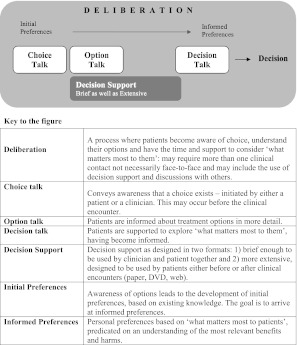
The principles of shared decision making are well documented but there is a lack of guidance about how to accomplish the approach in routine clinical practice. Our aim here is to translate existing conceptual descriptions into a three-step model that is practical, easy to remember, and can act as a guide to skill development. Achieving shared decision making depends on building a good relationship in the clinical encounter so that information is shared and patients are supported to deliberate and express their preferences and views during the decision making process. To accomplish these tasks, we propose a model of how to do shared decision making that is based on choice, option and decision talk. The model has three steps: a) introducing choice, b) describing options, often by integrating the use of patient decision support, and c) helping patients explore preferences and make decisions. This model rests on supporting a process of deliberation, and on understanding that decisions should be influenced by exploring and respecting "what matters most" to patients as individuals, and that this exploration in turn depends on them developing informed preferences.
Overview
The claims and statistics of this paper haven’t been checked yet.
Free: it reads the open-access text and checks the first 5 claims that cite a source we can check. Create a free account to check every claim.
Integrity signals
Registry
Cites
Statistics
Figures
Verification
Claims the paper makes
The claims and statistics of this paper haven’t been checked yet.
Free: it reads the open-access text and checks the first 5 claims that cite a source we can check. Create a free account to check every claim.
Claims other papers make about this one
Each is checked against this paper’s own text: does it say what the citing paper says it does?
The source backs part of the claim, not all of it — or backs it for a different population, condition or comparison.
In the citing paper
“It also highlights the value of each patient’s own experiences, thereby promoting their autonomy and empowering them to improve their health.72”
From Joint Clinical Practice Guideline on Benzodiazepine Tapering: Considerations When Risks Outweigh Benefits (2025) · cites this paper as [72]
Experimental — accuracy not yet measuredThe cited source says what the claim attributes to it.
In the citing paper
“Presenting evidence-based treatment options for both PTSD and insomnia and supporting patient preferences is consistent with a shared decision-making approach (Elwyn et al., 2012).”
From Benefits of Cognitive Behavioral Therapy for Insomnia for Women Veterans with and without Probable Post-Traumatic Stress Disorder (2022) · cites this paper as Elwyn et al., 2012
The cited source says what the claim attributes to it.
In the citing paper
“The concept of shared decision-making is built on engaging patients as active participants in their treatment rather than as passive recipients.72”
From Joint Clinical Practice Guideline on Benzodiazepine Tapering: Considerations When Risks Outweigh Benefits (2025) · cites this paper as [72]
The check wasn’t confident either way, so it gives no verdict — never disputed.
In the citing paper
“AI and robotics redefine the roles of healthcare professionals. For instance, radiologists may transition from image interpretation to supervising AI algorithms that assist in diagnostics, requiring new skill sets and responsibilities.[36]”
From Ethical implications of AI and robotics in healthcare: A review (2023) · cites this paper as [36]
Experimental — accuracy not yet measuredIn the citing paper
“Models of care that integrate education, engagement, and shared decision making are now available, 1023 and may be of particular value in the management of AF.”
From 2016 ESC Guidelines for the management of atrial fibrillation developed in collaboration with EACTS (2016) · cites this paper as [1023]
1 more claim about this paper
Create a free account to see every claim other papers make about this one.
Self-check
Percentages, sums and reported differences re-computed from the paper’s own numbers.
The self-check needs the paper’s full text.
Citations
Cites
Ryan, R. M., & Deci, E. L. (2000) · American Psychologist · doi:10.1037//0003-066x.55.1.68 · Cited by 54,599 · cited 1×
“Self-determination theory is concerned with our intrinsic tendencies to protect and preserve our well-being.(13) Relational autonomy is the term used to describe the view that we are not entirely free, self-governing agents but that our decisions Received August 22, 2011”
BackgroundPharmacological interventions for somatoform disorders in adults
Kleinstäuber, M., Witthöft, M., Steffanowski, A., van Marwijk, H., Hiller, W., & Lambert, M. J. (2014) · Cochrane Database of Systematic Reviews · doi:10.1002/14651858.cd010628.pub2 · Cited by 11,335
Decision aids for people facing health treatment or screening decisions
Stacey, D., Légaré, F., Lewis, K., Barry, M. J., Bennett, C. L., Eden, K. B., Holmes-Rovner, M., Llewellyn-Thomas, H., Lyddiatt, A., Thomson, R., et al. (2017) · Cochrane Database of Systematic Reviews · doi:10.1002/14651858.cd001431.pub5 · Cited by 6,685
Self-citationCharles, C., Gafni, A., & Whelan, T. (1997) · Social Science & Medicine · doi:10.1016/s0277-9536(96)00221-3 · Cited by 4,137
Shared decision making — The pinnacle of patient-centered care
Barry, M. J., & Edgman-Levitan, S. (2012) · New England Journal of Medicine · doi:10.1056/nejmp1109283 · Cited by 3,433
Self-citationSchiffrin, D. (1987) · Cambridge University Press eBooks · doi:10.1017/cbo9780511611841 · Cited by 2,810
Four Models of the Physician-Patient Relationship
Emanuel, E. J. (1992) · JAMA: The Journal of the American Medical Association · doi:10.1001/jama.1992.03480160079038 · Cited by 2,449
An integrative model of shared decision making in medical encounters
Makoul, G., & Clayman, M. L. (2006) · Patient Education and Counseling · doi:10.1016/j.pec.2005.06.010 · Cited by 1,621 · cited 2×
“The principles of SDM are well documented and the common elements have been summarized.(5) The earliest mention was in 1982,(6) but the idea draws on and deepens the principles of patient centered care.”
BackgroundPatient-Centered Medicine: Transforming the Clinical Method
Stewart, M., Brown, J. B., Weston, W. W., McWhinney, I. R., McWilliam, C. L., & Freeman, T. R. (1995) · Cited by 1,299
Skills for Communicating with Patients
Silverman, J., Kurtz, S., & Draper, J. (2016) · CRC Press eBooks · doi:10.1201/9781910227268 · Cited by 1,238
Cited by
Items 901–1,000 of 1,023
The duality of option-listing in cancer care
Tate, A., & Rimel, B. J. (2019) · Patient Education and Counseling · doi:10.1016/j.pec.2019.07.025 · Cited by 21
“SDM has promoted an ideal communicative mechanism for involving patients and providing them choices [4].”
BackgroundBreast Cancer Chemoprevention: A Practical Guide for the Primary Care Provider
Farkas, A. H., Vanderberg, R., Merriam, S. B., & DiNardo, D. J. (2020) · Journal of Women s Health · doi:10.1089/jwh.2018.7643 · Cited by 23
“47 This process of shared decision making can be daunting for many reasons, including difficulty communicating potential risks and benefits in understandable and meaningful terms, challenges incorporating individual patient values into decision making, and inadequate time to fully address this topic…”
Mattukat, K., Böhm, P., Raberger, K., Schaefer, C., Keyszer, G. M., & Mau, W. (2019) · Patient Preference and Adherence · doi:10.2147/ppa.s209346 · Cited by 25
“In clinical practice, shared decision-making (SDM) includes the physician’s explanation of the different treatment options, the exchange of views on their pros and cons with the patient, and finally, a joint decision that leaves both satisfied.(6,7) Furthermore, the patient’s personal values, preferences, opinions, an…”
BackgroundBraschi, É., Stacey, D., Légaré, F., Grad, R. M., & Archibald, D. (2020) · Perspectives on Medical Education · doi:10.1007/s40037-020-00578-0 · Cited by 29
To share or not to share: When is shared decision making the best option?
Thériault, G., Grad, R. M., Dickinson, J. A., Breault, P., Singh, H., Bell, N. R., & Szafran, O. (2020) · PubMed Central · Cited by 31
Choosing treatments and the role of shared decision-making
Légaré, F., Härter, M. C., Stiggelbout, A. M., Thomson, R., & Stacey, D. (2020) · Cambridge University Press eBooks · doi:10.1017/9781108855464.014 · Cited by 26
Self-citationDillon, E. C., Meehan, A. E., Nasrallah, C., Lai, S., Colocci, N., & Luft, H. (2020) · American Journal of Hospice and Palliative Medicine® · doi:10.1177/1049909120969202 · Cited by 25
Practical challenges in oral immunotherapy resolved through patient-centered care
Graham, F. J., Mack, D. P., & Bégin, P. (2021) · Allergy Asthma and Clinical Immunology · doi:10.1186/s13223-021-00533-6 · Cited by 24
Shared decision making and patients satisfaction with strabismus care—a pilot study
Paduca, A., Arnaut, O., Beschieru, E., Lundmark, P. O., & Bruenech, J. R. (2021) · BMC Medical Informatics and Decision Making · doi:10.1186/s12911-021-01469-y · Cited by 22
“In this context, the collaborative or shared decision is seen as a model for clinical practice [2] and was defined by Weston in 2001 as being one of the key components to patientcentered care [3].”
BackgroundGieseler, F., Heidenreich, A., Schubert, J., Frielitz, F., Rehmann‐Sutter, C., Wörler, F., Schües, C., Hübner, J., Elsner, S. A., Block, K., et al. (2021) · Health Science Reports · doi:10.1002/hsr2.281 · Cited by 23
Nielsen, J. H., Meléndez‐Torres, G. J., Rotevatn, T. A., Peven, K., Fonager, K., & Overgaard, C. (2021) · BMC Health Services Research · doi:10.1186/s12913-021-06569-z · Cited by 22
“, reminders), can act as a catalyst for a new discourse and help make shared decision making a practical reality in busy clinics, as they convey awareness of existing choices before the clinical encounter [53].”
BackgroundShewchuk, B., Green, L. A., Barber, T., Miller, J., Teare, S., Campbell-Scherer, D. L., Mrklas, K., LI, L. C., Marlett, N. J., Wasylak, T., et al. (2021) · JMIR Formative Research · doi:10.2196/30495 · Cited by 23
“Furthermore, improved patient-HCP communication and the discussion of priorities and best-available evidence may help bolster shared decision-making [42].”
BackgroundLu, Y., Elwyn, G. J., Moulton, B. W., Volk, R. J., Frosch, D. L., & Spatz, E. S. (2022) · Zeitschrift für Evidenz Fortbildung und Qualität im Gesundheitswesen · doi:10.1016/j.zefq.2022.04.031 · Cited by 28
Self-citationLinden, I., Hevink, M., Wolfs, C. A. G., Perry, M., Dirksen, C. D., & Ponds, R. (2022) · Aging & Mental Health · doi:10.1080/13607863.2022.2084505 · Cited by 22
Bylund, C. L., Eggly, S. S., LeBlanc, T. W., Kurtin, S. E., Gandee, M., Medhekar, R., Fu, A., Khurana, M., Delaney, K. M., Divita, A., et al. (2023) · Translational Behavioral Medicine · doi:10.1093/tbm/ibac099 · Cited by 22
Overcoming the myths of esketamine administration: different and not difficult
Buchmayer, F., & Kasper, S. F. (2023) · Frontiers in Psychiatry · doi:10.3389/fpsyt.2023.1279657 · Cited by 25
Søndergaard, S. R., Bechmann, T., Maae, E., Nielsen, A. W. M., Nielsen, M. H., Møller, M. H., Timm, S., Lorenzen, E. L., Berry, L. L., Zachariae, R. H., et al. (2024) · Radiotherapy and Oncology · doi:10.1016/j.radonc.2024.110115 · Cited by 21
Geta, E. T., Terefa, D. R., Hailu, W. B., Olani, W., Merdassa, E., Dessalegn, M., Gelchu, M., & Diriba, D. C. (2024) · PLOS ONE · doi:10.1371/journal.pone.0306296 · Cited by 21
Satterfield, J. M., Merrell, S. B., Hilton, J. F., Bogetz, A. L., Blankenburg, R. L., Buckelew, S. M., Chen, H. C., Monash, B., Ramos, J. S., Rennke, S., et al. (2014) · Academic Medicine · doi:10.1097/acm.0000000000000483 · Cited by 24
PSA measurement and prostate cancer – overdiagnosis and overtreatment?
Breidablik, H. J., Meland, E., Aakre, K. M., & Førde, O. H. (2013) · Tidsskrift for Den norske legeforening · doi:10.4045/tidsskr.13.0023 · Cited by 21
“Methods have been developed for holding dialogues on such decisions, and IT tools have also been developed to assist doctors and patients in revealing their preferences and the dilemmas associated with medical and surgical procedures (shared decision-making) (26).”
MethodCatling, C., Petrovska, K., Watts, N. P., Bisits, A., & Homer, C. (2015) · Midwifery · doi:10.1016/j.midw.2015.12.008 · Cited by 22
“There is also evidence that this promotes effective shared decision-making (Elwyn et al., 2012).”
BackgroundMalone, H., Biggar, S., Javadpour, S., Edworthy, Z., Sheaf, G., & Coyne, I. (2017) · Cochrane Database of Systematic Reviews · doi:10.1002/14651858.cd012578 · Cited by 22
“Elwyn built on this previous work, translating existing models into an easy to remember three-step model for clinical settings and based on 'choice talk', 'option talk' and 'decision talk' (Elwyn 2012).”
Patient Knowledge and Qualities of Treatment Decisions for Localized Prostate Cancer
Daum, L. M., Reamer, E. N., Ruterbusch, J. J., Liu, J., Holmes-Rovner, M. M., & Xu, J. (2017) · The Journal of the American Board of Family Medicine · doi:10.3122/jabfm.2017.03.160298 · Cited by 25
Shared Decision-Making with Parents of Acutely Ill Children: A Narrative Review
Aronson, P. L., Shapiro, E. D., Niccolai, L. M., & Fraenkel, L. (2017) · Academic Pediatrics · doi:10.1016/j.acap.2017.06.009 · Cited by 27
Marcus, R., Makarenko, I., Mazhnaya, A., Zelenev, A., Polonsky, M., Madden, L. M., Filippovych, S., Дворяк, С., Springer, S. A., & Altice, F. L. (2017) · Drug and Alcohol Dependence · doi:10.1016/j.drugalcdep.2017.07.010 · Cited by 21
“Shared decision aids that facilitate discussions between providers and patients would extend this practice so that a balanced discussion and therapeutic alliance would further engage patients and clinicians in treatment (Elwyn et al., 2012; Elwyn et al., 2016).”
BackgroundRennke, S., Yuan, P., Monash, B., Blankenburg, R. L., Chua, I. S., Harman, S. M., Sakai, D. S., Khan, A., Hilton, J. F., Shieh, L. Y., et al. (2017) · Journal of Hospital Medicine · doi:10.12788/jhm.2865 · Cited by 24
Decisional conflict in mental health care: a cross-sectional study
Metz, M. J., Veerbeek, M., Feltz-Cornelis, C. M. V. D., de Beurs, E., & Beekman, A. T. F. (2017) · Social Psychiatry and Psychiatric Epidemiology · doi:10.1007/s00127-017-1467-9 · Cited by 21
Ethical Issues in the Design and Implementation of Population Health Programs
DeCamp, M. W., Pomerantz, D. H., Cotts, K. G., Dzeng, E. W., Farber, N. J., Lehmann, L. S., Reynolds, P. P., Sulmasy, L. S., & Tilburt, J. C. (2017) · Journal of General Internal Medicine · doi:10.1007/s11606-017-4234-4 · Cited by 25
Shared decision‐making in tinnitus care – An exploration of clinical encounters
Pryce, H., Hall, A. J., Marks, E. M., Culhane, B., Swift, S., Straus, J., & Shaw, R. L. (2018) · British Journal of Health Psychology · doi:10.1111/bjhp.12308 · Cited by 21
“Elwyn et al. (2012) has noted the importance of different phases of discussion to inform choice of intervention, weighing up pros and cons of different options, and relating those pros and cons to individual preferences, values, and lifestyle.”
BackgroundGawande, R., Pine, E., Griswold, T., Creedon, T., Vallejo, Z., Rosenbaum, E., Lozada, A., & Schuman-Olivier, Z. (2019) · Mindfulness · doi:10.1007/s12671-019-01116-8 · Cited by 21
Adolescents’ participation in their healthcare: A sociomaterial investigation of a diabetes app
Ledderer, L., Møller, A. M., & Fage-Butler, A. M. (2019) · Digital Health · doi:10.1177/2055207619845448 · Cited by 24
“Despite the lack of incontrovertible evidence of the health-promoting effects of decision aids, the thrust of policy and practice is to endorse and promote them.(19,20) This tendency is a particularly prominent aspect of our increasingly digitized societies: according to Marres,(21) ‘[p]articipation has been one of th…”
BackgroundDavis, S., & MacKay, L. (2020) · Canadian Journal of Diabetes · doi:10.1016/j.jcjd.2020.03.009 · Cited by 21
Jiang, S., & Liu, J. (2020) · Chinese Journal of Communication · doi:10.1080/17544750.2020.1769700 · Cited by 25
Zisman‐Ilani, Y., Obeidat, R., Fang, L., Hsieh, S., & Berger, Z. D. (2020) · JMIR Formative Research · doi:10.2196/18223 · Cited by 25
Optimal Delivery of Follow-Up Care After Radical Cystectomy for Bladder Cancer
Jensen, B. T., Lauridsen, S. V., & Jensen, J. B. (2020) · Research and Reports in Urology · doi:10.2147/rru.s270240 · Cited by 28
GP involvement after a cancer diagnosis; patients’ call to improve decision support
Noteboom, E. A., Perfors, I. A. A., May, A. M., Stegmann, M., Duijts, S. F. A., Visserman, E., Engelen, V., Richel, C., van der Wall, E., de Wit, N. J., et al. (2020) · BJGP Open · doi:10.3399/bjgpopen20x101124 · Cited by 21
“An effective SDM process consists of four steps: 1) awareness of choice; 2) explanation of treatment options; 3) time for deliberation; and 4) making an informed decision.(2) Unfortunately, in the present hospitaloriented cancer care pathway, essential steps for successful SDM are usually insufficiently supported.”
BackgroundCommunication in decision aids for stage I–III colorectal cancer patients: a systematic review
Hommes, S., Vromans, R., Clouth, F. J., Verbeek, X. A. A. M., de Hingh, I. H. J. T., & Krahmer, E. (2021) · BMJ Open · doi:10.1136/bmjopen-2020-044472 · Cited by 22
Belvis, A. D., Pellegrino, R., Castagna, C., Morsella, A., Pastorino, R., & Boccia, S. (2021) · Journal of Personalized Medicine · doi:10.3390/jpm11070654 · Cited by 21
Bromhead, C., Wihongi, H., Sherman, S. M., Crengle, S. M., Grant, J., Martin, G., Maxwell, A. C., McPherson, G. S., Puloka, A., Reid, S., et al. (2021) · International Journal of Environmental Research and Public Health · doi:10.3390/ijerph181910050 · Cited by 27
Dowsey, M. M., Scott, A., Nelson, E. A., Li, J., Sundararajan, V., Nikpour, M., & Choong, P. (2016) · Trials · doi:10.1186/s13063-016-1536-5 · Cited by 23
Marshall, T., Kinnard, E. N., Hancock, M., King-Jones, S., Olson, K. L., Abba‐Aji, A., Rittenbach, K., & Vohra, S. (2018) · BMJ Open · doi:10.1136/bmjopen-2018-022267 · Cited by 23
“Additionally, there is promising evidence suggesting that incorporating patient preferences into chronic disease treatment plans in primary care settings may improve other important outcomes such as patient satisfaction, engagement, knowledge gain and/or treatment adherence.(2) 4 For this scoping review, SDM will be d…”
BackgroundPokorney, S. D., Bloom, D. L., Granger, C. B., Thomas, K. L., Al‐Khatib, S. M., Roettig, M. L., Anderson, J., Heflin, M. T., & Granger, B. B. (2018) · European Journal of Cardiovascular Nursing · doi:10.1177/1474515118812252 · Cited by 22
Shared decision-making in adolescent healthcare: a literature review of ethical considerations
Sobode, O. R., Jegan, R., Toelen, J., & Dierickx, K. (2024) · European Journal of Pediatrics · doi:10.1007/s00431-024-05687-0 · Cited by 28
“SDM is defined as an approach where Healthcare Professionals (HCPs) and patients together agree on an evidence-based treatment plan consistent with the patient’s values and preferences [2, 3].”
Dato, E. L., Gostoli, S., & Tomba, E. (2024) · Nutrients · doi:10.3390/nu16213687 · Cited by 25
“Patients may indeed have the opportunity to fully understand the risks and the benefits associated with a certain health-related decision and to make informed choices on their health [113].”
BackgroundSensemaking in the personal health space
Lahtiranta, J., Koskinen, J. S. S., Knaapi-Junnila, S., & Nurminen, M. I. (2015) · Information Technology and People · doi:10.1108/itp-09-2014-0214 · Cited by 25
“As such, the model is in line with patient-centered model for care, which emphasizes importance of patient’s self-determination (Elwyn et al., 2012; Légaré and Thompson-Leduc, 2014).”
MethodHealth of Older Adults in Assisted Living and Implications for Preventive Care
Kistler, C. E., Zimmerman, S. I., Ward, K. T., Reed, D., Golin, C. E., & Lewis, C. L. (2016) · The Gerontologist · doi:10.1093/geront/gnw053 · Cited by 22
Quigley, M., Dillon, M. P., & Fatone, S. (2018) · Prosthetics and Orthotics International · doi:10.1177/0309364617752984 · Cited by 24
Meffert, B. N., Morabito, D. M., Mosich, M. K., Loflin, M., Sottile, J. E., & Heinz, A. J. (2018) · Current Drug Research Reviews · doi:10.2174/2589977511666181109153958 · Cited by 23
Eggeling, M., Bientzle, M., Creß, U., Shiozawa, T., & Kimmerle, J. (2019) · Psychology Health & Medicine · doi:10.1080/13548506.2019.1687917 · Cited by 20
“Shared decision-making in medical consultation has increased over the last several decades (Charles, Gafni, & Whelan, 1997; Elwyn et al., 2012).”
BackgroundParents' Perspectives on Communication and Shared Decision Making for Febrile Infants ≤60 Days Old
Aronson, P. L., Schaeffer, P., Niccolai, L. M., Shapiro, E. D., & Fraenkel, L. (2020) · Pediatric Emergency Care · doi:10.1097/pec.0000000000001977 · Cited by 23
“The physician then helps the parents both consider and articulate what is important to them in making the decision (ie, their values and their preferences).(13) Although decisions regarding the management of febrile infants have been identified as well suited for SDM,(14) emergency medicine physicians and nurses have…”
BackgroundThe clinical effectiveness of the COPDnet integrated care model
Koolen, N., van den Borst, B., de Man, M., Antons, J. C., Robberts, B., Dekhuijzen, P. N. R., Vercoulen, J. H., van den Heuvel, M., Spruit, M. A., van der Wees, P. J., et al. (2020) · Respiratory Medicine · doi:10.1016/j.rmed.2020.106152 · Cited by 24
Case Studies AAOS Clinical Practice Guideline: Management of Rotator Cuff Injuries
Weber, S. C., & Chahal, J. (2020) · Journal of the American Academy of Orthopaedic Surgeons · doi:10.5435/jaaos-d-20-00450 · Cited by 20
Benzodiazepines: Thinking outside the black box
Pergolizzi, J. V., LeQuang, J. A., & Raffa, R. B. (2020) · Journal of Clinical Pharmacy and Therapeutics · doi:10.1111/jcpt.13333 · Cited by 20
Jensen, B. T. (2021) · Seminars in Oncology Nursing · doi:10.1016/j.soncn.2020.151106 · Cited by 24
Brand, S., & Timmons, S. (2021) · Health Expectations · doi:10.1111/hex.13209 · Cited by 23
“It has been shown to have benefits for patients, carers and HCPs, but also challenges in its practical implementation [19, 20, 21, 22].”
BackgroundWillaert, W., Leysen, L., Lenoir, D., Meeus, M., Cagnie, B. J., Nijs, J., Sterling, M. M., & Coppieters, I. (2021) · Physical Therapy · doi:10.1093/ptj/pzab105 · Cited by 25
Ilgunas, A., Lövgren, A., Fjellman‐Wiklund, A., Häggman‐Henrikson, B., Wirebring, L. K., Lobbezoo, F., Visscher, C. M., & Durham, J. (2021) · European Journal Of Oral Sciences · doi:10.1111/eos.12811 · Cited by 22
General dental practitioners' perceptions of shared decision making: a qualitative study
Hayer, N., & Wassif, H. S. (2022) · BDJ · doi:10.1038/s41415-022-3980-9 · Cited by 28
Zeyer, A. (2022) · Sustainability · doi:10.3390/su14106343 · Cited by 20
Valente, E. P., Mariani, I., Covi, B., & Lazzerini, M. (2022) · International Journal of Environmental Research and Public Health · doi:10.3390/ijerph19127166 · Cited by 27
“It should be accompanied by a trustful relationship between professionals and patients, transparent communication of the best available evidence, discussion of the individual’s preferences, and shared decision making [53,54].”
BackgroundHackert, M. Q. N., Ankersmid, J. W., Engels, N., Prick, J. C. M., Teerenstra, S., Siesling, S., Drossaert, C. H. C., Strobbe, L. J. A., van Riet, Y. E. A., van den Dorpel, R. M. A., et al. (2022) · BMJ Open · doi:10.1136/bmjopen-2021-055324 · Cited by 23
Lam, A. K. H., Fung, O. H.-Y., Kwan, C., Cheung, J. P. Y., Luk, K. D. K., Chiu, A. Y. Y., Descarreaux, M., Szeto, G. P. Y., & Wong, A. Y. L. (2022) · Archives of Rehabilitation Research and Clinical Translation · doi:10.1016/j.arrct.2022.100227 · Cited by 24
“Patients are encouraged to consider various options to attain informed preferences.(39,40) Further, family should be involved in the process of informed consent and decisionmaking for any elective surgery.”
BackgroundGuo, H., Hildon, Z. J., & Chow, A. L. (2022) · Frontiers in Public Health · doi:10.3389/fpubh.2022.1001282 · Cited by 23
Xu, X., Guo, T., Liu, Z., Chen, P., Zhang, Y., Ji, Q., & Xie, H. W. (2022) · Patient Preference and Adherence · doi:10.2147/ppa.s388356 · Cited by 23
“38,39 The patient-centered decision-making model did not completely transform the passive position of the patient in decision-making, suggesting that even with sufficient information about hypertension, the patient may consider the provider’s recommendations while participating in shared…”
BackgroundBernabeu‐Wittel, M., Para, O., Voicehovska, J., Gómez‐Huelgas, R., Václavík, J., Battegay, E. J., Holecki, M. T., Munster, B. C. V., Angermann, C. E., Battegay, E. J., et al. (2023) · European Journal of Internal Medicine · doi:10.1016/j.ejim.2023.01.011 · Cited by 29
Pérez‐Revuelta, J. I., González‐Sáiz, F., Paño, J. M. P., Mongil-Sanjuan, J. M., Rodríguez‐Gómez, C., Muñoz-Manchado, L. I., Mestre-Morales, J., Berrocoso, E., & Moreno, J. M. V. (2023) · Patient Education and Counseling · doi:10.1016/j.pec.2023.107656 · Cited by 22
Pel‐Littel, R. E., Buurman, B. M., van de Pol, M. H. J., Twisk, J. W. R., Tulner, L. R., Minkman, M. M. N., Reimer, W. J. M. S. O., & van Weert, J. C. M. (2023) · BMC Medical Informatics and Decision Making · doi:10.1186/s12911-023-02099-2 · Cited by 24
“‘Choice talk’, ‘Option talk’ and ‘Decision talk’ [6].”
Backgroundvan Til, J. A., Pearce, A. M., Özdemir, S., Hollin, I. L., Peay, H. L., Wu, A. W., Ostermann, J., Deal, K., & Craig, B. M. (2023) · Patient · doi:10.1007/s40271-023-00649-4 · Cited by 26
“In the most prominent models for SDM, patients’ decisional role preferences are discussed before, along with, or after patients’ health preferences, and individuals’ health preferences only influence the decision to the extent that their role preferences dictate [11–13].”
BackgroundDecision-making of the nursing team after the revitalization of a decentralized management model
Hayashida, K. Y., Bernardes, A., Maziero, V. G., & Gabriel, C. S. (2014) · Texto & Contexto - Enfermagem · doi:10.1590/0104-07072014001190013 · Cited by 20
Evidence-based practice: Embracing integration
Taylor, M. V., Priefer, B. A., & Alt‐White, A. C. (2016) · Nursing Outlook · doi:10.1016/j.outlook.2016.04.004 · Cited by 20
Kobayashi, L. C., Waller, J., von Wagner, C., & Wardle, J. (2016) · BMC Public Health · doi:10.1186/s12889-016-3374-5 · Cited by 21
Lanza, A. B. D. R., Álvarez, L. S., Vázquez, A. S., & Vázquez‐Casielles, R. (2016) · SpringerPlus · doi:10.1186/s40064-016-3086-4 · Cited by 28
“Thus SDM is now widely regarded as an essential component to reduce the asymmetry in information exchange and power distribution between doctor and patient (Charles et al.”
BackgroundDevelopment of a program theory for shared decision-making: a realist review protocol
Groot, G., Waldron, T., Carr, T., McMullen, L. M., Bandura, L.-A., Neufeld, S.-M., & Duncan, V. (2017) · Systematic Reviews · doi:10.1186/s13643-017-0508-5 · Cited by 28
When Personal Feels Invasive: Foreseeing Challenges in Precision Medicine Communication
Ratcliff, C. L., Kaphingst, K. A., & Jensen, J. D. (2018) · Journal of Health Communication · doi:10.1080/10810730.2017.1417514 · Cited by 20
“SDM emphasizes protecting patient autonomy by incorporating patient values and preferences, providing a range of options, and giving the patient sufficient education to make an informed choice (Elwyn et al., 2012; Makoul & Clayman, 2006).”
BackgroundCould shared decision making affect staying in hospital? A cross-sectional pilot study
Gualano, M. R., Bert, F., Passi, S., Stillo, M., Brescia, V., Scaioli, G., Thomas, R., Voglino, G., Minniti, D., Boraso, F., et al. (2019) · BMC Health Services Research · doi:10.1186/s12913-019-4002-8 · Cited by 22
“In the “Shared Model”, doctors and patients simultaneously share all the stages of the decisions related to the treatment process, recognizing the need to support autonomy by building good relationships, respecting both individual competence and interdependence on others [4, 5].”
BackgroundSharma, R. K., Cameron, K. A., Zech, J. M., Jones, S. F., Curtis, J. R., & Engelberg, R. A. (2019) · Journal of Pain and Symptom Management · doi:10.1016/j.jpainsymman.2019.05.002 · Cited by 24
on behalf of the 235th ENMC workshop study group, Ambrosini, A., Quinlivan, R. C. M., Sansone, V., Meijer, I., Schrijvers, G., Tibben, A., Padberg, G. W., de Wit, M. P. T., Sterrenburg, E., et al. (2019) · Orphanet Journal of Rare Diseases · doi:10.1186/s13023-019-1103-8 · Cited by 23
Invoking death: How oncologists discuss a deadly outcome
Tate, A. (2019) · Social Science & Medicine · doi:10.1016/j.socscimed.2019.112672 · Cited by 23
Astin, F., Stephenson, J. R., Probyn, J., Holt, J., Marshall, K. F., & Conway, D. (2019) · European Journal of Cardiovascular Nursing · doi:10.1177/1474515119879050 · Cited by 30
“16 important because patient awareness of ‘choice’ is the first step of the supported decision making process.(22) Research indicates that more often than not PCI patients do not fully understand that they have a choice which contributes to them adopting a passive role.”
BackgroundCass, A. L., Holt, E. W., Criss, S., Hunt, E., & Reed, R. (2020) · American Journal of Health Education · doi:10.1080/19325037.2020.1844103 · Cited by 25
Discrepancies in decision making preferences between parents and surgeons in pediatric surgery
Carlisle, E. M., Klipowicz, C. J., Shinkunas, L. A., Scherer, A. M., & Kaldjian, L. C. (2021) · BMC Medical Informatics and Decision Making · doi:10.1186/s12911-021-01414-z · Cited by 20
“SDM requires that physicians and patients work together to develop mutually agreed upon care plans that incorporate evidence-based standards of care and patient values and goals [2, 3].”
BackgroundDecision aids for prenatal testing: A systematic review and meta‐analysis
Yu, L., Yang, S., Zhang, C., Guo, P., Zhang, X., Xu, M., Tian, Q., Cui, X., & Zhang, W. (2021) · Journal of Advanced Nursing · doi:10.1111/jan.14875 · Cited by 22
Cassoobhoy, A., Sardana, J. J., Benigas, S., Tips, J., & Kees, A. (2021) · American Journal of Lifestyle Medicine · doi:10.1177/15598276211052248 · Cited by 22
“Education should include tools such as shared decision-making training where the clinician prioritizes the patient’s choices as they share high-quality information, discuss the multiple options available, and talk through the decision-making process while prioritizing the patient’s preferences.(26) Further, motivation…”
MethodSoundy, A., Roskell, C., Adams, R. L., Elder, T. J., & Dawes, H. (2016) · Open Journal of Therapy and Rehabilitation · doi:10.4236/ojtr.2016.44018 · Cited by 23
“Development of autonomy-supportive interactions [113] [114] and shared decisionmaking [115] are required for HCP-patient interactions.”
BackgroundEhrlich, C., & Dannapfel, P. (2016) · Mental Health & Prevention · doi:10.1016/j.mhp.2016.12.002 · Cited by 23
Holyoke, P., & Stephenson, B. (2017) · BMC Palliative Care · doi:10.1186/s12904-017-0197-9 · Cited by 26
“It is clearly the best practice for the person who is dying to make decisions about the care that he or she is receiving or will receive as death approaches [23, 36, 37].”
BackgroundApproach to assessing and using clinical practice guidelines
Armstrong, M. J., & Gronseth, G. (2018) · Neurology Clinical Practice · doi:10.1212/cpj.0000000000000417 · Cited by 20
Ke, Y., Fok, R. W., Soong, Y. L., Loh, K. W.-J., Farid, M., Low, L. L., Quah, J. H. M., Vasanwala, F. F., Low, S. G., Soh, L. L., et al. (2022) · BMC Family Practice · doi:10.1186/s12875-022-01673-3 · Cited by 20
“This result echoed oncologists as pivotal in engaging survivors in shared decision-making, guiding survivors to make informed decisions considering their personal health care preferences [41, 42].”
BackgroundSpoken language multilingualism in deaf children: Parental decision-making
Wright, E., Stojanovik, V., & Serratrice, L. (2022) · Deafness & Education International · doi:10.1080/14643154.2022.2143608 · Cited by 20
“…evidence when faced with the task of making decisions, and where patients are supported to consider options, to achieve informed preferences” (Elwyn et al., 2012, p. 1361) may therefore be more appropriate than informed choice where professionals provide information and parents complete…”
BackgroundSittig, D. F., Boxwala, A. A., Wright, A. T., Zott, C., Gauthreaux, N. A., Swiger, J., Lomotan, E. A., & Dullabh, P. (2024) · Journal of the American Medical Informatics Association · doi:10.1093/jamia/ocae138 · Cited by 23
“17 While patient participation in the clinical decision-making process is being increasingly promoted, many patient-related factors (eg, lack of medical knowledge, lack of confidence, co-morbidities, and other sociodemographic information) and clinician-related factors (eg, desire to maintain…”
BackgroundWyckoff, J., Lapolla, A., Asias-Dinh, B. D., Barbour, L. A., Brown, F. M., Catalano, P. M., Corcoy, R., Renzo, G. C. D., Drobycki, N., Kautzky‐Willer, A., et al. (2025) · European Journal of Endocrinology · doi:10.1093/ejendo/lvaf116 · Cited by 31
“Shared decision making should prioritize an individual’s autonomy and be informed by the clinician’s expertise 36,104 .”
Pieterse, A. H., Kunneman, M., Engelhardt, E. G., Brouwer, N. J., Kroep, J. R., Marijnen, C. A. M., Stiggelbout, A. M., & Smets, E. M. A. (2016) · Psycho-Oncology · doi:10.1002/pon.4241 · Cited by 21
“Experts recommend eliciting this information to help match patients' preferred and actual roles.(7,38) A few patients asked who should make the decision, suggesting awareness of their potential role.”
BackgroundInformed Consent: Ethical and Legal Considerations for Advanced Practice Nurses
Farmer, L., & Lundy, A. (2017) · The Journal for Nurse Practitioners · doi:10.1016/j.nurpra.2016.08.011 · Cited by 19
Lin, S., Ma, Y., & Zou, H. (2019) · Journal of Evaluation in Clinical Practice · doi:10.1111/jep.13311 · Cited by 21
Mina, D. S., Sellers, D., Au, D., Alibhai, S. M. H., Clarke, H. A., Cuthbertson, B. H., Darling, G. E., Danab, A. E., Govindarajan, A., Ladha, K. S., et al. (2021) · Frontiers in Oncology · doi:10.3389/fonc.2021.629207 · Cited by 22
Sobota, A., & Özakinci, G. (2021) · Frontiers in Psychology · doi:10.3389/fpsyg.2021.632162 · Cited by 24
“, 2004) and shared decisionmaking model (Elwyn et al., 2012) to study the decision-making processes.”
BackgroundConnors, E. H., Arora, P. G., Resnick, S. G., & McKay, M. M. (2023) · Psychological Services · doi:10.1037/ser0000617 · Cited by 22
Decision Making for Infants With Neurologic Conditions
Gerrity, C., Farley, S., Barks, M. C., Ubel, P. A., Brandon, D., Pollak, K. I., & Lemmon, M. E. (2022) · Journal of Child Neurology · doi:10.1177/08830738211056779 · Cited by 19
“5 (1-6) Conference length, min 44 (15-78) Family members Mother present 34 (100) Father present 23 (68) Total family members present 2 (1-7) Team members Clinician type present Neonatology 35 (95) Neurology 18 (49) Palliative Care 16 (43) Other specialists 14 (38) Resident 11 (30) MD/NP/PA student 7 (19) Unit staff pr…”
Backgroundvan Strien‐Knippenberg, I. S., Boshuizen, M. C. S., Determann, D., de Boer, J. H., & Damman, O. C. (2022) · Health Expectations · doi:10.1111/hex.13510 · Cited by 26
Ivasiy, R., Madden, L. M., Farnum, S. O., Shumskaia, N., de Leon, S. J. G., Bromberg, D. J., Kurmanalieva, A., Duishenaliev, A., Tokubaev, R., & Altice, F. L. (2022) · Drug and Alcohol Dependence Reports · doi:10.1016/j.dadr.2022.100075 · Cited by 23
Metadata
- Authors
- Elwyn, G., Frosch, D., Thomson, R., Joseph-Williams, N., Lloyd, A., Kinnersley, P., Cording, E., Tomson, D., Dodd, C., Rollnick, S., Edwards, A., & Barry, M.
- Affiliations
- Cardiff University (GB)
- Palo Alto Medical Foundation (US)
- Newcastle University (GB)
- Royal Victoria Infirmary (GB)
- Massachusetts General Hospital (US)
- Corresponding author
- Elwyn, Glyn
- ORCID
- Venue
- Journal of General Internal Medicine
- Published
- 2012-05-23
- Volume
- 27
- Issue
- 10
- Pages
- 1361-1367
- ISSN
- 0884-8734 (ISSN-L)
- 1525-1497
- PMC
- PMC3445676
- OpenAlex
- W2041927436
- Semantic Scholar
- 010654700f3b5c98fd2dba4f97661bd80e7c15b3
- Cited by
- 4,405
- References
- 56
- Citations by year
- 2026: 531 · 2025: 503 · 2024: 430 · 2023: 396 · 2022: 412 · 2021: 437 · 2020: 409 · 2019: 310 · 2018: 248 · 2017: 254 · 2016: 180 · 2015: 125 · 2014: 101 · 2013: 55 · 2012: 9
- FWCI
- 13.71
- Type
- journal article
- Language
- en
- Open access
- hybrid
- doi.org
- Licence
- cc-by
- Locations
- Journal of General Internal Medicine (publishedVersion, cc-by)
- PubMed Central (publishedVersion, cc-by)
- PubMed (publishedVersion)
- ORCA Online Research @Cardiff (Cardiff University) (submittedVersion)
- Radboud Repository (Radboud University) (submittedVersion)
- Newcastle University ePrints (Newcastle Univesity)
- Funders
- Dartmouth College
- Topics
- Health Sciences › Health Professions › General Health Professions › Patient-Provider Communication in Healthcare
- Health Sciences › Medicine › Public Health, Environmental and Occupational Health › Palliative Care and End-of-Life Issues
- Health Sciences › Medicine › Public Health, Environmental and Occupational Health › Ethics and bioethics in healthcare
- Keywords
- shared decision-making, patient preferences, patient decision support, patient encounters, deliberation, patient-clinician relationship, clinical practice model
- MeSH terms
- Cooperative Behavior, Decision Making, Humans, Models, Psychological, Patient Participation, Physician-Patient Relations, Patient-Centered Care
About these checks
Registry, retraction, Cites and statistics results are computed, not judged, with one exception: a printed reference that no index lists is read once by a model before it counts as a citation error. Claims are extracted by a model and kept only when their quote appears verbatim in the text; each cited source is then checked, with a model’s help, for whether it says what the claim relies on. Those verdicts can be wrong — read the claim’s quote and the cited source before relying on one.
Statistics and arithmetic are recomputed, not judged.
Confidence bands are shown only for fields calibrated on our annotated test set. None is calibrated yet, so no band is shown.
What counts as a claim ›How we measure confidence ›How we check this ›
Are you an author, or do you see a problem with this page? Request a review
Data sources
Bibliographic data: Semantic Scholar, OpenAlex, Crossref.
Contains information from the Semantic Scholar Academic Graph Datasets, made available under the ODC Attribution License (ODC-BY 1.0).
Semantic Scholar’s data is described in: Kinney, R., et al. (2023). The Semantic Scholar Open Data Platform. arXiv:2301.10140.
