

An Adaptable Framework for Factors Contributing to Medication Adherence: Results from a Systematic Review of 102 Conceptual Frameworks
Open accessThe DOI matches its Crossref record; 131 of the 131 references it cites were found in a registry or an index; 9 of the 24 sources its claims cite were checked for support.
Abstract
OBJECTIVE: To summarize the available conceptual models for factors contributing to medication adherence based on the World Health Organization (WHO)'s five dimensions of medication adherence via a systematic review, identify the patient groups described in available conceptual models, and present an adaptable conceptual model that describes the factors contributing to medication adherence in the identified patient groups. METHODS: We searched PubMed®, Embase®, CINAHL®, and PsycINFO® for English language articles published from inception until 31 March 2020. Full-text original publications in English that presented theoretical or conceptual models for factors contributing to medication adherence were included. Studies that presented statistical models were excluded. Two authors independently extracted the data. RESULTS: We identified 102 conceptual models, and classified the factors contributing to medication adherence using the WHO's five dimensions of medication adherence, namely patient-related, medication-related, condition-related, healthcare system/healthcare provider-related, and socioeconomic factors. Eight patient groups were identified based on age and disease condition. The most universally addressed factors were patient-related factors. Medication-related, condition-related, healthcare system-related, and socioeconomic factors were represented to various extents depending on the patient group. By systematically examining how the WHO's five dimensions of medication adherence were applied differently across the eight different patient groups, we present a conceptual model that can be adapted to summarize the common factors contributing to medication adherence in different patient groups. CONCLUSION: Our conceptual models can be utilized as a guide for clinicians and researchers in identifying the facilitators and barriers to medication adherence and developing future interventions to improve medication adherence. PROTOCOL REGISTRATION: PROSPERO Identifier: CRD42020181316.
Overview
CoChat Summary
## TL;DR
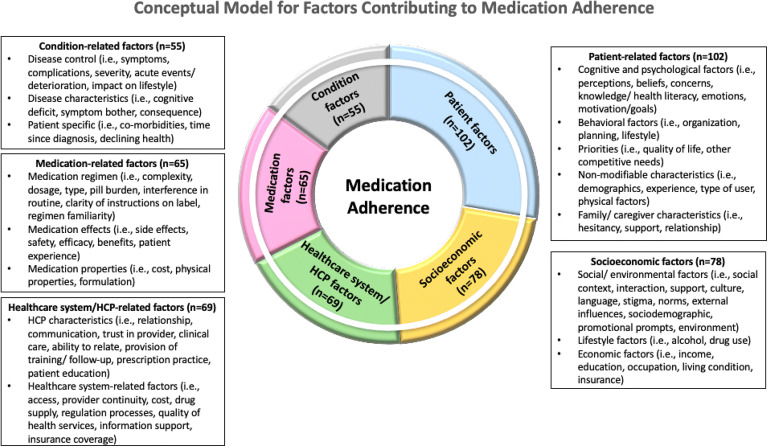
This systematic review synthesized 102 conceptual models of medication adherence and organized their factors using the WHO’s five dimensions. The authors propose an adaptable “donut model” that highlights common adherence factors across eight patient groups and can guide future interventions.
## Key findings
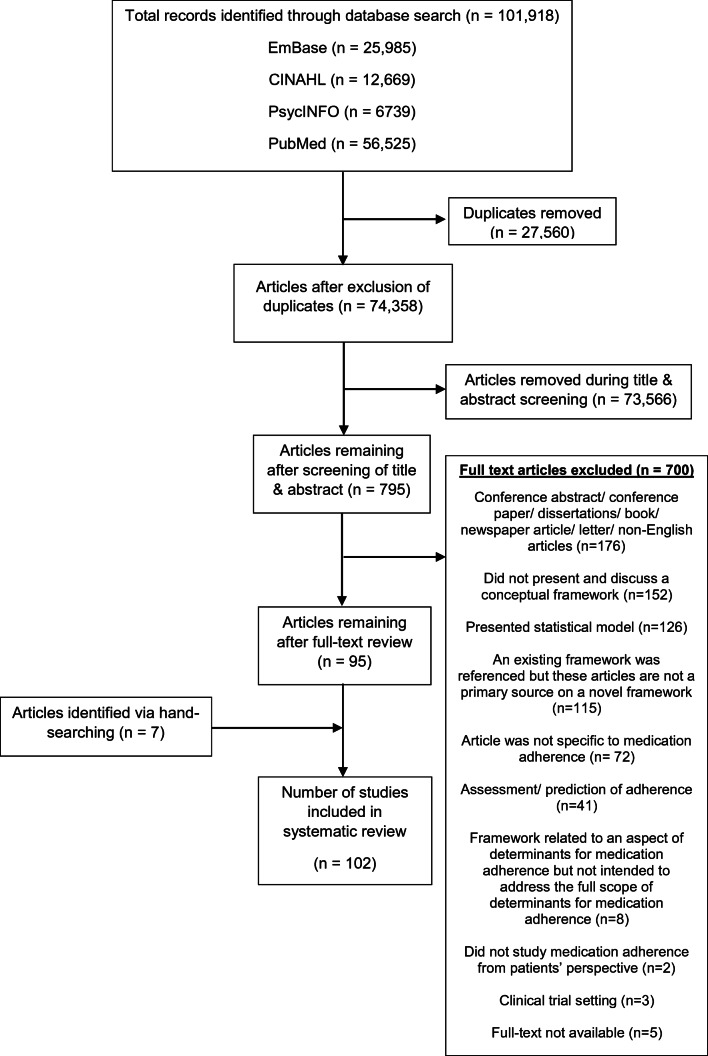
- The review included 102 relevant studies from an initial 101,918 records; 27,560 duplicates were removed, 73,566 titles/abstracts were excluded, 795 full texts were reviewed, and 700 were further excluded.
- The authors identified eight patient groups, including adults with chronic non-communicable conditions, cancer, symptomatic conditions, chronic communicable conditions, prevention of communicable diseases, psychiatric conditions, and pediatrics.
- Only 30 models addressed all five WHO dimensions of medication adherence; across models, the most universally addressed factors were patient-related factors.
- The WHO dimensions were represented to different degrees by patient group; for example, socioeconomic factors were especially prominent for communicable conditions, and caregiver characteristics/social support were common in pediatrics.
## Methods
- Design: Systematic review guided by PRISMA.
- Data/sample: Searched PubMed, Embase, CINAHL, and PsycINFO for English-language papers published up to 31 March 2020; included full-text original publications presenting theoretical or conceptual models of medication adherence factors, and excluded statistical models without a clear conceptual foundation.
- Analysis: Two reviewers independently screened, extracted data, and synthesized the models by mapping factors onto the WHO’s five dimensions and grouping them into eight patient groups; the team then developed an adaptable “donut model.”
## Limitations
- The paper states that it excluded conceptual models not based on patients’ perspectives and excluded three models from clinical trial settings, because such settings may include external prompts not present in routine care.
- The authors state that the relative quality of each study was not explored, and that reviewing conceptual frameworks is not amenable to standardized risk-of-bias tools.
- Evident from the text: the review was limited to English-language publications, so non-English conceptual models were not included.
Model-written summary. Check it against the paper before relying on it.
Integrity signals
Registry
Cites
Statistics
Figures
Verification
Claims the paper makes
8 Valid · 0 Not valid · 6 Not checked · 21 Own results and interpretations
Every source the paper cites for this claim was checked and supports it.
In the paper
“While these theories are helpful in understanding the contribution of patient-related factors and community or environment in medication adherence, they often ignore the effect of healthcare system– and healthcare team–related factors on patient behavior towards medication adherence.11”
§ An Adaptable Framework for Factors Contributing to Medication Adherence: Results from a Systematic Review of 102 Conceptual Frameworks > INTRODUCTION
What the sources say
- Supportedcites [11] Oori MJ Conceptual Model of Medication Adherence in Older Adults with High Blood Pressure-An Integrative Review of the Literature Curr Hypertens Rev 2019 15 2 85 92 30360745 PMC6635648 source
The Discussion section, under “Comparing the Designed Model with the Existing Models,” says these theories help explain patient and community or environmental factors but generally neglect healthcare-system and healthcare-team factors affecting medication-adherence behavior. This directly supports the attributed paraphrase. (LLM, conf=0.95)
plain- Asserted: passes — The authors put it forward as true.
- Checkable: passes — It can be checked against evidence.
- Load-bearing: passes — The paper’s conclusions depend on it.
- Based: passes — The paper gives a reason why it holds.
- Supported
The sources with a verdict support this claim; the rest weren’t checked yet, have no full text we could read, or their verdicts aren’t rated yet.
In the paper
“Many conceptual models have been developed to help understand the factors contributing to medication adherence in specific patient groups and/or for specific disease conditions.10–12”
§ An Adaptable Framework for Factors Contributing to Medication Adherence: Results from a Systematic Review of 102 Conceptual Frameworks > INTRODUCTION
What the sources say
- Not checked — no full text of the sourcecites [10] Murray MD A conceptual framework to study medication adherence in older adults Am J Geriatr Pharmacother 2004 2 1 36 43 15555477 source
- Supportedcites [11] Oori MJ Conceptual Model of Medication Adherence in Older Adults with High Blood Pressure-An Integrative Review of the Literature Curr Hypertens Rev 2019 15 2 85 92 30360745 PMC6635648 source
The Discussion section, “Comparing the Designed Model with the Existing Models,” lists multiple conceptual models used to explain factors influencing medication adherence. The Introduction discusses models applied to hypertensive patients, and the Conclusion describes the paper’s own model for older adults with high blood pressure. (LLM, conf=0.90)
- Not checked — no full text of the sourcecites [12] Jaam M A holistic conceptual framework model to describe medication adherence in and guide interventions in diabetes mellitus Res Soc Adm Pharm 2018 14 4 391 397 28533079 source
plain- Asserted: passes — The authors put it forward as true.
- Checkable: passes — It can be checked against evidence.
- Load-bearing: passes — The paper’s conclusions depend on it.
- Based: passes — The paper gives a reason why it holds.
Every source the paper cites for this claim was checked and supports it.
In the paper
“However, when medication is to be taken over a long period, adherence drops substantially for both prevention and cure.8”
§ An Adaptable Framework for Factors Contributing to Medication Adherence: Results from a Systematic Review of 102 Conceptual Frameworks > INTRODUCTION
What the sources say
- Supportedcites [8] Jimmy B Jose J Patient medication adherence: measures in daily practice Oman Med J 2011 26 3 155 159 22043406 PMC3191684 source
The passage in 'What influences medication adherence?' (p. ~3) states verbatim-equivalent content: 77% compliance when treatment was designed to cure and 63% when aimed at prevention, but 'when medication was to be taken over a long period, compliance rates dropped dramatically to around 50% for either prevention or cure' (citing ref. 33). The citing sentence's paraphrase of a substantial drop for both prevention and cure matches this, only omitting the ~50% figure, which is not a misattribution. (LLM, conf=0.92)
plainstates a cause- Asserted: passes — The authors put it forward as true.
- Checkable: passes — It can be checked against evidence.
- Load-bearing: unclear — It is unclear whether the paper’s conclusions depend on it.
- Based: passes — The paper gives a reason why it holds.
- Supported
A result the paper reports from its own data — it cites no other source for it, so there is none to check. The quote shows it is in the paper.
In the paper
“However, the factors within each model mapped well to one or more of the WHO dimensions, supporting the WHO dimensions to various degrees.”
§ An Adaptable Framework for Factors Contributing to Medication Adherence: Results from a Systematic Review of 102 Conceptual Frameworks > RESULTS > Model Development
boostedstates an association- Asserted: passes — The authors put it forward as true.
- Checkable: passes — It can be checked against evidence.
- Load-bearing: passes — The paper’s conclusions depend on it.
- Based: passes — The paper gives a reason why it holds.
A result the paper states — it cites no source for it, so there is none to check. The quote shows it is in the paper.
In the paper
“For adults with psychiatric conditions, patient- and medication-related factors were most commonly cited, likely attributed to cognitive factors and the side effects associated with psychiatric medications.”
§ An Adaptable Framework for Factors Contributing to Medication Adherence: Results from a Systematic Review of 102 Conceptual Frameworks > DISCUSSION
plain- Asserted: passes — The authors put it forward as true.
- Checkable: passes — It can be checked against evidence.
- Load-bearing: unclear — It is unclear whether the paper’s conclusions depend on it.
- Based: passes — The paper gives a reason why it holds.
15 more claims
Create a free account to see all 35 claims and to verify the 4 references still open.
- It may state two separate claims as one. 6
- Probably not a substantial claim. 10
- The quote only partly states this claim. 1
Citations
Cites
Preferred Reporting Items for Systematic Reviews and Meta-Analyses: the PRISMA statement
Moher, D., Liberati, A., Tetzlaff, J., Altman, D. G., & for the PRISMA Group (2009) · BMJ · doi:10.1136/bmj.b2535 · Cited by 83,823
Preferred reporting items for systematic reviews and meta-analyses: the PRISMA Statement.
(2009) · PubMed Central · Cited by 44,859
Osterberg, L., & Blaschke, T. (2005) · New England Journal of Medicine · doi:10.1056/nejmra050100 · Cited by 7,974
Adherence to Long-Term Therapies: Evidence for Action
De Geest, S., & Sabaté, E. (2003) · European Journal of Cardiovascular Nursing · doi:10.1016/s1474-5151(03)00091-4 · Cited by 6,272
Kirk, J., MacDonald, A., Lavender, P., Dean, J., & Rubin, G. (2017) · Biomedicine Hub · doi:10.1159/000480347 · Cited by 3,887
DiMatteo, M. R. (2004) · Medical Care · doi:10.1097/01.mlr.0000114908.90348.f9 · Cited by 2,169
A new taxonomy for describing and defining adherence to medications
Vrijens, B., De Geest, S., Hughes, D. A., Przemyslaw, K., Demonceau, J., Ruppar, T., Dobbels, F., Fargher, E., Morrison, V., Lewek, P., et al. (2012) · British Journal of Clinical Pharmacology · doi:10.1111/j.1365-2125.2012.04167.x · Cited by 2,028
Armijo‐Olivo, S., Stiles, C. R., Hagen, N. A., Biondo, P. D., & Cummings, G. G. (2012) · Journal of Evaluation in Clinical Practice · doi:10.1111/j.1365-2753.2010.01516.x · Cited by 1,539
Adherence with statin therapy in elderly patients with and without acute coronary syndromes
Jackevicius, C. A. (2002) · JAMA · doi:10.1001/jama.288.4.462 · Cited by 1,077
Determinants of Medication Compliance in Schizophrenia: Empirical and Clinical Findings
Fenton, W. S., Blyler, C. R., & Heinssen, R. K. (1997) · Schizophrenia Bulletin · doi:10.1093/schbul/23.4.637 · Cited by 957
Cited by
Sazali, M. F., Rahim, S. S. S. A., Mohammad, A. H., Kadir, F. B. M., Payus, A. O., Avoi, R., Jeffree, M. S., Omar, A., Ibrahim, M. Y., Atil, A., et al. (2023) · Tuberculosis & respiratory diseases · doi:10.4046/trd.2022.0148 · Cited by 134
Masa, R., Zimba, M., Tamta, M., Zimba, G., & Zulu, G. (2022) · Stigma and Health · doi:10.1037/sah0000404 · Cited by 59
Yoon, S., Kwan, Y. H., Yap, W. L., Lim, Z. Y., Phang, J. K., Loo, Y. X., Aw, J., & Low, L. L. (2023) · Frontiers in Pharmacology · doi:10.3389/fphar.2023.1124297 · Cited by 66
Self-citationBarriers and Facilitators to Medication Adherence among the Vulnerable Elderly: A Focus Group Study
Horvat, M., Eržen, I., & Vrbnjak, D. (2024) · Healthcare · doi:10.3390/healthcare12171723 · Cited by 47
Exploring a New Theoretical Model to Explain the Behavior of Medication Adherence
Unni, E., & Bae, S. (2022) · Pharmacy · doi:10.3390/pharmacy10020043 · Cited by 49
Bennett, M. J., & Perry, L. (2023) · Osteoporosis International · doi:10.1007/s00198-023-06748-0 · Cited by 36
Interventions to promote medication adherence for chronic diseases in India: a systematic review
Tolley, A., Hassan, R., Sanghera, R., Grewal, K., Kong, R., Sodhi, B., & Basu, S. (2023) · Frontiers in Public Health · doi:10.3389/fpubh.2023.1194919 · Cited by 52
Hafez, G., Aarnio, E., Mucherino, S., Kamusheva, M., Qvarnström, M., Potočnjak, I., Trečiokienė, I., Mihajlović, J., Ekenberg, M., van Boven, J. F. M., et al. (2024) · Journal of General Internal Medicine · doi:10.1007/s11606-024-08851-2 · Cited by 28
Yu, M., Wang, L., Guan, L., Qian, M., Lv, J., & Deng, M. (2021) · Geriatric Nursing · doi:10.1016/j.gerinurse.2021.12.001 · Cited by 30
Medication Adherence and Intervention Strategies: Why Should We Care
Schnorrerova, P., Matalová, P., & Wawruch, M. (2025) · Bratislavské lekárske listy/Bratislava medical journal · doi:10.1007/s44411-025-00227-0 · Cited by 30
(2024) · doi:10.2196/46979 · Cited by 17
Todd, A., Waldron, C., Hackshaw‐McGeagh, L., Norris, R. P., Bolnykh, I., Stewart, S.-J., Slodkowska‐Barabasz, J., Moon, Z., Cahir, C., Thompson, S. E., et al. (2024) · Cancer Medicine · doi:10.1002/cam4.6937 · Cited by 21
Yani, D. I., Juniarti, N., & Lukman, M. (2022) · Patient Preference and Adherence · doi:10.2147/ppa.s388989 · Cited by 17
Wilson, N., Liu, J., Adamjee, Q., Giorgio, S. D., Steer, S. E., Hutton, J., & Lempp, H. K. (2023) · BMC Rheumatology · doi:10.1186/s41927-023-00351-w · Cited by 17
Biswal, B., Bora, S., Anand, R., Bhatia, U., Fernandes, A., Joshi, M., & Nadkarni, A. (2024) · Drug and Alcohol Dependence · doi:10.1016/j.drugalcdep.2024.112429 · Cited by 20
Tolley, A., Grewal, K., Weiler, A., Papameletiou, A. M., Hassan, R., & Basu, S. (2023) · Frontiers in Pharmacology · doi:10.3389/fphar.2023.1183818 · Cited by 21
Cross-sectional analysis of factors associated with medication adherence in western Kenya
Gala, P., Kamano, J. H., Sanchez, M. V., Mugo, R., Orango, V., Pastakia, S. D., Horowitz, C. R., Hogan, J. W., & Vedanthan, R. (2023) · BMJ Open · doi:10.1136/bmjopen-2023-072358 · Cited by 21
Reach, G., Benarbia, L., Bruckert, É., Kévorkian, J.-P., Farnier, M., Mourad, J., & Vaïsse, B. (2021) · Patient Preference and Adherence · doi:10.2147/ppa.s318116 · Cited by 16
Dang, T. H., O’Callaghan, C. C., Alexander, M., Burbury, K., Jayaraman, P. P., Wickramasinghe, N. S., & Schofield, P. E. (2023) · Supportive Care in Cancer · doi:10.1007/s00520-023-08122-6 · Cited by 17
How is Patient Adherence Possible? A Novel Mechanistic Model of Adherence Based on Humanities
Reach, G. (2023) · Patient Preference and Adherence · doi:10.2147/ppa.s419277 · Cited by 20
A narrative review on the psychosocial domains of the impact of organ transplantation
Aderinto, N., Olatunji, G. D., Kokori, E., Ogieuhi, I. J., Moradeyo, A. A., Woldehana, N. A., Lawal, Z. D., Adetunji, B., Assi, G., Nazar, M. W., et al. (2025) · Discover Mental Health · doi:10.1007/s44192-025-00148-y · Cited by 22
Calleja, L., Glass, B. D., Cairns, A., & Taylor, S. M. (2023) · Pharmacy · doi:10.3390/pharmacy11060185 · Cited by 11
Kharmats, A. Y., Martinez, T. R., Belli, H. M., Zhao, Y., Mann, D. M., Schoenthaler, A., Voils, C. I., & Blecker, S. (2023) · Journal of Managed Care & Specialty Pharmacy · doi:10.18553/jmcp.2023.29.5.557 · Cited by 11
Lammila-Escalera, E., Greenfield, G., Pan, Z., Nicholls, D., Majeed, A., & Hayhoe, B. W. J. (2024) · British Journal of General Practice · doi:10.3399/bjgp.2023.0406 · Cited by 15
Wang, N., Ren, B., You, H., Chen, Y., Lin, S., Lei, S., & Feng, B. (2022) · Health Expectations · doi:10.1111/hex.13426 · Cited by 12
Biswal, B., Gandhi, Y., Singla, D. R., Velleman, R. D. B., Zhou, B., Fernandes, L., Patel, V., Prina, M. A., Sequeira, M., Garg, A., et al. (2024) · Cambridge Prisms Global Mental Health · doi:10.1017/gmh.2024.94 · Cited by 25
Medication adherence in migraine patients (data of an online survey)
Александровна, К. Н., Kiryanova, E. A., & Tabeeva, G. R. (2021) · Neurology neuropsychiatry Psychosomatics · doi:10.14412/2074-2711-2021-4-81-87 · Cited by 13
Bierbaum, M., Rapport, F., Arnolda, G., Tran, Y., Easpaig, B. N. G., Ludlow, K., Clay‐Williams, R., Austin, E. E., Laginha, B. I., Lo, C. Y., et al. (2023) · Asia-Pacific Journal of Clinical Oncology · doi:10.1111/ajco.13948 · Cited by 10
Liao, W.-C., Angus, F., Conley, J., & Chen, L. (2025) · JMIR Cancer · doi:10.2196/64208 · Cited by 20
Ellis, R. J. B., Andrews, A. M., Elomba, C. D., Remy, L. M., Ruggeri, S. Y., Russell, C. L., & Ruppar, T. M. (2023) · Patient Preference and Adherence · doi:10.2147/ppa.s393749 · Cited by 11
Mkhwanazi, T. W., Modjadji, P., Mokgalaboni, K., Madiba, S., & Roomaney, R. A. (2023) · Diseases · doi:10.3390/diseases11040129 · Cited by 13
Voshaar, M., van den Bemt, B. J. F., van de Laar, M. A. F. J., van Dulmen, S., & Vriezekolk, J. E. (2022) · BMC Health Services Research · doi:10.1186/s12913-021-07459-0 · Cited by 10
Tobin, R., Roberts, M., Phoo, N. N. N., Manning, L. A., Norman, R., Eadie-Mirams, E., Hla, T. K., Ong, J. J., Carey, R. N., Jancey, J. M., et al. (2025) · Bulletin of the World Health Organization · doi:10.2471/blt.24.291684 · Cited by 11
Shiyanbola, O. O., Maurer, M. A., Virrueta, N., Pigarelli, D. L. W., Huang, Y.-M., Unni, E., & Smith, P. D. (2022) · Patient Preference and Adherence · doi:10.2147/ppa.s349258 · Cited by 9
Beisel, C., Poretta, T., Sheppard, V. B., de Mendoza, A. H., Sipsma, H. L., Fuqua, E., Stwalley, B. D., Salvatore, A., & Yang, M. (2022) · Advances in Therapy · doi:10.1007/s12325-022-02221-2 · Cited by 6
Juon, H., Yang, D. X., Fang, C. X., Hann, H., Bae, H., Chang, M., & Klassen, A. C. (2025) · Journal of Viral Hepatitis · doi:10.1111/jvh.70010 · Cited by 9
Can digital health help improve medication adherence in cardiovascular disease?
Islam, S. M. S., Maddison, R., Karmakar, C. K., & Rahman, S. (2024) · Expert Review of Medical Devices · doi:10.1080/17434440.2024.2441954 · Cited by 9
Molteni, L., Marelli, G., Castagna, G., Brambilla, L., Acerbis, M., Alberghina, F., Carpani, A., Chiavenna, E., Ferlini, M. G., Impellizzeri, C., et al. (2024) · Endocrine Metabolic & Immune Disorders - Drug Targets · doi:10.2174/0118715303294909240221102552 · Cited by 10
Smaldone, A. M., Manwani, D. G., Aygün, B., Appiah‐Kubi, A., Smith‐Whitley, K., & Green, N. (2024) · Pediatric Blood & Cancer · doi:10.1002/pbc.31170 · Cited by 6
Understanding Study Drug Discontinuation Through EUCLID
Weissler, E. H., Mulder, H. S., Rockhold, F. W., Baumgärtner, I., Norgren, L., Blomster, J., Katona, B. G., Fowkes, F. G. R., Mahaffey, K. W., Bonaca, M. P., et al. (2022) · Frontiers in Cardiovascular Medicine · doi:10.3389/fcvm.2022.947645 · Cited by 5
Chen, Y., Ng, M. S. N., Zhang, M., & Chan, C. W. H. (2025) · Cancer Nursing · doi:10.1097/ncc.0000000000001450 · Cited by 6
Golob, A. L., Geyer, J. R., O'Keeffe, C., Nelson, K., Song, C., Vanderwarker, C., Britton, J., Reddy, A., Wong, E. S., & Schuttner, L. (2023) · BMJ Open Quality · doi:10.1136/bmjoq-2022-001985 · Cited by 4
Zamanillo‐Campos, R., Dezcallar, M. Z., Moreiro, M. A. B., Leiva, A., Ripoll, J., Konieczna, J., Fiol-deRoque, M. A., & Ricci‐Cabello, I. (2023) · European Journal of General Practice · doi:10.1080/13814788.2023.2268838 · Cited by 6
Oh, A. L., Makmor‐Bakry, M., Islahudin, F. H., Ting, C. Y., Chan, S. K., & Tie, S. T. (2024) · Research in Social and Administrative Pharmacy · doi:10.1016/j.sapharm.2024.08.091 · Cited by 3
Reach, G., Calvez, A., Sritharan, N., Boubaya, M., Lévy, V., Sidorkiewicz, S., & Fiani, M. (2023) · Drugs - Real World Outcomes · doi:10.1007/s40801-023-00361-7 · Cited by 7
The role of medication timing and patient involvement in adherence to treatment for hypertension
Akbaba, A., Dirik, H. F., & Mert, H. (2025) · Scientific Reports · doi:10.1038/s41598-025-98583-y · Cited by 5
Abed, A. I., Assab, M. A., Zakaraya, Z. Z., Dayyih, W. A., Alotaibi, B. S., & Alsubaie, N. (2026) · Frontiers in Public Health · doi:10.3389/fpubh.2025.1707561 · Cited by 3
Choi, J. Y., Ryu, E. J., Yun, S. Y., & Cho, S. (2024) · Korean Journal of Adult Nursing · doi:10.7475/kjan.2024.36.2.126 · Cited by 3
George, M., Maurina, I., & Schutte, A. E. (2025) · Advances in Therapy · doi:10.1007/s12325-025-03413-2 · Cited by 4
Elkefi, S., Blecker, S., & Bitan, Y. (2024) · Applied Clinical Informatics · doi:10.1055/s-0043-1776792 · Cited by 5
Li, A., Nie, Y., Chi, M., Wang, N., Ji, S., Zhu, Z., Li, S., & Hou, Y. (2024) · Patient Preference and Adherence · doi:10.2147/ppa.s487100 · Cited by 4
Khartabil, N., Morello, C. M., & Macedo, E. M. (2024) · Pharmacy · doi:10.3390/pharmacy12020072 · Cited by 4
Gadahad, P. R., & Joshi, A. N. (2024) · Studies in computational intelligence · doi:10.1007/978-981-97-4335-3_2 · Cited by 2
Terman, S. W., Silva, J. M., Kuster, M., Lee, J., Brand, A., Manuel, K., Kalia, N., Dugan, M. Q., Reid, M., Mortati, K. A., et al. (2025) · Epilepsy Research · doi:10.1016/j.eplepsyres.2025.107615 · Cited by 2
Bradley, S., Vitous, C. A., Marzoughi, M., Dualeh, S. H. A., Rivard, S. J., Duby, A. A., Hendren, S. K., & Suwanabol, P. A. (2024) · The American Journal of Surgery · doi:10.1016/j.amjsurg.2024.02.045 · Cited by 3
FACTORS ASSOCIATED WITH NON-ADHERENCE TO MEDICATION IN ELDERLY WITH HYPERTENSION
Akıncı, G. E., & Dündar, C. (2024) · Eskişehir Türk Dünyası Uygulama ve Araştırma Merkezi Halk Sağlığı Dergisi · doi:10.35232/estudamhsd.1517070 · Cited by 2
Clinicians’ view on non-adherence: sharing expert opinion
(2025) · doi:10.3389/fphar.2025.1636806 · Cited by 2
Willis, K. D., Walsh, E. A., Dunderdale, L., Post, K. E., Horick, N., Antoni, M. H., Safren, S. A., Partridge, A. H., Peppercorn, J. M., Park, E. R., et al. (2024) · JCO Oncology Practice · doi:10.1200/op.24.00316 · Cited by 3
Hackshaw‐McGeagh, L., Stewart, S.-J., Norris, R. P., Wells, M., Thompson, S. E., Mawson, P., Brett, J., Turner, M., Wolstenholme, J. L., Dakin, H., et al. (2025) · European Journal of Oncology Nursing · doi:10.1016/j.ejon.2025.103026 · Cited by 3
Villegas, O. O. V., Sánchez, V. G. C., Rubín-Alvarado, A. A., Gante-Díaz, S. A., Vázquez, J. A. C., Areyzaga-Mendizábal, B., Montiel-Pérez, J. Y., Sossa, H., Huerta-Trujillo, I., & Herrera, R. R. (2025) · Computers · doi:10.3390/computers14100421 · Cited by 3
Choi, E. H., Mizuno, H., Wang, Z., Fang, C., Mefford, M. T., Reynolds, K., Ghazi, L., Shimbo, D., & Muntner, P. (2024) · PLoS ONE · doi:10.1371/journal.pone.0300372 · Cited by 2
Bjørnstad, H., Frigaard, C., Gulbrandsen, P., Gerwing, J., Schirmer, H., & Menichetti, J. (2025) · BMC Health Services Research · doi:10.1186/s12913-025-13505-y · Cited by 2
Katende-Kyenda, L. N. (2025) · International Journal of Environmental Research and Public Health · doi:10.3390/ijerph22111665 · Cited by 6
Ashburn, N. P., Snavely, A. C., Ehrig, M. R., Shapiro, M. D., Herrington, D. M., Reboussin, D. M., Gesell, S. B., & Mahler, S. A. (2025) · Critical Pathways in Cardiology A Journal of Evidence-Based Medicine · doi:10.1097/hpc.0000000000000390 · Cited by 2
Buathong, N., Naruephai, S., Wanichanon, W., et al. (2024) · BMJ Open · doi:10.1136/bmjopen-2024-089301 · Cited by 2
Ask the Experts: Veterans’ Perspectives on Communicating About Airborne Hazard Exposures
Fix, G. M., Jordan, J. A., McDannold, S. E., Clayman, M. L., Baim‐Lance, A. M., Sullivan, N. L., Webber, K. T., McAndrew, L. M., & Barker, A. M. (2025) · Medical Care · doi:10.1097/mlr.0000000000002187 · Cited by 1
Oh, A. L., Makmor‐Bakry, M., Islahudin, F. H., Ting, C. Y., Chan, S. K., & Tie, S. T. (2024) · Health Promotion International · doi:10.1093/heapro/daae176 · Cited by 5
Abel, D., Anderson, D., Kallan, M. J., Utidjian, L., Burnham, J. M., Chang, J. C. H., Kenyon, C. C., & Gmuca, S. (2024) · Arthritis Care & Research · doi:10.1002/acr.25441 · Cited by 1
The Steps and Challenges in Preparing a Grant Application
Penckofer, S. M., & Martyn-Nemeth, P. A. (2024) · Nursing Science Quarterly · doi:10.1177/08943184241269955 · Cited by 1
Wahyuni, A. S., MARWA, D., OKTASARI, S. R., Yulianti, T. E., Nugraheni, A. Y., & AL-SAMEA, R. A. M. O. (2025) · International Journal of Applied Pharmaceutics · doi:10.22159/ijap.2025.v17s2.20 · Cited by 3
Turan, G. B., & Demir, M. (2026) · Brain and Behavior · doi:10.1002/brb3.71550 · Cited by 2
Alexander, G. C., Xu, Y., Xiao, X., Lewis, S. V., Zeger, S., & Mehta, H. B. (2026) · Obesity · doi:10.1002/oby.70076 · Cited by 1
“Our findings regarding weight gain with GLP-1 use are also important, since many individuals who are prescribed these treatments will not take them long term [11], whether due to coverage and reimbursement restrictions, intolerance, or other reasons [31].”
Sustainment of Hydroxyurea Adherence in Patients With Sickle Cell Disease
Heitzer, A. M., Wooten, Z., Luo, G., Treadwell, M. J., King, A. A., Gordeuk, V. R., Shah, N., Abrams, C. M., McCuskee, S., Gollan, S., et al. (2026) · JAMA Network Open · doi:10.1001/jamanetworkopen.2026.11257 · Cited by 1
Khamees, A. B., Arabyat, R. M., Alabbadi, I., & Alnahar, S. A. (2025) · Patient Preference and Adherence · doi:10.2147/ppa.s532590 · Cited by 1
Yang, L., Wu, Y., Gu, Z., Cao, Q., Zhang, Z., & He, Y. H. (2025) · International Journal of Clinical Pharmacy · doi:10.1007/s11096-025-02064-1 · Cited by 2
The Critical Role of Medicine Adherence in Management of Chronic Conditions: A Review Article
Katende-Kyenda, L. N. (2026) · Journal of Mind and Medical Sciences · doi:10.3390/jmms13010002 · Cited by 4
The impact of COVID-19 pandemic on treatment adherence of patients with breast cancer
Lavee, N. B., Barchana, M., Baevsky, T., & Yoles, I. (2025) · Supportive Care in Cancer · doi:10.1007/s00520-025-09582-8 · Cited by 2
Masiero, M. A., Marzorati, C., Fragale, E., Munzone, E., Pietrobon, R. S., Teixeira, L., Machiavelli, A., & Pravettoni, G. (2025) · Cancer Control · doi:10.1177/10732748251382300 · Cited by 1
Bridging the Gaps between Aspirin Guidelines and Pregnancy Outcomes
Hoffman, M. K. (2025) · Delaware Journal of Public Health · doi:10.32481/djph.2025.12.07 · Cited by 1
Xu, H., Jiang, M., Deng, Q., & Li, M. (2026) · European Journal of Cardiovascular Nursing · doi:10.1093/eurjcn/zvaf223 · Cited by 1
Tan, J., Zheng, W., Xu, C., Qu, X., Wu, J., Jiang, M., & Xu, H. (2023) · Journal of Multidisciplinary Healthcare · doi:10.2147/jmdh.s422501 · Cited by 2
Bužančić, I., Balen, M., Arbanas, D., Falamić, S., Šola, K. F., Skoko, A. G., Momčilović, M., Orbanić, A., Tatarević, A., & Hadžiabdić, M. O. (2024) · Pharmacy · doi:10.3390/pharmacy12040113 · Cited by 2
Nelson, T., Wilkie, D. J., Yao, Y., Segal, R., DeVaughan-Circles, A., Donahoo, W. T., Goins, R. T., Manson, S. M., Legaspi, A. B., & Scarton, L. J. (2024) · The Science of Diabetes Self-Management and Care · doi:10.1177/26350106241259007 · Cited by 2
Asher, M., Roe, D., Tuval‐Mashiach, R., & Hasson‐Ohayon, I. (2025) · Community Mental Health Journal · doi:10.1007/s10597-025-01465-w · Cited by 2
Factors Influencing Patient Adherence to Antibiotic Therapy: a Systematic Review
Aulia, R., Wiedyaningsih, C., & Indriasih, E. (2026) · Journal of Pharmaceutical And Sciences · doi:10.36490/journal-jps.com.v9i3.1818
Ojangba, T., Boamah, S., Miao, Y., Shen, Z., Dormatey, R., Zhu, D., Dedi, R., Dong, W., Zhao, Q., & 画宝勇 (2026) · Primary Health Care Research & Development · doi:10.1017/s1463423626101133
Kim, Y. H., Jeong, J. H., Kang, N., Ahn, J., Baek, J., Kim, J., Lee, H., Ahn, Y.-M., & Kim, S. H. (2026) · Korean Journal of Schizophrenia Research · doi:10.16946/kjsr.2026.29.1.25
Conquest, A., Sharma, S., Lawn, N. D., et al. (2025) · Epilepsia Open · doi:10.1002/epi4.70110 · Cited by 2
Mondal, P. P., de Boer, M., Rahman, A., Khaled, N., Zavala, E., Haque, R., Ali, H., Siddiqua, T. J., Afsana, K., Christian, P., et al. (2026) · BMJ Open · doi:10.1136/bmjopen-2025-115088 · Cited by 1
Herranz, R. M. G. D. M., Rujas, M., Barbancho, B. M., Arroyo, P., Cortés, J. B., Sanchez, B. B., Villimar-Rodríguez, A. I., Castillo-Sanz, A., Carlson, J. I., Lupiáñez‐Villanueva, F., et al. (2025) · Annual International Conference of the IEEE Engineering in Medicine and Biology Society (EMBC) · doi:10.1109/embc58623.2025.11254150
Akbar, H. H., Saimi, & Karjono, M. (2026) · Jurnal Penelitian Pendidikan IPA · doi:10.29303/jppipa.v12i6.14540
Acharya, S. M., Karanjkar, V. K., Goyal, M., Palkar, A., Deshpande, P., Dhande, S., Singh, A. P., Rathod, D., & Setia, M. S. (2026) · Cureus · doi:10.7759/cureus.100601
Metadata
- Authors
- Peh, K. Q. E., Kwan, Y. H., Goh, H., Ramchandani, H., Phang, J. K., Lim, Z. Y., Loh, D. H. F., Østbye, T., Blalock, D. V., Yoon, S., Bosworth, H. B., Low, L. L., & Thumboo, J.
- Affiliations
- Duke-NUS Medical School (SG)
- National University of Singapore (SG)
- Singapore General Hospital (SG)
- SingHealth (SG)
- Duke University (US)
- Corresponding author
- Kwan, Yu Heng
- ORCID
- Venue
- Journal of General Internal Medicine
- Published
- 2021-03-03
- Volume
- 36
- Issue
- 9
- Pages
- 2784-2795
- ISSN
- 0884-8734 (ISSN-L)
- 1525-1497
- PMC
- PMC8390603
- OpenAlex
- W3134412732
- Semantic Scholar
- 7a37fb29d70e2916438857bf6394cb155022fe22
- Cited by
- 151
- References
- 131
- Citations by year
- 2026: 37 · 2025: 43 · 2024: 34 · 2023: 22 · 2022: 12 · 2021: 3
- FWCI
- 4.22
- Type
- journal article
- Language
- en
- Open access
- hybrid
- doi.org
- Licence
- cc-by
- creativecommons.org/licenses/by/4.0 (tdm)
- creativecommons.org/licenses/by/4.0 (vor)
- Locations
- Journal of General Internal Medicine (publishedVersion, cc-by)
- Europe PMC (PubMed Central) (publishedVersion, other-oa)
- PubMed Central (publishedVersion, cc-by)
- PubMed (publishedVersion)
- National University of Singapore (submittedVersion, cc-by)
- Funders
- AM-ETHOS Duke-NUS Medical Student Fellowship Award (AM-ETHOS01/FY2020/27-A27)
- SingHealth RHS (PULSES) Centre Grant (CGDec19S03)
- Topics
- Health Sciences › Medicine › Family Practice › Medication Adherence and Compliance
- Health Sciences › Health Professions › Pharmacy › Pharmacy and Medical Practices
- Health Sciences › Medicine › Public Health, Environmental and Occupational Health › Patient Safety and Medication Errors
- Keywords
- medication adherence, conceptual model, patient factors, socioeconomic factors, health system factors, patient associations, barriers and facilitators, adherence interventions
- MeSH terms
- Humans, Models, Theoretical, Socioeconomic Factors, Medication Adherence
About these checks
Registry, retraction, Cites and statistics results are computed, not judged, with one exception: a printed reference that no index lists is read once by a model before it counts as a citation error. Claims are extracted by a model and kept only when their quote appears verbatim in the text; each cited source is then checked, with a model’s help, for whether it says what the claim relies on. Those verdicts can be wrong — read the claim’s quote and the cited source before relying on one.
The claim verdicts this report counts are experimental: their accuracy is not yet measured.
A language model drew the claims from the paper on 2026-10-10, under version 3 of the claim definition (model deepseek-v4.1-flash, prompt extract-v3).
A second model labelled each claim on 2026-10-10 (model jev-1.13-20260917, definition revision gold-guideline-v0.2).
Cited sources are checked with a language model’s help (gpt-6-sol and qwen3.8-omni-flash).
Statistics and arithmetic are recomputed, not judged.
Confidence bands are shown only for fields calibrated on our annotated test set. None is calibrated yet, so no band is shown.
What counts as a claim ›How we measure confidence ›How we check this ›
Are you an author, or do you see a problem with this page? Request a review
Data sources
Bibliographic data: Semantic Scholar, OpenAlex, Crossref.
Contains information from the Semantic Scholar Academic Graph Datasets, made available under the ODC Attribution License (ODC-BY 1.0).
Semantic Scholar’s data is described in: Kinney, R., et al. (2023). The Semantic Scholar Open Data Platform. arXiv:2301.10140.
