

An Adaptable Framework for Factors Contributing to Medication Adherence: Results from a Systematic Review of 102 Conceptual Frameworks
Open accessThe DOI matches its Crossref record; 131 of the 131 references it cites were found in a registry or an index; 9 of the 24 sources its claims cite were checked for support.
Abstract
OBJECTIVE: To summarize the available conceptual models for factors contributing to medication adherence based on the World Health Organization (WHO)'s five dimensions of medication adherence via a systematic review, identify the patient groups described in available conceptual models, and present an adaptable conceptual model that describes the factors contributing to medication adherence in the identified patient groups. METHODS: We searched PubMed®, Embase®, CINAHL®, and PsycINFO® for English language articles published from inception until 31 March 2020. Full-text original publications in English that presented theoretical or conceptual models for factors contributing to medication adherence were included. Studies that presented statistical models were excluded. Two authors independently extracted the data. RESULTS: We identified 102 conceptual models, and classified the factors contributing to medication adherence using the WHO's five dimensions of medication adherence, namely patient-related, medication-related, condition-related, healthcare system/healthcare provider-related, and socioeconomic factors. Eight patient groups were identified based on age and disease condition. The most universally addressed factors were patient-related factors. Medication-related, condition-related, healthcare system-related, and socioeconomic factors were represented to various extents depending on the patient group. By systematically examining how the WHO's five dimensions of medication adherence were applied differently across the eight different patient groups, we present a conceptual model that can be adapted to summarize the common factors contributing to medication adherence in different patient groups. CONCLUSION: Our conceptual models can be utilized as a guide for clinicians and researchers in identifying the facilitators and barriers to medication adherence and developing future interventions to improve medication adherence. PROTOCOL REGISTRATION: PROSPERO Identifier: CRD42020181316.
Overview
CoChat Summary
## TL;DR
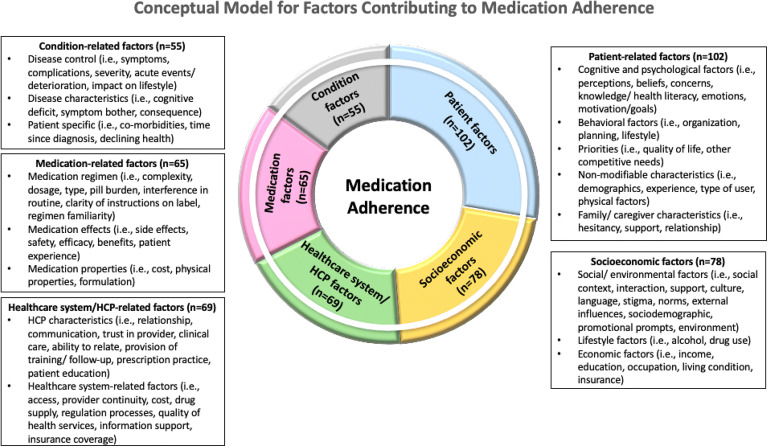
This systematic review synthesized 102 conceptual models of medication adherence and organized their factors using the WHO’s five dimensions. The authors propose an adaptable “donut model” that highlights common adherence factors across eight patient groups and can guide future interventions.
## Key findings
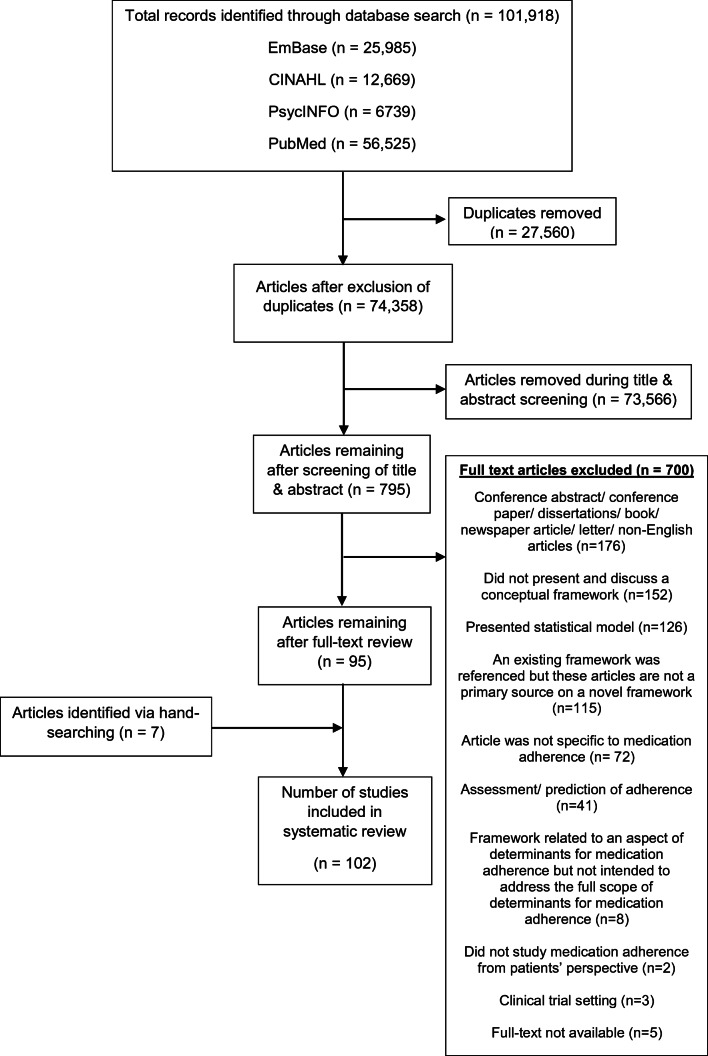
- The review included 102 relevant studies from an initial 101,918 records; 27,560 duplicates were removed, 73,566 titles/abstracts were excluded, 795 full texts were reviewed, and 700 were further excluded.
- The authors identified eight patient groups, including adults with chronic non-communicable conditions, cancer, symptomatic conditions, chronic communicable conditions, prevention of communicable diseases, psychiatric conditions, and pediatrics.
- Only 30 models addressed all five WHO dimensions of medication adherence; across models, the most universally addressed factors were patient-related factors.
- The WHO dimensions were represented to different degrees by patient group; for example, socioeconomic factors were especially prominent for communicable conditions, and caregiver characteristics/social support were common in pediatrics.
## Methods
- Design: Systematic review guided by PRISMA.
- Data/sample: Searched PubMed, Embase, CINAHL, and PsycINFO for English-language papers published up to 31 March 2020; included full-text original publications presenting theoretical or conceptual models of medication adherence factors, and excluded statistical models without a clear conceptual foundation.
- Analysis: Two reviewers independently screened, extracted data, and synthesized the models by mapping factors onto the WHO’s five dimensions and grouping them into eight patient groups; the team then developed an adaptable “donut model.”
## Limitations
- The paper states that it excluded conceptual models not based on patients’ perspectives and excluded three models from clinical trial settings, because such settings may include external prompts not present in routine care.
- The authors state that the relative quality of each study was not explored, and that reviewing conceptual frameworks is not amenable to standardized risk-of-bias tools.
- Evident from the text: the review was limited to English-language publications, so non-English conceptual models were not included.
Model-written summary. Check it against the paper before relying on it.
Integrity signals
Registry
Cites
Statistics
Figures
Verification
Claims the paper makes
8 Valid · 0 Not valid · 6 Not checked · 21 Own results and interpretations
Every source the paper cites for this claim was checked and supports it.
In the paper
“While these theories are helpful in understanding the contribution of patient-related factors and community or environment in medication adherence, they often ignore the effect of healthcare system– and healthcare team–related factors on patient behavior towards medication adherence.11”
§ An Adaptable Framework for Factors Contributing to Medication Adherence: Results from a Systematic Review of 102 Conceptual Frameworks > INTRODUCTION
What the sources say
- Supportedcites [11] Oori MJ Conceptual Model of Medication Adherence in Older Adults with High Blood Pressure-An Integrative Review of the Literature Curr Hypertens Rev 2019 15 2 85 92 30360745 PMC6635648 source
The Discussion section, under “Comparing the Designed Model with the Existing Models,” says these theories help explain patient and community or environmental factors but generally neglect healthcare-system and healthcare-team factors affecting medication-adherence behavior. This directly supports the attributed paraphrase. (LLM, conf=0.95)
plain- Asserted: passes — The authors put it forward as true.
- Checkable: passes — It can be checked against evidence.
- Load-bearing: passes — The paper’s conclusions depend on it.
- Based: passes — The paper gives a reason why it holds.
- Supported
The sources with a verdict support this claim; the rest weren’t checked yet, have no full text we could read, or their verdicts aren’t rated yet.
In the paper
“Many conceptual models have been developed to help understand the factors contributing to medication adherence in specific patient groups and/or for specific disease conditions.10–12”
§ An Adaptable Framework for Factors Contributing to Medication Adherence: Results from a Systematic Review of 102 Conceptual Frameworks > INTRODUCTION
What the sources say
- Not checked — no full text of the sourcecites [10] Murray MD A conceptual framework to study medication adherence in older adults Am J Geriatr Pharmacother 2004 2 1 36 43 15555477 source
- Supportedcites [11] Oori MJ Conceptual Model of Medication Adherence in Older Adults with High Blood Pressure-An Integrative Review of the Literature Curr Hypertens Rev 2019 15 2 85 92 30360745 PMC6635648 source
The Discussion section, “Comparing the Designed Model with the Existing Models,” lists multiple conceptual models used to explain factors influencing medication adherence. The Introduction discusses models applied to hypertensive patients, and the Conclusion describes the paper’s own model for older adults with high blood pressure. (LLM, conf=0.90)
- Not checked — no full text of the sourcecites [12] Jaam M A holistic conceptual framework model to describe medication adherence in and guide interventions in diabetes mellitus Res Soc Adm Pharm 2018 14 4 391 397 28533079 source
plain- Asserted: passes — The authors put it forward as true.
- Checkable: passes — It can be checked against evidence.
- Load-bearing: passes — The paper’s conclusions depend on it.
- Based: passes — The paper gives a reason why it holds.
Every source the paper cites for this claim was checked and supports it.
In the paper
“However, when medication is to be taken over a long period, adherence drops substantially for both prevention and cure.8”
§ An Adaptable Framework for Factors Contributing to Medication Adherence: Results from a Systematic Review of 102 Conceptual Frameworks > INTRODUCTION
What the sources say
- Supportedcites [8] Jimmy B Jose J Patient medication adherence: measures in daily practice Oman Med J 2011 26 3 155 159 22043406 PMC3191684 source
The passage in 'What influences medication adherence?' (p. ~3) states verbatim-equivalent content: 77% compliance when treatment was designed to cure and 63% when aimed at prevention, but 'when medication was to be taken over a long period, compliance rates dropped dramatically to around 50% for either prevention or cure' (citing ref. 33). The citing sentence's paraphrase of a substantial drop for both prevention and cure matches this, only omitting the ~50% figure, which is not a misattribution. (LLM, conf=0.92)
plainstates a cause- Asserted: passes — The authors put it forward as true.
- Checkable: passes — It can be checked against evidence.
- Load-bearing: unclear — It is unclear whether the paper’s conclusions depend on it.
- Based: passes — The paper gives a reason why it holds.
- Supported
A result the paper reports from its own data — it cites no other source for it, so there is none to check. The quote shows it is in the paper.
In the paper
“However, the factors within each model mapped well to one or more of the WHO dimensions, supporting the WHO dimensions to various degrees.”
§ An Adaptable Framework for Factors Contributing to Medication Adherence: Results from a Systematic Review of 102 Conceptual Frameworks > RESULTS > Model Development
boostedstates an association- Asserted: passes — The authors put it forward as true.
- Checkable: passes — It can be checked against evidence.
- Load-bearing: passes — The paper’s conclusions depend on it.
- Based: passes — The paper gives a reason why it holds.
A result the paper states — it cites no source for it, so there is none to check. The quote shows it is in the paper.
In the paper
“For adults with psychiatric conditions, patient- and medication-related factors were most commonly cited, likely attributed to cognitive factors and the side effects associated with psychiatric medications.”
§ An Adaptable Framework for Factors Contributing to Medication Adherence: Results from a Systematic Review of 102 Conceptual Frameworks > DISCUSSION
plain- Asserted: passes — The authors put it forward as true.
- Checkable: passes — It can be checked against evidence.
- Load-bearing: unclear — It is unclear whether the paper’s conclusions depend on it.
- Based: passes — The paper gives a reason why it holds.
15 more claims
Create a free account to see all 35 claims and to verify the 4 references still open.
- It may state two separate claims as one. 6
- Probably not a substantial claim. 10
- The quote only partly states this claim. 1
Citations
Cites
Preferred Reporting Items for Systematic Reviews and Meta-Analyses: the PRISMA statement
Moher, D., Liberati, A., Tetzlaff, J., Altman, D. G., & for the PRISMA Group (2009) · BMJ · doi:10.1136/bmj.b2535 · Cited by 83,823
Preferred reporting items for systematic reviews and meta-analyses: the PRISMA Statement.
(2009) · PubMed Central · Cited by 44,859
Osterberg, L., & Blaschke, T. (2005) · New England Journal of Medicine · doi:10.1056/nejmra050100 · Cited by 7,974
Adherence to Long-Term Therapies: Evidence for Action
De Geest, S., & Sabaté, E. (2003) · European Journal of Cardiovascular Nursing · doi:10.1016/s1474-5151(03)00091-4 · Cited by 6,272
Kirk, J., MacDonald, A., Lavender, P., Dean, J., & Rubin, G. (2017) · Biomedicine Hub · doi:10.1159/000480347 · Cited by 3,887
DiMatteo, M. R. (2004) · Medical Care · doi:10.1097/01.mlr.0000114908.90348.f9 · Cited by 2,169
A new taxonomy for describing and defining adherence to medications
Vrijens, B., De Geest, S., Hughes, D. A., Przemyslaw, K., Demonceau, J., Ruppar, T., Dobbels, F., Fargher, E., Morrison, V., Lewek, P., et al. (2012) · British Journal of Clinical Pharmacology · doi:10.1111/j.1365-2125.2012.04167.x · Cited by 2,028
Armijo‐Olivo, S., Stiles, C. R., Hagen, N. A., Biondo, P. D., & Cummings, G. G. (2012) · Journal of Evaluation in Clinical Practice · doi:10.1111/j.1365-2753.2010.01516.x · Cited by 1,539
Adherence with statin therapy in elderly patients with and without acute coronary syndromes
Jackevicius, C. A. (2002) · JAMA · doi:10.1001/jama.288.4.462 · Cited by 1,077
Determinants of Medication Compliance in Schizophrenia: Empirical and Clinical Findings
Fenton, W. S., Blyler, C. R., & Heinssen, R. K. (1997) · Schizophrenia Bulletin · doi:10.1093/schbul/23.4.637 · Cited by 957
Patient Medication Adherence: Measures in Daily Practice
Jimmy, B., & Jose, J. (2011) · Oman Medical Journal · doi:10.5001/omj.2011.38 · Cited by 956
Resisting medicines: a synthesis of qualitative studies of medicine taking
Pound, P., Britten, N., Morgan, M., Yardley, L., Pope, C., Daker-White, G., & Campbell, R. (2005) · Social Science & Medicine · doi:10.1016/j.socscimed.2004.11.063 · Cited by 868
Understanding and Improving Patient Compliance
ERAKER, S. A., KIRSCHT, J. P., & BECKER, M. H. (1984) · Annals of Internal Medicine · doi:10.7326/0003-4819-100-2-258 · Cited by 791
An information-motivation-behavioral skills model of adherence to antiretroviral therapy.
Fisher, J. D., Fisher, W. A., Amico, K. R., & Harman, J. J. (2006) · Health Psychology · doi:10.1037/0278-6133.25.4.462 · Cited by 696
Compliance, Adherence, and Concordance
Horne, R. (2006) · Chest · doi:10.1378/chest.130.1_suppl.65s · Cited by 602
Health Beliefs, Disease Severity, and Patient Adherence: A Meta-Analysis
DiMatteo, M. R., Haskard, K. B., & Williams, S. L. (2007) · Medical Care · doi:10.1097/mlr.0b013e318032937e · Cited by 482
Social Stigma Concerns and HIV Medication Adherence
Rintamaki, L. S., Davis, T. C., Skripkauskas, S., Bennett, C. L., & Wolf, M. S. (2006) · AIDS Patient Care and STDs · doi:10.1089/apc.2006.20.359 · Cited by 370
Fernandez-Lazaro, C. I., García-González, J. M., Adams, D. P., Fernandez-Lazaro, D., Mielgo-Ayuso, J., Caballero-Garcia, A., Moreno Racionero, F., Córdova, A., & Miron-Canelo, J. A. (2019) · BMC Family Practice · doi:10.1186/s12875-019-1019-3 · Cited by 321
Systematic review of the barriers affecting medication adherence in older adults
Yap, A. F., Thirumoorthy, T., & Kwan, Y. H. (2016) · Geriatrics & Gerontology International · doi:10.1111/ggi.12616 · Cited by 308
Self-citationAdherence in AIDS clinical trials: A framework for clinical research and clinical care
Ickovics, J. R., & Meisler, A. W. (1997) · Journal of Clinical Epidemiology · doi:10.1016/s0895-4356(97)00041-3 · Cited by 302
A conceptual framework to study medication adherence in older adults
MURRAY, M. (2004) · The American Journal of Geriatric Pharmacotherapy · doi:10.1016/s1543-5946(04)90005-0 · Cited by 222
Pediatric adherence to HIV antiretroviral therapy
Haberer, J., & Mellins, C. (2009) · Current HIV/AIDS Reports · doi:10.1007/s11904-009-0026-8 · Cited by 207
Barnhoorn, F., & Adriaanse, H. (1992) · Social Science & Medicine · doi:10.1016/0277-9536(92)90271-q · Cited by 205
Holmes, E. A. F., Hughes, D. A., & Morrison, V. L. (2014) · Value in Health · doi:10.1016/j.jval.2014.08.2671 · Cited by 199
Adherence to antipsychotic medications.
Perkins, D. O. (1999) · PubMed · Cited by 195
McHorney, C. A. (2009) · Current Medical Research and Opinion · doi:10.1185/03007990802619425 · Cited by 195
Merten, S., Kenter, E., McKenzie, O., Musheke, M., Ntalasha, H., & Martin‐Hilber, A. (2010) · Tropical Medicine & International Health · doi:10.1111/j.1365-3156.2010.02510.x · Cited by 192
Barriers and enablers for iron folic acid (IFA) supplementation in pregnant women
Siekmans, K., ROCHE, M. L., Kung’u, J. K., Desrochers, R. E., & De‐Regil, L. M. (2017) · Maternal and Child Nutrition · doi:10.1111/mcn.12532 · Cited by 178
A systematic review of factors affecting medication adherence among patients with osteoporosis
Yeam, C. T., Chia, S., Tan, H. C. C., Kwan, Y. H., Fong, W., & Seng, J. J. B. (2018) · Osteoporosis International · doi:10.1007/s00198-018-4759-3 · Cited by 170
Self-citationA qualitative study of medication-taking behaviour in primary care
Dowell, J. (1997) · Family Practice · doi:10.1093/fampra/14.5.369 · Cited by 167
Adherence to Preventive Medications
Walker, E. A., Molitch, M., Kramer, M. K., Kahn, S., Ma, Y., Edelstein, S., Smith, K., Johnson, M. K., Kitabchi, A., Crandall, J., et al. (2006) · Diabetes Care · doi:10.2337/dc06-0454 · Cited by 161
Rethinking adherence: a health literacy—informed model of medication self-management
Bailey, S. C., Oramasionwu, C. U., & Wolf, M. S. (2013) · Journal of Health Communication · doi:10.1080/10810730.2013.825672 · Cited by 160
The Medication Adherence Model: A Guide for Assessing Medication Taking
Johnson, M. J. (2002) · Research and theory for nursing practice · doi:10.1891/rtnp.16.3.179.53008 · Cited by 140
Piette, J. D., Heisler, M., Horne, R., & Caleb Alexander, G. (2006) · Social Science & Medicine · doi:10.1016/j.socscimed.2005.06.045 · Cited by 138
Participants' Explanations for Nonadherence in the FEM-PrEP Clinical Trial
Corneli, A. L., Perry, B., McKenna, K., Agot, K. E., Ahmed, K., Taylor, J., Malamatsho, F., Odhiambo, J. O., Skhosana, J., & Damme, L. V. (2015) · JAIDS Journal of Acquired Immune Deficiency Syndromes · doi:10.1097/qai.0000000000000880 · Cited by 138
Eshun‐Wilson, I., Rohwer, A. C., Hendricks, L., Oliver, S. R., & Garner, P. (2019) · PLoS ONE · doi:10.1371/journal.pone.0210408 · Cited by 132
Studying Adherence to Therapeutic Regimens
Brawley, L. R., & Culos-Reed, S. N. (2000) · Controlled Clinical Trials · doi:10.1016/s0197-2456(00)00073-8 · Cited by 129
Public perceptions of cancer: a qualitative study of the balance of positive and negative beliefs
Robb, K. A., Simon, A. E., Miles, A., & Wardle, J. (2014) · BMJ Open · doi:10.1136/bmjopen-2014-005434 · Cited by 125
Nam, S. L., Fielding, K., Avalos, A., Dickinson, D., Gaolathe, T., & Geissler, P. W. (2008) · Social Science & Medicine · doi:10.1016/j.socscimed.2008.03.042 · Cited by 123
An Information–Motivation–Behavioral Skills Model of PrEP Uptake
Dubov, A., Altice, F. L., & Fraenkel, L. (2018) · AIDS and Behavior · doi:10.1007/s10461-018-2095-4 · Cited by 120
Medication Compliance in Patients with Bipolar Disorder
Jamison, K. R., & Akiskal, H. S. (1983) · Psychiatric Clinics of North America · doi:10.1016/s0193-953x(18)30847-5 · Cited by 119
Maffoni, M., Traversoni, S., Costa, E. M., Midão, L., Kardas, P., Kurczewska-Michalak, M., & Giardini, A. (2020) · European Geriatric Medicine · doi:10.1007/s41999-020-00313-2 · Cited by 119
Watt, M. H., Maman, S., Earp, J. A., Eng, E., Setel, P. W., Golin, C. E., & Jacobson, M. (2009) · Social Science & Medicine · doi:10.1016/j.socscimed.2009.02.037 · Cited by 109
Patient perceptions of proactive medication discontinuation
Linsky, A. M., Simon, S. R., & Bokhour, B. G. (2014) · Patient Education and Counseling · doi:10.1016/j.pec.2014.11.010 · Cited by 108
Lim, R. H., & Sharmeen, T. (2018) · International Journal of Geriatric Psychiatry · doi:10.1002/gps.4985 · Cited by 105
Spanjol, J., Cui, A. S., Nakata, C. C., Sharp, L. K., Crawford, S. Y., Xiao, Y., & Watson‐Manheim, M. B. (2015) · Journal of Service Research · doi:10.1177/1094670515583824 · Cited by 103
Improving Adherence to Oral Cancer Therapy in Clinical Practice
McCue, D. A., Lohr, L., & Pick, A. M. (2014) · Pharmacotherapy The Journal of Human Pharmacology and Drug Therapy · doi:10.1002/phar.1399 · Cited by 102
Roe, D., Goldblatt, H., Baloush-Klienman, V., Swarbrick, M., & Davidson, L. (2009) · Psychiatric Rehabilitation Journal · doi:10.2975/33.1.2009.38.46 · Cited by 99
The myths of medication adherence
Gellad, W. F., Thorpe, C. T., Steiner, J. F., & Voils, C. I. (2017) · Pharmacoepidemiology and Drug Safety · doi:10.1002/pds.4334 · Cited by 98
Helping Patients Follow Prescribed Treatment: Clinical Applications
Haynes, R. B., McDonald, H. P., & Garg, A. X. (2002) · JAMA · doi:10.1001/jama.288.22.2880 · Cited by 98
Drug-taking compliance: a review and synthesis.
Christensen, D. B. (1978) · PubMed Central · Cited by 97
Rongkavilit, C., Naar‐King, S., Kaljee, L., Panthong, A., Koken, J. A., Bunupuradah, T., & Parsons, J. T. (2010) · AIDS Patient Care and STDs · doi:10.1089/apc.2010.0069 · Cited by 88
Reconciling Incompatibilities: A Grounded Theory of HIV Medication Adherence and Symptom Management
Wilson, H. S., Hutchinson, S. A., & Holzemer, W. L. (2002) · Qualitative Health Research · doi:10.1177/1049732302238745 · Cited by 79
Skovdal, M., Campbell, C., Nhongo, K., Nyamukapa, C., & Gregson, S. (2011) · The International Journal of Health Planning and Management · doi:10.1002/hpm.1082 · Cited by 77
Understanding adjuvant endocrine therapy persistence in breast Cancer survivors
Lambert, L. K., Balneaves, L. G., Howard, A. F., Chia, S., & Gotay, C. C. (2018) · BMC Cancer · doi:10.1186/s12885-018-4644-7 · Cited by 74
The problem of antiretroviral adherence: A self-regulatory model for intervention
Reynolds, N. R. (2003) · AIDS Care · doi:10.1080/0954012021000039815 · Cited by 74
Graham, S. M., Micheni, M., Secor, A., van der Elst, E., Kombo, B. K., Operario, D., Amico, K. R., Sanders, E. J., & Simoni, J. M. (2018) · AIDS Care · doi:10.1080/09540121.2018.1515471 · Cited by 73
Hall, N. J., Rubin, G. P., Hungin, A. P. S., & Dougall, A. (2007) · BMC Gastroenterology · doi:10.1186/1471-230x-7-20 · Cited by 70
Do patients' expectations influence their use of medications? Qualitative study.
Dolovich, L., Nair, K., Sellors, C., Lohfeld, L. H., Lee, A., & Levine, M. (2008) · PubMed · Cited by 65
Factors Sustaining Pediatric Adherence to Antiretroviral Therapy in Western Kenya
Vreeman, R., Nyandiko, W. M., Ayaya, S. O., Walumbe, E. G., Marrero, D. G., & Inui, T. S. (2009) · Qualitative Health Research · doi:10.1177/1049732309353047 · Cited by 63
Fields, E. L., Bogart, L. M., Thurston, I. B., Hu, C. H., Skeer, M. R., Safren, S. A., & Mimiaga, M. J. (2017) · Qualitative Health Research · doi:10.1177/1049732317697674 · Cited by 62
Jansà, M., Hernández, C., Vidal, M., Nuñez, M., Bertran, M. J., Sanz, S., Castell, C., & Sanz, G. (2010) · Patient Education and Counseling · doi:10.1016/j.pec.2009.12.012 · Cited by 61
Adherence to oral tyrosine kinase inhibitor therapies in chronic myeloid leukemia
Gater, A., Heron, L., Abetz-Webb, L., Coombs, J., Simmons, J., Guilhot, F., & Rea, D. (2012) · Leukemia Research · doi:10.1016/j.leukres.2012.01.021 · Cited by 59
Medication adherence decision-making among adolescents and young adults with cancer
McGrady, M. E., Brown, G. A., & Pai, A. L. H. (2015) · European Journal of Oncology Nursing · doi:10.1016/j.ejon.2015.08.007 · Cited by 53
Galea, J. T., Wong, M., Muñoz, M., Valle, E., León, S. R., Perez, D. D., Kolevic, L., & Franke, M. F. (2018) · PLoS ONE · doi:10.1371/journal.pone.0192791 · Cited by 50
Adherence to Acute Migraine Medication: What Does It Mean, Why Does It Matter?
Katić, B., Krause, S. J., Tepper, S. J., Hu, H. X., & BIGAL, M. E. (2010) · Headache The Journal of Head and Face Pain · doi:10.1111/j.1526-4610.2009.01535.x · Cited by 50
Jacobson, K. B., Niccolai, L. M., Mtungwa, N., Moll, A. P., & Shenoi, S. (2017) · AIDS Care · doi:10.1080/09540121.2017.1283390 · Cited by 49
Medication Adherence Decisions in Patients With Schizophrenia
Kikkert, M., & Dekker, J. (2017) · The Primary Care Companion For CNS Disorders · doi:10.4088/pcc.17n02182 · Cited by 49
Goh, H., Kwan, Y. H., Seah, Y., Low, L. L., Fong, W. W. S., & Thumboo, J. (2017) · Rheumatology International · doi:10.1007/s00296-017-3763-9 · Cited by 48
Self-citationVerbrugghe, M., Duprez, V., Beeckman, D., Grypdonck, M. H. F., Quaghebeur, M., Verschueren, C., Verhaeghe, S. T. L., & Hecke, A. V. (2015) · Cancer Nursing · doi:10.1097/ncc.0000000000000250 · Cited by 48
Adherence to BCR-ABL Inhibitors: Issues for CML Therapy
Jabbour, E. J., Saglio, G. N., Radich, J. P., & Kantarjian, H. M. (2012) · Clinical Lymphoma Myeloma & Leukemia · doi:10.1016/j.clml.2012.04.002 · Cited by 48
The self‐efficacy model of medication adherence in chronic mental illness
McCann, T. V., Clark, E., & Lu, L. (2008) · Journal of Clinical Nursing · doi:10.1111/j.1365-2702.2008.02354.x · Cited by 48
Conceptualizing antiretroviral adherence in Beijing, China
Starks, H. E., Simoni, J. M., Zhao, H., Huang, B., Fredriksen‐Goldsen, K. I., Pearson, C. R., Chen, W., Lu, L., & Zhang, F. (2008) · AIDS Care · doi:10.1080/09540120701660379 · Cited by 48
The social determinants of tuberculosis treatment adherence in a remote region of Papua New Guinea
Diefenbach-Elstob, T., Plummer, D., Dowi, R., Wamagi, S., Gula, B., Siwaeya, K., Pelowa, D., Siba, P., & Warner, J. (2017) · BMC Public Health · doi:10.1186/s12889-016-3935-7 · Cited by 47
Voshaar, M., Vriezekolk, J. E., van Dulmen, S., van den Bemt, B. J. F., & van de Laar, M. A. F. J. (2016) · BMC Musculoskeletal Disorders · doi:10.1186/s12891-016-1289-z · Cited by 45
A systematic review of factors that influence treatment adherence in paediatric oncology patients
Goh, X.-T.-W., Tan, Y. B., Thirumoorthy, T., & Kwan, Y. H. (2017) · Journal of Clinical Pharmacy and Therapeutics · doi:10.1111/jcpt.12441 · Cited by 44
Self-citationUnravelling adherence to prophylaxis in haemophilia: a patients’ perspective
Schrijvers, L. H., Kars, M. C., Beijlevelt‐van der Zande, M., Peters, M., Schuurmans, M. J., & Fischer, K. (2015) · Haemophilia · doi:10.1111/hae.12660 · Cited by 43
Sanders, J. J., Roose, R. J., Lubrano, M. C., & Lucan, S. C. (2013) · Journal of Addiction Medicine · doi:10.1097/adm.0b013e318297021e · Cited by 43
Brown, T. M., Siu, K., Walker, D., Pladevall-Vila, M., Sander, S., & Mordin, M. (2012) · Journal of Managed Care Pharmacy · doi:10.18553/jmcp.2012.18.5.351 · Cited by 43
Developing a generic, individualised adherence programme for chronic medication users
Herborg, H., Haugbølle, L. S., Sørensen, L., Rossing, C., & Dam, P. (2008) · Pharmacy Practice (Internet) · doi:10.4321/s1886-36552008000300006 · Cited by 43
Engler, K., Lènàrt, A., Lessard, D., Toupin, I., & Lebouché, B. (2018) · AIDS Care · doi:10.1080/09540121.2018.1469725 · Cited by 42
Easthall, C., Taylor, N., & Bhattacharya, D. (2019) · International Journal of Pharmacy Practice · doi:10.1111/ijpp.12491 · Cited by 41
Reasons for medication non-initiation: A qualitative exploration of the patients’ perspective
Gil‐Girbau, M., Aznar‐Lou, I., Peñarrubia‐María, M. T., Moreno-Peral, P., Fernández, A., Bellón, J. Á., Jové, A. M., Mendive, J. M., Fernández‐Vergel, R., Figueiras, A., et al. (2019) · Research in Social and Administrative Pharmacy · doi:10.1016/j.sapharm.2019.08.002 · Cited by 41
An Exploration of Patient Perceptions of Adherence to Tuberculosis Treatment in Tanzania
van den Boogaard, J., Msoka, E., Homfray, M., Kibiki, G. S., Heldens, J., Felling, A., & Aarnoutse, R. E. (2012) · Qualitative Health Research · doi:10.1177/1049732312438968 · Cited by 40
Lek, Y.-Y., & Bishop, G. D. (1995) · Psychology & Health · doi:10.1080/08870449508401950 · Cited by 39
Heiby, E. M., & Carlson, J. G. (1986) · PubMed · Cited by 37
Reconceptualizing Medication Adherence: Six Phases of Dynamic Adherence
Gearing, R. E., Townsend, L., MacKenzie, M., & Charach, A. (2011) · Harvard Review of Psychiatry · doi:10.3109/10673229.2011.602560 · Cited by 37
Petrovic, K., & Blank, T. (2015) · Cogent Psychology · doi:10.1080/23311908.2015.1038894 · Cited by 37
Medication adherence as a learning process: insights from cognitive psychology
Rottman, B. M., Marcum, Z. A., Thorpe, C. T., & Gellad, W. F. (2016) · Health Psychology Review · doi:10.1080/17437199.2016.1240624 · Cited by 37
Gill, M. M., Umutoni, A., Hoffman, H. J., Ndatimana, D., Ndayisaba, G., Kibitenga, S., Mugwaneza, P., Asiimwe, A., & Bobrow, E. (2017) · AIDS Patient Care and STDs · doi:10.1089/apc.2016.0234 · Cited by 37
Khan, M. U., & Aslani, P. (2019) · Journal of Child and Adolescent Psychopharmacology · doi:10.1089/cap.2018.0153 · Cited by 36
Tagutanazvo, O. B., Nolte, A. G. W., & Temane, A. (2019) · Health SA Gesondheid · doi:10.4102/hsag.v24i0.1088 · Cited by 35
Li, W., Stewart, A. L., Stotts, N. A., & Froelicher, E. S. (2005) · Journal of Nursing Measurement · doi:10.1891/jnum.13.3.231 · Cited by 35
HIV patient insight on adhering to medication: a qualitative analysis
Beusterien, K. M., Davis, E. A., Flood, R., Howard, K., & Jordan, J. C. (2008) · AIDS Care · doi:10.1080/09540120701487666 · Cited by 34
Understanding compliance issues for daily self-injectable treatment in ambulatory care settings.
Brod, M. I., Rousculp, M. D., & Cameron, A. (2008) · PubMed Central · Cited by 34
Reformulating the Common Sense Model of Self-Regulation: Toward Parent-Child Shared Regulation
Sonney, J., & Insel, K. C. (2016) · Nursing Science Quarterly · doi:10.1177/0894318416630091 · Cited by 33
A Model of Medication-Taking Behavior in Elderly Individuals With Chronic Disease
Chen, C.-H., Wu, J.-R., Yen, M., & Chen, Z.-C. (2007) · Journal of Cardiovascular Nursing · doi:10.1097/01.jcn.0000287029.87746.58 · Cited by 33
Toward an information–motivation–behavioral skills model of microbicide adherence in clinical trials
Ferrer, R. A., Morrow, K. M., Fisher, W. A., & Fisher, J. D. (2010) · AIDS Care · doi:10.1080/09540121003623719 · Cited by 32
Heneghan, M. B., Hussain, T., Barrera, L., Cai, S. W., Haugen, M., Duff, A., Shoop, J., Morgan, E. R., Rossoff, J. E., Weinstein, J. L., et al. (2020) · Pediatric Blood & Cancer · doi:10.1002/pbc.28216 · Cited by 32
Jaam, M., Awaisu, A., Mohamed Ibrahim, M. I., & Kheir, N. (2018) · Research in Social and Administrative Pharmacy · doi:10.1016/j.sapharm.2017.05.003 · Cited by 32
Bockwoldt, D., Staffileno, B. A., Coke, L. A., Hamilton, R., Fogg, L., Calvin, D. J., & Quinn, L. (2016) · Journal of Transcultural Nursing · doi:10.1177/1043659616651674 · Cited by 31
Wozniak, L., Johnson, J. A., McAlister, F. A., Beaupré, L. A., Bellerose, D., Rowe, B. H., & Majumdar, S. R. (2016) · Osteoporosis International · doi:10.1007/s00198-016-3693-5 · Cited by 29
Adherence to stimulants in adult ADHD
O’Callaghan, P. (2014) · ADHD Attention Deficit and Hyperactivity Disorders · doi:10.1007/s12402-014-0129-y · Cited by 29
Heidari, P., Cross, W. M., Weller, C. D., Victoria Team, Nazarinia, M. A., & Crawford, K. (2019) · International Journal of Rheumatic Diseases · doi:10.1111/1756-185x.13660 · Cited by 29
Moshkovska, T., Stone, M. A., Baker, R., & Mayberry, J. F. (2008) · Inflammatory Bowel Diseases · doi:10.1002/ibd.20404 · Cited by 29
Hoefnagels, J. W., Kars, M. C., Fischer, K., Schutgens, R. E. G., & Schrijvers, L. H. (2020) · Patient Preference and Adherence · doi:10.2147/ppa.s232393 · Cited by 28
Adherence to anti-psychotic medications and health behavior theories
Corrigan, P. W. (2002) · Journal of Mental Health · doi:10.1080/09638230020023633 · Cited by 28
A psychological flexibility model of medication adherence in psychotic-spectrum disorders
Moitra, E., & Gaudiano, B. A. (2016) · Journal of Contextual Behavioral Science · doi:10.1016/j.jcbs.2016.10.003 · Cited by 27
Koh, J. J. K., Cheng, R. X., Yap, Y. C., Haldane, V. E., Tan, Y. G., Teo, K. W. Q., Srivastava, A., Ong, P. S., Perel, P., & Legido‐Quigley, H. (2018) · Patient Preference and Adherence · doi:10.2147/ppa.s176256 · Cited by 25
Dockerty, T., Latham, S., & Smith, T. O. (2016) · Rheumatology International · doi:10.1007/s00296-016-3457-8 · Cited by 24
Li, W., Stotts, N. A., & Froelicher, E. S. (2007) · Research and theory for nursing practice · doi:10.1891/088971807782427967 · Cited by 24
Hon, A. C. U. (2012) · Journal of Psychiatric and Mental Health Nursing · doi:10.1111/j.1365-2850.2012.01898.x · Cited by 23
Can Human Error Theory Explain Non-adherence?
Barber, N., Safdar, A., & Franklin, B. D. (2005) · Pharmacy World & Science · doi:10.1007/s11096-005-0355-7 · Cited by 22
Gault, I., Gallagher, & Chambers (2013) · Patient Preference and Adherence · doi:10.2147/ppa.s44894 · Cited by 21
Naqvi, A. A., Hassali, M. A., Aftab, M. T., et al. (2019) · PubMed · Cited by 19
Olds, P., Kiwanuka, J. P., Ware, N. C., Tsai, A. C., & Haberer, J. E. (2014) · AIDS and Behavior · doi:10.1007/s10461-014-0924-7 · Cited by 19
Oori, M. J., Mohammadi, F., Norouzi, K., Fallahi-Khoshknab, M., & Ebadi, A. (2019) · Current Hypertension Reviews · doi:10.2174/1573402114666181022152313 · Cited by 19
Giralt, A. N., Nöstlinger, C., Lee, J. C. L., Salami, O., Lallemant, M. J., Onyango‐Ouma, W., Nyamongo, I. K., & Marchal, B. (2019) · PLoS ONE · doi:10.1371/journal.pone.0220408 · Cited by 18
Krentel, A., & Aunger, R. V. (2011) · Health Policy and Planning · doi:10.1093/heapol/czr048 · Cited by 16
August, K. J., & Billimek, J. (2016) · Journal of Health Psychology · doi:10.1177/1359105315589391 · Cited by 13
Medicine taking behaviours of people with type 2 diabetes in Indonesia: a qualitative study
Widayanti, A. W., Norris, P., Heydon, S. J., & Green, J. (2019) · International Journal of Clinical Pharmacy · doi:10.1007/s11096-019-00933-0 · Cited by 13
Boukhechba, M., Baee, S., Nobles, A. L., Gong, J., Wells, K., & Barnes, L. E. (2018) · 2018 IEEE EMBS International Conference on Biomedical & Health Informatics (BHI) · doi:10.1109/bhi.2018.8333422 · Cited by 10 · cited 1×
“Medication adherence is a complex behavior influenced by patient-related factors, the healthcare team/system, Kai Qi Elizabeth PEH and Yu Heng KWAN are co-first authors Hayden Barry BOSWORTH, Lian Leng LOWand Julian THUMBOO are cosenior authors Received October 28, 2020 Accepted January 28, 2021 2784 Published online…”
BackgroundThe Information-Motivation-Behavioral Skills Model of ART Adherence in Romanian Young Adults
Dima, A. L., Schweitzer, A.-M., Amico, K. R., & Wanless, R. S. (2013) · Journal of HIV/AIDS & Social Services · doi:10.1080/15381501.2012.749819 · Cited by 8
McLoughlin, A., Bennett, K., & Cahir, C. (2019) · Annals of Behavioral Medicine · doi:10.1093/abm/kaz004 · Cited by 7
Medication adherence in the management of nocturia: challenges and solutions
Jayadevappa, R., Newman, D. K., Chhatre, S., & Wein, A. J. (2015) · Patient Preference and Adherence · doi:10.2147/ppa.s51482 · Cited by 7
Xu, L., & Wang, A. (2019) · Patient Preference and Adherence · doi:10.2147/ppa.s217562 · Cited by 5
Ho, S., Stenhouse, R., & Holloway, A. S. (2020) · Journal of Clinical Nursing · doi:10.1111/jocn.15228 · Cited by 5
A concept analysis of analgesic nonadherence for cancer pain in a time of opioid crisis
Rosa, W. E., Riegel, B. J., Ulrich, C. M., et al. (2019) · Nursing Outlook · doi:10.1016/j.outlook.2019.06.017 · Cited by 5
Meaning of Pharmacological Treatment for Families of People With Depression
Vedana, K. G. G., Magrini, D. F., de Souza, J., Zanetti, A. C. G., Miasso, A. I., Filho, P. C. P. T., & Borges, T. L. (2016) · Issues in Mental Health Nursing · doi:10.3109/01612840.2015.1123335 · Cited by 4
The Schizophrenic Clients Reinforcement and Punishment for Medication Adherence
Davidhizar, R. (1984) · Issues in Mental Health Nursing · doi:10.3109/01612848409140889 · Cited by 3
Cited by
Sazali, M. F., Rahim, S. S. S. A., Mohammad, A. H., Kadir, F. B. M., Payus, A. O., Avoi, R., Jeffree, M. S., Omar, A., Ibrahim, M. Y., Atil, A., et al. (2023) · Tuberculosis & respiratory diseases · doi:10.4046/trd.2022.0148 · Cited by 134
Masa, R., Zimba, M., Tamta, M., Zimba, G., & Zulu, G. (2022) · Stigma and Health · doi:10.1037/sah0000404 · Cited by 59
Yoon, S., Kwan, Y. H., Yap, W. L., Lim, Z. Y., Phang, J. K., Loo, Y. X., Aw, J., & Low, L. L. (2023) · Frontiers in Pharmacology · doi:10.3389/fphar.2023.1124297 · Cited by 66
Self-citationBarriers and Facilitators to Medication Adherence among the Vulnerable Elderly: A Focus Group Study
Horvat, M., Eržen, I., & Vrbnjak, D. (2024) · Healthcare · doi:10.3390/healthcare12171723 · Cited by 47
Exploring a New Theoretical Model to Explain the Behavior of Medication Adherence
Unni, E., & Bae, S. (2022) · Pharmacy · doi:10.3390/pharmacy10020043 · Cited by 49
Metadata
- Authors
- Peh, K. Q. E., Kwan, Y. H., Goh, H., Ramchandani, H., Phang, J. K., Lim, Z. Y., Loh, D. H. F., Østbye, T., Blalock, D. V., Yoon, S., Bosworth, H. B., Low, L. L., & Thumboo, J.
- Affiliations
- Duke-NUS Medical School (SG)
- National University of Singapore (SG)
- Singapore General Hospital (SG)
- SingHealth (SG)
- Duke University (US)
- Corresponding author
- Kwan, Yu Heng
- ORCID
- Venue
- Journal of General Internal Medicine
- Published
- 2021-03-03
- Volume
- 36
- Issue
- 9
- Pages
- 2784-2795
- ISSN
- 0884-8734 (ISSN-L)
- 1525-1497
- PMC
- PMC8390603
- OpenAlex
- W3134412732
- Semantic Scholar
- 7a37fb29d70e2916438857bf6394cb155022fe22
- Cited by
- 151
- References
- 131
- Citations by year
- 2026: 37 · 2025: 43 · 2024: 34 · 2023: 22 · 2022: 12 · 2021: 3
- FWCI
- 4.22
- Type
- journal article
- Language
- en
- Open access
- hybrid
- doi.org
- Licence
- cc-by
- creativecommons.org/licenses/by/4.0 (tdm)
- creativecommons.org/licenses/by/4.0 (vor)
- Locations
- Journal of General Internal Medicine (publishedVersion, cc-by)
- Europe PMC (PubMed Central) (publishedVersion, other-oa)
- PubMed Central (publishedVersion, cc-by)
- PubMed (publishedVersion)
- National University of Singapore (submittedVersion, cc-by)
- Funders
- AM-ETHOS Duke-NUS Medical Student Fellowship Award (AM-ETHOS01/FY2020/27-A27)
- SingHealth RHS (PULSES) Centre Grant (CGDec19S03)
- Topics
- Health Sciences › Medicine › Family Practice › Medication Adherence and Compliance
- Health Sciences › Health Professions › Pharmacy › Pharmacy and Medical Practices
- Health Sciences › Medicine › Public Health, Environmental and Occupational Health › Patient Safety and Medication Errors
- Keywords
- medication adherence, conceptual model, patient factors, socioeconomic factors, health system factors, patient associations, barriers and facilitators, adherence interventions
- MeSH terms
- Humans, Models, Theoretical, Socioeconomic Factors, Medication Adherence
About these checks
Registry, retraction, Cites and statistics results are computed, not judged, with one exception: a printed reference that no index lists is read once by a model before it counts as a citation error. Claims are extracted by a model and kept only when their quote appears verbatim in the text; each cited source is then checked, with a model’s help, for whether it says what the claim relies on. Those verdicts can be wrong — read the claim’s quote and the cited source before relying on one.
The claim verdicts this report counts are experimental: their accuracy is not yet measured.
A language model drew the claims from the paper on 2026-10-10, under version 3 of the claim definition (model deepseek-v4.1-flash, prompt extract-v3).
A second model labelled each claim on 2026-10-10 (model jev-1.13-20260917, definition revision gold-guideline-v0.2).
Cited sources are checked with a language model’s help (gpt-6-sol and qwen3.8-omni-flash).
Statistics and arithmetic are recomputed, not judged.
Confidence bands are shown only for fields calibrated on our annotated test set. None is calibrated yet, so no band is shown.
What counts as a claim ›How we measure confidence ›How we check this ›
Are you an author, or do you see a problem with this page? Request a review
Data sources
Bibliographic data: Semantic Scholar, OpenAlex, Crossref.
Contains information from the Semantic Scholar Academic Graph Datasets, made available under the ODC Attribution License (ODC-BY 1.0).
Semantic Scholar’s data is described in: Kinney, R., et al. (2023). The Semantic Scholar Open Data Platform. arXiv:2301.10140.
