

Impact of a Mindfulness-Based Stress Reduction Program on Psychological Well-Being, Cortisol, and Inflammation in Women Veterans
Open accessThe DOI matches its Crossref record; 54 of the 54 references it cites were found in a registry or an index.
Abstract
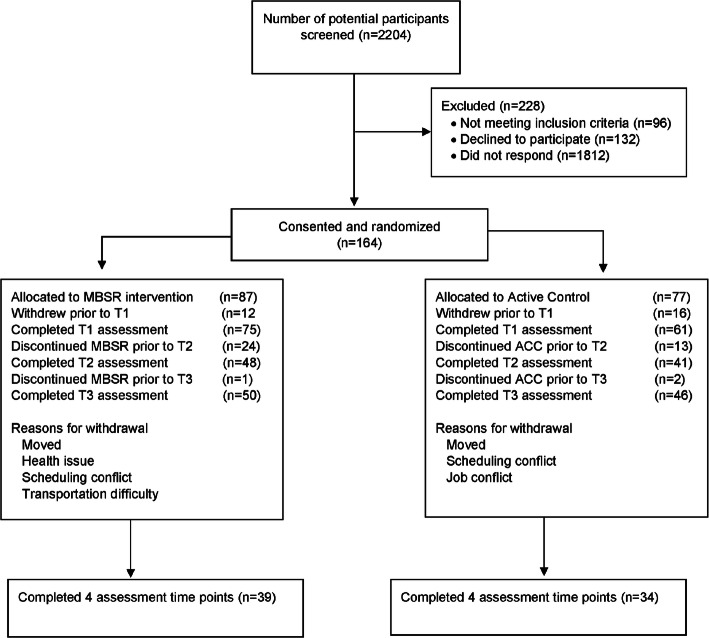
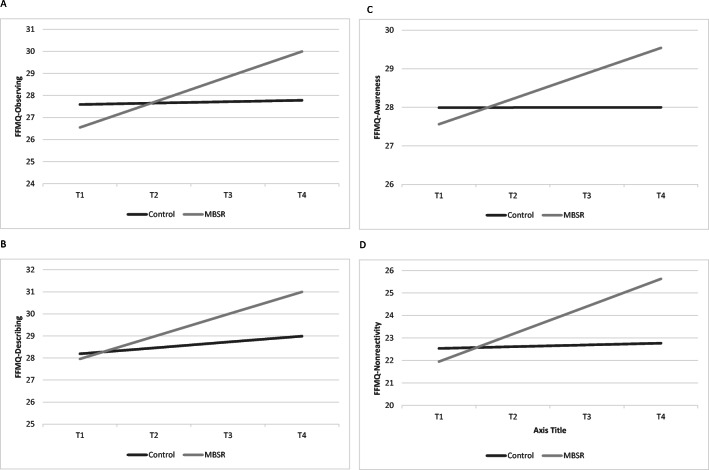
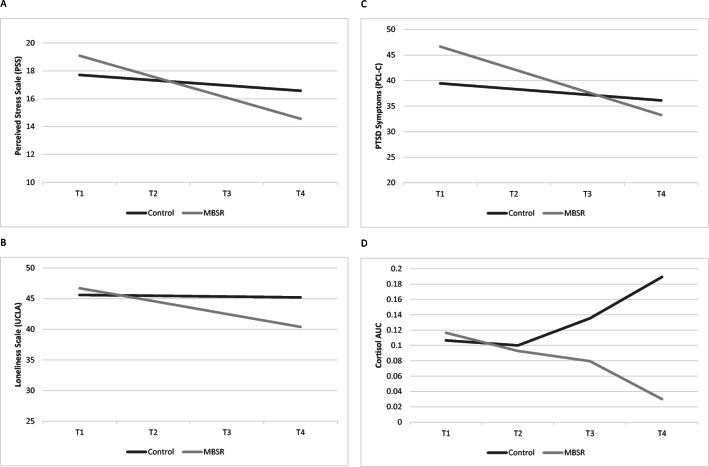
Background: Women veterans experience higher levels of stress-related symptoms than their civilian counterparts. Psychological stress is associated with greater inflammation and may increase risk for cardiovascular disease (CVD). Mindfulness-based stress reduction (MBSR) has been found to improve psychological well-being in other populations but no randomized controlled trials (RCT) have been conducted examining the impact of MBSR on well-being and inflammation in women veterans at risk for CVD. Objective: Determine the effectiveness of MBSR in improving psychological well-being, cortisol, and inflammation associated with CVD in women veterans. Design: The design is a RCT comparing MBSR to an active control condition (ACC) consisting of a health education program. Participants: Women veterans (N=164) with risk factors for CVD from the Chicagoland area participated in the study. Intervention: An 8-week MBSR program with weekly 2.5-h classes was compared to an ACC consisting of an 8-week health promotion education program with weekly 2.5-h classes. Main Measures: The outcomes were psychological well-being [perceived stress, depressive symptoms, loneliness, and post-traumatic stress disorder (PTSD)] symptoms and stress-related markers, including diurnal salivary cortisol and cytokines interleukin-6 (IL-6) and interferon gamma (IFN-γ). Data were collected at baseline, 4 weeks (mid-point of intervention), 8 weeks (completion of intervention), and 6 months after completion of MBSR or ACC. Key Results: Compared to the ACC, women who participated in MBSR reported less perceived stress, loneliness, and symptoms of PTSD. Although there were no significant differences between groups or changes over time in IL-6 or IFN-γ, participants in the MBSR program demonstrated a more rapid decline in diurnal salivary cortisol as compared to those in the ACC. Conclusions: MBSR was found to improve psychological well-being and decrease diurnal salivary cortisol in women veterans at risk for CVD. Health care providers may consider MBSR for women veterans as a means by which to improve their psychological well-being.
Overview
The claims and statistics of this paper haven’t been checked yet.
Free: it reads the open-access text and checks the first 5 claims that cite a source we can check. Create a free account to check every claim.
Integrity signals
Registry
Cites
Statistics
Figures
Verification
Claims the paper makes
The claims and statistics of this paper haven’t been checked yet.
Free: it reads the open-access text and checks the first 5 claims that cite a source we can check. Create a free account to check every claim.
Claims other papers make about this one
Each is checked against this paper’s own text: does it say what the citing paper says it does?
The source backs part of the claim, not all of it — or backs it for a different population, condition or comparison.
In the citing paper
“There is also evidence that psychological in terventions can influence cortisol levels in patients with cancer, psy chiatric conditions and other health issues (e.g., Antoni et al., 2023, Saban et al., 2022).”
From Effectiveness of stress management interventions to change cortisol levels: a systematic review and meta-analysis. (2024) · cites this paper as Saban et al., 2022
Experimental — accuracy not yet measured
Self-check
Percentages, sums and reported differences re-computed from the paper’s own numbers.
The self-check needs the paper’s full text.
Citations
Cites
The CES-D Scale: A Self-Report Depression Scale for Research in the General Population
Radloff, L. S. (1977) · Applied Psychological Measurement · doi:10.1177/014662167700100306 · Cited by 53,267
A Global Measure of Perceived Stress
Cohen, S., Kamarck, T., & Mermelstein, R. (1983) · Journal of Health and Social Behavior · doi:10.2307/2136404 · Cited by 32,807 · cited 1×
“The PSS is a measure of the degree to which situations in one’s life are considered to be stressful.(29) It contains ten questions with five responses on a Likert-type scale.”
BackgroundHierarchical Linear Models: Applications and Data Analysis Methods
Davidian, M. (2003) · Journal of the American Statistical Association · doi:10.1198/jasa.2003.s288 · Cited by 13,723
Applied Longitudinal Data Analysis: Modeling Change and Event Occurrence
Singer, J. D., & Willett, J. B. (2003) · doi:10.1093/acprof:oso/9780195152968.001.0001 · Cited by 10,647
Using Self-Report Assessment Methods to Explore Facets of Mindfulness
Baer, R. A., Smith, G. T., Hopkins, J., Krietemeyer, J., & Toney, L. (2006) · Assessment · doi:10.1177/1073191105283504 · Cited by 7,511
UCLA loneliness scale (version 3): reliability, validity, and factor structure
Russell, D. W. (1996) · Journal of Personality Assessment · doi:10.1207/s15327752jpa6601_2 · Cited by 5,800 · cited 1×
“The UCLALoneliness Scale is a 20item scale that assesses the subjective level of social isolation using a 4-point Likert-type scale.(31) Scores range from 0 to 60 with higher scores suggesting greater loneliness.”
MethodChronic inflammation in the etiology of disease across the life span
Furman, D., Campisi, J., Verdin, E., Carrera-Bastos, P., Targ, S., Franceschi, C., Ferrucci, L., Gilroy, D. W., Fasano, A., Miller, G. W., et al. (2019) · Nature Medicine · doi:10.1038/s41591-019-0675-0 · Cited by 4,915
Effects of mindfulness on psychological health: A review of empirical studies
Keng, S.-L., Smoski, M. J., & Robins, C. J. (2011) · Clinical Psychology Review · doi:10.1016/j.cpr.2011.04.006 · Cited by 2,687
Advances in Personal Relationships
Hall, J. A. (2020) · Cited by 1,978
Mindfulness-based stress reduction for healthy individuals: A meta-analysis
Khoury, B., Sharma, M., Rush, S. E., & Fournier, C. (2015) · Journal of Psychosomatic Research · doi:10.1016/j.jpsychores.2015.03.009 · Cited by 1,617
Research works printed but not linked: 1
- Witek-Janusek L Albuquerque K Chroniak KR Chroniak C Durazo-Arvizu R Mathews HL Effect of mindfulness based stress reduction on immune function, quality of life and coping in women newly diagnosed with early stage breast cancer Brain, Behavior, & Immunity. 2008 22 6 969 81 10.1016/j.bbi.2008.01.012 18359186 PMC2586059 · DOI · Paper page
Cited by
Rogerson, O., Wilding, S., Prudenzi, A., & O’Connor, D. B. (2024) · Psychoneuroendocrinology · doi:10.1016/j.psyneuen.2023.106415 · Cited by 87
Crovetto, F., Nakaki, A., Arranz, A., Borras, R., Vellvé, K., Paules, C., Boutet, M. L., Castro-Barquero, S., Freitas, T., Casas, R., et al. (2023) · JAMA Network Open · doi:10.1001/jamanetworkopen.2023.30255 · Cited by 41
Ballesio, A., Zagaria, A., Vacca, M., Pariante, C. M., & Lombardo, C. (2023) · Brain Behavior and Immunity · doi:10.1016/j.bbi.2023.05.006 · Cited by 32
Tan, L., Strudwick, J., Deady, M., Bryant, R. A., & Harvey, S. B. (2023) · BMJ Open · doi:10.1136/bmjopen-2022-064758 · Cited by 34
Lee, S.-C., Tsai, P.-H., Yu, K.-H., & Chan, T.-M. (2025) · Healthcare · doi:10.3390/healthcare13080952 · Cited by 25
Li, W. W., Nannestad, J., Leow, T. Y. Q., & Heward, C. (2024) · Health Psychology Open · doi:10.1177/20551029241302969 · Cited by 29
“One study (Saban et al., 2022) was excluded for the following reasons: the authors claimed no signi fi cant group differences at baseline in PTSD and depression be-tween MBSR and control groups, however the current research team found signi fi cant differences (PTSD: p = 0.048, depression: p = 0.042).”
InfluentialAn Evidence Map of the Women Veterans’ Health Literature, 2016 to 2023: A Systematic Review
Goldstein, K. M., Pace, R., Dancu, C., Raman, S. R., Bridges‐Curry, Z., Klimek, P., Jeevanathan, A., Gallion, A. H., Der, T., Tabriz, A. A., et al. (2025) · JAMA Network Open · doi:10.1001/jamanetworkopen.2025.6372 · Cited by 19
Plasma Concentration of Cortisol Negatively Associates with Platelet Reactivity in Older Subjects
Karolczak, K., Konieczna, L., Sołtysik, B. K., Kostka, T., Witas, P. J., Kostanek, J., Bączek, T., & Watała, C. W. (2022) · International Journal of Molecular Sciences · doi:10.3390/ijms24010717 · Cited by 13
“Based on the conclusions of other studies, it can be suggested that the decrease of cortisol concentration may be a method of cardiovascular prophylaxis, and an element of this prevention may be stress reduction [21].”
MethodÜNVER, H., Küçükkelepçe, D. Ş., Nacar, G., Çetin, N. Ş., & Taşhan, Ş. T. (2024) · Menopause The Journal of The North American Menopause Society · doi:10.1097/gme.0000000000002402 · Cited by 15
El-Malahi, O., Mohajeri, D., Bäuerle, A., Mincu, R. I., Rammos, C., Jansen, C., Teufel, M., Rassaf, T., & Lortz, J. (2025) · Journal of Medical Internet Research · doi:10.2196/67118 · Cited by 14
“Reducing stress can improve mental health disorders and lead to better outcomes for individuals with cardiovascular conditions [6].”
Murakami, Y., Goto, D., Tsukamoto, H., Yamaura, K., & Hashimoto, T. (2025) · Brain and Behavior · doi:10.1002/brb3.70284 · Cited by 10
Huang, X., Lv, J., Zhu, D., Peng, H., & Yu, T. (2025) · Biogerontology · doi:10.1007/s10522-025-10287-y · Cited by 7
“…al. 2020; Meyer et al. 2019; Montero-Marin et al. 2019; Ng et al. 2020; Oken et al. 2010; Oswald et al. 2022; Pradhan et al. 2007; Qiu et al. 2024; Saban et al. 2022; Sanabria-Mazo et al. 2020; Shapira et al. 2022; Siripanya et al. 2023; Smith et al. 2018; Tobón et al. 2023; Tolahunase et al.…”
The neuroscientific basis of post-traumatic stress disorder (PTSD): From brain to treatment
Agbaria, L., Mirzaei, F., A'amar, N. O., Raba, F. T., Papazian, G., Bhatnagar, K., Sirimanne, N., Ayoubkhan, A. A., Thilagendra, A. G., & Gupta, A. (2025) · Progress in brain research · doi:10.1016/bs.pbr.2025.01.009 · Cited by 8
Choi, Y., Cho, D.-H., & Lee, N.-R. (2024) · Digital Health · doi:10.1177/20552076241308986 · Cited by 5
Batie, C. M., Axon, R. N., & Pope, C. A. (2025) · Military Medicine · doi:10.1093/milmed/usaf005 · Cited by 5
Zhang, J., Liu, Y., & Zhao, K. (2026) · Behavioural Brain Research · doi:10.1016/j.bbr.2026.116268 · Cited by 6
Developing loneliness interventions for people with personality disorders: A call to action
Reinhard, M. A., & Padberg, F. (2025) · Annals of the New York Academy of Sciences · doi:10.1111/nyas.15367 · Cited by 7
“51”
Stress-Induced Metabolic Disorders: Mechanisms, Pathologies, and ProspectsPreprint
Zhang, W.-Z. (2025) · Preprints.org · doi:10.20944/preprints202504.1086.v1 · Cited by 10
The Impact of Mental Health on Cardiovascular Disease in Women
Mahana, I., Asturias, K. M., Mei, P., Kalt, M., Parashar, S., Rao, R. A., Kondapalli, L., Olubi, O. M., & Le, D. E. (2025) · Current Cardiology Reports · doi:10.1007/s11886-025-02263-2 · Cited by 2
“Women veterans experience higher levels of stress-related symptoms, when compared to their civilian counter-parts [43 ].”
Nakaki, A., Gomez, Y., Darecka, K., Borràs, R., Vellvé, K., Paulés, C., Boutet, M. L., Basso, A., Casu, G., Traversi, P., et al. (2024) · Fetal Diagnosis and Therapy · doi:10.1159/000540580 · Cited by 7
Bavi, S., Salar, A. R., Talayeri, A., & Bahmaei, H. (2025) · Journal of Contemporary Psychotherapy · doi:10.1007/s10879-025-09676-8 · Cited by 1
“Furthermore, replicating this study with a larger and more diverse sample would enhance the generalizability of the findings. disorder, consistent with prior research (Goldin & Gross, 2010; Saban et al., 2022).”
Gaskin, J., Chao, M., & Li, W. W. (2025) · Springer eBooks · doi:10.1007/978-3-032-00353-9_19 · Cited by 1
Positive Psychology Interventions and Cardiovascular Health
Hernández, R., Kwon, S., VELA, A. M., & Edwards, K. S. (2026) · Cardiology Clinics · doi:10.1016/j.ccl.2025.12.001 · Cited by 2
A influência do mindfulness no sistema imunológico: uma revisão narrativa
Bueno, E. H., Oles, H., & Huang, N. (2023) · Congresso Brasileiro de Medicina do Estilo de Vida · doi:10.61661/congresso.cbmev.6.2023.44
Hu, X., & Zhang, L. (2025) · Immune discovery. · doi:10.70322/immune.2025.10013 · Cited by 1
Carlton, T. (2026) · Springer eBooks · doi:10.1007/978-3-032-13695-4_8
Carlton, T. (2026) · Springer eBooks · doi:10.1007/978-3-032-13695-4_4
A Scholar Is Forged from Lived Experience to Evidence-Based Practice
Carlton, T. (2026) · Springer eBooks · doi:10.1007/978-3-032-13695-4_3
Toward a Resilience Index—Future Directions for BRAVE Research
Carlton, T. (2026) · Springer eBooks · doi:10.1007/978-3-032-13695-4_10
Almog, S., Krause‐Parello, C. A., Quintero, A., Taber, D., & Friedmann, E. (2026) · Healthcare · doi:10.3390/healthcare14091253
“The observed significant mean reductions of 3–4 points in perceived stress (PSS-10) reflect similar improvements that were seen in another dog training intervention [14] and in a mindfulness intervention in female veterans [51].”
Francois, T. L., Hilberdink, C. E., Guillery‐Girard, B., Leroux, E., Delamillieure, P., Tréhout, M., Chételat, G., Razafimandimby, A., & Bui, É. (2026) · Reviews in the Neurosciences · doi:10.1515/revneuro-2026-0019 · Cited by 1
“…2007; Zheng et al. 2019), as well as increased well-being by reducing biological (Basso et al. 2019; Carlson et al. 2004, 2007; Pascoe et al. 2020; Saban et al. 2022; Tang et al. 2007) and psychological stress responses (Basso et al. 2019; Carlson et al. 2004, 2007; Goyal et al. 2014; Ludwig…”
Metadata
- Authors
- Saban, K. L., Collins, E. G., Mathews, H. L., Bryant, F. B., Tell, D., Gonzalez, B., Bhoopalam, S., Chroniak, C. P., & Janusek, L. W.
- Affiliations
- Loyola University Chicago (US)
- Edward Hines, Jr. VA Hospital (US)
- Corresponding author
- Saban, Karen L.
- ORCID
- Venue
- Journal of General Internal Medicine
- Published
- 2022-08-30
- Volume
- 37
- Issue
- S3
- Pages
- 751-761
- ISSN
- 0884-8734 (ISSN-L)
- 1525-1497
- PMC
- PMC9481828
- OpenAlex
- W4293685790
- Semantic Scholar
- 06046795388450018a74c48a82a6a5ae0376b536
- Cited by
- 31
- References
- 54
- Citations by year
- 2026: 8 · 2025: 13 · 2024: 4 · 2023: 5 · 2022: 1
- FWCI
- 5.25
- Type
- journal article
- Language
- en
- Open access
- hybrid
- doi.org
- Licence
- cc-by
- creativecommons.org/licenses/by/4.0 (tdm)
- creativecommons.org/licenses/by/4.0 (vor)
- Locations
- Journal of General Internal Medicine (publishedVersion, cc-by)
- PubMed Central (publishedVersion, cc-by)
- PubMed (publishedVersion)
- Funders
- u.s. department of veterans affairs (HSR&D NRI 12-413)
- Topics
- Social Sciences › Psychology › Clinical Psychology › Mindfulness and Compassion Interventions
- Life Sciences › Neuroscience › Behavioral Neuroscience › Stress Responses and Cortisol
- Social Sciences › Psychology › Social Psychology › Psychological Well-being and Life Satisfaction
- Keywords
- mindfulness-based stress reduction, women veterans, psychological well-being, perceived stress, post-traumatic stress disorder, loneliness, depressive symptoms, inflammation, interleukin-6, interferon-gamma, cardiovascular risk, health promotion education
- MeSH terms
- Cardiovascular Diseases, Female, Humans, Hydrocortisone, Inflammation, Interferon-gamma, Stress, Psychological, Veterans, Interleukin-6, Cytokines, Treatment Outcome, Mindfulness
About these checks
Registry, retraction, Cites and statistics results are computed, not judged, with one exception: a printed reference that no index lists is read once by a model before it counts as a citation error. Claims are extracted by a model and kept only when their quote appears verbatim in the text; each cited source is then checked, with a model’s help, for whether it says what the claim relies on. Those verdicts can be wrong — read the claim’s quote and the cited source before relying on one.
Statistics and arithmetic are recomputed, not judged.
Confidence bands are shown only for fields calibrated on our annotated test set. None is calibrated yet, so no band is shown.
What counts as a claim ›How we measure confidence ›How we check this ›
Are you an author, or do you see a problem with this page? Request a review
Data sources
Bibliographic data: Semantic Scholar, OpenAlex, Crossref.
Contains information from the Semantic Scholar Academic Graph Datasets, made available under the ODC Attribution License (ODC-BY 1.0).
Semantic Scholar’s data is described in: Kinney, R., et al. (2023). The Semantic Scholar Open Data Platform. arXiv:2301.10140.
