

Distant agricultural landscapes
Open accessThe DOI matches its Crossref record; 75 of the 75 references it cites were found in a registry or an index.
Abstract
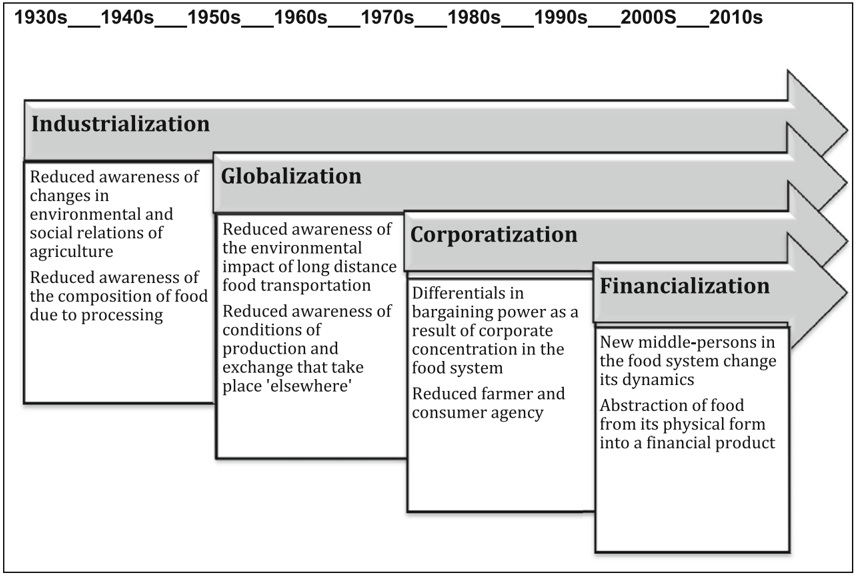
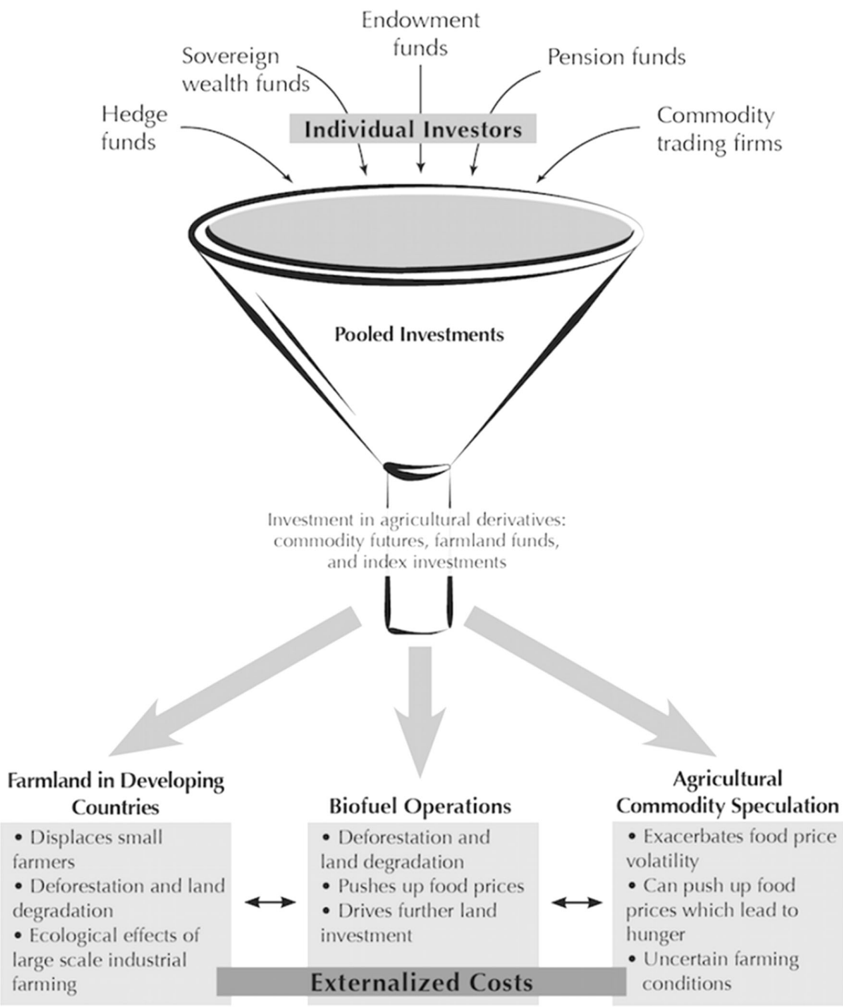
This paper examines the relationship between the development of the dominant industrial food system and its associated global economic drivers and the environmental sustainability of agricultural landscapes. It makes the case that the growth of the global industrial food system has encouraged increasingly complex forms of “distance” that separate food both geographically and mentally from the landscapes on which it was produced. This separation between food and its originating landscape poses challenges for the ability of more localized agricultural sustainability initiatives to address some of the broader problems in the global food system. In particular, distance enables certain powerful actors to externalize ecological and social costs, which in turn makes it difficult to link specific global actors to particular biophysical and social impacts felt on local agricultural landscapes. Feedback mechanisms that normally would provide pressure for improved agricultural sustainability are weak because there is a lack of clarity regarding responsibility for outcomes. The paper provides a brief illustration of these dynamics with a closer look at increased financialization in the food system. It shows that new forms of distancing are encouraged by the growing significance of financial markets in global agrifood value chains. This dynamic has a substantial impact on food system outcomes and ultimately complicates efforts to scale up small-scale local agricultural models that are more sustainable.
Overview
The claims and statistics of this paper haven’t been checked yet.
Free: it reads the open-access text and checks the first 5 claims that cite a source we can check. Create a free account to check every claim.
Integrity signals
Registry
Cites
Statistics
Figures

Verification
Claims the paper makes
The claims and statistics of this paper haven’t been checked yet.
Free: it reads the open-access text and checks the first 5 claims that cite a source we can check. Create a free account to check every claim.
Claims other papers make about this one
Each is checked against this paper’s own text: does it say what the citing paper says it does?
The check wasn’t confident either way, so it gives no verdict — never disputed.
In the citing paper
“This chilling effect is enhanced when HIC governments representing the interests of TFBCs (mainly the US and EU) have used WTO trade dispute mechanisms to challenge food regulations adopted by other countries 119,218 .”
From Ultra‐processed foods and the nutrition transition: global, regional and national trends, food systems transformations and political economy drivers (2020) · cites this paper as [218]
Experimental — accuracy not yet measured
Self-check
Percentages, sums and reported differences re-computed from the paper’s own numbers.
The self-check needs the paper’s full text.
Citations
Cites
The State of Food Insecurity in the World
WFP, W. (2015) · Cited by 2,947
Green Revolution: Impacts, limits, and the path ahead
Pingali, P. L. (2012) · Proceedings of the National Academy of Sciences · doi:10.1073/pnas.0912953109 · Cited by 2,442 · cited 1×
“The spread of industrial agricultural production methods under the Green Revolution, for example, sought to make food production more efficient by increasing output and addressing the problem of hunger and food shortages (Evenson and Gollin 2003; Pingali 2012).”
MethodClimate Change and Food Systems
Vermeulen, S. J., Campbell, B. M., & Ingram, J. S. I. (2012) · Annual Review of Environment and Resources · doi:10.1146/annurev-environ-020411-130608 · Cited by 2,423
Assessing the Impact of the Green Revolution, 1960 to 2000
Evenson, R. E., & Gollin, D. (2003) · Science · doi:10.1126/science.1078710 · Cited by 2,228 · cited 1×
“The spread of industrial agricultural production methods under the Green Revolution, for example, sought to make food production more efficient by increasing output and addressing the problem of hunger and food shortages (Evenson and Gollin 2003; Pingali 2012).”
MethodSustainable Intensification in Agriculture: Premises and Policies
Garnett, T., Appleby, M. C., Balmford, A., Bateman, I. J., Benton, T. G., Bloomer, P., Burlingame, B., Dawkins, M., Dolan, L., Fraser, D., et al. (2013) · Science · doi:10.1126/science.1234485 · Cited by 1,741 · cited 2×
“Corporations also have a say in how food is processed and stored, with rising levels of highly processed, packaged, and refrigerated foods marketed in the global food system, using increasing amounts of water and energy (Garnett 2013).”
BackgroundConceptualizing food systems for global environmental change research
Ericksen, P. J. (2008) · Global Environmental Change · doi:10.1016/j.gloenvcha.2007.09.002 · Cited by 1,486 · cited 2×
“Indeed, as Erikson notes in her articulation of a framework for analyzing food system–environment interactions (Ericksen 2008), there is a need to better understand the influence of external socioeconomic and environmental drivers that influence food systems, including their associated feedbacks (p.”
BackgroundAGRICULTURE AND THE STATE SYSTEM: The rise and decline of national agricultures, 1870 to the present
FRIEDMA, H., & McMICHAEL, P. (1989) · Sociologia Ruralis · doi:10.1111/j.1467-9523.1989.tb00360.x · Cited by 1,247 · cited 1×
“The industrial food system became increasingly globalized since the 1960s and 70s as integration within the world economy intensified (Friedmann and McMichael 1989).”
BackgroundMcMichael, P. (2009) · The Journal of Peasant Studies · doi:10.1080/03066150902820354 · Cited by 1,238
Food, livestock production, energy, climate change, and health
McMichael, A. J., Powles, J. W., Butler, C. D., & Uauy, R. (2007) · The Lancet · doi:10.1016/s0140-6736(07)61256-2 · Cited by 1,226 · cited 2×
“…an extensive literature emerge that highlights how these external economic drivers have been linked to a variety of ecological and social effects within food systems that have brought profound changes to agricultural landscapes (Weis 2007; McMichael et al. 2007; Sage 2011; Vermeulen et al. 2012).”
BackgroundRising global interest in farmland: can it yield sustainable and equitable benefits?
(2011) · Choice Reviews Online · doi:10.5860/choice.49-0396 · Cited by 1,204
Research works printed but not linked: 6
- Clapp J (2012) Food. Cambridge, Polity
- Daniel S, Mittal A (2011) The great land grab: rush for the world's farmland threatens food security for the poor. Oakland Institute, Oakland
- Fuchs N, Hoffmann U (2013) Ensuring food security and environ- mental resilience-the need for supportive agricultural trade rules. UNCTAD trade and environment review. UNCTAD, Geneva, pp 266-275
- Mintz S (1985) Sweetness and power: the place of sugar in world history. Viking, New York
- Princen T (2002) Distancing: consumption and the severing of feedback. In: Princen T, Maniates M, Conca K (eds) Confronting consumption. MIT Press, Cambridge
- Smith P (2013) Delivering food security without increasing pressure on land. Global Food Security 2(1):18-23 United Nations Conference on Trade and Development (2011) Price formation in financialized commodity markets: the role of information. http://www.unctad.org/en/docs/gds20111_en.pdf
Cited by
Baker, P., Machado, P., Santos, T., Sievert, K., Backholer, K., Hadjikakou, M., Russell, C., Huse, O., Bell, C., Scrinis, G., et al. (2020) · Obesity Reviews · doi:10.1111/obr.13126 · Cited by 1,194
The Global Food‐Energy‐Water Nexus
D'Odorico, P., Davis, K. F., Rosa, L., Carr, J. A., Chiarelli, D., Dell'Angelo, J., Gephart, J., MacDonald, G. K., Seekell, D. A., Suweis, S., et al. (2018) · Reviews of Geophysics · doi:10.1029/2017rg000591 · Cited by 796
“33 Clapp, 2015; Headey, 2008).”
BackgroundSustainable Agri-Food Systems: Environment, Economy, Society, and Policy
El Bilali, H., Strassner, C., & Ben Hassen, T. (2021) · Sustainability · doi:10.3390/su13116260 · Cited by 213
Rewiring food systems to enhance human health and biosphere stewardship
Gordon, L. J., Bignet, V., Crona, B., Henriksson, P. J. G., Van Holt, T., Jonell, M., Lindahl, T., Troell, M., Barthel, S., Deutsch, L., et al. (2017) · Environmental Research Letters · doi:10.1088/1748-9326/aa81dc · Cited by 180
Sustainable Food Systems: Building a New Paradigm
(2014) · Routledge eBooks · doi:10.4324/9780203083499 · Cited by 144
Metadata
- Authors
- Clapp, J.
- Venue
- Sustainability Science
- Published
- 2014-10-31
- Volume
- 10
- Issue
- 2
- Pages
- 305-316
- ISSN
- 1862-4057 (ISSN-L)
- 1862-4065
- OpenAlex
- W2129118005
- Cited by
- 113
- References
- 75
- Citations by year
- 2026: 2 · 2025: 4 · 2024: 8 · 2023: 7 · 2022: 6 · 2021: 24 · 2020: 15 · 2019: 13 · 2018: 14 · 2017: 7 · 2016: 9 · 2015: 3 · 2014: 1
- FWCI
- 24.55
- Type
- journal article
- Language
- en
- Open access
- hybrid
- doi.org
- Locations
- Sustainability Science (publishedVersion, cc-by)
- UWSpace (University of Waterloo) (submittedVersion, cc-by)
- Funders
- Pierre Elliott Trudeau Foundation
- Social Sciences and Humanities Research Council of Canada
- Topics
- Social Sciences › Development › Agriculture, Land Use, Rural Development
- Social Sciences › Business, Management and Accounting › Strategy and Management › Global trade, sustainability, and social impact
- Physical Sciences › Environmental Science › Ecology › Agriculture Sustainability and Environmental Impact
- Keywords
- industrial food system, agricultural landscapes, distance, food system sustainability, financialization, agri-food value chains, cost externalization, feedback mechanisms, scale-up, global food system
About these checks
Registry, retraction, Cites and statistics results are computed, not judged, with one exception: a printed reference that no index lists is read once by a model before it counts as a citation error. Claims are extracted by a model and kept only when their quote appears verbatim in the text; each cited source is then checked, with a model’s help, for whether it says what the claim relies on. Those verdicts can be wrong — read the claim’s quote and the cited source before relying on one.
Statistics and arithmetic are recomputed, not judged.
Confidence bands are shown only for fields calibrated on our annotated test set. None is calibrated yet, so no band is shown.
What counts as a claim ›How we measure confidence ›How we check this ›
Are you an author, or do you see a problem with this page? Request a review
How to cite
Cite CoChat for the checks on this page, and the paper for its own findings.
- This page
- CoChat. (2026). Citation check: Distant agricultural landscapes. https://app.cochat.ai/papers/10.1007/s11625-014-0278-0
- The paper
- Clapp, J. (2015). Distant agricultural landscapes. Sustainability Science. https://doi.org/10.1007/s11625-014-0278-0
Data sources
Bibliographic data: Semantic Scholar, OpenAlex, Crossref.
Contains information from the Semantic Scholar Academic Graph Datasets, made available under the ODC Attribution License (ODC-BY 1.0).
Semantic Scholar’s data is described in: Kinney, R., et al. (2023). The Semantic Scholar Open Data Platform. arXiv:2301.10140.
