

Neuronal correlates of personal space intrusion in violent offenders
Open accessThe DOI matches its Crossref record; 23 of the 23 references it cites were found in a registry or an index.
Abstract
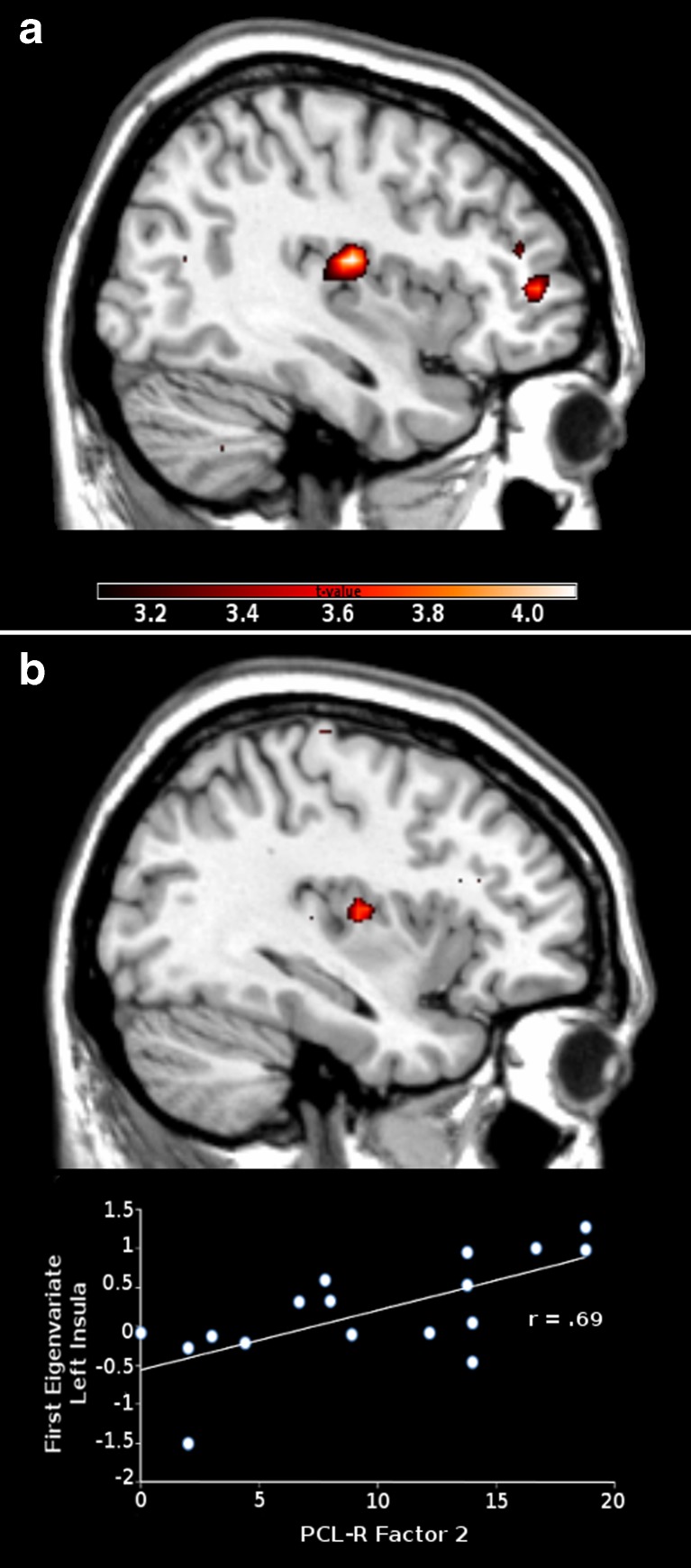
Personal space (PS) is defined as the imagery region immediately surrounding our body, which acts as safety zone. It has been suggested that PS is enlarged in violent offenders and that this group shows an enhanced sensitivity to the reduction of interpersonal distance. In the present fMRI study high-risk violent offenders and noncriminal controls were presented with photos of neutral facial expressions by men and women. All images were shown twice, as static photos, and animated (i.e., appearing to approach the subject) in order to simulate PS intrusion. Approaching faces generally provoked activation of a fronto-parietal network and the insula. Offenders responded with greater insula activation to approaching faces, especially when the person was male. Insular activation has been recognized before as a neuronal correlate of potential threat and harm detection in PS. The increased reactivity of violent offenders is possibly a result of their hostile attribution bias.
Overview
The claims and statistics of this paper haven’t been checked yet.
Free: it reads the open-access text and checks the first 5 claims that cite a source we can check. Create a free account to check every claim.
Integrity signals
Registry
Cites
Statistics
Figures
Verification
Claims the paper makes
The claims and statistics of this paper haven’t been checked yet.
Free: it reads the open-access text and checks the first 5 claims that cite a source we can check. Create a free account to check every claim.
Claims other papers make about this one
Each is checked against this paper’s own text: does it say what the citing paper says it does?
The source backs part of the claim, not all of it — or backs it for a different population, condition or comparison.
In the citing paper
“In this context, activation of AIC has also been observed during the perception of approaching emotionally salient stimuli such as hostile faces or avatars (Lloyd et al. 2006; Vieira et al. 2017; Schienle et al. 2017; de Borst and de Gelder 2022).”
From Neuroanatomical correlates of peripersonal space: bridging the gap between perception, action, emotion and social cognition (2024) · cites this paper as Schienle et al. 2017
Experimental — accuracy not yet measured
Self-check
Percentages, sums and reported differences re-computed from the paper’s own numbers.
The self-check needs the paper’s full text.
Citations
Cites
A new SPM toolbox for combining probabilistic cytoarchitectonic maps and functional imaging data
Eickhoff, S. B., Stephan, K. E., Mohlberg, H., Grefkes, C., Fink, G. R., Amunts, K., & Zilles, K. (2005) · NeuroImage · doi:10.1016/j.neuroimage.2004.12.034 · Cited by 4,033 · cited 2×
“For the present study we used ROIs from the automated anatomical labeling (AAL) template and from the Juelich histological atlas (Eickhoff et al. 2005).”
BackgroundMethodNeural systems supporting interoceptive awareness
Critchley, H. D., Wiens, S., Rotshtein, P., Öhman, A., & Dolan, R. J. (2004) · Nature Neuroscience · doi:10.1038/nn1176 · Cited by 3,406 · cited 2×
“Also, scores (M, SD) for Factor 1 (Offenders: 5.5 ± 3.4; Controls: 0.6 ± 0.7) and Factor 2 (Offenders: 9.7 ± 6.1; Controls: 1.1 ± 1.4) showed significant group differences (both p’s < .001).”
BackgroundInfluentialLeDoux, J. E. (2014) · Proceedings of the National Academy of Sciences · doi:10.1073/pnas.1400335111 · Cited by 891 · cited 2×
“…studies showed that seeing someone being touched (e.g. viewing one’s own face being touched) is able to elicit activation of the premotor cortex, which can be considered part of a system that monitors stimuli in the PS including those that could collide with the body (Cardini et al. 2010).”
BackgroundYang, Y., & Raine, A. (2009) · Psychiatry Research: Neuroimaging · doi:10.1016/j.pscychresns.2009.03.012 · Cited by 888 · cited 2×
“The bubble diameter (mm) was used as an indicator of PS size.”
BackgroundMethodStructured Clinical Interview for DSM-IV
(2007) · Encyclopedia of Measurement and Statistics · doi:10.4135/9781412952644.n443 · Cited by 718
The body schema and multisensory representation(s) of peripersonal space
Holmes, N. P., & Spence, C. (2004) · Cognitive Processing · doi:10.1007/s10339-004-0013-3 · Cited by 623 · cited 2×
“This region functions as a safety zone into which others may not intrude without causing discomfort (Holmes and Spence 2004).”
BackgroundPersonal space regulation by the human amygdala
Kennedy, D. P., Gläscher, J., Tyszka, J. M., & Adolphs, R. (2009) · Nature Neuroscience · doi:10.1038/nn.2381 · Cited by 450 · cited 8×
“Insula . fMRI”
BackgroundMethodResultInfluentialSKID. Strukturiertes Klinisches Interview für DSM-IV. Achse I und II. Handanweisung
Wïttchen, H., Zaudig, M., & Fydrich, T. (1997) · Max Planck Institute for Plasma Physics · Cited by 325
Hostile attributional bias in adults
Epps, J., & Kendall, P. C. (1995) · Cognitive Therapy and Research · doi:10.1007/bf02229692 · Cited by 205 · cited 2×
“Insula . fMRI”
BackgroundLloyd, D., Morrison, I., & Roberts, N. (2006) · Journal of Neurophysiology · doi:10.1152/jn.00614.2005 · Cited by 155 · cited 9×
“Insula . fMRI”
BackgroundMethodInfluential
Research works printed but not linked: 2
- Hare RD The hare pysychopathy checklist-revised 2003 2 Toronto, ON Multi-Health Systems
- Lundqvist D Flykt A Öhman A The Karolinska Directed Emotional Faces - KDEF, CD ROM Department Of Clinical Neuroscience 1998 Karolinska Institute Psychology section
Cited by
The Peripersonal Space in a social world
Bogdanova, O. V., Bogdanov, V. B., Dureux, A., Farnè, A., & Hadj-Bouziane, F. (2021) · Cortex · doi:10.1016/j.cortex.2021.05.005 · Cited by 86
“Approaching faces also induced activation of the insula (Schienle et al., 2017).”
BackgroundThe physiological correlates of interpersonal space
Candini, M., Battaglia, S., Benassi, M., di Pellegrino, G., & Frassinetti, F. (2021) · Scientific Reports · doi:10.1038/s41598-021-82223-2 · Cited by 73
Vieira, J. B., Pierzchajlo, S. R., & Mitchell, D. G. V. (2020) · Social Neuroscience · doi:10.1080/17470919.2019.1626763 · Cited by 54
de Borst, A. W., Sanchez-Vives, M. V., Slater, M., & de Gelder, B. (2020) · eNeuro · doi:10.1523/eneuro.0263-19.2019 · Cited by 53
Nikolic, M., Pezzoli, P., Jaworska, N., & Seto, M. C. (2022) · Progress in Neuro-Psychopharmacology and Biological Psychiatry · doi:10.1016/j.pnpbp.2022.110596 · Cited by 49
Effect of Gaze on Personal Space: A Japanese–German Cross-Cultural Study
Sicorello, M., Stevanov, J., Ashida, H., & Hecht, H. (2018) · Journal of Cross-Cultural Psychology · doi:10.1177/0022022118798513 · Cited by 36
Buck, R. W., Powers, S. R., & Hull, K. S. (2017) · Emotion · doi:10.1037/emo0000285 · Cited by 34
Vallet, W., Hone‐Blanchet, A., & Brunelin, J. (2019) · Psychological Medicine · doi:10.1017/s0033291719002216 · Cited by 31
Jeung-Maarse, H., Schmitgen, M. M., Schmitt, R., Bertsch, K., & Herpertz, S. C. (2023) · Neuropsychopharmacology · doi:10.1038/s41386-023-01549-9 · Cited by 33
“By contrast, threat and anger provocation did not relate to amygdala hyperresponsivity in other studies with violent offenders [8, 16, 17].”
ResultPsychopathy and the Regulation of Interpersonal Distance
Welsch, R., Hecht, H., & von Castell, C. (2018) · Clinical Psychological Science · doi:10.1177/2167702618788874 · Cited by 30
“Moreover, the activation of the amygdala may serve as an indicator of distress and perceived threat resulting from intrusion of personal space (Schienle et al., 2016) in tasks involving exocentric IPD judgments.”
BackgroundTrauma-related disorders and the bodily self: current perspectives and future directions
Laricchiuta, D., Garofalo, C., & Mazzeschi, C. (2023) · Frontiers in Psychology · doi:10.3389/fpsyg.2023.1166127 · Cited by 30
“Third, research suggests that violent offenders possess an enlarged perception of their PPS coupled with a hyper-sensitivity and an exaggerated neural response to perceptions of personal space invasion, a pattern that has been attributed to a tendency to hostile interpretation bias (Schienle et al., 2017) that is also…”
BackgroundDifferential amygdala activation during simulated personal space intrusion by men and women
Wabnegger, A., Leutgeb, V., & Schienle, A. (2016) · Neuroscience · doi:10.1016/j.neuroscience.2016.05.023 · Cited by 26
Self-citationBasile, G. A., Tatti, E., Bertino, S., Milardi, D., Genovese, G., Bruno, A., Muscatello, M. R. A., Ciurleo, R., Cerasa, A., Quartarone, A., et al. (2024) · Brain Structure and Function · doi:10.1007/s00429-024-02781-9 · Cited by 24
“In this context, activation of AIC has also been observed during the perception of approaching emotionally salient stimuli such as hostile faces or ava-tars (Lloyd et al. 2006; Vieira et al. 2017; Schienle et al. 2017; de Borst and de Gelder 2022).”
BackgroundVallet, W., Neige, C., Mouchet-Mages, S., Brunelin, J., & Grondin, S. (2021) · Neuroscience & Biobehavioral Reviews · doi:10.1016/j.neubiorev.2021.01.004 · Cited by 24
Neural Correlates of Interpersonal Space Permeability and Flexibility in Autism Spectrum Disorder
Massaccesi, C., Groessing, A., Rosenberger, L. A., Hartmann, H., Candini, M., di Pellegrino, G., Frassinetti, F., & Silani, G. (2021) · Cerebral Cortex · doi:10.1093/cercor/bhaa404 · Cited by 22
Spatiotemporal integration of looming visual and tactile stimuli near the face
Huang, R., Chen, C., & Sereno, M. I. (2018) · Human Brain Mapping · doi:10.1002/hbm.23995 · Cited by 17
Neural correlates of hostile attribution bias - A systematic review
Wagels, L., & Hernandez‐Pena, L. (2024) · Aggression and Violent Behavior · doi:10.1016/j.avb.2024.101975 · Cited by 17
Hidalgo, S., Castro, C., Zárate, R. V., Valderrama, B., Hodge, J. J. L., & Campusano, J. M. (2020) · Neurochemistry International · doi:10.1016/j.neuint.2020.104753 · Cited by 15
Huang, X., & Izumi, S. (2021) · Brain Sciences · doi:10.3390/brainsci11081015 · Cited by 14
“) (2017) [46] 17 violent offenders18 nondelinquent controls 34.”
BackgroundInfluentialBrain Anatomy in Boys with Conduct Disorder: Differences Among Aggression Subtypes
Jiang, Y., Gao, Y., Dong, D., Sun, X., Situ, W., & Yao, S. (2022) · Child Psychiatry & Human Development · doi:10.1007/s10578-022-01360-5 · Cited by 13
Yevdokimova, O. O., Okhrimenko, I. M., Філоненко, В. М., Шиліна, А. А., Ponomarenko, Y., Okhrimenko, S. S., & Aleksandrov, D. (2020) · Postmodern Openings · doi:10.18662/po/11.2sup1/186 · Cited by 12
“Concerning criminal behavior, some researchers point out that the psychological specificity of such behavior and unlawful actions in a number of cases should be combined not only with characteristic features but also with aggressive behavior (Burt, & Donnellan, 2008; Hornsveld et al., 2018; Jolliffe & Farrington, 2018…”
BackgroundLópez-Chao, V., & Adrián, V. (2016) · LA Referencia (Red Federada de Repositorios Institucionales de Publicaciones Científicas) · Cited by 18
Using physiological biomarkers in forensic psychiatry: a scoping review
Mens, J., Masthoff, E., Bogaerts, S., & Heus, P. (2025) · Frontiers in Psychiatry · doi:10.3389/fpsyt.2025.1580615 · Cited by 5
Huang, X., Izumi, S., & Suzukamo, Y. (2022) · Frontiers in Behavioral Neuroscience · doi:10.3389/fnbeh.2022.969440 · Cited by 4
“Moreover, other studies have shown an enhanced DLPFC in facial approach-approached stimuli (Schienle et al., 2017).”
ResultNikolic, M., Pezzoli, P., Jaworska, N., & Seto, M. C. (2022) · bioRxiv (Cold Spring Harbor Laboratory) · doi:10.1101/2022.01.11.475895 · Cited by 4
“Half reported ethnicity, with ∼70% of participants being Caucasian (17,18,45,47), while one included only Asian participants (44).”
BackgroundInfluentialI fear you’re getting too close: neural correlates of personal space violation in paranoia
Derome, M., Conring, F., Gangl, N., Hatzipanayioti, A., Wüthrich, F., Rüter, M., Lefebvre, S., Walther, S., & Stegmayer, K. (2025) · Schizophrenia · doi:10.1038/s41537-025-00625-x · Cited by 3
“The event-related previously validated experiment 33 consisted of two 10-minutes runs during which participants watched passively videos of faces in three different types of motion: approach, retreat, and static.”
Pazhoohi, F., Choi, G., & Kingstone, A. F. (2021) · Australian Journal of Psychology · doi:10.1080/00049530.2021.1882272 · Cited by 2
“…and aggression as previous research has shown that the space that individuals prefer to put between themselves and others changes with their anxiety (Iachini et al., 2015; De Vignemont & Iannetti, 2015) and aggressive traits (Curran et al., 1978; Schienle et al., 2017; Walkey & Gilmour, 1984).”
BackgroundTemporal dynamics of frontoparietal processing during personal space intrusion
Xiang, S., Zou, X., Luo, C., & Liu, N. (2026) · iScience · doi:10.1016/j.isci.2026.116829 · Cited by 1
“,18,19 These regions respond preferentially to approaching faces versus withdrawing faces, with no such bias observed for non-face objects, highlighting their roles in PS processing.”
Nonverbal Receiving Ability as Emotional and Cognitive Empathy: Conceptualization and Measurement
Buck, R. W., Graham, B., Allred, R., & Hancock, R. (2020) · Springer eBooks · doi:10.1007/978-3-030-34964-6_2 · Cited by 3
Empathic Communication Among Women with High or Low Social Anxiety
Byrne, S. E., & Rapee, R. M. (2021) · Cognitive Therapy and Research · doi:10.1007/s10608-021-10248-y · Cited by 1
An Empirical Study on Personal Space of College Students
章, 益. (2018) · Advances in Psychology · doi:10.12677/ap.2018.89164
Vallet, W., Neige, C., Mouchet-Mages, S., Brunelin, J., & Grondin, S. (2020) · PsyArXiv (OSF Preprints) · doi:10.31234/osf.io/9hc8n
Maier, A. (2023) · Dokumentenrepositorium der RUB (Ruhr University Bochum) · doi:10.13154/294-9602
Meta-analyysi antisosiaalisuuden hermostollisesta perustasta
Harju, H. (2023) · UTUPub (University of Turku)
The peripersonal space : a space to inter-act
Patané, I. (2018) · theses.fr (ABES) · doi:10.70675/65489b37z5297z4a85z96cczc535ef9ca767 · Cited by 1
Penavayre, M. (2020) · theses.fr (ABES) · doi:10.70675/7e1e3b29z1fa3z4af8zaeeaz545abbdbcff8 · Cited by 1
Dimension sociale de l’espace péri-personnel des primates
Dureux, A. (2021) · theses.fr (ABES) · doi:10.70675/624f12eaz695fz4433zbd0aza56128110325
OPRIȘ, L., & Visu‐Petra, L. (2026) · Studia Universitatis Babeș-Bolyai Psychologia-Paedagogia · doi:10.24193/subbpsyped.2026.1.01
“Previously, Schönenberg & Jusyte (2014) illustrated that offenders with antisocial traits often misinterpret ambiguous facial expressions as threat detection systems.”
Metadata
- Authors
- Schienle, A., Wabnegger, A., Leitner, M., & Leutgeb, V.
- Affiliations
- University of Graz (AT)
- Corresponding author
- Schienle, Anne
- Venue
- Brain Imaging and Behavior
- Published
- 2016-03-02
- Volume
- 11
- Issue
- 2
- Pages
- 454-460
- ISSN
- 1931-7557 (ISSN-L)
- 1931-7565
- PMC
- PMC5408037
- OpenAlex
- W2288398756
- Cited by
- 34
- References
- 23
- Citations by year
- 2026: 1 · 2025: 2 · 2024: 2 · 2023: 2 · 2022: 4 · 2021: 7 · 2020: 7 · 2019: 2 · 2018: 5 · 2017: 1 · 2016: 1
- FWCI
- 4.02
- Type
- journal article
- Language
- en
- Open access
- hybrid
- doi.org
- Locations
- Brain Imaging and Behavior (publishedVersion, cc-by)
- PubMed Central (publishedVersion, cc-by)
- PubMed (publishedVersion)
- Funders
- no funding
- Topics
- Social Sciences › Psychology › Clinical Psychology › Psychopathy, Forensic Psychiatry, Sexual Offending
- Life Sciences › Neuroscience › Cognitive Neuroscience › Face Recognition and Perception
- Social Sciences › Psychology › Social Psychology › Deception detection and forensic psychology
- Keywords
- personal space, violent offenders, interpersonal distance, threat detection, insula, frontoparietal network, hostile attribution bias, facial expressions, threat sensitivity
- MeSH terms
- Adult, Aggression, Cerebral Cortex, Facial Expression, Hostility, Humans, Male, Nerve Net, Personal Space, Social Perception, Space Perception, Violence, Visual Perception, Criminals
About these checks
Registry, retraction, Cites and statistics results are computed, not judged, with one exception: a printed reference that no index lists is read once by a model before it counts as a citation error. Claims are extracted by a model and kept only when their quote appears verbatim in the text; each cited source is then checked, with a model’s help, for whether it says what the claim relies on. Those verdicts can be wrong — read the claim’s quote and the cited source before relying on one.
Statistics and arithmetic are recomputed, not judged.
Confidence bands are shown only for fields calibrated on our annotated test set. None is calibrated yet, so no band is shown.
What counts as a claim ›How we measure confidence ›How we check this ›
Are you an author, or do you see a problem with this page? Request a review
Data sources
Bibliographic data: Semantic Scholar, OpenAlex, Crossref.
Contains information from the Semantic Scholar Academic Graph Datasets, made available under the ODC Attribution License (ODC-BY 1.0).
Semantic Scholar’s data is described in: Kinney, R., et al. (2023). The Semantic Scholar Open Data Platform. arXiv:2301.10140.
