

Neuronal correlates of personal space intrusion in violent offenders
Open accessThe DOI matches its Crossref record; 23 of the 23 references it cites were found in a registry or an index.
Abstract
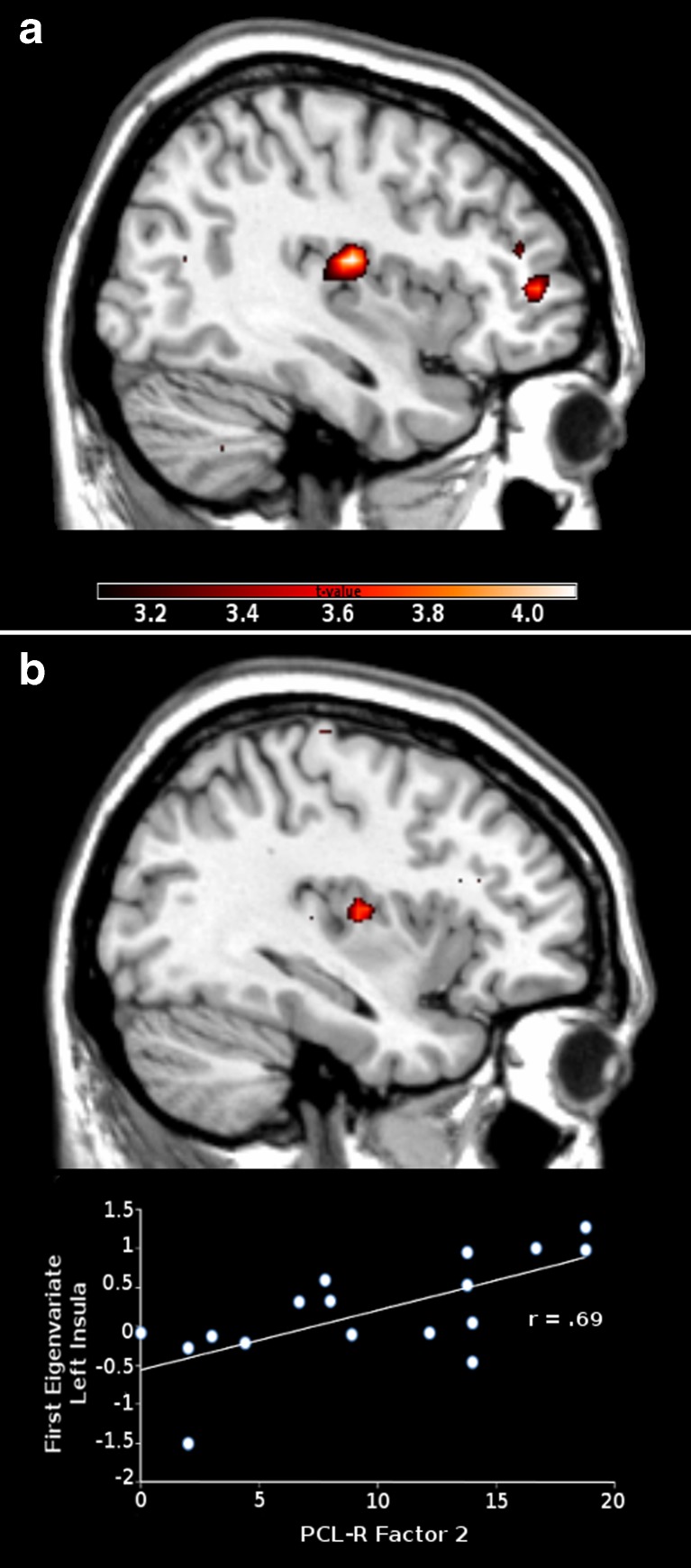
Personal space (PS) is defined as the imagery region immediately surrounding our body, which acts as safety zone. It has been suggested that PS is enlarged in violent offenders and that this group shows an enhanced sensitivity to the reduction of interpersonal distance. In the present fMRI study high-risk violent offenders and noncriminal controls were presented with photos of neutral facial expressions by men and women. All images were shown twice, as static photos, and animated (i.e., appearing to approach the subject) in order to simulate PS intrusion. Approaching faces generally provoked activation of a fronto-parietal network and the insula. Offenders responded with greater insula activation to approaching faces, especially when the person was male. Insular activation has been recognized before as a neuronal correlate of potential threat and harm detection in PS. The increased reactivity of violent offenders is possibly a result of their hostile attribution bias.
Overview
The claims and statistics of this paper haven’t been checked yet.
Free: it reads the open-access text and checks the first 5 claims that cite a source we can check. Create a free account to check every claim.
Integrity signals
Registry
Cites
Statistics
Figures
Verification
Claims the paper makes
The claims and statistics of this paper haven’t been checked yet.
Free: it reads the open-access text and checks the first 5 claims that cite a source we can check. Create a free account to check every claim.
Claims other papers make about this one
Each is checked against this paper’s own text: does it say what the citing paper says it does?
The source backs part of the claim, not all of it — or backs it for a different population, condition or comparison.
In the citing paper
“In this context, activation of AIC has also been observed during the perception of approaching emotionally salient stimuli such as hostile faces or avatars (Lloyd et al. 2006; Vieira et al. 2017; Schienle et al. 2017; de Borst and de Gelder 2022).”
From Neuroanatomical correlates of peripersonal space: bridging the gap between perception, action, emotion and social cognition (2024) · cites this paper as Schienle et al. 2017
Experimental — accuracy not yet measured
Self-check
Percentages, sums and reported differences re-computed from the paper’s own numbers.
The self-check needs the paper’s full text.
Citations
Cites
A new SPM toolbox for combining probabilistic cytoarchitectonic maps and functional imaging data
Eickhoff, S. B., Stephan, K. E., Mohlberg, H., Grefkes, C., Fink, G. R., Amunts, K., & Zilles, K. (2005) · NeuroImage · doi:10.1016/j.neuroimage.2004.12.034 · Cited by 4,033 · cited 2×
“For the present study we used ROIs from the automated anatomical labeling (AAL) template and from the Juelich histological atlas (Eickhoff et al. 2005).”
BackgroundMethodNeural systems supporting interoceptive awareness
Critchley, H. D., Wiens, S., Rotshtein, P., Öhman, A., & Dolan, R. J. (2004) · Nature Neuroscience · doi:10.1038/nn1176 · Cited by 3,406 · cited 2×
“Also, scores (M, SD) for Factor 1 (Offenders: 5.5 ± 3.4; Controls: 0.6 ± 0.7) and Factor 2 (Offenders: 9.7 ± 6.1; Controls: 1.1 ± 1.4) showed significant group differences (both p’s < .001).”
BackgroundInfluentialLeDoux, J. E. (2014) · Proceedings of the National Academy of Sciences · doi:10.1073/pnas.1400335111 · Cited by 891 · cited 2×
“…studies showed that seeing someone being touched (e.g. viewing one’s own face being touched) is able to elicit activation of the premotor cortex, which can be considered part of a system that monitors stimuli in the PS including those that could collide with the body (Cardini et al. 2010).”
BackgroundYang, Y., & Raine, A. (2009) · Psychiatry Research: Neuroimaging · doi:10.1016/j.pscychresns.2009.03.012 · Cited by 888 · cited 2×
“The bubble diameter (mm) was used as an indicator of PS size.”
BackgroundMethodStructured Clinical Interview for DSM-IV
(2007) · Encyclopedia of Measurement and Statistics · doi:10.4135/9781412952644.n443 · Cited by 718
The body schema and multisensory representation(s) of peripersonal space
Holmes, N. P., & Spence, C. (2004) · Cognitive Processing · doi:10.1007/s10339-004-0013-3 · Cited by 623 · cited 2×
“This region functions as a safety zone into which others may not intrude without causing discomfort (Holmes and Spence 2004).”
BackgroundPersonal space regulation by the human amygdala
Kennedy, D. P., Gläscher, J., Tyszka, J. M., & Adolphs, R. (2009) · Nature Neuroscience · doi:10.1038/nn.2381 · Cited by 450 · cited 8×
“Insula . fMRI”
BackgroundMethodResultInfluentialSKID. Strukturiertes Klinisches Interview für DSM-IV. Achse I und II. Handanweisung
Wïttchen, H., Zaudig, M., & Fydrich, T. (1997) · Max Planck Institute for Plasma Physics · Cited by 325
Hostile attributional bias in adults
Epps, J., & Kendall, P. C. (1995) · Cognitive Therapy and Research · doi:10.1007/bf02229692 · Cited by 205 · cited 2×
“Insula . fMRI”
BackgroundLloyd, D., Morrison, I., & Roberts, N. (2006) · Journal of Neurophysiology · doi:10.1152/jn.00614.2005 · Cited by 155 · cited 9×
“Insula . fMRI”
BackgroundMethodInfluentialBrozzoli, C., Ehrsson, H. H., & Farnè, A. (2014) · The Neuroscientist · doi:10.1177/1073858413511153 · Cited by 125 · cited 4×
“The frontal area consisted of the premotor cortex, a key region for PS representation (e.g., Brozzoli et al. 2014).”
BackgroundResultInfluentialNeural correlates of personal space intrusion
Holt, D. J., Cassidy, B. S., Yue, X., Rauch, S. L., Boeke, E. A., Nasr, S., Tootell, R. B. H., & Coombs, G. (2014) · The Journal of Neuroscience · doi:10.1523/jneurosci.0686-13.2014 · Cited by 114 · cited 11×
“Insula . fMRI”
BackgroundMethodResultInfluentialAdult attachment style and interpersonal distance
Kaitz, M., Bar-Haim, Y., Lehrer, M., & Grossman, E. (2004) · Attachment & Human Development · doi:10.1080/14616730412331281520 · Cited by 114 · cited 2×
“Therefore, a more ecologically valid PS assessment, such as the ‘Stop Distance Task’ might be helpful (Kaitz et al. 2004).”
BackgroundViewing one’s own face being touched modulates tactile perception: An fMRI study
Cardini, F., Costantini, M., Galati, G., Romani, G. L., Làdavas, E., & Serino, A. (2011) · Journal of Cognitive Neuroscience · doi:10.1162/jocn.2010.21484 · Cited by 92
The influence of perceived prison crowding on male inmates' perception of aggressive events
Lawrence, C., & Andrews, K. (2004) · Aggressive Behavior · doi:10.1002/ab.20024 · Cited by 92 · cited 2×
“They prefer a greater interpersonal distance during social interactions (e.g., McGurk et al. 1981; Curran et al. 1978; Gilmour and Walkey 1981; Lawrence and Andrews 2004).”
BackgroundLeutgeb, V., Leitner, M., Wabnegger, A., Klug, D., Scharmüller, W., Zussner, T., & Schienle, A. (2015) · Neuroscience · doi:10.1016/j.neuroscience.2015.09.011 · Cited by 73 · cited 2×
“In line with this conception, previous MRI investigations have shown that Factor 2 is associated with reactive anger, criminality, and impulsive violence (e.g., Leutgeb et al. 2015).”
BackgroundResultSelf-citationSchienle, A., Wabnegger, A., Schöngassner, F., & Leutgeb, V. (2015) · Social Cognitive and Affective Neuroscience · doi:10.1093/scan/nsv034 · Cited by 49 · cited 11×
“Insula . fMRI”
BackgroundMethodResultInfluentialSelf-citationCurran, S. F., Blatchley, R. J., & Hanlon, T. E. (1978) · Correctional Psychologist · doi:10.1177/009385487800500104 · Cited by 24 · cited 2×
“They prefer a greater interpersonal distance during social interactions (e.g., McGurk et al. 1981; Curran et al. 1978; Gilmour and Walkey 1981; Lawrence and Andrews 2004).”
BackgroundThe Role of Anterior Insula and Anterior Cingulate in Empathy for Pain
Valentini, E. (2010) · Journal of Neurophysiology · doi:10.1152/jn.00487.2010 · Cited by 23 · cited 1×
“Valentini (2010) suggested that insular activation is a general neuronal correlate of potential threat and harm detection in PS.”
BackgroundClose to You: Embodied Simulation for Peripersonal Space in Primary Somatosensory Cortex
Schaefer, M., Heinze, H.-J., & Rotte, M. (2012) · PLoS ONE · doi:10.1371/journal.pone.0042308 · Cited by 20 · cited 3×
“Likewise, Lloyd et al. (2006) demonstrated increased insula activity in response to observing a painful versus nonpainful stimulus without any tactile input.”
BackgroundIdentifying violent offenders using a video measure of interpersonal distance.
Gilmour, D. R., & Walkey, F. H. (1981) · Journal of Consulting and Clinical Psychology · doi:10.1037/0022-006x.49.2.287 · Cited by 12 · cited 2×
“They prefer a greater interpersonal distance during social interactions (e.g., McGurk et al. 1981; Curran et al. 1978; Gilmour and Walkey 1981; Lawrence and Andrews 2004).”
BackgroundAssaultive behavior personality and personal space
McGurk, B. J., Davis, J. D., & Grehan, J. (1981) · Aggressive Behavior · doi:10.1002/1098-2337(1981)7:4<317::aid-ab2480070402>3.0.co;2-g · Cited by 10 · cited 2×
“They prefer a greater interpersonal distance during social interactions (e.g., McGurk et al. 1981; Curran et al. 1978; Gilmour and Walkey 1981; Lawrence and Andrews 2004).”
BackgroundPersonal Space Variations as a Function of Criminal Behavior
Booraem, C. D., Bodner, G. E., Flowers, J. V., & Satterfield, D. A. (1977) · Psychological Reports · doi:10.2466/pr0.1977.41.3f.1115 · Cited by 6 · cited 2×
“Insula . fMRI”
Background
Research works printed but not linked: 2
- Hare RD The hare pysychopathy checklist-revised 2003 2 Toronto, ON Multi-Health Systems
- Lundqvist D Flykt A Öhman A The Karolinska Directed Emotional Faces - KDEF, CD ROM Department Of Clinical Neuroscience 1998 Karolinska Institute Psychology section
Cited by
The Peripersonal Space in a social world
Bogdanova, O. V., Bogdanov, V. B., Dureux, A., Farnè, A., & Hadj-Bouziane, F. (2021) · Cortex · doi:10.1016/j.cortex.2021.05.005 · Cited by 86
“Approaching faces also induced activation of the insula (Schienle et al., 2017).”
BackgroundThe physiological correlates of interpersonal space
Candini, M., Battaglia, S., Benassi, M., di Pellegrino, G., & Frassinetti, F. (2021) · Scientific Reports · doi:10.1038/s41598-021-82223-2 · Cited by 73
Vieira, J. B., Pierzchajlo, S. R., & Mitchell, D. G. V. (2020) · Social Neuroscience · doi:10.1080/17470919.2019.1626763 · Cited by 54
de Borst, A. W., Sanchez-Vives, M. V., Slater, M., & de Gelder, B. (2020) · eNeuro · doi:10.1523/eneuro.0263-19.2019 · Cited by 53
Nikolic, M., Pezzoli, P., Jaworska, N., & Seto, M. C. (2022) · Progress in Neuro-Psychopharmacology and Biological Psychiatry · doi:10.1016/j.pnpbp.2022.110596 · Cited by 49
Metadata
- Authors
- Schienle, A., Wabnegger, A., Leitner, M., & Leutgeb, V.
- Affiliations
- University of Graz (AT)
- Corresponding author
- Schienle, Anne
- Venue
- Brain Imaging and Behavior
- Published
- 2016-03-02
- Volume
- 11
- Issue
- 2
- Pages
- 454-460
- ISSN
- 1931-7557 (ISSN-L)
- 1931-7565
- PMC
- PMC5408037
- OpenAlex
- W2288398756
- Cited by
- 34
- References
- 23
- Citations by year
- 2026: 1 · 2025: 2 · 2024: 2 · 2023: 2 · 2022: 4 · 2021: 7 · 2020: 7 · 2019: 2 · 2018: 5 · 2017: 1 · 2016: 1
- FWCI
- 4.02
- Type
- journal article
- Language
- en
- Open access
- hybrid
- doi.org
- Locations
- Brain Imaging and Behavior (publishedVersion, cc-by)
- PubMed Central (publishedVersion, cc-by)
- PubMed (publishedVersion)
- Funders
- no funding
- Topics
- Social Sciences › Psychology › Clinical Psychology › Psychopathy, Forensic Psychiatry, Sexual Offending
- Life Sciences › Neuroscience › Cognitive Neuroscience › Face Recognition and Perception
- Social Sciences › Psychology › Social Psychology › Deception detection and forensic psychology
- Keywords
- personal space, violent offenders, interpersonal distance, threat detection, insula, frontoparietal network, hostile attribution bias, facial expressions, threat sensitivity
- MeSH terms
- Adult, Aggression, Cerebral Cortex, Facial Expression, Hostility, Humans, Male, Nerve Net, Personal Space, Social Perception, Space Perception, Violence, Visual Perception, Criminals
About these checks
Registry, retraction, Cites and statistics results are computed, not judged, with one exception: a printed reference that no index lists is read once by a model before it counts as a citation error. Claims are extracted by a model and kept only when their quote appears verbatim in the text; each cited source is then checked, with a model’s help, for whether it says what the claim relies on. Those verdicts can be wrong — read the claim’s quote and the cited source before relying on one.
Statistics and arithmetic are recomputed, not judged.
Confidence bands are shown only for fields calibrated on our annotated test set. None is calibrated yet, so no band is shown.
What counts as a claim ›How we measure confidence ›How we check this ›
Are you an author, or do you see a problem with this page? Request a review
Data sources
Bibliographic data: Semantic Scholar, OpenAlex, Crossref.
Contains information from the Semantic Scholar Academic Graph Datasets, made available under the ODC Attribution License (ODC-BY 1.0).
Semantic Scholar’s data is described in: Kinney, R., et al. (2023). The Semantic Scholar Open Data Platform. arXiv:2301.10140.
