

Exercise Following Bariatric Surgery: Systematic Review
Open accessThe DOI matches its Crossref record; 33 of the 33 references it cites were found in a registry or an index.
Abstract
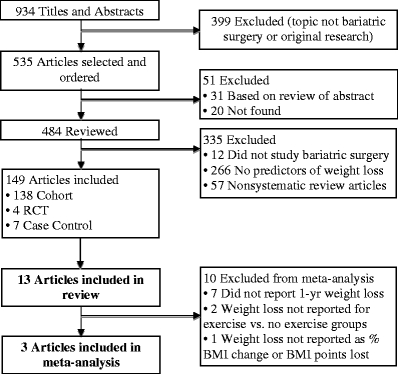
The contribution of physical activity on the degree of weight loss following bariatric surgery is unclear. To determine impact of exercise on postoperative weight loss. Medline search (1988-2009) was completed using MeSH terms including bariatric procedures and a spectrum of patient factors with potential relationship to weight loss outcomes. Of the 934 screened articles, 14 reported on exercise and weight loss outcomes. The most commonly used instruments to measure activity level were the Baecke Physical Activity Questionnaire, the International Physical Activity Questionnaire, and a variety of self-made questionnaires. The definition of an active patient varied but generally required a minimum of 30 min of exercise at least 3 days per week. Thirteen articles reported on exercise and degree of postoperative weight loss (n = 4,108 patients). Eleven articles found a positive association of exercise on postoperative weight loss, and two did not. Meta-analysis of three studies revealed a significant increase in 1-year postoperative weight loss (mean difference = 4.2% total body mass index (BMI) loss, 95% confidence interval (CI; 0.26-8.11)) for patients who exercise postoperatively. Exercise following bariatric surgery appears to be associated with a greater weight loss of over 4% of BMI. While a causal relationship cannot be established with observational data, this finding supports the continued efforts to encourage and support patients' involvement in post-surgery exercise. Further research is necessary to determine the recommended activity guidelines for this patient population.
Overview
The claims and statistics of this paper haven’t been checked yet.
Free: it reads the open-access text and checks the first 5 claims that cite a source we can check. Create a free account to check every claim.
Integrity signals
Registry
Cites
Statistics
Figures

Verification
Claims the paper makes
The claims and statistics of this paper haven’t been checked yet.
Free: it reads the open-access text and checks the first 5 claims that cite a source we can check. Create a free account to check every claim.
Claims other papers make about this one
Each is checked against this paper’s own text: does it say what the citing paper says it does?
In the citing paper
“Physical activity (PA) is associated with weight loss after BS [57, 58].”
Self-check
Percentages, sums and reported differences re-computed from the paper’s own numbers.
The self-check needs the paper’s full text.
Citations
Cites
International physical activity questionnaire: 12-country reliability and validity
CRAIG, C. L., MARSHALL, A. L., SJ??STR??M, M., BAUMAN, A. E., BOOTH, M. L., AINSWORTH, B. E., PRATT, M., EKELUND, U., YNGVE, A., SALLIS, J. F., et al. (2003) · Medicine & Science in Sports & Exercise · doi:10.1249/01.mss.0000078924.61453.fb · Cited by 21,619 · cited 2×
“This self-administered survey assesses walking and moderate or vigorous activities in everyday life, as measured for the past 7 days [26].”
Method(2007) · Circulation · doi:10.1161/circulationaha.107.185649 · Cited by 6,545 · cited 1×
“It also closely parallels the American Heart Association / American College of Sports Medicine guidelines on physical activity, which include 30 minutes of moderate-intensity aerobic activity on five days each week or 20 minutes of vigorousintensity activity for three days each week [31].”
BackgroundA short questionnaire for the measurement of habitual physical activity in epidemiological studies
Baecke, J., Burema, J., & Frijters, J. (1982) · The American Journal of Clinical Nutrition · doi:10.1093/ajcn/36.5.936 · Cited by 3,945 · cited 1×
“It has a total of 16 questions classified into three domains: work, sports, and non-sports leisure activity [24].”
BackgroundRoss, R., Dagnone, D., Jones, P. J. H., Smith, H., Paddags, A., Hudson, R., & Janssen, I. (2000) · Annals of Internal Medicine · doi:10.7326/0003-4819-133-2-200007180-00008 · Cited by 1,435
Dixon, J. B., O’Brien, P. E., Playfair, J., Chapman, L., Schachter, L. M., Skinner, S., Proietto, J., Bailey, M., & Anderson, M. (2008) · JAMA · doi:10.1001/jama.299.3.316 · Cited by 1,434 · cited 4×
“All studies have patient samples with a majority of female patients except Dixon et al [12], and baseline BMI in the 37 to 58 kg/m(2) range (Table 1).”
BackgroundInfluentialWei, M. (1999) · JAMA · doi:10.1001/jama.282.16.1547 · Cited by 1,168 · cited 1×
“Exercise also improves cardiopulmonary fitness, which may reduce mortality from cardiovascular disease [3].”
BackgroundDoes physical activity prevent weight gain – a systematic review
Fogelholm, M., & Kukkonen‐Harjula, K. (2000) · Obesity Reviews · doi:10.1046/j.1467-789x.2000.00016.x · Cited by 598 · cited 1×
“Long-term maintenance of physical activity (contributing to energy expenditure of 1,500 to 2,000 kilocalories (kcal) per week) has been found to decrease weight gain [7].”
BackgroundEXERCISE IN WEIGHT MANAGEMENT OF OBESITY
Poirier, P., & Després, J.-P. (2001) · Cardiology Clinics · doi:10.1016/s0733-8651(05)70229-0 · Cited by 272 · cited 1×
“walking) for 3 to 5 days per week has also been reported [30].”
BackgroundTreatment Modalities of Obesity
Hainer, V., Toplak, H., & Mitrakou, A. (2008) · Diabetes Care · doi:10.2337/dc08-s265 · Cited by 231
Chevallier, J.-M., Paita, M., Rodde-Dunet, M.-H., Marty, M., Nogues, F., Slim, K., & Basdevant, A. (2007) · Annals of Surgery · doi:10.1097/sla.0b013e31813e8a56 · Cited by 195 · cited 2×
“Three of the studies are prospective cohorts, two of which compare a group of active patients versus a group of inactive patients after bariatric surgery [13, 15].”
Background
Research works printed but not linked: 1
- Review Manager (RevMan) [Computer program]. Version 5.0. Copenhagen: The Nordic Cochrane Centre TCC2.
Cited by
Items 101–196 of 196
The Need for Objective Physical Activity Measurements in Routine Bariatric Care
Kuipers, E. A. M., Timmerman, J. G., van Det, M. J., & Vollenbroek-Hutten, M. M. R. (2022) · Obesity Surgery · doi:10.1007/s11695-022-06165-y · Cited by 11
“1 3 So far, most studies in the bariatric population used selfreported measures (questionnaires) to capture PA [1].”
BackgroundEffectiveness of a Functional Rehabilitation Program After Bariatric Surgery: a Pilot Study
Morana, C., Collignon, M., & Nocca, D. (2018) · Obesity Surgery · doi:10.1007/s11695-018-3154-7 · Cited by 14
Moore, D. D., Arterburn, D. E., Bai, Y. Z., Cornejo, M., Crawford, C. L., Drewnowski, A., Gray, M. F., Ji, M., Lewis, K. H., Paz, S. R., et al. (2020) · Obesity Surgery · doi:10.1007/s11695-020-05045-7 · Cited by 8
Burgess, L. C., Immins, T., & Wainwright, T. W. (2018) · European Journal of Physiotherapy · doi:10.1080/21679169.2018.1468813 · Cited by 11
“[39,40], weight loss and diet interventions [36], stretching”
BackgroundArtero, E. G., Ferrer-Márquez, M., Torrente‐Sánchez, M. J., Martínez‐Rosales, E., Carretero‐Ruiz, A., Hernández‐Martínez, A., López-Sánchez, L., Esteban‐Simón, A., del Rey, A. R., Alcaraz‐Ibáñez, M., et al. (2021) · Obesity Surgery · doi:10.1007/s11695-021-05559-8 · Cited by 11
Nijland, L. M. G., Reiber, B. M. M., Monpellier, V. M., Jacobs, A., Hazebroek, E. J., van Veen, R. N., Demirkiran, A., & de Castro, S. M. M. (2022) · Surgery for Obesity and Related Diseases · doi:10.1016/j.soard.2022.02.011 · Cited by 10
Weight Regain and Insufficient Weight Loss after Bariatric Surgery: A Call for Action
Elhag, W., & Ansari, W. E. (2021) · IntechOpen eBooks · doi:10.5772/intechopen.94848 · Cited by 10
“The represents a risk factor for WR Sedentary behavior is associated with increased risk of obesity and related comorbidities [40].”
BackgroundInfluentialQualidade de vida entre obesos mórbidos e pacientes submetidos à cirurgia bariátrica
Barros, L. M., Moreira, R. A. N., Frota, N. M., de Araújo, T. M., & Caetano, J. Á. (2015) · Revista Eletrônica de Enfermagem · doi:10.5216/ree.v17i2.27367 · Cited by 27
Coleman, K. J., Schlundt, D. G., Bonnet, K. R., Holmquist, K. J., Dunne, J., Crull, E., Hanaoka, B. Y., Lent, M. R., Nadglowski, J. F., Sylvia, L. G., et al. (2020) · Obesity Surgery · doi:10.1007/s11695-020-04404-8 · Cited by 11
Rios, I. N. M. S., Lamarca, F., Vieira, F. T., Braz-de-Melo, H. A., Magalhães, K. G., de Carvalho, K. M. B., & Pizato, N. (2021) · Obesity Surgery · doi:10.1007/s11695-021-05494-8 · Cited by 10
“Two studies conducted meta-analysis and showed that weight loss was greater in patients who underwent BS and exercised as compared to those who did not exercised [53, 54].”
ResultAlsehemi, N. H., Alharbi, A. A., Alamri, R. S., Fatani, B., AlYami, S. H., Elbarazi, I., & Aldhwayan, M. (2023) · Obesity Surgery · doi:10.1007/s11695-023-06480-y · Cited by 7
“This finding was similar to a meta-analysis that included 14 studies and 19 reviews; physical activity was associated with higher weight loss post-MBS [40].”
ResultSobhani, Z., Amini, M., Zarnaghash, M., Hosseini, S. V., & Foroutan, R. (2019) · WORLD JOURNAL OF PLASTIC SURGERY · doi:10.29252/wjps.8.1.85 · Cited by 9
Coleman, K. J., Paz, S. R., Bhakta, B. B., Taylor, B., Liu, J., Yoon, T. K., Macias, M. M., Arterburn, D. E., Crawford, C. L., Drewnowksi, A., et al. (2022) · BMJ Open · doi:10.1136/bmjopen-2021-059611 · Cited by 9
Feig, E. H., Harnedy, L. E., Thorndike, A. N., Psaros, C., Healy, B. C., & Huffman, J. C. (2022) · JMIR Research Protocols · doi:10.2196/39856 · Cited by 7
“Physical activity is critical for weight loss maintenance and improved health after bariatric surgery, particularly given the increased risk of cardiometabolic disease in this population [5-7].”
BackgroundWeight loss maintenance after bariatric surgery
Cho, Y. H., Lee, Y., Choi, J. I., Lee, S. R., & Lee, S. Y. (2023) · World Journal of Clinical Cases · doi:10.12998/wjcc.v11.i18.4241 · Cited by 12
Weight loss surgery and subsequent emergency care use: a population-based cohort study
Bhatti, J. A., Nathens, A. B., Thiruchelvam, D., & Redelmeier, D. A. (2016) · The American Journal of Emergency Medicine · doi:10.1016/j.ajem.2016.02.007 · Cited by 8
Hung, K., Ho, C., Chen, J., Liu, W., Sun, C., & Soong, T. (2019) · Surgery for Obesity and Related Diseases · doi:10.1016/j.soard.2019.06.016 · Cited by 5
Feasibility of implementing a meditative movement intervention with bariatric patients
Smith, L. L., Larkey, L., Celaya, M. P., & Blackstone, R. P. (2014) · Applied Nursing Research · doi:10.1016/j.apnr.2014.02.009 · Cited by 9
“PA has been positively associated with the successful maintenance of surgical weight loss (Livhits et al., 2010a, 2010b).”
BackgroundErickson, L. C., Zeeland, A. A. S., Hamilton, G., Lincoln, A. J., & Golomb, B. A. (2011) · Journal of Autism and Developmental Disorders · doi:10.1007/s10803-011-1359-x · Cited by 8
Hardy, K. M., Kwok, K., B̀ouchard, D. R., Bharti, N., Gamey, D., & Vergis, A. S. (2022) · Cureus · doi:10.7759/cureus.22566 · Cited by 10
“Only 20% of adults who are trying to lose weight successfully attend to calorie restriction and exercise for at least 150 minutes per week [3].”
BackgroundPrescribing exercise to help your patients lose weight
Higgins, J. P., & Higgins, C. L. (2016) · Cleveland Clinic Journal of Medicine · doi:10.3949/ccjm.83a.14139 · Cited by 10
“76 These findings were consistent with those of yet another meta-analysis.”
ResultChen, J., Lee, H.-M., Chen, C. O., Chen, Y.-C., Lin, C., Su, C.-Y., Tsai, C.-F., & Tu, W.-L. (2021) · Obesity Surgery · doi:10.1007/s11695-021-05776-1 · Cited by 6
Shame, Psychiatric Disorders and Health Promoting Life Style after Bariatric Surgery
Lier, H. Ø., Biringer, E., & Bjørkvik, J. (2011) · Journal of Obesity & Weight loss Therapy · doi:10.4172/2165-7904.1000113 · Cited by 12
“Engagement in health promoting behaviours, including regular exercise and healthy eating behaviours are related to maintenance of weight loss and physical and mental wellbeing after surgery [2-7].”
BackgroundObjectively Monitored Physical Activity and Sitting Time in Bariatric Patients Pre- and Post-Surgery
(2015) · Journal of Obesity and Bariatrics · doi:10.13188/2377-9284.1000015 · Cited by 10
Self‐management Behaviors and Anthropometric Indices after Roux‐en‐Y Gastric Bypass
Sobhani, Z., Amini, M., Zarnaghash, M., Foroutan, H. R., Mojab, S. V., Khazraei, H., & Hosseini, S. V. (2021) · World Journal of Surgery · doi:10.1007/s00268-021-05959-y · Cited by 6
Gradaschi, R., Camerini, G. B., Carlini, F., Sukkar, S. G., Sopinaro, N., & Adami, G. F. (2013) · Obesity Surgery · doi:10.1007/s11695-013-1078-9 · Cited by 9
Evaluation of an exercise programme for post‐bariatric surgery patients: views of participants
Gill, D. L., Fasczewski, K. S., Reifsteck, E. J., Rothberger, S. M., & Davis, P. G. (2018) · Obesity Science & Practice · doi:10.1002/osp4.165 · Cited by 7
“Specific exercise recommendations for this population have yet to be established; however, a metaanalytic review by Livhits and colleagues (13) found that 11 out of 13 studies indicated physical activity participation resulted in greater post-operative weight loss at 12 and 24 months compared with individuals who did…”
BackgroundHung, K., Wu, S., Chang, Y.-J., Chiang, M., Chen, I., Sun, C., & Soong, T. (2019) · Obesity Surgery · doi:10.1007/s11695-019-03869-6 · Cited by 5
Exercise Program in Patients After Bariatric Surgery: A Systematic Review
Karaaslan, T. C., Leblebici, G., Üçgül, M. Ş., Yılmaz, M., Kalaycı, M. G., & Aslan, G. K. (2019) · Bariatric Surgical Practice and Patient Care · doi:10.1089/bari.2019.0048 · Cited by 5
“16,17 In previous literature, the effects of exercise on weight loss, physical fitness, and wellness have been clearly defined.”
Stewart, A. D., Rolland, C., Gryka, A., Findlay, S., Smith, S., Jones, J., & Davidson, I. M. (2013) · Journal of Sports Sciences · doi:10.1080/02640414.2013.812791 · Cited by 6
“It has been flagged for use with post-bariatric surgery patients (Livhits et al., 2010) and provides a significant self-management component.”
Complémentarité de la chirurgie bariatrique et de l’activité physique
Filou, V., Richou, M., Bughin, F., Fédou, C., de Mauverger, E., Mercier, J., & Brun, J.-F. (2018) · Science & Sports · doi:10.1016/j.scispo.2017.10.002 · Cited by 4
Ghannadi, S., Selk-Ghaffari, M., Ejtahed, H., Khalaji, K., Tavassol, Z. H., Shahi, M. H. P., & Hasani‐Ranjbar, S. (2024) · Obesity Surgery · doi:10.1007/s11695-024-07333-y · Cited by 7
“A significant weight loss of over 4% of body mass index was indicated in individuals who exercised following bariatric metabolic surgery [41].”
Ricci, P. A., Thommazo‐Luporini, L. D., Santos‐de‐Araújo, A. D., Jürgensen, S. P., André, L. D., de Oliveira, C. R., Haddad, J. M., Arena, R. A., & Borghi‐Silva, A. (2025) · Obesity Surgery · doi:10.1007/s11695-025-08107-w · Cited by 10
“In addition to the nutritional consequences after bariatric surgery, it has been well established that physical activity has a key role in weight loss [13, 14], preserving LM associated with FM reduction as well as metabolic function, and optimizing exercise and functional capacity [12].”
Preventing Long-term Poor Outcomes in the Bariatric Patient Postoperatively
Cooley, M. (2016) · Dimensions of Critical Care Nursing · doi:10.1097/dcc.0000000000000223 · Cited by 4
“The postoperative time period most often refers to 30 days after surgery, whereas long-term postoperative period is anything greater than 12 months.(13) The definition of success in long- term studies of bariatric surgery outcomes is defined as maintained loss of excess weight greater than 50% beyond the first 2 years…”
BackgroundInfluentialAl-Wadaani, H. A., & Memon, A. Q. (2017) · Pakistan Journal of Medical Sciences · doi:10.12669/pjms.333.12874 · Cited by 4
Sogg, S., Lauretti, J. M., & West‐Smith, L. (2016) · Cited by 4
Lawson, J. L., Kerrigan, S. G., Carr, M. M., Wiedemann, A. A., Ivezaj, V., & Grilo, C. M. (2020) · Mental health and physical activity · doi:10.1016/j.mhpa.2020.100343 · Cited by 5
Gasmi, A., Boukhmis, B., Bjørklund, G., Elkhidir, I., Semenova, Y. M., Doşa, A., Piscopo, S., Adekunle, H., Noor, S., & Costea, D. O. (2022) · Critical Reviews in Food Science and Nutrition · doi:10.1080/10408398.2022.2056868 · Cited by 4
“FM and FFM also act as tool indicators to maintain lean body mass (Livhits et al. 2010) as patients who underwent bariatric surgery lose weight in terms of their fat mass and fat-free mass (Chaston, Dixon, and O’Brien 2007).”
BackgroundPossible Weight Regain Managements after Bariatric Surgery
Ardekani, M. K., Lacy, V. A., Eshghjoo, S., & Anbara, T. (2022) · Obesity and metabolism · doi:10.14341/omet12859 · Cited by 5
The Role of Physical Activity in Optimizing Bariatric Surgery Outcomes
Bond, D. S., & King, W. C. (2014) · Springer eBooks · doi:10.1007/978-1-4939-1197-4_22 · Cited by 4
Wilms, B., Ernst, B., Thurnheer, M., & Schultes, B. (2015) · Obesity Research & Clinical Practice · doi:10.1016/j.orcp.2015.02.010 · Cited by 4
Physical activity and sedentary behaviors in bariatric surgery patients: A scoping review
Al-Hazzaa, H. M. (2019) · Saudi Journal of Obesity · doi:10.4103/sjo.sjo_8_22 · Cited by 4
[Nutritional graph for Argentina's bariatric population].
Pateiro, L. F., Pampillón, N., Coqueugniot, M., Rosa, P. D., Pagano, C., Reynoso, C., Pizzol, C. D., Iturralde, C., Podestá, S., & Penutto, C. (2014) · PubMed · doi:10.3305/nh.2014.29.6.7233 · Cited by 3
Benson‐Davies, S., Davies, M. L., & Kattelmann, K. K. (2013) · Bariatric Surgical Practice and Patient Care · doi:10.1089/bari.2013.9997 · Cited by 3
“33 35, 37 In addition , the review found that common barriers to exercise included health concerns concerns, joint physical limitations, Researchers suggest that data collection from self-monitoring tools is only one factor toward implementing intentional behavior change.”
Mechanisms of weight recurrence after bariatric surgery
Yadav, R. K., Zhang, Y., Lv, Y., Liu, S., Yang, J., Wang, Y., & Gang, X. (2026) · Nutrition & Metabolism · doi:10.1186/s12986-026-01115-2 · Cited by 3
“A meta-analysis of 14 studies and a review of 19 additional studies found a clear association between higher levels of physical activity and greater weight loss in BS patients [76].”
Manzoni, G. M., Tomba, E., Gardini, V., Cena, H., Schumann, R., Ballardini, D., Donini, L. M., Manzato, E., Gravina, G., Pauli, D. D., et al. (2026) · Eating and Weight Disorders - Studies on Anorexia Bulimia and Obesity · doi:10.1007/s40519-026-01818-8 · Cited by 1
Physical Therapy Management of Patients' Status Post–Bariatric Surgery in Acute Care
Hinkle, C. E., Buchanan, A., & Paz, J. C. (2013) · Journal of Acute Care Physical Therapy · doi:10.1097/01.jat.0000436265.27830.30 · Cited by 1
“Literature is available on bariatric patients and surgery focusing on long-term outcomes (12-27 months) regarding weight loss, quality of life, reduction of chronic disease risk factors, and exercise capacity.(5,6) While general guidelines and precautions for postoperative patients will apply to this population, to da…”
BackgroundCoales, P. (2017) · Physiotherapy · doi:10.1016/j.physio.2017.11.083 · Cited by 1
Wolfe, B. M., & Walker, E. (2019) · Springer eBooks · doi:10.1007/978-3-030-27021-6_39 · Cited by 1
Usta, E., & Aygın, D. (2020) · Sağlık Bilimlerinde Değer · doi:10.33631/duzcesbed.621996 · Cited by 2
“ay izlem (T2) Değişim % 3 [2,1] 1,4 [1,1] -56,25 [34,9] 2,2 [2] 1,6 [1,15] -15,34 [55,95] <0,001 0,021 0,138 0,096 0,005”
Gilyana, M., Batrakoulis, A., Goulis, D. G., Symeonidou, K., Al-Mhanna, S. B., & Kouidi, E. J. (2024) · Annals of Applied Sport Science · doi:10.61186/aassjournal.1353 · Cited by 4
Accuracy of Physical Activity Monitors in Persons with Class III Obesity
Browning, M. G. (2012) · Cited by 3
Centro de Referência em Obesidade do Município do Rio de Janeiro – O Papel do Educador Físico
Rodrigues, P. A. F., Bustamante, C. G., & Reis, E. (2014) · Revista Brasileira de Atividade Física & Saúde · doi:10.12820/rbafs.v.19n5p656 · Cited by 1
Rehabilitation for Thoracic Surgical Patients: Why, When, and How
Blaudszun, G., Triponez, F., Bridevaux, P., & Licker, M. J. (2017) · Springer eBooks · doi:10.1007/978-3-319-19908-5_18 · Cited by 1
Paz, J. C. (2013) · Elsevier eBooks · doi:10.1016/b978-1-4557-2896-1.00008-1 · Cited by 1
Comment on: Walking capacity of bariatric surgery candidates
Bond, D. S. (2011) · Surgery for Obesity and Related Diseases · doi:10.1016/j.soard.2011.07.004 · Cited by 1
Monpellier (2019) · Research Publications (Maastricht University) · doi:10.26481/dis.20190322vm · Cited by 3
Guimarães, L. C. (2022) · Digital Library of Theses and Dissertations (Universidade de São Paulo) · doi:10.11606/t.5.2022.tde-29112022-122456 · Cited by 2
Exercise after bariatric surgery for obese adults
Parra, M. T., Riera, R., Atallah, Á. N., & Porfírio, G. J. M. (2014) · Cochrane Database of Systematic Reviews · doi:10.1002/14651858.cd011340
RetractedNijamkin, M. P. (2010) · FIU - Digital Commons (Florida International University) · doi:10.25148/etd.fi10112003
Revisions for Failed Weight Loss
Obinwanne, K. M., & Kothari, S. N. (2013) · Current Surgery Reports · doi:10.1007/s40137-013-0022-1
“[5] showed that exercise and physical activity were associated with a greater postoperative weight loss after bariatric surgery.”
BackgroundBaudino-Burgarello, E., Cohen, D. A., Cerami, J., & Conn, C. A. (2014) · Topics in Clinical Nutrition · doi:10.1097/01.tin.0000443024.21277.0f
Nutritional Assessment of the Bariatric Surgery Patient
Collazo–Clavell, M. L. (2014) · CRC Press eBooks · doi:10.1201/b17281-3
Bova, C., Fox, E., Alencar, M., & Kerksick, C. M. (2016) · Strength and conditioning journal · doi:10.1519/ssc.0000000000000248
“2% lower BMI one year postoperatively (25).”
The role of subjective well-being in mediating the psychological impact of obesity
Todd, V. (2016) · Liverpool John Moores University · doi:10.24377/ljmu.t.00004443
Perioperative physiology and optimalisation in bariatric and metabolic surgery
Pouwels (2017) · Research Publications (Maastricht University) · doi:10.26481/dis.20170531sp
Alejandra, M. S. N. A. (2019) · Advances in Obesity Weight Management & Control · doi:10.15406/aowmc.2019.09.00287
Mahawar, K. K., Hayes, C., & Graham, Y. N. H. (2019) · Bariatric Surgical Practice and Patient Care · doi:10.1089/bari.2019.0023
“17,18 There is a recognized significant positive association between higher postsurgery physical activity levels and better postoperative weight loss outcomes.”
Should preoperative weight loss be used as a marker for clinical outcomes after bariatric surgery?
Bindal, V., & Sethi, D. (2020) · Surgery for Obesity and Related Diseases · doi:10.1016/j.soard.2020.06.044
The Sleeve Diet and Exercise Programs
Stavola, S. (2021) · Springer eBooks · doi:10.1007/978-3-030-57373-7_64
The war in the north: Repetition of a tragedy
Mutibwa, P. M. (1987) · Figshare
Determinants of Total Body Weight Loss Among Palestinian Adults Post–Bariatric Surgery
Kittana, M., Badrasawi, M., Hamdan, M., Sharkh, K. A., & Shabaneh, N. (2022) · Topics in Clinical Nutrition · doi:10.1097/tin.0000000000000273
“0 g/dL Vitamin B12 89 (88) 7 (8) 64 (72) 18 (20) 160-950 pg/mL Vitamin D 80 (77) 4 (5) 55 (69) 21 (26) 30-50 ng/mL Calcium 82 (77) 9 (11) 58 (71) 15 (18) 8.”
Courcoulas, A. P., & Wolfe, B. M. (2014) · Springer eBooks · doi:10.1007/978-1-4939-1206-3_36
Hoff, A. C., & Barrichello, S. A. (2020) · Springer eBooks · doi:10.1007/978-3-030-27897-7_33
Clinical Outcomes and Weight Loss Trend After Bariatric Surgery in a Population of Obese PatientsPreprint
Palumbo, P., Banchelli, F., Miloro, C., Toschi, P. F., Mécheri, F., Gabriele, S., Pantaleoni, M., D’Amico, R., & Menozzi, R. (2022) · Research Square · doi:10.21203/rs.3.rs-1977256/v1
Die Rolle der körperlichen Aktivität im Kontext der bariatrischen Chirurgie
Notz, S., Mann, O., & Plitzko, G. (2023) · Adipositas - Ursachen Folgeerkrankungen Therapie · doi:10.1055/a-1973-8823
“[27] Livhits M, mercado C, Yermilov I et al.”
BackgroundTypes of Recommended Physical Activity
Higueras, A. (2023) · Springer eBooks · doi:10.1007/978-3-031-26614-0_14
When to Start Postoperative Physical Activity?
Moreno, C. G. (2023) · Springer eBooks · doi:10.1007/978-3-031-26614-0_10 · Cited by 1
วรเศรษฐวัฒน์, ธ. (2020) · Chula Digiverse · doi:10.58837/chula.the.2020.1001
Samaddar, R., Pawha, S., & Sharma, K. (2023) · Journal of Bariatric Surgery · doi:10.4103/jbs.jbs_8_23
Huzum, B. (2023) · The Medical-Surgical Journal · doi:10.22551/msj.2023.03.15
Results of Longitudinal gastrectomy in treating diseases associated with obesityPreprint
Hammadieh, A. R., Oudeh, M., & AlAttar, R. (2024) · Research Square · doi:10.21203/rs.3.rs-3991671/v1
Sobhani, Z., Poursharifi, H., Khazraei, H., & Hosseini, S. V. (2024) · Research Square · doi:10.21203/rs.3.rs-4381126/v1
Weight Regain after Bariatric and Metabolic Surgery: A Dreaded Complication
Ullah, A., Jamil, M., & Jamil, J. (2025) · IntechOpen eBooks · doi:10.5772/intechopen.1006289
Effects of Socioeconomic Status on Early Results After Sleeve Gastrectomy
Ozbalci, C., Mutlu, V., Yüksek, M. A., & Şahin, S. (2025) · Cureus · doi:10.7759/cureus.81755
“It is quite possible that patients who choose to exercise more are more motivated to adhere to a postoperative diet program than those who do not exercise [27,28].”
Jang, H. N., Park, Y. S., Choi, S. H., Cho, Y. M., Jang, H. C., & Oh, T. J. (2025) · Scientific Reports · doi:10.1038/s41598-025-19383-y · Cited by 2
“Therefore, lifestyle changes, such as exercise, should accompany MBS to optimize outcomes 7 .”
Lier, H. Ø. (2012) · NORA - Norwegian Open Research Archives
Obesidade ante et post cirurgia
da Silva, M. A. M. (2016) · Antropologia Portuguesa · doi:10.14195/2182-7982_31_6
Pan, R., Zhao, P., Huang, X., Liu, S., Shu, J., Tao, R., Liu, T., & Li, W. (2026) · Obesity Surgery · doi:10.1007/s11695-025-08478-0
Patient experience of improvements in physical activity and movement after gastric bypass
Wennerlund, J., Strigård, K., Sundbom, M., & Edin-Liljegren, A. (2026) · Obesity Research & Clinical Practice · doi:10.1016/j.orcp.2026.03.002
Butensky, S. D., Hamid, S. A., Graetz, E., Ying, L., Schwartz, J. S., Schneider, E. B., Ghiassi, S., & Gibbs, K. E. (2026) · Obesity Surgery · doi:10.1007/s11695-026-08645-x · Cited by 1
Kuipers, E. A. M., Timmerman, J., van Det, M. V., Vermeer, M., & Vollenbroek-Hutten, M. (2026) · PLoS ONE · doi:10.1371/journal.pone.0352252
“Previous research has examined several modifiable behavioral and psychosocial factors in relation to weight loss outcomes after MBS, including physical activity [10,11], problematic eating behavior [11–15], and ongoing psycho-pathology [16,17].”
Sallet, P. C., Nunes, D. D. A., Arruda, M., Fontinele, A. C., Gianetti, B. A. P., Guieser, A. B. S., Collis, E. R., de Godoy, B., Silva, C., Medeiros, V. G., et al. (2026) · Research Square · doi:10.21203/rs.3.rs-10962859/v1
Martinez, E. E. (2014) · DukeSpace (Duke University)
Metadata
- Authors
- Livhits, M., Mercado, C., Yermilov, I., Parikh, J. A., Dutson, E., Mehran, A., Ko, C. Y., & Gibbons, M. M.
- Affiliations
- University of California, Los Angeles (US)
- Corresponding author
- Livhits, Masha
- ORCID
- Venue
- Obesity Surgery
- Published
- 2010-02-24
- Volume
- 20
- Issue
- 5
- Pages
- 657-665
- ISSN
- 0960-8923 (ISSN-L)
- 1708-0428
- PMC
- PMC2850994
- OpenAlex
- W2067718823
- Semantic Scholar
- f705f35edb1122103128c5e63e23b65c8f2ec6c8
- Cited by
- 197
- References
- 33
- Citations by year
- 2026: 7 · 2025: 4 · 2024: 5 · 2023: 11 · 2022: 13 · 2021: 12 · 2020: 20 · 2019: 17 · 2018: 11 · 2017: 14 · 2016: 18 · 2015: 11 · 2014: 19 · 2013: 17 · 2012: 6
- FWCI
- 1.93
- Type
- journal article
- Language
- en
- Open access
- hybrid
- doi.org
- Licence
- cc-by-nc
- Locations
- Obesity Surgery (publishedVersion, cc-by-nc)
- PubMed Central (publishedVersion, cc-by-nc)
- PubMed (publishedVersion)
- eScholarship (California Digital Library) (submittedVersion)
- Topics
- Health Sciences › Medicine › Surgery › Bariatric Surgery and Outcomes
- Health Sciences › Medicine › Surgery › Body Contouring and Surgery
- Health Sciences › Medicine › Public Health, Environmental and Occupational Health › Obesity, Physical Activity, Diet
- Keywords
- bariatric surgery, postoperative exercise
- MeSH terms
- Humans, Motor Activity, Obesity, Morbid, Postoperative Care, Surveys and Questionnaires, Weight Loss, Exercise, Bariatric Surgery
About these checks
Registry, retraction, Cites and statistics results are computed, not judged, with one exception: a printed reference that no index lists is read once by a model before it counts as a citation error. Claims are extracted by a model and kept only when their quote appears verbatim in the text; each cited source is then checked, with a model’s help, for whether it says what the claim relies on. Those verdicts can be wrong — read the claim’s quote and the cited source before relying on one.
Statistics and arithmetic are recomputed, not judged.
Confidence bands are shown only for fields calibrated on our annotated test set. None is calibrated yet, so no band is shown.
What counts as a claim ›How we measure confidence ›How we check this ›
Are you an author, or do you see a problem with this page? Request a review
Data sources
Bibliographic data: Semantic Scholar, OpenAlex, Crossref.
Contains information from the Semantic Scholar Academic Graph Datasets, made available under the ODC Attribution License (ODC-BY 1.0).
Semantic Scholar’s data is described in: Kinney, R., et al. (2023). The Semantic Scholar Open Data Platform. arXiv:2301.10140.
