

Exercise Following Bariatric Surgery: Systematic Review
Open accessThe DOI matches its Crossref record; 33 of the 33 references it cites were found in a registry or an index.
Abstract
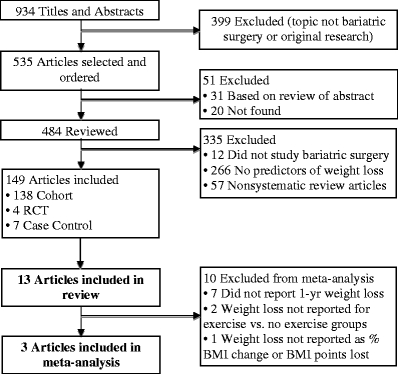
The contribution of physical activity on the degree of weight loss following bariatric surgery is unclear. To determine impact of exercise on postoperative weight loss. Medline search (1988-2009) was completed using MeSH terms including bariatric procedures and a spectrum of patient factors with potential relationship to weight loss outcomes. Of the 934 screened articles, 14 reported on exercise and weight loss outcomes. The most commonly used instruments to measure activity level were the Baecke Physical Activity Questionnaire, the International Physical Activity Questionnaire, and a variety of self-made questionnaires. The definition of an active patient varied but generally required a minimum of 30 min of exercise at least 3 days per week. Thirteen articles reported on exercise and degree of postoperative weight loss (n = 4,108 patients). Eleven articles found a positive association of exercise on postoperative weight loss, and two did not. Meta-analysis of three studies revealed a significant increase in 1-year postoperative weight loss (mean difference = 4.2% total body mass index (BMI) loss, 95% confidence interval (CI; 0.26-8.11)) for patients who exercise postoperatively. Exercise following bariatric surgery appears to be associated with a greater weight loss of over 4% of BMI. While a causal relationship cannot be established with observational data, this finding supports the continued efforts to encourage and support patients' involvement in post-surgery exercise. Further research is necessary to determine the recommended activity guidelines for this patient population.
Overview
The claims and statistics of this paper haven’t been checked yet.
Free: it reads the open-access text and checks the first 5 claims that cite a source we can check. Create a free account to check every claim.
Integrity signals
Registry
Cites
Statistics
Figures

Verification
Claims the paper makes
The claims and statistics of this paper haven’t been checked yet.
Free: it reads the open-access text and checks the first 5 claims that cite a source we can check. Create a free account to check every claim.
Claims other papers make about this one
Each is checked against this paper’s own text: does it say what the citing paper says it does?
In the citing paper
“Physical activity (PA) is associated with weight loss after BS [57, 58].”
Self-check
Percentages, sums and reported differences re-computed from the paper’s own numbers.
The self-check needs the paper’s full text.
Citations
Cites
International physical activity questionnaire: 12-country reliability and validity
CRAIG, C. L., MARSHALL, A. L., SJ??STR??M, M., BAUMAN, A. E., BOOTH, M. L., AINSWORTH, B. E., PRATT, M., EKELUND, U., YNGVE, A., SALLIS, J. F., et al. (2003) · Medicine & Science in Sports & Exercise · doi:10.1249/01.mss.0000078924.61453.fb · Cited by 21,619 · cited 2×
“This self-administered survey assesses walking and moderate or vigorous activities in everyday life, as measured for the past 7 days [26].”
Method(2007) · Circulation · doi:10.1161/circulationaha.107.185649 · Cited by 6,545 · cited 1×
“It also closely parallels the American Heart Association / American College of Sports Medicine guidelines on physical activity, which include 30 minutes of moderate-intensity aerobic activity on five days each week or 20 minutes of vigorousintensity activity for three days each week [31].”
BackgroundA short questionnaire for the measurement of habitual physical activity in epidemiological studies
Baecke, J., Burema, J., & Frijters, J. (1982) · The American Journal of Clinical Nutrition · doi:10.1093/ajcn/36.5.936 · Cited by 3,945 · cited 1×
“It has a total of 16 questions classified into three domains: work, sports, and non-sports leisure activity [24].”
BackgroundRoss, R., Dagnone, D., Jones, P. J. H., Smith, H., Paddags, A., Hudson, R., & Janssen, I. (2000) · Annals of Internal Medicine · doi:10.7326/0003-4819-133-2-200007180-00008 · Cited by 1,435
Dixon, J. B., O’Brien, P. E., Playfair, J., Chapman, L., Schachter, L. M., Skinner, S., Proietto, J., Bailey, M., & Anderson, M. (2008) · JAMA · doi:10.1001/jama.299.3.316 · Cited by 1,434 · cited 4×
“All studies have patient samples with a majority of female patients except Dixon et al [12], and baseline BMI in the 37 to 58 kg/m(2) range (Table 1).”
BackgroundInfluentialWei, M. (1999) · JAMA · doi:10.1001/jama.282.16.1547 · Cited by 1,168 · cited 1×
“Exercise also improves cardiopulmonary fitness, which may reduce mortality from cardiovascular disease [3].”
BackgroundDoes physical activity prevent weight gain – a systematic review
Fogelholm, M., & Kukkonen‐Harjula, K. (2000) · Obesity Reviews · doi:10.1046/j.1467-789x.2000.00016.x · Cited by 598 · cited 1×
“Long-term maintenance of physical activity (contributing to energy expenditure of 1,500 to 2,000 kilocalories (kcal) per week) has been found to decrease weight gain [7].”
BackgroundEXERCISE IN WEIGHT MANAGEMENT OF OBESITY
Poirier, P., & Després, J.-P. (2001) · Cardiology Clinics · doi:10.1016/s0733-8651(05)70229-0 · Cited by 272 · cited 1×
“walking) for 3 to 5 days per week has also been reported [30].”
BackgroundTreatment Modalities of Obesity
Hainer, V., Toplak, H., & Mitrakou, A. (2008) · Diabetes Care · doi:10.2337/dc08-s265 · Cited by 231
Chevallier, J.-M., Paita, M., Rodde-Dunet, M.-H., Marty, M., Nogues, F., Slim, K., & Basdevant, A. (2007) · Annals of Surgery · doi:10.1097/sla.0b013e31813e8a56 · Cited by 195 · cited 2×
“Three of the studies are prospective cohorts, two of which compare a group of active patients versus a group of inactive patients after bariatric surgery [13, 15].”
Background
Research works printed but not linked: 1
- Review Manager (RevMan) [Computer program]. Version 5.0. Copenhagen: The Nordic Cochrane Centre TCC2.
Cited by
Garvey, W. T., Mechanick, J. I., Brett, E. M., Garber, A. J., Hurley, D. L., Jastreboff, A. M., Nadolsky, K., Pessah-Pollack, R., & Plodkowski, R. (2016) · Endocrine Practice · doi:10.4158/ep161365.gl · Cited by 1,914
Mechanick, J. I., Youdim, A., Jones, D. B., Garvey, W. T., Hurley, D. L., McMahon, M. M., Heinberg, L. J., Kushner, R., Adams, T. D., Shikora, S., et al. (2013) · Obesity · doi:10.1002/oby.20461 · Cited by 1,650
“[346] Livhits M, Mercado C, Yermilov I, et al.”
BackgroundMechanick, J. I., Youdim, A., Jones, D. B., Timothy Garvey, W., Hurley, D. L., Molly McMahon, M., Heinberg, L. J., Kushner, R., Adams, T. D., Shikora, S., et al. (2013) · Surgery for Obesity and Related Diseases · doi:10.1016/j.soard.2012.12.010 · Cited by 703
“[346] Livhits M, Mercado C, Yermilov I, et al.”
BackgroundEl Ansari, W., & Elhag, W. (2021) · Obesity Surgery · doi:10.1007/s11695-020-05160-5 · Cited by 482
“Physical Inactivity Physical activity (PA) is associated with weight loss after BS [57, 58].”
BackgroundMechanick, J. I., Youdim, A., Jones, D. B., Garvey, W. T., Hurley, D. L., McMahon, M. M., Heinberg, L. J., Kushner, R., Adams, T. D., Shikora, S., et al. (2013) · Endocrine Practice · doi:10.4158/ep12437.gl · Cited by 395
Nutritional Recommendations for Adult Bariatric Surgery Patients: Clinical Practice
Sherf Dagan, S., Goldenshluger, A., Globus, I., Schweiger, C., Kessler, Y., Kowen Sandbank, G., Ben-Porat, T., & Sinai, T. (2017) · Advances in Nutrition · doi:10.3945/an.116.014258 · Cited by 348
Recommendations for the Presurgical Psychosocial Evaluation of Bariatric Surgery Patients
Sogg, S., Lauretti, J., & West-Smith, L. (2016) · Surgery for Obesity and Related Diseases · doi:10.1016/j.soard.2016.02.008 · Cited by 310
“[267] Livhits M, Mercado C, Yermilov I, et al.”
BackgroundPost-operative Psychosocial Predictors of Outcome in Bariatric Surgery
Sheets, C. S., Peat, C. M., Berg, K. C., White, E. K., Bocchieri-Ricciardi, L., Chen, E. Y., & Mitchell, J. E. (2015) · Obesity Surgery · doi:10.1007/s11695-014-1490-9 · Cited by 205
“Physical Activity A recent meta-analysis of 14 studies [54] and literature review [55] of 19 studies concluded that postoperative physical activity was significantly associated with greater post-surgery weight loss.”
BackgroundRudolph, A., & Hilbert, A. (2013) · Obesity Reviews · doi:10.1111/obr.12013 · Cited by 173
“Empirical findings underlined the putative difficulties to adhere to post-operative behaviour changes and revealed significant increases in energy intake during the post-operative period (9,17–19), lower levels of physical activity (20,21), and patterns of uncontrolled eating and grazing (22,23) following bariatric su…”
BackgroundBernhardt, V., Lorenzo, S., Babb, T. G., & Zavorsky, G. S. (2013) · Chest · doi:10.1378/chest.12-0896 · Cited by 168
Herring, L. Y., Stevinson, C., Davies, M. J., Biddle, S. J., Sutton, C., Bowrey, D., & Carter, P. (2016) · Obesity Reviews · doi:10.1111/obr.12361 · Cited by 155
King, W. C., Hsu, J. Y., Belle, S. H., Courcoulas, A. P., Eid, G. M., Flum, D. R., Mitchell, J. E., Pender, J. R., Smith, M. D., Steffen, K. J., et al. (2012) · Surgery for Obesity and Related Diseases · doi:10.1016/j.soard.2011.07.018 · Cited by 153
“Observational studies suggest that more pre- and post-operative physical activity (PA) is related to improved surgical outcomes, including weight loss(1;2).”
Metabolic surgery and cancer: Protective effects of bariatric procedures
Ashrafian, H., Ahmed, K., Rowland, S. P., Patel, V. M., Gooderham, N. J., Holmes, E., Darzi, A., & Athanasiou, T. (2011) · Cancer · doi:10.1002/cncr.25738 · Cited by 149
“Furthermore, metabolic surgery patients can find increased physical activity more feasible after surgery where the degree of postoperative weight loss is associated with increased levels of exercise.(31,66) These operations may offer some anticancerous effects through increased physical activity as this can decrease m…”
BackgroundThree-year weight outcomes from a bariatric surgery registry in a large integrated healthcare system
Coleman, K. J., Huang, Y.-C., Hendee, F. N., Watson, H. L., Casillas, R. A., & Brookey, J. (2014) · Surgery for Obesity and Related Diseases · doi:10.1016/j.soard.2014.02.044 · Cited by 121
“These indicators have been shown to have a strong effect on surgical outcomes for bariatric patients [35,36].”
BackgroundWeight regain after gastric bypass: etiology and treatment options
Maleckas, A., Gudaitytė, R., Petereit, R., Venclauskas, L., & Veličkienė, D. (2016) · Gland Surgery · doi:10.21037/gs.2016.12.02 · Cited by 109
“The importance of physical activity for post-operative weight loss was proven by recent meta-analysis (18).”
Hassannejad, A., Khalaj, A., Mansournia, M. A., Rajabian Tabesh, M., & Alizadeh, Z. (2017) · Obesity Surgery · doi:10.1007/s11695-017-2717-3 · Cited by 108
CELIK, O., & Yıldız, B. O. (2021) · Minerva Endocrinology · doi:10.23736/s2724-6507.20.03361-1 · Cited by 149
Campanha-Versiani, L., Pereira, D. A. G., Ribeiro-Samora, G. A., Ramos, A. V., Diniz, M. F. H. D. S., Marco, L. A. D., & Soares, M. M. S. (2017) · Obesity Surgery · doi:10.1007/s11695-017-2618-5 · Cited by 119
Tettero, O. M., Aronson, T., Wolf, R. J., Nuijten, M. A. H., Hopman, M. T. E., & Janssen, I. M. C. (2018) · Obesity Surgery · doi:10.1007/s11695-018-3439-x · Cited by 86
Stop Regain: A Pilot Psychological Intervention for Bariatric Patients Experiencing Weight Regain
Himes, S. M., Grothe, K. B., Clark, M. M., Swain, J. M., Collazo–Clavell, M. L., & Sarr, M. G. (2015) · Obesity Surgery · doi:10.1007/s11695-015-1611-0 · Cited by 97
“It is difficult to determine factors that contribute clearly to weight regain because studies in this area have often been limited by small sample sizes, lack of long-term follow-up, lack of objectively measured weights, or a high percent of patients lost at follow-up time points [8].”
BackgroundMundi, M. S., Lorentz, P. A., Grothe, K. B., Kellogg, T. A., & Collazo–Clavell, M. L. (2015) · Obesity Surgery · doi:10.1007/s11695-015-1617-7 · Cited by 85
“Analysis of weight loss following bariatric surgery has revealed key predictors of post-surgical success, including level of physical activity before and after surgery [8–10], preoperative eating behavior, post-operative dietary adherence [11], and psychosocial stability [12].”
BackgroundPrevention of Weight Regain Following Bariatric Surgery
Kushner, R. F., & Sorensen, K. W. (2015) · Current Obesity Reports · doi:10.1007/s13679-015-0146-y · Cited by 91
Lier, H. Ø., Biringer, E., Stubhaug, B., & Tangen, T. (2011) · Patient Education and Counseling · doi:10.1016/j.pec.2011.09.014 · Cited by 94
“Psychological well-being, physical exercise, and healthy eating habits are associated with weight loss and postoperative sustained improvement in quality of life [3–7].”
BackgroundHindle, A., Garcia, X. D. L. P., & Brennan, L. (2017) · Obesity Reviews · doi:10.1111/obr.12496 · Cited by 79
“For example, where increased physical activity was associated with improved weight loss, the authors noted that it was unclear whether patients experienced more weight loss because of their adherence to exercise or whether they increased their exercise because the weight loss allowed them to do so (10,12).”
BackgroundCarnero, E. A., Dubis, G. S., Hames, K. C., Jakicic, J. M., Houmard, J. A., Coen, P. M., & Goodpaster, B. H. (2017) · Obesity · doi:10.1002/oby.21864 · Cited by 73
Exercício físico e obesidade mórbida: uma revisão sistemática
Fonseca, S. J., Sá, C. G. A. D. B., Rodrigues, P. A. F., de Oliveira, A. J., & Filho, J. F. (2013) · ABCD Arquivos Brasileiros de Cirurgia Digestiva (São Paulo) · doi:10.1590/s0102-67202013000600015 · Cited by 116
Understanding the Capacity for Exercise in Post-Bariatric Patients
Coleman, K. J., Caparosa, S. L., Nichols, J. F., Fujioka, K., Koebnick, C., McCloskey, K. N., Xiang, A. H., Ngor, E. W., & Levy, S. S. (2017) · Obesity Surgery · doi:10.1007/s11695-016-2240-y · Cited by 71
“Observational studies have shown that one of the most important predictors of weight loss post-surgery is increases in selfreported physical activity [5, 6].”
BackgroundNeurodegenerative disease and obesity: what is the role of weight loss and bariatric interventions?
Ashrafian, H., Harling, L., Darzi, A. W., & Athanasiou, T. (2013) · Metabolic Brain Disease · doi:10.1007/s11011-013-9412-4 · Cited by 77
“2011) Both low calorie diets and bariatric surgery (Livhits et al. 2010) offer the potential for increasing physical activity and exercise.”
BackgroundMor, A., Sharp, L. S., Portenier, D. D., Sudan, R., & Torquati, A. (2012) · Surgery for Obesity and Related Diseases · doi:10.1016/j.soard.2012.06.014 · Cited by 69
“One way to perhaps rescue patients at risk for poor weight loss long term would be to have more intensive follow-up early to identify barriers to good exercise habits, identify eating habits or food choices that may be counterproductive, and provide continued peer support and assess adequacy of current treatment regim…”
BackgroundBellicha, A., Ciangura, C., Roda, C., Torcivia, A., Aron-Wisnewsky, J., Poitou, C., & Oppert, J.-M. (2022) · PLOS ONE · doi:10.1371/journal.pone.0271561 · Cited by 68
Herman, K. M., Carver, T. E., Christou, N. V., & Andersen, R. E. (2014) · Obesity Surgery · doi:10.1007/s11695-014-1212-3 · Cited by 81
“Over the short-term postsurgery, PA often increases, and this higher PA is associated with greater postoperative weight loss (6 months–5 years; few studies beyond 2 years) [17–19].”
BackgroundBaillot, A., Mampuya, W. M., Comeau, É., Méziat-Burdin, A., & Langlois, M. (2013) · Obesity Surgery · doi:10.1007/s11695-013-0875-5 · Cited by 73
“Indeed, the literature highlights that individuals who practice regular physical activity before and after surgery achieve better weight loss and maintenance [16–18].”
BackgroundDagan, S. S., Keidar, A., Raziel, A., Sakran, N., Goitein, D., Shibolet, O., & Zelber‐Sagi, S. (2017) · Obesity Surgery · doi:10.1007/s11695-017-2633-6 · Cited by 77
Vatier, C., Hénégar, C., Ciangura, C., Poitou, C., Bouillot, J., Basdevant, A., & Oppert, J. (2012) · Obesity Surgery · doi:10.1007/s11695-012-0619-y · Cited by 70
“Overall LTPA (h/week, MET-h/week) was increased after bypass, in accordance with previous reviews in obesity surgery [2–4].”
ResultCastello-Simões, V., Polaquini Simões, R., Beltrame, T., Bassi, D., Maria Catai, A., Arena, R., Azambuja, N. C., Nascimento Ortega, J. D., & Borghi-Silva, A. (2013) · Disability and Rehabilitation · doi:10.3109/09638288.2012.694575 · Cited by 61
“Gastric bypass surgery (GBS) is an option for treatment of morbid obesity [7], and the best results in weight loss are achieved when this surgical procedure is followed with regular physical activity [8,9].”
BackgroundHan, S., Agostini, G., Brewis, A. A., & Wutich, A. (2018) · BMC Obesity · doi:10.1186/s40608-018-0195-3 · Cited by 61
Bobowicz, M., Lehmann, A., Orlowski, M., Lech, P., & Michalik, M. (2011) · Obesity Surgery · doi:10.1007/s11695-011-0403-4 · Cited by 58
“Mean BMI significantly differed between genders and was 43 kg/m2 in females (SD±7.08) and 49.5 kg/m2 in males (SD±7.35; p=0.001).”
BackgroundInfluentialon behalf of the Guidance Development Group, Welbourn, R., Dixon, J. B., Barth, J. H., Finer, N., Hughes, C. A., le Roux, C. W., & Wass, J. A. H. (2016) · Obesity Surgery · doi:10.1007/s11695-015-2041-8 · Cited by 68
Aspects of Exercise before or after Bariatric Surgery: A Systematic Review
Pouwels, S., Wit, M., Teijink, J. A. W., & Nienhuijs, S. W. (2015) · Obesity Facts · doi:10.1159/000381201 · Cited by 56
Rosenberger, P. H., Henderson, K. E., White, M. A., Masheb, R. M., & Grilo, C. M. (2011) · Obesity Surgery · doi:10.1007/s11695-010-0283-z · Cited by 55
“A recent systematic review of the literature by Livhits and colleagues [5] identified only 13 published studies that reported on the relationship between physical activity and degree of postoperative weight loss following bariatric surgery.”
BackgroundInfluentialRen, Z.-Q., Lu, G.-D., Zhang, T.-Z., & Xu, Q. (2018) · BMJ Open · doi:10.1136/bmjopen-2018-023208 · Cited by 54
Obeidat, F., & Shanti, H. (2015) · Obesity Surgery · doi:10.1007/s11695-015-1903-4 · Cited by 56
Video Ratings of Surgical Skill and Late Outcomes of Bariatric Surgery
Scally, C. P., Varban, O. A., Carlin, A. M., Birkmeyer, J. D., Dimick, J. B., & Collaborative, F. T. M. B. S. (2016) · JAMA Surgery · doi:10.1001/jamasurg.2016.0428 · Cited by 60
Vassilev, G., Galata, C. L., Finze, A., Weiß, C., Otto, M., Reißfelder, C., & Blank, S. (2022) · Journal of Clinical Medicine · doi:10.3390/jcm11061468 · Cited by 57
“In addition, such interventions lead to a better preservation of muscle strength, muscle mass, endurance capacity, and bone mineral density as well as greater quality of life [28].”
BackgroundCurrent concepts in management of weight regain following bariatric surgery
Shukla, A. P., He, D., Saunders, K. H., Andrew, C., & Aronne, L. J. (2018) · Expert Review of Endocrinology & Metabolism · doi:10.1080/17446651.2018.1447922 · Cited by 49
Changes in physical activity after bariatric surgery: using objective and self-reported measures
Afshar, S., Seymour, K., Kelly, S. B., Woodcock, S., van Hees, V. T., & Mathers, J. C. (2016) · Surgery for Obesity and Related Diseases · doi:10.1016/j.soard.2016.09.012 · Cited by 54
Hansen, D., Decroix, L., Devos, Y., Nocca, D., Cornelissen, V., Dillemans, B., & Lannoo, M. (2020) · Obesity Surgery · doi:10.1007/s11695-020-04390-x · Cited by 46
“2% greater BMI reduction and prevents weight regain within the first 2 years [23].”
BackgroundUnick, J. L., Bond, D. S., Jakicic, J. M., Vithiananthan, S., Ryder, B. A., Roye, G. D., Pohl, D., Trautvetter, J., & Wing, R. R. (2011) · Obesity Surgery · doi:10.1007/s11695-011-0491-1 · Cited by 53
“The role of physical activity (PA) for optimizing bariatric surgery outcomes has been receiving growing attention [1, 2].”
Monpellier, V. M., Janssen, I. M. C., Antoniou, E. E., & Jansen, A. T. M. (2018) · Obesity Surgery · doi:10.1007/s11695-018-3560-x · Cited by 59
Carretero‐Ruiz, A., Porcel, M. D. C. O., Cavero‐Redondo, I., Álvarez‐Bueno, C., Martínez‐Vizcaíno, V., Márquez, M. F., Soriano‐Maldonado, A., & Artero, E. G. (2019) · Obesity Surgery · doi:10.1007/s11695-019-04096-9 · Cited by 47
Heinberg, L. J., Bond, D. S., Carroll, I., Crosby, R., Fodor, A., Fouladi, F., Gunstad, J., Mitchell, J., Peat, C., & Steffen, K. (2020) · Surgery for Obesity and Related Diseases · doi:10.1016/j.soard.2020.06.020 · Cited by 43
Impact of Excess Skin from Massive Weight Loss on the Practice of Physical Activity in Women
Baillot, A., Asselin, M., Comeau, É., Méziat-Burdin, A., & Langlois, M. (2013) · Obesity Surgery · doi:10.1007/s11695-013-0932-0 · Cited by 47
“The regular practice of PA after bariatric surgery is recommended to optimize and maintain weight loss [16, 17] as well as HRQoL, health, and physical fitness [18–21].”
BackgroundImpact of physical activity and fitness in class II and III obese individuals: a systematic review
Baillot, A., Audet, M., Baillargeon, J., Dionne, I. J., Valiquette, L., Fortin, M.-M. R., Chakra, C. N. A., Comeau, É., & Langlois, M. (2014) · Obesity Reviews · doi:10.1111/obr.12171 · Cited by 49
Physical Activity and Sedentary Behavior in Bariatric Patients Long-Term Post-Surgery
Reid, R. E. R., Carver, T. E., Andersen, K. M., Court, O., & Andersen, R. E. (2015) · Obesity Surgery · doi:10.1007/s11695-015-1624-8 · Cited by 41
“Although there are national recommendations denoting 10, 000 steps/day as being considered active [4, 12], many studies have shown that higher levels of physical activity improve weight loss maintenance for bariatric patients in the longterm post-surgery compared to lower levels of physical activity [13, 14].”
BackgroundMeta-analysis of the effect of bariatric surgery on physical function
Adil, M. T., Jain, V, Rashid, F., Al-taan, O., Whitelaw, D., & Jambulingam, P. (2018) · British Journal of Surgery · doi:10.1002/bjs.10880 · Cited by 36
Early prediction of failure to lose weight after obesity surgery
Ritz, P., Caiazzo, R. J., Bécouarn, G., Arnalsteen, L., Andrieu, S., Topart, P. A., & Pattou, F. N. (2011) · Surgery for Obesity and Related Diseases · doi:10.1016/j.soard.2011.10.022 · Cited by 33
Modifiable factors associated with weight regain after bariatric surgery: a scoping review
Kaouk, L., Hsu, A. T., Tanuseputro, P., & Jessri, M. (2019) · F1000Research · doi:10.12688/f1000research.18787.2 · Cited by 63
“Four systematic reviews reinforced that lower physical activity levels were associated with poorer weight loss outcomes and higher weight regain, despite undergoing bariatric surgery 8,18,29,33,34 .”
Moderate Physical Activity as Predictor of Weight Loss After Bariatric Surgery
Mundi, M. S., Lorentz, P. A., Swain, J. M., Grothe, K. B., & Collazo–Clavell, M. L. (2013) · Obesity Surgery · doi:10.1007/s11695-013-0979-y · Cited by 44
Samnani, S. S., Umer, M. F., Mehdi, S. M., & Farid, F. N. (2014) · International Scholarly Research Notices · doi:10.1155/2014/250536 · Cited by 39
“One of the study findings revealed that preoperative instructions about exercise impact postoperative compliance with exercise [16].”
BackgroundZabatiero, J. G., Smith, A. J., Hill, K., Hamdorf, J. M., Taylor, S., Hagger, M. S., & Gucciardi, D. F. (2017) · Obesity Research & Clinical Practice · doi:10.1016/j.orcp.2017.11.001 · Cited by 40
King, W. C., Hinerman, A. S., White, G. E., Courcoulas, A. P., BuSaad, M. A., & Belle, S. H. (2020) · Annals of Surgery · doi:10.1097/sla.0000000000004456 · Cited by 36
“Most prior studies of free-living PA in the context of bariatric surgery have utilized self-reported PA and only measured PA once postsurgery, usually within the 3 years of surgery.(11,16,17,49) Thus, a major strength of this study was the serial assessment of PA across long-term follow-up with an objective and popula…”
BackgroundChanges in Physical Activities and Body Composition after Roux-Y Gastric Bypass Surgery
Crisp, A. H., Verlengia, R., Ravelli, M. N., Rasera, I., & de Oliveira, M. R. M. (2017) · Obesity Surgery · doi:10.1007/s11695-017-3074-y · Cited by 36
Acarbose promotes remission of both early and late dumping syndromes in post-bariatric patients
Cadegiani, F., & Silva, O. S. (2016) · Diabetes Metabolic Syndrome and Obesity · doi:10.2147/dmso.s123244 · Cited by 27
“However, most of the potential benefits of the current approaches are observed only in late DS, but not in the early DS, nor in exercise-induced dumping, a condition described that affects some post-bariatric athletes, specially during intense physical activities,(10,11) whose pathophysiology remains uncertain but may…”
Murphy, J., Uttamlal, T., Schmidtke, K. A., Vlaev, I., Taylor, D., Ahmad, M., Alsters, S., Purkayastha, P., Scholtz, S., Ramezani, R., et al. (2020) · BMC Medical Informatics and Decision Making · doi:10.1186/s12911-020-1025-3 · Cited by 33
Bone Health after Bariatric Surgery: Consequences, Prevention, and Treatment
Shahraki, M. S., Mahmoudieh, M., Kalidari, B., Melali, H., Mousavi, M., Abadi, M. R. G., Mirhosseini, S. H., & Dehabadi, S. A. M. (2022) · Advanced Biomedical Research · doi:10.4103/abr.abr_182_21 · Cited by 28
“[143] Physical activity after BS plays a vital role in eliminating lean body mass.[141] Exercise in patients undergoing BS can cause weight loss of more than 4% of BMI.”
BackgroundInfluentialPerioperative Exercise Therapy in Bariatric Surgery: Improving Patient Outcomes
Pouwels, S., Sanches, E. E., Çağıltay, E., Severin, R. S., & Philips, S. A. (2020) · Diabetes Metabolic Syndrome and Obesity · doi:10.2147/dmso.s215157 · Cited by 25
Fontana, A. D., Lópes, A. D., & Lunardi, A. C. (2019) · Obesity Surgery · doi:10.1007/s11695-019-03859-8 · Cited by 30
İn, G., Taşkın, H. E., Al, M., Alptekin, H. K., Zengin, K., Yumuk, V., & İkitimur, B. (2021) · Obesity Surgery · doi:10.1007/s11695-020-05144-5 · Cited by 29
Julien, C. A., Lavoie, K., Ribeiro, P. A. B., Dragomir, A. I., Mercier, L. A., Garneau, P. Y., Pescarus, R., & Bacon, S. (2021) · Obesity Reviews · doi:10.1111/obr.13168 · Cited by 25
Kvalem, I. L., Bergh, I., von Soest, T., Rosenvinge, J. H., Johnsen, T. A., Martinsen, E. W., Mala, T., & Kristinsson, J. A. (2015) · BMC Obesity · doi:10.1186/s40608-016-0084-6 · Cited by 27
“In general, the individual’s ability to regulate behavioral changes, such as diet and physical activity, are considered factors central to achieving sustained weight loss after both surgical and non-surgical weight loss interventions [1, 3–6].”
Meta-analysis of the effect of bariatric surgery on physical activity
Adil, M. T., Jain, V., Rashid, F., Al‐Taan, O., Al-Rashedy, M., Jambulingam, P. S., & Whitelaw, D. (2019) · Surgery for Obesity and Related Diseases · doi:10.1016/j.soard.2019.06.014 · Cited by 21
How to address weight regain after bariatric surgery in an individualized way
COHEN, R. V., & Petry, T. B. Z. (2023) · Reviews in Endocrine and Metabolic Disorders · doi:10.1007/s11154-023-09806-4 · Cited by 28
Moehlecke, M., Blume, C. A., Rheinheimer, J., Trindade, M. R. M., Crispim, D., & Leitão, C. B. (2016) · Surgery for Obesity and Related Diseases · doi:10.1016/j.soard.2016.08.027 · Cited by 24
Trojian, T. H., Colberg, S., Harris, G., Oh, R., Dixit, S., Gibson, M., Corcoran, M., Ramey, L., & Berg, P. V. (2021) · Clinical Journal of Sport Medicine · doi:10.1097/jsm.0000000000000906 · Cited by 24
Jacobs, A., Monpellier, V. M., Torensma, B., Antoniou, E. E., Janssen, I. M. C., Tollenaar, R. A. �. �., & Jansen, A. T. M. (2024) · Obesity Reviews · doi:10.1111/obr.13729 · Cited by 33
Weight management in Canada: an environmental scan of health services for adults with obesity
Rosa Fortin, M.-M., Brown, C., Ball, G. D., Chanoine, J.-P., & Langlois, M.-F. (2014) · BMC Health Services Research · doi:10.1186/1472-6963-14-69 · Cited by 20
“This is surprising since it appears that exercise may help weight loss after the surgery [31–33] and that physical activity favors weight maintenance [34–36].”
BackgroundChen, C. O., Lee, C.-H., Lee, H.-M., Yin, W., Chin, W.-L., Lee, M.-H., & Chen, J. (2020) · Scientific Reports · doi:10.1038/s41598-020-69714-4 · Cited by 21
“They think surgery is just a quick fix”
Groven, K. S. (2014) · International Journal of Qualitative Studies on Health and Well-Being · doi:10.3402/qhw.v9.24378 · Cited by 22
“Furthermore, their meta-analysis of three studies revealed a significant increase in 1-year post-operative weight loss among individuals who exercised on a regular basis after surgery (Livhits et al., 2010).”
BackgroundWhat Are Obese Patients Able to Eat after Roux-en-Y Gastric Bypass?
Ortega, J., Ortega-Evangelio, G., Fernández, N. C., & Sebastiá, V. (2012) · Obesity Facts · doi:10.1159/000339769 · Cited by 21
Changes in Reward after Gastric Bypass: the Advantages and Disadvantages
Scholtz, S., Goldstone, A. P., & le Roux, C. W. (2015) · Current Atherosclerosis Reports · doi:10.1007/s11883-015-0534-5 · Cited by 19
“Physical exercise is a positive predictor of outcome after bariatric surgery [72, 73].”
BackgroundPostural Stability in Obese Preoperative Bariatric Patients Using Static and Dynamic Evaluation
Pagnotti, G. M., Haider, A., Yang, A., Cottell, K. E., Tuppo, C., Tong, R. K., Pryor, A. D., Rubin, C. T., & Chan, M. E. (2020) · Obesity Facts · doi:10.1159/000509163 · Cited by 28
The impact of selected factors on parameters of weight loss after sleeve gastrectomy.
Binda, A., Jaworski, P., Kudlicka, E., Ciesielski, A., Cabaj, H., & Tarnowski, W. (2016) · Videosurgery and Other Miniinvasive Techniques · doi:10.5114/wiitm.2016.64999 · Cited by 18
Groven, K. S., Råheim, M., & Engelsrud, G. H. (2013) · Health Care For Women International · doi:10.1080/07399332.2013.794465 · Cited by 26
González‐Cutre, D., Megías, Á., Beltrán‐Carrillo, V. J., Cervelló, E. M., & Spray, C. M. (2018) · Journal of Health Psychology · doi:10.1177/1359105318770729 · Cited by 23
“…are common after bariatric surgery, as a large number of studies show positive associations between PA and postoperative weight loss (Bond et al., 2008; Livhits et al., 2010; Moya et al., 2014), overall mental health–related quality of life (Bond et al., 2008; Forbush et al., 2011), and”
BackgroundInfluentialPereira, L. M. C., Aidar, F. J., de Matos, D. G., Neto, J. P. D. F., de Souza, R. F., Sousa, A. C. S., de Almeida, R. R., Nunes, M. A. P., Nunes-Silva, A., & Júnior, W. M. D. S. (2019) · International Journal of Environmental Research and Public Health · doi:10.3390/ijerph16111975 · Cited by 23
“Physically active individuals have a lower body mass index (BMI) and achieve greater weight loss [15,16].”
BackgroundBarbosa, C. G. R., Verlengia, R., Ribeiro, A. G. S. V., de Oliveira, M. R. M., & Crisp, A. H. (2018) · Obesity Medicine · doi:10.1016/j.obmed.2018.12.003 · Cited by 16
Feig, E. H., Golden, J., & Huffman, J. C. (2019) · Obesity Surgery · doi:10.1007/s11695-019-03833-4 · Cited by 17
Etienne, J. H., Petrucciani, N., Goetschy, M., Gugenheim, J., Schneck, A. S., & Iannelli, A. (2020) · Obesity Surgery · doi:10.1007/s11695-020-04728-5 · Cited by 15
Kourounis, G., Kong, C. Y., Logue, J., & Gibson, S. C. (2020) · Clinical Obesity · doi:10.1111/cob.12392 · Cited by 15
Rothwell, L. A., Kow, L., & Toouli, J. (2014) · Obesity Surgery · doi:10.1007/s11695-014-1323-x · Cited by 15
Preis, M. A., Zellerhoff, M., & Brockmeyer, T. (2020) · Journal of Health Psychology · doi:10.1177/1359105320913936 · Cited by 15
“Consequently, this study should be replicated in a sample of obese individuals (BMI > 30 kg/m2).”
BackgroundInfluentialOsland, E., Yunus, R. M., Khan, S., & Memon, M. A. (2020) · Surgical Laparoscopy Endoscopy & Percutaneous Techniques · doi:10.1097/sle.0000000000000834 · Cited by 13
Browning, M. G., Baugh, N. G., Wolfe, L. G., Kellum, J. M., Maher, J. W., & Evans, R. K. (2014) · Obesity Surgery · doi:10.1007/s11695-014-1283-1 · Cited by 14
“Less than 30 % of participants in the current study met current PA guidelines for weight loss both prior to surgery and at the 12 months of follow-up, and this statistic is even more alarming when considering that self-reported PA is inflated relative to objectively measured volumes in the bariatric population [28].”
Weight loss trend after bariatric surgery in a population of obese patients
Palumbo, P., Banchelli, F., Miloro, C., Toschi, P. F., Mécheri, F., Gabriele, S., Pantaleoni, M., D’Amico, R., & Menozzi, R. (2023) · Clinical Nutrition ESPEN · doi:10.1016/j.clnesp.2023.06.015 · Cited by 13
Hooshmand, S., Halabchi, F., Hashempour, A., Tabesh, M. R., & Alizadeh, Z. (2019) · Science & Sports · doi:10.1016/j.scispo.2018.12.004 · Cited by 12
Lifestyle Modification for the Treatment of Obesity
Sarwer, D. B., Butryn, M. L., Forman, E. M., & Bradley, L. E. (2014) · Springer eBooks · doi:10.1007/978-1-4939-1197-4_15 · Cited by 14
Early Ambulation and Physiotherapy After Surgery
Wainwright, T. W., & Burgess, L. C. (2020) · Springer eBooks · doi:10.1007/978-3-030-33443-7_23 · Cited by 17
Bonn, S. E., Hult, M., Spetz, K., Eke, H., Andersson, E., Wirén, M., Löf, M., & Lagerros, Y. T. (2023) · Obesity Surgery · doi:10.1007/s11695-023-06753-6 · Cited by 13
CANCINO-RAMÍREZ, J., Troncoso-Ortiz, E. J., Pino-Zúñiga, J., Olivares, M., Escaffi, M. J., RIFFO, A., Donoso, I. A. P., M., M. V., & González-Rojas, L. (2019) · Revista médica de Chile · doi:10.4067/s0034-98872019001101468 · Cited by 13
Perceptions of Success in Bariatric Surgery: a Nationwide Survey Among Medical Professionals
Dagan, S. S., Schechter, L., Lapidus, R., Sakran, N., Goitein, D., & Raziel, A. (2017) · Obesity Surgery · doi:10.1007/s11695-017-2800-9 · Cited by 12
Metadata
- Authors
- Livhits, M., Mercado, C., Yermilov, I., Parikh, J. A., Dutson, E., Mehran, A., Ko, C. Y., & Gibbons, M. M.
- Affiliations
- University of California, Los Angeles (US)
- Corresponding author
- Livhits, Masha
- ORCID
- Venue
- Obesity Surgery
- Published
- 2010-02-24
- Volume
- 20
- Issue
- 5
- Pages
- 657-665
- ISSN
- 0960-8923 (ISSN-L)
- 1708-0428
- PMC
- PMC2850994
- OpenAlex
- W2067718823
- Semantic Scholar
- f705f35edb1122103128c5e63e23b65c8f2ec6c8
- Cited by
- 197
- References
- 33
- Citations by year
- 2026: 7 · 2025: 4 · 2024: 5 · 2023: 11 · 2022: 13 · 2021: 12 · 2020: 20 · 2019: 17 · 2018: 11 · 2017: 14 · 2016: 18 · 2015: 11 · 2014: 19 · 2013: 17 · 2012: 6
- FWCI
- 1.93
- Type
- journal article
- Language
- en
- Open access
- hybrid
- doi.org
- Licence
- cc-by-nc
- Locations
- Obesity Surgery (publishedVersion, cc-by-nc)
- PubMed Central (publishedVersion, cc-by-nc)
- PubMed (publishedVersion)
- eScholarship (California Digital Library) (submittedVersion)
- Topics
- Health Sciences › Medicine › Surgery › Bariatric Surgery and Outcomes
- Health Sciences › Medicine › Surgery › Body Contouring and Surgery
- Health Sciences › Medicine › Public Health, Environmental and Occupational Health › Obesity, Physical Activity, Diet
- Keywords
- bariatric surgery, postoperative exercise
- MeSH terms
- Humans, Motor Activity, Obesity, Morbid, Postoperative Care, Surveys and Questionnaires, Weight Loss, Exercise, Bariatric Surgery
About these checks
Registry, retraction, Cites and statistics results are computed, not judged, with one exception: a printed reference that no index lists is read once by a model before it counts as a citation error. Claims are extracted by a model and kept only when their quote appears verbatim in the text; each cited source is then checked, with a model’s help, for whether it says what the claim relies on. Those verdicts can be wrong — read the claim’s quote and the cited source before relying on one.
Statistics and arithmetic are recomputed, not judged.
Confidence bands are shown only for fields calibrated on our annotated test set. None is calibrated yet, so no band is shown.
What counts as a claim ›How we measure confidence ›How we check this ›
Are you an author, or do you see a problem with this page? Request a review
Data sources
Bibliographic data: Semantic Scholar, OpenAlex, Crossref.
Contains information from the Semantic Scholar Academic Graph Datasets, made available under the ODC Attribution License (ODC-BY 1.0).
Semantic Scholar’s data is described in: Kinney, R., et al. (2023). The Semantic Scholar Open Data Platform. arXiv:2301.10140.
