

A survey on large language model based autonomous agents
Open accessThe DOI matches its Crossref record; 205 of the 205 references it cites were found in a registry or an index; 159 of the 182 sources its claims cite were checked for support.
Abstract
Abstract Autonomous agents have long been a research focus in academic and industry communities. Previous research often focuses on training agents with limited knowledge within isolated environments, which diverges significantly from human learning processes, and makes the agents hard to achieve human-like decisions. Recently, through the acquisition of vast amounts of Web knowledge, large language models (LLMs) have shown potential in human-level intelligence, leading to a surge in research on LLM-based autonomous agents. In this paper, we present a comprehensive survey of these studies, delivering a systematic review of LLM-based autonomous agents from a holistic perspective. We first discuss the construction of LLM-based autonomous agents, proposing a unified framework that encompasses much of previous work. Then, we present a overview of the diverse applications of LLM-based autonomous agents in social science, natural science, and engineering. Finally, we delve into the evaluation strategies commonly used for LLM-based autonomous agents. Based on the previous studies, we also present several challenges and future directions in this field.
Overview
CoChat Summary
## TL;DR
This paper is a survey of LLM-based autonomous agents, organizing the literature around three pillars: construction, application, and evaluation. It proposes a unified framework for agent architecture, reviews application areas across social science, natural science, and engineering, and summarizes common evaluation strategies plus open challenges.
## Key findings
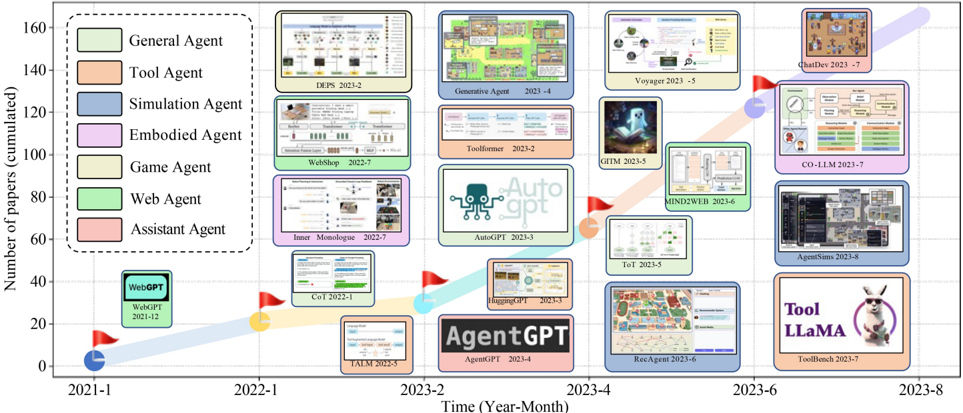
- The authors state they compiled 100 relevant works on LLM-based agents and synthesized them into a taxonomy covering construction, application, and evaluation.
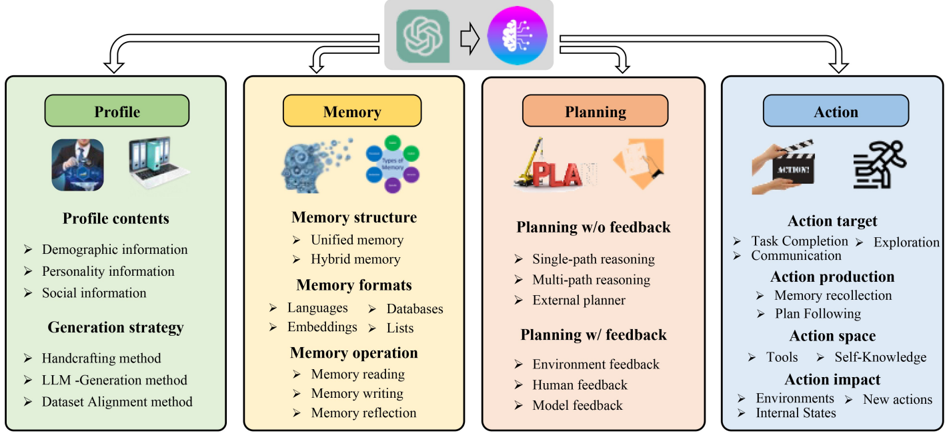
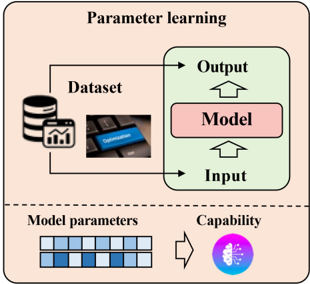
- For agent construction, they propose a unified architecture with four modules: profiling, memory, planning, and action; they also divide capability acquisition into fine-tuning and non-fine-tuning strategies.
- For evaluation, they distinguish subjective and objective methods; objective evaluation is further broken into metrics, protocols, and benchmarks such as task success, human similarity, efficiency, real-world simulation, social evaluation, multi-task evaluation, and software testing.
- The paper identifies major challenges including role-playing capability, prompt robustness, hallucination, knowledge boundary, and efficiency.
## Methods
- This is a survey/review paper, not an experimental study; it systematically organizes prior work on LLM-based autonomous agents.
- The survey is structured around three aspects: agent construction, application, and evaluation; construction is further split into architecture design and capability acquisition.
- The authors use taxonomies and representative examples from prior papers to synthesize methods, applications, benchmarks, and challenges.
## Limitations
- The paper does not report original experiments or new quantitative results; this is implied by the survey nature of the work.
- The text states that the field is “still at its initial stage”, so the synthesis is limited by the maturity of the underlying literature.
- The authors note that some content is “not explicitly discussed in the paper” in their tables/figures, indicating incomplete coverage of all possible agent designs and evaluation modes.
Model-written summary. Check it against the paper before relying on it.
Integrity signals
Registry
Cites
Statistics
Figures













Verification
Claims the paper makes
90 Valid · 12 Not valid · 9 Not checked · 90 Own results and interpretations
The cited sources support only part of this claim — read each source’s verdict below.
In the paper
“Building upon this capability, there has been a growing research area that employs LLMs as central controllers to construct autonomous agents to obtain human-like decisionmaking capabilities [11][12][13][14][15][16][17].”
§ A survey on large language model based autonomous agents > 1 Introduction
What the sources say
- Could not verifycites [11] 11. Chen X, Li S, Li H, Jiang S, Qi Y, Song L. Generative adversarial user model for reinforcement learning based recommendation system. In: Proceedings of the 36th International Conference on Machine Learning. 2019, 1052-1061 sourceExperimental — accuracy not yet measured
Our copy of Chen et al. (2018) is entirely about a model-based RL framework for recommendation systems: a GAN user-behaviour model plus a Cascading DQN policy (Abstract; Introduction, pp.1-2; Sections 5-6.3). No passage mentions large language models, LLMs as controllers, or autonomous agents with human-like decision-making; searches for 'large language model as central controller autonomous agent', 'LLM agent human-like decision-making capabilities' and 'language model transformer pre-trained controller agent' returned only semantically nearest passages on model-based RL, robotics sample efficiency (Introduction; Related Work) and the MovieLens/Taobao datasets (Section 6). The reference list (References, items 1-24) likewise stops at 2019 works (Shi et al., 2019) with no LLM-related entry, so the claim's point is not addressed by this source at all — neither supported nor contradicted. (LLM, conf=0.72)
- Supportedcites [12] 12. Shinn N, Cassano F, Gopinath A, rasimhan K, Yao S. Reflexion: language agents with verbal reinforcement learning. NaIn: Proceedings of the 37th Conference on Neural Information Processing Systems. 2023, 36 source
The Introduction (page not specified) describes recent research on autonomous decision-making agents built around an LLM core, with LLMs generating actions executed in an environment. This supports the citing sentence’s broad description of the research area; it does not establish that the agents’ decisions match human decisions. (LLM, conf=0.88)
- Partly supportedcites [13] 13. Shen Y, Song K, Tan X, Li D, Lu W, Zhuang Y. HuggingGPT: solving AI tasks with chatGPT and its friends in hugging face. In: Proceedings of the 37th Conference on Neural Information Processing Systems. 2023, 36 sourceExperimental — accuracy not yet measured
The “LLM as Controller” section describes an LLM directing expert models and serving as the brain for planning and decisions. “B More Discussion about Related Works” identifies HuggingGPT and other LLM-based systems as autonomous agents. These passages support the controller-and-agent research claim, but they do not establish that the agents attain human-like decision-making capabilities. (LLM, conf=0.82)
plainstates a cause- Asserted: passes — The authors put it forward as true.
- Checkable: passes — It can be checked against evidence.
- Load-bearing: passes — The paper’s conclusions depend on it.
- Based: passes — The paper gives a reason why it holds.
- Could not verify
The cited sources support only part of this claim — read each source’s verdict below.
In the paper
“Autonomous agents typically perform tasks by assuming specific roles, such as coders, teachers and domain experts [18,19].”
§ A survey on large language model based autonomous agents > 2.1.1 Profiling module
What the sources say
- Partly supportedcites [18] 18. Qian C, Cong X, Liu W, Yang C, Chen W, Su Y, Dang Y, Li J, Xu J, Li S, Liu Z, Sun M. Communicative agents for software development. 2023, arXiv preprint arXiv: 2307.07924 sourceExperimental — accuracy not yet measured
The Introduction describes autonomous agents with specialized roles cooperating on software-development tasks, and the Ablation Study discusses programmer and reviewer roles. The paper supports the role-based approach and the coder example, but the cited passages do not establish teachers or domain experts as agent roles, or that agents typically use roles across tasks generally. (LLM, conf=0.84)
- Supportedcites [19] 19. Chen W, Su Y, Zuo J, Yang C, Yuan C, Chan C, Yu H, Lu Y, Hung Y, Qian C, Qin Y, Cong X, Xie R, Liu Z, Sun M, Zhou, J. Agentverse: Facilitating multi-agent collaboration and exploring emergent behaviors in agents. arXiv preprint arXiv:2308.10848 . source
Section 2.1, “Expert Recruitment” (page not provided), says that current methods predominantly assign role descriptions to autonomous agents. The paper’s role prompts illustrate domain experts and coding-related roles, while its Evaluator prompt assigns an agent the role of a mathematics teacher. (LLM, conf=0.88)
plain- Asserted: passes — The authors put it forward as true.
- Checkable: passes — It can be checked against evidence.
- Load-bearing: unclear — It is unclear whether the paper’s conclusions depend on it.
- Based: passes — The paper gives a reason why it holds.
- Partly supported
Every source the paper cites for this claim was checked and supports it.
In the paper
“More specifically, in Generative Agent [20], the agent has the capability to summarize its past experiences stored in memory into broader and more abstract insights.”
§ A survey on large language model based autonomous agents > Memory operations:
What the sources say
- Supportedcites [20] 20. Park J S, O'Brien J, Cai C J, Morris M R, Liang P, Bernstein M S. Generative agents: interactive simulacra of human behavior. In: Proceedings of the 36th Annual ACM Symposium on User Interface Software and Technology. 2023, 2 source
The Introduction describes a memory stream that records agents’ experiences and a reflection component that synthesizes those memories into higher-level inferences. Section 4 likewise says memory records are recursively synthesized into higher-level reflections. (LLM, conf=0.94)
plain- Asserted: passes — The authors put it forward as true.
- Checkable: passes — It can be checked against evidence.
- Load-bearing: unclear — It is unclear whether the paper’s conclusions depend on it.
- Based: passes — The paper gives a reason why it holds.
- Supported
The cited sources support only part of this claim — read each source’s verdict below.
In the paper
“Usually, there three commonly used criteria for information extraction, that is, the recency, relevance, and importance [20].”
§ A survey on large language model based autonomous agents > Memory operations:
What the sources say
- Partly supportedcites [20] 20. Park J S, O'Brien J, Cai C J, Morris M R, Liang P, Bernstein M S. Generative agents: interactive simulacra of human behavior. In: Proceedings of the 36th Annual ACM Symposium on User Interface Software and Technology. 2023, 2 sourceExperimental — accuracy not yet measured
The Introduction says the paper’s memory-retrieval model combines recency, relevance, and importance to select records. It does not establish that these are commonly used criteria for information extraction generally; the claim extends the paper’s specific design into a broader practice. (LLM, conf=0.84)
plain- Asserted: passes — The authors put it forward as true.
- Checkable: passes — It can be checked against evidence.
- Load-bearing: unclear — It is unclear whether the paper’s conclusions depend on it.
- Based: passes — The paper gives a reason why it holds.
- Partly supported
The cited sources support only part of this claim — read each source’s verdict below.
In the paper
“Agents can directly alter environment states by actions, such as moving their positions, collecting items, and constructing buildings.”
§ A survey on large language model based autonomous agents > Action goal:
What the sources say
- Supportedcites [16] 16. Zhu X, Chen Y, Tian H, Tao C, Su W, Yang C, Huang G, Li B, Lu L, 16. Wang X, Qiao Y, Zhang Z, Dai J. Ghost in the minecraft: generally capable agents for open-world environments via large language models with text-based knowledge and memory. 2023, arXiv preprint arXiv: 2305.17144 source
The action descriptions on p. 14 say the agent walks toward objects, collects dropped items after mining or attacking, and places blocks according to a blueprint when building. These support the examples of changing position, collecting items, and constructing buildings. (LLM, conf=0.93)
- Partly supportedcites [38] 38. Wang G, Xie Y, Jiang Y, Mandlekar A, Xiao C, Zhu Y, Fan L, Anandkumar A. Voyager: an open-ended embodied agent with large language models. 2023, arXiv preprint arXiv: 2305.16291 sourceExperimental — accuracy not yet measured
The Introduction (p. 2) describes exploration and gathering resources, and the Full Prompt (p. 27) provides actions for moving to a position and placing a block. But the automatic-curriculum prompt (p. 22) explicitly excludes building tasks, so the paper does not establish constructing buildings as an activity of these agents. (LLM, conf=0.85)
plainstates a cause- Asserted: passes — The authors put it forward as true.
- Checkable: passes — It can be checked against evidence.
- Load-bearing: unclear — It is unclear whether the paper’s conclusions depend on it.
- Based: passes — The paper gives a reason why it holds.
- Supported
41 more claims · 22 with their cited sources checked
Create a free account to see all 201 claims and to verify the 14 references still open.
- It may state two separate claims as one. 79
- Probably not a substantial claim. 112
- The quote only partly states this claim. 2
Claims other papers make about this one
Each is checked against this paper’s own text: does it say what the citing paper says it does?
The source backs part of the claim, not all of it — or backs it for a different population, condition or comparison.
In the citing paper
“The existing literature reaches neither goal. Benchmark surveys report scores (typically SWEBench [1]) without touching architecture; conceptual taxonomies [5, 6] describe patterns without implementations; the one concurrent source-level taxonomy [34] excludes the provider-native systems that define the field's frontier.”
From Harness Engineering: Anatomy, Architecture, and Evolution of Coding Agents -- A Source-Code Study of Eleven Systems (2026) · cites this paper as [6]
Experimental — accuracy not yet measuredThe source backs part of the claim, not all of it — or backs it for a different population, condition or comparison.
In the citing paper
“Recent studies have converged on a recurring set of functional components underlying such systems, often defined by 4 core components: planning, action, reflection, and memory (PARM) [11].”
From Medical AI Agents for Clinical Decision Support: Viewpoint Using the Planning, Action, Reflection, and Memory (PARM) Analytical Lens (2026) · cites this paper as [11]
Experimental — accuracy not yet measuredThe source backs part of the claim, not all of it — or backs it for a different population, condition or comparison.
In the citing paper
“MAS, in which multiple autonomous agents collaborate as a team, are emerging as a powerful paradigm for biomedical and clinical data analysis [1,2].”
From A Review of Multi-Agent AI Systems for Biological and Clinical Data Analysis (2026) · cites this paper as [1]
Experimental — accuracy not yet measuredThe source backs part of the claim, not all of it — or backs it for a different population, condition or comparison.
In the citing paper
“LLM-based autonomous agents can achieve greater flexibility and robustness by dividing labor among sub-agents [1,3].”
From A Review of Multi-Agent AI Systems for Biological and Clinical Data Analysis (2026) · cites this paper as [1]
Experimental — accuracy not yet measuredThe source backs part of the claim, not all of it — or backs it for a different population, condition or comparison.
In the citing paper
“collaborative agent teams have produced superior results on complex bioinformatics analyses and clinical decision support challenges where no single model excels [1,4].”
From A Review of Multi-Agent AI Systems for Biological and Clinical Data Analysis (2026) · cites this paper as [1]
Experimental — accuracy not yet measured
23 more claims about this paper
Create a free account to see every claim other papers make about this one.
Citations
Cites
Proximal Policy Optimization Algorithms
Schulman, J., Wolski, F., Dhariwal, P., Radford, A., & Klimov, O. (2017) · arXiv · doi:10.48550/arxiv.1707.06347 · Cited by 40,403 · cited 1×
“In earlier paradigms, the policy functions that dictated the agent’s actions were conceived through heuristic methodologies and subsequently refined through environmental engagements [101, 86, 120, 55, 9, 116].”
Human-level control through deep reinforcement learning
Mnih, V., Kavukcuoglu, K., Silver, D., Rusu, A. A., Veness, J., Bellemare, M. G., Graves, A., Riedmiller, M., Fidjeland, A. K., Ostrovski, G., et al. (2015) · Nature · doi:10.1038/nature14236 · Cited by 30,357 · cited 1×
“In previous studies, the agents are assumed to act based on simple and heuristic policy functions, and learned in isolated and restricted environments [113, 96, 134, 60, 11, 127].”
BackgroundLanguage Models are Few-Shot Learners
Brown, T. B., Mann, B., Ryder, N., Subbiah, M., Kaplan, J., Dhariwal, P., Neelakantan, A., Shyam, P., Sastry, G., Askell, A., et al. (2020) · arXiv · doi:10.48550/arxiv.2005.14165 · Cited by 23,372 · cited 2×
“In earlier paradigms, the policy functions that dictated the agent’s actions were conceived through heuristic methodologies and subsequently refined through environmental engagements [101, 86, 120, 55, 9, 116].”
Advances in neural information processing systems 7
Cios, K., & Shields, M. (1997) · Neurocomputing · doi:10.1016/s0925-2312(97)90018-7 · Cited by 22,059
Proceedings of the 24th international conference on Machine learning
(2007) · doi:10.1145/1273496 · Cited by 11,630
Continuous control with deep reinforcement learning
Lillicrap, T. P., Hunt, J. J., Pritzel, A., Heess, N., Erez, T., Tassa, Y., Silver, D., & Wierstra, D. (2015) · arXiv · doi:10.48550/arxiv.1509.02971 · Cited by 10,782
Tree of Thoughts: Deliberate Problem Solving with Large Language Models
Yao, S., Yu, D., Zhao, J., Shafran, I., Griffiths, T. L., Cao, Y., & Narasimhan, K. (2023) · arXiv · doi:10.48550/arxiv.2305.10601 · Cited by 7,650 · cited 2×
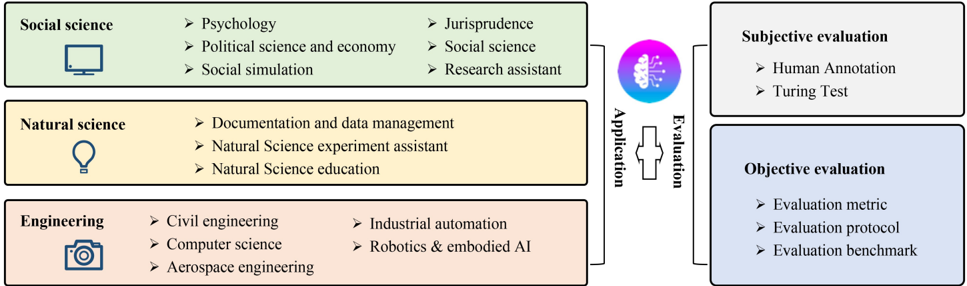
“5 The applications (left) and evaluation strategies (right) of LLM-based agents. but are highly related to this area.”
Soft actor-critic Off-policy maximum entropy deep reinforcement learning with a stochastic actor
Haarnoja, T., Zhou, A., Abbeel, P., & Levine, S. (2018) · arXiv · doi:10.48550/arxiv.1801.01290 · Cited by 5,594
Survey of Hallucination in Natural Language Generation
Ji, Z., Lee, N., Frieske, R., Yu, T., Su, D., Xu, Y., Ishii, E., Bang, Y. J., Madotto, A., & Fung, P. (2023) · ACM Computing Surveys · doi:10.1145/3571730 · Cited by 5,025 · cited 2×
“Hallucination can lead to serious consequences such as incorrect or misleading code, security risks, and ethical issues [74].”
BackgroundSurvey of Hallucination in Natural Language Generation
Ji, Z., Lee, N., Frieske, R., Yu, T., Su, D., Xu, Y., Ishii, E., Bang, Y., Chen, D., Dai, W., et al. (2022) · arXiv · doi:10.48550/arxiv.2202.03629 · Cited by 4,981
Research works printed but not linked: 6
- 6. Radford A, Wu J, Child R, Luan D, Amodei D, Sutskever I. Language models are unsupervised multitask learners. OpenAI Blog, 2019, 1(8): 9
- 47. Raman S S, Cohen V, Rosen E, Idrees I, Paulius D, Tellex S. Planning with large language models via corrective re-prompting. In: Proceedings of Foundation Models for Decision Making Workshop at Neural Information Processing Systems. 2022
- 86. Weng X, Gu Y, Zheng B, Chen S, Stevens S, Wang B, Sun H, Su Y. Mind2Web: towards a generalist agent for the Web. In: Proceedings of the 37th Conference on Neural Information Processing Systems. 2023, 36
- 103. Aher G V, Arriaga R I, Kalai A T. Using large language models to simulate multiple humans and replicate human subject studies. In: Proceedings of the 40th International Conference on Machine Learning. 2023, 337-371 102.
- 123. Mehta N, Teruel M, Sanz P F, Deng X, Awadallah A H, Kiseleva J. Improving grounded language understanding in a collaborative environment by interacting with agents through help feedback. 2024, arXiv preprint arXiv: 2304.10750 122. SmolModels. See Githubcom/smol-ai/developer website, 2023 123. DemoGPT. See Github.com/melih-unsal/Demo website, 2023 124. · arXiv
- 135. Nottingham K, Ammanabrolu P, Suhr A, Choi Y, Hajishirzi H, Singh S, Fox R. Do embodied agents dream of pixelated sheep: embodied decision making using language guided world modelling. In: Proceedings of the 40th International Conference on Machine Learning. 2023, 26311-26325 137.
Cited by
Items 1,501–1,600 of 1,854
Research on Intelligent Assistance Mechanisms for CTF Competitions Based on Large Language Models
Liu, C.-X., Song, H.-J., Huang, C.-L., Cheng, H., & Zhou, J. (2026) · Proceedings of the 2nd International Conference on Software Engineering and Computer Applications · doi:10.1145/3829641.3829764
Xiong, J., Ji, Y., Gj, W., & Wang, Y. (2026) · Expert Systems with Applications · doi:10.1016/j.eswa.2026.133604
Multi-criteria optimization for the management of intensive care beds in an epidemic context
Wan, F. (2024) · theses.fr (ABES) · doi:10.70675/79f4d0a6zc6ddz4374z92abz7adf6bc278e6
From Model Assessment to Process Fit: Designing Benchmark Dimensions for LLMs in Business Contexts
Pinto, R., Alfnes, E., Bandinelli, R., & Zenezini, G. (2026) · IFIP advances in information and communication technology · doi:10.1007/978-3-032-38614-4_41
Di, Q., Du, K., Chen, G., & Deng, H. (2026) · Expert Systems · doi:10.1111/exsy.70436
Chatbots: Evolution, Technologies, and Applications
Shrivastav, A., Sankathala, S., Chaturvedi, K., Saraf, A. H., Patre, K., & Das, S. (2025) · Advances in computational intelligence and robotics book series · doi:10.4018/979-8-3373-8011-7.ch004
Wei, H., Chai, Y., You, S., Jia, Y., Lu, W., & Sok, M. (2026) · International Conference on Artificial Intelligence, Internet of Things and Cloud Computing Technology (AIoTC) · doi:10.1109/aiotc71250.2026.11689071
BioTrouble: A Multi-Agent Workflow for Troubleshooting Molecular Biology TechniquesPreprint
Ameri, M., Yousefabadi, H., & Ramezani, A. (2026) · bioRxiv (Cold Spring Harbor Laboratory) · doi:10.64898/2025.12.30.697016
From Review to Refine: A Multi-Agent System for Structured Academic Paper Refinement
Chen, X.-Y., Chen, S.-H., Pang, S., Geng, C., & Shi, X. (2025) · International Conference on Agents · doi:10.1109/ica67499.2025.00023 · Cited by 1
Self-citationXu, Y., Yang, Z., Liang, S., et al. (2026) · International Journal of Intelligent Systems · doi:10.1155/int/8100559
Wadibhasme, S., Abhyankar, J., Tikale, V., Shingote, A., Bhasme, S., & Hajare, S. (2026) · International Conference Computational Vision and Bio Inspired Computing · doi:10.1109/iccvbic71195.2026.11689044
The Expert Validation Framework (EVF): Enabling Domain Expert Control in AI Engineering
Gren, L., & Dobslaw, F. (2026) · IEEE/ACM International Conference on AI Engineering – Software Engineering for AI (CAIN) · doi:10.1145/3793653.3793796 · Cited by 1
Librarian of Alexandria: A Modular Chemical Data Extraction Pipeline to Compare LLM Performance
Grougan, M., Subasinghe, J., Hix, M. A., & Walker, A. R. (2026) · Journal of Chemical Information and Modeling · doi:10.1021/acs.jcim.6c00374 · Cited by 3
Self-Refining Topology Optimization via an LLM-Based Multi-Agent FrameworkPreprint
Park, H., & Chung, H. (2026) · SSRN Electronic Journal · doi:10.2139/ssrn.7162224
Alviz-Meza, A., Valencia-Arias, A., Rojas-Flores, S., & Díaz, F. (2026) · Processes · doi:10.3390/pr14182917 · Cited by 1
Andreadakis, Z. (2025) · De Gruyter eBooks · doi:10.1515/9783112206393-012
Autonomous Content Generation and Management for Startup Social Media Marketing using Agentic AI
Aslam, K. S., Nair, L. A., Sebastian, R. R., Seemon, S., & Thomas, A. R. (2026) · International Conference on Advances in Intelligent Computing and Applications (AICAPS) · doi:10.1109/aicaps68631.2026.11453213 · Cited by 3
Shopping By Algorithm: How Agentic AI Deploys Human Heuristics as a Surrogate ConsumerPreprint
Wadi, D., & Ma, Y. (2026) · SSRN Electronic Journal · doi:10.2139/ssrn.6938899
Yang, L., Cao, Y., Yang, N., Mao, L., & Zhang, X. (2026) · Sustainability · doi:10.3390/su18178768
Exploring an Endless Learning Paradigm Supported by Large Model Services and Educational Agents
Ouyang, W., Mei, G., Pan, L., & Khan, S. (2026) · IEEE International Conference on Software Services Engineering (SSE) · doi:10.1109/sse72781.2026.00046
From Traceability to Reviewability: Intent-Anchored Claim Review for Agentic AI Design HandoffsPreprint
Ming, S., He, Z., Zhao, N., et al. (2026) · SSRN Electronic Journal · doi:10.2139/ssrn.7030983
Aruna Gladys, A., Aishwarya, R., Vetriselvi, V., Daphne, S., Baskar, P. N., & Rajan, A. A. (2026) · Archives of Computational Methods in Engineering · doi:10.1007/s11831-026-10598-4 · Cited by 3
Jin, F., Qu, W., Liu, Q., Chen, B., & Song, Z. (2026) · International Conference on Machine Learning and Neural Networks · doi:10.1145/3821725.3821792
Engineering multi-agent systems for the Web of Things
Vachtsevanou, D., Lemée, J., Mayer, S., & Ciortea, A. (2026) · Elsevier eBooks · doi:10.1016/b978-0-44-344679-5.00012-6
LLM‐Based Scientific Assistants for Knowledge Extraction: Which Design Choices Matter?
Exler, D., Raimann, M., Münker, M. F., Rosin, M., Gómez, J. E. U., Niemeyer, C. M., Reischl, M., & Rettenberger, L. (2026) · Advanced Intelligent Discovery · doi:10.1002/aidi.202500197 · Cited by 1
Ali, Y. A. M., Kaymih, N. A., & Alawad, N. A. (2026) · doi:10.1109/ais69919.2026.11621717
MFTP: Multi-round Feedback for Dynamic Travel Itinerary Optimization
Lu, Y., Jin, P., Zhang, Y., Xu, L., Wang, B., & Chen, X. (2025) · Lecture notes in computer science · doi:10.1007/978-981-95-3052-6_8
Self-citationAgrawal, R. K., Tambe, W. M. A., & Karra, N. (2026) · Preprints.org · doi:10.20944/preprints202608.2126.v1
Context Engineering for AI ‐Assisted Pharmacometrics: A Practical Tutorial
Pritchard‐Bell, A., Lin, C., Holmes, W. R., & Doshi, S. (2026) · CPT Pharmacometrics & Systems Pharmacology · doi:10.1002/psp4.70317
Rudder: Steering Prefetching in Distributed GNN Training using LLM Agents
Sarkar, A., Ghosh, S., Tallent, N. R., Chadha, A. R., Roosta, T. G., & Jannesari, A. (2026) · International Conference on Supercomputing · doi:10.1145/3797905.3800542 · Cited by 1
A Two-Step, Multidimensional Account of Deception in Language Models
Dung, L. (2025) · Erkenntnis · doi:10.1007/s10670-025-01017-4 · Cited by 3
LLM-driven paradigm for agent-based modeling and simulation: A review and organizing framework
Wang, J., Li, X., & Xiao, G. (2026) · Computer Science Review · doi:10.1016/j.cosrev.2026.101054
Fu, V., Xu, X., Xu, W., Ren, R., Deng, B., Chen, J., Zhao, X., Cao, J. W., & Cao, X. (2026) · ACM SIGKDD Conference on Knowledge Discovery and Data Mining (KDD) · doi:10.1145/3770855.3818940
LLM-KGPlan: Long-Horizon Task Planning via Knowledge-Guided Reasoning
Fang, W., Yang, D., Chen, N., Fan, G., Rao, L., Cheng, S., Song, X., & Yu, Y. (2026) · Lecture notes in computer science · doi:10.1007/978-981-95-7078-2_49
Dynamic plan generation with LLMs: automatic execution of abstract BDI-agent goals
Schulz, T., & Jander, K. (2025) · International Journal of Parallel Emergent and Distributed Systems · doi:10.1080/17445760.2025.2541956
Narolski, P. (2026) · Lecture notes in networks and systems · doi:10.1007/978-3-032-27927-9_29
A Domain-Agnostic Agentic Architecture for Structured Extraction of Engineering Knowledge
Ikechukwu, O. C., Tarkian, M., Nambiar, S., Jonsson, M., & Brax, C. (2026) · Applied Artificial Intelligence · doi:10.1080/08839514.2026.2712892
Grounding Generative AI in Software Engineering: Are We There Yet?
Saad, M., López, J. R., Chen, B., Ernst, N., Varró, D., & Sharma, T. (2026) · IEEE International Conference on Software Analysis, Evolution and Reengineering (SANER) · doi:10.1109/saner67736.2026.00091
Wang, Y., Li, M., Liu, S., & Xue, L. (2026) · Expert Systems with Applications · doi:10.1016/j.eswa.2026.134222
Confidence-Driven Human-in-the-Loop Governance for Reliable Agentic AI Decision-Making
Bakar, M. A., Yu, D., & Liu, Y. (2026) · International Conference on Artificial Intelligence and Materials (ICAIM) · doi:10.1109/icaim69488.2026.11601705
Summarizing Online Discussions with Prototype Relation Networks Using Large Language Models
Power, W., Gupta, S., & Zoran Obradovic, A. (2025) · IFIP advances in information and communication technology · doi:10.1007/978-3-031-96235-6_28
Sherson, J. F., Rafner, J. F., Reiter‐Palmon, R., Lebuda, I., Kjeldsen, F. B., Söllner, M., Kenett, Y. N., Emruli, B., Rindle, M., Weiss, S., et al. (2026) · Nordic Conference on Human-Computer Interaction · doi:10.1145/3821402.3830141 · Cited by 2
Jiao, S., Ao, C., Zou, Q., & Yang, H. (2026) · BMC Biology · doi:10.1186/s12915-026-02636-1
Self-citationData-driven Hospital Operation and Policy Synergy
Jia, W., Li, J., Zha, H., Chen, X., Wang, S., Huo, H., Zhang, W., & Geng, N. (2025) · 中国科学基金 · doi:10.3724/bnsfc-2025.01.06.0003
Self-citationIs CUI a Dated Way of Saying LLM?
Simpson, J. (2026) · ACM Conference on Conversational User Interfaces (CUI) · doi:10.1145/3816046.3816302
A Comparative Evaluation of AI Agent Orchestration Frameworks for Regulated Environments
Zukeram, R., Mergulhão, V., de Medeiros, Y., Melo, M., JÚNIOR, R. D. C. D. N., Loss, S. M., Cacho, N., & Lopes, F. (2026) · doi:10.5753/semish.2026.22198
Prediction-in-the-Loop: a decision-making paradigm endowing agents with foresight
Liu, Y., Yuan, M., Zhang, L., Zhou, Z., & Liu, L. (2026) · Scientia Sinica Informationis · doi:10.1360/ssi-2026-0130
Goto, H., Iio, T., Sumioka, H., Sakata, M., & Shiomi, M. (2026) · Advanced Robotics · doi:10.1080/01691864.2026.2707054
The Future of Mechanical Metastructures: There is Plenty of Room at the Top
Wu, W., Yu, H., Xu, K., Yang, H., Wang, H., Xu, F., & Lu, T. J. (2026) · ENGINEERING Transformative Materials · doi:10.2738/engtm.2026.0007
Self-citationH 2 R: Hierarchical Hindsight Reflection for Multi-Task LLM Agents
Ye, S., Yu, C., Ke, K., Xu, C., & Wei, Y. (2025) · IEEE International Conference on Agents (ICA) · doi:10.1109/ica67499.2025.00030 · Cited by 15
Cidadão.AI: Uma Proposta de Sistema Multiagente para Democratização da Transparência Governamental
da Silva, A. H., & Fassbinder, A. G. D. O. (2026) · Anais Estendidos do Simpósio Brasileiro de Sistemas de Informação (SBSI) · doi:10.5753/sbsi_estendido.2026.249058
Silva, A. L., Lima, A. M. A., Valença, G., & Cabral, G. G. (2025) · Anais do Simpósio Brasileiro de Sistemas de Informação (SBSI) · doi:10.5753/sbsi.2025.246628 · Cited by 1
Self-Evolving AI Learning and Assessment System using the R-Zero Framework
Vivekanandan, S., Begum, S. J., Priya, T. S. V., Vijay, K., Yaswanth, R., & Piruthvi, M. (2026) · International conference Computer Networks and Inventive Communication Technologies · doi:10.1109/iccnct68477.2026.11590000
Masram, B., Wankhede, S., Bandivadekar, S., Shah, N., & Badhe, Y. (2026) · International Conference on Intelligent Technologies (CONIT) · doi:10.1109/conit69683.2026.11621638
Deng, Y. (2026) · 2026 3rd World Conference on Computer and Information Security (WCCIS) · doi:10.1109/wccis70285.2026.11651016
Liu, Q., & Xu, W. (2026) · International Journal of Energy and Environmental Science · doi:10.11648/j.ijees.20261102.11
LMW: LLM-Driven Multi-Agent Workflow for Unmanned Platforms
Huang, X., Li, Q., Zhu, C., Zhu, X., Zang, Y., Chen, T., & Zhang, S. (2025) · Conference proceedings/Conference proceedings - IEEE International Conference on Systems, Man, and Cybernetics · doi:10.1109/smc58881.2025.11343649 · Cited by 1
Dang, Q. P., Tran-Truong, P. T., Vu, D., Nguyen, L., Vo, Q., & Quan, T. T. (2026) · Computers and Education Artificial Intelligence · doi:10.1016/j.caeai.2026.100578
The Market's Mirror: Revealing Investor Disagreement with LLMsPreprint
Bhagwat, V., Cookson, J. A., Dim, C., & Niessner, M. (2025) · SSRN Electronic Journal · doi:10.2139/ssrn.5375473 · Cited by 22
QRNG-DD: Software Data Diode for Quantum Random Number Distribution with AI Agent IntegrationPreprint
Bocan, V. (2026) · SSRN Electronic Journal · doi:10.2139/ssrn.6029168
Evaluating the Performance of Large Language Model on Structural Defect Assessment
Zhang, Y. J., & Su, R. K. L. (2025) · Lecture notes in civil engineering · doi:10.1007/978-981-96-4698-2_3
Agent-Based Control of Robot Behavior Using Reasoning Language Models
Скороходов, М. С., Latalin, V. E., Борисович, Р. Р., & Sboev, A. G. (2025) · Automation and Remote Control · doi:10.1134/s0005117925601101 · Cited by 2
Xu, C., Zhang, X., & Gong, X. (2026) · ACM/IEEE International Conference on Software Engineering: Companion Proceedings (ICSE-Companion) · doi:10.1145/3744916.3773243
Human versus artificial social cognition and metacognition: the normative difference
Tison, R., & Zawidzki, T. W. (2025) · AI and Ethics · doi:10.1007/s43681-025-00774-w · Cited by 2
Predictive Self-Healing for Multi-Agent LLM Pipelines Using Model Predictive Control
Patel, T., Padhy, A. K., Shivam, S., Ranganathan, V., Elengovan, A. K., & Kole, D. (2026) · IEEE Conference on Technologies for Sustainability · doi:10.1109/sustech67720.2026.11536606
Towards an Ontology of Normative Role Design for Multi-agent LLM Systems
Nejad, M. H., & de Vasconcelos, J. B. (2026) · Lecture notes in networks and systems · doi:10.1007/978-3-032-32026-1_28
Pritul, T. I., & Ratul, Q. E. A. (2026) · Intermountain Engineering, Technology and Computing (IETC) · doi:10.1109/ietc69527.2026.11568677
Privacy-Preserving Agentic AI in Edge Networks With Content and Trace Protection
Peng, S., Jiang, Y., Liu, Y., Yu, X., & Zhu, L. (2026) · IEEE Transactions on Network Science and Engineering · doi:10.1109/tnse.2026.3720648 · Cited by 1
Tang, J., Li, Z., Yang, J., 林雕, Zhang, B., Yang, G., & Fang, L. (2026) · The Knowledge Engineering Review · doi:10.48130/ker-0026-0013 · Cited by 1
Self-citationWang, J., Wang, Q., Yang, P., Li, G., Wang, X., Sun, Y., Feng, Z., Gao, Y., Li, Y., Guo, W., et al. (2026) · npj Digital Public Health · doi:10.1038/s44482-026-00045-3
Agentic AI and reference services: The promise of the fifth industrial revolution in libraries
Egbe, I. M., Ajani, Y. A., & Abubakar, S. (2026) · Business Information Review · doi:10.1177/02663821261475992
Liu, Z., Zhang, Y., Huang, H., Xie, K., & Tang, X. (2026) · Research Square · doi:10.21203/rs.3.rs-10653499/v1
AVATAR-AGENT: A Multi-Agent System for Expressive 3D Avatar Generation
Ding, J., Gangaraju, R., Garikipati, K. C., Dabiri, F., & Xu, C. (2026) · International Workshop on Agentic Engineering · doi:10.1145/3786167.3788404 · Cited by 1
An LLM-Based Approach for Creating Multi-agent Systems
Rezunik, L., Alexandrov, D., & Prozorskiy, M. A. (2026) · Smart innovation, systems and technologies · doi:10.1007/978-3-032-04186-9_8
Six misconceptions about large language models: A minimal model and diagnostic taxonomy
Lin, Z.-C. (2026) · PNAS Nexus · doi:10.1093/pnasnexus/pgag236 · Cited by 1
TAV-Nav: A Tool-Augmented VLM Navigator for Safe and Efficient Lunar Rover Path Planning
Han, H., Wu, A., & Wan, X. (2025) · International Conference on Robotics, Intelligent Control and Artificial Intelligence (RICAI) · doi:10.1109/ricai68060.2025.11385111
Context-engineered question answering for multi-format construction safety documentation
Shuai, B., & Caldas, C. H. (2026) · Engineering Applications of Artificial Intelligence · doi:10.1016/j.engappai.2026.116399
Verifiable and Privacy-Preserving Decentralized Collaboration for Machine Learning Model ImprovementPreprint
Burgos, J. B., Sedlar, U., & Pustišek, M. (2025) · SSRN Electronic Journal · doi:10.2139/ssrn.5420991
A Natural Language Driven Agentic AI Framework for Automated Household Inventory Management
Yashaswini, C., Dicken Kumar, K., Habeeb, A., et al. (2026) · International Conference on Knowledge Engineering and Communication Systems (ICKECS) · doi:10.1109/ickecs70176.2026.11528057
A Large Language Model-Driven Natural Language Instructions Control System for Robotic Arm
Wu, Z., Jia, Z., & Zeng, Z. (2025) · China Automation Congress (CAC) · doi:10.1109/cac67268.2025.11487326
Saju, G., Akhi, M., & 仇, 长. (2026) · IEEE International Conference on AI and Data Analytics (ICAD) · doi:10.1109/icad69378.2026.11608529
Making Enterprise AI Explainable through Calibrated Confidence and Provenance
Krstev, S., Devedžić, V., & Krneta, D. (2026) · Applied Artificial Intelligence · doi:10.1080/08839514.2026.2739513 · Cited by 1
Mapping the Landscape of LLM Deployment in the Wild: Prevalence, Patterns, and Perils
Hou, X., Han, J., Zhao, Y., Wang, S., & Wang, H. (2026) · ACM SIGMETRICS International Conference on Measurement and Modeling of Computer Systems (SIGMETRICS) · doi:10.1145/3801489.3806879
A Tool-Augmented AI Agent for Grounded Access to European Cultural Heritage
Landolfi, P., Porcelli, F., Cioffi, S., Cuffa, L. D., Volpe, M., Nardo, E. D., & Ciaramella, A. (2026) · Lecture notes in computer science · doi:10.1007/978-3-032-39385-2_3
MGFS: Structure-Aware Multi-granular Function Selection for LLM-Based Agents
Zhang, Y., Li, C., Ma, J., Wang, Q., Yang, W., & Zhao, Z. (2026) · Lecture notes in computer science · doi:10.1007/978-981-92-3403-5_11
The Agentic Verification Gap: Governing AI-Delegated Work in Business EducationPreprint
Pham, Q., & Nguyen, H. T. T. (2026) · SSRN Electronic Journal · doi:10.2139/ssrn.7228214
Sarı, M., & Tüfenkçi, P. (2025) · European Annals of Dental Sciences · doi:10.52037/eads.2025.0002
Simson, R., Kiil, M., Võsa, K.-V., & Kurnitski, J. (2026) · SSRN Electronic Journal · doi:10.2139/ssrn.7300707
A systematic mapping study of AI agent–Tool communication: protocols, security, and orchestration
UMER, H. S., Nawaz, N. A. H., Ishaq, K., & Ahmad, A. (2026) · Intelligent Systems with Applications · doi:10.1016/j.iswa.2026.200733
Artificial Intelligence-Assisted Analog IC Design: Bridging human intuition and machine intelligence
Poddar, S., Liu, B., Kim, S., & Pan, D. Z. (2026) · IEEE Solid-State Circuits Magazine · doi:10.1109/mssc.2026.3678510
Application Research of Collaborative Multi-Agent Systems in Industrial Software Talent Cultivation
Huang, M., Ma, J., & Bo, S. (2026) · International Conference on Educational and Information Technology · doi:10.1109/iceit68991.2026.11521648
Rai, B., & Popović, M. J. (2026) · Applied Decision Analytics · doi:10.66972/ada202734
HELP: Hierarchical Embodied Language Planner for Household Tasks
Korchemnyi, A., Onishchenko, A., Bakaeva, E. A., Kovalev, A., & Panov, A. (2026) · Lecture notes in computer science · doi:10.1007/978-3-032-34387-1_5
Chrysikou, V., Karageorgos, A., Τρίγκας, Μ., et al. (2025) · IEEE/WIC International Conference on Web Intelligence and Intelligent Agent Technology (WI-IAT) · doi:10.1109/wi-iat67162.2025.00091
Scalable Task Planning via Large Language Models and Structured World Representations
Pérez‐Dattari, R., Li, Z., Babuška, R., Kober, J., & Santina, C. D. (2025) · Advanced Robotics Research · doi:10.1002/adrr.202500002 · Cited by 3
BODNAR, D., & Koldovskyy, V. (2026) · Advances in Cyber-Physical Systems · doi:10.23939/acps2026.01.012
Chatbots integrated in the metaverse: a conceptual model based on interaction ritual chain theory
Yan, Y., & Fan, M. (2025) · PeerJ Computer Science · doi:10.7717/peerj-cs.3235 · Cited by 1
Hao, Z., Jia, D., Yu, H., Liu, H., Huang, S., Fuchao, S., Li, B., Zhang, S., Zhang, Z., & Wei, R. (2026) · Engineering · doi:10.1016/j.eng.2026.08.023
Self-citation
Metadata
- Authors
- Wang, L., Ma, C., Feng, X., Zhang, Z., Yang, H., Zhang, J., Chen, Z., Tang, J., Chen, X., Lin, Y., Zhao, W. X., Wei, Z., & Wen, J.
- Affiliations
- Renmin University of China (CN)
- Corresponding author
- Chen, Xu
- Lin, Yankai
- ORCID
- Venue
- Frontiers of Computer Science
- Published
- 2024-03-22
- Volume
- 18
- Issue
- 6
- ISSN
- 2095-2228 (ISSN-L)
- 2095-2236
- OpenAlex
- W4393065402
- Semantic Scholar
- 28c6ac721f54544162865f41c5692e70d61bccab
- Cited by
- 1,941
- References
- 61
- Citations by year
- 2026: 1060 · 2025: 623 · 2024: 249
- FWCI
- 284.94
- Type
- journal article
- Language
- en
- Open access
- hybrid
- doi.org
- Licence
- cc-by
- creativecommons.org/licenses/by/4.0 (tdm)
- creativecommons.org/licenses/by/4.0 (vor)
- Locations
- Frontiers of Computer Science (publishedVersion, cc-by)
- arXiv (Cornell University) (submittedVersion, cc-by)
- arXiv (Cornell University) (cc-by)
- Funders
- National Natural Science Foundation of China (62102420)
- Renmin University of China
- Topics
- Physical Sciences › Computer Science › Artificial Intelligence › Artificial Intelligence Applications
- Physical Sciences › Computer Science › Artificial Intelligence › AI-based Problem Solving and Planning
- Physical Sciences › Computer Science › Artificial Intelligence › Topic Modeling
- Keywords
- large language models, autonomous agents, LLM agents, agent applications, assessment methods, human-like decision making, social science applications, engineering applications
About these checks
Registry, retraction, Cites and statistics results are computed, not judged, with one exception: a printed reference that no index lists is read once by a model before it counts as a citation error. Claims are extracted by a model and kept only when their quote appears verbatim in the text; each cited source is then checked, with a model’s help, for whether it says what the claim relies on. Those verdicts can be wrong — read the claim’s quote and the cited source before relying on one.
The claim verdicts this report counts are experimental: their accuracy is not yet measured.
A language model drew the claims from the paper on 2026-09-28, under version 3 of the claim definition (model deepseek-v4.1-flash, prompt extract-v3).
A second model labelled each claim on 2026-09-28 (model jev-1.13-20260917, definition revision gold-guideline-v0.2).
Cited sources are checked with a language model’s help (qwen3.8-omni-flash and gpt-6-sol).
Statistics and arithmetic are recomputed, not judged.
Confidence bands are shown only for fields calibrated on our annotated test set. None is calibrated yet, so no band is shown.
What counts as a claim ›How we measure confidence ›How we check this ›
Are you an author, or do you see a problem with this page? Request a review
Data sources
Bibliographic data: Semantic Scholar, OpenAlex, Crossref.
Contains information from the Semantic Scholar Academic Graph Datasets, made available under the ODC Attribution License (ODC-BY 1.0).
Semantic Scholar’s data is described in: Kinney, R., et al. (2023). The Semantic Scholar Open Data Platform. arXiv:2301.10140.
