

A survey on large language model based autonomous agents
Open accessThe DOI matches its Crossref record; 205 of the 205 references it cites were found in a registry or an index; 159 of the 182 sources its claims cite were checked for support.
Abstract
Abstract Autonomous agents have long been a research focus in academic and industry communities. Previous research often focuses on training agents with limited knowledge within isolated environments, which diverges significantly from human learning processes, and makes the agents hard to achieve human-like decisions. Recently, through the acquisition of vast amounts of Web knowledge, large language models (LLMs) have shown potential in human-level intelligence, leading to a surge in research on LLM-based autonomous agents. In this paper, we present a comprehensive survey of these studies, delivering a systematic review of LLM-based autonomous agents from a holistic perspective. We first discuss the construction of LLM-based autonomous agents, proposing a unified framework that encompasses much of previous work. Then, we present a overview of the diverse applications of LLM-based autonomous agents in social science, natural science, and engineering. Finally, we delve into the evaluation strategies commonly used for LLM-based autonomous agents. Based on the previous studies, we also present several challenges and future directions in this field.
Overview
CoChat Summary
## TL;DR
This paper is a survey of LLM-based autonomous agents, organizing the literature around three pillars: construction, application, and evaluation. It proposes a unified framework for agent architecture, reviews application areas across social science, natural science, and engineering, and summarizes common evaluation strategies plus open challenges.
## Key findings
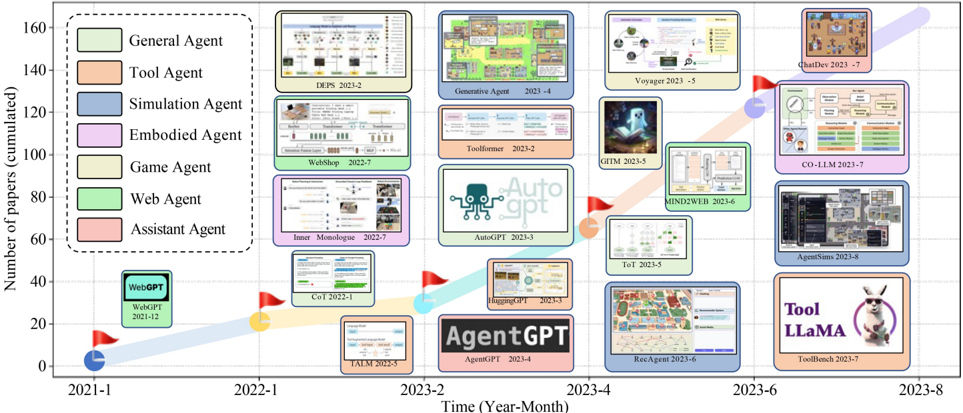
- The authors state they compiled 100 relevant works on LLM-based agents and synthesized them into a taxonomy covering construction, application, and evaluation.
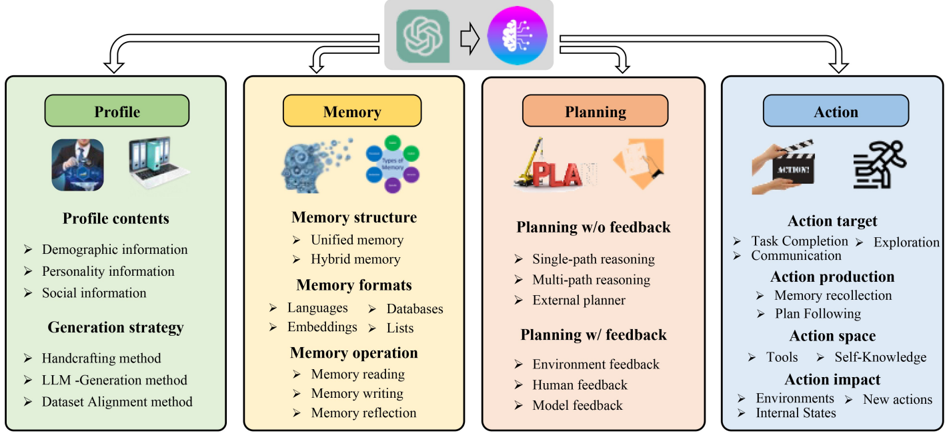
- For agent construction, they propose a unified architecture with four modules: profiling, memory, planning, and action; they also divide capability acquisition into fine-tuning and non-fine-tuning strategies.
- For evaluation, they distinguish subjective and objective methods; objective evaluation is further broken into metrics, protocols, and benchmarks such as task success, human similarity, efficiency, real-world simulation, social evaluation, multi-task evaluation, and software testing.
- The paper identifies major challenges including role-playing capability, prompt robustness, hallucination, knowledge boundary, and efficiency.
## Methods
- This is a survey/review paper, not an experimental study; it systematically organizes prior work on LLM-based autonomous agents.
- The survey is structured around three aspects: agent construction, application, and evaluation; construction is further split into architecture design and capability acquisition.
- The authors use taxonomies and representative examples from prior papers to synthesize methods, applications, benchmarks, and challenges.
## Limitations
- The paper does not report original experiments or new quantitative results; this is implied by the survey nature of the work.
- The text states that the field is “still at its initial stage”, so the synthesis is limited by the maturity of the underlying literature.
- The authors note that some content is “not explicitly discussed in the paper” in their tables/figures, indicating incomplete coverage of all possible agent designs and evaluation modes.
Model-written summary. Check it against the paper before relying on it.
Integrity signals
Registry
Cites
Statistics
Figures













Verification
Claims the paper makes
90 Valid · 12 Not valid · 9 Not checked · 90 Own results and interpretations
The cited sources support only part of this claim — read each source’s verdict below.
In the paper
“Building upon this capability, there has been a growing research area that employs LLMs as central controllers to construct autonomous agents to obtain human-like decisionmaking capabilities [11][12][13][14][15][16][17].”
§ A survey on large language model based autonomous agents > 1 Introduction
What the sources say
- Could not verifycites [11] 11. Chen X, Li S, Li H, Jiang S, Qi Y, Song L. Generative adversarial user model for reinforcement learning based recommendation system. In: Proceedings of the 36th International Conference on Machine Learning. 2019, 1052-1061 sourceExperimental — accuracy not yet measured
Our copy of Chen et al. (2018) is entirely about a model-based RL framework for recommendation systems: a GAN user-behaviour model plus a Cascading DQN policy (Abstract; Introduction, pp.1-2; Sections 5-6.3). No passage mentions large language models, LLMs as controllers, or autonomous agents with human-like decision-making; searches for 'large language model as central controller autonomous agent', 'LLM agent human-like decision-making capabilities' and 'language model transformer pre-trained controller agent' returned only semantically nearest passages on model-based RL, robotics sample efficiency (Introduction; Related Work) and the MovieLens/Taobao datasets (Section 6). The reference list (References, items 1-24) likewise stops at 2019 works (Shi et al., 2019) with no LLM-related entry, so the claim's point is not addressed by this source at all — neither supported nor contradicted. (LLM, conf=0.72)
- Supportedcites [12] 12. Shinn N, Cassano F, Gopinath A, rasimhan K, Yao S. Reflexion: language agents with verbal reinforcement learning. NaIn: Proceedings of the 37th Conference on Neural Information Processing Systems. 2023, 36 source
The Introduction (page not specified) describes recent research on autonomous decision-making agents built around an LLM core, with LLMs generating actions executed in an environment. This supports the citing sentence’s broad description of the research area; it does not establish that the agents’ decisions match human decisions. (LLM, conf=0.88)
- Partly supportedcites [13] 13. Shen Y, Song K, Tan X, Li D, Lu W, Zhuang Y. HuggingGPT: solving AI tasks with chatGPT and its friends in hugging face. In: Proceedings of the 37th Conference on Neural Information Processing Systems. 2023, 36 sourceExperimental — accuracy not yet measured
The “LLM as Controller” section describes an LLM directing expert models and serving as the brain for planning and decisions. “B More Discussion about Related Works” identifies HuggingGPT and other LLM-based systems as autonomous agents. These passages support the controller-and-agent research claim, but they do not establish that the agents attain human-like decision-making capabilities. (LLM, conf=0.82)
plainstates a cause- Asserted: passes — The authors put it forward as true.
- Checkable: passes — It can be checked against evidence.
- Load-bearing: passes — The paper’s conclusions depend on it.
- Based: passes — The paper gives a reason why it holds.
- Could not verify
The cited sources support only part of this claim — read each source’s verdict below.
In the paper
“Autonomous agents typically perform tasks by assuming specific roles, such as coders, teachers and domain experts [18,19].”
§ A survey on large language model based autonomous agents > 2.1.1 Profiling module
What the sources say
- Partly supportedcites [18] 18. Qian C, Cong X, Liu W, Yang C, Chen W, Su Y, Dang Y, Li J, Xu J, Li S, Liu Z, Sun M. Communicative agents for software development. 2023, arXiv preprint arXiv: 2307.07924 sourceExperimental — accuracy not yet measured
The Introduction describes autonomous agents with specialized roles cooperating on software-development tasks, and the Ablation Study discusses programmer and reviewer roles. The paper supports the role-based approach and the coder example, but the cited passages do not establish teachers or domain experts as agent roles, or that agents typically use roles across tasks generally. (LLM, conf=0.84)
- Supportedcites [19] 19. Chen W, Su Y, Zuo J, Yang C, Yuan C, Chan C, Yu H, Lu Y, Hung Y, Qian C, Qin Y, Cong X, Xie R, Liu Z, Sun M, Zhou, J. Agentverse: Facilitating multi-agent collaboration and exploring emergent behaviors in agents. arXiv preprint arXiv:2308.10848 . source
Section 2.1, “Expert Recruitment” (page not provided), says that current methods predominantly assign role descriptions to autonomous agents. The paper’s role prompts illustrate domain experts and coding-related roles, while its Evaluator prompt assigns an agent the role of a mathematics teacher. (LLM, conf=0.88)
plain- Asserted: passes — The authors put it forward as true.
- Checkable: passes — It can be checked against evidence.
- Load-bearing: unclear — It is unclear whether the paper’s conclusions depend on it.
- Based: passes — The paper gives a reason why it holds.
- Partly supported
Every source the paper cites for this claim was checked and supports it.
In the paper
“More specifically, in Generative Agent [20], the agent has the capability to summarize its past experiences stored in memory into broader and more abstract insights.”
§ A survey on large language model based autonomous agents > Memory operations:
What the sources say
- Supportedcites [20] 20. Park J S, O'Brien J, Cai C J, Morris M R, Liang P, Bernstein M S. Generative agents: interactive simulacra of human behavior. In: Proceedings of the 36th Annual ACM Symposium on User Interface Software and Technology. 2023, 2 source
The Introduction describes a memory stream that records agents’ experiences and a reflection component that synthesizes those memories into higher-level inferences. Section 4 likewise says memory records are recursively synthesized into higher-level reflections. (LLM, conf=0.94)
plain- Asserted: passes — The authors put it forward as true.
- Checkable: passes — It can be checked against evidence.
- Load-bearing: unclear — It is unclear whether the paper’s conclusions depend on it.
- Based: passes — The paper gives a reason why it holds.
- Supported
The cited sources support only part of this claim — read each source’s verdict below.
In the paper
“Usually, there three commonly used criteria for information extraction, that is, the recency, relevance, and importance [20].”
§ A survey on large language model based autonomous agents > Memory operations:
What the sources say
- Partly supportedcites [20] 20. Park J S, O'Brien J, Cai C J, Morris M R, Liang P, Bernstein M S. Generative agents: interactive simulacra of human behavior. In: Proceedings of the 36th Annual ACM Symposium on User Interface Software and Technology. 2023, 2 sourceExperimental — accuracy not yet measured
The Introduction says the paper’s memory-retrieval model combines recency, relevance, and importance to select records. It does not establish that these are commonly used criteria for information extraction generally; the claim extends the paper’s specific design into a broader practice. (LLM, conf=0.84)
plain- Asserted: passes — The authors put it forward as true.
- Checkable: passes — It can be checked against evidence.
- Load-bearing: unclear — It is unclear whether the paper’s conclusions depend on it.
- Based: passes — The paper gives a reason why it holds.
- Partly supported
The cited sources support only part of this claim — read each source’s verdict below.
In the paper
“Agents can directly alter environment states by actions, such as moving their positions, collecting items, and constructing buildings.”
§ A survey on large language model based autonomous agents > Action goal:
What the sources say
- Supportedcites [16] 16. Zhu X, Chen Y, Tian H, Tao C, Su W, Yang C, Huang G, Li B, Lu L, 16. Wang X, Qiao Y, Zhang Z, Dai J. Ghost in the minecraft: generally capable agents for open-world environments via large language models with text-based knowledge and memory. 2023, arXiv preprint arXiv: 2305.17144 source
The action descriptions on p. 14 say the agent walks toward objects, collects dropped items after mining or attacking, and places blocks according to a blueprint when building. These support the examples of changing position, collecting items, and constructing buildings. (LLM, conf=0.93)
- Partly supportedcites [38] 38. Wang G, Xie Y, Jiang Y, Mandlekar A, Xiao C, Zhu Y, Fan L, Anandkumar A. Voyager: an open-ended embodied agent with large language models. 2023, arXiv preprint arXiv: 2305.16291 sourceExperimental — accuracy not yet measured
The Introduction (p. 2) describes exploration and gathering resources, and the Full Prompt (p. 27) provides actions for moving to a position and placing a block. But the automatic-curriculum prompt (p. 22) explicitly excludes building tasks, so the paper does not establish constructing buildings as an activity of these agents. (LLM, conf=0.85)
plainstates a cause- Asserted: passes — The authors put it forward as true.
- Checkable: passes — It can be checked against evidence.
- Load-bearing: unclear — It is unclear whether the paper’s conclusions depend on it.
- Based: passes — The paper gives a reason why it holds.
- Supported
41 more claims · 22 with their cited sources checked
Create a free account to see all 201 claims and to verify the 14 references still open.
- It may state two separate claims as one. 79
- Probably not a substantial claim. 112
- The quote only partly states this claim. 2
Claims other papers make about this one
Each is checked against this paper’s own text: does it say what the citing paper says it does?
The source backs part of the claim, not all of it — or backs it for a different population, condition or comparison.
In the citing paper
“The existing literature reaches neither goal. Benchmark surveys report scores (typically SWEBench [1]) without touching architecture; conceptual taxonomies [5, 6] describe patterns without implementations; the one concurrent source-level taxonomy [34] excludes the provider-native systems that define the field's frontier.”
From Harness Engineering: Anatomy, Architecture, and Evolution of Coding Agents -- A Source-Code Study of Eleven Systems (2026) · cites this paper as [6]
Experimental — accuracy not yet measuredThe source backs part of the claim, not all of it — or backs it for a different population, condition or comparison.
In the citing paper
“Recent studies have converged on a recurring set of functional components underlying such systems, often defined by 4 core components: planning, action, reflection, and memory (PARM) [11].”
From Medical AI Agents for Clinical Decision Support: Viewpoint Using the Planning, Action, Reflection, and Memory (PARM) Analytical Lens (2026) · cites this paper as [11]
Experimental — accuracy not yet measuredThe source backs part of the claim, not all of it — or backs it for a different population, condition or comparison.
In the citing paper
“MAS, in which multiple autonomous agents collaborate as a team, are emerging as a powerful paradigm for biomedical and clinical data analysis [1,2].”
From A Review of Multi-Agent AI Systems for Biological and Clinical Data Analysis (2026) · cites this paper as [1]
Experimental — accuracy not yet measuredThe source backs part of the claim, not all of it — or backs it for a different population, condition or comparison.
In the citing paper
“LLM-based autonomous agents can achieve greater flexibility and robustness by dividing labor among sub-agents [1,3].”
From A Review of Multi-Agent AI Systems for Biological and Clinical Data Analysis (2026) · cites this paper as [1]
Experimental — accuracy not yet measuredThe source backs part of the claim, not all of it — or backs it for a different population, condition or comparison.
In the citing paper
“collaborative agent teams have produced superior results on complex bioinformatics analyses and clinical decision support challenges where no single model excels [1,4].”
From A Review of Multi-Agent AI Systems for Biological and Clinical Data Analysis (2026) · cites this paper as [1]
Experimental — accuracy not yet measured
23 more claims about this paper
Create a free account to see every claim other papers make about this one.
Citations
Cites
Proximal Policy Optimization Algorithms
Schulman, J., Wolski, F., Dhariwal, P., Radford, A., & Klimov, O. (2017) · arXiv · doi:10.48550/arxiv.1707.06347 · Cited by 40,403 · cited 1×
“In earlier paradigms, the policy functions that dictated the agent’s actions were conceived through heuristic methodologies and subsequently refined through environmental engagements [101, 86, 120, 55, 9, 116].”
Human-level control through deep reinforcement learning
Mnih, V., Kavukcuoglu, K., Silver, D., Rusu, A. A., Veness, J., Bellemare, M. G., Graves, A., Riedmiller, M., Fidjeland, A. K., Ostrovski, G., et al. (2015) · Nature · doi:10.1038/nature14236 · Cited by 30,357 · cited 1×
“In previous studies, the agents are assumed to act based on simple and heuristic policy functions, and learned in isolated and restricted environments [113, 96, 134, 60, 11, 127].”
BackgroundLanguage Models are Few-Shot Learners
Brown, T. B., Mann, B., Ryder, N., Subbiah, M., Kaplan, J., Dhariwal, P., Neelakantan, A., Shyam, P., Sastry, G., Askell, A., et al. (2020) · arXiv · doi:10.48550/arxiv.2005.14165 · Cited by 23,372 · cited 2×
“In earlier paradigms, the policy functions that dictated the agent’s actions were conceived through heuristic methodologies and subsequently refined through environmental engagements [101, 86, 120, 55, 9, 116].”
Advances in neural information processing systems 7
Cios, K., & Shields, M. (1997) · Neurocomputing · doi:10.1016/s0925-2312(97)90018-7 · Cited by 22,059
Proceedings of the 24th international conference on Machine learning
(2007) · doi:10.1145/1273496 · Cited by 11,630
Continuous control with deep reinforcement learning
Lillicrap, T. P., Hunt, J. J., Pritzel, A., Heess, N., Erez, T., Tassa, Y., Silver, D., & Wierstra, D. (2015) · arXiv · doi:10.48550/arxiv.1509.02971 · Cited by 10,782
Tree of Thoughts: Deliberate Problem Solving with Large Language Models
Yao, S., Yu, D., Zhao, J., Shafran, I., Griffiths, T. L., Cao, Y., & Narasimhan, K. (2023) · arXiv · doi:10.48550/arxiv.2305.10601 · Cited by 7,650 · cited 2×
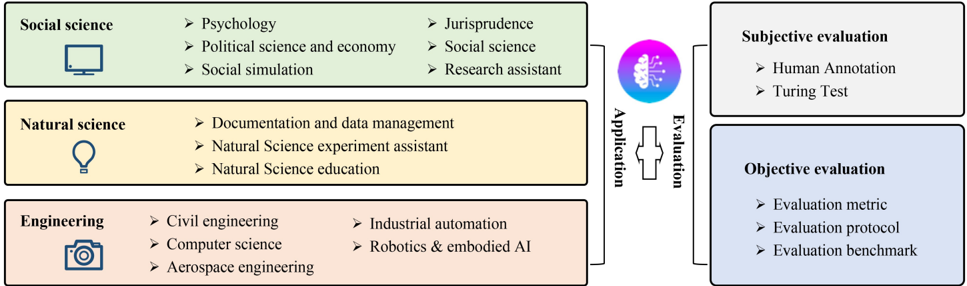
“5 The applications (left) and evaluation strategies (right) of LLM-based agents. but are highly related to this area.”
Soft actor-critic Off-policy maximum entropy deep reinforcement learning with a stochastic actor
Haarnoja, T., Zhou, A., Abbeel, P., & Levine, S. (2018) · arXiv · doi:10.48550/arxiv.1801.01290 · Cited by 5,594
Survey of Hallucination in Natural Language Generation
Ji, Z., Lee, N., Frieske, R., Yu, T., Su, D., Xu, Y., Ishii, E., Bang, Y. J., Madotto, A., & Fung, P. (2023) · ACM Computing Surveys · doi:10.1145/3571730 · Cited by 5,025 · cited 2×
“Hallucination can lead to serious consequences such as incorrect or misleading code, security risks, and ethical issues [74].”
BackgroundSurvey of Hallucination in Natural Language Generation
Ji, Z., Lee, N., Frieske, R., Yu, T., Su, D., Xu, Y., Ishii, E., Bang, Y., Chen, D., Dai, W., et al. (2022) · arXiv · doi:10.48550/arxiv.2202.03629 · Cited by 4,981
Research works printed but not linked: 6
- 6. Radford A, Wu J, Child R, Luan D, Amodei D, Sutskever I. Language models are unsupervised multitask learners. OpenAI Blog, 2019, 1(8): 9
- 47. Raman S S, Cohen V, Rosen E, Idrees I, Paulius D, Tellex S. Planning with large language models via corrective re-prompting. In: Proceedings of Foundation Models for Decision Making Workshop at Neural Information Processing Systems. 2022
- 86. Weng X, Gu Y, Zheng B, Chen S, Stevens S, Wang B, Sun H, Su Y. Mind2Web: towards a generalist agent for the Web. In: Proceedings of the 37th Conference on Neural Information Processing Systems. 2023, 36
- 103. Aher G V, Arriaga R I, Kalai A T. Using large language models to simulate multiple humans and replicate human subject studies. In: Proceedings of the 40th International Conference on Machine Learning. 2023, 337-371 102.
- 123. Mehta N, Teruel M, Sanz P F, Deng X, Awadallah A H, Kiseleva J. Improving grounded language understanding in a collaborative environment by interacting with agents through help feedback. 2024, arXiv preprint arXiv: 2304.10750 122. SmolModels. See Githubcom/smol-ai/developer website, 2023 123. DemoGPT. See Github.com/melih-unsal/Demo website, 2023 124. · arXiv
- 135. Nottingham K, Ammanabrolu P, Suhr A, Choi Y, Hajishirzi H, Singh S, Fox R. Do embodied agents dream of pixelated sheep: embodied decision making using language guided world modelling. In: Proceedings of the 40th International Conference on Machine Learning. 2023, 26311-26325 137.
Cited by
Items 1,701–1,800 of 1,854
A Large Language Model-based Multi-Agent Framework for Automated Privacy Policy Analysis
Tian, R., Zhao, S., Yang, Q., Zhang, Y., & Wang, H. (2025) · IEEE Annual Congress on Artificial Intelligence of Things (AIoT) · doi:10.1109/aiot66900.2025.00149
Wang, S., Liu, A., & Xu, X. (2026) · Procedia CIRP · doi:10.1016/j.procir.2026.05.242
Khan, S., Samuelsson, J. G., Cai, X., Natarajan, K., & Madhavan, S. (2026) · Drug Discovery Today · doi:10.1016/j.drudis.2026.104754 · Cited by 1
Bougault, P., Ma, L., & Guey, W. (2026) · Lecture notes in computer science · doi:10.1007/978-3-032-29842-3_20
The Survey for a Hierarchical Resource Management Framework Enabled with LLM-based Agents
Chan, D., Wu, Y., Bai, D., Mak, T., Chan, T., XinXu, & Qiu, T. (2024) · IEEE Future Networks World Forum (FNWF) · doi:10.1109/fnwf63303.2024.11028788
Automated Structural Testing of LLM-Based Agents: Methods, Framework, and Case Studies
Kohl, J., Kruse, O., Mostafa, Y., Luckow, A., Schroer, K., Riedl, T. R., French, R., Katz, D., Luitz, M. P., Takher, T., et al. (2025) · IEEE International Conference on Big Data (BigData) · doi:10.1109/bigdata66926.2025.11401679 · Cited by 2
LOOM: Weaving high-quality long-texts through hierarchical planning and reflective feedback
Guo, T., Yang, Q., Liu, Y., Tang, J., Qu, F., & Wen, Y. (2026) · Expert Systems with Applications · doi:10.1016/j.eswa.2026.132879
Self-citationXue, X., Lin, S., Liang, J., Kumari, S., Alsabaan, M., & Li, N. (2026) · IEEE Journal of Selected Topics in Applied Earth Observations and Remote Sensing · doi:10.1109/jstars.2026.3719281 · Cited by 3
Agentic AI in Optical Networks: Navigating the Autonomy and Abstraction Trade-offs
Ahmadian, M., Natalino, C., & Monti, P. (2026) · International Conference on Transparent Optical Networks · doi:10.1109/icton71309.2026.11705323
Large Language Model-Based Smart Agents for Attack-Defense Game on Cyber-Physical Power Systems
Wang, B., Zhou, Y., Wang, S., Xu, B., & Deng, R. (2026) · IEEE Transactions on Smart Grid · doi:10.1109/tsg.2026.3681079 · Cited by 3
Congestion-Aware Scheduling for Heterogeneous LLM-Agent Teams
Xie, W.-Q., & Li, Y. (2026) · Annual International Computer Software and Applications Conference · doi:10.1109/compsac69091.2026.00432
MindTrellis: Co-Creating Knowledge Structures with AI through Interactive Visual Exploration
Li, X., Li, C. Y., Kuang, E., Liu, C., & Zhao, J. (2026) · Designing Interactive Systems Conference · doi:10.1145/3800645.3813045 · Cited by 3
Skill VM: Write Once, Run Everywhere Efficiently
Chen, L., Feng, E.-H., Xia, Y.-B., & Chen, H.-B. (2026) · Proceedings of the ACM SIGOPS 32nd Symposium on Operating Systems Principles · doi:10.1145/3830418.3843874
Mohamed, N., Chakrabarti, P., & Gupta, S. K. (2026) · Journal of Smart Algorithms and Applications (JSAA) · doi:10.66279/y29vex64
Software Performance Engineering for Foundation Model-Powered Software
Zhang, H., Chang, S., Leung, A., Thangarajah, K., Chen, B., Lutfiyya, H. L., & Hassan, A. E. (2026) · ACM Transactions on Software Engineering and Methodology · doi:10.1145/3794844 · Cited by 4
Agentic Self-RAG: An Ablation Study for Zero-Shot Biomedical Question Answering
Wibawa, R. P., Putri, S. W., Wijaya, A. L., & Hidayaturrahman (2026) · IEEE International Conference on Industry 4.0, Artificial Intelligence, and Communications Technology (IAICT) · doi:10.1109/iaict71158.2026.11621038
Sim-Stu: A Multi-Agent System for Simulating Learning Processes
Zhang, W., Du, X., Dong, T., Ren, W., Tan, J. Y., & Ma, B. (2025) · IEEE International Conference on Agents (ICA) · doi:10.1109/ica67499.2025.00019
CostGuard: A Cost-Aware Agentic AI Framework for Efficient Enterprise LLM Workflows
Sriram, S., & Arul Murugan, A. (2026) · International Conference on Data Science for Cyber-Physical Systems Resilience using Advanced Applications (ICDCA) · doi:10.1109/icdca69396.2026.11620090 · Cited by 1
Design of Intelligent Marking System Based on LLM
魏, 明. (2025) · Management Science and Engineering · doi:10.12677/mse.2025.143087
Matilla-Molina, A., Dodero, J. M., & Muñoz, A. (2026) · IEEE International Conference on Big Data Computing Service and Applications (BigDataService) · doi:10.1109/bigdataservice70481.2026.00020
Designing A Scalable LLM Agent Framework for Large-scale Urban Segregation Simulation
Zeng, Q., Yan, Y., Zheng, Z., Yuan, J., Zhang, J., Feng, J., Xu, F., Evans, J. A., & Li, Y. (2026) · ACM SIGKDD Conference on Knowledge Discovery and Data Mining (KDD) · doi:10.1145/3770855.3818944 · Cited by 1
Self-citationDesigning Inclusive Hybrid Pedagogies in Physical Science With AI From Classroom to Cloud
Devaki, V., Suresh, C., Vidya, V., & Boopathi, L. (2026) · Advances in computational intelligence and robotics book series · doi:10.4018/979-8-3373-7462-8.ch009 · Cited by 1
AutoEER: Large Language Model Agent Framework for Automated English Exam Report
Xie, D., Li, X., Xiong, Q., Wang, S., Jiang, Y., Liang, Y., & Jin, A. (2025) · International Academic Exchange Conference on Science and Technology Innovation (IAECST) · doi:10.1109/iaecst68792.2025.11415007
Explainable dynamic service price prediction using guided self-reflective large language models
Yu, C.-Z., Li, Z., Wang, Y., Li, W., & Mo, T. (2026) · Service Oriented Computing and Applications · doi:10.1007/s11761-025-00486-3
Agentic AI for Autonomous Marketing: Taxonomy, Benchmark, and an Open-Source Agent
Thapa, P., Khadka, S., Sharma, P., Rai, A., Bhattarai, U., Regmi, K., & Bohara, P. (2026) · doi:10.1145/3838457.3838570
How to Steer Your Multi-Agent System: Human-LLM Collaborative Planning
He, Z., Kim, H., Zhang, D., & Junior, E. R. H. (2026) · ACM Conference on AI and Agentic Systems (CAIS) · doi:10.1145/3786335.3813144 · Cited by 4
Dutta, A. (2026) · Advances in computational intelligence and robotics book series · doi:10.4018/979-8-2600-0263-6.ch011
Singh, A., Mukhopadhyay, A., Saini, M. L., Kumar, A., & Verma, S. K. (2026) · International Conference on Smart Futuristic Technology (SMARTTECH) · doi:10.1109/icsft66733.2026.11506779
Jiménez-Sánchez, A., Rodríguez-Marcos, C., Domínguez-Castro, S., Carrera, A., & Alonso, R. S. (2026) · Electronics · doi:10.3390/electronics15163704
A detailed review of large language models in the healthcare sector
Ozsahin, D. U., Emegano, D. I., Uzun, B., & Özsahin, İ. (2026) · Journal of Electrical Systems and Information Technology · doi:10.1186/s43067-026-00327-z
Yifeng, P. (2024) · SSRN Electronic Journal · doi:10.2139/ssrn.4885346
PERSIST: Threat Modeling Memory‐Persistent AI Agents in Cloud‐to‐Edge Environments
Brobbey, A. A., & Bhosale, N. P. (2026) · Security and Privacy · doi:10.1002/spy2.70248
An NPC Interaction Architecture Design for AI-Driven Game
Wu, H.-C., Chou, T.-H., Huang, Y., et al. (2026) · IEEE International Conference on Consumer Electronics - Taiwan (ICCE-Taiwan) · doi:10.1109/icce-taiwan71481.2026.11652768
Poster Abstract: Generative Occupants: LLM Agents in a Physics-Based Building Energy Simulation
Nicholas, L., Gauthier, S., Stein, S., & Gerding, E. (2026) · ACM Sustainability Week · doi:10.1145/3765611.3815333
Patlolla, C. S. R. A. R. R. (2025) · International Journal of Advanced Research in Science Communication and Technology · doi:10.48175/ijarsct-28493
Integrating LLMs and Classical Planning for Pallet Logistics: A Case Study
Goebel, K., Lorang, P., Staderini, V., & Zips, P. (2025) · IFAC-PapersOnLine · doi:10.1016/j.ifacol.2025.10.237 · Cited by 2
AgentInspect: Diagnosing Behavioral Failures in Artificial Intelligence Agents
Manke, R., Wardat, M., Khomh, F., & Rajan, H. (2026) · Proceedings of the ACM on software engineering. · doi:10.1145/3832174 · Cited by 1
A Generative AI-Based Framework for Business Process Orchestration in Industrial Enterprises
Ilieva, G., & Iliev, Y. (2026) · Electronics · doi:10.3390/electronics15153392 · Cited by 1
Time to Proceed with Higher Reasoning Models for Surgical Academics than General-Purpose LLMs
Ray, P. (2025) · Indian Journal of Surgery · doi:10.1007/s12262-025-04362-4
Architecture Without Architects: How AI Coding Agents Shape Software Architecture
Konrad, P. M., Adam, T. L., Terrenzi, R., & Ayvaz, S. (2026) · IEEE International Conference on Software Architecture Companion (ICSA-C) · doi:10.1109/icsa-c68850.2026.00087 · Cited by 5
Heuristically motivating large language models for task planning
Wang, C., Cao, L., Qi, J., & Ye, L. (2026) · Knowledge-Based Systems · doi:10.1016/j.knosys.2026.115725 · Cited by 1
Adaptive Ambiguity Reduction in Crop Disease Diagnosis via an LLM Agent
Ghommat, K., Bourkoukou, O., & Ouaarab, A. (2026) · International Conference on Circuit, Systems and Communication (ICCSC) · doi:10.1109/iccsc71566.2026.11650340
Zhang, X., Xu, G., Wang, C., Wang, H., She, M., Qiao, S., Shen, W., & Liu, M. (2026) · Journal of Manufacturing Systems · doi:10.1016/j.jmsy.2026.08.005
Chao, L., & Ma, X. (2026) · Research Square · doi:10.21203/rs.3.rs-10644054/v1
Extending CArtAgO to Support the Engineering of Distributed Environments at the Knowledge Level
Ricci, A., Ciortea, A., & Burattini, S. (2026) · Lecture notes in computer science · doi:10.1007/978-3-032-22817-8_2
Li, X., Zh, L., Jiang, S., Chen, J., & Chen, W. (2026) · International Journal of STEM Education · doi:10.1186/s40594-026-00641-y · Cited by 1
BlinkChat: Blink-Augmented Prompting for Adaptive Human–LLM Interaction
Li, Z., & Li, T. (2026) · International Conference on Mobile Systems, Applications, and Services · doi:10.1145/3812836.3814747
iBRAHIMOĞLU, N., Demirezen, M. U., & Yıldız, F. (2026) · Cluster Computing · doi:10.1007/s10586-026-06537-4 · Cited by 3
Comparing the Neuropsychology Knowledge Base of Publicly Available Large Language Models
Kronenberger, O. R., Hutnyan, M., Kaser, A. N., Bullinger, L., Lacritz, L. H., & Cullum, C. M. (2025) · Archives of Clinical Neuropsychology · doi:10.1093/arclin/acaf112
Privacy, Data Sovereignty, and Consent Ethics of Agentic AI in Higher Education
Nwasra, N. M., & Alharthy, A. (2026) · Advances in computational intelligence and robotics book series · doi:10.4018/979-8-2600-4050-8.ch002
Knowledge-guided multi-agent framework for intelligent acupuncture diagnosis and reasoning
Zhang, W., Cui, J., Zhao, M., Zhang, M., & Li, P. (2026) · Engineering Applications of Artificial Intelligence · doi:10.1016/j.engappai.2026.116139
Zhang, C.-Y. (2026) · 2026 12th International Conference on Big Data and Information Analytics (BigDIA) · doi:10.1109/bigdia71496.2026.11684535
周一村 (2026) · Journal of Computer Science and Artificial Intelligence · doi:10.54097/e8q82083
Sun, Z., Groppe, J., & Groppe, S. (2026) · Lecture notes in computer science · doi:10.1007/978-3-032-34374-1_15
Ghaywat, V., Singh, A., Shahade, A. K., Khan, W., & Deshmukh, P. V. (2026) · Discover Artificial Intelligence · doi:10.1007/s44163-026-02373-y
AgentHOI: Towards Multi-Agent Collaborative Human-Object Interaction Detection
Wang, Y., Lei, Y., & Liu, Q. (2026) · IEEE Internet of Things Journal · doi:10.1109/jiot.2026.3685409
Enhancing Outcome Based Education with Data Science: A Case Study at Parul University
Agal, S., Raulji, K. M., Parashar, P., & Shekokar, K. (2026) · Lecture notes in networks and systems · doi:10.1007/978-3-032-22567-2_26
Enhancing ROS Debugging: A User-Centric Diagnostic Framework
Katuwandeniya, K., Widhanapathirana, S. R. J., Kulić, D., & Tian, L. (2026) · IEEE Robotics and Automation Letters · doi:10.1109/lra.2026.3703238 · Cited by 1
Progressive subgoal-aggregated long-sequence decision-making with large language models
Li, Y., Liu, Y., Zhang, T., Huang, B., & Cui, Z. (2026) · Engineering Applications of Artificial Intelligence · doi:10.1016/j.engappai.2026.115538
AI Agent Framework Research for Dynamic BIM Query via Retrieval-Augmented Code Generation for IFC
Kang, T. (2026) · Buildings · doi:10.3390/buildings16142786 · Cited by 1
Multi-Agent LLM Architecture for Systems Engineering Automation
Padubrin, M., Kulzer, A. C., & Guerocak, E. (2026) · SAE technical papers on CD-ROM/SAE technical paper series · doi:10.4271/2026-01-0777
Event-Structured LLM Planning for Continuous-Parameter Industrial Workflows
Wei, H., & Zhang, Z. (2026) · International Conference on Mechatronics Technology and Intelligent Manufacturing (ICMTIM) · doi:10.1109/icmtim69588.2026.11525771
Self-citationAgentic AI Unleashed: Power, Promise, and Ethical Frontiers
Wang, M., Wang, Y., & Ma, Q. (2026) · Lecture notes in computer science · doi:10.1007/978-981-92-3761-6_3
Reimagining Educational Techniques with Artificial Intelligence 1
Kloos, C. D., Alario‐Hoyos, C., Muñoz-Merino, P. J., Ayres, I. E., Moreno-Marcos, P. M., Callejo, P., & Kemcha, R. (2026) · IEEE Global Engineering Education Conference (EDUCON) · doi:10.1109/educon67543.2026.11574341 · Cited by 1
Machine learning for mineralogy: From atoms to earth system
Zhao, Z., Chen, H., Ji, X., Lu, X., & Li, W. (2026) · Earth-Science Reviews · doi:10.1016/j.earscirev.2026.105514 · Cited by 1
Hintze, A., Sokratous, K., & Thomas, I. (2026) · Computers in Human Behavior Artificial Humans · doi:10.1016/j.chbah.2026.100306
Nimmakayala, S. (2025) · 2025 International Conference on Intelligent Computing, Information and Control Systems (ICOIICS) · doi:10.1109/icoiics67115.2025.11390272
Shiqi, W. (2026) · International Conference on Multi-scale Artificial Intelligence (MAI) · doi:10.1109/mai69289.2026.11543776
Simulating Influence Dynamics with LLM Agents
Nasim, M., Gilani, S. M., Qasmi, A., & Naseem, U. (2025) · IEEE International Conference on Big Data (BigData) · doi:10.1109/bigdata66926.2025.11401885 · Cited by 3
Kim, J. (2026) · Journal of Smart Tourism · doi:10.1177/27652157261488111
Agile Design of Intelligent Packaging Inspection System Based on RAG Agent
Ding, Y., & Yang, Z. (2025) · International Symposium on Computational Intelligence and Design · doi:10.1109/iscid68789.2025.00045
LLM Deployment Strategies on Mobile Edge Servers for Dynamic Uncertain User Requests
Liu, J., Wang, J., Huang, Y., & Wang, C. (2026) · IEEE Transactions on Network and Service Management · doi:10.1109/tnsm.2026.3708677 · Cited by 1
Wang, C., Bai, J., Zhang, Z., luo, L., & Zhu, C. (2026) · Swarm and Evolutionary Computation · doi:10.1016/j.swevo.2026.102539
Self-citationAn Organization-Scoped LLM Agent Runtime Architecture for Regulated Cybersecurity Operations
Fatouros, G., Makridis, G., Kousiouris, G., Soldatos, J., & Kyriazis, D. (2026) · International Conference on Distributed Computing in Smart Systems and the Internet of Things (DCOSS-IoT) · doi:10.1109/dcoss-iot69657.2026.00163 · Cited by 4
Learning to Debate: Optimal Stopping Strategies for Multi-Agent LLM Deliberation
Zhang, X., & Hu, D. (2026) · International Conference on Generative Artificial Intelligence and Information Security (GAIIS) · doi:10.1109/gaiis69281.2026.11519273
Towards an Approach for Specifying Intelligent Systems Involving Foundation Model Based Agents
Araújo, J., Araújo, M. C., Boaro, J. M. C., & Kalinowski, M. (2026) · IEEE/ACM International Conference on AI Engineering – Software Engineering for AI (CAIN) · doi:10.1145/3793653.3793788 · Cited by 1
Interfacing Minds, Organizing Interactions: A Novel Human-AI Interaction Framework for Dyadic Teams
Merwin, E. R., Brennan, L., Gonzalez, G. M., Lazzara, E. H., & Keebler, J. R. (2026) · Lecture notes in computer science · doi:10.1007/978-3-032-30846-7_22
Closing the Empirical Loop: Autonomous AI Agents Conduct End‐to‐end Research With Human Participants
Wehr, G., Rideaux, R., Fox, A. J., Lightfoot, D. R., Tangen, J. M., Mattingley, J. B., & Ehrhardt, S. E. (2026) · Advanced Science · doi:10.1002/advs.76675
Intent-Driven Cooperative Control of UAV Swarms: An LLM-Based Approach
Li, Z., Qian, R., Qi, Y., Wang, C., & Su, H. (2026) · Applied Sciences · doi:10.3390/app16073297 · Cited by 2
A Progressive Visual-Logic-Aligned Framework for Ride-Hailing Adjudication
Wu, W., Cheng, Z.-J., Meng, J., Zhen, 彭. P., Huang, S., Li, Q., Wu, G., & Guo, L.-Z. (2026) · ACM SIGKDD Conference on Knowledge Discovery and Data Mining (KDD) · doi:10.1145/3770855.3817688 · Cited by 1
Kim, J., & Oh, U. (2026) · CHI Conference Extended Abstracts on Human Factors in Computing Systems (CHI EA) · doi:10.1145/3772363.3798781
Chen, S. (2026) · arXiv · doi:10.48550/arxiv.2606.22528 · Cited by 21
Large language models for agentic NetOps and AIOps: Architectures, evaluation, and safety
Bilal, M., Crowcroft, J., Wang, R., Xu, X., & Dustdar, S. (2027) · Computer Science Review · doi:10.1016/j.cosrev.2026.101075 · Cited by 10
“[35], [36], [37], [38] Agent architectures, tool use, planning, memory, and feedback Gives the general agentic de-sign vocabulary needed for LLM-based agents Usually treats tools as capabilities.”
ReasoningBank: Scaling Agent Self-Evolving with Reasoning Memory
Ouyang, S., Yan, J., Hsu, I.-H., Chen, Y., Jiang, K., Wang, Z., Han, R., Le, L. T., Daruki, S., Tang, X., et al. (2025) · arXiv · doi:10.48550/arxiv.2509.25140 · Cited by 295
“The rapid advancement of large language models (LLMs) has significantly accelerated the development of LLM agents (Liu et al., 2025a; Wang et al., 2024), which are crucial for tackling complex real-world tasks that require multi-step interactions with environments, including web browsing (Gur et…”
Multi-Agent Debate Strategies: Survey, Taxonomy, and Challenges
Motger, Q., Oriol, M., Marco, J., & Franch, X. (2026) · arXiv · doi:10.48550/arxiv.2607.26212 · Cited by 5
D-MEM: Dopamine-Gated Agentic Memory via Reward Prediction Error Routing
Song, Y., & Xin, Q. (2026) · arXiv · doi:10.48550/arxiv.2603.14597 · Cited by 1
“Autonomous Large Language Model (LLM) agents have rapidly transitioned from stateless task-solvers to persistent, stateful systems capable of long-term interaction [Wang et al., 2024, Xi et al., 2023].”
Xia, B., Liu, Y., Lu, Q., Zhu, L., Sejdinović, D., & Xu, X. (2026) · Information and Software Technology · doi:10.1016/j.infsof.2026.108307 · Cited by 2
Huang, Y., Feng, M., He, Z., Peng, Y., & Li, J. (2025) · International Workshop on Multimodal and Responsible Affective Computing (MRAC) · doi:10.1145/3746270.3760223 · Cited by 2
Enhancing LLM Agent Effectiveness via Reflective Multi-Agent System
Mohamed, A. H., Santos, F. A., & dos Reis, J. C. (2025) · Anais do Workshop-Escola de Sistemas de Agentes, seus Ambientes e Aplicações (WESAAC) · doi:10.5753/wesaac.2025.37536 · Cited by 2
ijlessjournal (2026) · مجلة القانون والأعمال الدولية · doi:10.63585/ozsp2793 · Cited by 15
Bahi, A., & Ourici, A. (2026) · Computer Science Review · doi:10.1016/j.cosrev.2026.101076
A critical assessment of the rise of agentic AI, its capabilities, task domains and open challenges
Khan, R. U., Aljuaid, H., & Ning, Z. (2026) · Discover Artificial Intelligence · doi:10.1007/s44163-026-02342-5 · Cited by 3
Kabir-Chisty, M. (2026) · Research Square · doi:10.21203/rs.3.rs-11227072/v1
Leuva, N., Patadia, C., & Goyal, U. (2026) · doi:10.1109/aims71270.2026.11712705
Comparing large language models and prompting techniques to control an embodied persuasive coach
Corrò, C., & Chittaro, L. (2026) · Behaviour and Information Technology · doi:10.1080/0144929x.2026.2742725
Kővári, A. (2026) · Discover Artificial Intelligence · doi:10.1007/s44163-026-02312-x
Syed, T. A., Akarma, A., Kamal, S., Jan, S., Alkhodre, A. B., & Jamal, A. (2026) · Frontiers in Artificial Intelligence · doi:10.3389/frai.2026.1942376 · Cited by 1
Déjà Vu: Unlocking Transparent Action Reasoning for Object-Goal Navigation via Large Language Models
Du, H., Wang, S., Li, X., & Yu, X. (2026) · Proceedings - IEEE International Conference on Robotics and Automation/Proceedings · doi:10.1109/icra57385.2026.11696038
Intelligent Mechatronics: intelligence in the design process, not only the machine
Hagen, D. (2026) · Frontiers in Mechanical Engineering · doi:10.3389/fmech.2026.1968837
Metadata
- Authors
- Wang, L., Ma, C., Feng, X., Zhang, Z., Yang, H., Zhang, J., Chen, Z., Tang, J., Chen, X., Lin, Y., Zhao, W. X., Wei, Z., & Wen, J.
- Affiliations
- Renmin University of China (CN)
- Corresponding author
- Chen, Xu
- Lin, Yankai
- ORCID
- Venue
- Frontiers of Computer Science
- Published
- 2024-03-22
- Volume
- 18
- Issue
- 6
- ISSN
- 2095-2228 (ISSN-L)
- 2095-2236
- OpenAlex
- W4393065402
- Semantic Scholar
- 28c6ac721f54544162865f41c5692e70d61bccab
- Cited by
- 1,941
- References
- 61
- Citations by year
- 2026: 1060 · 2025: 623 · 2024: 249
- FWCI
- 284.94
- Type
- journal article
- Language
- en
- Open access
- hybrid
- doi.org
- Licence
- cc-by
- creativecommons.org/licenses/by/4.0 (tdm)
- creativecommons.org/licenses/by/4.0 (vor)
- Locations
- Frontiers of Computer Science (publishedVersion, cc-by)
- arXiv (Cornell University) (submittedVersion, cc-by)
- arXiv (Cornell University) (cc-by)
- Funders
- National Natural Science Foundation of China (62102420)
- Renmin University of China
- Topics
- Physical Sciences › Computer Science › Artificial Intelligence › Artificial Intelligence Applications
- Physical Sciences › Computer Science › Artificial Intelligence › AI-based Problem Solving and Planning
- Physical Sciences › Computer Science › Artificial Intelligence › Topic Modeling
- Keywords
- large language models, autonomous agents, LLM agents, agent applications, assessment methods, human-like decision making, social science applications, engineering applications
About these checks
Registry, retraction, Cites and statistics results are computed, not judged, with one exception: a printed reference that no index lists is read once by a model before it counts as a citation error. Claims are extracted by a model and kept only when their quote appears verbatim in the text; each cited source is then checked, with a model’s help, for whether it says what the claim relies on. Those verdicts can be wrong — read the claim’s quote and the cited source before relying on one.
The claim verdicts this report counts are experimental: their accuracy is not yet measured.
A language model drew the claims from the paper on 2026-09-28, under version 3 of the claim definition (model deepseek-v4.1-flash, prompt extract-v3).
A second model labelled each claim on 2026-09-28 (model jev-1.13-20260917, definition revision gold-guideline-v0.2).
Cited sources are checked with a language model’s help (qwen3.8-omni-flash and gpt-6-sol).
Statistics and arithmetic are recomputed, not judged.
Confidence bands are shown only for fields calibrated on our annotated test set. None is calibrated yet, so no band is shown.
What counts as a claim ›How we measure confidence ›How we check this ›
Are you an author, or do you see a problem with this page? Request a review
Data sources
Bibliographic data: Semantic Scholar, OpenAlex, Crossref.
Contains information from the Semantic Scholar Academic Graph Datasets, made available under the ODC Attribution License (ODC-BY 1.0).
Semantic Scholar’s data is described in: Kinney, R., et al. (2023). The Semantic Scholar Open Data Platform. arXiv:2301.10140.
