

A survey on large language model based autonomous agents
Open accessThe DOI matches its Crossref record; 205 of the 205 references it cites were found in a registry or an index; 159 of the 182 sources its claims cite were checked for support.
Abstract
Abstract Autonomous agents have long been a research focus in academic and industry communities. Previous research often focuses on training agents with limited knowledge within isolated environments, which diverges significantly from human learning processes, and makes the agents hard to achieve human-like decisions. Recently, through the acquisition of vast amounts of Web knowledge, large language models (LLMs) have shown potential in human-level intelligence, leading to a surge in research on LLM-based autonomous agents. In this paper, we present a comprehensive survey of these studies, delivering a systematic review of LLM-based autonomous agents from a holistic perspective. We first discuss the construction of LLM-based autonomous agents, proposing a unified framework that encompasses much of previous work. Then, we present a overview of the diverse applications of LLM-based autonomous agents in social science, natural science, and engineering. Finally, we delve into the evaluation strategies commonly used for LLM-based autonomous agents. Based on the previous studies, we also present several challenges and future directions in this field.
Overview
CoChat Summary
## TL;DR
This paper is a survey of LLM-based autonomous agents, organizing the literature around three pillars: construction, application, and evaluation. It proposes a unified framework for agent architecture, reviews application areas across social science, natural science, and engineering, and summarizes common evaluation strategies plus open challenges.
## Key findings
- The authors state they compiled 100 relevant works on LLM-based agents and synthesized them into a taxonomy covering construction, application, and evaluation.
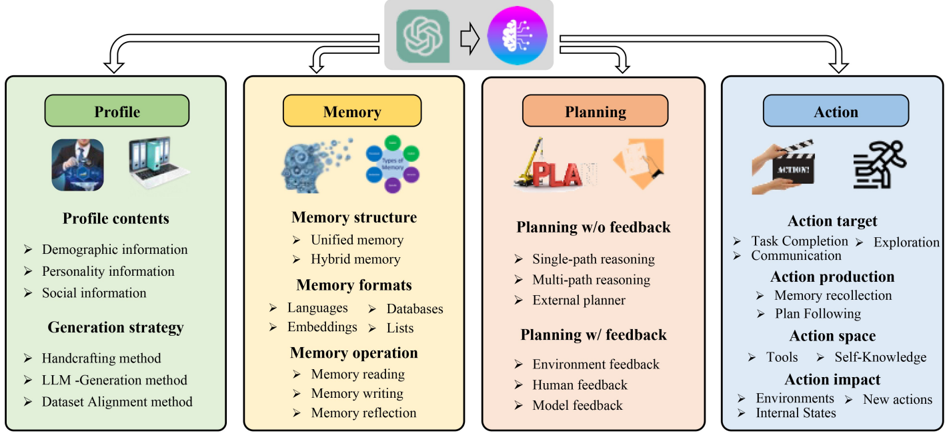
- For agent construction, they propose a unified architecture with four modules: profiling, memory, planning, and action; they also divide capability acquisition into fine-tuning and non-fine-tuning strategies.
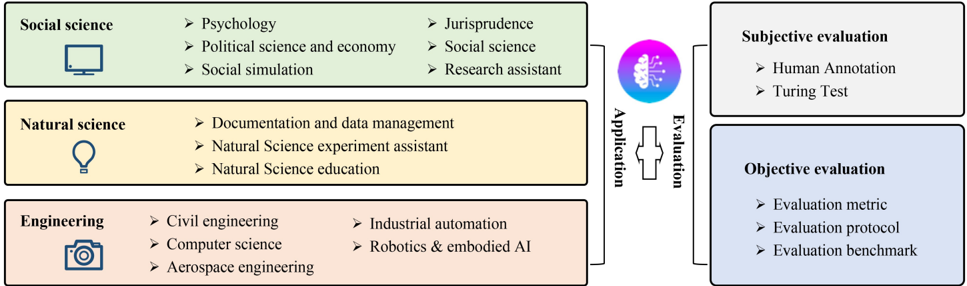
- For evaluation, they distinguish subjective and objective methods; objective evaluation is further broken into metrics, protocols, and benchmarks such as task success, human similarity, efficiency, real-world simulation, social evaluation, multi-task evaluation, and software testing.
- The paper identifies major challenges including role-playing capability, prompt robustness, hallucination, knowledge boundary, and efficiency.
## Methods
- This is a survey/review paper, not an experimental study; it systematically organizes prior work on LLM-based autonomous agents.
- The survey is structured around three aspects: agent construction, application, and evaluation; construction is further split into architecture design and capability acquisition.
- The authors use taxonomies and representative examples from prior papers to synthesize methods, applications, benchmarks, and challenges.
## Limitations
- The paper does not report original experiments or new quantitative results; this is implied by the survey nature of the work.
- The text states that the field is “still at its initial stage”, so the synthesis is limited by the maturity of the underlying literature.
- The authors note that some content is “not explicitly discussed in the paper” in their tables/figures, indicating incomplete coverage of all possible agent designs and evaluation modes.
Model-written summary. Check it against the paper before relying on it.
Integrity signals
Registry
Cites
Statistics
Figures













Verification
Claims the paper makes
90 Valid · 12 Not valid · 9 Not checked · 90 Own results and interpretations
The cited sources support only part of this claim — read each source’s verdict below.
In the paper
“Building upon this capability, there has been a growing research area that employs LLMs as central controllers to construct autonomous agents to obtain human-like decisionmaking capabilities [11][12][13][14][15][16][17].”
§ A survey on large language model based autonomous agents > 1 Introduction
What the sources say
- Could not verifycites [11] 11. Chen X, Li S, Li H, Jiang S, Qi Y, Song L. Generative adversarial user model for reinforcement learning based recommendation system. In: Proceedings of the 36th International Conference on Machine Learning. 2019, 1052-1061 sourceExperimental — accuracy not yet measured
Our copy of Chen et al. (2018) is entirely about a model-based RL framework for recommendation systems: a GAN user-behaviour model plus a Cascading DQN policy (Abstract; Introduction, pp.1-2; Sections 5-6.3). No passage mentions large language models, LLMs as controllers, or autonomous agents with human-like decision-making; searches for 'large language model as central controller autonomous agent', 'LLM agent human-like decision-making capabilities' and 'language model transformer pre-trained controller agent' returned only semantically nearest passages on model-based RL, robotics sample efficiency (Introduction; Related Work) and the MovieLens/Taobao datasets (Section 6). The reference list (References, items 1-24) likewise stops at 2019 works (Shi et al., 2019) with no LLM-related entry, so the claim's point is not addressed by this source at all — neither supported nor contradicted. (LLM, conf=0.72)
- Supportedcites [12] 12. Shinn N, Cassano F, Gopinath A, rasimhan K, Yao S. Reflexion: language agents with verbal reinforcement learning. NaIn: Proceedings of the 37th Conference on Neural Information Processing Systems. 2023, 36 source
The Introduction (page not specified) describes recent research on autonomous decision-making agents built around an LLM core, with LLMs generating actions executed in an environment. This supports the citing sentence’s broad description of the research area; it does not establish that the agents’ decisions match human decisions. (LLM, conf=0.88)
- Partly supportedcites [13] 13. Shen Y, Song K, Tan X, Li D, Lu W, Zhuang Y. HuggingGPT: solving AI tasks with chatGPT and its friends in hugging face. In: Proceedings of the 37th Conference on Neural Information Processing Systems. 2023, 36 sourceExperimental — accuracy not yet measured
The “LLM as Controller” section describes an LLM directing expert models and serving as the brain for planning and decisions. “B More Discussion about Related Works” identifies HuggingGPT and other LLM-based systems as autonomous agents. These passages support the controller-and-agent research claim, but they do not establish that the agents attain human-like decision-making capabilities. (LLM, conf=0.82)
plainstates a cause- Asserted: passes — The authors put it forward as true.
- Checkable: passes — It can be checked against evidence.
- Load-bearing: passes — The paper’s conclusions depend on it.
- Based: passes — The paper gives a reason why it holds.
- Could not verify
The cited sources support only part of this claim — read each source’s verdict below.
In the paper
“Autonomous agents typically perform tasks by assuming specific roles, such as coders, teachers and domain experts [18,19].”
§ A survey on large language model based autonomous agents > 2.1.1 Profiling module
What the sources say
- Partly supportedcites [18] 18. Qian C, Cong X, Liu W, Yang C, Chen W, Su Y, Dang Y, Li J, Xu J, Li S, Liu Z, Sun M. Communicative agents for software development. 2023, arXiv preprint arXiv: 2307.07924 sourceExperimental — accuracy not yet measured
The Introduction describes autonomous agents with specialized roles cooperating on software-development tasks, and the Ablation Study discusses programmer and reviewer roles. The paper supports the role-based approach and the coder example, but the cited passages do not establish teachers or domain experts as agent roles, or that agents typically use roles across tasks generally. (LLM, conf=0.84)
- Supportedcites [19] 19. Chen W, Su Y, Zuo J, Yang C, Yuan C, Chan C, Yu H, Lu Y, Hung Y, Qian C, Qin Y, Cong X, Xie R, Liu Z, Sun M, Zhou, J. Agentverse: Facilitating multi-agent collaboration and exploring emergent behaviors in agents. arXiv preprint arXiv:2308.10848 . source
Section 2.1, “Expert Recruitment” (page not provided), says that current methods predominantly assign role descriptions to autonomous agents. The paper’s role prompts illustrate domain experts and coding-related roles, while its Evaluator prompt assigns an agent the role of a mathematics teacher. (LLM, conf=0.88)
plain- Asserted: passes — The authors put it forward as true.
- Checkable: passes — It can be checked against evidence.
- Load-bearing: unclear — It is unclear whether the paper’s conclusions depend on it.
- Based: passes — The paper gives a reason why it holds.
- Partly supported
Every source the paper cites for this claim was checked and supports it.
In the paper
“More specifically, in Generative Agent [20], the agent has the capability to summarize its past experiences stored in memory into broader and more abstract insights.”
§ A survey on large language model based autonomous agents > Memory operations:
What the sources say
- Supportedcites [20] 20. Park J S, O'Brien J, Cai C J, Morris M R, Liang P, Bernstein M S. Generative agents: interactive simulacra of human behavior. In: Proceedings of the 36th Annual ACM Symposium on User Interface Software and Technology. 2023, 2 source
The Introduction describes a memory stream that records agents’ experiences and a reflection component that synthesizes those memories into higher-level inferences. Section 4 likewise says memory records are recursively synthesized into higher-level reflections. (LLM, conf=0.94)
plain- Asserted: passes — The authors put it forward as true.
- Checkable: passes — It can be checked against evidence.
- Load-bearing: unclear — It is unclear whether the paper’s conclusions depend on it.
- Based: passes — The paper gives a reason why it holds.
- Supported
The cited sources support only part of this claim — read each source’s verdict below.
In the paper
“Usually, there three commonly used criteria for information extraction, that is, the recency, relevance, and importance [20].”
§ A survey on large language model based autonomous agents > Memory operations:
What the sources say
- Partly supportedcites [20] 20. Park J S, O'Brien J, Cai C J, Morris M R, Liang P, Bernstein M S. Generative agents: interactive simulacra of human behavior. In: Proceedings of the 36th Annual ACM Symposium on User Interface Software and Technology. 2023, 2 sourceExperimental — accuracy not yet measured
The Introduction says the paper’s memory-retrieval model combines recency, relevance, and importance to select records. It does not establish that these are commonly used criteria for information extraction generally; the claim extends the paper’s specific design into a broader practice. (LLM, conf=0.84)
plain- Asserted: passes — The authors put it forward as true.
- Checkable: passes — It can be checked against evidence.
- Load-bearing: unclear — It is unclear whether the paper’s conclusions depend on it.
- Based: passes — The paper gives a reason why it holds.
- Partly supported
The cited sources support only part of this claim — read each source’s verdict below.
In the paper
“Agents can directly alter environment states by actions, such as moving their positions, collecting items, and constructing buildings.”
§ A survey on large language model based autonomous agents > Action goal:
What the sources say
- Supportedcites [16] 16. Zhu X, Chen Y, Tian H, Tao C, Su W, Yang C, Huang G, Li B, Lu L, 16. Wang X, Qiao Y, Zhang Z, Dai J. Ghost in the minecraft: generally capable agents for open-world environments via large language models with text-based knowledge and memory. 2023, arXiv preprint arXiv: 2305.17144 source
The action descriptions on p. 14 say the agent walks toward objects, collects dropped items after mining or attacking, and places blocks according to a blueprint when building. These support the examples of changing position, collecting items, and constructing buildings. (LLM, conf=0.93)
- Partly supportedcites [38] 38. Wang G, Xie Y, Jiang Y, Mandlekar A, Xiao C, Zhu Y, Fan L, Anandkumar A. Voyager: an open-ended embodied agent with large language models. 2023, arXiv preprint arXiv: 2305.16291 sourceExperimental — accuracy not yet measured
The Introduction (p. 2) describes exploration and gathering resources, and the Full Prompt (p. 27) provides actions for moving to a position and placing a block. But the automatic-curriculum prompt (p. 22) explicitly excludes building tasks, so the paper does not establish constructing buildings as an activity of these agents. (LLM, conf=0.85)
plainstates a cause- Asserted: passes — The authors put it forward as true.
- Checkable: passes — It can be checked against evidence.
- Load-bearing: unclear — It is unclear whether the paper’s conclusions depend on it.
- Based: passes — The paper gives a reason why it holds.
- Supported
41 more claims · 22 with their cited sources checked
Create a free account to see all 201 claims and to verify the 14 references still open.
- It may state two separate claims as one. 79
- Probably not a substantial claim. 112
- The quote only partly states this claim. 2
Claims other papers make about this one
Each is checked against this paper’s own text: does it say what the citing paper says it does?
The source backs part of the claim, not all of it — or backs it for a different population, condition or comparison.
In the citing paper
“The existing literature reaches neither goal. Benchmark surveys report scores (typically SWEBench [1]) without touching architecture; conceptual taxonomies [5, 6] describe patterns without implementations; the one concurrent source-level taxonomy [34] excludes the provider-native systems that define the field's frontier.”
From Harness Engineering: Anatomy, Architecture, and Evolution of Coding Agents -- A Source-Code Study of Eleven Systems (2026) · cites this paper as [6]
Experimental — accuracy not yet measuredThe source backs part of the claim, not all of it — or backs it for a different population, condition or comparison.
In the citing paper
“Recent studies have converged on a recurring set of functional components underlying such systems, often defined by 4 core components: planning, action, reflection, and memory (PARM) [11].”
From Medical AI Agents for Clinical Decision Support: Viewpoint Using the Planning, Action, Reflection, and Memory (PARM) Analytical Lens (2026) · cites this paper as [11]
Experimental — accuracy not yet measuredThe source backs part of the claim, not all of it — or backs it for a different population, condition or comparison.
In the citing paper
“MAS, in which multiple autonomous agents collaborate as a team, are emerging as a powerful paradigm for biomedical and clinical data analysis [1,2].”
From A Review of Multi-Agent AI Systems for Biological and Clinical Data Analysis (2026) · cites this paper as [1]
Experimental — accuracy not yet measuredThe source backs part of the claim, not all of it — or backs it for a different population, condition or comparison.
In the citing paper
“LLM-based autonomous agents can achieve greater flexibility and robustness by dividing labor among sub-agents [1,3].”
From A Review of Multi-Agent AI Systems for Biological and Clinical Data Analysis (2026) · cites this paper as [1]
Experimental — accuracy not yet measuredThe source backs part of the claim, not all of it — or backs it for a different population, condition or comparison.
In the citing paper
“collaborative agent teams have produced superior results on complex bioinformatics analyses and clinical decision support challenges where no single model excels [1,4].”
From A Review of Multi-Agent AI Systems for Biological and Clinical Data Analysis (2026) · cites this paper as [1]
Experimental — accuracy not yet measured
23 more claims about this paper
Create a free account to see every claim other papers make about this one.
Citations
Cites
Proximal Policy Optimization Algorithms
Schulman, J., Wolski, F., Dhariwal, P., Radford, A., & Klimov, O. (2017) · arXiv · doi:10.48550/arxiv.1707.06347 · Cited by 40,403 · cited 1×
“In earlier paradigms, the policy functions that dictated the agent’s actions were conceived through heuristic methodologies and subsequently refined through environmental engagements [101, 86, 120, 55, 9, 116].”
Human-level control through deep reinforcement learning
Mnih, V., Kavukcuoglu, K., Silver, D., Rusu, A. A., Veness, J., Bellemare, M. G., Graves, A., Riedmiller, M., Fidjeland, A. K., Ostrovski, G., et al. (2015) · Nature · doi:10.1038/nature14236 · Cited by 30,357 · cited 1×
“In previous studies, the agents are assumed to act based on simple and heuristic policy functions, and learned in isolated and restricted environments [113, 96, 134, 60, 11, 127].”
BackgroundLanguage Models are Few-Shot Learners
Brown, T. B., Mann, B., Ryder, N., Subbiah, M., Kaplan, J., Dhariwal, P., Neelakantan, A., Shyam, P., Sastry, G., Askell, A., et al. (2020) · arXiv · doi:10.48550/arxiv.2005.14165 · Cited by 23,372 · cited 2×
“In earlier paradigms, the policy functions that dictated the agent’s actions were conceived through heuristic methodologies and subsequently refined through environmental engagements [101, 86, 120, 55, 9, 116].”
Advances in neural information processing systems 7
Cios, K., & Shields, M. (1997) · Neurocomputing · doi:10.1016/s0925-2312(97)90018-7 · Cited by 22,059
Proceedings of the 24th international conference on Machine learning
(2007) · doi:10.1145/1273496 · Cited by 11,630
Continuous control with deep reinforcement learning
Lillicrap, T. P., Hunt, J. J., Pritzel, A., Heess, N., Erez, T., Tassa, Y., Silver, D., & Wierstra, D. (2015) · arXiv · doi:10.48550/arxiv.1509.02971 · Cited by 10,782
Tree of Thoughts: Deliberate Problem Solving with Large Language Models
Yao, S., Yu, D., Zhao, J., Shafran, I., Griffiths, T. L., Cao, Y., & Narasimhan, K. (2023) · arXiv · doi:10.48550/arxiv.2305.10601 · Cited by 7,650 · cited 2×
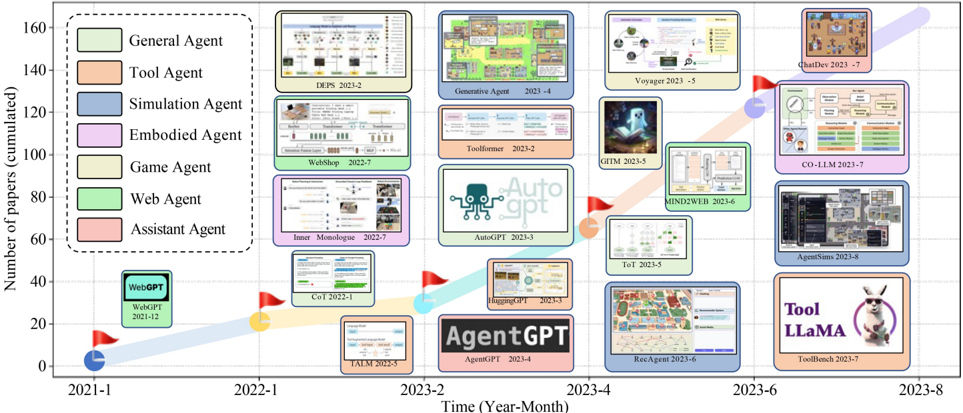
“5 The applications (left) and evaluation strategies (right) of LLM-based agents. but are highly related to this area.”
Soft actor-critic Off-policy maximum entropy deep reinforcement learning with a stochastic actor
Haarnoja, T., Zhou, A., Abbeel, P., & Levine, S. (2018) · arXiv · doi:10.48550/arxiv.1801.01290 · Cited by 5,594
Survey of Hallucination in Natural Language Generation
Ji, Z., Lee, N., Frieske, R., Yu, T., Su, D., Xu, Y., Ishii, E., Bang, Y. J., Madotto, A., & Fung, P. (2023) · ACM Computing Surveys · doi:10.1145/3571730 · Cited by 5,025 · cited 2×
“Hallucination can lead to serious consequences such as incorrect or misleading code, security risks, and ethical issues [74].”
BackgroundSurvey of Hallucination in Natural Language Generation
Ji, Z., Lee, N., Frieske, R., Yu, T., Su, D., Xu, Y., Ishii, E., Bang, Y., Chen, D., Dai, W., et al. (2022) · arXiv · doi:10.48550/arxiv.2202.03629 · Cited by 4,981
LLaMA: Open and Efficient Foundation Language Models
Touvron, H., Lavril, T., Izacard, G., Martinet, X., Lachaux, M.-A., Lacroix, T., Rozière, B., Goyal, N., Hambro, E., Azhar, F., et al. (2023) · arXiv · doi:10.48550/arxiv.2302.13971 · Cited by 4,602
Chain-Of-Thought Prompting Elicits Reasoning in Large Language Models
Wei, J., Wang, X., Schuurmans, D., Bosma, M., Ichter, B., Xia, F., Chi, E., Le, Q. V., & Zhou, D. (2022) · Advances in Neural Information Processing Systems 35 · doi:10.52202/068431-1800 · Cited by 4,505
Dual-Process Theories of Higher Cognition: Advancing the Debate
Evans, J. S. B. T., & Stanovich, K. E. (2013) · Perspectives on Psychological Science · doi:10.1177/1745691612460685 · Cited by 4,271
Chain-of-Thought Prompting Elicits Reasoning in Large Language Models
Wei, J., Wang, X., Schuurmans, D., Bosma, M., Ichter, B., Xia, F., Chi, E., Le, Q., & Zhou, D. (2022) · arXiv · doi:10.48550/arxiv.2201.11903 · Cited by 4,263
A Survey on Evaluation of Large Language Models
Chang, Y., Wang, X., Wang, J., Wu, Y., Yang, L., Zhu, K., Chen, H., Yi, X., Wang, C., Wang, Y., et al. (2024) · ACM Transactions on Intelligent Systems and Technology · doi:10.1145/3641289 · Cited by 4,254 · cited 1×
“[15] shed light on evaluating LLMs, addressing what to evaluate, where to evaluate, and how to assess their performance in downstream tasks and societal impact.”
BackgroundA Survey on Evaluation of Large Language Models
Chang, Y., Wang, X., Wang, J., Wu, Y., Yang, L., Zhu, K., Chen, H., Yi, X., Wang, C., Wang, Y., et al. (2023) · arXiv · doi:10.48550/arxiv.2307.03109 · Cited by 3,159
MetaGPT: Meta Programming for A Multi-Agent Collaborative Framework
Hong, S., Zhuge, M., Chen, J., Zheng, X., Cheng, Y., Zhang, C., Wang, J., Wang, Z., Yau, S. K. S., Lin, Z., et al. (2023) · arXiv · doi:10.48550/arxiv.2308.00352 · Cited by 2,825
Llama 2: Open Foundation and Fine-Tuned Chat Models
Touvron, H., Martin, L., Stone, K., Albert, P., Almahairi, A., Babaei, Y., Bashlykov, N., Batra, S., Bhargava, P., Bhosale, S., et al. (2023) · arXiv · doi:10.48550/arxiv.2307.09288 · Cited by 2,604
Self-Refine: Iterative Refinement with Self-Feedback
Madaan, A., Tandon, N., Gupta, P., Hallinan, S., Gao, L., Wiegreffe, S., Alon, U., Dziri, N., Prabhumoye, S., Yang, Y., et al. (2023) · arXiv · doi:10.48550/arxiv.2303.17651 · Cited by 2,314
Generative Agents: Interactive Simulacra of Human Behavior
Park, J. S., O'Brien, J., Cai, C. J., Morris, M. R., Liang, P., & Bernstein, M. S. (2023) · Proceedings of the 36th Annual ACM Symposium on User Interface Software and Technology · doi:10.1145/3586183.3606763 · Cited by 2,187 · cited 10×
“Usually, there three commonly used criteria for information extraction, that is, the recency, relevance, and importance [121].”
InfluentialGenerative Agents: Interactive Simulacra of Human Behavior
Park, J. S., O'Brien, J. C., Cai, C. J., Morris, M. R., Liang, P., & Bernstein, M. S. (2023) · arXiv · doi:10.48550/arxiv.2304.03442 · Cited by 2,173
A Survey of Large Language Models
Zhao, W. X., Zhou, K., Li, J., Tang, T., Dong, Z., Hou, Y., Zhang, B., Min, Y., Zhang, J., Liu, P., et al. (2026) · Frontiers of Computer Science · doi:10.1007/s11704-026-60308-3 · Cited by 2,093 · cited 2×
“Ac-tually, simulating the human negative aspects can be even more important, since an important goal of simulation is to discover and solve problems, and without negative aspects means no problem to be solved.”
Self-citationA Survey of Large Language Models
Zhao, W. X., Zhou, K., Li, J., Tang, T., Wang, X., Hou, Y., Min, Y., Zhang, B., Zhang, J., Dong, Z., et al. (2023) · arXiv · doi:10.48550/arxiv.2303.18223 · Cited by 2,090
Self-citationLarge language models are zero-shot reasoners
Kojima, T., Gu, S. (., Reid, M., Matsuo, Y., & Iwasawa, Y. (2022) · Advances in Neural Information Processing Systems 35 · doi:10.52202/068431-1613 · Cited by 2,013 · cited 2×
“In the following, we introduce each of them more in detail.”
Large Language Models are Zero-Shot Reasoners
Kojima, T., Gu, S. S., Reid, M., Matsuo, Y., & Iwasawa, Y. (2022) · arXiv · doi:10.48550/arxiv.2205.11916 · Cited by 2,013
Proceedings for the 5th International Conference on Learning Representations
Srivastava, A., & Sutton, C. A. (2017) · Cited by 1,837
Evaluating Large Language Models Trained on Code
Chen, M., Tworek, J., Jun, H., Yuan, Q., Pinto, H. P. D. O., Kaplan, J., Edwards, H., Burda, Y., Joseph, N., Brockman, G., et al. (2021) · arXiv · doi:10.48550/arxiv.2107.03374 · Cited by 1,436
Self-citationImproving Factuality and Reasoning in Language Models through Multiagent Debate
Du, Y., Li, S., Torralba, A., Tenenbaum, J. B., & Mordatch, I. (2023) · arXiv · doi:10.48550/arxiv.2305.14325 · Cited by 1,202
Toolformer: Language Models Can Teach Themselves to Use Tools
Schick, T., Dwivedi-Yu, J., Dessì, R., Raileanu, R., Lomeli, M., Zettlemoyer, L., Cancedda, N., & Scialom, T. (2023) · arXiv · doi:10.48550/arxiv.2302.04761 · Cited by 1,150
Reflexion: Language Agents with Verbal Reinforcement Learning
Shinn, N., Cassano, F., Berman, E., Gopinath, A., Narasimhan, K., & Yao, S. (2023) · arXiv · doi:10.48550/arxiv.2303.11366 · Cited by 1,087 · cited 12×
“Common metrics include success rate [156, 151, 125, 90], reward/score [156, 151, 99], coverage [161], and accuracy [113, 1, 61].”
InfluentialJohn, O. P., Donahue, E. M., & Kentle, R. L. (2012) · PsycTESTS Dataset · doi:10.1037/t07550-000 · Cited by 971
Can Large Language Models Transform Computational Social Science?
Ziems, C., Held, W., Shaikh, O., Chen, J., Zhang, Z., & Yang, D. (2023) · arXiv · doi:10.48550/arxiv.2305.03514 · Cited by 839
Self-citationSelf-Consistency Improves Chain of Thought Reasoning in Language Models
Wang, X., Wei, J., Schuurmans, D., Le, Q., Chi, E., Narang, S., Chowdhery, A., & Zhou, D. (2022) · arXiv · doi:10.48550/arxiv.2203.11171 · Cited by 829
Augmenting large language models with chemistry tools
M. Bran, A., Cox, S., Schilter, O., Baldassari, C., White, A. D., & Schwaller, P. (2024) · Nature Machine Intelligence · doi:10.1038/s42256-024-00832-8 · Cited by 794
Out of One, Many: Using Language Models to Simulate Human Samples
Argyle, L. P., Busby, E. C., Fulda, N., Gubler, J. R., Rytting, C., & Wingate, D. (2023) · Political Analysis · doi:10.1017/pan.2023.2 · Cited by 783 · cited 12×
“Social Science Political Science and Economy Out of One [5], Horton [65], Ziems et al.”
BackgroundMethodInfluentialEvaluating large language models trained on code
Chen, M. (2024) · TIB Data Manager · doi:10.57702/wbv3e61b · Cited by 737
ChatEval: Towards Better LLM-based Evaluators through Multi-Agent Debate
Chan, C.-M., Chen, W., Su, Y., Yu, J., Xue, W., Zhang, S., Fu, J., & Liu, Z. (2023) · arXiv · doi:10.48550/arxiv.2308.07201 · Cited by 725
Harnessing the power of llms in practice: a survey on chatGPT and beyond
Yang, J., Jin, H., Tang, R., Han, X., Feng, Q., Jiang, H., Zhong, S., Yin, B., & Hu, X. (2024) · ACM Transactions on Knowledge Discovery from Data · doi:10.1145/3649506 · Cited by 644 · cited 1×
“On the other hand, [166] primarily focus on the applications of LLMs in various downstream tasks and the challenges associated with their deployment.”
BackgroundHarnessing the Power of LLMs in Practice: A Survey on ChatGPT and Beyond
Yang, J., Jin, H., Tang, R., Han, X., Feng, Q., Jiang, H., Yin, B., & Hu, X. (2023) · arXiv · doi:10.48550/arxiv.2304.13712 · Cited by 644
Do As I Can, Not As I Say: Grounding Language in Robotic Affordances
Ahn, M., Brohan, A., Brown, N., Chebotar, Y., Cortes, O., David, B., Finn, C., Fu, C., Gopalakrishnan, K., Hausman, K., et al. (2022) · arXiv · doi:10.48550/arxiv.2204.01691 · Cited by 624
ReAct: Synergizing Reasoning and Acting in Language Models
Yao, S., Zhao, J., Yu, D., Du, N., Shafran, I., Narasimhan, K., & Cao, Y. (2022) · arXiv · doi:10.48550/arxiv.2210.03629 · Cited by 608
Can Large Language Models Transform Computational Social Science?
Ziems, C., Held, W., Shaikh, O., Chen, J., Zhang, Z., & Yang, D. (2024) · Computational Linguistics · doi:10.1162/coli_a_00502 · Cited by 585 · cited 8×
“[86] Jurisprudence ChatLaw [25], Blind Judgement [61] Research Assistant Ziems et al [187], Bail et al.”
BackgroundMethodInfluentialSelf-citationGraph of Thoughts: Solving Elaborate Problems with Large Language Models
Besta, M., Blach, N., Kubicek, A., Gerstenberger, R., Podstawski, M., Gianinazzi, L., Gajda, J., Lehmann, T., Niewiadomski, H., Nyczyk, P., et al. (2024) · Proceedings of the AAAI Conference on Artificial Intelligence · doi:10.1609/aaai.v38i16.29720 · Cited by 556 · cited 13×
“(2) Action via Plan Following .”
InfluentialGraph of Thoughts: Solving Elaborate Problems with Large Language Models
Besta, M., Blach, N., Kubicek, A., Gerstenberger, R., Podstawski, M., Gianinazzi, L., Gajda, J., Lehmann, T., Niewiadomski, H., Nyczyk, P., et al. (2023) · arXiv · doi:10.48550/arxiv.2308.09687 · Cited by 556
Johnson, J. A. (2014) · Journal of Research in Personality · doi:10.1016/j.jrp.2014.05.003 · Cited by 537
HuggingGPT: Solving AI Tasks with ChatGPT and its Friends in Hugging Face
Shen, Y., Song, K., Tan, X., Li, D., Lu, W., & Zhuang, Y. (2023) · arXiv · doi:10.48550/arxiv.2303.17580 · Cited by 477 · cited 2×
“In the following, we introduce each of them more in detail.”
HuggingGPT: Solving AI Tasks with ChatGPT and its Friends in Hugging Face
Shen, Y., Song, K., Tan, X., Li, D., Lu, W., & Zhuang, Y. (2023) · Advances in Neural Information Processing Systems 36 · doi:10.52202/075280-1657 · Cited by 475
LLM-Planner: Few-Shot Grounded Planning for Embodied Agents with Large Language Models
Song, C. H., Sadler, B. M., Wu, J., Chao, W.-L., Washington, C., & Su, Y. (2023) · 2023 IEEE/CVF International Conference on Computer Vision (ICCV) · doi:10.1109/iccv51070.2023.00280 · Cited by 435 · cited 1×
“Previous work has demonstrated that LLMs can be used as decent planers to decompose complex task into simpler ones [45].”
Towards Reasoning in Large Language Models: A Survey
Huang, J., & Chang, K. C.-C. (2023) · Findings of the Association for Computational Linguistics: ACL 2023 · doi:10.18653/v1/2023.findings-acl.67 · Cited by 428
Towards Reasoning in Large Language Models: A Survey
Huang, J., & Chang, K. C.-C. (2022) · arXiv · doi:10.48550/arxiv.2212.10403 · Cited by 428
AI and the transformation of social science research
Grossmann, I., Feinberg, M., Parker, D. C., Christakis, N. A., Tetlock, P. E., & Cunningham, W. A. (2023) · Science · doi:10.1126/science.adi1778 · Cited by 377 · cited 1×
“ChemCrow [75], Boiko et al. [115], Grossmann et al. [122] Natural Science Education ChemCrow [75], CodeHelp [120], Boiko et al. [115], MathA-gent [117], Drori et al. [118] Engineering”
BackgroundCan Generative AI Improve Social Science?
Bail, C. A. (2023) · doi:10.31235/osf.io/rwtzs · Cited by 369
Can Generative AI improve social science?
Bail, C. A. (2024) · Proceedings of the National Academy of Sciences · doi:10.1073/pnas.2314021121 · Cited by 369
Large Language Models as Simulated Economic Agents: What Can We Learn from Homo Silicus?
Horton, J., Filippas, A., & Manning, B. (2023) · National Bureau of Economic Research · doi:10.3386/w31122 · Cited by 329
CAMEL: Communicative Agents for "Mind" Exploration of Large Language Model Society
Li, G., Hammoud, H. A. A. K., Itani, H., Khizbullin, D., & Ghanem, B. (2023) · arXiv · doi:10.48550/arxiv.2303.17760 · Cited by 315
TaskMatrix.AI: Completing Tasks by Connecting Foundation Models with Millions of APIsPreprint
Liang, Y., Wu, C., Song, T., Wu, W., Xia, Y., Liu, Y., Ou, Y., Lu, S., Ji, L., Mao, S., et al. (2023) · Intelligent Computing · doi:10.48550/arxiv.2303.16434 · Cited by 291
Inner Monologue: Embodied Reasoning through Planning with Language Models
Huang, W., Xia, F., Xiao, T., Chan, H., Liang, J., Florence, P., Zeng, A., Tompson, J., Mordatch, I., Chebotar, Y., et al. (2022) · arXiv · doi:10.48550/arxiv.2207.05608 · Cited by 287 · cited 10×
“In Inner Monologue [61], the agent actively engages in communication with humans and adjusts its action strategies based on human feedback.”
InfluentialViperGPT: Visual Inference via Python Execution for Reasoning
Surís, D., Menon, S., & Vondrick, C. (2023) · 2023 IEEE/CVF International Conference on Computer Vision (ICCV) · doi:10.1109/iccv51070.2023.01092 · Cited by 273
WebGPT: Browser-assisted question-answering with human feedback
Nakano, R., Hilton, J., Balaji, S., Wu, J., Ouyang, L., Kim, C., Hesse, C., Jain, S., Kosaraju, V., Saunders, W., et al. (2021) · arXiv · doi:10.48550/arxiv.2112.09332 · Cited by 272 · cited 1×
“In the following, we introduce each of them more in detail.”
ChatGPT and Software Testing Education: Promises & Perils
Jalil, S., Rafi, S., LaToza, T. D., Moran, K., & Lam, W. (2023) · 2023 IEEE International Conference on Software Testing, Verification and Validation Workshops (ICSTW) · doi:10.1109/icstw58534.2023.00078 · Cited by 270
Self-collaboration Code Generation via ChatGPT
Dong, Y., Jiang, X., Jin, Z., & Li, G. (2023) · arXiv · doi:10.48550/arxiv.2304.07590 · Cited by 256
Self-collaboration code generation via ChatGPT
Dong, Y., Jiang, X., Jin, Z., & Li, G. (2024) · ACM Transactions on Software Engineering and Methodology · doi:10.1145/3672459 · Cited by 256 · cited 5×
“ChemCrow [75], Boiko et al. [115], Grossmann et al. [122] Natural Science Education ChemCrow [75], CodeHelp [120], Boiko et al. [115], MathA-gent [117], Drori et al. [118] Engineering”
InfluentialMemoryBank: Enhancing Large Language Models with Long-Term Memory
Zhong, W., Guo, L., Gao, Q., Ye, H., & Wang, Y. (2023) · arXiv · doi:10.48550/arxiv.2305.10250 · Cited by 253
Gorilla: Large Language Model Connected with Massive APIs
Patil, S. G., Zhang, T., Wang, X., & Gonzalez, J. E. (2023) · arXiv · doi:10.48550/arxiv.2305.15334 · Cited by 226 · cited 1×
“In the following, we introduce each of them more in detail.”
Gorilla: Large Language Model Connected with Massive APIs
Patil, S., Zhang, T., Wang, X., & Gonzalez, J. (2024) · Advances in Neural Information Processing Systems 37 · doi:10.52202/079017-4020 · Cited by 226 · cited 1×
“In the following, we introduce each of them more in detail.”
Voyager: An Open-Ended Embodied Agent with Large Language Models
Wang, G., Xie, Y., Jiang, Y., Mandlekar, A., Xiao, C., Zhu, Y., Fan, L., & Anandkumar, A. (2023) · arXiv · doi:10.48550/arxiv.2305.16291 · Cited by 222
Memory-assisted prompt editing to improve GPT-3 after deployment
Madaan, A., Tandon, N., Clark, P., & Yang, Y.-M. (2022) · Conference on Empirical Methods in Natural Language Processing · doi:10.48550/arxiv.2201.06009 · Cited by 214
Social Simulacra: Creating Populated Prototypes for Social Computing Systems
Park, J. S., Popowski, L., Cai, C., Morris, M. R., Liang, P., & Bernstein, M. S. (2022) · Proceedings of the 35th Annual ACM Symposium on User Interface Software and Technology · doi:10.1145/3526113.3545616 · Cited by 212 · cited 11×
“For example, Social Simulacra [79] simulates an online social community and explores the potential of utilizing agent-based simulations to aid decision-makers to improve community regulations.”
BackgroundInfluentialTidyBot: personalized robot assistance with large language models
Wu, J., Antonova, R., Kan, A., Lepert, M., Zeng, A., Song, S., Bohg, J., Rusinkiewicz, S., & Funkhouser, T. (2023) · Autonomous Robots · doi:10.1007/s10514-023-10139-z · Cited by 212
Large Language Models are Few-shot Testers: Exploring LLM-based General Bug Reproduction
Kang, S., Yoon, J., & Yoo, S. (2023) · 2023 IEEE/ACM 45th International Conference on Software Engineering (ICSE) · doi:10.1109/icse48619.2023.00194 · Cited by 204 · cited 3×
“WebShop [168] 1 3 ✓ 07/2022 Social Simulacra [122] 1 2 08/2022 TE [1] 2 08/2022 LIBRO [78] 4 09/2022 ReAct [170] 1 ✓ 10/2022 Out of One, Many [5] 2 2 3 02/2023 DEPS [154] 1 ✓ 02/2023 Jalil et al.”
AutoGen: Enabling Next-Gen LLM Applications via Multi-Agent Conversation
Wu, Q., Bansal, G., Zhang, J., Wu, Y., Li, B., Zhu, E., Jiang, L., Zhang, X., Zhang, S., Liu, J., et al. (2023) · arXiv · doi:10.48550/arxiv.2308.08155 · Cited by 193
Self-citationCodeHelp: Using Large Language Models with Guardrails for Scalable Support in Programming Classes
Liffiton, M., Sheese, B. E., Savelka, J., & Denny, P. (2023) · Proceedings of the 23rd Koli Calling International Conference on Computing Education Research · doi:10.1145/3631802.3631830 · Cited by 192
Drori, I., Zhang, S., Shuttleworth, R., Tang, L., Lu, A., Ke, E., Liu, K., Chen, L., Tran, S., Cheng, N., et al. (2022) · Proceedings of the National Academy of Sciences · doi:10.1073/pnas.2123433119 · Cited by 187 · cited 2×
“Natural Science Education: LLM-based agents can communicate with humans fluently, often being utilized to develop agent-based educational tools [9, 145, 34, 19].”
BackgroundMethodTool Learning with Foundation Models
Qin, Y., Hu, S., Lin, Y., Chen, W., Ding, N., Cui, G., Zeng, Z., Huang, Y., Xiao, C., Han, C., et al. (2023) · arXiv · doi:10.48550/arxiv.2304.08354 · Cited by 184 · cited 13×
“BMTools [153] is an open-source repository that extends LLMs with tools and provides a platform for community-driven tool building and sharing.”
InfluentialSelf-citation(2024) · doi:10.1145/3704435 · Cited by 184
Self-citationLanguage Models Meet World Models: Embodied Experiences Enhance Language Models
Xiang, J., Tao, T., Gu, Y., Shu, T., Wang, Z., Yang, Z., & Hu, Z. (2023) · Advances in Neural Information Processing Systems 36 · doi:10.52202/075280-3295 · Cited by 183
RoCo: Dialectic Multi-Robot Collaboration with Large Language Models
Mandi, Z., Jain, S., & Song, S. (2023) · arXiv · doi:10.48550/arxiv.2307.04738 · Cited by 180 · cited 7×
“In RoCo [108], the agent first proposes a sub-task plan and a path of 3D waypoints for each robot in a multi-robot collaboration task.”
InfluentialExpeL: LLM Agents Are Experiential Learners
Zhao, A., Huang, D., Xu, Q., Lin, M., Liu, Y.-J., & Huang, G. (2023) · arXiv · doi:10.48550/arxiv.2308.10144 · Cited by 179 · cited 1×
“In the following, we turn our focus to memory operations, which are used to interact with external environments.”
Toxicity in chatgpt: Analyzing persona-assigned language models
Deshpande, A., Murahari, V., Rajpurohit, T., Kalyan, A., & Narasimhan, K. (2023) · Findings of the Association for Computational Linguistics: EMNLP 2023 · doi:10.18653/v1/2023.findings-emnlp.88 · Cited by 178
Toxicity in ChatGPT: Analyzing Persona-assigned Language Models
Deshpande, A., Murahari, V., Rajpurohit, T., Kalyan, A., & Narasimhan, K. (2023) · arXiv · doi:10.48550/arxiv.2304.05335 · Cited by 178 · cited 1×
“[31] studies the toxicity of the LLM output by manually prompting LLMs with different roles, such as politicians, journalists and businesspersons.”
BackgroundReasoning with Language Model is Planning with World Model
Hao, S., Gu, Y., Ma, H., Hong, J., Wang, Z., Wang, D., & Hu, Z. (2023) · Proceedings of the 2023 Conference on Empirical Methods in Natural Language Processing · doi:10.18653/v1/2023.emnlp-main.507 · Cited by 168
Reasoning with Language Model is Planning with World Model
Hao, S., Gu, Y., Ma, H., Hong, J. J., Wang, Z., Wang, D. Z., & Hu, Z. (2023) · arXiv · doi:10.48550/arxiv.2305.14992 · Cited by 166
Augmented Language Models: a Survey
Mialon, G., Dessì, R., Lomeli, M., Nalmpantis, C., Pasunuru, R., Raileanu, R., Rozière, B., Schick, T., Dwivedi-Yu, J., Celikyilmaz, A., et al. (2023) · arXiv · doi:10.48550/arxiv.2302.07842 · Cited by 160 · cited 1×
“In [79], annotators are asked to determine whether the specifically designed models can significantly enhance the development of rules within online communities.”
RecMind: Large Language Model Powered Agent For RecommendationPreprint
Wang, Y.-C., Jiang, Z., Chen, Z., Yang, F., Zhou, Y., Cho, E., Fan, X., Huang, X., Lu, Y., & Yang, Y. (2023) · arXiv (Cornell University) · doi:10.48550/arxiv.2308.14296 · Cited by 160
Self-citationPersonality Traits in Large Language Models
Serapio-García, G., Safdari, M., Crepy, C., Sun, L., Fitz, S., Romero, P., Abdulhai, M., Faust, A., & Matarić, M. (2023) · arXiv · Cited by 137
Personality Traits in Large Language Models
Serapio-García, G., Safdari, M., Crepy, C., Sun, L., Fitz, S., Abdulhai, M., Faust, A., & Matarić, M. (2023) · Research Square · doi:10.21203/rs.3.rs-3296728/v1 · Cited by 134
API-Bank: A Comprehensive Benchmark for Tool-Augmented LLMs
Li, M., Zhao, Y., Yu, B., Song, F., Li, H., Yu, H., Li, Z., Huang, F., & Li, Y. (2023) · Proceedings of the 2023 Conference on Empirical Methods in Natural Language Processing · doi:10.18653/v1/2023.emnlp-main.187 · Cited by 124
API-Bank: A Comprehensive Benchmark for Tool-Augmented LLMs
Li, M., Zhao, Y., Yu, B., Song, F., Li, H., Yu, H., Li, Z., Huang, F., & Li, Y. (2023) · arXiv · doi:10.48550/arxiv.2304.08244 · Cited by 124 · cited 4×
“API-Bank [69] is an LLM-based API recommendation agent that can automatically search and generate appropriate API calls for various programming languages and domains.”
InfluentialChemCrow: Augmenting large-language models with chemistry tools
Bran, A. M., Cox, S., Schilter, O., Baldassari, C., White, A. D., & Schwaller, P. (2023) · arXiv · doi:10.48550/arxiv.2304.05376 · Cited by 122
S3: Social-network Simulation System with Large Language Model-Empowered Agents
Gao, C., Lan, X., Lu, Z., Mao, J., Piao, J., Wang, H., Jin, D., & Li, Y. (2023) · doi:10.2139/ssrn.4607026 · Cited by 113
TaskMatrix.AI: Completing Tasks by Connecting Foundation Models with Millions of APIs
Liang, Y., Wu, C., Song, T., Wu, W., Xia, Y., Liu, Y., Ou, Y., Lu, S., Ji, L., Mao, S., et al. (2024) · Intelligent Computing · doi:10.34133/icomputing.0063 · Cited by 108
OpenAGI: When LLM Meets Domain Experts
Ge, Y., Hua, W., Mei, K., Li, Z., Tan, J., Xu, S., Li, Z., & Zhang, Y. (2023) · neural information processing systems · doi:10.52202/075280-0242 · Cited by 108
WebShop: Towards Scalable Real-World Web Interaction with Grounded Language Agents
Yao, S., Chen, H., Yang, J., & Narasimhan, K. (2022) · Advances in Neural Information Processing Systems 35 · doi:10.52202/068431-1508 · Cited by 107
Large Language Models Are Semi-Parametric Reinforcement Learning Agents
Zhang, D., Chen, L., Zhang, S., Xu, H., Zhao, Z., & Yu, K. (2023) · neural information processing systems · doi:10.52202/075280-3419 · Cited by 106
Language Model Behavior: A Comprehensive Survey
Chang, T. A., & Bergen, B. K. (2024) · Computational Linguistics · doi:10.1162/coli_a_00492 · Cited by 105 · cited 1×
“[14] also discusses the capabilities and limitations of LLMs in various downstream tasks.”
BackgroundLLM+P: Empowering Large Language Models with Optimal Planning Proficiency
Liu, B., Jiang, Y., Zhang, X., Liu, Q., Zhang, S., Biswas, J., & Stone, P. (2023) · arXiv · doi:10.48550/arxiv.2304.11477 · Cited by 104
Xia, Y., Shenoy, M., Jazdi, N., & Weyrich, M. (2023) · 2023 IEEE 28th International Conference on Emerging Technologies and Factory Automation (ETFA) · doi:10.1109/etfa54631.2023.10275362 · Cited by 103
Playing repeated games with Large Language Models
Akata, E., Schulz, L., Coda-Forno, J., Oh, S. J., Bethge, M., & Schulz, E. (2023) · arXiv · doi:10.48550/arxiv.2305.16867 · Cited by 99
Chatlaw: A Multi-Agent Legal Assistant based on a Role-Aligned Mixture-of-Experts Architecture
Cui, J., Ning, M., Li, Z., Chen, B., Yan, Y., Li, H., Ling, B., Tian, Y., & Yuan, L. (2023) · arXiv · doi:10.48550/arxiv.2306.16092 · Cited by 94
Recommender AI Agent: Integrating Large Language Models for Interactive Recommendations
Huang, X., Lian, J., Lei, Y., Yao, J., Lian, D., & Xie, X. (2023) · arXiv · doi:10.48550/arxiv.2308.16505 · Cited by 89
Recommender AI Agent: Integrating Large Language Models for Interactive Recommendations
Huang, X., Lian, J., Lei, Y., Yao, J., Lian, D., & Xie, X. (2025) · ACM Transactions on Information Systems · doi:10.1145/3731446 · Cited by 89
ProAgent: Building Proactive Cooperative Agents with Large Language Models
Zhang, C., Yang, K., Hu, S., Wang, Z., Li, G., Sun, Y., Zhang, C., Zhang, Z., Liu, A., Zhu, S.-C., et al. (2024) · Proceedings of the AAAI Conference on Artificial Intelligence · doi:10.1609/aaai.v38i16.29710 · Cited by 88 · cited 1×
“ChemCrow [75], Boiko et al. [115], Grossmann et al. [122] Natural Science Education ChemCrow [75], CodeHelp [120], Boiko et al. [115], MathA-gent [117], Drori et al. [118] Engineering”
Self-citationThe Hitchhiker's Guide to Program Analysis: A Journey with Large Language ModelsPreprint
Li, H., Hao, Y., Zhai, Y., & Qian, Z. (2023) · arXiv (Cornell University) · doi:10.48550/arxiv.2308.00245 · Cited by 86
ChatDev: Communicative Agents for Software Development
Qian, C., Liu, W., Liu, H., Chen, N., Dang, Y., Li, J., Yang, C., Chen, W., Su, Y., Cong, X., et al. (2023) · arXiv · doi:10.48550/arxiv.2307.07924 · Cited by 81
AgentBench: Evaluating LLMs as Agents
Liu, X., Yu, H., Zhang, H., Xu, Y., Lei, X., Lai, H., Gu, Y., Ding, H., Men, K., Yang, K., et al. (2023) · arXiv · doi:10.48550/arxiv.2308.03688 · Cited by 79 · cited 4×
“AgentBench [172] provides a comprehensive framework for evaluating LLMs as autonomous agents across diverse environments.”
InfluentialSelf-citationChatEDA: A Large Language Model Powered Autonomous Agent for EDA
He, Z., Wu, H., Zhang, X., Yao, X., Zheng, S., Zheng, H., & Yu, B. (2023) · ACM/IEEE Workshop on Machine Learning for CAD (MLCAD) · doi:10.1109/mlcad58807.2023.10299852 · Cited by 78
MM-REACT: Prompting ChatGPT for Multimodal Reasoning and Action
Yang, Z., Li, L., Wang, J., Lin, K., Azarnasab, E., Ahmed, F., Liu, Z., Liu, C., Zeng, M., & Wang, L. (2023) · arXiv (Cornell University) · doi:10.48550/arxiv.2303.11381 · Cited by 78
Self-citationTidyBot: Personalized Robot Assistance with Large Language Models
Wu, J., Antonova, R., Kan, A., Lepert, M., Zeng, A., Song, S., Bohg, J., Rusinkiewicz, S., & Funkhouser, T. (2023) · 2023 IEEE/RSJ International Conference on Intelligent Robots and Systems (IROS) · doi:10.1109/iros55552.2023.10341577 · Cited by 77
Memory Augmented Large Language Models are Computationally UniversalPreprint
Schuurmans, D. (2023) · arXiv (Cornell University) · doi:10.48550/arxiv.2301.04589 · Cited by 76
RecMind: Large Language Model Powered Agent For Recommendation
Wang, Y., Jiang, Z., Chen, Z., Yang, F., Zhou, Y., Cho, E., Fan, X., Lu, Y., Huang, X., & Yang, Y. (2024) · Findings of the Association for Computational Linguistics: NAACL 2024 · doi:10.18653/v1/2024.findings-naacl.271 · Cited by 74
Self-citationChoi, M., Pei, J., Kumar, S., Shu, C., & Jurgens, D. (2023) · arXiv · doi:10.48550/arxiv.2305.14938 · Cited by 73
Emergent autonomous scientific research capabilities of large language models
Boiko, D. A., MacKnight, R., & Gomes, G. (2023) · arXiv · doi:10.48550/arxiv.2304.05332 · Cited by 72 · cited 8×
“Natural Science Education: Benefiting from the natural language capabilities, LLMs facilitate seamless communication with humans through natural language interactions, making them exciting educational tools that offer real-time question-answering and knowledge dissemination [7, 129, 30, 18].”
InfluentialQin, Y., Liang, S., Ye, Y., Zhu, K., Yan, L., Lu, Y., Lin, Y., Cong, X., Tang, X., Qian, B., et al. (2023) · arXiv (Cornell University) · doi:10.48550/arxiv.2307.16789 · Cited by 71 · cited 12×
“ToolBench [153] is an open-source project that aims to support the development of powerful LLMs with general tool-use capability.”
InfluentialSelf-citationA large language model-assisted education tool to provide feedback on open-ended responsesPreprint
Matelsky, J., Parodi, F., Liu, T., Lange, R. D., & Kording, K. P. (2023) · arXiv (Cornell University) · doi:10.48550/arxiv.2308.02439 · Cited by 71
Aligning Large Language Models with Human: A Survey
Wang, Y., Zhong, W., Li, L., Mi, F., Zeng, X., Huang, W., Shang, L., Jiang, X., & Liu, Q. (2023) · arXiv · doi:10.48550/arxiv.2307.12966 · Cited by 69 · cited 1×
“For example, in [20], the authors employ many an-notators, and ask them to provide feedback on five key questions that directly associated with the agent capability.”
RAH! RecSys–Assistant–Human: A Human-Centered Recommendation Framework With LLM Agents
Shu, Y., Zhang, H., Gu, H., Zhang, P., Lu, T., Li, D., & Gu, N. (2024) · IEEE Transactions on Computational Social Systems · doi:10.1109/tcss.2024.3404039 · Cited by 66
Socially situated artificial intelligence enables learning from human interaction
Krishna, R., Lee, D., Fei-Fei, L., & Bernstein, M. S. (2022) · Proceedings of the National Academy of Sciences · doi:10.1073/pnas.2115730119 · Cited by 63
Self-Adaptive Large Language Model (LLM)-Based Multiagent Systems
Nascimento, N., Alencar, P., & Cowan, D. (2023) · 2023 IEEE International Conference on Autonomic Computing and Self-Organizing Systems Companion (ACSOS-C) · doi:10.1109/acsos-c58168.2023.00048 · Cited by 62
Evaluating Human-Language Model Interaction
Lee, M., Srivastava, M., Hardy, A., Thickstun, J., Durmus, E., Paranjape, A., Gerard-Ursin, I., Li, X. L., Ladhak, F., Rong, F., et al. (2022) · arXiv · doi:10.48550/arxiv.2212.09746 · Cited by 61 · cited 1×
“[70], Self-collaboration [24], SQL-PALM [90], RAH [92], DB-GPT [41], RecMind [51], ChatEDA [123], InteRecA-gent [124], PentestGPT [125], CodeHelp [120], SmolMod-els [126], DemoGPT [127], GPTEngineer [128] Industrial Automation GPT4IA [129], IELLM [130], TaskMatrix.AI [71] Robotics & Embodied AI…”
Memory-assisted prompt editing to improve GPT-3 after deployment
Madaan, A., Tandon, N., Clark, P., & Yang, Y. (2022) · Proceedings of the 2022 Conference on Empirical Methods in Natural Language Processing · doi:10.18653/v1/2022.emnlp-main.183 · Cited by 60
Large Language Models Understand and Can be Enhanced by Emotional Stimuli
Li, C., Wang, J., Zhang, Y., Zhu, K., Hou, W., Lian, J., Luo, F., Yang, Q., & Xie, X. (2023) · arXiv · doi:10.48550/arxiv.2307.11760 · Cited by 59 · cited 1×
“[179] presents the current state of research on LLMs’ reasoning abilities, exploring approaches to improve and evaluate their reasoning skills.”
User Behavior Simulation with Large Language Model-based Agents
Wang, L., Zhang, J., Yang, H., Chen, Z.-Y., Tang, J., Zhang, Z., Chen, X., Lin, Y., Sun, H., Song, R., et al. (2025) · ACM Transactions on Information Systems · doi:10.1145/3708985 · Cited by 59
Self-citationChatCoT: Tool-Augmented Chain-of-Thought Reasoning on Chat-based Large Language ModelsPreprint
Chen, Z., Zhou, K., Zhang, B., et al. (2023) · Conference on Empirical Methods in Natural Language Processing · doi:10.48550/arxiv.2305.14323 · Cited by 57
Self-citationWang, Z., Cai, S., Chen, G., Liu, A., Ma, X., & Liang, Y. (2023) · arXiv · doi:10.48550/arxiv.2302.01560 · Cited by 55
Building Cooperative Embodied Agents Modularly with Large Language Models
Zhang, H., Du, W., Shan, J., Zhou, Q., Du, Y., Tenenbaum, J. B., Shu, T., & Gan, C. (2023) · arXiv · doi:10.48550/arxiv.2307.02485 · Cited by 52 · cited 17×
“Common metrics include success rate [156, 151, 125, 90], reward/score [156, 151, 99], coverage [161], and accuracy [113, 1, 61].”
InfluentialLLM As DBAPreprint
Zhou, X., Li, G., & Liu, Z. (2023) · arXiv (Cornell University) · doi:10.48550/arxiv.2308.05481 · Cited by 52
SwiftSage: A Generative Agent with Fast and Slow Thinking for Complex Interactive Tasks
Lin, B. Y., Fu, Y., Yang, K., Brahman, F., Huang, S., Bhagavatula, C., Ammanabrolu, P., Choi, Y., & Ren, X. (2023) · Advances in Neural Information Processing Systems 36 · doi:10.52202/075280-1034 · Cited by 50
Towards Autonomous Testing Agents via Conversational Large Language Models
Feldt, R., Kang, S., Yoon, J., & Yoo, S. (2023) · 2023 38th IEEE/ACM International Conference on Automated Software Engineering (ASE) · doi:10.1109/ase56229.2023.00148 · Cited by 49 · cited 2×
“[66] 5 02/2023 Reflexion[125] 2 03/2023 IGLU[99] 1 ✓ 04/2023 LLM+P[90] 2 04/2023 Generative Agents[109] 12 04/2023 ToolBench[114] 4 ✓ 04/2023 GITM[161] 1 ✓ 05/2023 Two-Failures[16] 1 05/2023 Voyager[133] 1 ✓ 05/2023 SocKET [21] 2 3 4 ✓ 05/2023 MobileEnv [155] 1 2 4 ✓ 05/2023 clembench [11] 1 ✓ 05/2023 Dialop [88] 3 ✓…”
Karpas, E., Abend, O., Belinkov, Y., Lenz, B., Lieber, O., Ratner, N., Shoham, Y., Bata, H., Levine, Y., Leyton-Brown, K., et al. (2022) · arXiv · doi:10.48550/arxiv.2205.00445 · Cited by 49 · cited 1×
“In the following, we introduce each of them more in detail.”
Large Language Models as Simulated Economic Agents: What Can We Learn from Homo Silicus?
Horton, J. J., Filippas, A., & Manning, B. S. (2023) · arXiv · doi:10.48550/arxiv.2301.07543 · Cited by 47
Kovač, G., Portelas, R., Dominey, P. F., & Oudeyer, P. (2024) · Frontiers in Neurorobotics · doi:10.3389/fnbot.2024.1396359 · Cited by 46
EduChat: A Large-Scale Language Model-based Chatbot System for Intelligent Education
Dan, Y., Lei, Z., Gu, Y., Li, Y., Yin, J., Lin, J., Ye, L., Tie, Z., Zhou, Y., Wang, Y., et al. (2023) · arXiv · doi:10.48550/arxiv.2308.02773 · Cited by 41
Ma, Z., Mei, Y., & Su, Z. (2023) · arXiv · doi:10.48550/arxiv.2307.15810 · Cited by 40
AgentVerse: Facilitating Multi-Agent Collaboration and Exploring Emergent Behaviors
Chen, W., Su, Y., Zuo, J., Yang, C., Yuan, C., Chan, C.-M., Yu, H., Lu, Y., Hung, Y.-H., Qian, C., et al. (2023) · arXiv · doi:10.48550/arxiv.2308.10848 · Cited by 39 · cited 1×
“ChemCrow [75], Boiko et al. [115], Grossmann et al. [122] Natural Science Education ChemCrow [75], CodeHelp [120], Boiko et al. [115], MathA-gent [117], Drori et al. [118] Engineering”
Choi, M., Pei, J., Kumar, S., Shu, C., & Jurgens, D. (2023) · Proceedings of the 2023 Conference on Empirical Methods in Natural Language Processing · doi:10.18653/v1/2023.emnlp-main.699 · Cited by 38 · cited 5×
“[73] 4 02/2023 Reflexion [139] 1 3 03/2023 IGLU [110] 1 ✓ 04/2023 Generative Agents [121] 1 2 04/2023 ToolBench [125] 3 ✓ 04/2023 GITM [184] 1 ✓ 05/2023 Two-Failures [17] 3 05/2023 Voyager [148] 1 ✓ 05/2023 SocKET [23] 2 3 ✓ 05/2023 MobileEnv [175] 1 3 ✓ 05/2023 Clembench [12] 1 3 ✓ 05/2023 Dialop [98] 2 ✓ 06/2023 Fel…”
BackgroundMethodInfluentialPentestGPT: An LLM-empowered Automatic Penetration Testing Tool
Deng, G., Liu, Y., Mayoral-Vilches, V., Liu, P., Li, Y., Xu, Y., Zhang, T., Liu, Y., Pinzger, M., & Rass, S. (2023) · arXiv · doi:10.48550/arxiv.2308.06782 · Cited by 37 · cited 6×
“PENTESTGPT [29] is a penetration testing tool based on LLMs, which can effectively identify common vulnerabilities, and interpret source code to develop exploits.”
InfluentialCan Language Models Teach Weaker Agents? Teacher Explanations Improve Students via PersonalizationPreprint
Saha, S., Hase, P., & Bansal, M. (2023) · arXiv (Cornell University) · doi:10.48550/arxiv.2306.09299 · Cited by 37
Quantifying the Impact of Large Language Models on Collective Opinion DynamicsPreprint
Li, C., Su, X., Han, H.-Y., Xue, C., Zheng, C.-M., & Fan, C. (2023) · arXiv.org · doi:10.48550/arxiv.2308.03313 · Cited by 36
Memory Sandbox: Transparent and Interactive Memory Management for Conversational Agents
Huang, Z., Gutierrez, S., Kamana, H., & Macneil, S. (2023) · Adjunct Proceedings of the 36th Annual ACM Symposium on User Interface Software and Technology · doi:10.1145/3586182.3615796 · Cited by 34 · cited 1×
“MemorySandbox [72] implements long-term and short-term memory by utilizing a 2D canvas to store memory objects, which can then be accessed throughout various conversations.”
BackgroundZhu, X., Chen, Y., Tian, H., Tao, C., Su, W., Yang, C., Huang, G., Li, B., Lu, L., Wang, X., et al. (2023) · arXiv · doi:10.48550/arxiv.2305.17144 · Cited by 33 · cited 7×
“Above, we mainly discuss the internal designs of the memory module.”
InfluentialSelf-citationCALYPSO: LLMs as Dungeon Master's Assistants
Zhu, A., Martin, L., Head, A., & Callison-Burch, C. (2023) · Proceedings of the AAAI Conference on Artificial Intelligence and Interactive Digital Entertainment · doi:10.1609/aiide.v19i1.27534 · Cited by 31 · cited 1×
“CALYPSO [32] is an agent designed for the game Dungeons & Dragons, which can assist Dungeon Masters in the creation and nar-ration of stories.”
Zhuo, T. Y., Li, Z., Huang, Y., Shiri, F., Wang, W., Haffari, G., & Li, Y.-F. (2023) · Proceedings of the 17th Conference of the European Chapter of the Association for Computational Linguistics · doi:10.18653/v1/2023.eacl-main.77 · Cited by 31
SQL-PaLM: Improved Large Language Model Adaptation for Text-to-SQL (extended)
Sun, R., Arik, S. Ö., Muzio, A., Miculicich, L., Gundabathula, S., Yin, P., Dai, H., Nakhost, H., Sinha, R., Wang, Z., et al. (2023) · arXiv · doi:10.48550/arxiv.2306.00739 · Cited by 31
WebArena: A Realistic Web Environment for Building Autonomous Agents
Zhou, S., Xu, F. F., Zhu, H., Zhou, X., Lo, R., Sridhar, A., Cheng, X., Ou, T., Bisk, Y., Fried, D., et al. (2023) · arXiv · doi:10.48550/arxiv.2307.13854 · Cited by 31
ChatCoT: Tool-Augmented Chain-of-Thought Reasoning on Chat-based Large Language Models
Chen, Z., Zhou, K., Zhang, B., Gong, Z., Zhao, X., & Wen, J.-R. (2023) · Findings of the Association for Computational Linguistics: EMNLP 2023 · doi:10.18653/v1/2023.findings-emnlp.985 · Cited by 30
Self-citationChain of Hindsight Aligns Language Models with Feedback
Liu, H., Sferrazza, C., & Abbeel, P. (2023) · arXiv · doi:10.48550/arxiv.2302.02676 · Cited by 30 · cited 1×
“SWIFTSAGE [87] is an agent influenced by the dual-process theory of human cognition [88], which is e ff ective for solving complex interactive reasoning tasks.”
A psychometric framework for evaluating and shaping personality traits in large language models
Serapio-García, G., Safdari, M., Crepy, C., Sun, L., Fitz, S., Romero, P., Abdulhai, M., Faust, A., & Matarić, M. (2025) · Nature Machine Intelligence · doi:10.1038/s42256-025-01115-6 · Cited by 30
SayPlan: Grounding Large Language Models using 3D Scene Graphs for Scalable Robot Task Planning
Rana, K., Haviland, J., Garg, S., Abou-Chakra, J., Reid, I., & Suenderhauf, N. (2023) · arXiv · doi:10.48550/arxiv.2307.06135 · Cited by 29
Minding Language Models’ (Lack of) Theory of Mind: A Plug-and-Play Multi-Character Belief Tracker
Sclar, M., Kumar, S., West, P., Suhr, A., Choi, Y., & Tsvetkov, Y. (2023) · Proceedings of the 61st Annual Meeting of the Association for Computational Linguistics (Volume 1: Long Papers) · doi:10.18653/v1/2023.acl-long.780 · Cited by 27
Ogundare, O., Madasu, S., & Wiggins, N. (2023) · International Conference on Control, Mechatronics and Automation (ICCMA) · doi:10.1109/iccma59762.2023.10374622 · Cited by 27
Generating Executable Action Plans with Environmentally-Aware Language Models
Gramopadhye, M., & Szafir, D. (2023) · 2023 IEEE/RSJ International Conference on Intelligent Robots and Systems (IROS) · doi:10.1109/iros55552.2023.10341989 · Cited by 26
Mindstorms in Natural Language-Based Societies of Mind
Zhuge, M., Liu, H., Faccio, F., Ashley, D. R., Csordás, R., Gopalakrishnan, A., Hamdi, A., Hammoud, H. A. A. K., Herrmann, V., Irie, K., et al. (2023) · arXiv · doi:10.48550/arxiv.2305.17066 · Cited by 24
Embodied Task Planning with Large Language Models
Wu, Z., Wang, Z., Xu, X., Lu, J., & Yan, H. (2023) · arXiv · doi:10.48550/arxiv.2307.01848 · Cited by 23
Epidemic Modeling with Generative Agents
Williams, R., Hosseinichimeh, N., Majumdar, A., & Ghaffarzadegan, N. (2023) · arXiv · doi:10.48550/arxiv.2307.04986 · Cited by 19
Benchmarking LLM powered Chatbots: Methods and Metrics
Banerjee, D., Singh, P., Avadhanam, A., & Srivastava, S. (2023) · arXiv · doi:10.48550/arxiv.2308.04624 · Cited by 18
SelfCheck: Using LLMs to Zero-Shot Check Their Own Step-by-Step Reasoning
Miao, N., Teh, Y. W., & Rainforth, T. (2023) · arXiv · doi:10.48550/arxiv.2308.00436 · Cited by 18 · cited 1×
“(2) Altering Internal States.”
Training Socially Aligned Language Models on Simulated Social Interactions
Liu, R., Yang, R., Jia, C., Zhang, G., Zhou, D., Dai, A. M., Yang, D., & Vosoughi, S. (2023) · arXiv · doi:10.48550/arxiv.2305.16960 · Cited by 18 · cited 2×
“[92] proposed a stable alignment approach for fine-tuning LLMs based on social interaction.”
ReWOO: Decoupling Reasoning from Observations for Efficient Augmented Language Models
Xu, B., Peng, Z., Lei, B., Mukherjee, S., Liu, Y., & Xu, D. (2023) · arXiv · doi:10.48550/arxiv.2305.18323 · Cited by 17 · cited 1×
“In Inner Monologue [61], the agent actively engages in communication with humans and adjusts its action strategies based on human feedback.”
Towards A Unified Agent with Foundation Models
Di Palo, N., Byravan, A., Hasenclever, L., Wulfmeier, M., Heess, N., & Riedmiller, M. (2023) · arXiv · doi:10.48550/arxiv.2307.09668 · Cited by 16
SimplyRetrieve: A Private and Lightweight Retrieval-Centric Generative AI ToolPreprint
Ng, Y., Miyashita, D., Hoshi, Y., Morioka, Y., Torii, O., Kodama, T., & Deguchi, J. (2023) · arXiv (Cornell University) · doi:10.48550/arxiv.2308.03983 · Cited by 16
Enabling Intelligent Interactions between an Agent and an LLM: A Reinforcement Learning Approach
Hu, B., Zhao, C., Zhang, P., Zhou, Z., Yang, Y., Xu, Z., & Liu, B. (2023) · arXiv · doi:10.48550/arxiv.2306.03604 · Cited by 15 · cited 4×
“Robotics & Embodied Artificial Intelligence: Recent works have developed more efficient reinforcement learning agents for robotics and embodied artificial intelligence [25, 160, 106, 143, 133, 161, 60, 142, 154, 28, 2].”
InfluentialAlgorithm of Thoughts: Enhancing Exploration of Ideas in Large Language Models
Sel, B., Al-Tawaha, A., Khattar, V., Jia, R., & Jin, M. (2023) · arXiv · doi:10.48550/arxiv.2308.10379 · Cited by 15 · cited 1×
“In general, we can roughly divide these actions into two classes: (1) external tools and (2) internal knowledge of the LLMs.”
Collaborating with language models for embodied reasoning
Dasgupta, I., Kaeser-Chen, C., Marino, K., Ahuja, A., Babayan, S., Hill, F., & Fergus, R. (2023) · arXiv · doi:10.48550/arxiv.2302.00763 · Cited by 14
Emotionally Numb or Empathetic? Evaluating How LLMs Feel Using EmotionBench
Huang, J.-T., Lam, M. H., Li, E. J., Ren, S., Wang, W., Jiao, W., Tu, Z., & Lyu, M. R. (2023) · arXiv · doi:10.48550/arxiv.2308.03656 · Cited by 14
AgentSims: An Open-Source Sandbox for Large Language Model Evaluation
Lin, J., Zhao, H., Zhang, A., Wu, Y., Ping, H., & Chen, Q. (2023) · arXiv · doi:10.48550/arxiv.2308.04026 · Cited by 14 · cited 11×
“Civil Engineering : In civil engineering, LLM-based agents can be used to design and optimize Out of One [29], Horton [106], Ziems et al. [105] Social Simulation Social Simulacra [79], Generative Agents [20], SocialAI School [109], AgentSims [34], S 3 [77], Williams et al. [110], Li et al. [107], Chao et al. [108] Jur…”
InfluentialChatDB: Augmenting LLMs with Databases as Their Symbolic Memory
Hu, C., Fu, J., Du, C., Luo, S., Zhao, J., & Zhao, H. (2023) · arXiv · doi:10.48550/arxiv.2306.03901 · Cited by 13
Blind Judgement: Agent-Based Supreme Court Modelling With GPT
Hamilton, S. (2023) · arXiv · doi:10.48550/arxiv.2301.05327 · Cited by 13 · cited 3×
“Jurisprudence : LLM-based agents can serve as aids in legal decision-making processes, facilitating more informed judgements [112, 113].”
ViperGPT: Visual Inference via Python Execution for ReasoningPreprint
Surís, D., Menon, S., & Vondrick, C. (2023) · arXiv (Cornell University) · doi:10.48550/arxiv.2303.08128 · Cited by 12
Quantifying the Impact of Large Language Models on Collective Opinion DynamicsPreprint
Li, C., Su, X., Han, H., Xue, C., Zheng, C., & Fan, C. (2024) · SSRN Electronic Journal · doi:10.2139/ssrn.4688547 · Cited by 11
AppAgent: Multimodal Agents as Smartphone Users
Zhang, C., Yang, Z., Liu, J., Li, Y., Han, Y., Chen, X., Huang, Z., Fu, B., & Yu, G. (2023) · arXiv · doi:10.48550/arxiv.2312.13771 · Cited by 11 · cited 1×
“5 The applications (left) and evaluation strategies (right) of LLM-based agents. but are highly related to this area.”
Self-citationTPTU: Large Language Model-based AI Agents for Task Planning and Tool Usage
Ruan, J., Chen, Y., Zhang, B., Xu, Z., Bao, T., Du, G., Shi, S., Mao, H., Li, Z., Zeng, X., et al. (2023) · arXiv · doi:10.48550/arxiv.2308.03427 · Cited by 11 · cited 3×
“[66, 67] propose to automatically generate queries to extract relevant content from external web pages when responding to user request.”
BOLAA: Benchmarking and Orchestrating LLM-augmented Autonomous Agents
Liu, Z., Yao, W., Zhang, J., Xue, L., Heinecke, S., Murthy, R., Feng, Y., Chen, Z., Niebles, J. C., Arpit, D., et al. (2023) · arXiv · doi:10.48550/arxiv.2308.05960 · Cited by 11
Self-citationChatMOF: An Autonomous AI System for Predicting and Generating Metal-Organic Frameworks
Kang, Y., & Kim, J. (2023) · arXiv · doi:10.48550/arxiv.2308.01423 · Cited by 10 · cited 4×
“ChatMOF [70] leverages LLMs to extract key points from human-written textual descriptions and formulate a plan to invoke necessary toolkits in order to predict properties and structures of metal-organic frameworks.”
InfluentialS$^3$: Social-network Simulation System with Large Language Model-Empowered Agents
Gao, C., Lan, X., Lu, Z., Mao, J., Piao, J., Wang, H., Jin, D., & Li, Y. (2023) · arXiv · doi:10.48550/arxiv.2307.14984 · Cited by 10 · cited 5×
“Social Simulation Social Simulacra [122], Generative Agents [121], SocialAI School [83], AgentSims [99], S(3) [55], Williams et al.”
BackgroundResultInfluentialRetroformer: Retrospective Large Language Agents with Policy Gradient Optimization
Yao, W., Heinecke, S., Niebles, J. C., Liu, Z., Feng, Y., Xue, L., Murthy, R., Chen, Z., Zhang, J., Arpit, D., et al. (2023) · arXiv · doi:10.48550/arxiv.2308.02151 · Cited by 10
Self-citationclembench: Using Game Play to Evaluate Chat-Optimized Language Models as Conversational Agents
Chalamalasetti, K., Götze, J., Hakimov, S., Madureira, B., Sadler, P., & Schlangen, D. (2023) · Proceedings of the 2023 Conference on Empirical Methods in Natural Language Processing · doi:10.18653/v1/2023.emnlp-main.689 · Cited by 9
Gekhman, Z., Oved, N., Keller, O., Szpektor, I., & Reichart, R. (2023) · Transactions of the Association for Computational Linguistics · doi:10.1162/tacl_a_00549 · Cited by 9
RET-LLM: Towards a General Read-Write Memory for Large Language Models
Modarressi, A., Imani, A., Fayyaz, M., & Schütze, H. (2023) · arXiv · doi:10.48550/arxiv.2305.14322 · Cited by 8 · cited 8×
“RET-LLM [42] initially converts natural language sentences into triplet phrases, and subsequently stores them in memory.”
InfluentialLi, S., Yang, J., & Zhao, K. (2023) · arXiv (Cornell University) · doi:10.48550/arxiv.2307.10337 · Cited by 8
Two Failures of Self-Consistency in the Multi-Step Reasoning of LLMs
Chen, A., Phang, J., Parrish, A., Padmakumar, V., Zhao, C., Bowman, S. R., & Cho, K. (2023) · arXiv · doi:10.48550/arxiv.2305.14279 · Cited by 7
Plan, Eliminate, and Track - Language Models are Good Teachers for Embodied Agents
Wu, Y., Min, S. Y., Bisk, Y., Salakhutdinov, R., Azaria, A., Li, Y., Mitchell, T., & Prabhumoye, S. (2023) · arXiv · doi:10.48550/arxiv.2305.02412 · Cited by 7 · cited 1×
“ChemCrow [75], Boiko et al. [115], Grossmann et al. [122] Natural Science Education ChemCrow [75], CodeHelp [120], Boiko et al. [115], MathA-gent [117], Drori et al. [118] Engineering”
InterAct: Exploring the Potentials of ChatGPT as a Cooperative Agent
Chen, P.-L., & Chang, C.-S. (2023) · arXiv · doi:10.48550/arxiv.2308.01552 · Cited by 7
Mehta, N., Teruel, M., Sanz, P. F., Deng, X., Awadallah, A. H., & Kiseleva, J. (2023) · arXiv · doi:10.48550/arxiv.2304.10750 · Cited by 7 · cited 10×
“Common metrics include success rate [156, 151, 125, 90], reward/score [156, 151, 99], coverage [161], and accuracy [113, 1, 61].”
InfluentialUser Behavior Simulation with Large Language Model based Agents
Wang, L., Zhang, J., Yang, H., Chen, Z., Tang, J., Zhang, Z., Chen, X., Lin, Y., Song, R., Zhao, W. X., et al. (2023) · arXiv · doi:10.48550/arxiv.2306.02552 · Cited by 6 · cited 3×
“In the following, we introduce each of them more in detail.”
Self-citationGentopia: A Collaborative Platform for Tool-Augmented LLMs
Xu, B., Liu, X., Shen, H., Han, Z., Li, Y., Yue, M., Peng, Z., Liu, Y., Yao, Z., & Xu, D. (2023) · arXiv · doi:10.48550/arxiv.2308.04030 · Cited by 6
SCM: Enhancing Large Language Model with Self-Controlled Memory Framework
Wang, B., Liang, X., Yang, J., Huang, H., Wu, S., Wu, P., Lu, L., Ma, Z., & Li, Z. (2023) · arXiv · doi:10.48550/arxiv.2304.13343 · Cited by 5 · cited 3×
“SCM [84] selectively activates the most relevant long-term knowledge to combine with short-term memory, enabling reasoning over complex contextual dialogues.”
PREFER: Prompt Ensemble Learning via Feedback-Reflect-RefinePreprint
Zhang, C., Liu, L., Wang, J., et al. (2023) · arXiv (Cornell University) · doi:10.48550/arxiv.2308.12033 · Cited by 5
Dagan, G., Keller, F., & Lascarides, A. (2023) · arXiv · doi:10.48550/arxiv.2308.06391 · Cited by 5 · cited 1×
“ToolFormer [15] is an LLM-based tool transformation system that can automatically convert a given tool into another one with di ff erent functionalities or formats based on natural language instructions.”
Gentopia.AI: A Collaborative Platform for Tool-Augmented LLMs
Xu, B., Liu, X., Shen, H., Han, Z., Li, Y., Yue, M., Peng, Z., Liu, Y., Yao, Z., & Xu, D. (2023) · Proceedings of the 2023 Conference on Empirical Methods in Natural Language Processing: System Demonstrations · doi:10.18653/v1/2023.emnlp-demo.20 · Cited by 4
Dialogue Shaping: Empowering Agents through NPC Interaction
Zhou, W., Peng, X., & Riedl, M. (2023) · arXiv · doi:10.48550/arxiv.2307.15833 · Cited by 4
Math Agents: Computational Infrastructure, Mathematical Embedding, and Genomics
Swan, M., Kido, T., Roland, E., & Santos, R. P. D. (2023) · arXiv · doi:10.48550/arxiv.2307.02502 · Cited by 4 · cited 11×
“Agents can directly alter environment states by actions, such as moving their positions, collecting items, constructing buildings, etc.”
InfluentialDecision-Oriented Dialogue for Human-AI CollaborationPreprint
Lin, J., Tomlin, N., Andreas, J., et al. (2023) · arXiv (Cornell University) · doi:10.48550/arxiv.2305.20076 · Cited by 3
Liang, Y., Zhu, L., & Yang, Y. (2023) · arXiv · doi:10.48550/arxiv.2307.12573 · Cited by 3
The SocialAI School: Insights from Developmental Psychology Towards Artificial Socio-Cultural Agents
Kovač, G., Portelas, R., Dominey, P. F., & Oudeyer, P.-Y. (2023) · arXiv · doi:10.48550/arxiv.2307.07871 · Cited by 3
ProAgent: Building Proactive Cooperative Agents with Large Language ModelsPreprint
Zhang, C., Yang, K., Hu, S., et al. (2023) · arXiv (Cornell University) · doi:10.48550/arxiv.2308.11339 · Cited by 3
Zhuo, T. Y., Li, Z., Huang, Y., et al. (2023) · arXiv (Cornell University) · doi:10.48550/arxiv.2301.12868 · Cited by 3
RAH! RecSys-Assistant-Human: A Human-Centered Recommendation Framework with LLM AgentsPreprint
Shu, Y., Zhang, H., Gu, H., et al. (2023) · arXiv (Cornell University) · doi:10.48550/arxiv.2308.09904 · Cited by 2
Reflective Linguistic Programming (RLP): A Stepping Stone in Socially-Aware AGI (SocialAGI)
Fischer, K. A. (2023) · arXiv · doi:10.48550/arxiv.2305.12647 · Cited by 2
Mobile-Env: Building Qualified Evaluation Benchmarks for LLM-GUI Interaction
Zhang, D., Shen, Z., Xie, R., Zhang, S., Xie, T., Zhao, Z., Chen, S., Chen, L., Xu, H., Cao, R., et al. (2023) · arXiv · doi:10.48550/arxiv.2305.08144 · Cited by 1
Minding Language Models' (Lack of) Theory of Mind: A Plug-and-Play Multi-Character Belief TrackerPreprint
Sclar, M., Kumar, S., West, P., et al. (2023) · arXiv (Cornell University) · doi:10.48550/arxiv.2306.00924
Research works printed but not linked: 6
- 6. Radford A, Wu J, Child R, Luan D, Amodei D, Sutskever I. Language models are unsupervised multitask learners. OpenAI Blog, 2019, 1(8): 9
- 47. Raman S S, Cohen V, Rosen E, Idrees I, Paulius D, Tellex S. Planning with large language models via corrective re-prompting. In: Proceedings of Foundation Models for Decision Making Workshop at Neural Information Processing Systems. 2022
- 86. Weng X, Gu Y, Zheng B, Chen S, Stevens S, Wang B, Sun H, Su Y. Mind2Web: towards a generalist agent for the Web. In: Proceedings of the 37th Conference on Neural Information Processing Systems. 2023, 36
- 103. Aher G V, Arriaga R I, Kalai A T. Using large language models to simulate multiple humans and replicate human subject studies. In: Proceedings of the 40th International Conference on Machine Learning. 2023, 337-371 102.
- 123. Mehta N, Teruel M, Sanz P F, Deng X, Awadallah A H, Kiseleva J. Improving grounded language understanding in a collaborative environment by interacting with agents through help feedback. 2024, arXiv preprint arXiv: 2304.10750 122. SmolModels. See Githubcom/smol-ai/developer website, 2023 123. DemoGPT. See Github.com/melih-unsal/Demo website, 2023 124. · arXiv
- 135. Nottingham K, Ammanabrolu P, Suhr A, Choi Y, Hajishirzi H, Singh S, Fox R. Do embodied agents dream of pixelated sheep: embodied decision making using language guided world modelling. In: Proceedings of the 40th International Conference on Machine Learning. 2023, 26311-26325 137.
Cited by
A Survey of Large Language Models
Zhao, W. X., Zhou, K., Li, J., Tang, T., Dong, Z., Hou, Y., Zhang, B., Min, Y., Zhang, J., Liu, P., et al. (2026) · Frontiers of Computer Science · doi:10.1007/s11704-026-60308-3 · Cited by 2,093
Self-citationThe Rise and Potential of Large Language Model Based Agents: A Survey
Xi, Z., Chen, W., Guo, X., He, W., Ding, Y., Hong, B., Zhang, M., Wang, J., Jin, S., Zhou, E., et al. (2023) · arXiv · doi:10.48550/arxiv.2309.07864 · Cited by 972
The rise and potential of large language model based agents: a survey
Xi, Z., Chen, W., Guo, X., He, W., Ding, Y., Hong, B., Zhang, M., Wang, J., Jin, S., Zhou, E., et al. (2025) · Science China Information Sciences · doi:10.1007/s11432-024-4222-0 · Cited by 970
“Effectively and objectively evaluating LLMs agents presents significant challenges, despite their excellent performance in areas such as standalone operation, collective cooperation, and human interaction [70,484].”
A Survey on the Memory Mechanism of Large Language Model based Agents
Zhang, Z., Bo, X., Ma, C., Li, R., Chen, X., Dai, Q., Zhu, J., Dong, Z., & Wen, J.-R. (2024) · arXiv · doi:10.48550/arxiv.2404.13501 · Cited by 149
Self-citationA survey on LLM-based multi-agent systems: Workflow, infrastructure, and challenges
Li, X., Wang, S., Zeng, S., Wu, Y., & Yang, Y. (2024) · Vicinagearth · doi:10.1007/s44336-024-00009-2 · Cited by 404
“This mechanism is vividly demonstrated in complex task planning and robotic simulations within dynamic environmental scenarios [17, 132, 268].”
Influential
Metadata
- Authors
- Wang, L., Ma, C., Feng, X., Zhang, Z., Yang, H., Zhang, J., Chen, Z., Tang, J., Chen, X., Lin, Y., Zhao, W. X., Wei, Z., & Wen, J.
- Affiliations
- Renmin University of China (CN)
- Corresponding author
- Chen, Xu
- Lin, Yankai
- ORCID
- Venue
- Frontiers of Computer Science
- Published
- 2024-03-22
- Volume
- 18
- Issue
- 6
- ISSN
- 2095-2228 (ISSN-L)
- 2095-2236
- OpenAlex
- W4393065402
- Semantic Scholar
- 28c6ac721f54544162865f41c5692e70d61bccab
- Cited by
- 1,941
- References
- 61
- Citations by year
- 2026: 1060 · 2025: 623 · 2024: 249
- FWCI
- 284.94
- Type
- journal article
- Language
- en
- Open access
- hybrid
- doi.org
- Licence
- cc-by
- creativecommons.org/licenses/by/4.0 (tdm)
- creativecommons.org/licenses/by/4.0 (vor)
- Locations
- Frontiers of Computer Science (publishedVersion, cc-by)
- arXiv (Cornell University) (submittedVersion, cc-by)
- arXiv (Cornell University) (cc-by)
- Funders
- National Natural Science Foundation of China (62102420)
- Renmin University of China
- Topics
- Physical Sciences › Computer Science › Artificial Intelligence › Artificial Intelligence Applications
- Physical Sciences › Computer Science › Artificial Intelligence › AI-based Problem Solving and Planning
- Physical Sciences › Computer Science › Artificial Intelligence › Topic Modeling
- Keywords
- large language models, autonomous agents, LLM agents, agent applications, assessment methods, human-like decision making, social science applications, engineering applications
About these checks
Registry, retraction, Cites and statistics results are computed, not judged, with one exception: a printed reference that no index lists is read once by a model before it counts as a citation error. Claims are extracted by a model and kept only when their quote appears verbatim in the text; each cited source is then checked, with a model’s help, for whether it says what the claim relies on. Those verdicts can be wrong — read the claim’s quote and the cited source before relying on one.
The claim verdicts this report counts are experimental: their accuracy is not yet measured.
A language model drew the claims from the paper on 2026-09-28, under version 3 of the claim definition (model deepseek-v4.1-flash, prompt extract-v3).
A second model labelled each claim on 2026-09-28 (model jev-1.13-20260917, definition revision gold-guideline-v0.2).
Cited sources are checked with a language model’s help (qwen3.8-omni-flash and gpt-6-sol).
Statistics and arithmetic are recomputed, not judged.
Confidence bands are shown only for fields calibrated on our annotated test set. None is calibrated yet, so no band is shown.
What counts as a claim ›How we measure confidence ›How we check this ›
Are you an author, or do you see a problem with this page? Request a review
Data sources
Bibliographic data: Semantic Scholar, OpenAlex, Crossref.
Contains information from the Semantic Scholar Academic Graph Datasets, made available under the ODC Attribution License (ODC-BY 1.0).
Semantic Scholar’s data is described in: Kinney, R., et al. (2023). The Semantic Scholar Open Data Platform. arXiv:2301.10140.
