

Sophisticated collective foraging with minimalist agents: a swarm robotics test
Open accessThe DOI matches its Crossref record; 134 of the 134 references it cites were found in a registry or an index.
Abstract
How groups of cooperative foragers can achieve efficient and robust collective foraging is of interest both to biologists studying social insects and engineers designing swarm robotics systems. Of particular interest are distance-quality trade-offs and swarm-size-dependent foraging strategies. Here, we present a collective foraging system based on virtual pheromones, tested in simulation and in swarms of up to 200 physical robots. Our individual agent controllers are highly simplified, as they are based on binary pheromone sensors. Despite being simple, our individual controllers are able to reproduce classical foraging experiments conducted with more capable real ants that sense pheromone concentration and follow its gradient. One key feature of our controllers is a control parameter which balances the trade-off between distance selectivity and quality selectivity of individual foragers. We construct an optimal foraging theory model that accounts for distance and quality of resources, as well as overcrowding, and predicts a swarm-size-dependent strategy. We test swarms implementing our controllers against our optimality model and find that, for moderate swarm sizes, they can be parameterised to approximate the optimal foraging strategy. This study demonstrates the sufficiency of simple individual agent rules to generate sophisticated collective foraging behaviour.
Overview
The claims and statistics of this paper haven’t been checked yet.
Free: it reads the open-access text and checks the first 5 claims that cite a source we can check. Create a free account to check every claim.
Integrity signals
Registry
Cites
Statistics
Figures
Verification
Claims the paper makes
The claims and statistics of this paper haven’t been checked yet.
Free: it reads the open-access text and checks the first 5 claims that cite a source we can check. Create a free account to check every claim.
Claims other papers make about this one
Each is checked against this paper’s own text: does it say what the citing paper says it does?
The source backs part of the claim, not all of it — or backs it for a different population, condition or comparison.
In the citing paper
“In the swarm robotics literature, pheromone-based stigmergy has been predominantly designed manually, via trial and error, to address specific missions under specific conditions 26,34,35 .”
From Automatic design of stigmergy-based behaviours for robot swarms (2024) · cites this paper as [26]
Experimental — accuracy not yet measuredThe source backs part of the claim, not all of it — or backs it for a different population, condition or comparison.
In the citing paper
“In the last two decades, swarm robotics has grown from a small domain initiated by a few studies with a clear biological inspiration [9]- [12] to a mature research field involving several labs and researchers worldwide.”
From Swarm Robotics: Past, Present, and Future [Point of View] (2021) · cites this paper as [10]
Experimental — accuracy not yet measured
Self-check
Percentages, sums and reported differences re-computed from the paper’s own numbers.
The self-check needs the paper’s full text.
Citations
Cites
Hölldobler, B., & Wilson, E. O. (1990) · Springer eBooks · doi:10.1007/978-3-662-10306-7 · Cited by 5,438
Optimal foraging, the marginal value theorem
Charnov, E. L. (1976) · Theoretical Population Biology · doi:10.1016/0040-5809(76)90040-x · Cited by 5,374
Krause, J., & Ruxton, G. D. (2002) · doi:10.1093/oso/9780198508175.001.0001 · Cited by 3,189
Fick, A. (1855) · Annalen der Physik · doi:10.1002/andp.18551700105 · Cited by 2,304
Optimal Foraging Theory: A Critical Review
Pyke, G. H. (1984) · Annual Review of Ecology and Systematics · doi:10.1146/annurev.ecolsys.15.1.523 · Cited by 2,210 · cited 3×
“For the latter, we refer to more comprehensive overviews, e.g. see Charnov (1976); Pyke (1984); Stephens and Krebs (1986); Houston and McNamara (1999).”
BackgroundMethodProgrammable self-assembly in a thousand-robot swarm
Rubenstein, M., Cornejo, A., & Nagpal, R. (2014) · Science · doi:10.1126/science.1254295 · Cited by 1,308 · cited 2×
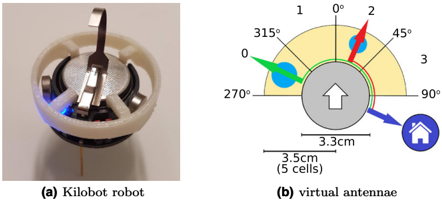
“1a), which are minimalistic robots widely employed in swarm robotics research, with very limited capabilities provided by a small range of sensors and actuators (Rubenstein et al. 2014a).”
BackgroundOptimality theory in evolutionary biology
Parker, G. A., & Smith, J. M. (1990) · Nature · doi:10.1038/348027a0 · Cited by 972 · cited 1×
“Engineering and biology share common core interests in the efficiency of behaviour-generating mechanisms (e.g. Parker and Smith 1990; Houston and McNamara 1999; Ferrante et al. 2013; Gauci et al. 2014; Özdemir et al. 2018), and scalability (e.g. Rubenstein et al. 2014b; Khaluf et al. 2017;…”
BackgroundThe self-organizing exploratory pattern of the argentine ant
Deneubourg, J. L., Aron, S., Goss, S., & Pasteels, J. M. (1990) · Journal of Insect Behavior · doi:10.1007/bf01417909 · Cited by 921 · cited 2×
“…best-quality food source available in the environment (Beckers et al. 1990, 1993; Reid et al. 2012; Shaffer et al. 2013), selecting the shortest path linking the food source to the nest (Goss et al. 1989; Deneubourg et al. 1990), and balancing predation risk and food quality (Nonacs and Dill 1990).”
BackgroundSelf-organized shortcuts in the Argentine ant
Goss, S., Aron, S., Deneubourg, J. L., & Pasteels, J. M. (1989) · Naturwissenschaften · doi:10.1007/bf00462870 · Cited by 919 · cited 3×
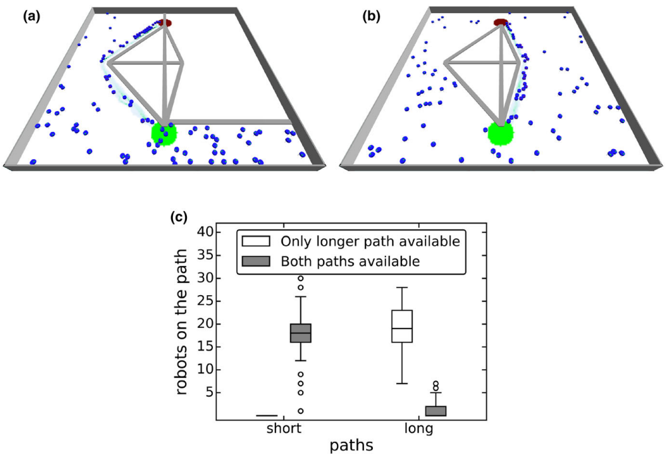
“Obstacle avoidance Figure 7b shows a screenshot of an experiment inspired by the well-known study of Goss et al. (1989) which showed that ants are able to exploit the shorter path in double-bridge experiments with branching paths of different lengths.”
BackgroundResultDeangelis, D. L. (1979) · Journal of Environmental Quality · doi:10.2134/jeq1979.00472425000800040038x · Cited by 836
Research works printed but not linked: 2
- In M. Dorigo, et al. (Eds.), Swarm intelligence (ANTS 2016), LNCS (Vol. 9882, pp. 185-196). Berlin: Springer.
- Orians, G. H., & Pearson, N. E. (1979). On the theory of central place foraging. In D. J. Horn, R. D. Mitchell, & G. R. Stairs (Eds.), Analysis of ecological systems (pp. 154-177). Columbus: The Ohio State University Press.
Cited by
Swarm Robotics: Past, Present, and Future [Point of View]
Dorigo, M., Theraulaz, G., & Trianni, V. (2021) · Proceedings of the IEEE · doi:10.1109/jproc.2021.3072740 · Cited by 431
“Kilobots were conceived to support the first demonstration of a large robot swarm designed for shape formation [31] and have been later used for several successful studies, allowing swarm robotics to be demonstrated in physical settings with hundreds of robots [32]–[34].”
BackgroundAugmented Reality for Robotics: A Review
Makhataeva, Z., & Varol, H. (2020) · Robotics · doi:10.3390/robotics9020021 · Cited by 266
“The study on the collective foraging behavior continued [122], where behaviors of around 200 Kilobots having access to the sensing data from the virtual sensors and actuators were studied.”
BackgroundWhen less is more: Robot swarms adapt better to changes with constrained communication
Talamali, M. S., Saha, A., Marshall, J. A. R., & Reina, A. (2021) · Science Robotics · doi:10.1126/scirobotics.abf1416 · Cited by 142
“Value sensitivity has been predicted and observed in a variety of natural systems (26, 27, 60, 61) and engineered in robot swarms (9, 28, 62) in a variety of processes, such as decision-making or foraging.”
Self-citationSwarm Robotics: A Perspective on the Latest Reviewed Concepts and Applications
Dias, P. G. F., Silva, M. C., Filho, G. P. R., Vargas, P. A., Cota, L. P., & Pessin, G. (2021) · Sensors · doi:10.3390/s21062062 · Cited by 152
“Talamali et al. [117] introduce a cooperative foraging system supported by virtual pheromones, testing with essays, and swarms of up to 200 physical agents.”
BackgroundSwarm Robotics: Simulators, Platforms and Applications Review
Calderón-Arce, C., Brenes-Torres, J. C., & Solís-Ortega, R. (2022) · Computation · doi:10.3390/computation10060080 · Cited by 54
“Talamali et al. in [63] propose a collective foraging system based on virtual pheromones.”
BackgroundCoherent collective behaviour emerging from decentralised balancing of social feedback and noise
Rausch, I., Reina, A., Simoens, P., & Khaluf, Y. (2019) · Swarm Intelligence · doi:10.1007/s11721-019-00173-y · Cited by 39
“…feedback have been previously investigated in systems of collective motion (Torney et al. 2009; Shklarsh et al. 2011; Khaluf et al. 2018), foraging (Pagliara et al. 2018; Piton-akova et al. 2018; Talamali et al. 2019a; Rausch et al. 2019), and collective decision-making (Talamali et al. 2019b).”
BackgroundSelf-citationScalability in Computing and Robotics
Hamann, H., & Reina, A. (2021) · IEEE Transactions on Computers · doi:10.1109/tc.2021.3089044 · Cited by 49
“In multi-robot systems, similar performance curves have been observed and scalability is a key aspect of numerous studies [Hamann, 2018b, Bjerknes and Win-field, 2013, Talamali et al., 2020].”
BackgroundInfluentialSelf-citationSalman, M., Garzón Ramos, D., Hasselmann, K., & Birattari, M. (2020) · Frontiers in Robotics and AI · doi:10.3389/frobt.2020.591402 · Cited by 27
“…using an overhead camera and the pheromone trails are then either projected on the ground (Hamann et al., 2007; Garnier et al., 2013; Hunt et al., 2019; Talamali et al., 2020) or displayed on LCD screens that serve as the floor on which the robots move (Arvin et al., 2015; Na et al., 2019, 2020).”
MethodAutomatic design of stigmergy-based behaviours for robot swarms
Salman, M., Garzón Ramos, D., & Birattari, M. (2024) · Communications Engineering · doi:10.1038/s44172-024-00175-7 · Cited by 26
“…a system of sta-tionarydevices(e.g.,RFIDtags)spreadthroughouttheenvironmenttostore virtualpheromones 15 – 19 ,(ii)devicestodisplayorprojectvirtualpheromones on the ground 20 – 23 , or (iii) augmented reality to immerse the robots in a virtualenvironmentinwhichtheycanlayandsensepheromones 24 – 26 .”
BackgroundMethodPerception of motion salience shapes the emergence of collective motions
Xiao, Y., Lei, X., Zheng, Z., Xiang, Y., Liu, Y., & Peng, X. (2024) · Nature Communications · doi:10.1038/s41467-024-49151-x · Cited by 33
“Moreover, we also test the performance of AMS in another type of swarm experiment known as collective following, which simulates the collective behaviors observed during foraging activities 62,63 .”
Swarm Foraging Review: Closing the Gap Between Proof and Practice
Lu, Q., Fricke, G. M., Ericksen, J., & Moses, M. E. (2020) · Current Robotics Reports · doi:10.1007/s43154-020-00018-1 · Cited by 26
Visual social information use in collective foraging
Mezey, D., Deffner, D., Kurvers, R. H. J. M., & Romańczuk, P. (2024) · PLoS Computational Biology · doi:10.1371/journal.pcbi.1012087 · Cited by 18
Robot Swarms Break Decision Deadlocks in Collective Perception Through Cross-Inhibition
Zakir, R., Dorigo, M., & Reina, A. (2022) · Lecture notes in computer science · doi:10.1007/978-3-031-20176-9_17 · Cited by 19
“…many different types of algorithms to enable robot swarms to make consensus decisions, such as selecting the aggregation site [27], selecting the direction of motion [7,9,17], selecting the predominant environmental feature [33], or selecting the shortest path for transporting items efficiently [29].”
BackgroundSelf-citationTowards applied swarm robotics: current limitations and enablers
Kegeleirs, M., & Birattari, M. (2025) · Frontiers in Robotics and AI · doi:10.3389/frobt.2025.1607978 · Cited by 35
Mokhtarian, A., Xu, J., Scheffe, P., Kloock, M., Schäfer, S., Bang, H., Le, V.-A., Ulhas, S. S., Betz, J., Wilson, S., et al. (2024) · IEEE Robotics & Automation Magazine · doi:10.1109/mra.2024.3505772 · Cited by 27
Lecheval, V., Larson, H. K., Burns, D. D. R., Ellis, S., Powell, S., Donaldson-Matasci, M. C., & Robinson, E. J. H. (2021) · Proceedings of the Royal Society B Biological Sciences · doi:10.1098/rspb.2021.0430 · Cited by 16
“Theoretical models combined with robot experiments show that pheromone laying is a reliable behavioural mechanism to optimally address quality-distance trade-offs [27,28].”
BackgroundCollective decision-making in living and artificial systems: editorial
Reina, A., Ferrante, E., & Valentini, G. (2021) · Swarm Intelligence · doi:10.1007/s11721-021-00195-5 · Cited by 19
Self-citationA blockchain-based information market to incentivise cooperation in swarms of self-interested robots
Calck, L. V., Pacheco, A., Strobel, V., Dorigo, M., & Reina, A. (2023) · Scientific Reports · doi:10.1038/s41598-023-46238-1 · Cited by 17
“…or the number of target locations 28 , and foraging studies can focus on various different aspects, for example, on the coordinated navigation of the environment 29,30 , on the collective transport of resources 31,32 , or on the allocation of robots between exploratory and exploitative tasks 33 .”
BackgroundSelf-citationHoneybee-like collective decision making in a kilobot swarm
March-Pons, D., Múgica, J., Ferrero, E. E., & Miguel, M. C. (2024) · Physical Review Research · doi:10.1103/physrevresearch.6.033149 · Cited by 18
“…have previously been used to study collective decision-making [27, 39–41, 54, 55], pattern formation [56], morphogenesis [57], space exploration [43, 58], collective transport of objects [59] in different experimental setups, and morphological computation and decentralized learning [60].”
MethodFuzzy-based self organizing aggregation method for swarm robots
Mısır, O., Gökrem, L., & Can, M. S. (2020) · Biosystems · doi:10.1016/j.biosystems.2020.104187 · Cited by 12
Swarm Foraging Under Communication and Vision Uncertainties
Obute, S. O., Kilby, P., Doğar, M. R., & Boyle, J. H. (2022) · IEEE Transactions on Automation Science and Engineering · doi:10.1109/tase.2022.3164044 · Cited by 11
A self-guided approach for navigation in a minimalistic foraging robotic swarm
Adams, S., Ornia, D. J., & Mazo, M. (2023) · Autonomous Robots · doi:10.1007/s10514-023-10102-y · Cited by 9
Hamann, H., Aust, T., & Reina, A. (2020) · Lecture notes in computer science · doi:10.1007/978-3-030-60376-2_11 · Cited by 8
“This is similar to other approaches where simulated physics (embodied systems not allowing to pass through other bodies) was turned on/off [39, 42].”
BackgroundResultSelf-citationMagnetic Trails: A Novel Artificial Pheromone for Swarm Robotics in Outdoor Environments
Brenes-Torres, J. C., Blanes, F., & Simó, J. E. (2022) · Computation · doi:10.3390/computation10060098 · Cited by 9
Dynamic Response Threshold Model for Self-Organized Task Allocation in a Swarm of Foraging Robots
Pang, B. J., Zhang, Z., Song, Y. H., Yuan, X., & Xu, Q. (2023) · Applied Sciences · doi:10.3390/app13169107 · Cited by 7
Chang, J. C., Powell, S., Robinson, E. J. H., & Donaldson-Matasci, M. C. (2021) · Swarm Intelligence · doi:10.1007/s11721-021-00187-5 · Cited by 6
Emergent naming conventions in a foraging robot swarm
Miletitch, R., Reina, A., Dorigo, M., & Trianni, V. (2022) · Swarm Intelligence · doi:10.1007/s11721-022-00212-1 · Cited by 16
“, 2010; Saleh & Chittka, 2007) is certainly one among the most studied (Ducatelle et al., 2014; Ferrante et al., 2015; Miletitch et al., 2018; Talamali et al., 2020), as it lends itself to represent multiple realistic applications like mining, search-and-rescue or logistics.”
BackgroundSelf-citationMulti-Swarm Interaction Through Augmented Reality for Kilobots
Feola, L., Reina, A., Talamali, M. S., & Trianni, V. (2023) · IEEE Robotics and Automation Letters · doi:10.1109/lra.2023.3312031 · Cited by 8
“Thanks to the ARK system, the Kilobot capabilities have been extended by superimposing a virtual environment to the physical one, hence enabling abilities such as wall avoidance, phototaxis, self-localisation, pheromone laying/sensing, and task execution [22], [23], [24], [25].”
MethodSelf-citationMemory Induced Aggregation in Collective Foraging
Nauta, J., Simoens, P., & Khaluf, Y. (2020) · Lecture notes in computer science · doi:10.1007/978-3-030-60376-2_14 · Cited by 8
Distributed spatial awareness for robot swarms
Jones, S. P., & Hauert, S. (2025) · Autonomous Robots · doi:10.1007/s10514-025-10228-1 · Cited by 6
“Swarm logistics can be regarded as a real-world application of foraging [30–33].”
Swarm Robot Exploration Strategy for Path Formation Tasks Inspired by Physarum polycephalum
Luo, Y., Guo, J., Lao, Z., Zhang, S., & Yan, X. (2021) · Complexity · doi:10.1155/2021/6698421 · Cited by 6
“-is computer stores the pheromone information, and the robots spread and sense such information while passing by [35].”
BackgroundRisk-aware Collection Strategies for Multirobot Foraging in Hazardous Environments
Di, K., Zhou, Y., Jiang, J., Yan, F., Yang, S., & Jiang, Y. (2021) · ACM Transactions on Autonomous and Adaptive Systems · doi:10.1145/3514251 · Cited by 6
“Many of these related works on the robot foraging problem focused on robot models or resource models, without any reference to the existence of hazards in the environments [59, 62].”
BackgroundHammoud, A., Iskandar, A., & Kovács, B. (2025) · Informatics and Automation · doi:10.15622/ia.24.1.3 · Cited by 5
Advancements in robotic positioning: A comprehensive review of measurement methods and systems
Haq, I. U., Felicetti, F., Carnì, D. L., & Lamonaca, F. (2026) · Measurement Sensors · doi:10.1016/j.measen.2026.102000 · Cited by 6
Bayesian Optimization of Distributed Neurodynamical Controller Models for Spatial Navigation
Hadžić, A., Hwang, G. M., Zhang, K., Schultz, K., & Monaco, J. D. (2022) · Array · doi:10.1016/j.array.2022.100218 · Cited by 6
Toward a Myriad Robot Swarm Aggregation
Kiszli, Z., Na, S., & Arvin, F. (2022) · International Conference on Control and Robotics Engineering (ICCRE) · doi:10.1109/iccre55123.2022.9770261 · Cited by 4
Visual social information use in collective foragingPreprint
Mezey, D., Deffner, D., Kurvers, R., & Romanczuk, P. (2023) · bioRxiv · doi:10.1101/2023.11.30.569379 · Cited by 17
“The integration of personal and social information is a key challenge for agents in human [1, 2, 3, 4], animal [5, 6, 7, 8, 9, 10] or robotic collectives [11, 12, 13].”
BackgroundBrenes-Torres, J. C., Calderón-Arce, C., Blanes, F., & Simó, J. E. (2024) · Bioinspiration & Biomimetics · doi:10.1088/1748-3190/ad8d28 · Cited by 3
“The most prevalent method is the deposition of chemical pheromones by insects and other species [10].”
Reinforcement learning as a rehearsal for swarm foraging
Nguyen, T. T., & Banerjee, B. (2021) · Swarm Intelligence · doi:10.1007/s11721-021-00203-8 · Cited by 3
“Recently, Talamali et al. (2020) tested an optimal foraging theory model that finds the distance–quality trade-offs and swarm-size-dependent foraging strategies on the virtual pheromone collective foraging system.”
BackgroundRusin, F., & Medvet, E. (2024) · Artificial Life · doi:10.1162/artl_a_00447 · Cited by 4
“Talamali et al. (2020) showed how swarms of robots equipped with very simple communication devices based on virtual pheromones were capable of producing cooperating behavior with hundreds of agents.”
Minimalist Protocols for Quorum Sensing in Robot Swarms
Oddi, F., Reina, A., & Trianni, V. (2024) · Lecture notes in computer science · doi:10.1007/978-3-031-70932-6_11 · Cited by 4
Self-citationModular microrobotics transitioning from remote to on-board electronic control
McCaskill, J. S., Bandari, V. K., Schmidt, S., & Schmidt, O. G. (2026) · Nature Reviews Materials · doi:10.1038/s41578-025-00889-w · Cited by 5
“Modular robot swarms can search large spaces in parallel (such as mazes 36 ), forage for energy and materials like ants do 37 , duplicate extended objects 38 , and communicate early warnings through collective information transmission 3,39,40 .”
The effect of uneven and obstructed site layouts in best-of-N
Leaf, J., & Adams, J. A. (2024) · Swarm Intelligence · doi:10.1007/s11721-024-00236-9 · Cited by 3
“…Val-entini et al., 2016; Cody and Adams, 2017; Prasetyo et al., 2018, 2019; Prasetyo et al., 2020; Valentini et al., 2020), where sites are evenly distributed spatially throughout the environment (e.g., Talamali et al., 2019), or where the two sites had equal quality values (Reina et al., 2018).”
Kaminka, G. A. (2025) · Philosophical Transactions of the Royal Society A Mathematical Physical and Engineering Sciences · doi:10.1098/rsta.2024.0136 · Cited by 2
“Multi-robot foraging [49,50,56,75] is a good example.”
An Adaptive Epidemiology-Based Approach to Swarm Foraging with Dynamic Deadlines
ElGibreen, H. (2021) · Applied Sciences · doi:10.3390/app11104627 · Cited by 2
“An ACO-based collective foraging method was proposed in [7], where robots coordinated in an unknown environment to collect resources.”
BackgroundMethodRobot Swarm Navigation: Methods, Analysis, and Applications
Sun, Z. (2021) · International Conference on Big Data & Artificial Intelligence & Software Engineering (ICBASE) · doi:10.1109/icbase53849.2021.00131 · Cited by 2
The Lasso Method for Multi-Robot Foraging
Vardy, A. (2022) · Canadian Conference on Computer and Robot Vision · doi:10.1109/crv55824.2022.00022 · Cited by 2
“For example, many papers abstract away the physical interaction between the robots and the objects they manipulate (e.g. [19]).”
BackgroundTesting the reality gap with kilobots performing two ant-inspired foraging behavioursPreprint
Ellis, N., Caravaggio, A., Kelly, J., Young, I., Manfredini, F., & Giannaccini, M. E. (2024) · bioRxiv (Cold Spring Harbor Laboratory) · doi:10.1101/2024.06.02.596655 · Cited by 2
“Using augmented reality for Kilobots (ARK) [43], [23], which provides Kilobots with extra information based on their location and state, could reduce the errors that occurred during our experiments and likely caused the occurrence of the reported breakouts.”
BackgroundMethodEmergent In-group Bias: Sociality and Individuation in Robotic Swarms
Miletitch, R., & Raviv, L. (2026) · Lecture notes in computer science · doi:10.1007/978-3-032-26123-6_11 · Cited by 2
Analysis of Swarm Robotics Cooperative Control Strategy from the Patent Perspective
Fang, X., Xu, H., Chen, B., Fang, K., Li, G., Mao, Z., Zheng, L., & Jiang, J. (2022) · International Symposium on Intelligent Robotics and Systems (ISoIRS) · doi:10.1109/isoirs57349.2022.00039 · Cited by 2
“Interaction among Swarm robotics can either take place directly (robot-to-robot) or indirectly (robotto-environment), and the collective behaviors that results from these interactions enables the ‘swarm system’ to carry out complex tasks – just like the swarms in our natural environment[13].”
BackgroundRobots as Actors in a Film: No War, A Robot StoryPreprint
Reina, A., Ioannou, V., Chen, J., Lu, L., Kent, C., & Marshall, J. A. R. (2019) · arXiv (Cornell University) · doi:10.48550/arxiv.1910.12294 · Cited by 3
“The other Kilobot carries a basket with red mushrooms, representing a citation to the foraging research study of [25], [26] in which Kilobots collect virtual items”
BackgroundSelf-citationImproved Swarm Engineering: Aligning Intuition and AnalysisPreprint
Harwell, J., & Gini, M. L. (2020) · arXiv (Cornell University) · doi:10.48550/arxiv.2012.04144 · Cited by 3
“Similar controllers can be found in [33].”
BackgroundMethodCharacterizing The Limits of Linear Modeling of Non-Linear Swarm BehaviorsPreprint
Harwell, J., Sylvester, A., & Gini, M. L. (2021) · arXiv (Cornell University) · doi:10.48550/arxiv.2110.12307 · Cited by 6
“Many SR systems have been designed around imitating natural systems exactly, and use heuristic decision making [3] rather than combining natural principles with a strong mathematical grounding [37].”
BackgroundSearch and restore: a study of cooperative multi-robot systems
Haire, M. (2021) · Sheffield Hallam University · doi:10.7190/shu-thesis-00395
Self-citationXiang, Y., Lei, X., Duan, Z., Dong, F., & Gao, Y. (2023) · Electronics · doi:10.3390/electronics12122588
Collective Cognition on Global Density in Dynamic Swarm
Luan, P. G., & Thinh, N. T. (2023) · Sensors · doi:10.3390/s23104648
“Many task-based controllers have been designed for self-organized swarm robot systems such as collective transporting [1–3], collective foraging [4,5], collective decision-making [6,7] and collective exploration [8].”
BackgroundExploring Planner-Guided Swarms Running on Real Robots
Schader, M., & Luke, S. (2023) · Lecture notes in computer science · doi:10.1007/978-3-031-37616-0_26
“Talamali et al. [24] combined 200 Kilobots (small limited-capability swarm robots) with augmented reality to implement virtual pheromones and to investigate collective foraging.”
BackgroundAn empirical characterization of ODE models of swarm behaviors in common foraging scenarios
Harwell, J., Sylvester, A., & Gini, M. L. (2023) · Autonomous Robots · doi:10.1007/s10514-023-10121-9
“Many SR systems have been designed around imitating natu-ralsystems,anduseheuristicdecisionmaking(Castelloetal., 2016) rather than combining natural principles with a mathematical grounding (Talamali et al., 2020).”
BackgroundВолодимирович, А. Ф., Serzhanov, V., Andreiev, O., Andreieva, O., Diachenko, T., & Maksymenko, I. A. (2023) · IEEE International Conference on Electronics and Information Technologies (ELIT) · doi:10.1109/elit61488.2023.10310884
“Compared to all other algorithms for controlling a swarm of robots [1-8], the main difference between all existing varieties of the ant algorithm is the use of individual units of the swarm system of pheromone trails or their analogues.”
MethodMapping the Pathways: Stigmergy Theory as a Lens for Analyzing e-Participation
Nash, K., & Wakefield, R. L. (2025) · International Journal of Public Administration · doi:10.1080/01900692.2025.2466658 · Cited by 4
“In doing so, researchers demonstrated how coordination is achieved Collective foraging Indirect communication (Talamali et al., 2020) to solve complex optimization and distributed control problems (Dorigo & Gambardella, 1997).”
Distributed Spatial Awareness for Robot Swarms
Jones, S., & Hauert, S. (2025) · Springer proceedings in advanced robotics · doi:10.1007/978-3-032-04584-3_36
Robotic group formation with phosphorescent trails
Jagla, T., Schulte, D., Wieseke, N., & Middendorf, M. (2026) · Autonomous Robots · doi:10.1007/s10514-026-10261-8
Comparing two ant-inspired foraging behaviours using simulation and physical swarm robot performancePreprint
Ellis, N., Kelly, J., Young, I., Caravaggio, A., Manfredini, F., & Giannaccini, M. E. (2026) · SSRN Electronic Journal · doi:10.2139/ssrn.6249640
Lévy-modulated Correlated Random Walks in Swarm Robotics
Feola, L., & Trianni, V. (2026) · Swarm Intelligence · doi:10.1007/s11721-026-00258-5
“…used platform in swarm robotics research, thanks to its simplicity, small size and low cost that enable experiments with dozens or hundreds of robots at the same time (Rubenstein et al., 2014b ; Valentini et al., 2016 ; Pluhacek et al., 2023 ; Talamali et al., 2020 ; Feola and Trianni, 2022 ).”
Daring few, patient many: Division of labor in decentralized foraging collectives
Kim, H., Kilpatrick, Z. P., & Josić́, K. (2026) · Proceedings of the National Academy of Sciences · doi:10.1073/pnas.2605309123
Comprehensive review of swarm intelligence for space robotics
Zhang, Z., & Zhu, Z. H. (2026) · Progress in Aerospace Sciences · doi:10.1016/j.paerosci.2026.101238
A Visitation Grid for Complete Coverage Foraging in Robot Swarms
Gonzalez, A., Gao, Y., Zhang, L., & Lu, Q. (2026) · International Conference on Ubiquitous Robots (UR) · doi:10.1109/ur69537.2026.11626681
“The relationship between resource quality and distances from the pheromone trail is described in [17], which presents a collective foraging system based on virtual pheromones.”
Comparing simulation and physical kilobots performance in two ant-inspired foraging behaviours
Ellis, N., Kelly, J., Caravaggio, A., Young, I., Manfredini, F., & Giannaccini, M. E. (2026) · Frontiers in Robotics and AI · doi:10.3389/frobt.2026.1828495
“Using augmented reality for Kilobots (ARK) (Reina et al., 2017), (Talamali et al., 2020), which provides Kilobots with extra information based on their location and state, could reduce the errors that occurred during our experiments and likely caused the occurrence of the reported breakouts.”
Scalability, Robustness, and Resilience
Kuckling, J., Pacheco, A., Reina, A., & Hamann, H. (2026) · Springer eBooks · doi:10.1007/978-3-642-41610-1_227-1
Self-citationPavone, M. F., Brancaforte, M., Cassia, M., Mezzina, A., & Crespi, C. (2026) · Computers · doi:10.3390/computers15100684
Metadata
- Authors
- Talamali, M. S., Bose, T., Haire, M., Xu, X., Marshall, J. A. R., & Reina, A.
- Affiliations
- University of Sheffield (GB)
- Sheffield Hallam University (GB)
- Corresponding author
- Talamali, Mohamed S.
- Venue
- Swarm Intelligence
- Published
- 2019-10-10
- Volume
- 14
- Issue
- 1
- Pages
- 25-56
- ISSN
- 1935-3812 (ISSN-L)
- 1935-3820
- OpenAlex
- W2979406491
- Cited by
- 70
- References
- 133
- Citations by year
- 2026: 12 · 2025: 6 · 2024: 10 · 2023: 10 · 2022: 9 · 2021: 14 · 2020: 7 · 2019: 2
- FWCI
- 4.50
- Type
- journal article
- Language
- en
- Open access
- hybrid
- doi.org
- Licence
- cc-by
- creativecommons.org/licenses/by/4.0 (tdm)
- creativecommons.org/licenses/by/4.0 (vor)
- Locations
- Swarm Intelligence (publishedVersion, cc-by)
- White Rose Research Online (University of Leeds, The University of Sheffield, University of York) (acceptedVersion)
- SHURA (Sheffield Hallam University Research Archive) (Sheffield Hallam University) (acceptedVersion)
- Dépôt institutionnel de l'Université libre de Bruxelles (Université Libre de Bruxelles) (submittedVersion, other-oa)
- Funders
- H2020 European Research Council (647704)
- Topics
- Physical Sciences › Engineering › Mechanical Engineering › Modular Robots and Swarm Intelligence
- Physical Sciences › Computer Science › Artificial Intelligence › Metaheuristic Optimization Algorithms Research
- Physical Sciences › Engineering › Control and Systems Engineering › Distributed Control Multi-Agent Systems
- Keywords
- group foraging, swarm robotics, virtual pheromones, swarm size, optimal foraging theory, ant foraging behavior, resource quality, overcrowding
About these checks
Registry, retraction, Cites and statistics results are computed, not judged, with one exception: a printed reference that no index lists is read once by a model before it counts as a citation error. Claims are extracted by a model and kept only when their quote appears verbatim in the text; each cited source is then checked, with a model’s help, for whether it says what the claim relies on. Those verdicts can be wrong — read the claim’s quote and the cited source before relying on one.
Statistics and arithmetic are recomputed, not judged.
Confidence bands are shown only for fields calibrated on our annotated test set. None is calibrated yet, so no band is shown.
What counts as a claim ›How we measure confidence ›How we check this ›
Are you an author, or do you see a problem with this page? Request a review
Data sources
Bibliographic data: Semantic Scholar, OpenAlex, Crossref.
Contains information from the Semantic Scholar Academic Graph Datasets, made available under the ODC Attribution License (ODC-BY 1.0).
Semantic Scholar’s data is described in: Kinney, R., et al. (2023). The Semantic Scholar Open Data Platform. arXiv:2301.10140.
