

Lipoprotein apheresis is an optimal therapeutic option to reduce increased Lp(a) levels
Open accessThe DOI matches its Crossref record; 47 of the 47 references it cites were found in a registry or an index.
Abstract
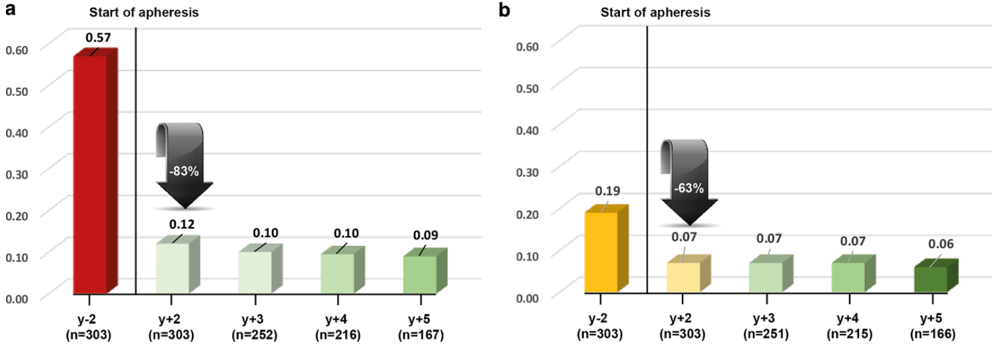
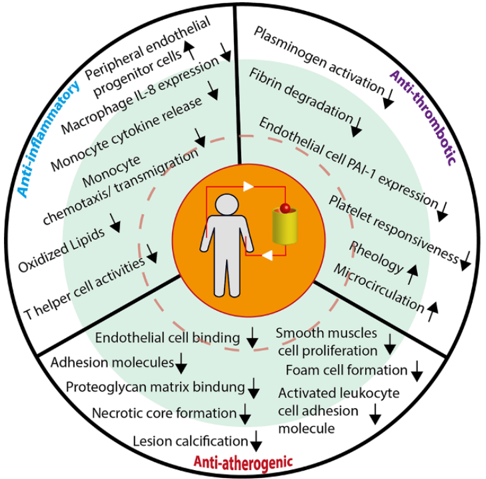
BACKGROUND: Lipoprotein(a) (Lp(a)) is a genetic risk factor for cardiovascular disease (CVD) and is associated with the induction and sustaining of atherosclerotic cardiovascular diseases (ASCVD). Since 2008 Lp(a) along with progressive CVD has been approved as an indication for regular lipoprotein apheresis (LA) in Germany. The German Lipoprotein Apheresis Registry (GLAR) has been initiated to provide statistical evidence for the assessment of extracorporeal procedures to treat dyslipidemia for both LDL-cholesterol (LDL-C) and Lp(a). The GLAR now allows prospective investigations over a 5-year period about annual incidence rates of cardiovascular events. Here Lp(a) patients (LDL-C < 100 mg/dl; Lp(a) > 60 mg/dl or >120 nmol/l) showed the same reduction of major coronary (83%) and non-coronary events (63%) as had been formerly shown in the Pro(a)LiFe study. However, Lp(a) is not only an apolipoprotein(a) (apo(a)) and LDL-C containing particle, which is covalently bound to a LDL-C core by a disulphide bridge. The composition of this particle, inter alia containing oxidized phospholipids, gives pro-atherosclerotic, pro-inflammatory, and pro-thrombotic properties, inducing atherosclerotic processes mainly in the arterial wall. However, recent investigations have shown that a reduction of inflammatory settings without LDL-C or Lp(a) reduction may reduce ASCVD events. Lipoprotein apheresis (LA) could not only reduce LDL-C and Lp(a) in parallel, but also different inflammatory and coagulation parameters. In summary lipoprotein apheresis is not only anti-atherosclerotic, but also anti-inflammatory and anti-thrombotic and therefore an ideal treatment option with respect to the shown reduction of major adverse coronary events (MACE) and major adverse non-coronary events (MANCE) by reducing Lp(a) levels.
Overview
The claims and statistics of this paper haven’t been checked yet.
Free: it reads the open-access text and checks the first 5 claims that cite a source we can check. Create a free account to check every claim.
Integrity signals
Registry
Cites
Statistics
Figures
Verification
Claims the paper makes
The claims and statistics of this paper haven’t been checked yet.
Free: it reads the open-access text and checks the first 5 claims that cite a source we can check. Create a free account to check every claim.
Claims other papers make about this one
Each is checked against this paper’s own text: does it say what the citing paper says it does?
The cited source says what the claim attributes to it.
In the citing paper
“Two studies reported a significantly lower cardiovascular event rate in patients treated with lipid apheresis for Lp(a) [194, 195].”
From Established and Emerging Lipid-Lowering Drugs for Primary and Secondary Cardiovascular Prevention (2023) · cites this paper as [194]
Experimental — accuracy not yet measured
Self-check
Percentages, sums and reported differences re-computed from the paper’s own numbers.
The self-check needs the paper’s full text.
Citations
Cites
Yusuf, S., Hawken, S., Ôunpuu, S., Dans, T., Avezum, A., Lanas, F., McQueen, M., Budaj, A., Pais, P., Varigos, J., et al. (2004) · The Lancet · doi:10.1016/s0140-6736(04)17018-9 · Cited by 12,026
Antiinflammatory Therapy with Canakinumab for Atherosclerotic Disease
Ridker, P. M., Everett, B. M., Thuren, T., MacFadyen, J. G., Chang, W. H., Ballantyne, C., Fonseca, F., Nicolau, J., Koenig, W., Anker, S. D., et al. (2017) · New England Journal of Medicine · doi:10.1056/nejmoa1707914 · Cited by 9,482
Evolocumab and Clinical Outcomes in Patients with Cardiovascular Disease
Sabatine, M. S., Giugliano, R. P., Keech, A. C., Honarpour, N., Wiviott, S. D., Murphy, S. A., Kuder, J. F., Wang, H., Liu, T., Wasserman, S. M., et al. (2017) · New England Journal of Medicine · doi:10.1056/nejmoa1615664 · Cited by 6,138
Alirocumab and Cardiovascular Outcomes after Acute Coronary Syndrome
Schwartz, G. G., Steg, P. G., Szarek, M., Bhatt, D. L., Bittner, V. A., Diaz, R., Edelberg, J. M., Goodman, S. G., Hanotin, C., Harrington, R. A., et al. (2018) · New England Journal of Medicine · doi:10.1056/nejmoa1801174 · Cited by 3,634
Lipoprotein(a) as a cardiovascular risk factor: current status
Nordestgaard, B. G., Chapman, M. J., Ray, K., Borén, J., Andreotti, F., Watts, G. F., Ginsberg, H., Amarenco, P., Catapano, A., Descamps, O. S., et al. (2010) · European Heart Journal · doi:10.1093/eurheartj/ehq386 · Cited by 1,807
A Test in Context: Lipoprotein(a)
Tsimikas, S. (2017) · Journal of the American College of Cardiology · doi:10.1016/j.jacc.2016.11.042 · Cited by 1,137
The immunology of atherosclerosis
Gisterå, A., & Hansson, G. K. (2017) · Nature Reviews Nephrology · doi:10.1038/nrneph.2017.51 · Cited by 982
van der Valk, F. M., Bekkering, S., Kroon, J., Yeang, C., Van den Bossche, J., van Buul, J. D., Ravandi, A., Nederveen, A. J., Verberne, H. J., Scipione, C., et al. (2016) · Circulation · doi:10.1161/circulationaha.116.020838 · Cited by 674
Nordestgaard, B. G., & Langsted, A. (2016) · Journal of Lipid Research · doi:10.1194/jlr.r071233 · Cited by 575
Willeit, P., Ridker, P. M., Nestel, P. J., Simes, J., Tonkin, A. M., Pedersen, T. R., Schwartz, G. G., Olsson, A. G., Colhoun, H. M., Kronenberg, F., et al. (2018) · The Lancet · doi:10.1016/s0140-6736(18)31652-0 · Cited by 564
Inflammation, Immunity, and Infection in Atherothrombosis
Libby, P., Loscalzo, J., Ridker, P. M., Farkouh, M. E., Hsue, P. Y., Fuster, V., Hasan, A. A., & Amar, S. (2018) · Journal of the American College of Cardiology · doi:10.1016/j.jacc.2018.08.1043 · Cited by 548
(2021) · Journal of Lipid Research · doi:10.1194/jlr · Cited by 427
Anti-inflammatory therapies for atherosclerosis
Bäck, M., & Hansson, G. K. (2015) · Nature Reviews Cardiology · doi:10.1038/nrcardio.2015.5 · Cited by 378
Leebmann, J., Roeseler, E., Julius, U., Heigl, F., Spitthoever, R., Heutling, D., Breitenberger, P., Maerz, W., Lehmacher, W., Heibges, A., et al. (2013) · Circulation · doi:10.1161/circulationaha.113.002432 · Cited by 329
Self-citationRelationship of Apolipoproteins A-1 and B, and Lipoprotein(a) to Cardiovascular Outcomes
Albers, J. J., Slee, A., O'Brien, K. D., Robinson, J. G., Kashyap, M. L., Kwiterovich, P. O., Xu, P., & Marcovina, S. M. (2013) · Journal of the American College of Cardiology · doi:10.1016/j.jacc.2013.06.051 · Cited by 318
(2022) · Cineca Institutional Research Information System (Tor Vergata University) · doi:10.1161/circulationaha · Cited by 291
Changes in serum lipoprotein pattern induced by acute infections
Sammalkorpi, K., Valtonen, V., Kerttula, Y., Nikkilä, E., & Taskinen, M.-R. (1988) · Metabolism · doi:10.1016/0026-0495(88)90120-5 · Cited by 275
Inhibition of Atherosclerosis in ApoE-Null Mice by Immunization with ApoB-100 Peptide Sequences
Fredrikson, G. N., Söderberg, I., Lindholm, M., Dimayuga, P., Chyu, K.-Y., Shah, P. K., & Nilsson, J. (2003) · Arteriosclerosis, Thrombosis, and Vascular Biology · doi:10.1161/01.atv.0000067937.93716.db · Cited by 261
Roeseler, E., Julius, U., Heigl, F., Spitthoever, R., Heutling, D., Breitenberger, P., Leebmann, J., Lehmacher, W., Kamstrup, P. R., Nordestgaard, B. G., et al. (2016) · Arteriosclerosis, Thrombosis, and Vascular Biology · doi:10.1161/atvbaha.116.307983 · Cited by 227
Self-citationMadhur, M. S., Funt, S. A., Li, L., Vinh, A., Chen, W., Lob, H. E., Iwakura, Y., Blinder, Y., Rahman, A., Quyyumi, A. A., et al. (2011) · Arteriosclerosis, Thrombosis, and Vascular Biology · doi:10.1161/atvbaha.111.227629 · Cited by 212
Schiopu, A., Bengtsson, J., Söderberg, I., Janciauskiene, S., Lindgren, S., Ares, M. P. S., Shah, P. K., Carlsson, R., Nilsson, J., & Fredrikson, G. N. (2004) · Circulation · doi:10.1161/01.cir.0000143162.56057.b5 · Cited by 209
Stiekema, L. C. A., Stroes, E. S. G., Verweij, S. L., Kassahun, H., Chen, L., Wasserman, S. M., Sabatine, M. S., Mani, V., & Fayad, Z. A. (2019) · European Heart Journal · doi:10.1093/eurheartj/ehy862 · Cited by 141
Holmqvist, M. E., Wedrén, S., Jacobsson, L. T. H., Klareskog, L., Nyberg, F., Rantapää‐Dahlqvist, S., Alfredsson, L., & Askling, J. (2010) · Journal of Internal Medicine · doi:10.1111/j.1365-2796.2010.02260.x · Cited by 140
Lipoprotein(a) and its role in inflammation, atherosclerosis and malignancies
Orsó, E., & Schmitz, G. (2017) · Clinical Research in Cardiology Supplements · doi:10.1007/s11789-017-0084-1 · Cited by 125
Khan, T. Z., Hsu, L., Arai, A. E., Rhodes, S., Pottle, A., Wage, R., BANYA, W. A. S., Gatehouse, P. D., Giri, S., Collins, P., et al. (2017) · European Heart Journal · doi:10.1093/eurheartj/ehx178 · Cited by 113
Tsimikas, S., Fazio, S., Viney, N. J., Xia, S., Witztum, J. L., & Marcovina, S. M. (2018) · Journal of Clinical Lipidology · doi:10.1016/j.jacl.2018.07.003 · Cited by 109
Capoulade, R., Yeang, C., Chan, K. L., Pibarot, P., & Tsimikas, S. (2018) · JAMA Cardiology · doi:10.1001/jamacardio.2018.3798 · Cited by 107
Lipoprotein(a): A missing culprit in the management of athero‐thrombosis?
Ferretti, G., Bacchetti, T., Johnston, T. P., Banach, M., Pirro, M., & Sahebkar, A. (2017) · Journal of Cellular Physiology · doi:10.1002/jcp.26050 · Cited by 98
Toth, P. P., Worthy, G., Gandra, S. R., Sattar, N., Bray, S., Cheng, L., Bridges, I., Worth, G. M., Dent, R., Forbes, C. A., et al. (2017) · Journal of the American Heart Association · doi:10.1161/jaha.116.005367 · Cited by 92
Acute impact of apheresis on oxidized phospholipids in patients with familial hypercholesterolemia
Arai, K., Orsoni, A., Mallat, Z., Tedgui, A., Witztum, J. L., Bruckert, E., Tselepis, A. D., Chapman, M. J., & Tsimikas, S. (2012) · Journal of Lipid Research · doi:10.1194/jlr.p027235 · Cited by 67
Lipoprotein(a): novel target and emergence of novel therapies to lower cardiovascular disease risk
Tsimikas, S. (2016) · Current Opinion in Endocrinology, Diabetes & Obesity · doi:10.1097/med.0000000000000237 · Cited by 62
Current view: indications for extracorporeal lipid apheresis treatment
The German Apheresis Working Group, Schettler, V. J. J., Neumann, C. L., Hulpke‐Wette, M., Hagenah, G. C., Schulz, E. G., & Wieland, E. (2012) · Clinical Research in Cardiology Supplements · doi:10.1007/s11789-012-0046-6 · Cited by 55
Self-citationAtherosclerosis in the single-cell era
Winkels, H., Ehinger, E., Ghosheh, Y., Wolf, D., & Ley, K. (2018) · Current Opinion in Lipidology · doi:10.1097/mol.0000000000000537 · Cited by 54
Wieland, E., Schettler, V. J. J., & Armstrong, V. W. (2002) · Atherosclerosis · doi:10.1016/s0021-9150(01)00698-0 · Cited by 40
Self-citationEffects of different lipoprotein apheresis methods on serum protein levels
Julius, U., Siegert, G., Kostka, H., Schatz, U., & Hohenstein, B. (2015) · Atherosclerosis Supplements · doi:10.1016/j.atherosclerosissup.2015.02.018 · Cited by 39
Self-citationLDL lipid apheresis rapidly increases peripheral endothelial progenitor cell competence
Patschan, D., Patschan, S. A., Henze, E., Wessels, J. T., Koziolek, M. J., & Muller, G. A. (2009) · Journal of Clinical Apheresis · doi:10.1002/jca.20208 · Cited by 28
Lipid apheresis: oxidative stress, rheology, and vasodilatation
Mellwig, K. P., Pulawski, E., Horstkotte, D., & van Buuren, F. (2012) · Clinical Research in Cardiology Supplements · doi:10.1007/s11789-012-0043-9 · Cited by 27
Current insights into the German Lipoprotein Apheresis Registry (GLAR) – Almost 5 years on
Schettler, V. J. J., Neumann, C. L., Peter, C., Zimmermann, T., Julius, U., Roeseler, E., Heigl, F., Grützmacher, P., Blume, H., Vogt, A., et al. (2017) · Atherosclerosis Supplements · doi:10.1016/j.atherosclerosissup.2017.05.006 · Cited by 27
Self-citationRomagnuolo, I., Sticchi, E., Attanasio, M., Grifoni, E., Cioni, G., Cellai, A. P., Abbate, R., & Fatini, C. (2016) · Fertility and Sterility · doi:10.1016/j.fertnstert.2016.01.014 · Cited by 25
Parhofer, K. G. (2009) · Vascular Health and Risk Management · doi:10.2147/vhrm.s4502 · Cited by 23
Pleiotropic effects of LDL apheresis
Ramunni, A., Burzo, M., Vernò, L., & Brescia, P. (2009) · Atherosclerosis Supplements · doi:10.1016/s1567-5688(09)71811-2 · Cited by 21
Schettler, Methe, Schuff‐Werner, Müller, & Wieland (2000) · European Journal of Clinical Investigation · doi:10.1046/j.1365-2362.2000.00583.x · Cited by 17
JCL roundtable—Lipoprotein(a): The emerging risk factor
Marcovina, S. M., Moriarty, P. M., Koschinsky, M. L., & Guyton, J. R. (2018) · Journal of clinical lipidology · doi:10.1016/j.jacl.2018.11.003 · Cited by 14
Wieland, E., Schettler, V. J. J., Creutzfeldt, C., Kickbusch, H., & Schuff‐Werner, P. (1995) · European Journal of Clinical Investigation · doi:10.1111/j.1365-2362.1995.tb01693.x · Cited by 12
Self-citationvon Bauer, R., Oikonomou, D., Sulaj, A., Kopf, S., Fleming, T. H., Rudofsky, G., & Nawroth, P. P. (2018) · Experimental and Clinical Endocrinology & Diabetes · doi:10.1055/a-0630-0232 · Cited by 5
Schettler, V. J. J., Schulz, E. G., Hagenah, G. C., & Neumann, C. L. (2014) · Clinical Kidney Journal · doi:10.1093/ckj/sfu083 · Cited by 4
Self-citationBarbero (2014) · doi:10.1016/j · Cited by 1
Cited by
PoLA/CFPiP/PCS/PSLD/PSD/PSH guidelines on diagnosis and therapy of lipid disorders in Poland 2021
Banach, M., Burchardt, P., Chlebus, K., Dobrowolski, P., Dudek, D., Dyrbuś, K., Gąsior, M., Jankowski, P., Jozwiak, J. J., Kłosiewicz−Latoszek, L., et al. (2021) · Archives of Medical Science · doi:10.5114/aoms/141941 · Cited by 189
Vinci, P., Girolamo, F. G. D., Panizon, E., Tosoni, L. M., Cerrato, C., Pellicori, F., Altamura, N., Pirulli, A., Zaccari, M., Biasinutto, C., et al. (2023) · International Journal of Environmental Research and Public Health · doi:10.3390/ijerph20186721 · Cited by 139
Established and Emerging Lipid-Lowering Drugs for Primary and Secondary Cardiovascular Prevention
Michaeli, D. T., Michaeli, J. C., Albers, S., Boch, T., & Michaeli, T. (2023) · American Journal of Cardiovascular Drugs · doi:10.1007/s40256-023-00594-5 · Cited by 109
“Two studies reported a significantly lower cardiovascular event rate in patients treated with lipid apheresis for Lp(a) [194, 195].”
BackgroundGenetics and Pathophysiological Mechanisms of Lipoprotein(a)‐Associated Cardiovascular Risk
Volgman, A. S., Koschinsky, M. L., Mehta, A., & Rosenson, R. S. (2024) · Journal of the American Heart Association · doi:10.1161/jaha.123.033654 · Cited by 80
Lipid Lowering Drugs: Present Status and Future Developments
Ruscica, M., Ferri, N., Santos, R. D., Sirtori, C. R., & Corsini, A. (2021) · Current Atherosclerosis Reports · doi:10.1007/s11883-021-00918-3 · Cited by 73
Metadata
- Authors
- Scientific Board of GLAR for the German Apheresis Working Group, Schettler, V. J. J., Neumann, C. L., Peter, C., Zimmermann, T., Julius, U., Hohenstein, B., Roeseler, E., Heigl, F., Grützmacher, P., Blume, H., Klingel, R., & Vogt, A.
- Affiliations
- Nephrologisches Zentrum Goettingen (DE)
- Landesamt für Gesundheit und Soziales (DE)
- University Hospital Carl Gustav Carus (DE)
- Agaplesion Markus Hospital (DE)
- Apherese Forschungsinstitut (DE)
- Ludwig-Maximilians-Universität München (DE)
- Corresponding author
- Schettler, V. J. J.
- Venue
- Clinical Research in Cardiology Supplements
- Published
- 2019-03-05
- Volume
- 14
- Issue
- S1
- Pages
- 33-38
- ISSN
- 1861-0706 (ISSN-L)
- 1861-0714
- OpenAlex
- W2922236150
- Semantic Scholar
- d20aafb555f9621715ef4eb7fb6cb2066381f956
- Cited by
- 37
- References
- 44
- Citations by year
- 2026: 4 · 2025: 3 · 2024: 6 · 2023: 8 · 2022: 6 · 2021: 5 · 2020: 2 · 2019: 3
- FWCI
- 3.85
- Type
- journal article
- Language
- en
- Open access
- hybrid
- doi.org
- Licence
- cc-by
- creativecommons.org/licenses/by/4.0 (tdm)
- Locations
- Clinical Research in Cardiology Supplements (publishedVersion, cc-by)
- PubMed (publishedVersion)
- GoeScholar The Publication Server of the Georg-August-Universität Göttingen (Georg-August-Universität Göttingen) (submittedVersion, cc-by)
- Topics
- Health Sciences › Medicine › Cardiology and Cardiovascular Medicine › Lipoproteins and Cardiovascular Health
- Life Sciences › Immunology and Microbiology › Immunology › Atherosclerosis and Cardiovascular Diseases
- Health Sciences › Medicine › Cardiology and Cardiovascular Medicine › Lipid metabolism and disorders
- Keywords
- lipoprotein apheresis, lipoprotein(a), cardiovascular disease, atherosclerotic cardiovascular disease, major adverse coronary events, dyslipidemia, apolipoprotein(a), inflammation, coagulation, oxidized phospholipids, LDL cholesterol
- MeSH terms
- Blood Component Removal, Cardiovascular Diseases, Germany, Humans, Cholesterol, LDL, Registries, Risk Factors, Lipoprotein(a), Genetic Predisposition to Disease, Dyslipidemias, Atherosclerosis
About these checks
Registry, retraction, Cites and statistics results are computed, not judged, with one exception: a printed reference that no index lists is read once by a model before it counts as a citation error. Claims are extracted by a model and kept only when their quote appears verbatim in the text; each cited source is then checked, with a model’s help, for whether it says what the claim relies on. Those verdicts can be wrong — read the claim’s quote and the cited source before relying on one.
Statistics and arithmetic are recomputed, not judged.
Confidence bands are shown only for fields calibrated on our annotated test set. None is calibrated yet, so no band is shown.
What counts as a claim ›How we measure confidence ›How we check this ›
Are you an author, or do you see a problem with this page? Request a review
Data sources
Bibliographic data: Semantic Scholar, OpenAlex, Crossref.
Contains information from the Semantic Scholar Academic Graph Datasets, made available under the ODC Attribution License (ODC-BY 1.0).
Semantic Scholar’s data is described in: Kinney, R., et al. (2023). The Semantic Scholar Open Data Platform. arXiv:2301.10140.
