

Mind the gap: the effect of cultural distance on mergers and acquisitions—evidence from glassdoor reviews
Open accessThe DOI matches its Crossref record; 172 of the 173 references it cites were found in a registry or an index; none of the 165 sources its claims cite is checked for support yet.
Abstract
This paper investigates the impact of differences in organizational culture on M&A outcomes during the transaction and post-merger integration phase. Using a state-of-the-art large language model, we construct a novel measure of organizational cultural distance based on employee reviews from Glassdoor.com covering 243 M&A deals from 2008 to 2021. First, we hypothesize and find that organizational cultural distance between acquirer and target firms lead to cultural frictions during the transaction and post-merger integration phases of the deal, which negatively affect short-term capital market reactions and long-term synergy gains. Second, our results suggest that cultural differences are positively related to the acquisition premium paid by the acquirer, supporting the hypothesis that cultural distance reduces the acquirer’s ability to accurately assess the true value of the target, leading to an overestimation of the realizable synergy potential. Third, we show that cultural distance is negatively related to the long-term innovativeness of the acquiring firm. Specifically, our results suggest that patent growth and new product development, measured two years after the deal, are significantly lower for firms that acquire a culturally distant target. We then examine the underlying cultural dimensions that drive these effects. Consistent with previous studies, we find that performance effects are driven by differences in market orientation, while innovation effects are driven by differences in hierarchy or adhocracy orientation, depending on whether innovation is measured in terms of tangible or intangible assets. Our findings contribute to the broad M&A literature and have practical relevance for firms engaged in M&A transactions.
Overview
CoChat Summary
TL;DR
Using Culture-BERT on Glassdoor employee reviews to measure organizational cultural distance, this paper studies 243 M&A deals from 2008–2021 and finds that greater acquirer–target cultural distance is associated with worse announcement returns, lower post-deal sales growth, higher acquisition premiums, and lower post-deal patent and new-product growth. The performance and premium effects are mainly driven by differences in market culture, while innovation effects are driven by adhocracy (patents) and hierarchy (new product development) differences.
Key findings
- Organizational cultural distance is negatively associated with capital market reactions and long-term synergies: acquirer CAR[-10,10] coefficient = -0.900 (t = -2.278, p < 0.05), acquirer CAR[-5,5] = -0.436 (t = -2.081, p < 0.05), value-weighted combined CAR[-5,5] = -0.138 (t = -1.718, p < 0.1); sales growth = -0.321 (t = -1.892, p < 0.1) at two years and -0.349 (t = -2.972, p < 0.001) at four years. These effects are mainly driven by absolute differences in market culture (e.g., CAR[-10,10] = -1.536, p < 0.01; four-year sales growth = -0.424, p < 0.01).
- Organizational cultural distance is positively associated with acquisition premiums: coefficients = 0.465 (p < 0.05) for 1-day, 0.491 (p < 0.05) for 1-week, and 0.503 (p < 0.1) for 1-month premiums; average premiums range from 33% to 38%. Market culture differences drive this effect (e.g., 1-week premium = 0.959, p < 0.01).
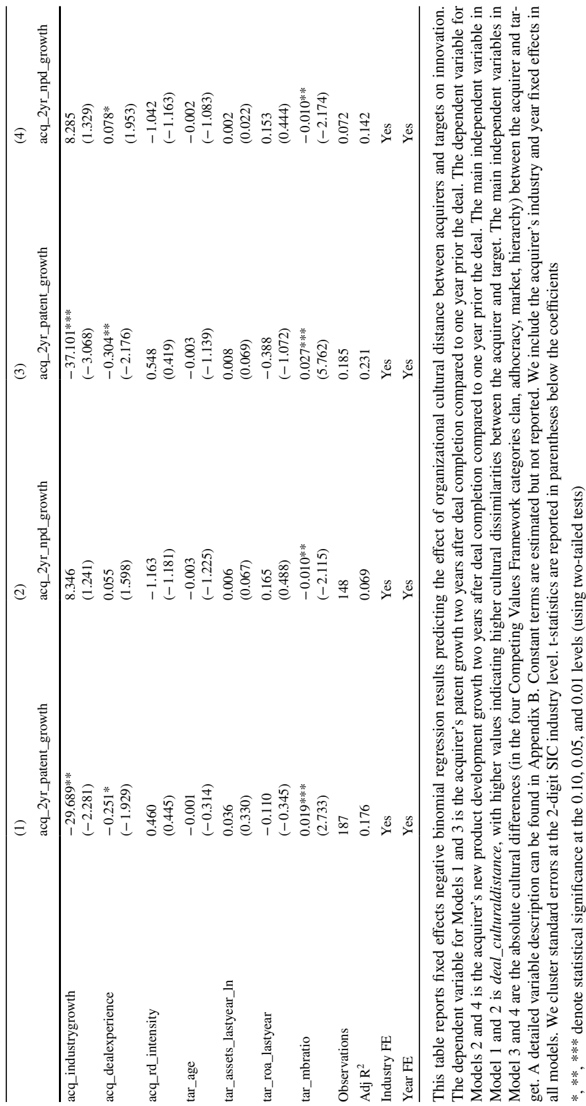
- Organizational cultural distance is negatively associated with post-deal innovativeness: patent growth = -0.051 (t = -2.573, p < 0.05) and new product development growth = -0.028 (t = -1.827, p < 0.1). Patent effects are driven by adhocracy differences (-5.036, p < 0.1), while NPD effects are driven by hierarchy differences (-2.008, p < 0.001).
- Robustness checks support the long-term synergy result: propensity score matching shows high cultural distance reduced long-term synergies by -0.089 points (95% CI [-0.157, -0.021], p < 0.05), and a synthetic counterfactual analysis shows a reduction of -0.122 points (95% CI [-0.3729, -0.0209], p < 0.01).
Methods
- Sample: SDC deal data, Refinitiv firm data, and Glassdoor reviews; final sample of 243 M&A deals from 2008–2021, 437 unique firms, 347,279 acquirer reviews and 68,069 target reviews; deals restricted to US, Canada, Australia, or UK firms with at least 10 Glassdoor reviews for both acquirer and target prior to announcement.
- Cultural distance measure: CultureBERT (RoBERTa-based) applied to merged Glassdoor pro/con text, limited to 300 tokens per review (median 128), producing probability scores for the four Competing Values Framework dimensions (clan, adhocracy, market, hierarchy); firm scores averaged before deal announcement; distance computed using Kogut and Singh’s index adapted with the Konara and Mohr correction, plus separate absolute dimension differences.
- Analysis: cross-sectional two-way fixed effects OLS regressions with acquirer industry and year fixed effects, standard errors clustered at the 2-digit SIC industry level; dependent variables include acquirer and combined CARs, sales growth, acquisition premiums, patent growth, and new product development growth; innovation models use fixed effects negative binomial regression; robustness checks include Jensen-Shannon divergence, excluding toehold and cross-border deals, quadratic term, premium control, propensity score matching, and synthetic counterfactual analysis.
Limitations
- Stated in the paper: short-term analysis assumes near-instantaneous, complete, and unbiased market reactions under the semi-strong efficient market hypothesis; findings are limited to major English-speaking economies (US, Canada, Australia, UK), limiting generalizability; only completed transactions are studied, so withdrawn deals and self-selection are not examined; Glassdoor reviews are voluntary, may not represent the entire workforce, may skew toward strong positive or negative opinions, and text may not fully capture organizational culture complexity.
- Evident from the text: dependent-variable samples are smaller than the full 243 deals (e.g., sales growth N = 182/131, premiums N = 226, patent growth N = 189, NPD N = 154), reducing power and generalizability; acquirer reviews are about five times more numerous than target reviews, and acquirer cultural dimension standard deviations are lower; the design is observational and cross-sectional, so causal interpretation relies on robustness checks rather than experimental identification.
Model-written summary. Check it against the paper before relying on it.
Integrity signals
Registry
Cites
Statistics
Figures
Verification
Claims the paper makes
0 Valid · 3 Not valid · 115 Not checked · 95 Own results and interpretations
A result the paper reports from its own data — it cites no other source for it, so there is none to check. The quote shows it is in the paper.
In the paper
“Third, we show that cultural distance is negatively related to the long-term innovativeness of the acquiring firm.”
§ Mind the gap: the effect of cultural distance on mergers and acquisitions-evidence from glassdoor reviews > Abstract
plainstates an association- Asserted: passes — The authors put it forward as true.
- Checkable: passes — It can be checked against evidence.
- Load-bearing: passes — The paper’s conclusions depend on it.
- Based: passes — The paper gives a reason why it holds.
A result the paper reports from its own data — it cites no other source for it, so there is none to check. The quote shows it is in the paper.
In the paper
“Second, our results suggest that organizational cultural distance leads to higher acquisition premiums by impairing the acquirer's ability to accurately value the target and assess synergy potential.”
§ Mind the gap: the effect of cultural distance on mergers and acquisitions-evidence from glassdoor reviews > 1 Introduction
hedgedstates a cause- Asserted: passes — The authors put it forward as true.
- Checkable: passes — It can be checked against evidence.
- Load-bearing: passes — The paper’s conclusions depend on it.
- Based: passes — The paper gives a reason why it holds.
A result the paper reports from its own data — it cites no other source for it, so there is none to check. The quote shows it is in the paper.
In the paper
“Third, we find that cultural differences negatively affect the acquirer's post-deal innovativeness, with reduced patent growth and new product development two years after the acquisition.”
§ Mind the gap: the effect of cultural distance on mergers and acquisitions-evidence from glassdoor reviews > 1 Introduction
plainstates a cause- Asserted: passes — The authors put it forward as true.
- Checkable: passes — It can be checked against evidence.
- Load-bearing: passes — The paper’s conclusions depend on it.
- Based: passes — The paper gives a reason why it holds.
A result the paper states — it cites no source for it, so there is none to check. The quote shows it is in the paper.
In the paper
“Second, our results suggest that cultural differences are positively related to the acquisition premium paid by the acquirer, supporting the hypothesis that cultural distance reduces the acquirer's ability to accurately assess the true value of the target, leading to an overestimation of the realizable synergy potential.”
§ Mind the gap: the effect of cultural distance on mergers and acquisitions-evidence from glassdoor reviews > Abstract
hedgedstates an association- Asserted: passes — The authors put it forward as true.
- Checkable: passes — It can be checked against evidence.
- Load-bearing: passes — The paper’s conclusions depend on it.
- Based: passes — The paper gives a reason why it holds.
None of the sources cited for this claim have been checked yet.
In the paper
“Further analysis shows that differences in market orientation between acquirers and targets primarily drive this negative performance effect, aligning with previous findings by Deshpandé and Farley (2004) and Eisend et al. (2016) that emphasize market orientation as a key driver of firm performance.”
§ Mind the gap: the effect of cultural distance on mergers and acquisitions-evidence from glassdoor reviews > 1 Introduction
What the sources say
- Not checked yetcites Deshpandé and Farley 2004 matched to “Organizational culture, market orientation, innovativeness, and firm performance: an international research odyssey” (2004) source
- Not checked yetcites Eisend et al. 2016 matched to “The Influence of Organizational and National Culture on New Product Performance” (2016) source
plainstates a cause- Asserted: passes — The authors put it forward as true.
- Checkable: passes — It can be checked against evidence.
- Load-bearing: passes — The paper’s conclusions depend on it.
- Based: passes — The paper gives a reason why it holds.
81 more claims
Create a free account to see all 213 claims and to verify the 153 references still open.
- It may state two separate claims as one. 68
- Probably not a substantial claim. 82
Statistics recomputed
Every reported test result, recomputed from its test statistic and degrees of freedom. A result shows as not adding up only once an independent check has confirmed it.
- Consistentz = -3.032reported p < .01 · recomputed p = .002
“z = -3.032,p < .01”
- Consistentz = -3.458reported p < .001 · recomputed p < .001
“z = -3.458,p < .001”
Self-check
Percentages, sums and reported differences re-computed from the paper’s own numbers.
Each contradiction between two passages listed here was confirmed by an independent check.
Rated major: it would touch a result — a value a result rests on, reported and recomputed p-values on opposite sides of the significance level, two passages that conflict with no sign which is right, or a cited work retracted before this paper was published.
In the paper
§ Mind the gap: the effect of cultural distance on mergers and acquisitions-evidence from glassdoor reviews > 4.1 Organizational cultural distance measure
“Then, for each firm involved in a particular M&A deal, we calculated the cumulative mean for each of the four organizational culture scores for all reviews published prior to the announcement of the deal”
§ Mind the gap: the effect of cultural distance on mergers and acquisitions-evidence from glassdoor reviews > Appendix B-variable definitions
“Firms' culture scores are first averaged by year and then averaged over all years until deal announcement”
Rated minor: it would not touch a result — a value no result rests on, a p-value that stays on the same side of the significance level, or a conflict that is clerical, resolved elsewhere in the paper, or outside its own findings.
In the paper
§ Mind the gap: the effect of cultural distance on mergers and acquisitions-evidence from glassdoor reviews > 5.3 Results of H2-organizational cultural distance and acquisition premiums
“The dependent variable for Models 1 and 3 is the acquirer's growth in return on sales two years after deal completion.The dependent variable for Models 2 and 4 is the acquirer's growth in return on sales four years after deal completion.”
§ Mind the gap: the effect of cultural distance on mergers and acquisitions-evidence from glassdoor reviews > 5.2 Results of H1-organizational cultural distance, capital market reactions, and post-deal synergies
“Therefore, we replace the dependent variable CAR with the acquirer's sales growth in the two and four years following the deal.”
Rated minor: it would not touch a result — a value no result rests on, a p-value that stays on the same side of the significance level, or a conflict that is clerical, resolved elsewhere in the paper, or outside its own findings.
In the paper
§ Mind the gap: the effect of cultural distance on mergers and acquisitions-evidence from glassdoor reviews > 4.3 Control variables
“we control for national cultural differences between the acquirers and the targets (deal_hofstede_distance) using the cultural distance measure developed by Kogut and Singh (1988)”
§ Mind the gap: the effect of cultural distance on mergers and acquisitions-evidence from glassdoor reviews > Appendix B-variable definitions
“deal_hofstede_distance National cultural distance between the acquirer's and target's nations, computed as the Euclidean distance of Hofstede's six cultural dimensions”
Citations
Cites
(2003) · Journal of Machine Learning Research · doi:10.5555/944919.944937 · Cited by 32,337
The central role of the propensity score in observational studies for causal effects
ROSENBAUM, P. R., & RUBIN, D. B. (1983) · Biometrika · doi:10.1093/biomet/70.1.41 · Cited by 31,241
Distributed Representations of Words and Phrases and their Compositionality
Mikolov, T., Sutskever, I., Chen, K., Corrado, G., & Dean, J. (2013) · arXiv · doi:10.48550/arxiv.1310.4546 · Cited by 24,533
The Market for "Lemons": Quality Uncertainty and the Market Mechanism
Akerlof, G. A. (1970) · The Quarterly Journal of Economics · doi:10.2307/1879431 · Cited by 23,016
Advances in neural information processing systems 7
Cios, K., & Shields, M. (1997) · Neurocomputing · doi:10.1016/s0925-2312(97)90018-7 · Cited by 22,059
RoBERTa: A Robustly Optimized BERT Pretraining Approach
Liu, Y., Ott, M., Goyal, N., Du, J., Joshi, M., Chen, D., Levy, O., Lewis, M., Zettlemoyer, L., & Stoyanov, V. (2019) · arXiv · doi:10.48550/arxiv.1907.11692 · Cited by 16,515
EFFICIENT CAPITAL MARKETS: A REVIEW OF THEORY AND EMPIRICAL WORK*
Malkiel, B. G., & Fama, E. F. (1970) · The Journal of Finance · doi:10.1111/j.1540-6261.1970.tb00518.x · Cited by 15,699
Efficient capital markets: A review of theory and empirical work
Fama, E. F. (1970) · The Journal of Finance · doi:10.2307/2325486 · Cited by 13,635
Organizational Culture and Leadership
Tierney, W. G., & Schein, E. H. (1986) · The Academy of Management Review · doi:10.2307/258322 · Cited by 9,601
Signaling Theory: A Review and Assessment
Connelly, B. L., Certo, S. T., Ireland, R. D., & Reutzel, C. R. (2011) · Journal of Management · doi:10.1177/0149206310388419 · Cited by 6,735
Research works printed but not linked: 3
- Hofstede GH (2001) Culture's consequences: comparing values, behaviors, institutions, and organizations across nations, 2nd edn. SAGE, Thousand Oaks
- Schweiger DM (2002) M&A integration-a framework for executives & manager. Mcgraw-Hill Book Co, New York
- Sheth J, Malhotra N, Sheth JN, Malhotra NK (eds) (2011) Wiley international encyclopedia of marketing. Wiley-Blackwell, Chichester
Cited by
Mohammadi, N., & Mohammadian, B. (2025) · Results in Engineering · doi:10.1016/j.rineng.2025.107973 · Cited by 10
The impact of biotech acquisitions on inventor productivity
Verginer, L., & Riccaboni, M. (2025) · Journal of Business Research · doi:10.1016/j.jbusres.2025.115573 · Cited by 6
Costs and Benefits of Mergers and Acquisitions in Improving Company Efficiency and Performance
Ermawati, Y., Labo, I. A., Pontoh, S., Rahmi, R., & Tahir, A. (2025) · ATESTASI Jurnal Ilmiah Akuntansi · doi:10.57178/atestasi.v8i2.1625 · Cited by 2
From ESG Alignment to Value: Post-Merger ESG Dynamics and Market Valuation in Global M&As
Kamiloğlu, S., & Genç, E. G. (2026) · International Journal of Financial Studies · doi:10.3390/ijfs14030058 · Cited by 1
From barriers to strategic readiness: how decision-makers build confidence in M&A under uncertainty
Silva, P. M., & Gomes, R. P. M. (2026) · Strategy and Leadership · doi:10.1108/sl-02-2026-0058 · Cited by 1
Metadata
- Authors
- Brede, M., Gerstel, H., Wöhrmann, A., & Bausch, A.
- Affiliations
- Justus-Liebig-Universität Gießen (DE)
- Corresponding author
- Brede, Marius
- Venue
- Review of Managerial Science
- Published
- 2024-10-05
- Volume
- 19
- Issue
- 8
- Pages
- 2279-2326
- ISSN
- 1863-6683 (ISSN-L)
- 1863-6691
- OpenAlex
- W4403146393
- Cited by
- 14
- References
- 170
- Citations by year
- 2026: 9 · 2025: 4 · 2024: 1
- FWCI
- 2.99
- Type
- journal article
- Language
- en
- Update notices
- correction (2025-02-07)
- Open access
- hybrid
- doi.org
- Licence
- cc-by-nc-nd
- creativecommons.org/licenses/by-nc-nd/4.0 (tdm)
- creativecommons.org/licenses/by-nc-nd/4.0 (vor)
- Locations
- Review of Managerial Science (publishedVersion, cc-by-nc-nd)
- Econstor (Econstor) (submittedVersion, cc-by-nc-nd)
- Topics
- Social Sciences › Economics, Econometrics and Finance › Finance › Corporate Finance and Governance
- Social Sciences › Business, Management and Accounting › Strategy and Management › International Business and FDI
- Social Sciences › Business, Management and Accounting › Strategy and Management › Innovation and Knowledge Management
- Keywords
- mergers and acquisitions, cultural distance, organizational culture, post-merger integration, synergy gains, acquisition premiums, capital market reaction, employee reviews, Glassdoor, innovation, market orientation, cultural dimensions, patent growth, new product development
About these checks
Registry, retraction, Cites and statistics results are computed, not judged, with one exception: a printed reference that no index lists is read once by a model before it counts as a citation error. Claims are extracted by a model and kept only when their quote appears verbatim in the text; each cited source is then checked, with a model’s help, for whether it says what the claim relies on. Those verdicts can be wrong — read the claim’s quote and the cited source before relying on one.
A language model drew the claims from the paper on 2026-11-23, under version 3 of the claim definition (model deepseek-v4.1-flash, prompt extract-v3).
A second model labelled each claim on 2026-11-23 (model jev-1.13-20260917, definition revision gold-guideline-v0.2).
Statistics and arithmetic are recomputed, not judged.
Confidence bands are shown only for fields calibrated on our annotated test set. None is calibrated yet, so no band is shown.
What counts as a claim ›How we measure confidence ›How we check this ›
Are you an author, or do you see a problem with this page? Request a review
How to cite
Cite CoChat for the checks on this page, and the paper for its own findings.
- This page
- CoChat. (2026). Citation check: Mind the gap: the effect of cultural distance on mergers and acquisitions—evidence from glassdoor reviews. https://app.cochat.ai/papers/10.1007/s11846-024-00811-8
- The paper
- Brede, M., Gerstel, H., Wöhrmann, A., & Bausch, A. (2025). Mind the gap: the effect of cultural distance on mergers and acquisitions—evidence from glassdoor reviews. Review of Managerial Science. https://doi.org/10.1007/s11846-024-00811-8
Data sources
Bibliographic data: Semantic Scholar, OpenAlex, Crossref.
Contains information from the Semantic Scholar Academic Graph Datasets, made available under the ODC Attribution License (ODC-BY 1.0).
Semantic Scholar’s data is described in: Kinney, R., et al. (2023). The Semantic Scholar Open Data Platform. arXiv:2301.10140.
