

Mind the gap: the effect of cultural distance on mergers and acquisitions—evidence from glassdoor reviews
Open accessThe DOI matches its Crossref record; 172 of the 173 references it cites were found in a registry or an index; none of the 165 sources its claims cite is checked for support yet.
Abstract
This paper investigates the impact of differences in organizational culture on M&A outcomes during the transaction and post-merger integration phase. Using a state-of-the-art large language model, we construct a novel measure of organizational cultural distance based on employee reviews from Glassdoor.com covering 243 M&A deals from 2008 to 2021. First, we hypothesize and find that organizational cultural distance between acquirer and target firms lead to cultural frictions during the transaction and post-merger integration phases of the deal, which negatively affect short-term capital market reactions and long-term synergy gains. Second, our results suggest that cultural differences are positively related to the acquisition premium paid by the acquirer, supporting the hypothesis that cultural distance reduces the acquirer’s ability to accurately assess the true value of the target, leading to an overestimation of the realizable synergy potential. Third, we show that cultural distance is negatively related to the long-term innovativeness of the acquiring firm. Specifically, our results suggest that patent growth and new product development, measured two years after the deal, are significantly lower for firms that acquire a culturally distant target. We then examine the underlying cultural dimensions that drive these effects. Consistent with previous studies, we find that performance effects are driven by differences in market orientation, while innovation effects are driven by differences in hierarchy or adhocracy orientation, depending on whether innovation is measured in terms of tangible or intangible assets. Our findings contribute to the broad M&A literature and have practical relevance for firms engaged in M&A transactions.
Overview
CoChat Summary
TL;DR
Using Culture-BERT on Glassdoor employee reviews to measure organizational cultural distance, this paper studies 243 M&A deals from 2008–2021 and finds that greater acquirer–target cultural distance is associated with worse announcement returns, lower post-deal sales growth, higher acquisition premiums, and lower post-deal patent and new-product growth. The performance and premium effects are mainly driven by differences in market culture, while innovation effects are driven by adhocracy (patents) and hierarchy (new product development) differences.
Key findings
- Organizational cultural distance is negatively associated with capital market reactions and long-term synergies: acquirer CAR[-10,10] coefficient = -0.900 (t = -2.278, p < 0.05), acquirer CAR[-5,5] = -0.436 (t = -2.081, p < 0.05), value-weighted combined CAR[-5,5] = -0.138 (t = -1.718, p < 0.1); sales growth = -0.321 (t = -1.892, p < 0.1) at two years and -0.349 (t = -2.972, p < 0.001) at four years. These effects are mainly driven by absolute differences in market culture (e.g., CAR[-10,10] = -1.536, p < 0.01; four-year sales growth = -0.424, p < 0.01).
- Organizational cultural distance is positively associated with acquisition premiums: coefficients = 0.465 (p < 0.05) for 1-day, 0.491 (p < 0.05) for 1-week, and 0.503 (p < 0.1) for 1-month premiums; average premiums range from 33% to 38%. Market culture differences drive this effect (e.g., 1-week premium = 0.959, p < 0.01).
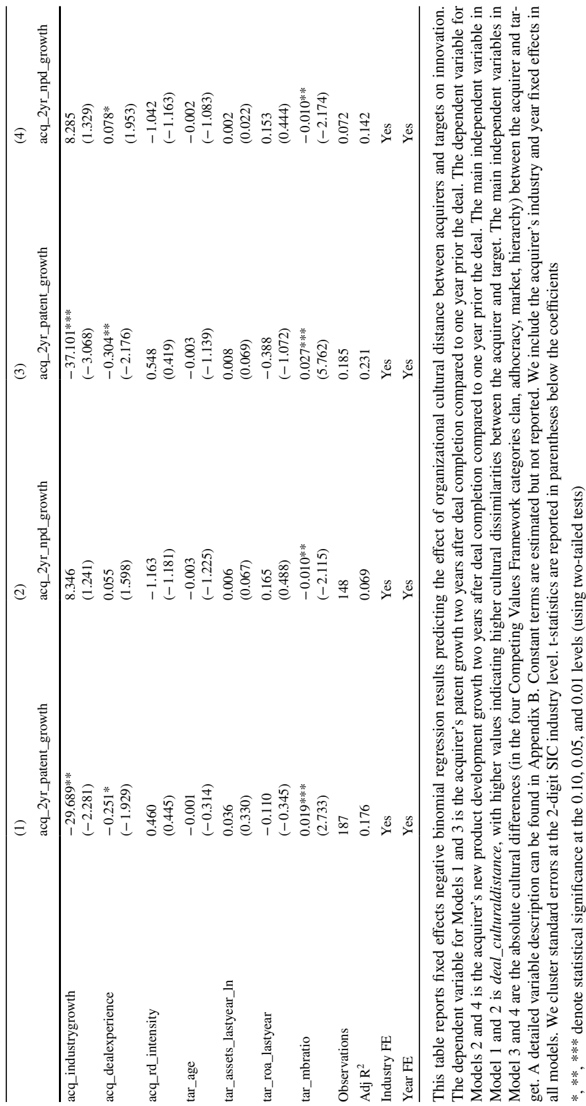
- Organizational cultural distance is negatively associated with post-deal innovativeness: patent growth = -0.051 (t = -2.573, p < 0.05) and new product development growth = -0.028 (t = -1.827, p < 0.1). Patent effects are driven by adhocracy differences (-5.036, p < 0.1), while NPD effects are driven by hierarchy differences (-2.008, p < 0.001).
- Robustness checks support the long-term synergy result: propensity score matching shows high cultural distance reduced long-term synergies by -0.089 points (95% CI [-0.157, -0.021], p < 0.05), and a synthetic counterfactual analysis shows a reduction of -0.122 points (95% CI [-0.3729, -0.0209], p < 0.01).
Methods
- Sample: SDC deal data, Refinitiv firm data, and Glassdoor reviews; final sample of 243 M&A deals from 2008–2021, 437 unique firms, 347,279 acquirer reviews and 68,069 target reviews; deals restricted to US, Canada, Australia, or UK firms with at least 10 Glassdoor reviews for both acquirer and target prior to announcement.
- Cultural distance measure: CultureBERT (RoBERTa-based) applied to merged Glassdoor pro/con text, limited to 300 tokens per review (median 128), producing probability scores for the four Competing Values Framework dimensions (clan, adhocracy, market, hierarchy); firm scores averaged before deal announcement; distance computed using Kogut and Singh’s index adapted with the Konara and Mohr correction, plus separate absolute dimension differences.
- Analysis: cross-sectional two-way fixed effects OLS regressions with acquirer industry and year fixed effects, standard errors clustered at the 2-digit SIC industry level; dependent variables include acquirer and combined CARs, sales growth, acquisition premiums, patent growth, and new product development growth; innovation models use fixed effects negative binomial regression; robustness checks include Jensen-Shannon divergence, excluding toehold and cross-border deals, quadratic term, premium control, propensity score matching, and synthetic counterfactual analysis.
Limitations
- Stated in the paper: short-term analysis assumes near-instantaneous, complete, and unbiased market reactions under the semi-strong efficient market hypothesis; findings are limited to major English-speaking economies (US, Canada, Australia, UK), limiting generalizability; only completed transactions are studied, so withdrawn deals and self-selection are not examined; Glassdoor reviews are voluntary, may not represent the entire workforce, may skew toward strong positive or negative opinions, and text may not fully capture organizational culture complexity.
- Evident from the text: dependent-variable samples are smaller than the full 243 deals (e.g., sales growth N = 182/131, premiums N = 226, patent growth N = 189, NPD N = 154), reducing power and generalizability; acquirer reviews are about five times more numerous than target reviews, and acquirer cultural dimension standard deviations are lower; the design is observational and cross-sectional, so causal interpretation relies on robustness checks rather than experimental identification.
Model-written summary. Check it against the paper before relying on it.
Integrity signals
Registry
Cites
Statistics
Figures
Verification
Claims the paper makes
0 Valid · 3 Not valid · 115 Not checked · 95 Own results and interpretations
A result the paper reports from its own data — it cites no other source for it, so there is none to check. The quote shows it is in the paper.
In the paper
“Third, we show that cultural distance is negatively related to the long-term innovativeness of the acquiring firm.”
§ Mind the gap: the effect of cultural distance on mergers and acquisitions-evidence from glassdoor reviews > Abstract
plainstates an association- Asserted: passes — The authors put it forward as true.
- Checkable: passes — It can be checked against evidence.
- Load-bearing: passes — The paper’s conclusions depend on it.
- Based: passes — The paper gives a reason why it holds.
A result the paper reports from its own data — it cites no other source for it, so there is none to check. The quote shows it is in the paper.
In the paper
“Second, our results suggest that organizational cultural distance leads to higher acquisition premiums by impairing the acquirer's ability to accurately value the target and assess synergy potential.”
§ Mind the gap: the effect of cultural distance on mergers and acquisitions-evidence from glassdoor reviews > 1 Introduction
hedgedstates a cause- Asserted: passes — The authors put it forward as true.
- Checkable: passes — It can be checked against evidence.
- Load-bearing: passes — The paper’s conclusions depend on it.
- Based: passes — The paper gives a reason why it holds.
A result the paper reports from its own data — it cites no other source for it, so there is none to check. The quote shows it is in the paper.
In the paper
“Third, we find that cultural differences negatively affect the acquirer's post-deal innovativeness, with reduced patent growth and new product development two years after the acquisition.”
§ Mind the gap: the effect of cultural distance on mergers and acquisitions-evidence from glassdoor reviews > 1 Introduction
plainstates a cause- Asserted: passes — The authors put it forward as true.
- Checkable: passes — It can be checked against evidence.
- Load-bearing: passes — The paper’s conclusions depend on it.
- Based: passes — The paper gives a reason why it holds.
A result the paper states — it cites no source for it, so there is none to check. The quote shows it is in the paper.
In the paper
“Second, our results suggest that cultural differences are positively related to the acquisition premium paid by the acquirer, supporting the hypothesis that cultural distance reduces the acquirer's ability to accurately assess the true value of the target, leading to an overestimation of the realizable synergy potential.”
§ Mind the gap: the effect of cultural distance on mergers and acquisitions-evidence from glassdoor reviews > Abstract
hedgedstates an association- Asserted: passes — The authors put it forward as true.
- Checkable: passes — It can be checked against evidence.
- Load-bearing: passes — The paper’s conclusions depend on it.
- Based: passes — The paper gives a reason why it holds.
None of the sources cited for this claim have been checked yet.
In the paper
“Further analysis shows that differences in market orientation between acquirers and targets primarily drive this negative performance effect, aligning with previous findings by Deshpandé and Farley (2004) and Eisend et al. (2016) that emphasize market orientation as a key driver of firm performance.”
§ Mind the gap: the effect of cultural distance on mergers and acquisitions-evidence from glassdoor reviews > 1 Introduction
What the sources say
- Not checked yetcites Deshpandé and Farley 2004 matched to “Organizational culture, market orientation, innovativeness, and firm performance: an international research odyssey” (2004) source
- Not checked yetcites Eisend et al. 2016 matched to “The Influence of Organizational and National Culture on New Product Performance” (2016) source
plainstates a cause- Asserted: passes — The authors put it forward as true.
- Checkable: passes — It can be checked against evidence.
- Load-bearing: passes — The paper’s conclusions depend on it.
- Based: passes — The paper gives a reason why it holds.
81 more claims
Create a free account to see all 213 claims and to verify the 153 references still open.
- It may state two separate claims as one. 68
- Probably not a substantial claim. 82
Statistics recomputed
Every reported test result, recomputed from its test statistic and degrees of freedom. A result shows as not adding up only once an independent check has confirmed it.
- Consistentz = -3.032reported p < .01 · recomputed p = .002
“z = -3.032,p < .01”
- Consistentz = -3.458reported p < .001 · recomputed p < .001
“z = -3.458,p < .001”
Self-check
Percentages, sums and reported differences re-computed from the paper’s own numbers.
Each contradiction between two passages listed here was confirmed by an independent check.
Rated major: it would touch a result — a value a result rests on, reported and recomputed p-values on opposite sides of the significance level, two passages that conflict with no sign which is right, or a cited work retracted before this paper was published.
In the paper
§ Mind the gap: the effect of cultural distance on mergers and acquisitions-evidence from glassdoor reviews > 4.1 Organizational cultural distance measure
“Then, for each firm involved in a particular M&A deal, we calculated the cumulative mean for each of the four organizational culture scores for all reviews published prior to the announcement of the deal”
§ Mind the gap: the effect of cultural distance on mergers and acquisitions-evidence from glassdoor reviews > Appendix B-variable definitions
“Firms' culture scores are first averaged by year and then averaged over all years until deal announcement”
Rated minor: it would not touch a result — a value no result rests on, a p-value that stays on the same side of the significance level, or a conflict that is clerical, resolved elsewhere in the paper, or outside its own findings.
In the paper
§ Mind the gap: the effect of cultural distance on mergers and acquisitions-evidence from glassdoor reviews > 5.3 Results of H2-organizational cultural distance and acquisition premiums
“The dependent variable for Models 1 and 3 is the acquirer's growth in return on sales two years after deal completion.The dependent variable for Models 2 and 4 is the acquirer's growth in return on sales four years after deal completion.”
§ Mind the gap: the effect of cultural distance on mergers and acquisitions-evidence from glassdoor reviews > 5.2 Results of H1-organizational cultural distance, capital market reactions, and post-deal synergies
“Therefore, we replace the dependent variable CAR with the acquirer's sales growth in the two and four years following the deal.”
Rated minor: it would not touch a result — a value no result rests on, a p-value that stays on the same side of the significance level, or a conflict that is clerical, resolved elsewhere in the paper, or outside its own findings.
In the paper
§ Mind the gap: the effect of cultural distance on mergers and acquisitions-evidence from glassdoor reviews > 4.3 Control variables
“we control for national cultural differences between the acquirers and the targets (deal_hofstede_distance) using the cultural distance measure developed by Kogut and Singh (1988)”
§ Mind the gap: the effect of cultural distance on mergers and acquisitions-evidence from glassdoor reviews > Appendix B-variable definitions
“deal_hofstede_distance National cultural distance between the acquirer's and target's nations, computed as the Euclidean distance of Hofstede's six cultural dimensions”
Citations
Cites
(2003) · Journal of Machine Learning Research · doi:10.5555/944919.944937 · Cited by 32,337
The central role of the propensity score in observational studies for causal effects
ROSENBAUM, P. R., & RUBIN, D. B. (1983) · Biometrika · doi:10.1093/biomet/70.1.41 · Cited by 31,241
Distributed Representations of Words and Phrases and their Compositionality
Mikolov, T., Sutskever, I., Chen, K., Corrado, G., & Dean, J. (2013) · arXiv · doi:10.48550/arxiv.1310.4546 · Cited by 24,533
The Market for "Lemons": Quality Uncertainty and the Market Mechanism
Akerlof, G. A. (1970) · The Quarterly Journal of Economics · doi:10.2307/1879431 · Cited by 23,016
Advances in neural information processing systems 7
Cios, K., & Shields, M. (1997) · Neurocomputing · doi:10.1016/s0925-2312(97)90018-7 · Cited by 22,059
RoBERTa: A Robustly Optimized BERT Pretraining Approach
Liu, Y., Ott, M., Goyal, N., Du, J., Joshi, M., Chen, D., Levy, O., Lewis, M., Zettlemoyer, L., & Stoyanov, V. (2019) · arXiv · doi:10.48550/arxiv.1907.11692 · Cited by 16,515
EFFICIENT CAPITAL MARKETS: A REVIEW OF THEORY AND EMPIRICAL WORK*
Malkiel, B. G., & Fama, E. F. (1970) · The Journal of Finance · doi:10.1111/j.1540-6261.1970.tb00518.x · Cited by 15,699
Efficient capital markets: A review of theory and empirical work
Fama, E. F. (1970) · The Journal of Finance · doi:10.2307/2325486 · Cited by 13,635
Organizational Culture and Leadership
Tierney, W. G., & Schein, E. H. (1986) · The Academy of Management Review · doi:10.2307/258322 · Cited by 9,601
Signaling Theory: A Review and Assessment
Connelly, B. L., Certo, S. T., Ireland, R. D., & Reutzel, C. R. (2011) · Journal of Management · doi:10.1177/0149206310388419 · Cited by 6,735
Brown, S. J., & Warner, J. B. (1985) · Journal of Financial Economics · doi:10.1016/0304-405x(85)90042-x · Cited by 6,488
The Effect of National Culture on the Choice of Entry Mode
Kogut, B., & Singh, H. (1988) · Journal of International Business Studies · doi:10.1057/palgrave.jibs.8490394 · Cited by 6,240
Matching Methods for Causal Inference: A Review and a Look Forward
Stuart, E. A. (2010) · Statistical Science · doi:10.1214/09-sts313 · Cited by 5,478
Zaheer, A., McEvily, B., & Perrone, V. (1998) · Organization Science · doi:10.1287/orsc.9.2.141 · Cited by 4,179
Human Groups and Social Categories: Studies in Social Psychology.
Rose, A., & Tajfel, H. (1983) · Contemporary Sociology · doi:10.2307/2066820 · Cited by 4,110
Garcia, R., & Calantone, R. (2002) · Journal of Product Innovation Management · doi:10.1111/1540-5885.1920110 · Cited by 3,470
Jehn, K. A., Northcraft, G. B., & Neale, M. A. (1999) · Administrative Science Quarterly · doi:10.2307/2667054 · Cited by 3,359
Quinn, R. E., & Rohrbaugh, J. (1983) · Management Science · doi:10.1287/mnsc.29.3.363 · Cited by 3,329
The Central Role of the Propensity Score in Observational Studies for Causal Effects
Rosenbaum, P. R., & Rubin, D. B. (1983) · Biometrika · doi:10.2307/2335942 · Cited by 3,261
Hofstede, G. (1980) · International Studies of Management & Organization · doi:10.1080/00208825.1980.11656300 · Cited by 3,178
Reducing Bias in Observational Studies Using Subclassification on the Propensity Score
Rosenbaum, P. R., & Rubin, D. B. (1984) · Journal of the American Statistical Association · doi:10.1080/01621459.1984.10478078 · Cited by 3,082
New Evidence and Perspectives on Mergers
Andrade, G., Mitchell, M., & Stafford, E. (2001) · Journal of Economic Perspectives · doi:10.1257/jep.15.2.103 · Cited by 2,798
Social identity and intergroup relations.
Abrams, D. (2015) · APA handbook of personality and social psychology, Volume 2: Group processes. · doi:10.1037/14342-008 · Cited by 2,686
Technological acquisitions and the innovation performance of acquiring firms: a longitudinal study
Ahuja, G., & Katila, R. (2001) · Strategic Management Journal · doi:10.1002/smj.157 · Cited by 2,404
Firm size and the gains from acquisitions
Moeller, S. B., Schlingemann, F. P., & Stulz, R. M. (2004) · Journal of Financial Economics · doi:10.1016/j.jfineco.2003.07.002 · Cited by 2,322
Kirkman, B. L., Lowe, K. B., & Gibson, C. B. (2006) · Journal of International Business Studies · doi:10.1057/palgrave.jibs.8400202 · Cited by 2,212
Diagnosing cultural barriers to knowledge management
De Long, D. W., & Fahey, L. (2000) · Academy of Management Perspectives · doi:10.5465/ame.2000.3979820 · Cited by 1,927
Do Managerial Objectives Drive Bad Acquisitions?
MORCK, R., SHLEIFER, A., & VISHNY, R. W. (1990) · The Journal of Finance · doi:10.1111/j.1540-6261.1990.tb05079.x · Cited by 1,887
Watson, W. E., Kumar, K., & Michaelsen, L. K. (1993) · Academy of Management Journal · doi:10.2307/256593 · Cited by 1,867
FOREIGN ENTRY, CULTURAL BARRIERS, AND LEARNING
BARKEMA, H. G., BELL, J. H. J., & PENNINGS, J. M. (1996) · Strategic Management Journal · doi:10.1002/(sici)1097-0266(199602)17:2<151::aid-smj799>3.0.co;2-z · Cited by 1,845
Explaining the Premiums Paid for Large Acquisitions: Evidence of CEO Hubris
Hayward, M. L. A., & Hambrick, D. C. (1997) · Administrative Science Quarterly · doi:10.2307/2393810 · Cited by 1,787
Social Distance and Social Decisions
Akerlof, G. A. (1997) · Econometrica · doi:10.2307/2171877 · Cited by 1,443
An institutional approach to cross-national distance
Berry, H., Guillén, M. F., & Zhou, N. (2010) · Journal of International Business Studies · doi:10.1057/jibs.2010.28 · Cited by 1,335
Zheng, W., Yang, B., & McLean, G. N. (2010) · Journal of Business Research · doi:10.1016/j.jbusres.2009.06.005 · Cited by 1,269
Cultures In Organizations: Three Perspectives
Martin, J. (1992) · doi:10.1093/oso/9780195071634.001.0001 · Cited by 1,183
Corporate Acquisitions: A Process Perspective
Jemison, D. B., & Sitkin, S. B. (1986) · The Academy of Management Review · doi:10.2307/258337 · Cited by 1,159
Cross-country determinants of mergers and acquisitions
Rossi, S., & Volpin, P. F. (2004) · Journal of Financial Economics · doi:10.1016/j.jfineco.2003.10.001 · Cited by 1,144
National Cultural Distance and Cross-Border Acquisition Performance
Morosini, P., Shane, S., & Singh, H. (1998) · Journal of International Business Studies · doi:10.1057/palgrave.jibs.8490029 · Cited by 1,118
THE MARKET FOR CORPORATE CONTROL AND FIRM INNOVATION.
HITT, M. A., HOSKISSON, R. E., JOHNSON, R. A., & MOESEL, D. D. (1996) · Academy of Management Journal · doi:10.2307/256993 · Cited by 1,112
Zollo, M., & Singh, H. (2004) · Strategic Management Journal · doi:10.1002/smj.426 · Cited by 1,106
Glamour, value and the post-acquisition performance of acquiring firms
Raghavendra Rau, P. (1998) · Journal of Financial Economics · doi:10.1016/s0304-405x(98)00023-3 · Cited by 1,067
Lost in translation? The effect of cultural values on mergers around the world
Ahern, K. R., Daminelli, D., & Fracassi, C. (2015) · Journal of Financial Economics · doi:10.1016/j.jfineco.2012.08.006 · Cited by 1,055
The Strength of Corporate Culture and the Reliability of Firm Performance
Sørensen, J. B. (2002) · Administrative Science Quarterly · doi:10.2307/3094891 · Cited by 1,004 · cited 2×
“…arguments for the positive impact of cultural differences on M&A performance are primarily based on the theory of interorganizational learning (Sørensen 2002), according to which M&As involving culturally distant firms provide significant learning opportunities that enable the profitable…”
Measuring Corporate Culture Using Machine Learning
Li, K., Mai, F., Shen, R., & Yan, X. (2021) · The Review of Financial Studies · doi:10.1093/rfs/hhaa079 · Cited by 999
The value of corporate culture
Guiso, L., Sapienza, P., & Zingales, L. (2015) · Journal of Financial Economics · doi:10.1016/j.jfineco.2014.05.010 · Cited by 950
THE INFLUENCE OF ORGANIZATION STRUCTURE ON THE UTILITY OF AN ENTREPRENEURIAL TOP MANAGEMENT STYLE
Covin, J. G., & Slevin, D. P. (1988) · Journal of Management Studies · doi:10.1111/j.1467-6486.1988.tb00033.x · Cited by 907
Do Long‐Term Shareholders Benefit From Corporate Acquisitions?
LOUGHRAN, T., & VIJH, A. M. (1997) · The Journal of Finance · doi:10.1111/j.1540-6261.1997.tb02741.x · Cited by 877
Do Long-Term Shareholders Benefit From Corporate Acquisitions?
Loughran, T., & Vijh, A. M. (1997) · The Journal of Finance · doi:10.2307/2329464 · Cited by 875
Corporate Innovations and Mergers and Acquisitions
BENA, J., & LI, K. (2014) · The Journal of Finance · doi:10.1111/jofi.12059 · Cited by 869
Hostility in Takeovers: In the Eyes of the Beholder?
Schwert, G. W. (2000) · The Journal of Finance · doi:10.1111/0022-1082.00301 · Cited by 847
Organizational fit and acquisition performance: Effects of post‐acquisition integration
Datta, D. K. (1991) · Strategic Management Journal · doi:10.1002/smj.4250120404 · Cited by 764
Cultural differences and shareholder value in related mergers: Linking equity and human capital
Chatterjee, S., Lubatkin, M. H., Schweiger, D. M., & Weber, Y. (1992) · Strategic Management Journal · doi:10.1002/smj.4250130502 · Cited by 754
Do Cultural Differences Matter in Mergers and Acquisitions? A Tentative Model and Examination
Stahl, G. K., & Voigt, A. (2008) · Organization Science · doi:10.1287/orsc.1070.0270 · Cited by 704
Interpreting and responding to strategic issues: The impact of national culture
Schneider, S. C., & De Meyer, A. (1991) · Strategic Management Journal · doi:10.1002/smj.4250120406 · Cited by 688
Matched Sampling for Causal Effects
Rubin, D. B. (2006) · Cambridge University Press eBooks · doi:10.1017/cbo9780511810725 · Cited by 676
The Economics of Patents: Lessons from Recent U.S. Patent Reform
Gallini, N. T. (2002) · Journal of Economic Perspectives · doi:10.1257/0895330027292 · Cited by 659
Organizational Culture and Innovation: A Meta‐Analytic Review
Büschgens, T., Bausch, A., & Balkin, D. B. (2013) · Journal of Product Innovation Management · doi:10.1111/jpim.12021 · Cited by 649
Self-citationChatterjee, A., & Hambrick, D. C. (2011) · Administrative Science Quarterly · doi:10.1177/0001839211427534 · Cited by 636
EFFECTS OF ACQUISITIONS ON R&D INPUTS AND OUTPUTS.
Hitt, M. A., Ireland, R. D., Harrison, J. S., & HOSKISSON, R. E. (1991) · Academy of Management Journal · doi:10.2307/256412 · Cited by 623
When Cultures Collide: The Anatomy of a Merger
Buono, A. F., Bowditch, J. L., & Lewis, J. W. (1985) · Human Relations · doi:10.1177/001872678503800506 · Cited by 611
Cultural Conflict and Merger Failure: An Experimental Approach
Weber, R. A., & Camerer, C. F. (2003) · Management Science · doi:10.1287/mnsc.49.4.400.14430 · Cited by 601
The role of culture compatibility in successful organizational marriage
Cartwright, S., & Cooper, C. L. (1993) · Academy of Management Perspectives · doi:10.5465/ame.1993.9411302324 · Cited by 591
Innovation or imitation? The role of organizational culture
Naranjo‐Valencia, J. C., Jiménez‐Jiménez, D., & Sanz‐Valle, R. (2011) · Management Decision · doi:10.1108/00251741111094437 · Cited by 585
Deshpandé, R., & Farley, J. U. (2004) · International Journal of Research in Marketing · doi:10.1016/j.ijresmar.2003.04.002 · Cited by 573
FOREIGN SUBSIDIARY COMPENSATION STRATEGY: AN AGENCY THEORY PERSPECTIVE.
Roth, K., & O'Donnell, S. (1996) · Academy of Management Journal · doi:10.2307/256659 · Cited by 560
The Synergy Trap: How Companies Lose the Acquisition Game
Sirower, M. L. (2000) · Cited by 503
Bauer, F., & Matzler, K. (2014) · Strategic Management Journal · doi:10.1002/smj.2091 · Cited by 498
Cross-border acquisitions and firm value: An analysis of emerging-market multinationals
Aybar, B., & Ficici, A. (2009) · Journal of International Business Studies · doi:10.1057/jibs.2009.15 · Cited by 481
Haunschild, P. R. (1994) · Administrative Science Quarterly · doi:10.2307/2393296 · Cited by 430
Corporate culture: Evidence from the field
Graham, J. R., Grennan, J., Harvey, C. R., & Rajgopal, S. (2022) · Journal of Financial Economics · doi:10.1016/j.jfineco.2022.07.008 · Cited by 428
Mars–Venus marriages: Culture and cross-border M&A
Chakrabarti, R., Gupta-Mukherjee, S., & Jayaraman, N. (2009) · Journal of International Business Studies · doi:10.1057/jibs.2008.58 · Cited by 409
Paradigm lost: Reinvigorating the study of organizational culture
Chatman, J. A., & O’Reilly, C. A. (2016) · Research in Organizational Behavior · doi:10.1016/j.riob.2016.11.004 · Cited by 408
Zollo, M., & Meier, D. (2008) · Academy of Management Perspectives · doi:10.5465/amp.2008.34587995 · Cited by 397
National vs. corporate culture: Implications for human resource management
Schneider, S. C. (1988) · Human Resource Management · doi:10.1002/hrm.3930270207 · Cited by 396
The Impact of Acquisitions on Innovation: Poison Pill, Placebo, or Tonic?
Prabhu, J. C., Chandy, R. K., & Ellis, M. E. (2005) · Journal of Marketing · doi:10.1509/jmkg.69.1.114.55514 · Cited by 391
On the Discursive Construction of Success/Failure in Narratives of Post-Merger Integration
Vaara, E. (2002) · Organization Studies · doi:10.1177/0170840602232003 · Cited by 384
Do corporate codes of ethics reflect national character? Evidence from Europe and the United States
Langlois, C. C., & Schlegelmilch, B. B. (1990) · Journal of International Business Studies · doi:10.1057/palgrave.jibs.8490340 · Cited by 381 · cited 1×
“Organizational practices (Child et al. 2003; Kogut and Singh 1988), decision-making styles (Schneider and Meyer 1991), and codes of ethics (Langlois and Schlegelmilch 1990) are highly culturally specific.”
Do Cultural Differences Between Contracting Parties Matter? Evidence from Syndicated Bank Loans
Giannetti, M., & Yafeh, Y. (2012) · Management Science · doi:10.1287/mnsc.1110.1378 · Cited by 381
How Do Diversity of Opinion and Information Asymmetry Affect Acquirer Returns?
Moeller, S. B., Schlingemann, F. P., & Stulz, R. M. (2007) · Review of Financial Studies · doi:10.1093/rfs/hhm040 · Cited by 356
Homburg, C., & Bucerius, M. (2006) · Strategic Management Journal · doi:10.1002/smj.520 · Cited by 350
Failure and success in mergers and acquisitions
Renneboog, L., & Vansteenkiste, C. (2019) · Journal of Corporate Finance · doi:10.1016/j.jcorpfin.2019.07.010 · Cited by 344
Arrow, K. J. (1974) · Cited by 342
The Impact on UK Acquirers of Domestic, Cross‐border, Public and Private Acquisitions
Conn, R. L., Cosh, A., Guest, P. M., & Hughes, A. (2005) · Journal of Business Finance & Accounting · doi:10.1111/j.0306-686x.2005.00615.x · Cited by 332
Corporate Cultural Fit and Performance in Mergers and Acquisitions
Weber, Y. (1996) · Human Relations · doi:10.1177/001872679604900903 · Cited by 326
The liability of foreignness in capital markets: Sources and remedies
Bell, R. G., Filatotchev, I., & Rasheed, A. A. (2012) · Journal of International Business Studies · doi:10.1057/jibs.2011.55 · Cited by 322
Sarala, R. M., & Vaara, E. (2010) · Journal of International Business Studies · doi:10.1057/jibs.2009.89 · Cited by 315
Financial Statement Comparability and the Efficiency of Acquisition Decisions
Chen, C., Collins, D. W., Kravet, T. D., & Mergenthaler, R. D. (2018) · Contemporary Accounting Research · doi:10.1111/1911-3846.12380 · Cited by 312
The Culture–Performance Relationship in M&A: From Yes/No to How
Teerikangas, S., & Very, P. (2006) · British Journal of Management · doi:10.1111/j.1467-8551.2006.00477.x · Cited by 311
Ahammad, M. F., Tarba, S. Y., Liu, Y., & Glaister, K. W. (2016) · International Business Review · doi:10.1016/j.ibusrev.2014.06.015 · Cited by 310
Competing Values Leadership: Creating Value in Organizations
Cameron, K. S., Quinn, R. E., DeGraff, J., & Thakor, A. V. (2006) · Edward Elgar Publishing eBooks · doi:10.4337/9781847201560 · Cited by 307
KRISHNAN, H. A., MILLER, A., & JUDGE, W. Q. (1997) · Strategic Management Journal · doi:10.1002/(sici)1097-0266(199705)18:5<361::aid-smj866>3.0.co;2-l · Cited by 307
Bidding strategies and takeover premiums: A review
Eckbo, B. E. (2009) · Journal of Corporate Finance · doi:10.1016/j.jcorpfin.2008.09.016 · Cited by 306
Role of subjective culture in organizations: A review and directions for future research.
Bhagat, R. S., & McQuaid, S. J. (1982) · Journal of Applied Psychology · doi:10.1037//0021-9010.67.5.653 · Cited by 283
Growth, Acquisition Activity and Firm Size: Evidence from the United Kingdom
Kumar, M. S. (1985) · Journal of Industrial Economics · doi:10.2307/2098540 · Cited by 278
CEO Preferences and Acquisitions
JENTER, D., & LEWELLEN, K. (2015) · The Journal of Finance · doi:10.1111/jofi.12283 · Cited by 268
Corporate Acquisitions, Diversification, and the Firm's Life Cycle
Arikan, A. M., & Stulz, R. M. (2016) · The Journal of Finance · doi:10.1111/jofi.12362 · Cited by 268
Vaara, E., Sarala, R., Stahl, G. K., & Björkman, I. (2012) · Journal of Management Studies · doi:10.1111/j.1467-6486.2010.00975.x · Cited by 260
Do early birds get the returns? An empirical investigation of early‐mover advantages in acquisitions
Carow, K., Heron, R., & Saxton, T. (2004) · Strategic Management Journal · doi:10.1002/smj.404 · Cited by 250
RAMASWAMY, K. (1997) · Academy of Management Journal · doi:10.2307/257059 · Cited by 242
Textual Analysis in Accounting: What's Next?*
Bochkay, K., Brown, S. V., Leone, A. J., & Tucker, J. W. (2023) · Contemporary Accounting Research · doi:10.1111/1911-3846.12825 · Cited by 242
A Signaling Theory of Acquisition Premiums: Evidence from IPO Targets
Reuer, J. J., Tong, T. W., & Wu, C.-W. (2012) · Academy of Management Journal · doi:10.5465/amj.2010.0259 · Cited by 242
The measurement of innovation performance in the firm: An overview
Cordero, R. (1990) · Research Policy · doi:10.1016/0048-7333(90)90048-b · Cited by 238
Kim, J.-Y. (., Haleblian, J. (., & Finkelstein, S. (2011) · Administrative Science Quarterly · doi:10.2189/asqu.2011.56.1.026 · Cited by 227
Do financial markets care about SRI? Evidence from mergers and acquisitions
Aktas, N., de Bodt, E., & Cousin, J.-G. (2011) · Journal of Banking & Finance · doi:10.1016/j.jbankfin.2010.12.006 · Cited by 215
Bereskin, F., Byun, S. K., Officer, M. S., & Oh, J.-M. (2018) · Journal of Financial and Quantitative Analysis · doi:10.1017/s0022109018000716 · Cited by 214
Blonigen, B. A., & Taylor, C. T. (2000) · The Journal of Industrial Economics · doi:10.1111/1467-6451.00112 · Cited by 211
On the role of acquisition premium in acquisition research
Laamanen, T. (2007) · Strategic Management Journal · doi:10.1002/smj.639 · Cited by 200
Corritore, M., Goldberg, A., & Srivastava, S. B. (2020) · Administrative Science Quarterly · doi:10.1177/0001839219844175 · Cited by 198
Slangen, A. H. L. (2006) · Journal of World Business · doi:10.1016/j.jwb.2006.01.003 · Cited by 198
Organizational Political Ideology and Corporate Openness to Social Activism
Gupta, A., & Briscoe, F. S. (2019) · Administrative Science Quarterly · doi:10.1177/0001839219852954 · Cited by 185
The Road to Hell: The Dynamics of Distrust in an Era of Quality
Sitkin, S. B., & Stickel, D. (1996) · Trust in Organizations: Frontiers of Theory and Research · doi:10.4135/9781452243610.n10 · Cited by 181
Transfer Effects in Large Acquisitions: How Size-Specific Experience Matters
Ellis, K. M., Reus, T. H., Lamont, B. T., & Ranft, A. L. (2011) · Academy of Management Journal · doi:10.5465/amj.2009.0122 · Cited by 178
Financial credibility, ownership, and financing constraints in private firms
Hope, O.-K., Thomas, W., & Vyas, D. (2011) · Journal of International Business Studies · doi:10.1057/jibs.2011.23 · Cited by 173
Enculturation Trajectories: Language, Cultural Adaptation, and Individual Outcomes in Organizations
Srivastava, S. B., Goldberg, A., Manian, V. G., & Potts, C. (2018) · Management Science · doi:10.1287/mnsc.2016.2671 · Cited by 165
Angwin, D. (2001) · Journal of World Business · doi:10.1016/s1090-9516(00)00053-5 · Cited by 164
Managerial Ownership, the Method of Payment for Acquisitions, and Executive Job Retention
Ghosh, A., & Ruland, W. (1998) · The Journal of Finance · doi:10.1111/0022-1082.325125 · Cited by 155
Spin‐off performance: A case of overstated expectations?
Woo, C. Y., Willard, G. E., & Daellenbach, U. S. (1992) · Strategic Management Journal · doi:10.1002/smj.4250130604 · Cited by 151
A Meta‐Analytic Integration of Acquisition Performance Prediction
King, D. R., Wang, G., Samimi, M., & Cortes, A. F. (2021) · Journal of Management Studies · doi:10.1111/joms.12636 · Cited by 134
von der Mosel, J., Trautsch, A., & Herbold, S. (2022) · IEEE Transactions on Software Engineering · doi:10.1109/tse.2022.3178469 · Cited by 133
Cheng, C., & Yang, M. (2017) · Journal of Business Research · doi:10.1016/j.jbusres.2017.08.019 · Cited by 118
Tone at the Bottom: Measuring Corporate Misconduct Risk from the Text of Employee Reviews
Campbell, D. W., & Shang, R. (2022) · Management Science · doi:10.1287/mnsc.2021.4211 · Cited by 118
Bauer, F., Matzler, K., & Wolf, S. (2016) · International Business Review · doi:10.1016/j.ibusrev.2014.07.010 · Cited by 112
The challenge of renewal through acquisitions
Haspeslagh, P. C., & Jemison, D. B. (1991) · Strategy and Leadership · doi:10.1108/eb054320 · Cited by 111
The translation of corporate governance changes across national cultures: the case of Germany
Buck, T., & Shahrim, A. (2005) · Journal of International Business Studies · doi:10.1057/palgrave.jibs.8400109 · Cited by 110
Cross‐border mergers and acquisitions amid political uncertainty: A bargaining perspective
Lee, K. H. (2018) · Strategic Management Journal · doi:10.1002/smj.2944 · Cited by 109
Bhagat, R. S. (2002) · Academy of Management Review · doi:10.5465/amr.2002.7389951 · Cited by 105
Using Option Prices to Infer Overpayments and Synergies in M&A Transactions
Barraclough, K., Robinson, D. T., Smith, T. M., & Whaley, R. E. (2012) · Review of Financial Studies · doi:10.1093/rfs/hhs119 · Cited by 103
Lim, J., Makhija, A. K., & Shenkar, O. (2016) · Journal of Corporate Finance · doi:10.1016/j.jcorpfin.2016.07.007 · Cited by 102
How mergers affect innovation: Theory and evidence
Haucap, J., Rasch, A., & Stiebale, J. (2019) · International Journal of Industrial Organization · doi:10.1016/j.ijindorg.2018.10.003 · Cited by 98
Board Composition, Board Effectiveness, and the Observed Form of Takeover Bids
Bange, M. M., & Mazzeo, M. A. (2004) · Review of Financial Studies · doi:10.1093/rfs/hhh001 · Cited by 94
Target Firm-Specific Information and Acquisition Efficiency
Martin, X., & Shalev, R. (2017) · Management Science · doi:10.1287/mnsc.2015.2371 · Cited by 93
Cherchem, N. (2017) · Journal of Family Business Strategy · doi:10.1016/j.jfbs.2017.04.001 · Cited by 91
Louis, M. R. (1981) · Human Systems Management · doi:10.3233/hsm-1981-2403 · Cited by 91
Does target firm insider trading signal the target's synergy potential in mergers and acquisitions?
Suk, I., & Wang, M. (2021) · Journal of Financial Economics · doi:10.1016/j.jfineco.2021.05.038 · Cited by 78
Why We Should Stop Using the Kogut and Singh Index
Konara, P., & Mohr, A. (2019) · Management International Review · doi:10.1007/s11575-019-00378-7 · Cited by 75
CEO pay inequity, CEO-TMT pay gap, and acquisition premiums
Lee, G., Cho, S. Y., Arthurs, J. D., & Lee, E. K. (2019) · Journal of Business Research · doi:10.1016/j.jbusres.2019.01.023 · Cited by 72
Lawrence, E. R., Raithatha, M., & Rodriguez, I. (2021) · Journal of Corporate Finance · doi:10.1016/j.jcorpfin.2021.101950 · Cited by 68
Causal inference with observational data: A tutorial on propensity score analysis
Narita, K., Tena, J. D. D., & Detotto, C. (2023) · The Leadership Quarterly · doi:10.1016/j.leaqua.2023.101678 · Cited by 64
The Influence of Organizational and National Culture on New Product Performance
Eisend, M., Evanschitzky, H., & Gilliland, D. I. (2016) · Journal of Product Innovation Management · doi:10.1111/jpim.12268 · Cited by 61
Corporate culture and firm value: Evidence from crisis
Fang, Y., Fiordelisi, F., Hasan, I., Leung, W. S., & Wong, G. (2023) · Journal of Banking & Finance · doi:10.1016/j.jbankfin.2022.106710 · Cited by 58
Review of the Literature on Merger Waves
Cho, S., & Chung, C. (2022) · Journal of risk and financial management · doi:10.3390/jrfm15100432 · Cited by 53
Successful Product Development after Firm Acquisitions: The Role of Research and Development
Grimpe, C. (2007) · Journal of Product Innovation Management · doi:10.1111/j.1540-5885.2007.00275.x · Cited by 49
Pesch, R., & Bouncken, R. B. (2017) · Cross Cultural & Strategic Management · doi:10.1108/ccsm-03-2016-0065 · Cited by 47
Do synergies exist in related acquisitions? A meta-analysis of acquisition studies
Homberg, F., Rost, K., & Osterloh, M. (2009) · Review of Managerial Science · doi:10.1007/s11846-009-0026-5 · Cited by 46
Technology in the Modern Corporation
(1986) · Elsevier eBooks · doi:10.1016/c2013-0-03824-8 · Cited by 46
Overbidding in cross-border acquisitions: Misperceptions in assessing and valuing knowledge
Mukherji, A., Mukherji, J., Dibrell, C., & Francis, J. D. (2013) · Journal of World Business · doi:10.1016/j.jwb.2012.06.005 · Cited by 42
Opposing positions in M&A research: culture, integration and performance
Dauber, D. (2012) · Cross Cultural Management: An International Journal · doi:10.1108/13527601211247107 · Cited by 39
Cultural differences and synergy realization in cross-border acquisitions
Wang, D., Hain, D. S., Larimo, J., & Dao, L. T. (2020) · International Business Review · doi:10.1016/j.ibusrev.2020.101675 · Cited by 38
Rottig, D. (2017) · International Journal of Emerging Markets · doi:10.1108/ijoem-01-2015-0003 · Cited by 34
The effect of target’s CSR performance on M&A deal premiums: a case for service firms
Ozdemir, O., Binesh, F., & Erkmen, E. (2022) · Review of Managerial Science · doi:10.1007/s11846-021-00471-y · Cited by 32
The Role of Corporate Culture in Mergers & AcquisitionsPreprint
Bouwman, C. H. S. (2013) · SSRN Electronic Journal · Cited by 28
Corporate social responsibility culture and international M&As
Alexandridis, G., Hoepner, A. G. F., Huang, Z., & Oikonomou, I. (2022) · The British Accounting Review · doi:10.1016/j.bar.2021.101035 · Cited by 27
Family firms, national culture and corporate social performance: a meta-analysis
Chen, J., & Liu, L. (2022) · Cross Cultural & Strategic Management · doi:10.1108/ccsm-09-2020-0178 · Cited by 24
Baik, B., Cho, K., Choi, W., & Kang, J.-K. (2015) · Management International Review · doi:10.1007/s11575-015-0249-4 · Cited by 23
Balancing Treatment and Control Groups in Quasi‐Experiments: An Introduction to Propensity Scoring
Connelly, B. S., Sackett, P. R., & Waters, S. D. (2013) · Personnel Psychology · doi:10.1111/peps.12020 · Cited by 21
Li, C., & Haleblian, J. (. (2022) · Journal of Management · doi:10.1177/01492063211010219 · Cited by 21
The key role of market orientation in innovation ambidexterity in agribusiness firms
Corchuelo Martínez-Azúa, B., Dias, Á., & Sama-Berrocal, C. (2025) · Review of Managerial Science · doi:10.1007/s11846-024-00732-6 · Cited by 18
How does Soft Information Affect External Firm Financing? Evidence from Online Employee Ratings
Chemmanur, T. J., Rajaiya, H., & Sheng, J. (2019) · SSRN Electronic Journal · doi:10.2139/ssrn.3507695 · Cited by 15
Targets' Accounting Conservatism and the Gains from Acquisition*
Ahmed, A. S., Chen, L. H., Duellman, S., & Sun, Y. (2022) · Contemporary Accounting Research · doi:10.1111/1911-3846.12814 · Cited by 15
Smeulders, D., Dekker, H. C., & Van den Abbeele, A. (2023) · Accounting, Organizations and Society · doi:10.1016/j.aos.2022.101427 · Cited by 14
Rahahleh, N. A., & Wei, P. (2013) · Journal of Multinational Financial Management · doi:10.1016/j.mulfin.2013.06.001 · Cited by 14
Dahlgrün, P. W., & Bausch, A. (2019) · Journal of International Management · doi:10.1016/j.intman.2018.08.001 · Cited by 13
Self-citationAlnahedh, S., & Alhashel, B. (2021) · Journal of Business Finance & Accounting · doi:10.1111/jbfa.12531 · Cited by 10
Christoffersen, J., Globerman, S., & Nielsen, B. B. (2013) · International Journal of Strategic Business Alliances · doi:10.1504/ijsba.2013.058299 · Cited by 9
Managing Corporate Entrepreneurship
Burgelman, R. A. (1986) · Technology in the Modern Corporation · doi:10.1016/b978-0-08-034239-9.50006-2 · Cited by 9
Language Similarity and M&A Transactions
Pan, X., & Zhang, J. (2022) · European Accounting Review · doi:10.1080/09638180.2022.2117221 · Cited by 8
The Management of International Acquisitions
Child, J., Faulkner, D., & Pitkethly, R. (2003) · doi:10.1093/acprof:oso/9780199267101.001.0001 · Cited by 6
Financial Credibility, Ownership, and Financing Constraints in Private Firms
Hope, O.-K., Thomas, W. B., & Vyas, D. (2008) · doi:10.2139/ssrn.1264730 · Cited by 4
Divergence amidst Volatility: Cultural Fragmentation and the Dynamics of Organizational CulturePreprint
Corritore, M. (2018) · SSRN Electronic Journal · doi:10.2139/ssrn.3152747 · Cited by 2
(2005) · RePEc: Research Papers in Economics
(1990)
(1981)
(1985)
Research works printed but not linked: 3
- Hofstede GH (2001) Culture's consequences: comparing values, behaviors, institutions, and organizations across nations, 2nd edn. SAGE, Thousand Oaks
- Schweiger DM (2002) M&A integration-a framework for executives & manager. Mcgraw-Hill Book Co, New York
- Sheth J, Malhotra N, Sheth JN, Malhotra NK (eds) (2011) Wiley international encyclopedia of marketing. Wiley-Blackwell, Chichester
Cited by
Mohammadi, N., & Mohammadian, B. (2025) · Results in Engineering · doi:10.1016/j.rineng.2025.107973 · Cited by 10
The impact of biotech acquisitions on inventor productivity
Verginer, L., & Riccaboni, M. (2025) · Journal of Business Research · doi:10.1016/j.jbusres.2025.115573 · Cited by 6
Costs and Benefits of Mergers and Acquisitions in Improving Company Efficiency and Performance
Ermawati, Y., Labo, I. A., Pontoh, S., Rahmi, R., & Tahir, A. (2025) · ATESTASI Jurnal Ilmiah Akuntansi · doi:10.57178/atestasi.v8i2.1625 · Cited by 2
From ESG Alignment to Value: Post-Merger ESG Dynamics and Market Valuation in Global M&As
Kamiloğlu, S., & Genç, E. G. (2026) · International Journal of Financial Studies · doi:10.3390/ijfs14030058 · Cited by 1
From barriers to strategic readiness: how decision-makers build confidence in M&A under uncertainty
Silva, P. M., & Gomes, R. P. M. (2026) · Strategy and Leadership · doi:10.1108/sl-02-2026-0058 · Cited by 1
Metadata
- Authors
- Brede, M., Gerstel, H., Wöhrmann, A., & Bausch, A.
- Affiliations
- Justus-Liebig-Universität Gießen (DE)
- Corresponding author
- Brede, Marius
- Venue
- Review of Managerial Science
- Published
- 2024-10-05
- Volume
- 19
- Issue
- 8
- Pages
- 2279-2326
- ISSN
- 1863-6683 (ISSN-L)
- 1863-6691
- OpenAlex
- W4403146393
- Cited by
- 14
- References
- 170
- Citations by year
- 2026: 9 · 2025: 4 · 2024: 1
- FWCI
- 2.99
- Type
- journal article
- Language
- en
- Update notices
- correction (2025-02-07)
- Open access
- hybrid
- doi.org
- Licence
- cc-by-nc-nd
- creativecommons.org/licenses/by-nc-nd/4.0 (tdm)
- creativecommons.org/licenses/by-nc-nd/4.0 (vor)
- Locations
- Review of Managerial Science (publishedVersion, cc-by-nc-nd)
- Econstor (Econstor) (submittedVersion, cc-by-nc-nd)
- Topics
- Social Sciences › Economics, Econometrics and Finance › Finance › Corporate Finance and Governance
- Social Sciences › Business, Management and Accounting › Strategy and Management › International Business and FDI
- Social Sciences › Business, Management and Accounting › Strategy and Management › Innovation and Knowledge Management
- Keywords
- mergers and acquisitions, cultural distance, organizational culture, post-merger integration, synergy gains, acquisition premiums, capital market reaction, employee reviews, Glassdoor, innovation, market orientation, cultural dimensions, patent growth, new product development
About these checks
Registry, retraction, Cites and statistics results are computed, not judged, with one exception: a printed reference that no index lists is read once by a model before it counts as a citation error. Claims are extracted by a model and kept only when their quote appears verbatim in the text; each cited source is then checked, with a model’s help, for whether it says what the claim relies on. Those verdicts can be wrong — read the claim’s quote and the cited source before relying on one.
A language model drew the claims from the paper on 2026-11-23, under version 3 of the claim definition (model deepseek-v4.1-flash, prompt extract-v3).
A second model labelled each claim on 2026-11-23 (model jev-1.13-20260917, definition revision gold-guideline-v0.2).
Statistics and arithmetic are recomputed, not judged.
Confidence bands are shown only for fields calibrated on our annotated test set. None is calibrated yet, so no band is shown.
What counts as a claim ›How we measure confidence ›How we check this ›
Are you an author, or do you see a problem with this page? Request a review
Data sources
Bibliographic data: Semantic Scholar, OpenAlex, Crossref.
Contains information from the Semantic Scholar Academic Graph Datasets, made available under the ODC Attribution License (ODC-BY 1.0).
Semantic Scholar’s data is described in: Kinney, R., et al. (2023). The Semantic Scholar Open Data Platform. arXiv:2301.10140.
