

Digital Health Solutions for Indigenous Mental Well-Being
Open accessThe DOI matches its Crossref record; 49 of the 49 references it cites were found in a registry or an index.
Abstract
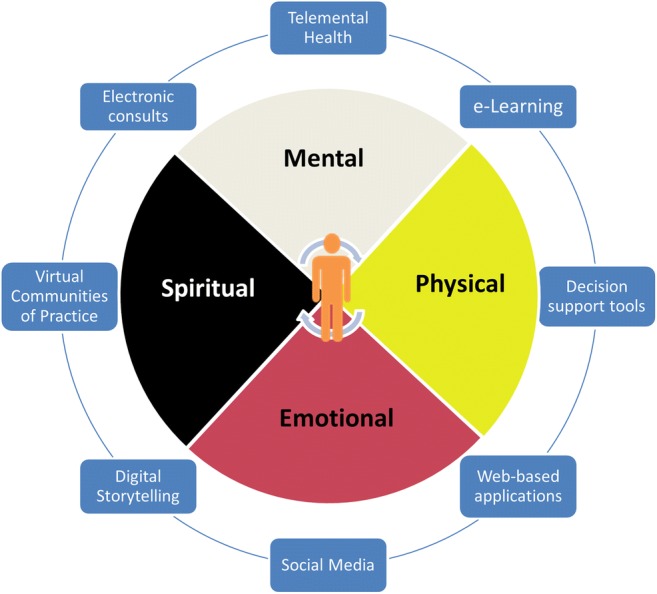
PURPOSE OF REVIEW: This review summarizes digital health solutions being used for Indigenous mental well-being, with emphasis on available evidence and examples reported in the literature. We also describe our own local experience with a rural telemental health service for Indigenous youth and discuss the unique opportunities and challenges. RECENT FINDINGS: Digital health solutions can be grouped into three main categories: (1) remote access to specialists, (2) building and supporting local capacity, and (3) patient-directed interventions. Limited evidence exists for the majority of digital solutions specifically in Indigenous contexts, although examples and pilot projects have been described. Telemental health has the strongest evidence, along with a growing evidence for web-based applications, largely led by Australia. Other digital approaches remain areas of promise requiring additional study. Co-design and service integration and respect for Indigenous history and ideologies are essential for success. While the use of digital health solutions for Indigenous mental well-being holds promise, there is a limited evidence base for most of them. Future efforts to expand the use of digital solutions in this population should adhere to best practices for the delivery of Indigenous health services.
Overview
The claims and statistics of this paper haven’t been checked yet.
Free: it reads the open-access text and checks the first 5 claims that cite a source we can check. Create a free account to check every claim.
Integrity signals
Registry
Cites
Statistics
Figures
Verification
Claims the paper makes
The claims and statistics of this paper haven’t been checked yet.
Free: it reads the open-access text and checks the first 5 claims that cite a source we can check. Create a free account to check every claim.
Claims other papers make about this one
Each is checked against this paper’s own text: does it say what the citing paper says it does?
The source backs part of the claim, not all of it — or backs it for a different population, condition or comparison.
In the citing paper
“We work in a novel area in the literature, providing a VR intervention for an Indigenous population with a specifically therapeutic aim [24].”
From A Virtual Reality-Assisted Cognitive Behavioral Therapy for and With Inuit in Québec: Protocol for a Proof-of-Concept Randomized Controlled Trial (2023) · cites this paper as [24]
Experimental — accuracy not yet measuredThe source backs part of the claim, not all of it — or backs it for a different population, condition or comparison.
In the citing paper
“most follow a format of conventional psychotherapy via telemedicine [21,24].”
From A Virtual Reality-Assisted Cognitive Behavioral Therapy for and With Inuit in Québec: Protocol for a Proof-of-Concept Randomized Controlled Trial (2023) · cites this paper as [24]
Experimental — accuracy not yet measuredThe cited source says what the claim attributes to it.
In the citing paper
“There is interest in digital technology solutions for Indigenous health and mental well-being”
From A Virtual Reality-Assisted Cognitive Behavioral Therapy for and With Inuit in Québec: Protocol for a Proof-of-Concept Randomized Controlled Trial (2023) · cites this paper as [24]
The cited source says what the claim attributes to it.
In the citing paper
“The potential benefits of digital health solutions, particularly those developed and implemented in a culturally informed way, could be substantial [7].”
From Feasibility and Acceptability of the Aboriginal and Islander Mental Health Initiative for Youth App: Nonrandomized Pilot With First Nations Young People (2023) · cites this paper as [7]
Self-check
Percentages, sums and reported differences re-computed from the paper’s own numbers.
The self-check needs the paper’s full text.
Citations
Cites
Michie, S., Yardley, L., West, R., Patrick, K., & Greaves, F. (2017) · Journal of Medical Internet Research · doi:10.2196/jmir.7126 · Cited by 865
The Mental Health of Aboriginal Peoples: Transformations of Identity and Community
Kirmayer, L. J., Brass, G. M., & Tait, C. L. (2000) · The Canadian Journal of Psychiatry · doi:10.1177/070674370004500702 · Cited by 631
Hoeft, T. J., Fortney, J. C., Patel, V., & Unützer, J. (2018) · The Journal of Rural Health · doi:10.1111/jrh.12229 · Cited by 619
Sinclair, P. M., Kable, A., Levett-Jones, T., & Booth, D. (2016) · International Journal of Nursing Studies · doi:10.1016/j.ijnurstu.2016.01.011 · Cited by 362
Browne, A. J., Varcoe, C., Lavoie, J., Smye, V., Wong, S. T., Krause, M., Tu, D., Godwin, O., Khan, K., & Fridkin, A. (2016) · BMC Health Services Research · doi:10.1186/s12913-016-1707-9 · Cited by 358
Elias, B., Mignone, J., Hall, M., Hong, S. P., Hart, L., & Sareen, J. (2012) · Social Science & Medicine · doi:10.1016/j.socscimed.2012.01.026 · Cited by 293
Self-citationUsefulness of telepsychiatry: A critical evaluation of videoconferencing-based approaches
Chakrabarti, S. (2015) · World Journal of Psychiatry · doi:10.5498/wjp.v5.i3.286 · Cited by 292
Rice, E. S., Haynes, E., Royce, P., & Thompson, S. C. (2016) · International Journal for Equity in Health · doi:10.1186/s12939-016-0366-0 · Cited by 271
Tighe, J., Shand, F., Ridani, R., Mackinnon, A., De La Mata, N., & Christensen, H. (2017) · BMJ Open · doi:10.1136/bmjopen-2016-013518 · Cited by 227
The mental health of Indigenous peoples in Canada: A critical review of research
Nelson, S. E., & Wilson, K. (2017) · Social Science & Medicine · doi:10.1016/j.socscimed.2017.01.021 · Cited by 223
Research works printed but not linked: 1
- Katz R Indigenous healing psychology: honoring the wisdom of the first peoples 2017 Rochester Healing Arts Press
Cited by
Zidaru, T., Morrow, E. M., & Stockley, R. (2021) · Health Expectations · doi:10.1111/hex.13299 · Cited by 119
Reavley, N. J., Morgan, A. J., Fischer, J.-A., Kitchener, B., Bovopoulos, N., & Jorm, A. F. (2018) · BMC Psychiatry · doi:10.1186/s12888-018-1888-3 · Cited by 75
Is There an App for That?: Ethical Issues in the Digital Mental Health Response to COVID-19
Skorburg, J. A., & Yam, J. (2022) · AJOB Neuroscience · doi:10.1080/21507740.2021.1918284 · Cited by 64
Reilly, R. E., Stephens, J. H., Micklem, J., Tufănaru, C., Harfield, S. G., Fisher, I., Pearson, O. R., & Ward, J. S. (2020) · Systematic Reviews · doi:10.1186/s13643-020-01374-x · Cited by 51
“Indigenous models of health and wellbeing [47].”
Li, J., & Brar, A. (2022) · Computers in Human Behavior · doi:10.1016/j.chb.2021.106988 · Cited by 42
Mobile Health and Cultural Competencies as a Foundation for Telehealth Care: Scoping Review
Hilty, D. M., Crawford, A. S., Teshima, J., Nasatir-Hilty, S. E., Luo, J. S., Chisler, L. S. M., Hilty, Y. S. M. G., Servis, M. E., Godbout, R., Lim, R. F., et al. (2021) · Journal of Technology in Behavioral Science · doi:10.1007/s41347-020-00180-5 · Cited by 47
Walker, R., Usher, K. J., Jackson, D. W., Reid, C. L., Hopkins, K. D., Shepherd, C., Smallwood, R., & Marriott, R. (2021) · International Journal of Environmental Research and Public Health · doi:10.3390/ijerph18042141 · Cited by 51
“Importantly, recent studies have shown that digital technologies and social media platforms are both acceptable and effective in supporting mental health and well-being to help mitigate likely impacts for young Indigenous people and, therefore, are a crucial component of the COVID-19 response [19].”
BackgroundMoecke, D. P., Holyk, T., Beckett, M., Chopra, S., Petlitsyna, P., Girt, M., Kirkham, A. R., Kamurasi, I., Turner, J., Sneddon, D., et al. (2023) · Journal of Telemedicine and Telecare · doi:10.1177/1357633x231158835 · Cited by 61
Toombs, E., Kowatch, K. R., Dalicandro, L., McConkey, S., Hopkins, C., & Mushquash, C. J. (2021) · Journal of Telemedicine and Telecare · doi:10.1177/1357633x19899231 · Cited by 35
“Similar findings reported digital health technologies for Indigenous people, and described technologies for remote access to health-care specialists, building community support and capacity, and patient-directed interventions.(40) The included studies did not provide a discussion of the privacy and confidentiality con…”
Connected Mental Health: Systematic Mapping Study
(2020) · doi:10.2196/19950 · Cited by 33
Ghidei, W., Montesanti, S. R., Tomkow, K., Silverstone, P. H., Wells, L., & Campbell, S. (2022) · Trauma Violence & Abuse · doi:10.1177/15248380211069059 · Cited by 38
“Virtual delivery of interventions incorporates the use of technology to provide communication, education, intervention, or service between a provider and a client (Chen et al., 2020; Hensel et al., 2019; Jack et al., 2020).”
BackgroundPovey, J., Sweet, M., Nagel, T., Lowell, A., Shand, F., Vigona, J., & Dingwall, K. M. (2022) · JMIR Formative Research · doi:10.2196/28342 · Cited by 26
“The integrated AIMhi Stay Strong therapy follows a 4-step process: identifying people who keep them strong, strengths, worries, and supported goal-setting, which is interspersed with psychoeducational videos [63].”
BackgroundSmith‐MacDonald, L., Lusk, J., Lee‐Baggley, D., Bright, K. S., Laidlaw, A., Voth, M., Spencer, S., Mack, E., Pike, A., Jones, C., et al. (2022) · Frontiers in Psychiatry · doi:10.3389/fpsyt.2021.801680 · Cited by 27
“…which shows that online means may be useful for a number of serious mental health conditions including psychosis (57), PTSD (58), major depressive disorder (59), and anxiety disorders (60) along with vulnerable populations such as indigenous (61), refugee (62), and trauma-affected populations (63).”
The need for early intervention for psychosis to persist throughout the COVID-19 pandemic and beyond
O'Donoghue, B. N., O’Connor, K., Thompson, A. D., & McGorry, P. D. (2020) · Irish Journal of Psychological Medicine · doi:10.1017/ipm.2020.56 · Cited by 24
“This approach has been used successful and effectively for rural and remote areas already (Hensel et al. 2019) and has recently been adopted at the EPPIC service in Melbourne and other services worldwide.”
MethodDingwall, K. M., Povey, J., Sweet, M., Friel, J., Shand, F., Titov, N., Wormer, J., Mirza, T., & Nagel, T. (2023) · JMIR Human Factors · doi:10.2196/40111 · Cited by 21
“A recent review identified 3 individual-directed web-based apps available in the Australian First Nations context [7].”
Raphiphatthana, B., Sweet, M., Puszka, S., Dingwall, K. M., & Nagel, T. M. (2020) · BMC Health Services Research · doi:10.1186/s12913-020-05431-y · Cited by 19
Fitts, M. S., Cullen, J., Kingston, G., Wills, E., & Soldatić, K. (2022) · International Journal of Environmental Research and Public Health · doi:10.3390/ijerph192214744 · Cited by 21
“Use of digital health for health screening, education care in mental health, and chronic health conditions is perceived to be feasible, satisfactory, and accessible [55], but there is a limited evidence base for digital health use with Aboriginal and Torres Strait Islander peoples [56].”
BackgroundShang, Z., Arnaert, A., Hindle, Y., Debe, Z., Côté-Leblanc, G., & Saadi, A. (2021) · BMC Health Services Research · doi:10.1186/s12913-021-06072-5 · Cited by 18
“Overall, there are various challenges present in Western-based technologies such as the difficulty of integrating traditional Indigenous teachings and historical/cultural ways of healing, leading to challenges in maintaining the therapeutic alliance and patient engagement [33].”
BackgroundVerdezoto, N. X., Carpio-Arias, F. A., Carpio-Arias, T. V., Mackintosh, N. J., Eslambolchilar, P., Delgado, V., Andrade, C., & Merino, G. X. V. (2020) · Nordic Conference on Human-Computer Interaction · doi:10.1145/3419249.3420141 · Cited by 22
“However, digital health should go beyond supporting medical care and oneway strategies [146] and focus on understanding and supporting indigenous women’s wellbeing [51, 89] accounting for the ethnic di-”
BackgroundUsing the Stay Strong App for the Well-being of Indigenous Australian Prisoners: Feasibility Study
Perdacher, E., Kavanagh, D. J., Sheffield, J. K., Healy, K. L., Dale, P., & Heffernan, E. (2022) · JMIR Formative Research · doi:10.2196/32157 · Cited by 17
“The evidence base for digital mental health tools and systems, guided or unguided, for Indigenous people is practically nonexistent, especially for Indigenous prisoners, which limits the generalizability of these results to this population [42].”
BackgroundGhidei, W., Montesanti, S. R., Wells, L., & Silverstone, P. H. (2022) · BMC Public Health · doi:10.1186/s12889-022-14224-3 · Cited by 19
“individuals affected by IPV, conducted respectfully and in collaboration with local community-based organizations, and connect to local resources [34, 72].”
BackgroundHicks, L. J., Toombs, E., Lund, J. I., Kowatch, K. R., Hopkins, C., & Mushquash, C. J. (2024) · Journal of Telemedicine and Telecare · doi:10.1177/1357633x241239715 · Cited by 21
Effective Modalities of Virtual Care to Deliver Mental Health and Addictions Services in Canada
Lo, B., Strudwick, G., Mah, L., Mushquash, C. J., McKenzie, K. J., Khenti, A., Crawford, A. S., Bhattacharya, O., Allen, U., Bodmer, N. S., et al. (2022) · doi:10.47326/ocsat.2022.03.66.1.0 · Cited by 19
Seon, Q., Mady, N., Yang, M., Karia, M., Lashley, M., Sescu, C., Lalonde, M., Puskas, S., Outerbridge, J., Parent-Racine, E., et al. (2023) · JMIR Research Protocols · doi:10.2196/40236 · Cited by 12
“There is interest in digital technology solutions for Indigenous health and mental well-being; however, most follow a format of conventional psychotherapy via telemedicine [21,24].”
Povey, J., Raphiphatthana, B., Torok, M. H., Nagel, T. M., Mills, P. P. J. R., Sells, J. R. H., Shand, F., Sweet, M., Lowell, A., & Dingwall, K. M. (2023) · Systematic Reviews · doi:10.1186/s13643-023-02262-w · Cited by 15
“Two prior systematic reviews have described dMH products and outcomes for Indigenous young people [35, 48] but previous reviews have not examined the processes undertaken to engage Indigenous young people in developing or evaluating dMH tools.”
BackgroundPovey, J., Raphiphatthana, B., Torok, M. H., Nagel, T. M., Shand, F., Sweet, M., Lowell, A., Mills, P. P. J. R., & Dingwall, K. M. (2021) · Systematic Reviews · doi:10.1186/s13643-021-01685-7 · Cited by 16
“One other related article contains a literature review and a case study [19].”
BackgroundDriver, R. (2024) · Social Work in Mental Health · doi:10.1080/15332985.2024.2368594 · Cited by 13
“Mental health professionals working at the service often travel to rural and remote communities to engage with Indigenous community members and young people receiving care (Hensel et al., 2019).”
InfluentialNasir, B., MacAskill, W., Leedie, F., Martin, P., Alam, K., Wallis, K. A., McGrail, M. R., & Kondalsamy‐Chennakesavan, S. (2024) · Australian Journal of Rural Health · doi:10.1111/ajr.13206 · Cited by 15
Haydon, H. M., Caffery, L. J., Snoswell, C. L., Thomas, E. E., Wright, R., Doolan, R., Garner, L., Aitken, P., & Smith, A. C. (2022) · Journal of Telemedicine and Telecare · doi:10.1177/1357633x221119610 · Cited by 10
Faruk, M. O. (2025) · Cambridge Prisms Global Mental Health · doi:10.1017/gmh.2025.10008 · Cited by 15
Werkmeister, B. J., Haase, A. M., Fleming, T. M., & Officer, T. N. (2023) · JMIR Formative Research · doi:10.2196/50486 · Cited by 9
Quantifying Citizens’ Well-Being in Areas with Natural Based Solutions Using Mobile Computing
Gallos, P., Menychtas, A., Panagopoulos, C., Bimpas, M., & Maglogiannis, I. G. (2022) · Studies in health technology and informatics · doi:10.3233/shti210958 · Cited by 9
“Many studies also present the value of mHealth in the well-being of mental health patients [8,9].”
BackgroundGallos, P., Menychtas, A., Panagopoulos, C., Kaselimi, M., Τέμενος, Α., Rallis, I., Doulamis, A. D., Doulamis, N. D., Bimpas, M., Aggeli, A., et al. (2022) · Studies in health technology and informatics · doi:10.3233/shti220791 · Cited by 9
Young, A. M., Sinicrope, P. S., Kelpin, S. S., Roche, A. I., Sabaque, C., Pham, C., Marsch, L. A., Campbell, A. N. C., Venner, K. L., Bastian, E., et al. (2023) · American Journal of Health Promotion · doi:10.1177/08901171231205355 · Cited by 10
Wills, M. N., Rodaughan, J., Jobson, L., Adams, K., & Murrup-Stewart, C. (2024) · AlterNative An International Journal of Indigenous Peoples · doi:10.1177/11771801241235370 · Cited by 4
“Few studies have considered the perspectives of First Nations youth and the role of cultural safety in the design and use of e-health (Hensel et al., 2019).”
BackgroundDigital Narrative Medicine: Translating Stories Into Medical Education and Better Patient Care
Sage, C. M. (2026) · Journal of Medical Internet Research · doi:10.2196/93037 · Cited by 2
Werkmeister, B. J., Haase, A. M., Fleming, T. M., & Officer, T. N. (2024) · International Journal of Telemedicine and Applications · doi:10.1155/2024/8835933 · Cited by 6
“However, following on from our prior work [17, 18, 48], the potential for addressing issues with supply and demand for mental health services should be considered alongside the potential for digital exclusion [46, 89, 90].”
BackgroundPovey, J., Raphiphatthana, B., Torok, M. H., Nagel, T. M., Shand, F., Sweet, M., Lowell, A., & Dingwall, K. M. (2020) · Research Square · doi:10.21203/rs.3.rs-75519/v1 · Cited by 2
“One other related article contains a literature review and a case study (20).”
BackgroundArias-Murcia, S. E., Sánchez-Castro, J. C., Hrynyschyn, R., & Stock, C. (2025) · Exploration of Digital Health Technologies · doi:10.37349/edht.2025.101161 · Cited by 1
Zhai, S., Goodman, A., Smith, A. C., Diminic, S., & Zhou, X. (2026) · Interactive Journal of Medical Research · doi:10.2196/80386 · Cited by 2
“Consistent with a previous government report [88] and similar studies [89-91], qualitative studies included in this review suggested that DMH interventions can support mental health improvement, increase self-reflection, and enhance self-confidence and empowerment [68,74,75,80,81,84].”
Gallos, P., Menychtas, A., Panagopoulos, C., Protopapadakis, E. E., Doulamis, N. D., Doulamis, A. D., Sardis, E., Bimpas, M., Kaselimi, M., & Maglogiannis, I. G. (2022) · Lecture notes of the Institute for Computer Sciences, Social Informatics and Telecommunications Engineering · doi:10.1007/978-3-031-15101-9_7 · Cited by 2
Leader, J. S. (2022) · The International Journal of Technology Knowledge and Society · doi:10.18848/1832-3669/cgp/v18i02/45-64 · Cited by 2
Scarfe, B., Budrikis, A., & Bracknell, C. (2023) · Musicology Australia · doi:10.1080/08145857.2023.2270270 · Cited by 1
Mahmoud, H., Whaibeh, E. R., & Dickenson, F. (2022) · Springer eBooks · doi:10.1007/978-3-030-97325-4_4
Telebehavioral Health: The Basics
Vogt, E. L., & Whaibeh, E. R. (2022) · Springer eBooks · doi:10.1007/978-3-030-97325-4_2
IsHak, W. W., Magakian, N., Ishak, W. W., Mikhail, A. A., & Lim, R. F. (2023) · Springer eBooks · doi:10.1007/978-3-031-15401-0_25
Francis, K., Latimer, M. A., Gould, H., Blackmore, S., & MacLeod, E. (2023) · doi:10.2196/preprints.48370
Regional Differences in the Supply of Medical Resources in China
Geng, G. (2023) · Advances in Social Science, Education and Humanities Research/Advances in social science, education and humanities research · doi:10.2991/978-2-38476-126-5_47
Francis, K., Francis, J., Latimer, M. A., Gould, H., Blackmore, S., & MacLeod, E. (2025) · JMIR Human Factors · doi:10.2196/48370 · Cited by 2
“In a review of digital health solutions for Indigenous mental well-being across Canada, the United States, Australia, and New Zealand, Hensel et al [17] indicated that co-designed app-based interventions had been shown to reduce anxiety and depression symptoms and contribute to well-being.”
Bridging the Digital Gap: Strategies for Enhancing Indigenous Digital Inclusion
Dayanand, A., Devi, U., & Kumar, R. (2025) · Advances in educational technologies and instructional design book series · doi:10.4018/979-8-3693-8191-5.ch008 · Cited by 2
Zhai, S., Goodman, A., Smith, A. C., Diminic, S., & Zhou, X. (2025) · medRxiv · doi:10.1101/2025.04.27.25326251
Zhai, S., Goodman, A., Smith, A. C., Diminic, S., & Zhou, X. (2025) · doi:10.2196/preprints.80386
Isokon, B. E., Tiku, O. T., Abonor, L. B., Tangban, E. E., & Effiong, M. L. (2025) · Social Work in Mental Health · doi:10.1080/15332985.2025.2592968
“High cost of hospital bills, deprivation, and despera-tion prevented many from visiting neuropsychiatric hospitals for care (Hensel et al., 2019).”
Povey, J., Raphiphatthana, B., Torok, M. H., Nagel, T. M., Shand, F., Sweet, M., Lowell, A., Mills, P. P. J. R., & Dingwall, K. M. (2021) · Figshare · doi:10.6084/m9.figshare.14545221
Povey, J., Raphiphatthana, B., Torok, M. H., Nagel, T. M., Mills, P. P. J. R., Sells, J. R. H., Shand, F., Sweet, M., Lowell, A., & Dingwall, K. M. (2024) · Figshare · doi:10.6084/m9.figshare.26601358
Povey, J., Raphiphatthana, B., Torok, M. H., Nagel, T. M., Shand, F., Sweet, M., Lowell, A., Mills, P. P. J. R., & Dingwall, K. M. (2021) · Figshare · doi:10.6084/m9.figshare.14545218
Povey, J., Raphiphatthana, B., Torok, M. H., Nagel, T. M., Mills, P. P. J. R., Sells, J. R. H., Shand, F., Sweet, M., Lowell, A., & Dingwall, K. M. (2024) · Figshare · doi:10.6084/m9.figshare.26601364
Povey, J., Raphiphatthana, B., Torok, M. H., Nagel, T. M., Mills, P. P. J. R., Sells, J. R. H., Shand, F., Sweet, M., Lowell, A., & Dingwall, K. M. (2024) · Figshare · doi:10.6084/m9.figshare.26601361
Povey, J., Raphiphatthana, B., Torok, M. H., Nagel, T. M., Mills, P. P. J. R., Sells, J. R. H., Shand, F., Sweet, M., Lowell, A., & Dingwall, K. M. (2024) · Figshare · doi:10.6084/m9.figshare.26601367
Agyapong, B., Liebenberg, L., Eboreime, E., Greenshaw, A. J., & Agyapong, V. I. O. (2026) · Frontiers in Digital Health · doi:10.3389/fdgth.2026.1830295
“…and other equity-deserving groups is increasingly recognized as essential for cultural safety, relevance, and sustained engagement (27, 28), particularly where digital interventions risk exacerbating inequities if language, context, and access realities are not addressed from inception (29, 30).”
Digital Strategies to Design and Deliver Health Education
Rooney, E. J., Hopwood, M., Hooper, M., Hutton, A., & Wilson, R. L. (2026) · Springer eBooks · doi:10.1007/978-3-032-32552-5_21
Metadata
- Authors
- Hensel, J. M., Ellard, K., Koltek, M., Wilson, G., & Sareen, J.
- Affiliations
- University of Manitoba (CA)
- Corresponding author
- Hensel, Jennifer M.
- Venue
- Current Psychiatry Reports
- Published
- 2019-07-01
- Volume
- 21
- Issue
- 8
- Pages
- 68-68
- ISSN
- 1523-3812 (ISSN-L)
- 1535-1645
- PMC
- PMC6602981
- OpenAlex
- W2954264266
- Cited by
- 61
- References
- 49
- Citations by year
- 2026: 3 · 2025: 7 · 2024: 10 · 2023: 10 · 2022: 13 · 2021: 10 · 2020: 7
- FWCI
- 1.60
- Type
- journal article
- Language
- en
- Open access
- hybrid
- doi.org
- Licence
- cc-by
- creativecommons.org/licenses/by/4.0 (tdm)
- creativecommons.org/licenses/by/4.0 (vor)
- Locations
- Current Psychiatry Reports (publishedVersion, cc-by)
- Europe PMC (PubMed Central) (publishedVersion, cc-by)
- PubMed Central (publishedVersion, cc-by)
- PubMed (publishedVersion)
- UNM’s Digital Repository (University of New Mexico) (submittedVersion)
- Funders
- University of Manitoba
- Topics
- Social Sciences › Health › Indigenous Health, Education, and Rights
- Social Sciences › Psychology › Applied Psychology › Digital Mental Health Interventions
- Health Sciences › Medicine › Public Health, Environmental and Occupational Health › Telemedicine and Telehealth Implementation
- Keywords
- digital health, Indigenous mental health, telemental health, Indigenous youth, web application, Indigenous health services, co-design, service integration, rural mental health services
- MeSH terms
- Indigenous Peoples, Australia, Health Services, Indigenous, Humans, Mental Health, Telemedicine
About these checks
Registry, retraction, Cites and statistics results are computed, not judged, with one exception: a printed reference that no index lists is read once by a model before it counts as a citation error. Claims are extracted by a model and kept only when their quote appears verbatim in the text; each cited source is then checked, with a model’s help, for whether it says what the claim relies on. Those verdicts can be wrong — read the claim’s quote and the cited source before relying on one.
Statistics and arithmetic are recomputed, not judged.
Confidence bands are shown only for fields calibrated on our annotated test set. None is calibrated yet, so no band is shown.
What counts as a claim ›How we measure confidence ›How we check this ›
Are you an author, or do you see a problem with this page? Request a review
Data sources
Bibliographic data: Semantic Scholar, OpenAlex, Crossref.
Contains information from the Semantic Scholar Academic Graph Datasets, made available under the ODC Attribution License (ODC-BY 1.0).
Semantic Scholar’s data is described in: Kinney, R., et al. (2023). The Semantic Scholar Open Data Platform. arXiv:2301.10140.
