

The DOI matches its Crossref record; 146 of the 146 references it cites were found in a registry or an index.
Role of Chemokines in the Development and Progression of Alzheimer’s Disease
Open accessAbstract
Alzheimer’s disease (AD) is a progressive neurogenerative disorder manifested by gradual memory loss and cognitive decline due to profound damage of cholinergic neurons. The neuropathological hallmarks of AD are intracellular deposits of neurofibrillary tangles (NFTs) and extracellular aggregates of amyloid β (Aβ). Mounting evidence indicates that intensified neuroinflammatory processes play a pivotal role in the pathogenesis of AD. Chemokines serve as signaling molecules in immune cells but also in nerve cells. Under normal conditions, neuroinflammation plays a neuroprotective role against various harmful factors. However, overexpression of chemokines initiates disruption of the integrity of the blood–brain barrier, facilitating immune cells infiltration into the brain. Then activated adjacent glial cells–astrocytes and microglia, release massive amounts of chemokines. Prolonged inflammation loses its protective role and drives an increase in Aβ production and aggregation, impairment of its clearance, or enhancement of tau hyperphosphorylation, contributing to neuronal loss and exacerbation of AD. Moreover, chemokines can be further released in response to growing deposits of toxic forms of Aβ. On the other hand, chemokines seem to exert multidimensional effects on brain functioning, including regulation of neurogenesis and synaptic plasticity in regions responsible for memory and cognitive abilities. Therefore, underexpression or complete genetic ablation of some chemokines can worsen the course of AD. This review covers the current state of knowledge on the role of particular chemokines and their receptors in the development and progression of AD. Special emphasis is given to their impact on forming Aβ and NFTs in humans and in transgenic murine models of AD.
Overview
The claims and statistics of this paper haven’t been checked yet.
Run the check — free, no account needed. It reads the open-access text and checks the sources it cites.
Integrity signals
Registry
Cites
Statistics
Figures
Verification
Claims the paper makes
The claims and statistics of this paper haven’t been checked yet.
Run the check — free, no account needed. It reads the open-access text and checks the sources it cites.
Claims other papers make about this one
Each is checked against this paper’s own text: does it say what the citing paper says it does?
The cited source says what the claim attributes to it.
In the citing paper
“consistent with the known capacity of CCL2 to break down the blood brain barrier and recruit peripheral immune cells to sites of damage.58–62”
From TET2-mutant myeloid cells mitigate Alzheimer’s disease progression via CNS infiltration and enhanced phagocytosis in mice (2025) · cites this paper as [60]
Self-check
Percentages, sums and reported differences re-computed from the paper’s own numbers.
The self-check needs the paper’s full text.
Citations
Cites
McKhann, G. M., Knopman, D. S., Chertkow, H., Hyman, B. T., Jack, C. R., Kawas, C. H., Klunk, W. E., Koroshetz, W. J., Manly, J. J., Mayeux, R., et al. (2011) · Alzheimer's & Dementia · doi:10.1016/j.jalz.2011.03.005 · Cited by 18,657 · cited 1×
“As the disease progresses, preclinical AD transits to mild cognitive impairment (MCI) in which cognition deficits do not affect patients’ performance at work or regular daily activities, but eventually may develop into AD (McKhann et al. 2011; Saido 2013).”
BackgroundA new class of membrane-bound chemokine with a CX3C motif
Bazan, J. F., Bacon, K. B., Hardiman, G., Wang, W., Soo, K., Rossi, D., Greaves, D. R., Zlotnik, A., & Schall, T. J. (1997) · Nature · doi:10.1038/385640a0 · Cited by 2,013
The cholinergic system in the pathophysiology and treatment of Alzheimer’s disease
Hampel, H., Mesulam, M.-M., Cuello, A. C., Farlow, M. R., Giacobini, E., Grossberg, G. T., Khachaturian, A. S., Vergallo, A., Cavedo, E., Snyder, P. J., et al. (2018) · Brain · doi:10.1093/brain/awy132 · Cited by 1,918
The ageing systemic milieu negatively regulates neurogenesis and cognitive function
Villeda, S. A., Luo, J., Mosher, K. I., Zou, B., Britschgi, M., Bieri, G., Stan, T. M., Fainberg, N., Ding, Z., Eggel, A., et al. (2011) · Nature · doi:10.1038/nature10357 · Cited by 1,763
A guide to chemokines and their receptors
Hughes, C. E., & Nibbs, R. J. B. (2018) · FEBS Journal · doi:10.1111/febs.14466 · Cited by 1,510 · cited 2×
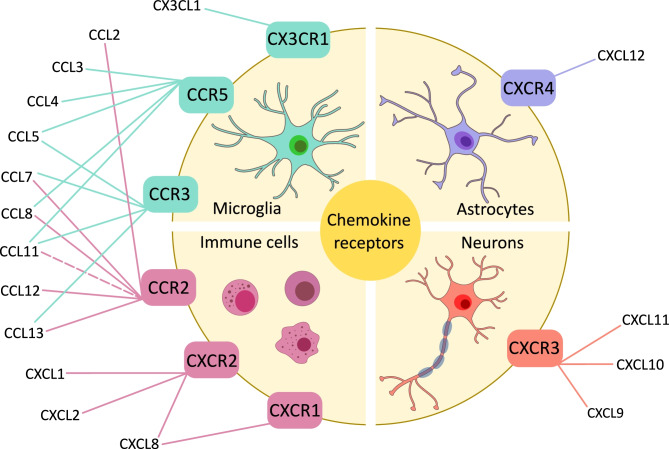
“To date, six CXC receptors have been identified, named from CXCR1 to CXCR6, and eleven CC receptors, from CCR1 to CCR11, along with a single receptor for CX3CL1 and one for lymphotactin α/β, called CX3CR1 and XCR1, respectively (Hughes and Nibbs 2018).”
BackgroundZhao, Q.-F., Tan, L., Wang, H.-F., Jiang, T., Tan, M.-S., Tan, L., Xu, W., Li, J.-Q., Wang, J., Lai, T.-J., et al. (2016) · Journal of Affective Disorders · doi:10.1016/j.jad.2015.09.069 · Cited by 916
El Khoury, J., Toft, M., Hickman, S. E., Means, T. K., Terada, K., Geula, C., & Luster, A. D. (2007) · Nature Medicine · doi:10.1038/nm1555 · Cited by 915
Risk factors for Alzheimer’s disease
Armstrong, R. A. (2019) · Folia Neuropathologica · doi:10.5114/fn.2019.85929 · Cited by 679
Hippocampus and its involvement in Alzheimer’s disease: a review
Rao, Y. L., Ganaraja, B., Murlimanju, B. V., Joy, T., Krıshnamurthy, A., & Agrawal, A. (2022) · 3 Biotech · doi:10.1007/s13205-022-03123-4 · Cited by 646
Neurotactin, a membrane-anchored chemokine upregulated in brain inflammation
Pan, Y., Lloyd, C. M., Zhou, H., Dolich, S., Deeds, J., Gonzalo, J.-Á., Vath, J., Gosselin, M., Ma, J., Dussault, B. J., et al. (1997) · Nature · doi:10.1038/42491 · Cited by 643 · cited 1×
“This chemokine exists in both soluble and membrane-bound forms (Bajetto et al. 2002; Bazan et al. 1997; Pan et al. 1997).”
Background
Research works printed but not linked: 1
- Gutiérrez SE, Allison EK, Coleman U, Kingery-Gallagher ND, El Khoury J (2019b) Heterozygous CX3CR1 deficiency in microglia restores neuronal β-amyloid clearance pathways and slows progression of Alzheimer’s like-disease in PS1-APP mice. Front Immunol 10:2780. https://doi.org/10.3389/fimmu.2019.02780 · DOI · Paper page
Cited by
Sorted by citations
Items 101–123 of 123
van Olst, L., Kamermans, A., Halters, S., van der Pol, S. M. A., Rodríguez, E., Verberk, I. M. W., Verberk, S. G. S., Wessels, D. W. R., Rodriguez-Mogeda, C., Verhoeff, J., et al. (2024) · Figshare · doi:10.6084/m9.figshare.26711633
van Olst, L., Kamermans, A., Halters, S., van der Pol, S. M. A., Rodríguez, E., Verberk, I. M. W., Verberk, S. G. S., Wessels, D. W. R., Rodriguez-Mogeda, C., Verhoeff, J., et al. (2024) · Figshare · doi:10.6084/m9.figshare.26711645
van Olst, L., Kamermans, A., Halters, S., van der Pol, S. M. A., Rodríguez, E., Verberk, I. M. W., Verberk, S. G. S., Wessels, D. W. R., Rodriguez-Mogeda, C., Verhoeff, J., et al. (2024) · Figshare · doi:10.6084/m9.figshare.25687445
Juvenal, G. D. A., Meinerz, C., Ayupe, A. C., Campos, H. C., Reis, E. M., Longo, B. M., Pillat, M. M., & Ulrich, H. (2024) · Figshare · doi:10.6084/m9.figshare.26061538
Juvenal, G. D. A., Meinerz, C., Ayupe, A. C., Campos, H. C., Reis, E. M., Longo, B. M., Pillat, M. M., & Ulrich, H. (2024) · Figshare · doi:10.6084/m9.figshare.26735721
van Olst, L., Kamermans, A., Halters, S., van der Pol, S. M. A., Rodríguez, E., Verberk, I. M. W., Verberk, S. G. S., Wessels, D. W. R., Rodriguez-Mogeda, C., Verhoeff, J., et al. (2024) · Figshare · doi:10.6084/m9.figshare.26711618
van Olst, L., Kamermans, A., Halters, S., van der Pol, S. M. A., Rodríguez, E., Verberk, I. M. W., Verberk, S. G. S., Wessels, D. W. R., Rodriguez-Mogeda, C., Verhoeff, J., et al. (2024) · Figshare · doi:10.6084/m9.figshare.26711669
van Olst, L., Kamermans, A., Halters, S., van der Pol, S. M. A., Rodríguez, E., Verberk, I. M. W., Verberk, S. G. S., Wessels, D. W. R., Rodriguez-Mogeda, C., Verhoeff, J., et al. (2024) · Figshare · doi:10.6084/m9.figshare.26711627
Juvenal, G. D. A., Meinerz, C., Ayupe, A. C., Campos, H. C., Reis, E. M., Longo, B. M., Pillat, M. M., & Ulrich, H. (2024) · Figshare · doi:10.6084/m9.figshare.26735727
Juvenal, G. D. A., Meinerz, C., Ayupe, A. C., Campos, H. C., Reis, E. M., Longo, B. M., Pillat, M. M., & Ulrich, H. (2024) · Figshare · doi:10.6084/m9.figshare.26735736
van Olst, L., Kamermans, A., Halters, S., van der Pol, S. M. A., Rodríguez, E., Verberk, I. M. W., Verberk, S. G. S., Wessels, D. W. R., Rodriguez-Mogeda, C., Verhoeff, J., et al. (2024) · Figshare · doi:10.6084/m9.figshare.26711666
van Olst, L., Kamermans, A., Halters, S., van der Pol, S. M. A., Rodríguez, E., Verberk, I. M. W., Verberk, S. G. S., Wessels, D. W. R., Rodriguez-Mogeda, C., Verhoeff, J., et al. (2024) · Figshare · doi:10.6084/m9.figshare.26711660
Schweitzer, N., Son, S. J., Iordanova, B. E., Fitz, N. F., Costa, A. P., Li, J., Chen, C., Yang, S., Hong, C. H., Roh, H. W., et al. (2026) · Alzheimer s & Dementia Diagnosis Assessment & Disease Monitoring · doi:10.1002/dad2.70256 · Cited by 1
Zhang, H.-X., & Li, H.-Y. (2026) · Medicine · doi:10.1097/md.0000000000048105
“[98] Researching how chemokines and their receptors function in AD could clarify the disorder’s mechanisms and support the development of innovative therapies.”
Chemokines and redox homeostasis in aging: A dynamic relationship
González, G. O., & Borrás, C. (2026) · Mechanisms of Ageing and Development · doi:10.1016/j.mad.2026.112185
Tsukahara, T., Haniu, H., & Matsuda, Y. (2026) · Brain Sciences · doi:10.3390/brainsci16050485
“…BBB function may allow infiltration of immune cells, including T lymphocytes and monocyte-derived macrophages, into the CNS. Chemokines such as CCL2 and CXCL10 are involved in this process [94], although the timing and extent of infiltration vary across experimental systems and disease conditions.”
Ekanayake, D. V., Verma, G., & Nagamoto‐Combs, K. (2026) · Brain Behavior and Immunity · doi:10.1016/j.bbi.2026.106793
Chemokines in Alzheimer's Disease: Early Defence, Late Damage and the Impact of Sex and Infection
Aldana, B. I., & Freude, K. (2026) · Basic & Clinical Pharmacology & Toxicology · doi:10.1111/bcpt.70273
“In AD, this dysregulation intensifies dramatically: chemokine networks undergo systems-level rewiring wherein homeostatic signals are converted into persistent inflammatory drivers, gradients become distorted and cell-type specificity diminishes [5].”
Tang, L., Wu, N., Zhu, Y., Xu, H., & Mo, Y. (2026) · BMC Neurology · doi:10.1186/s12883-026-05144-5
“…potential mechanistic link: impaired mitochondrial function in brain cells, signaled by low expression of these MRGs, may create or per-petuate an inflammatory microenvironment that favors the recruitment and activity of specific myeloid lineages while suppressing certain lymphoid subsets [42–44].”
Lower content of cerebrospinal fluid chemokines in patients with cancer cachexia
FORTES, M., Fortes, G. N., Fortes, M. N., Gomes, F. C., Seelaender, M. C. L., de Pinho, A. M. S., de Jesus, J. D. C. R., & Otoch, J. P. (2026) · Acta Cirúrgica Brasileira · doi:10.1590/acb414726
“Patients with cancer cachexia presented lower CSF VEGF, MCP-1 and IP-10 compared to control subjects, and patients with CWC had lower CSF VEGF and MCP-1 compared to the control group.”
Wu, Y., Xu, Q., Qin, Z.-H., Wu, X., Hu, Z., Yang, W., Ren, P.-Y., Tian, Y.-Y., Lin, Z., & Xian, Y. (2026) · Acta Pharmacologica Sinica · doi:10.1038/s41401-026-01896-5
Singh, R. K., Bekena, S., Walker, A. I. B., Taylor, K., Zhu, Y., Pal, S., Mohamed, E. A., Trani, J., Kaplan, I., & Babulal, G. M. (2026) · Journal of Alzheimer s Disease · doi:10.1177/13872877261481701
Samantaray, P., & Verma, P. (2026) · Molecular and Cellular Neuroscience · doi:10.1016/j.mcn.2026.104130
Metadata
- Authors
- Wojcieszak, J., Kuczyńska, K., & Zawilska, J. B.
- Affiliations
- Karolinska Institutet (SE)
- Medical University of Lodz (PL)
- Corresponding author
- Zawilska, Jolanta B.
- Venue
- Journal of Molecular Neuroscience
- Published
- 2022-07-12
- Volume
- 72
- Issue
- 9
- Pages
- 1929-1951
- ISSN
- 0895-8696 (ISSN-L)
- 1559-1166
- PMC
- PMC9392685
- OpenAlex
- W4285089500
- Cited by
- 97
- References
- 146
- Citations by year
- 2026: 25 · 2025: 20 · 2024: 35 · 2023: 17
- FWCI
- 3.37
- Type
- journal article
- Language
- en
- Open access
- hybrid
- doi.org
- Locations
- Journal of Molecular Neuroscience (publishedVersion, cc-by)
- PubMed Central (publishedVersion, cc-by)
- PubMed (publishedVersion)
- Funders
- Uniwersytet Łódzki (503-31-001)
- Topics
- Life Sciences › Neuroscience › Cellular and Molecular Neuroscience › Alzheimer's disease research and treatments
- Life Sciences › Neuroscience › Neurology › Neuroinflammation and Neurodegeneration Mechanisms
- Health Sciences › Medicine › Psychiatry and Mental health › Dementia and Cognitive Impairment Research
- Keywords
- Alzheimer's disease, chemokines, chemokine receptors, neuroinflammation, amyloid-beta, neurofibrillary tangles, blood-brain barrier, microglia, astrocytes, tau hyperphosphorylation, neurogenesis, synaptic plasticity, cholinergic neurons, transgenic mouse model
- MeSH terms
- Alzheimer Disease, Animals, Humans, Amyloid beta-Peptides, Neurofibrillary Tangles, Microglia, Chemokines, Mice
About these checks
Registry, retraction, Cites and statistics results are computed, not judged, with one exception: a printed reference that no index lists is read once by a model before it counts as a citation error. Claims are extracted by a model and kept only when their quote appears verbatim in the text; each cited source is then checked, with a model’s help, for whether it says what the claim relies on. Those verdicts can be wrong — read the claim’s quote and the cited source before relying on one.
Statistics and arithmetic are recomputed, not judged.
Confidence bands are shown only for fields calibrated on our annotated test set. None is calibrated yet, so no band is shown.
What counts as a claim ›How we measure confidence ›How we check this ›
Are you an author, or do you see a problem with this page? Request a review
