

Simulating the deep decarbonisation of residential heating for limiting global warming to 1.5 °C
Open accessThe DOI matches its Crossref record; 94 of the 94 references it cites were found in a registry or an index.
Abstract
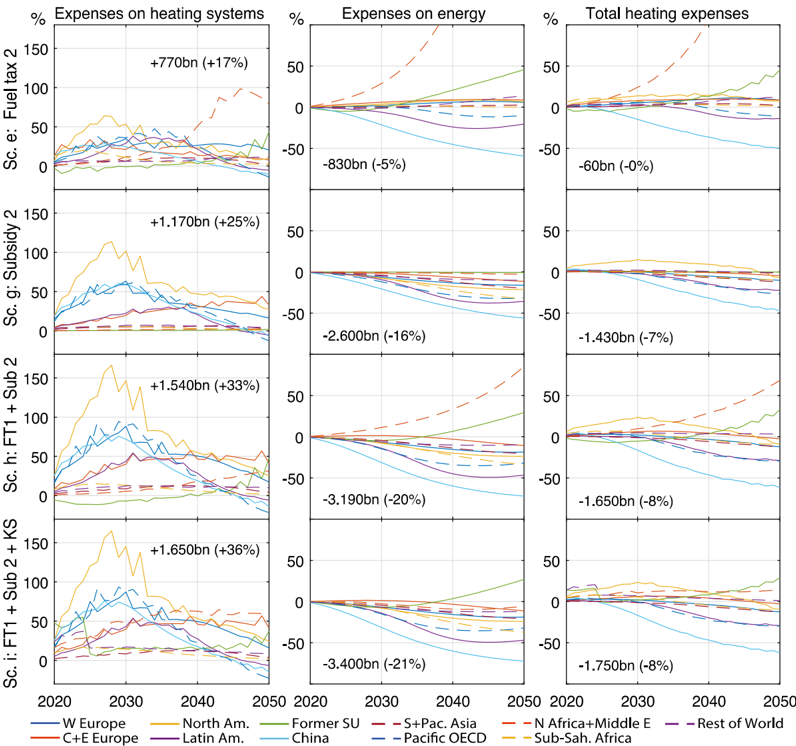
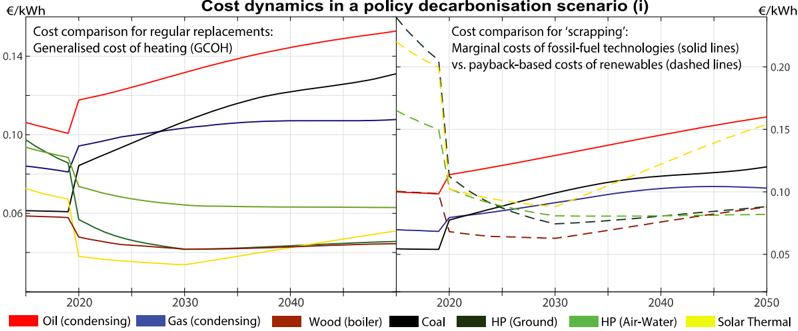
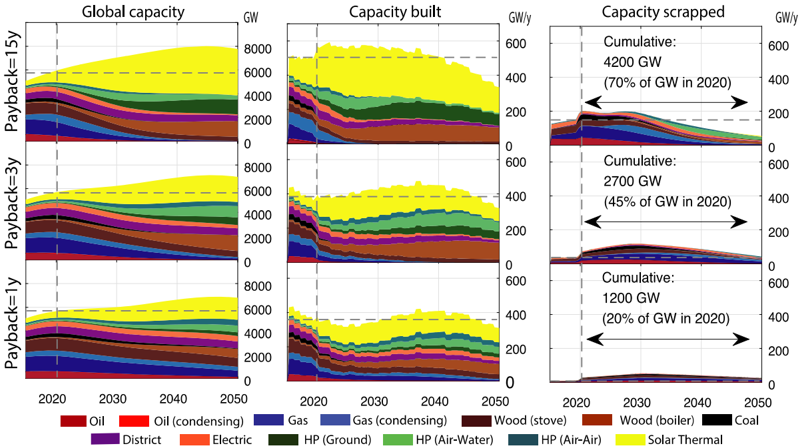
Whole-economy scenarios for limiting global warming to 1.5 °C suggest that direct carbon emissions in the buildings sector should decrease to almost zero by 2050, but leave unanswered the question how this could be achieved by real-world policies. We simulate which policy measures could induce an almost complete decarbonisation of residential heating, the by far largest source of direct emissions in residential buildings. Under which assumptions is it possible, and how long would it take? We use the non-equilibrium bottom-up model FTT:Heat to simulate policies for a transition towards low-carbon heating in a context of inertia and bounded rationality, focusing on the uptake of heating systems. Our results indicate that the near-zero decarbonisation is achievable by 2050, but requires substantial policy efforts. We find that policy mixes are more effective for incentivising the uptake of fuel-efficient low-carbon technologies, compared to a residential carbon tax as the only policy. In combination with subsidies and procurement policies for renewables, near-complete decarbonisation could be achieved with a tax of 50–200 €/tCO 2. Without being complimented by additional policies, carbon taxes show a decreasing marginal impact on total emission reductions, thus remaining insufficient for deep decarbonisation. In all scenarios, the decarbonisation of heating would increase projected heating costs faced by households initially, but could lead to cost reductions in most world regions in the medium term. We show that the potential impacts of policies highly depend on behavioural decision-making by households, especially in a context of deep decarbonisation and rapid transformation.
Overview
The claims and statistics of this paper haven’t been checked yet.
Free: it reads the open-access text and checks the first 5 claims that cite a source we can check. Create a free account to check every claim.
Integrity signals
Registry
Cites
Statistics
Figures
Verification
Claims the paper makes
The claims and statistics of this paper haven’t been checked yet.
Free: it reads the open-access text and checks the first 5 claims that cite a source we can check. Create a free account to check every claim.
Claims other papers make about this one
Each is checked against this paper’s own text: does it say what the citing paper says it does?
The source backs part of the claim, not all of it — or backs it for a different population, condition or comparison.
In the citing paper
“This model’s representation of technology uptake in transport and heating is strongly empirical, based on detailed regional datasets on consumer markets, and simulates technology diffusion profiles consistent with historical observations (see Methods)29–31.”
From Net emission reductions from electric cars and heat pumps in 59 world regions over time (2020) · cites this paper as [30]
Experimental — accuracy not yet measuredThe check wasn’t confident either way, so it gives no verdict — never disputed.
In the citing paper
“For cars, the distribution of current sales was derived from detailed market data on vehicle sales (years 2004-2012), which we compiled by matching sales data to manufacturer data for thousands of individual vehicle models currently on the market in 18 countries, and we extrapolated these values for countries where data is missing29,30.”
From Net emission reductions from electric cars and heat pumps in 59 world regions over time (2020) · cites this paper as [30]
Experimental — accuracy not yet measured
Self-check
Percentages, sums and reported differences re-computed from the paper’s own numbers.
The self-check needs the paper’s full text.
Citations
Cites
Prospect Theory: An Analysis of Decision under Risk
Kahneman, D., & Tversky, A. (1979) · Econometrica · doi:10.2307/1914185 · Cited by 48,524
Rogers, E. M., Singhal, A., & Quinlan, M. M. (2019) · An Integrated Approach to Communication Theory and Research · doi:10.4324/9780203710753-35 · Cited by 37,322
Prospect theory: An analysis of decision under risk
Kahneman, D., & Tversky, A. (1988) · Decision, Probability and Utility · doi:10.1017/cbo9780511609220.014 · Cited by 32,474 · cited 1×
“…as described by behavioural economics (e.g. loss aversion, sub-optimal decision heuristics, status quo bias, saliency, procrastination) (Allcott and Mullainathan 2010; Bager and Mundaca 2017; Frederick et al. 2002; Kahneman and Tversky 1979; Lillemo 2014; Shogren and Taylor 2008; Simon 1955).”
A BEHAVIORAL MODEL OF RATIONAL CHOICE
Simon, H. A. (1955) · The Quarterly Journal of Economics · doi:10.2307/1884852 · Cited by 15,877 · cited 1×
“…as described by behavioural economics (e.g. loss aversion, sub-optimal decision heuristics, status quo bias, saliency, procrastination) (Allcott and Mullainathan 2010; Bager and Mundaca 2017; Frederick et al. 2002; Kahneman and Tversky 1979; Lillemo 2014; Shogren and Taylor 2008; Simon 1955).”
BackgroundCompeting Technologies, Increasing Returns, and Lock-In by Historical Events
Arthur, W. B. (1989) · The Economic Journal · doi:10.2307/2234208 · Cited by 7,489 · cited 1×
“Endogenous cost reductions increases path dependence in technology diffusion (Arthur 1989), leading to increasing returns to scale for growing technologies.”
Geels, F. W. (2002) · Research Policy · doi:10.1016/s0048-7333(02)00062-8 · Cited by 7,275 · cited 1×
“The resulting technology transitions usually take decades rather than years, being accompanied by changes in regulation, infrastructure, user practices and culture (Geels 2002).”
BackgroundRiahi, K., van Vuuren, D. P., Kriegler, E., Edmonds, J., O’Neill, B. C., Fujimori, S., Bauer, N., Calvin, K., Dellink, R., Fricko, O., et al. (2017) · Global Environmental Change · doi:10.1016/j.gloenvcha.2016.05.009 · Cited by 6,607
Time Discounting and Time Preference: A Critical Review
Frederick, S., Loewenstein, G. F., & O’Donoghue, T. (2002) · Journal of Economic Literature · doi:10.1257/002205102320161311 · Cited by 6,381 · cited 2×
“…as described by behavioural economics (e.g. loss aversion, sub-optimal decision heuristics, status quo bias, saliency, procrastination) (Allcott and Mullainathan 2010; Bager and Mundaca 2017; Frederick et al. 2002; Kahneman and Tversky 1979; Lillemo 2014; Shogren and Taylor 2008; Simon 1955).”
(2023) · doi:10.1126/science · Cited by 6,063
Evolutionary Games and Population Dynamics
Hofbauer, J., & Sigmund, K. (1998) · doi:10.1017/cbo9781139173179 · Cited by 5,502 · cited 2×
“Formula (8) is the non-linear dynamic shares equation, conceptually similar to the modelling of imitation dynamics in evolutionary game theory (Hofbauer and Sigmund 1998), originating in the description of evolutionary competition between different species.”
Research works printed but not linked: 6
- 9. Cambridge Econometrics. (2014). E3ME Manual, Version 6.
- 36. IEA. (2017). World energy statistics and balances (2017 edition). International Energy Agency. IEA/ETSAP. (2012). Space heating and cooling-technology brief R02. International Energy Agency (IEA) Energy Technology Systems Analysis Program. IEA/ETSAP and IRENA. (2013). Heat pumps technology brief. Energy Technology Systems Analysis Programme (ETSAP) of the International Energy Agency (IEA) and International Renewable Energy Agency (IRENA). International Energy Agency. (2017). Tracking clean energy prog- ress 2017.
- 44. Kegel, M., Tamasauskas, J., Sunye, R., Giguère, D. (2014). Heat pumps in the Canadian residential sector. 11th IEA Heat Pump Conf. 2014 Montr. Canada 19.
- Ürge-Vorsatz, D., Petrichenko, K., Antal, M., Staniec, M., Labelle, M., Ozden, E., Labzina, E. (2012b). Best practice policies for low energy and carbon buildings: A scenario analysis.
- 95. Ürge-Vorsatz, D., Reith, A., Korytarova, K., Egyed, M., Dollenstein, J. (2015b). Monetary benefits of ambitious building energy policies.
- 98. WBCSD. (2016). A handbook on creating dynamic local markets for energy efficiency in buildings.
Cited by
Items 101–113 of 113
Clean Heat Standards: Foundations, Policy Mechanisms, and Recent Developments
Rosenow, J., Santini, M., Cowart, R., Thomas, S., Gibb, D., & Lowes, R. (2025) · Energies · doi:10.3390/en18112764
Gonatas, C. (2025) · The Electricity Journal · doi:10.1016/j.tej.2025.107477
Clean Power Transition Triggers Carbon Rebound in Steel Sector via Cost-Driven Technology RegressionPreprint
Wang, B., Wang, C., Wang, Z., Zhang, S., Nie, F., & Wang, S. (2025) · SSRN Electronic Journal · doi:10.21203/rs.3.rs-6893205/v1
Nieto, J. Z., Brockway, P. E., Johnson, E., & John, B. (2026) · Applied Energy · doi:10.1016/j.apenergy.2026.128391
A Case Study into Municipal Heat Transition: A Data-Driven Policy-making Tool
Mustika Siti Hajarini, M. (. (2020) · Research Repository (Delft University of Technology)
Emission-reduced asphalt paving: fuel consumption, environmental impact and economic cost
Johansson, E., & Levin, B. (2025) · Diva portal (Dalarna University Library)
Sârbu, I., & Dorca, A. (2026) · Green energy and technology · doi:10.1007/978-3-032-12784-6_1
Fereidani, N. A. (2025) · Portuguese National Funding Agency for Science, Research and Technology (RCAAP Project by FCT)
Progress and Prospects of Equity Assessment and Pathway Simulation in Residential Energy Transition
Zhu, R., & Ou, Y. (2026) · Journal of Energy and Climate Change · doi:10.3724/j.issn.2097-4981.jecc-2026-0029
Risk-aware decarbonisation of residential heat: a case study of IrelandPreprint
Lynch, M. Á. (2026) · SSRN Electronic Journal · doi:10.2139/ssrn.7519174
Yerravally, S. K., Means, K., Taylor, S., Palanki, S., & Garapati, N. (2026) · Renewable energy focus · doi:10.1016/j.ref.2026.100959
2050 Subnational Residential Natural Gas Demand Forecasting Using Pooled Panel Data
Gulaydin, O., & Mourshed, M. M. (2026) · Energies · doi:10.3390/en19215101
Decarbonisation pathway of Australia’s land freight transport sector
Boroujerdi, A. (n.d.) · Murdoch University Research Portal · Cited by 1
Metadata
- Authors
- Knobloch, F., Pollitt, H., Chewpreecha, U., Daioglou, V., & Mercure, J.-F.
- Affiliations
- Radboud University Nijmegen (NL)
- University of Cambridge (GB)
- Cambridge Econometrics (United Kingdom) (GB)
- Netherlands Environmental Assessment Agency (NL)
- Corresponding author
- Knobloch, Florian
- Venue
- Energy Efficiency
- Published
- 2018-07-05
- Volume
- 12
- Issue
- 2
- Pages
- 521-550
- ISSN
- 1570-646X (ISSN-L)
- 1570-6478
- OpenAlex
- W2766951003
- Cited by
- 6
- References
- 91
- Citations by year
- 2026: 1 · 2025: 1 · 2024: 1 · 2022: 2 · 2020: 1
- FWCI
- 0.38
- Type
- journal article
- Language
- en
- Open access
- hybrid
- doi.org
- Licence
- cc-by
- creativecommons.org/licenses/by/4.0 (tdm)
- Locations
- Energy Efficiency (publishedVersion, cc-by)
- RePEc: Research Papers in Economics (submittedVersion)
- arXiv (Cornell University) (submittedVersion)
- Radboud Repository (Radboud University) (submittedVersion, other-oa)
- Utrecht University Repository (Utrecht University) (submittedVersion, other-oa)
- Figshare (submittedVersion, cc-by)
- Open Research Exeter (University of Exeter) (submittedVersion, cc-by)
- arXiv (Cornell University)
- Funders
- European Commission (ENER/A4/2015-436/SER/S12.716128)
- Engineering and Physical Sciences Research Council (EP/K007254/1)
- Directorate-General for Energy (ENER/A4/2015-436/SER/S12.716128)
- Topics
- Social Sciences › Economics, Econometrics and Finance › Economics and Econometrics › Climate Change Policy and Economics
- Physical Sciences › Energy › Renewable Energy, Sustainability and the Environment › Energy, Environment, and Transportation Policies
- Physical Sciences › Engineering › Electrical and Electronic Engineering › Integrated Energy Systems Optimization
- Keywords
- 1.5 °C warming target, carbon tax, policy mix, bounded rationality, behavioral decision making, building carbon emissions, low-carbon transition
About these checks
Registry, retraction, Cites and statistics results are computed, not judged, with one exception: a printed reference that no index lists is read once by a model before it counts as a citation error. Claims are extracted by a model and kept only when their quote appears verbatim in the text; each cited source is then checked, with a model’s help, for whether it says what the claim relies on. Those verdicts can be wrong — read the claim’s quote and the cited source before relying on one.
Statistics and arithmetic are recomputed, not judged.
Confidence bands are shown only for fields calibrated on our annotated test set. None is calibrated yet, so no band is shown.
What counts as a claim ›How we measure confidence ›How we check this ›
Are you an author, or do you see a problem with this page? Request a review
Data sources
Bibliographic data: Semantic Scholar, OpenAlex, Crossref.
Contains information from the Semantic Scholar Academic Graph Datasets, made available under the ODC Attribution License (ODC-BY 1.0).
Semantic Scholar’s data is described in: Kinney, R., et al. (2023). The Semantic Scholar Open Data Platform. arXiv:2301.10140.
