

Simulating the deep decarbonisation of residential heating for limiting global warming to 1.5 °C
Open accessThe DOI matches its Crossref record; 94 of the 94 references it cites were found in a registry or an index.
Abstract
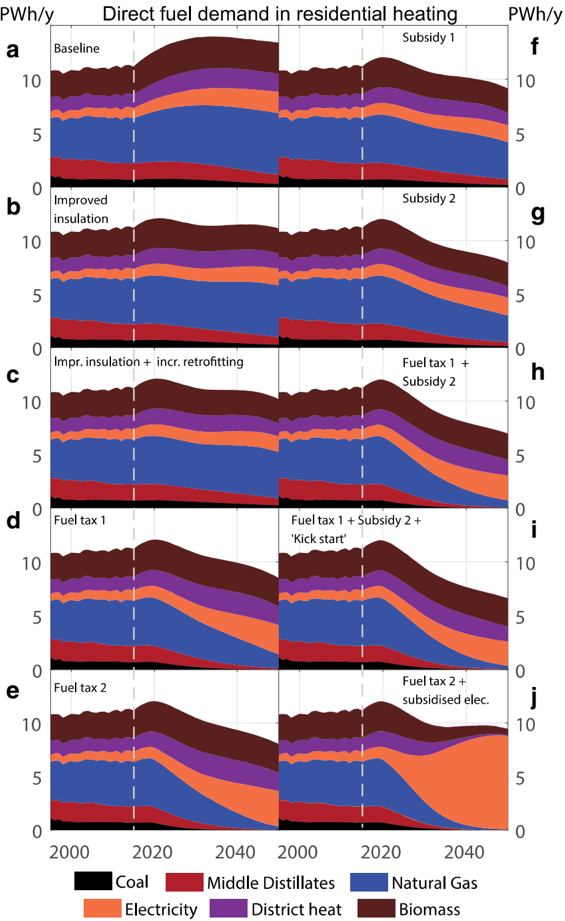
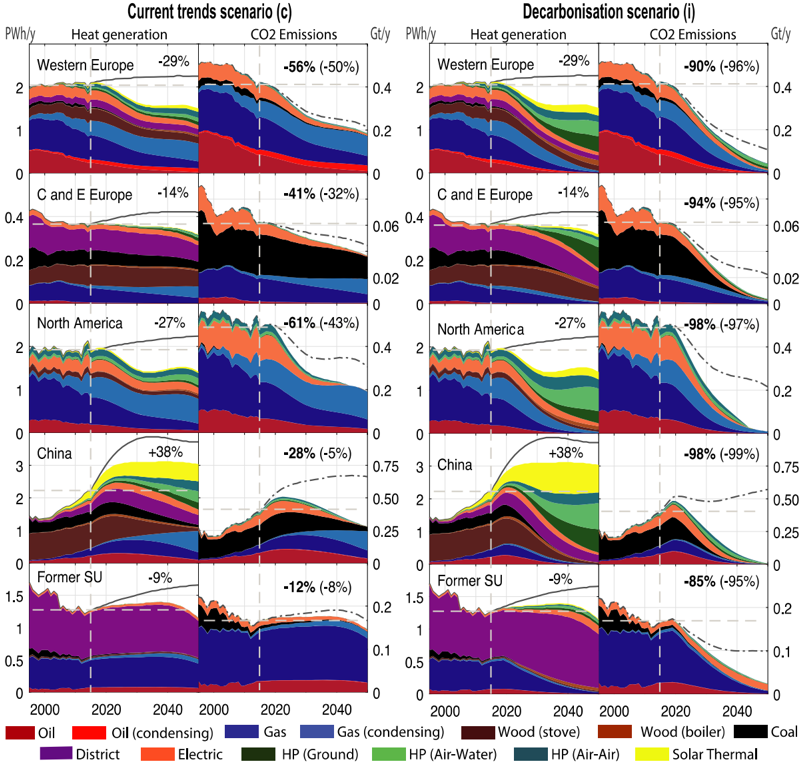
Whole-economy scenarios for limiting global warming to 1.5 °C suggest that direct carbon emissions in the buildings sector should decrease to almost zero by 2050, but leave unanswered the question how this could be achieved by real-world policies. We simulate which policy measures could induce an almost complete decarbonisation of residential heating, the by far largest source of direct emissions in residential buildings. Under which assumptions is it possible, and how long would it take? We use the non-equilibrium bottom-up model FTT:Heat to simulate policies for a transition towards low-carbon heating in a context of inertia and bounded rationality, focusing on the uptake of heating systems. Our results indicate that the near-zero decarbonisation is achievable by 2050, but requires substantial policy efforts. We find that policy mixes are more effective for incentivising the uptake of fuel-efficient low-carbon technologies, compared to a residential carbon tax as the only policy. In combination with subsidies and procurement policies for renewables, near-complete decarbonisation could be achieved with a tax of 50–200 €/tCO 2. Without being complimented by additional policies, carbon taxes show a decreasing marginal impact on total emission reductions, thus remaining insufficient for deep decarbonisation. In all scenarios, the decarbonisation of heating would increase projected heating costs faced by households initially, but could lead to cost reductions in most world regions in the medium term. We show that the potential impacts of policies highly depend on behavioural decision-making by households, especially in a context of deep decarbonisation and rapid transformation.
Overview
The claims and statistics of this paper haven’t been checked yet.
Free: it reads the open-access text and checks the first 5 claims that cite a source we can check. Create a free account to check every claim.
Integrity signals
Registry
Cites
Statistics
Figures
Verification
Claims the paper makes
The claims and statistics of this paper haven’t been checked yet.
Free: it reads the open-access text and checks the first 5 claims that cite a source we can check. Create a free account to check every claim.
Claims other papers make about this one
Each is checked against this paper’s own text: does it say what the citing paper says it does?
The source backs part of the claim, not all of it — or backs it for a different population, condition or comparison.
In the citing paper
“This model’s representation of technology uptake in transport and heating is strongly empirical, based on detailed regional datasets on consumer markets, and simulates technology diffusion profiles consistent with historical observations (see Methods)29–31.”
From Net emission reductions from electric cars and heat pumps in 59 world regions over time (2020) · cites this paper as [30]
Experimental — accuracy not yet measuredThe check wasn’t confident either way, so it gives no verdict — never disputed.
In the citing paper
“For cars, the distribution of current sales was derived from detailed market data on vehicle sales (years 2004-2012), which we compiled by matching sales data to manufacturer data for thousands of individual vehicle models currently on the market in 18 countries, and we extrapolated these values for countries where data is missing29,30.”
From Net emission reductions from electric cars and heat pumps in 59 world regions over time (2020) · cites this paper as [30]
Experimental — accuracy not yet measured
Self-check
Percentages, sums and reported differences re-computed from the paper’s own numbers.
The self-check needs the paper’s full text.
Citations
Cites
Prospect Theory: An Analysis of Decision under Risk
Kahneman, D., & Tversky, A. (1979) · Econometrica · doi:10.2307/1914185 · Cited by 48,524
Rogers, E. M., Singhal, A., & Quinlan, M. M. (2019) · An Integrated Approach to Communication Theory and Research · doi:10.4324/9780203710753-35 · Cited by 37,322
Prospect theory: An analysis of decision under risk
Kahneman, D., & Tversky, A. (1988) · Decision, Probability and Utility · doi:10.1017/cbo9780511609220.014 · Cited by 32,474 · cited 1×
“…as described by behavioural economics (e.g. loss aversion, sub-optimal decision heuristics, status quo bias, saliency, procrastination) (Allcott and Mullainathan 2010; Bager and Mundaca 2017; Frederick et al. 2002; Kahneman and Tversky 1979; Lillemo 2014; Shogren and Taylor 2008; Simon 1955).”
A BEHAVIORAL MODEL OF RATIONAL CHOICE
Simon, H. A. (1955) · The Quarterly Journal of Economics · doi:10.2307/1884852 · Cited by 15,877 · cited 1×
“…as described by behavioural economics (e.g. loss aversion, sub-optimal decision heuristics, status quo bias, saliency, procrastination) (Allcott and Mullainathan 2010; Bager and Mundaca 2017; Frederick et al. 2002; Kahneman and Tversky 1979; Lillemo 2014; Shogren and Taylor 2008; Simon 1955).”
BackgroundCompeting Technologies, Increasing Returns, and Lock-In by Historical Events
Arthur, W. B. (1989) · The Economic Journal · doi:10.2307/2234208 · Cited by 7,489 · cited 1×
“Endogenous cost reductions increases path dependence in technology diffusion (Arthur 1989), leading to increasing returns to scale for growing technologies.”
Geels, F. W. (2002) · Research Policy · doi:10.1016/s0048-7333(02)00062-8 · Cited by 7,275 · cited 1×
“The resulting technology transitions usually take decades rather than years, being accompanied by changes in regulation, infrastructure, user practices and culture (Geels 2002).”
BackgroundRiahi, K., van Vuuren, D. P., Kriegler, E., Edmonds, J., O’Neill, B. C., Fujimori, S., Bauer, N., Calvin, K., Dellink, R., Fricko, O., et al. (2017) · Global Environmental Change · doi:10.1016/j.gloenvcha.2016.05.009 · Cited by 6,607
Time Discounting and Time Preference: A Critical Review
Frederick, S., Loewenstein, G. F., & O’Donoghue, T. (2002) · Journal of Economic Literature · doi:10.1257/002205102320161311 · Cited by 6,381 · cited 2×
“…as described by behavioural economics (e.g. loss aversion, sub-optimal decision heuristics, status quo bias, saliency, procrastination) (Allcott and Mullainathan 2010; Bager and Mundaca 2017; Frederick et al. 2002; Kahneman and Tversky 1979; Lillemo 2014; Shogren and Taylor 2008; Simon 1955).”
(2023) · doi:10.1126/science · Cited by 6,063
Evolutionary Games and Population Dynamics
Hofbauer, J., & Sigmund, K. (1998) · doi:10.1017/cbo9781139173179 · Cited by 5,502 · cited 2×
“Formula (8) is the non-linear dynamic shares equation, conceptually similar to the modelling of imitation dynamics in evolutionary game theory (Hofbauer and Sigmund 1998), originating in the description of evolutionary competition between different species.”
Research works printed but not linked: 6
- 9. Cambridge Econometrics. (2014). E3ME Manual, Version 6.
- 36. IEA. (2017). World energy statistics and balances (2017 edition). International Energy Agency. IEA/ETSAP. (2012). Space heating and cooling-technology brief R02. International Energy Agency (IEA) Energy Technology Systems Analysis Program. IEA/ETSAP and IRENA. (2013). Heat pumps technology brief. Energy Technology Systems Analysis Programme (ETSAP) of the International Energy Agency (IEA) and International Renewable Energy Agency (IRENA). International Energy Agency. (2017). Tracking clean energy prog- ress 2017.
- 44. Kegel, M., Tamasauskas, J., Sunye, R., Giguère, D. (2014). Heat pumps in the Canadian residential sector. 11th IEA Heat Pump Conf. 2014 Montr. Canada 19.
- Ürge-Vorsatz, D., Petrichenko, K., Antal, M., Staniec, M., Labelle, M., Ozden, E., Labzina, E. (2012b). Best practice policies for low energy and carbon buildings: A scenario analysis.
- 95. Ürge-Vorsatz, D., Reith, A., Korytarova, K., Egyed, M., Dollenstein, J. (2015b). Monetary benefits of ambitious building energy policies.
- 98. WBCSD. (2016). A handbook on creating dynamic local markets for energy efficiency in buildings.
Cited by
Net emission reductions from electric cars and heat pumps in 59 world regions over time
Knobloch, F., Hanssen, S. V., Lam, A., Pollitt, H., Salas, P., Chewpreecha, U., Huijbregts, M. A. J., & Mercure, J.-F. (2020) · Nature Sustainability · doi:10.1038/s41893-020-0488-7 · Cited by 407
Self-citationThe momentum of the solar energy transition
Nijsse, F. J. M. M., Mercure, J.-F., Ameli, N., Larosa, F., Kothari, S., Rickman, J., Vercoulen, P., & Pollitt, H. (2023) · Nature Communications · doi:10.1038/s41467-023-41971-7 · Cited by 389
Self-citationStranded fossil-fuel assets translate to major losses for investors in advanced economies
Semieniuk, G., Holden, P. B., Mercure, J.-F., Salas, P., Pollitt, H., Jobson, K., Vercoulen, P., Chewpreecha, U., Edwards, N. R., & Viñuales, J. E. (2022) · Nature Climate Change · doi:10.1038/s41558-022-01356-y · Cited by 294
Self-citationMitigation Pathways Compatible with Long-term Goals
(2023) · Climate Change 2022 - Mitigation of Climate Change · doi:10.1017/9781009157926.005 · Cited by 288
Zhao, N., & You, F. (2020) · Applied Energy · doi:10.1016/j.apenergy.2020.115889 · Cited by 253
Reframing incentives for climate policy action
Mercure, J.-F., Salas, P., Vercoulen, P., Semieniuk, G., Lam, A., Pollitt, H., Holden, P. B., Vakilifard, N., Chewpreecha, U., Edwards, N. R., et al. (2021) · Nature Energy · doi:10.1038/s41560-021-00934-2 · Cited by 217
Self-citationGlobal scenarios of residential heating and cooling energy demand and CO2 emissions
Mastrucci, A., van Ruijven, B. J., Byers, E. A., Poblete-Cazenave, M., & Pachauri, S. (2021) · Climatic Change · doi:10.1007/s10584-021-03229-3 · Cited by 190
Demand-side approaches for limiting global warming to 1.5 °C
Mundaca, L., Ürge-Vorsatz, D., & Wilson, C. (2019) · Energy Efficiency · doi:10.1007/s12053-018-9722-9 · Cited by 128
“Knobloch et al. (2018) explore policy mixes and their interactions.”
InfluentialHybrid photovoltaic/thermal and ground source heat pump: Review and perspective
You, T., Wu, W., Yang, H., Liu, J., & Li, X. (2021) · Renewable and Sustainable Energy Reviews · doi:10.1016/j.rser.2021.111569 · Cited by 133
Twenty years of climate policy: G20 coverage and gaps
Nascimento, L., Kuramochi, T., Iacobuţă, G., den Elzen, M. G. J., Fekete, H., Weishaupt, M., van Soest, H. L., Roelfsema, M., de Vivero, G., Lui, S., et al. (2021) · Climate Policy · doi:10.1080/14693062.2021.1993776 · Cited by 133
The centre cannot (always) hold: Examining pathways towards energy system de-centralisation
Judson, E., Fitch-Roy, O., Pownall, T., Bray, R. N., Poulter, H., Soutar, I., Lowes, R., Connor, P., Britton, J., Woodman, B., et al. (2019) · Renewable and Sustainable Energy Reviews · doi:10.1016/j.rser.2019.109499 · Cited by 116
To tax or to trade? A global review of carbon emissions reduction strategies
Pan, J., Cross, J. L., Zou, X., & Zhang, B. (2024) · Energy Strategy Reviews · doi:10.1016/j.esr.2024.101508 · Cited by 104
Lam, A., & Mercure, J.-F. (2021) · Energy Research & Social Science · doi:10.1016/j.erss.2021.101951 · Cited by 100
Self-citationWang, Y., Wang, J., & He, W. (2021) · Renewable and Sustainable Energy Reviews · doi:10.1016/j.rser.2021.111747 · Cited by 93
Risk-opportunity analysis for transformative policy design and appraisal
Mercure, J.-F., Sharpe, S., Vinuales, J. E., Ives, M. C., Grubb, M. J., Lam, A., Drummond, P., Pollitt, H., Knobloch, F., & Nijsse, F. J. M. M. (2021) · Global Environmental Change · doi:10.1016/j.gloenvcha.2021.102359 · Cited by 92
Self-citationWhat is stopping low-carbon buildings? A global review of enablers and barriers
Mata, É., Peñaloza, D., Sandkvist, F., & Nyberg, T. (2021) · Energy Research & Social Science · doi:10.1016/j.erss.2021.102261 · Cited by 80
Determinants of Decarbonisation in the Transformation of the Energy Sector: The Case of Poland
Wójcik-Jurkiewicz, M., Czarnecka, M., Kinelski, G., Sadowska, B., & Bilińska–Reformat, K. (2021) · Energies · doi:10.3390/en14051217 · Cited by 65
Daioglou, V., Mikropoulos, E., Gernaat, D., & van Vuuren, D. P. (2022) · Energy · doi:10.1016/j.energy.2021.122994 · Cited by 66
Self-citationYang, X., Hu, M., Zhang, C., & Steubing, B. R. P. (2022) · Resources Conservation and Recycling · doi:10.1016/j.resconrec.2022.106388 · Cited by 71
CO2 mitigation or removal: The optimal uses of biomass in energy system decarbonization
Patrizio, P., Fajardy, M., Bui, M., & Dowell, N. M. (2021) · iScience · doi:10.1016/j.isci.2021.102765 · Cited by 56
“However, considering the requirement for achieving 85%–95% emission reduction in the residential sector by 2050 (Knobloch et al., 2019), the adoption of heat pumps for space heating is often seen as the most promising technological option (Thomaben et al., 2021), provided the availability of…”
BackgroundNamdar, H., di Schio, E. R., Semprini, G., & Valdiserri, P. (2025) · Energy and Buildings · doi:10.1016/j.enbuild.2025.115516 · Cited by 63
Pollitt, H., Lewney, R., Kiss-Dobronyi, B., & Lin, X. (2021) · Climate Policy · doi:10.1080/14693062.2021.1965525 · Cited by 58
Self-citationOrganic waste recycling for carbon smart circular bioeconomy and sustainable development: A review
Awasthi, M. K., Yan, B., Şar, T., Gómez‐García, R., Ren, L., Sharma, P., Binod, P., Sindhu, R., Kumar, V., Kumar, D., et al. (2022) · Bioresource Technology · doi:10.1016/j.biortech.2022.127620 · Cited by 58
Renewable Energy Acceptance by Households: Evidence from Lithuania
Štreimikienė, D., Lekavičius, V., Stankūnienė, G., & Pažėraitė, A. (2022) · Sustainability · doi:10.3390/su14148370 · Cited by 51
Frankowski, J., & Herrero, S. T. (2020) · Energy Research & Social Science · doi:10.1016/j.erss.2020.101787 · Cited by 56
Disruptive and uncertain: Policy makers’ perceptions on UK heat decarbonisation
Lowes, R., & Woodman, B. (2020) · Energy Policy · doi:10.1016/j.enpol.2020.111494 · Cited by 55
Renewable energy technologies in households: Challenges and low carbon energy transition justice
Štreimikienė, D. (2022) · Economics & Sociology · doi:10.14254/2071-789x.2022/15-3/6 · Cited by 51
Özcan, H., El-Emam, R. S., Çelik, S., & Horri, B. A. (2023) · Cleaner Chemical Engineering · doi:10.1016/j.clce.2023.100115 · Cited by 52
The impacts of the trade liberalization of environmental goods on power system and CO2 emissions
Hu, X., Pollitt, H., Pirie, J., Mercure, J.-F., Liu, J., Meng, J., & Tao, S. (2020) · Energy Policy · doi:10.1016/j.enpol.2019.111173 · Cited by 44
Self-citationFouladvand, J., Rojas, M. A., Hoppe, T., & Ghorbani, A. (2021) · Applied Energy · doi:10.1016/j.apenergy.2021.117897 · Cited by 49
Chatterjee, S., Stavrakas, V., Oreggioni, G. D., Süsser, D., Staffell, I., Lilliestam, J., Molnár, G., Flamos, A., & Ürge-Vorsatz, D. (2022) · Energy Research & Social Science · doi:10.1016/j.erss.2022.102662 · Cited by 44
Reducing heat pump installed costs: Reviewing historic trends and assessing future prospects
Winskel, M., Heptonstall, P. J., & Gross, R. (2024) · Applied Energy · doi:10.1016/j.apenergy.2024.124014 · Cited by 39
Akinpelu, A. A., Alam, M. S., Shafiullah, M., Rahman, S. M., & Al–Ismail, F. S. (2023) · Sustainability · doi:10.3390/su15075639 · Cited by 39
“Planning for the significant growth of low-carbon energy infrastructure, including low-carbon power generation and hydrogen production, is becoming increasingly necessary to support emissions reductions in the transportation sector [74].”
BackgroundTowards a unified theory of domestic hydrogen acceptance: An integrative, comparative review
Gordon, J. A., Balta‐Ozkan, N., & Nabavi, S. A. (2023) · International Journal of Hydrogen Energy · doi:10.1016/j.ijhydene.2023.12.167 · Cited by 38
“In response, this integrative, comparative review is grounded in the following rationale: accelerating and sustaining momentum towards realising visions for low-carbon homes will entail developing a better understanding of consumer acceptance [85,86].”
InfluentialThe role of the IPCC in assessing actionable evidence for climate policymaking
Pollitt, H., Mercure, J.-F., Barker, T., Salas, P., & Scrieciu, Ş. (2024) · npj Climate Action · doi:10.1038/s44168-023-00094-x · Cited by 41
“The approach combines a wide range of technology options with a bounded rational representation of human decision-making for the power sector 104 , personal transport 105 , household heating 106 and the steel sector 107 .”
BackgroundSelf-citationFTT:Heat — A simulation model for technological change in the European residential heating sector
Knobloch, F., Pollitt, H., Chewpreecha, U., Lewney, R., Huijbregts, M. A. J., & Mercure, J.-F. (2021) · Energy Policy · doi:10.1016/j.enpol.2021.112249 · Cited by 41
Self-citationHopes and fears for a sustainable energy future: Enter the hydrogen acceptance matrix
Gordon, J. A., Balta‐Ozkan, N., & Nabavi, S. A. (2024) · International Journal of Hydrogen Energy · doi:10.1016/j.ijhydene.2024.02.247 · Cited by 38
Fernandes, M. S., Coutinho, B. H., & Rodrigues, E. M. D. S. (2024) · Journal of Cleaner Production · doi:10.1016/j.jclepro.2024.141255 · Cited by 34
Chen, Y., Jensen, I. G., Kirkerud, J. G., & Bolkesjø, T. F. (2020) · Energy · doi:10.1016/j.energy.2020.119576 · Cited by 36
Ashrafi, N., Ahmadi, R., & Zahedi, A. (2023) · Energy and Buildings · doi:10.1016/j.enbuild.2023.113048 · Cited by 33
Rodrigues, C., Rodrigues, E. M. D. S., Fernandes, M. S., & Tadeu, S. (2024) · Applied Energy · doi:10.1016/j.apenergy.2024.123867 · Cited by 34
Modelling the effectiveness of climate policies: How important is loss aversion by consumers?
Knobloch, F., Huijbregts, M. A. J., & Mercure, J.-F. (2019) · Renewable and Sustainable Energy Reviews · doi:10.1016/j.rser.2019.109419 · Cited by 37
“Furthermore, its simulations for the near future are consistent with observed technology choices in the past [51,52].”
BackgroundSelf-citationTemporospatial techno-economic analysis of heat pumps for decarbonising heating in Great Britain
Wang, Y., & He, W. (2021) · Energy and Buildings · doi:10.1016/j.enbuild.2021.111198 · Cited by 31
Brown, C., Hampton, S., & Fawcett, T. (2024) · Energy Research & Social Science · doi:10.1016/j.erss.2024.103644 · Cited by 33
Sârbu, I., Dorca, A., & Mirza, M. (2024) · Sustainable Cities and Society · doi:10.1016/j.scs.2024.105897 · Cited by 29
Exploring the potential of heat as a service in decarbonization: Evidence needs and research gaps
Britton, J., Miñas, A. M., Marques, C., & Pourmirza, Z. (2021) · Energy Sources Part B Economics Planning and Policy · doi:10.1080/15567249.2021.1873460 · Cited by 28
“It is widely acknowledged in academic and policy landscapes that urgent and radical heat decarbonization is essential to reducing greenhouse gas emissions compatible with the 1.5°C mitigation pathway (IEA 2019; IPCC 2018; Knobloch et al. 2019).”
BackgroundInfluentialLong term, cross-country effects of buildings insulation policies
Edelenbosch, O. Y., Rovelli, D., Levesque, A., Marangoni, G., & Tavoni, M. (2021) · Technological Forecasting and Social Change · doi:10.1016/j.techfore.2021.120887 · Cited by 27
Assessment of Solid Waste Management and Decarbonization Strategies
Chiang, P. F., Zhang, T., Claire, M. J., Maurice, N. J., Ahmed, J., & Giwa, A. S. (2024) · Processes · doi:10.3390/pr12071473 · Cited by 25
Experience rates of low-carbon domestic heating technologies in the United Kingdom
Renaldi, R., Hall, R., Jamasb, T., & Roskilly, A. P. (2021) · Energy Policy · doi:10.1016/j.enpol.2021.112387 · Cited by 25
Important social and technical factors shaping the prospects for thermal energy storage
Barns, D. G., Taylor, P., Bale, C. S. E., & Owen, A. M. (2021) · Journal of Energy Storage · doi:10.1016/j.est.2021.102877 · Cited by 29
Niamir, L., Mastrucci, A., & van Ruijven, B. J. (2024) · Energy Research & Social Science · doi:10.1016/j.erss.2024.103445 · Cited by 22
Maciejewska, A., Kuzak, Ł., Sobieraj, J., & Metelski, D. (2022) · Energies · doi:10.3390/en15155402 · Cited by 24
“Many lignite mines are under increasing pressure due to initiatives to reduce CO 2 emissions [6], the rapidly growing renewable energy capacity and the promotion of other alternative technologies [7].”
BackgroundThe technical impacts of the carbon tax in China
Chen, S. (2021) · Discover Sustainability · doi:10.1007/s43621-021-00060-9 · Cited by 20
“This finding could be explained by the uncertainties existing in the household decision-making [39].”
BackgroundEvidence of a cascading positive tipping point towards electric vehicles
Mercure, J.-F., Lam, A., Buxton, J. E., Boulton, C. A., Akther, A., & Lenton, T. M. (2025) · Nature Communications · doi:10.1038/s41467-025-66945-9 · Cited by 27
Self-citationDyussembekova, N., Temirgaliyeva, N., Umyshev, D. R., Шавдинова, М. Д., Schütt, R. J., & Bektalieva, D. (2022) · Sustainability · doi:10.3390/su14169813 · Cited by 19
Towards net-zero emissions in global residential heating and cooling: a global scenario analysis
Mastrucci, A., Boza‐Kiss, B., & van Ruijven, B. J. (2025) · Climatic Change · doi:10.1007/s10584-025-03923-6 · Cited by 17
“While existing cost fig - ures are mostly based on exemplary buildings, wide-scale cost assessments are still limited, especially at the global level (Knobloch et al. 2019; Daioglou et al. 2022).”
López-Bernabé, E., Linares, P., & Galarraga, I. (2022) · Energy Policy · doi:10.1016/j.enpol.2022.113211 · Cited by 17
“technological, behavioural, economic, socio-cultural, institutional) (Csutora et al., 2021; Knobloch et al., 2019; Narula et al., 2020) and one that involves many stakeholders (consumers, builders, firms, policy-makers) (Gago et al.”
Kato, S., Lee, S., He, Y., Yoshioka, T., Morotomi, T., & Chewpreecha, U. (2023) · Springer eBooks · doi:10.1007/978-981-95-9861-8_2 · Cited by 16
Self-citationDiminishing benefits of thermal mass in Iranian climate: Present and future scenarios
Rodrigues, E. M. D. S., Fereidani, N. A., Fernandes, M. S., & Gaspar, A. R. (2024) · Building and Environment · doi:10.1016/j.buildenv.2024.111635 · Cited by 16
Zhang, S., Wang, M., Jiang, H., & Guan, D. (2024) · Building and Environment · doi:10.1016/j.buildenv.2024.112505 · Cited by 16
Odenweller, A. (2022) · Technological Forecasting and Social Change · doi:10.1016/j.techfore.2022.121568 · Cited by 17
“…solution, future research could extend this study to a more comprehensive coupling, for example linking REMIND with multiple available FTT models, not only for the power sector, but also for transport (Lam et al., 2018), heating (Knobloch et al., 2018), and industry (Vercoulen et al., 2019).”
BackgroundMethodChallenges of Energy Transition in the Individual Heating Sector
Pavlović, B., Ivezić, D. D., & Živković, M. (2022) · Energija Ekonomija Ekologija · doi:10.46793/eee22-1.17p · Cited by 13
Energy Policies for Eco-Friendly Households in Luxembourg: a Study Based on the LuxHEI Model
Poncin, S. (2020) · Environmental Modeling & Assessment · doi:10.1007/s10666-020-09725-7 · Cited by 14
Hou, X., Zhong, S., & Zhao, J. (2022) · Energies · doi:10.3390/en15031183 · Cited by 12
Torné, A., & Trutnevyte, E. (2025) · Energy Policy · doi:10.1016/j.enpol.2025.114872 · Cited by 12
Smith, W., Demski, C., & Pidgeon, N. F. (2024) · Energy Research & Social Science · doi:10.1016/j.erss.2024.103844 · Cited by 11
A relational approach to characterizing householder perceptions of disruption in heat transitions
Thomas, G., Flower, J., Gross, R., Henwood, K. L., Shirani, F., Speirs, J. F., & Pidgeon, N. (2024) · Nature Energy · doi:10.1038/s41560-024-01506-w · Cited by 11
Frilingou, N., Koasidis, K., Spyridaki, N.-A., Νίκας, Α., Marinakis, V., & Doukas, H. (2024) · Energy Policy · doi:10.1016/j.enpol.2024.114112 · Cited by 10
Yu, H., Bergaentzlé, C., Petrović, S. N., Ahlgren, E. O., & Johnsson, F. (2024) · Smart Energy · doi:10.1016/j.segy.2024.100144 · Cited by 9
Midões, C., van den Bergh, J. C. J. M., Savin, I. V., & de Alessandri, G. (2026) · Environmental and Resource Economics · doi:10.1007/s10640-026-01098-x · Cited by 8
Ciołek, M., Emerling, I., Olejko, K., Sadowska, B., & Wójcik-Jurkiewicz, M. (2022) · Energies · doi:10.3390/en15051945 · Cited by 9
“The share of coal in electricity production decreased last year in the European Union by 24 percent, according to the report “European energy sector” in 2019 [51].”
BackgroundInfluentialVecchi, A., Davis, D., Brear, M. J., & Aye, L. (2024) · Journal of Cleaner Production · doi:10.1016/j.jclepro.2024.141465 · Cited by 8
Fereidani, N. A., Rodrigues, E. M. D. S., & Gaspar, A. R. (2025) · Energy · doi:10.1016/j.energy.2025.134742 · Cited by 8
Analysis for the Implementation of Surplus Hydropower for Green Hydrogen Production in Ecuador
Pinchao, P., Torres, A., Yánez, M., Reina, S., & Cando, E. (2024) · Energies · doi:10.3390/en17236051 · Cited by 6
Energy Retrofitting in Public Housing and Fuel Poverty Reduction: Cost–Benefit Trade-Offs
D’Alpaos, C., & Bragolusi, P. (2021) · Green energy and technology · doi:10.1007/978-3-030-57332-4_38 · Cited by 6
Moya, D., Giarola, S., & Hawkes, A. D. (2021) · IEEE International Conference on Big Data (BigData) · doi:10.1109/bigdata52589.2021.9671339 · Cited by 6
Towards net zero: sectoral ambitions and global trends in building decarbonisation
Caballero-Güereca, C. E., Vogel, J., Alaux, N., Ouellet‐Plamondon, C., Santana, J. S., Foliente, G., Lützkendorf, T., & Passer, A. (2026) · Buildings and Cities · doi:10.5334/bc.724 · Cited by 8
George, J. F., Held, A., Winkler, J., Eichhammer, W., & Ragwitz, M. (2024) · Smart Energy · doi:10.1016/j.segy.2024.100149 · Cited by 6
Energy users’ social drivers to transition from natural gas: a Dutch municipality case study
Hajarini, M. M. S., Zuiderwijk, A., Diran, D., & Chappin, E. J. L. (2022) · IOP Conference Series Earth and Environmental Science · doi:10.1088/1755-1315/1085/1/012045 · Cited by 4
Gender and the heat pump transition
Crawley, J., Wade, F., & de Wilde, M. (2023) · Buildings and Cities · doi:10.5334/bc.392 · Cited by 4
Barns, D. G., Bale, C. S. E., Taylor, P., & Owen, A. M. (2024) · Frontiers in Sustainable Cities · doi:10.3389/frsc.2024.1339709 · Cited by 4
Dorca, A., & Sârbu, I. (2025) · Thermal Science and Engineering Progress · doi:10.1016/j.tsep.2025.104059 · Cited by 6
Opportunities and costs for shared ground loops
Barns, D. G., Bale, C. S. E., Turner, J. L., Loveridge, F. A., Rees, S., & Fletcher, M. (2025) · Renewable and Sustainable Energy Reviews · doi:10.1016/j.rser.2025.116490 · Cited by 4
Quantifying inequalities in the global employment landscape during the low-carbon transition
Wang, C., Wang, B., Vu, T. N. A., Xu, S., Song, W., Wang, Z., & Li, Z. (2026) · Nexus · doi:10.1016/j.ynexs.2026.100120 · Cited by 3
An algorithm to assess the heating strategy of buildings in cold climates: a case study of Germany
Mazhar, A. R., Zou, Y., Zeng, C., Shen, Y., & Liu, S. (2022) · International Journal of Low-Carbon Technologies · doi:10.1093/ijlct/ctac023 · Cited by 3
Kovács, A. F. (2021) · Budapesti Corvinus Egyetem eBooks · doi:10.14267/978-963-503-890-9 · Cited by 3
Integrating Multiple Timescales in the Economic Modelling of the Low-Carbon Transition
Pollitt, H. (2023) · Mathematics online first collections · doi:10.1007/16618_2023_65 · Cited by 4
Self-citationCombining Short-Term Economic Recovery with Long-Term Sustainability
Chewpreecha, U., Pollitt, H., & Mercure, J.-F. (2023) · International papers in political economy · doi:10.1007/978-3-031-19256-2_6 · Cited by 4
Self-citationAkimoto, K., Sano, F., Nakano, Y., & Jung, T. Y. (2026) · Carbon Management · doi:10.1080/17583004.2026.2614424 · Cited by 2
Alyasari, H. I., Altaweel, M. D., & Dhumad, A. K. (2023) · International Journal of Sustainable Development and Planning · doi:10.18280/ijsdp.180230 · Cited by 2
Global research on building sector climate mitigation lacks full feasibility scope
Mata, É., Cabeza, L. F., Cheng, S. H., Johansson, S., Kronnäs, V., & Mawlayi, F. (2026) · Environmental Research Communications · doi:10.1088/2515-7620/ae244b · Cited by 1
Pajek, L., Fernandes, M. S., & Rodrigues, E. M. D. S. (2026) · Renewable Energy · doi:10.1016/j.renene.2026.125315 · Cited by 1
Dorca, A., & Sârbu, I. (2026) · Sustainability · doi:10.3390/su18104965 · Cited by 1
Nawrocki, K., Matuszak-Flejszman, A., & Błaszczyk, A. (2026) · Energy Policy · doi:10.1016/j.enpol.2026.115408 · Cited by 1
Sparking change in residential electrification in Victoria: The role of local government
Holdsworth, S., Sandri, O. J., & Hayes, J. (2026) · Energy Research & Social Science · doi:10.1016/j.erss.2026.104992 · Cited by 1
Nudges for Enhancing Sustainable Energy Consumption in Households
Štreimikienė, D., & Stankūnienė, G. (2021) · Practice, progress, and proficiency in sustainability · doi:10.4018/978-1-7998-8426-2.ch009 · Cited by 1
The influence of Variable Geometry Control on a R290 Ejector Refrigeration System
Besagni, G., & Inzoli, F. (2022) · Journal of Physics Conference Series · doi:10.1088/1742-6596/2177/1/012010 · Cited by 1
Enabling future climate policy : an analysis of policy gaps and progress under the Paris Agreement
Nascimento, L. (2024) · doi:10.18174/642585 · Cited by 2
Experimental study of a R290 variable geometry ejector
Besagni, G., Inzoli, F., Croci, L., Brignoli, V., Smołka, J., Palacz, M., Haida, M., Bodys, J., Fingas, R., Nowak, A. J., et al. (2023) · Journal of Physics Conference Series · doi:10.1088/1742-6596/2509/1/012006
Sadowska, B., Lew, G., Wójcik-Jurkiewicz, M., Drożdż, W., & Pilecki, B. (2025) · Energies · doi:10.3390/en18051094
Metadata
- Authors
- Knobloch, F., Pollitt, H., Chewpreecha, U., Daioglou, V., & Mercure, J.-F.
- Affiliations
- Radboud University Nijmegen (NL)
- University of Cambridge (GB)
- Cambridge Econometrics (United Kingdom) (GB)
- Netherlands Environmental Assessment Agency (NL)
- Corresponding author
- Knobloch, Florian
- Venue
- Energy Efficiency
- Published
- 2018-07-05
- Volume
- 12
- Issue
- 2
- Pages
- 521-550
- ISSN
- 1570-646X (ISSN-L)
- 1570-6478
- OpenAlex
- W2766951003
- Cited by
- 6
- References
- 91
- Citations by year
- 2026: 1 · 2025: 1 · 2024: 1 · 2022: 2 · 2020: 1
- FWCI
- 0.38
- Type
- journal article
- Language
- en
- Open access
- hybrid
- doi.org
- Licence
- cc-by
- creativecommons.org/licenses/by/4.0 (tdm)
- Locations
- Energy Efficiency (publishedVersion, cc-by)
- RePEc: Research Papers in Economics (submittedVersion)
- arXiv (Cornell University) (submittedVersion)
- Radboud Repository (Radboud University) (submittedVersion, other-oa)
- Utrecht University Repository (Utrecht University) (submittedVersion, other-oa)
- Figshare (submittedVersion, cc-by)
- Open Research Exeter (University of Exeter) (submittedVersion, cc-by)
- arXiv (Cornell University)
- Funders
- European Commission (ENER/A4/2015-436/SER/S12.716128)
- Engineering and Physical Sciences Research Council (EP/K007254/1)
- Directorate-General for Energy (ENER/A4/2015-436/SER/S12.716128)
- Topics
- Social Sciences › Economics, Econometrics and Finance › Economics and Econometrics › Climate Change Policy and Economics
- Physical Sciences › Energy › Renewable Energy, Sustainability and the Environment › Energy, Environment, and Transportation Policies
- Physical Sciences › Engineering › Electrical and Electronic Engineering › Integrated Energy Systems Optimization
- Keywords
- 1.5 °C warming target, carbon tax, policy mix, bounded rationality, behavioral decision making, building carbon emissions, low-carbon transition
About these checks
Registry, retraction, Cites and statistics results are computed, not judged, with one exception: a printed reference that no index lists is read once by a model before it counts as a citation error. Claims are extracted by a model and kept only when their quote appears verbatim in the text; each cited source is then checked, with a model’s help, for whether it says what the claim relies on. Those verdicts can be wrong — read the claim’s quote and the cited source before relying on one.
Statistics and arithmetic are recomputed, not judged.
Confidence bands are shown only for fields calibrated on our annotated test set. None is calibrated yet, so no band is shown.
What counts as a claim ›How we measure confidence ›How we check this ›
Are you an author, or do you see a problem with this page? Request a review
Data sources
Bibliographic data: Semantic Scholar, OpenAlex, Crossref.
Contains information from the Semantic Scholar Academic Graph Datasets, made available under the ODC Attribution License (ODC-BY 1.0).
Semantic Scholar’s data is described in: Kinney, R., et al. (2023). The Semantic Scholar Open Data Platform. arXiv:2301.10140.
