

Negative emotions about climate change are related to insomnia symptoms and mental health: Cross-sectional evidence from 25 countries
Open accessThe DOI matches its Crossref record; 47 of the 47 references it cites were found in a registry or an index.
Abstract
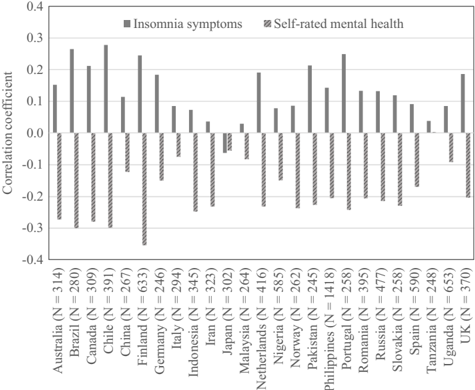
Climate change threatens mental health via increasing exposure to the social and economic disruptions created by extreme weather and large-scale climatic events, as well as through the anxiety associated with recognising the existential threat posed by the climate crisis. Considering the growing levels of climate change awareness across the world, negative emotions like anxiety and worry about climate-related risks are a potentially pervasive conduit for the adverse impacts of climate change on mental health. In this study, we examined how negative climate-related emotions relate to sleep and mental health among a diverse non-representative sample of individuals recruited from 25 countries, as well as a Norwegian nationally-representative sample. Overall, we found that negative climate-related emotions are positively associated with insomnia symptoms and negatively related to self-rated mental health in most countries. Our findings suggest that climate-related psychological stressors are significantly linked with mental health in many countries and draw attention to the need for cross-disciplinary research aimed at achieving rigorous empirical assessments of the unique challenge posed to mental health by negative emotional responses to climate change.
Overview
The claims and statistics of this paper haven’t been checked yet.
Free: it reads the open-access text and checks the first 5 claims that cite a source we can check. Create a free account to check every claim.
Integrity signals
Registry
Cites
Statistics
Figures
Verification
Claims the paper makes
The claims and statistics of this paper haven’t been checked yet.
Free: it reads the open-access text and checks the first 5 claims that cite a source we can check. Create a free account to check every claim.
Claims other papers make about this one
Each is checked against this paper’s own text: does it say what the citing paper says it does?
The source backs part of the claim, not all of it — or backs it for a different population, condition or comparison.
In the citing paper
“Investigations into anxiety about climate change have revealed that it is increasingly common for many people across the globe [9], with large-scale international studies identifying growing concern about climate change [10–12].”
From The relationship between climate change and mental health: a systematic review of the association between eco-anxiety, psychological distress, and symptoms of major affective disorders (2024) · cites this paper as [12]
Experimental — accuracy not yet measuredThe source backs part of the claim, not all of it — or backs it for a different population, condition or comparison.
In the citing paper
“Eco-anxiety has been considered to have conceptual overlap with Generalised Anxiety Disorder (GAD), with anticipatory worry representing a core feature of eco-anxiety [12, 75].”
From The relationship between climate change and mental health: a systematic review of the association between eco-anxiety, psychological distress, and symptoms of major affective disorders (2024) · cites this paper as [12]
Experimental — accuracy not yet measuredThe source backs part of the claim, not all of it — or backs it for a different population, condition or comparison.
In the citing paper
“and varied understandings and experiences of climate change have differing impacts on the relationship with mental health [10, 12].”
From The relationship between climate change and mental health: a systematic review of the association between eco-anxiety, psychological distress, and symptoms of major affective disorders (2024) · cites this paper as [12]
Experimental — accuracy not yet measuredThe cited source says what the claim attributes to it.
In the citing paper
“The consensus among mental health professionals is that most of these feelings and experiences represent adaptive responses and do not constitute a mental illness in themselves, although they might constitute a stressor that worsens mental health, and evidence published in 2021 links negative climate emotions to worsened mental health.16”
The cited source says what the claim attributes to it.
In the citing paper
“The consensus among mental health professionals is that most of these feelings and experiences represent adaptive responses and do not constitute a mental illness in themselves, although they might constitute a stressor that worsens mental health, and evidence published in 2021 links negative climate emotions to worsened mental health.16”
Self-check
Percentages, sums and reported differences re-computed from the paper’s own numbers.
The self-check needs the paper’s full text.
Citations
Cites
Back-translation for cross-cultural research.
Brislin, R. W. (1970) · Journal of Cross-Cultural Psychology · doi:10.1177/135910457000100301 · Cited by 14,091 · cited 1×
“In non-English speaking countries, the questionnaire was translated into local languages by competent bilingual speakers using the translation-back-translation method (Brislin, 1970).”
MethodState-Trait Anxiety Inventory for Adults
Spielberger, C. D. (2012) · PsycTESTS Dataset · doi:10.1037/t06496-000 · Cited by 3,479
Climate anxiety: Psychological responses to climate change
Clayton, S. (2020) · Journal of Anxiety Disorders · doi:10.1016/j.janxdis.2020.102263 · Cited by 1,409 · cited 2×
“Although climate change anxiety is not currently classified as a mental health disorder, dysregulated negative emotional responses to environmental problems can significantly impair individuals’ health and psychological functioning (Clayton, 2020).”
BackgroundEcological grief as a mental health response to climate change-related loss
Cunsolo, A., & Ellis, N. R. (2018) · Nature Climate Change · doi:10.1038/s41558-018-0092-2 · Cited by 1,408
Development and validation of a measure of climate change anxiety
Clayton, S., & Karazsia, B. T. (2020) · Journal of Environmental Psychology · doi:10.1016/j.jenvp.2020.101434 · Cited by 1,196 · cited 2×
“Although climate change anxiety is not currently classified as a mental health disorder, dysregulated negative emotional responses to environmental problems can significantly impair individuals’ health and psychological functioning (Clayton, 2020).”
BackgroundSleep and mental disorders: a meta-analysis of polysomnographic research
Baglioni, C., Nanovska, S., Regen, W., Spiegelhalder, K., Feige, B., Nissen, C., Reynolds, C. F., & Riemann, D. (2016) · Psychological Bulletin · doi:10.1037/bul0000053 · Cited by 1,074
The psychological impacts of global climate change
Doherty, T. J., & Clayton, S. (2011) · American Psychologist · doi:10.1037/a0023141 · Cited by 894
Sleep and emotions: a focus on insomnia
Baglioni, C., Spiegelhalder, K., Lombardo, C., & Riemann, D. (2010) · Sleep Medicine Reviews · doi:10.1016/j.smrv.2009.10.007 · Cited by 873
Schmidt, A., Ivanova, A., & Schäfer, M. S. (2013) · Global Environmental Change · doi:10.1016/j.gloenvcha.2013.07.020 · Cited by 753
Climate change and mental health: risks, impacts and priority actions
Hayes, K., Blashki, G., Wiseman, J., Burke, S., & Reifels, L. (2018) · International Journal of Mental Health Systems · doi:10.1186/s13033-018-0210-6 · Cited by 746
Research works printed but not linked: 2
- 10. Bednarek, S. (2019). Is there a therapy for climate change anxiety? Therapy Today, 30(5), 36-39.
- 18. Clayton, S., Manning, C., Krygsman, K., & Speiser, M. (2017). Mental health and our changing climate: impacts, implications and guidance. https://www.apa.org/news/press/releases/2017/03/ mental-health-climate.pdf
Cited by
Items 101–200 of 327
Timmons, S., Andersson, Y., & Lunn, P. (2024) · Climate Policy · doi:10.1080/14693062.2024.2341080 · Cited by 16
“For example, a large-scale survey from 25 countries found negative climate related emotions to be associated with sleep and mental health issues (Ogunbode et al., 2021).”
Spano, G., Ricciardi, E., Tinella, L., Caffò, A. O., Sanesi, G., & Bosco, A. (2024) · Heliyon · doi:10.1016/j.heliyon.2024.e41406 · Cited by 15
Henschel, L. D., Franke, G. H., & Jagla-Franke, M. (2025) · BMC Public Health · doi:10.1186/s12889-025-22849-3 · Cited by 15
“Furthermore, climate anxiety has been associated with increased levels of depression and generalized anxiety [3, 6] as well as insomnia [24].”
Lohani, M., & Blodgett, G. R. (2025) · Frontiers in Psychology · doi:10.3389/fpsyg.2025.1557055 · Cited by 14
Current understanding of the impact of climate change on mental health within UK parliament
Pirkle, L. T., Jennings, N. R., Vercammen, A., & Lawrance, E. L. (2022) · Frontiers in Public Health · doi:10.3389/fpubh.2022.913857 · Cited by 15
“Although these “eco-emotions” are understandable and can be even healthy responses to the experienced threats and losses, and are not in themselves clinical conditions, severe cases can require medical intervention (19), especially if they exacerbate other mental health disorders such as anxiety, depression or insomni…”
BackgroundHelm, S., Kemper, J. A., White, S., & Dean, D. (2024) · Environmental Sociology · doi:10.1080/23251042.2024.2408779 · Cited by 14
“Previous research suggests that young adults experiencing depression may be particularly vulnerable to negative mental health outcomes associated with climate change worry (Ogunbode et al. 2021).”
Kurt, G., & Akdur, R. (2024) · Sustainability · doi:10.3390/su16062269 · Cited by 13
Wan, C., Zhou, Y., & Geng, L. (2024) · Journal of Cleaner Production · doi:10.1016/j.jclepro.2024.144271 · Cited by 13
Couto, M. T., Senent‐Valero, M., dos Santos, L. A., Carmo, M. M., Matijasevich, A., & Pastor‐Valero, M. (2025) · Frontiers in Public Health · doi:10.3389/fpubh.2025.1555386 · Cited by 13
Gkargkavouzi, A., & Halkos, G. (2025) · Sustainable Development · doi:10.1002/sd.70401 · Cited by 13
Shinan‐Altman, S., & Hamama‐Raz, Y. (2023) · Sustainability · doi:10.3390/su151813689 · Cited by 12
Richter, E. P., Brähler, E., Zenger, M., Stöbel‐Richter, Y., Emmerich, F., Junghans, J., Krause, J., Irmscher, L., & Berth, H. (2024) · Journal of Clinical Medicine · doi:10.3390/jcm13164754 · Cited by 12
“A study across 25 countries provided conclusive evidence of a relationship between negative emotions related to climate change and poor mental health, including insomnia symptoms and a lower self-rated mental state [14].”
BackgroundInterventions for the Treatment of Eco-anxiety
Turğut, F. S., & Öztürk, M. (2025) · Psikiyatride Guncel Yaklasimlar - Current Approaches in Psychiatry · doi:10.18863/pgy.1508265 · Cited by 11
Assessing eco-anxiety across the lifespan: A systematic review of current global scales
Samarawickrama, S. K., Richmond, S., Freeman, N. C., & Kirk, H. (2025) · The Journal of Climate Change and Health · doi:10.1016/j.joclim.2025.100595 · Cited by 11
“The Climate Emotions Scale [36], the Negative Climate-Related Emotion Scale [37], and the Unnamed Adolescent Climate Anxiety Scale [38] only reported internal consistency, making it difficult to ascertain their utility beyond reliability between items [96].”
InfluentialKenstler, M., & Shelley, G. P. (2024) · Ecopsychology · doi:10.1089/eco.2023.0062 · Cited by 11
“This, in turn, can lead to functional impairment like loss of sleep, loss of appetite (Clayton & Karazsia, 2020; Hogg et al., 2021; Ogunbode et al., 2023), or a kind of paralysis of action in response to ecological challenges that could be misinterpreted as apathy or denial (Ágoston et al., 2022;…”
Zhang, X., Yang, X., Li, S., Ding, S., Tan, C., Wu, C., Shen, Y., & Xu, L. (2024) · International Journal of Disaster Risk Reduction · doi:10.1016/j.ijdrr.2024.104693 · Cited by 11
Self-citationRobison, R., van Bommel, M., & Rohse, M. (2022) · Frontiers in Climate · doi:10.3389/fclim.2022.794669 · Cited by 11
“%) had a multi-country focus (Clemens et al., 2020; Ogunbode et al., 2021).”
BackgroundAdaptation of the Climate Anxiety Scale in Indonesian version: The sample of young adults
Jaro’ah, S., & Saffana, K. (2023) · Psikohumaniora Jurnal Penelitian Psikologi · doi:10.21580/pjpp.v8i2.17462 · Cited by 11
“…climate and environmental conditions range from anxiety and depression (Clayton & Karazsia, 2020); to post-traumatic stress and suicidal tendencies (Cianconi et al., 2020), insomnia and self-rated mental health (Ogunbode et al., 2023), and reduced individual well-being (Ogunbode et al., 2022).”
BackgroundWilliams, M. O., Buekers, J., Castaño‐Vinyals, G., de Cid, R., Delgado‐Ortiz, L., Espinosa, A., García‐Aymerich, J., Koch, S., Kogevinas, M., Viola, M., et al. (2024) · British Journal of Health Psychology · doi:10.1111/bjhp.12746 · Cited by 10
“A cross-sectional study across 25 countries showed an association between distress about climate change and poor sleep (Ogunbode et al., 2021), although these authors did not account for the potential influence of generalized anxiety, which is known to be associated with poorer sleep quality (Maher…”
BackgroundSimon, P. D., Aruta, J. J. B. R., Fryer, L. K., & Bridges, S. (2024) · The Educational and Developmental Psychologist · doi:10.1080/20590776.2024.2440457 · Cited by 10
“The increased prevalence of what has been signified as “climate worry” implies a growing concern over climate change across a wide demographic range (Ogunbode et al., 2021).”
Understanding climate anxiety and potential impacts on pro-environment behaviours
Coates, Z., Brown, S. D., & Kelly, M. (2025) · Journal of Anxiety Disorders · doi:10.1016/j.janxdis.2025.103049 · Cited by 10
Self-reported reasons for (not) being worried about climate change
Gregersen, T., Doran, R., & Storelv, S. (2023) · Current Research in Ecological and Social Psychology · doi:10.1016/j.cresp.2023.100154 · Cited by 10
Self-citationErnyasih, E., Fajrini, F., Herdiansyah, D., Aulia, L., Andriyani, A., Lusida, N., Fauziah, M., & Dihartawan, D. (2023) · ENVIRONMENTAL OCCUPATIONAL HEALTH AND SAFETY JOURNAL · doi:10.24853/eohjs.3.2.95-102 · Cited by 10
‘Safe spaces’ and community building for climate scientists, exploring emotions through a case study
Haddaway, N., & Duggan, J. (2023) · Global Environmental Psychology · doi:10.5964/gep.11347 · Cited by 10
“…mental health disorder in its own right, and caution that doing so may lead to a lack of action against climate change (Bhullar et al., 2022), it is clear that maladaptive aspects of climate anxiety may be a risk factor and exacerbate or trigger other mental health problems (Ogunbode et al., 2023).”
BackgroundFreeston, M. H., Sermin‐Reed, L., Whittaker, S. J., Worbey, J., & Jopling, C. (2024) · The Cognitive Behaviour Therapist · doi:10.1017/s1754470x24000205 · Cited by 10
“For example, a study of adults from 25 countries across all continents ( n = 10,143) reported robust weak relationships between stronger negative emotions in response to climate change, increased insomnia, and poorer mental health (Ogunbode et al ., 2023).”
Cameron, E. C., & Kagee, A. (2025) · Trends in Psychology · doi:10.1007/s43076-025-00444-0 · Cited by 10
Galway, L. P. (2025) · Environment and Planning E Nature and Space · doi:10.1177/25148486241313355 · Cited by 9
“…although there is general movement in both literature and practice toward recognizing that climate emotions are valid and appropriate, there is also a growing body of research pointing to potential harms and pathologies in some contexts and for some people and populations (Ogunbode et al., 2021).”
Provoking Sustainability: The Evolving Role of Management Educators
Beigh, J. N. S. (2025) · Organizational Behavior Teaching Review · doi:10.1177/10525629241310867 · Cited by 9
“Many of us suffer from “eco-anxiety,” that is, feelings that encompass environmentally situated angst and grief, and an enveloping experience of deep-seated feelings of loss, hope-lessness, anger, and dread for the future (Ogunbode et al., 2023; Usher et al., 2019).”
How Do Religions and Religiosity Matter for Climate Anxiety?
Toros, E. (2025) · Religions · doi:10.3390/rel16030275 · Cited by 9
“Climate anxiety is a popular concept widely discussed in academic circles, the media, and the general public (Haseley 2019; Hickman 2020; Ogunbode et al. 2023; Pihkala 2020a, 2020b), which attracts a considerable amount of attention (Cunsolo et al. 2020).”
Hanss, D., Ogunbode, C. A., Doran, R., Renkel, J. E., Müller, H., Albzour, M., Ardi, R., Ayanian, A. H., Bayad, A., van den Broek, K. L., et al. (2025) · Journal of Environmental Psychology · doi:10.1016/j.jenvp.2025.102695 · Cited by 9
Self-citationFuture Actions towards Climate Change: The Role of Threat Perception and Emotions
Aguilar‐Luzón, M. D. C., Carmona, B., & Loureiro, A. (2023) · European Journal of Sustainable Development · doi:10.14207/ejsd.2023.v12n4p379 · Cited by 9
Eco-anxiety: An adaptive behavior or a mental disorder? Results of a psychometric study
Micoulaud‐Franchi, J., Coelho, J., Geoffroy, P. A., Vecchierini, M., Poirot, I., Royant‐Parola, S., Hartley, S., Cugy, D., Gronfier, C., Gauld, C., et al. (2024) · L Encéphale · doi:10.1016/j.encep.2023.08.009 · Cited by 9
Climate Distress among Young People: An Overview
Clayton, S., & Crandon, T. (2024) · Cambridge University Press eBooks · doi:10.1017/9781009252904.002 · Cited by 9
Crises impact youth mental health
Lawrance, E. L. (2024) · Nature Climate Change · doi:10.1038/s41558-024-02144-6 · Cited by 10
Lörzing, R., & Bartelmeß, T. (2025) · Nutrition & Dietetics · doi:10.1111/1747-0080.70046 · Cited by 8
“50 Moreover, the issue of climate change can generally trigger negative emotions that are associated with insomnia symptoms and mental health concerns, for example, 51 underscoring the importance of addressing intra-personal competence.”
Demetriou, K., Rana, S. S. J. B., & Williams, J. M. (2024) · Journal of Environmental Psychology · doi:10.1016/j.jenvp.2024.102433 · Cited by 8
Climate change and its impact on mental health
Bhugra, D. (2025) · Neuropsychiatrie · doi:10.1007/s40211-025-00537-3 · Cited by 8
Fabio, A. D., & Svicher, A. (2024) · Frontiers in Psychology · doi:10.3389/fpsyg.2024.1173303 · Cited by 8
Core design principles for just sustainability transitions: a framework for transformative research
Herwix, A., Bogner, K., & Schlaile, M. P. (2025) · Sustainability Science · doi:10.1007/s11625-025-01707-6 · Cited by 7
Economic vulnerability and emotions toward climate change: A case study of Spain
Fernández, J. J., Orriols, L., & Poncela, P. A. (2025) · Journal of Environmental Psychology · doi:10.1016/j.jenvp.2025.102537 · Cited by 7
Eco-concerns and risk for eating disorders and orthorexia nervosa
Devecchi, A., Ponzo, V., Favaro, E., Goitre, I., Stella, B., Pagliuca, G., Cuniberti, F., Daga, G. A., Donini, L. M., & Bo, S. (2025) · Journal of Affective Disorders · doi:10.1016/j.jad.2025.04.113 · Cited by 7
“These emotions resulted to be associated both to self-rated mental health and predictors of insomnia symptoms in most countries [Ogunbode et al., 2021].”
Kratz, S., & McEwan, K. (2025) · Current Psychology · doi:10.1007/s12144-025-08216-w · Cited by 7
“Exposure to media representations of environmental crises, coupled with personal experiences of landscape changes, is a significant driver of eco-anxiety (Ogunbode et al., 2023).”
Eating disorders and eco-anxiety: exploring mental health challenges in university students
Tavolacci, M., & Ladner, J. (2025) · Journal of Eating Disorders · doi:10.1186/s40337-025-01382-z · Cited by 7
“While connections between mental health, eco-anxiety, and EDs are hypothesized, there is limited empirical data on how these factors intersect in student populations [21, 22].”
Lohani, M., Wei, W., Janney, B., Zummo, L., & Blodgett, G. R. (2025) · Frontiers in Psychology · doi:10.3389/fpsyg.2025.1575185 · Cited by 7
Student responses to the climate crisis: managing distress and exploring support systems
Lohani, M., Cachelin, A., Banerjee, D., Brunelle, A. R., Yeo, S. K., Zummo, L., & Shah, J. J. F. (2025) · International Journal of Sustainability in Higher Education · doi:10.1108/ijshe-03-2025-0154 · Cited by 7
Emotional climate: a bibliometric analysis of the psychological consequences of climate change
Momenpour, Y., & Choobchian, S. (2025) · Frontiers in Psychology · doi:10.3389/fpsyg.2025.1521771 · Cited by 6
The Emergence of Ecological Consciousness: A Transformative Journey
Corvello, M. M., Benomar, C., & Maggi, S. (2025) · Youth · doi:10.3390/youth5030076 · Cited by 7
Guzmán, C. M., Cabaero, M. L. L., Lo, J. R., Loro, J. R., Crisostomo, M. V., Ylade, M. C., & Agrupis, K. A. (2025) · Frontiers in Climate · doi:10.3389/fclim.2025.1594793 · Cited by 6
Fernandez-Urbano, R., Bulut, H., & Samuel, R. (2025) · Journal of Happiness Studies · doi:10.1007/s10902-025-00950-z · Cited by 6
“For instance, in a cross-sectional study conducted across 25 countries, Ogunbode et al. (2021) found that negative emotions about climate change were significantly related to worse mental health outcomes.”
Shao, L., & Yu, G. (2025) · Journal of Environmental Psychology · doi:10.1016/j.jenvp.2025.102751 · Cited by 6
Swahn, M. H., Matovu, G., Natuhamya, C., Murray, K., Ndetei, D. M., Palmier, J. B., Nabulya, A., Wandji, S. R., & Twinomuhangi, R. (2025) · BMJ Public Health · doi:10.1136/bmjph-2024-002439 · Cited by 6
Validation of the Inventory of Climate Emotions (ICE) in a German sample
Metzen, D., Blumenschein, P., Peter, F., Bechtoldt, M. N., Frisch, A. L., Tschorn, M., & Heinzel, S. (2025) · Environmental Psychology Open · doi:10.69805/epo.v29.a36 · Cited by 6
“These findings support past research showing that climate emotions are associated with mental health problems (Heinzel et al., 2023; Mouguiama-Daouda et al., 2022; Ogunbode et al., 2023; Whitmarsh et al., 2022).”
Rana, S. S. J. B., Morris, P. G., Brett, C. E., Pacheco, E.-M., Demetriou, K., & Tunç, H. (2026) · Applied Psychology Health and Well-Being · doi:10.1111/aphw.70157 · Cited by 8
“…while some studies reported average scores above or below their respective scale midpoints (e.g., Hickman et al., 2021; Lawrance et al., 2022; Ogunbode et al., 2021; Stanley et al., 2021), such values should be interpreted with caution unless supported by normative data or theoretical…”
Veijonaho, S., & Salmela‐Aro, K. (2025) · Psykologia · doi:10.62443/psykologia.v57i4.110981 · Cited by 7
Self-citationSteentjes, K., & Roberts, E. (2024) · Frontiers in Psychology · doi:10.3389/fpsyg.2024.1404252 · Cited by 5
Practising CBT amid the climate and ecological crises
Marks, E. M., & Cole, A. (2024) · The Cognitive Behaviour Therapist · doi:10.1017/s1754470x24000242 · Cited by 5
“Feeling overwhelmed by climate change and distressing eco-emotions is increasingly common and has been associated with impaired mental health and functioning, which has been described as eco-anxiety or eco-distress (Hickman et al ., 2021; Ogunbode et al ., 2021; Whitmarsh et al ., 2022).”
From detached to alarmed: How eco-emotion profiles predict concern and sacrifice for the planet
Jäger, A. K., & Hine, D. W. (2025) · PLoS ONE · doi:10.1371/journal.pone.0325916 · Cited by 5
“To further support the success of interventions eliciting specific patterns of eco-emotions, additional factors may need to be considered, including the level of self-efficacy [27,74], ethical considerations [31,34,71,75], and potential adverse effects of too intensely experienced eco-emotions [76].”
Predictive effect of climate change worry on depression in pregnant women
Kartal, B., & Güncü, S. (2025) · Current Psychology · doi:10.1007/s12144-025-08154-7 · Cited by 5
“The anxiety of foresight arising from the existential threat posed by climate change constitutes climate change anxiety (Ogunbode et al., 2023).”
Excluded voices – investigating youth climate anxiety and distress beyond Western contexts
Chuah, C., Homer, S. T., & Loo, W. H. (2025) · International Journal of Sustainability in Higher Education · doi:10.1108/ijshe-09-2024-0637 · Cited by 5
The interplay of dual awareness in shaping carbon-neutral travel behavior among young adults
Hatamifar, P., Tervo-Kankare, K., & Ghaderi, Z. (2025) · Scandinavian Journal of Hospitality and Tourism · doi:10.1080/15022250.2025.2593818 · Cited by 5
“Finally, as highlighted by Ogunbode et al. (2023) and Cianconi et al. (2020), negative climate-related emotions and feelings could negatively and significantly affect mental health (i.e. affective and anxiety disorders).”
Martin, G., Treble, M., Dubois, C., Ojala, M., Faulkner, V., Roswell, T., Card, K., Gilliland, J., & Cosma, A. P. (2025) · Wellbeing Space and Society · doi:10.1016/j.wss.2025.100325 · Cited by 5
Liashenko, O., Adamyk, B., & Adamyk, O. (2026) · Energy Research & Social Science · doi:10.1016/j.erss.2026.104533 · Cited by 5
Trifunović, M., & Rajčević, V. (2024) · Journal of the Geographical Institute Jovan Cvijic SASA · doi:10.2298/ijgi2402245t · Cited by 5
Worry about Climate Change of Outdoor Recreation Participants: A Case Study in Türkiye
Aslan, R., Köçer, M. S., & Mızrak, S. (2023) · Weather Climate and Society · doi:10.1175/wcas-d-23-0039.1 · Cited by 5
Mclean, L. (2023) · Open Access Victoria University of Wellington | Te Herenga Waka (Figshare) · doi:10.26686/wgtn.22065410 · Cited by 5
Emotions and Pro-Environmental Action – Common MisconceptionsPreprint
Landmann, H. (2024) · PsyArXiv (OSF Preprints) · doi:10.31234/osf.io/e5mkf · Cited by 5
Global Research and Action Agenda for Climate Change and Mental HealthPreprint
Lawrance, E. L., Vay, J. N. L., Ajlouni, Y., Ali, S., Yongabi, K. A., Aruta, J. J. B. R., Bailey, M., Belkin, G. S., Clayton, S., Collins, P. Y., et al. (2026) · Research Square · doi:10.21203/rs.3.rs-9003383/v1 · Cited by 5
Lloyd, D., & Hazelhurst, E. T. (2025) · Journalism · doi:10.1177/14648849251383363 · Cited by 4
“…has also repeatedly suggested a strong link between increased levels of ecoanxiety and media coverage relating to climate change, in some extreme cases even triggering post-traumatic stress disorder, anxiety and depression (Shao and Yu, 2023; Maran and Begotti, 2021; Ogunbode et al., 2021, 2022).”
Doherty, T. J., & Lykins, A. D. (2024) · Oxford University Press eBooks · doi:10.1093/oso/9780197683293.003.0009 · Cited by 4
Li, J., Xu, W., Wang, Q., Zhou, X., & Peng, C. (2025) · Aging & Mental Health · doi:10.1080/13607863.2024.2448212 · Cited by 4
“The method of using single-item measurements to compute a latent variable of mental health has also been widely adopted in previous studies (Baker et al., 2021; Ogunbode et al., 2023).”
Abd–El–Aal, W. M. M., & Evans, N. S. (2025) · Journal of Science Teacher Education · doi:10.1080/1046560x.2024.2442839 · Cited by 4
da Silva, R. R. (2025) · International Journal of Sustainability in Higher Education · doi:10.1108/ijshe-09-2024-0602 · Cited by 4
Lackner, Z., Graton, A., & Carré, A. (2025) · Collabra Psychology · doi:10.1525/collabra.128467 · Cited by 4
Matijasevich, A., Xavier, M. O., Tovo‐Rodrigues, L., Ribeiro, A. I., Henriques, A., Pastor‐Valero, M., & Santos, I. S. (2025) · Journal of Environmental Psychology · doi:10.1016/j.jenvp.2025.102792 · Cited by 4
Kwong, Y. M. C. (2024) · Frontiers in Sustainable Tourism · doi:10.3389/frsut.2023.1291142 · Cited by 4
Esteban, K. T. L., Chaves, P. M. L., Milan, V. M. B., Oamil, E. B. M., Ocampo, P. B., Crystal Amiel M. Estrada, P., & Ernesto R. Gregorio Jr., M. (2025) · Acta Medica Philippina · doi:10.47895/amp.vi0.11617 · Cited by 3
Coates, Z., Brown, S. D., & Kelly, M. (2025) · Climate · doi:10.3390/cli13060128 · Cited by 3
Too anxious to eat? Climate anxiety and intentions to reduce meat in the UK
Boaitey, A. (2025) · Food Quality and Preference · doi:10.1016/j.foodqual.2025.105649 · Cited by 3
Ardelia, V., & Jaro’ah, S. (2025) · Psikologika Jurnal Pemikiran dan Penelitian Psikologi · doi:10.20885/psikologika.vol30.iss1.art9 · Cited by 4
Banerjee, D., & Kasibhatta, S. (2025) · Environmental Development · doi:10.1016/j.envdev.2025.101368 · Cited by 3
Mouguiama-Daouda, C., McNally, R. J., & Heeren, A. (2026) · Journal of Anxiety Disorders · doi:10.1016/j.janxdis.2026.103114 · Cited by 3
Ding, Y., Zhang, H., Tan, L., & Zhang, X. (2026) · Sustainability · doi:10.3390/su18104653 · Cited by 3
Zauner, L., Urbild, J., Hilbig, B. E., Lane, S. P., & Hepp, J. (2026) · Journal of Environmental Psychology · doi:10.1016/j.jenvp.2026.103102 · Cited by 4
Climate Change, Sleep, and Mental Health
Wallace, D. A., & Johnson, D. A. (2024) · Springer eBooks · doi:10.1007/978-3-031-56736-0_7 · Cited by 3
Rising temperatures and physical pain: Evidence from over 2 million U.S. residents
Tang, C. K., Powdthavee, N., & Macchia, L. (2025) · Ecological Economics · doi:10.1016/j.ecolecon.2025.108871 · Cited by 3
Do climate emotions matter? Investigating their role in pro-environmental behavior
Blumenschein, P., Metzen, D., Hamann, K. R. S., & Heinzel, S. (2026) · Journal of Environmental Psychology · doi:10.1016/j.jenvp.2026.103092 · Cited by 4
Klöckner, C. A., & Richter, I. (2022) · Psychology and our planet · doi:10.1007/978-3-031-17165-9_2 · Cited by 3
Analisis Bibliometrik Perkembangan Penelitian Perubahan Iklim dan Kesehatan
Sari, P. N. (2024) · Jurnal Keselamatan Kesehatan Kerja dan Lingkungan · doi:10.25077/jk3l.5.2.141-150.2024 · Cited by 3
The impact of climate change anxiety on suicidal impulses
Kim, J. (2025) · Journal of Climate Change Research · doi:10.15531/ksccr.2025.16.2.147 · Cited by 3
Are we attending to climate change? A systematic review of the cognitive science literature
Carlson, J. M., Fang, L., Weiler, M., & Dawson, A. J. (2025) · Cognitive Processing · doi:10.1007/s10339-025-01284-7 · Cited by 2
The vegan dystopia: Understanding the psychosocial experience of vystopia
Veitch, P., & Gregson, R. (2025) · Psychology of Human-Animal Intergroup Relations · doi:10.5964/phair.17679 · Cited by 2
Climate anxiety among adolescents in a pediatric emergency department
Assaf, R. R., Shelton, S. K., Morphew, T. L., Clayton, S., & Wu, J. (2025) · Environmental Research Health · doi:10.1088/2752-5309/ae09d2 · Cited by 2
“Still, higher CCAS scores have been associated with higher anxiety, stress, depression, and poor psychological well-being on psychometric scales [13, 27, 29, 30, 49–51].”
Lep, Ž., Mirazchiyski, E. K., & Recek, Ž. M. (2025) · Psihološka obzorja · doi:10.20419/2025.34.616 · Cited by 2
Ng, M., Herbert, N., Ram, N., & Wong‐Parodi, G. (2025) · Journal of Risk Research · doi:10.1080/13669877.2025.2603989 · Cited by 2
“Negative affect can be painful (Hickman et al. 2021; ogunbode et al. 2023), and negative experiences could indicate maladaptation.”
An Adolescent-Caregiver Dyad Approach to Climate Anxiety in the Pediatric Emergency Department
Assaf, R. R., Shelton, S. K., Morphew, T. L., Clayton, S., & Wu, J. (2026) · INQUIRY The Journal of Health Care Organization Provision and Financing · doi:10.1177/00469580251411470 · Cited by 2
Szeberényi, A. (2026) · Discover Sustainability · doi:10.1007/s43621-026-02666-3 · Cited by 2
“This research highlights that climate anxiety is not merely a cognitive concern but has tangible somatic consequences that cross geographic and cultural boundaries, supporting the investigation of sleep disorders as a key indicator of environmental distress among youth [33].”
Where is the ‘Anxious’ in climate anxiety? Evidence from Chinese social media big data
Tan, L., Yang, Z., Xu, Z., Xu, Y., & Wu, X. (2026) · Journal of Anxiety Disorders · doi:10.1016/j.janxdis.2026.103127 · Cited by 2
Helminen, V., Jokela, M. M., & Elovainio, M. J. (2026) · International Journal of Psychology · doi:10.1002/ijop.70221 · Cited by 2
“Moreover, most previous studies have assessed how climate-related feelings, or symptoms of climate anxiety and the impairment related to it, are associated with domain general mental health (e.g., Ogunbode et al. 2021; Schwartz et al. 2023; Searle and Gow 2010).”
Yan, X., Chen, Y., & Lin, Y. (2026) · Corporate Social Responsibility and Environmental Management · doi:10.1002/csr.70705 · Cited by 2
The mental health impacts of climate change across diverse global settings
Garfin, D. R., Tao, T. J., Zasiekina, L., & Lowe, S. R. (2026) · Journal of Traumatic Stress · doi:10.1002/jts.70095 · Cited by 2
Metadata
- Authors
- Ogunbode, C. A., Pallesen, S., Böhm, G., Doran, R., Bhullar, N., Aquino, S., Marot, T., Schermer, J. A., Wlodarczyk, A., Lu, S., Jiang, F., Salmela-Aro, K., Hanss, D., Maran, D. A., Ardi, R., Chegeni, R., Tahir, H., Ghanbarian, E., Park, J., Tsubakita, T., Tan, C.-S., van den Broek, K. L., Chukwuorji, J. C., Ojewumi, K., Reyes, M. E. S., Lins, S., Enea, V., Volkodav, T., Sollar, T., Navarro-Carrillo, G., Torres-Marín, J., Mbungu, W., Onyutha, C., & Lomas, M. J.
- Affiliations
- University of Nottingham (GB)
- University of Bergen (NO)
- University of Inland Norway (NO)
- University of New England (AU)
- Pontifícia Universidade Católica do Rio de Janeiro (BR)
- Western University (CA)
- De Montfort University (GB)
- Central University of Finance and Economics (CN)
- Darmstadt University of Applied Sciences (DE)
- University of Turin (IT)
- Universitas Airlangga (ID)
- University of Tehran (IR)
- Nagoya University of Commerce and Business (JP)
- Universiti Tunku Abdul Rahman (MY)
- University of Nigeria (NG)
- Adekunle Ajasin University (NG)
- University of Santo Tomas (PH)
- Universidade do Porto (PT)
- Alexandru Ioan Cuza University (RO)
- Kuban State University (RU)
- Sokoine University of Agriculture (TZ)
- Kyambogo University (UG)
- University of Salford (GB)
- Corresponding author
- Ogunbode, Charles Adedayo
- ORCID
- Ogunbode, Charles Adedayo
- Pallesen, Ståle
- Böhm, Gisela
- Doran, Rouven
- Bhullar, Navjot
- Aquino, Sibele
- Marot, Tiago
- Schermer, Julie Aitken
- Lu, Su
- Jiang, Feng
- Hanss, Daniel
- Maran, Daniela Acquadro
- Ardi, Rahkman
- Chegeni, Razieh
- Tahir, Hajra
- Ghanbarian, Elahe
- Park, Joonha
- Tsubakita, Takashi
- Tan, Chee-Seng
- Chukwuorji, JohnBosco Chika
- Reyes, Marc Eric S.
- Lins, Samuel
- Enea, Violeta
- Volkodav, Tatiana
- Mbungu, Winfred
- Onyutha, Charles
- Lomas, Michael J.
- Venue
- Current Psychology
- Published
- 2021-02-16
- Volume
- 42
- Issue
- 2
- Pages
- 845-854
- ISSN
- 1046-1310 (ISSN-L)
- 1936-4733
- OpenAlex
- W3130421427
- Semantic Scholar
- f7470d5b3ec578ca3f33fe9fd4c68e8d2be6c95d
- Cited by
- 255
- References
- 46
- Citations by year
- 2026: 40 · 2025: 71 · 2024: 62 · 2023: 39 · 2022: 28 · 2021: 15
- FWCI
- 49.87
- Type
- journal article
- Language
- en
- Open access
- hybrid
- doi.org
- Licence
- cc-by
- creativecommons.org/licenses/by/4.0 (tdm)
- creativecommons.org/licenses/by/4.0 (vor)
- Locations
- Current Psychology (publishedVersion, cc-by)
- Repository@Nottingham (University of Nottingham) (publishedVersion, cc-by)
- Universitas Airlangga Repository (Universitas Airlangga) (acceptedVersion)
- Repository@Nottingham (University of Nottingham) (submittedVersion, cc-by)
- Institutional Research Information System University of Turin (University of Turin) (submittedVersion, cc-by)
- University of Salford Institutional Repository (University of Salford) (submittedVersion, cc-by)
- Scholarship@Western (Western University) (submittedVersion, cc-by)
- Zenodo (CERN European Organization for Nuclear Research) (submittedVersion, cc-by)
- Charles Sturt University Research Output (CRO) (submittedVersion, cc-by)
- NORA - Norwegian Open Research Archives (submittedVersion, cc-by)
- Institutional Repository of the University of Granada (University of Granada) (submittedVersion, cc-by)
- Utrecht University Repository (Utrecht University) (submittedVersion, other-oa)
- Työväentutkimus Vuosikirja (submittedVersion)
- Scholarship@Western (Western University) (submittedVersion)
- Portuguese National Funding Agency for Science, Research and Technology (RCAAP Project by FCT) (submittedVersion, other-oa)
- RUNE (Research UNE) (submittedVersion, cc-by)
- Greater South Information System
- Funders
- Japan Society for the Promotion of Science (20KK0056)
- Topics
- Social Sciences › Sociology and Political Science › Climate Change Communication and Perception
- Physical Sciences › Environmental Science › Health, Toxicology and Mutagenesis › Climate Change and Health Impacts
- Social Sciences › Psychology › Clinical Psychology › COVID-19 and Mental Health
- Keywords
- climate change, negative emotions, climate anxiety, insomnia, sleep, mental health, psychological stressors, cross-national comparison
About these checks
Registry, retraction, Cites and statistics results are computed, not judged, with one exception: a printed reference that no index lists is read once by a model before it counts as a citation error. Claims are extracted by a model and kept only when their quote appears verbatim in the text; each cited source is then checked, with a model’s help, for whether it says what the claim relies on. Those verdicts can be wrong — read the claim’s quote and the cited source before relying on one.
Statistics and arithmetic are recomputed, not judged.
Confidence bands are shown only for fields calibrated on our annotated test set. None is calibrated yet, so no band is shown.
What counts as a claim ›How we measure confidence ›How we check this ›
Are you an author, or do you see a problem with this page? Request a review
Data sources
Bibliographic data: Semantic Scholar, OpenAlex, Crossref.
Contains information from the Semantic Scholar Academic Graph Datasets, made available under the ODC Attribution License (ODC-BY 1.0).
Semantic Scholar’s data is described in: Kinney, R., et al. (2023). The Semantic Scholar Open Data Platform. arXiv:2301.10140.
