

Negative emotions about climate change are related to insomnia symptoms and mental health: Cross-sectional evidence from 25 countries
Open accessThe DOI matches its Crossref record; 47 of the 47 references it cites were found in a registry or an index.
Abstract
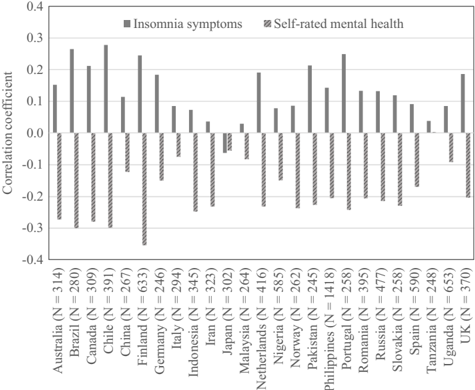
Climate change threatens mental health via increasing exposure to the social and economic disruptions created by extreme weather and large-scale climatic events, as well as through the anxiety associated with recognising the existential threat posed by the climate crisis. Considering the growing levels of climate change awareness across the world, negative emotions like anxiety and worry about climate-related risks are a potentially pervasive conduit for the adverse impacts of climate change on mental health. In this study, we examined how negative climate-related emotions relate to sleep and mental health among a diverse non-representative sample of individuals recruited from 25 countries, as well as a Norwegian nationally-representative sample. Overall, we found that negative climate-related emotions are positively associated with insomnia symptoms and negatively related to self-rated mental health in most countries. Our findings suggest that climate-related psychological stressors are significantly linked with mental health in many countries and draw attention to the need for cross-disciplinary research aimed at achieving rigorous empirical assessments of the unique challenge posed to mental health by negative emotional responses to climate change.
Overview
The claims and statistics of this paper haven’t been checked yet.
Free: it reads the open-access text and checks the first 5 claims that cite a source we can check. Create a free account to check every claim.
Integrity signals
Registry
Cites
Statistics
Figures
Verification
Claims the paper makes
The claims and statistics of this paper haven’t been checked yet.
Free: it reads the open-access text and checks the first 5 claims that cite a source we can check. Create a free account to check every claim.
Claims other papers make about this one
Each is checked against this paper’s own text: does it say what the citing paper says it does?
The source backs part of the claim, not all of it — or backs it for a different population, condition or comparison.
In the citing paper
“Investigations into anxiety about climate change have revealed that it is increasingly common for many people across the globe [9], with large-scale international studies identifying growing concern about climate change [10–12].”
From The relationship between climate change and mental health: a systematic review of the association between eco-anxiety, psychological distress, and symptoms of major affective disorders (2024) · cites this paper as [12]
Experimental — accuracy not yet measuredThe source backs part of the claim, not all of it — or backs it for a different population, condition or comparison.
In the citing paper
“Eco-anxiety has been considered to have conceptual overlap with Generalised Anxiety Disorder (GAD), with anticipatory worry representing a core feature of eco-anxiety [12, 75].”
From The relationship between climate change and mental health: a systematic review of the association between eco-anxiety, psychological distress, and symptoms of major affective disorders (2024) · cites this paper as [12]
Experimental — accuracy not yet measuredThe source backs part of the claim, not all of it — or backs it for a different population, condition or comparison.
In the citing paper
“and varied understandings and experiences of climate change have differing impacts on the relationship with mental health [10, 12].”
From The relationship between climate change and mental health: a systematic review of the association between eco-anxiety, psychological distress, and symptoms of major affective disorders (2024) · cites this paper as [12]
Experimental — accuracy not yet measuredThe cited source says what the claim attributes to it.
In the citing paper
“The consensus among mental health professionals is that most of these feelings and experiences represent adaptive responses and do not constitute a mental illness in themselves, although they might constitute a stressor that worsens mental health, and evidence published in 2021 links negative climate emotions to worsened mental health.16”
The cited source says what the claim attributes to it.
In the citing paper
“The consensus among mental health professionals is that most of these feelings and experiences represent adaptive responses and do not constitute a mental illness in themselves, although they might constitute a stressor that worsens mental health, and evidence published in 2021 links negative climate emotions to worsened mental health.16”
Self-check
Percentages, sums and reported differences re-computed from the paper’s own numbers.
The self-check needs the paper’s full text.
Citations
Cites
Back-translation for cross-cultural research.
Brislin, R. W. (1970) · Journal of Cross-Cultural Psychology · doi:10.1177/135910457000100301 · Cited by 14,091 · cited 1×
“In non-English speaking countries, the questionnaire was translated into local languages by competent bilingual speakers using the translation-back-translation method (Brislin, 1970).”
MethodState-Trait Anxiety Inventory for Adults
Spielberger, C. D. (2012) · PsycTESTS Dataset · doi:10.1037/t06496-000 · Cited by 3,479
Climate anxiety: Psychological responses to climate change
Clayton, S. (2020) · Journal of Anxiety Disorders · doi:10.1016/j.janxdis.2020.102263 · Cited by 1,409 · cited 2×
“Although climate change anxiety is not currently classified as a mental health disorder, dysregulated negative emotional responses to environmental problems can significantly impair individuals’ health and psychological functioning (Clayton, 2020).”
BackgroundEcological grief as a mental health response to climate change-related loss
Cunsolo, A., & Ellis, N. R. (2018) · Nature Climate Change · doi:10.1038/s41558-018-0092-2 · Cited by 1,408
Development and validation of a measure of climate change anxiety
Clayton, S., & Karazsia, B. T. (2020) · Journal of Environmental Psychology · doi:10.1016/j.jenvp.2020.101434 · Cited by 1,196 · cited 2×
“Although climate change anxiety is not currently classified as a mental health disorder, dysregulated negative emotional responses to environmental problems can significantly impair individuals’ health and psychological functioning (Clayton, 2020).”
BackgroundSleep and mental disorders: a meta-analysis of polysomnographic research
Baglioni, C., Nanovska, S., Regen, W., Spiegelhalder, K., Feige, B., Nissen, C., Reynolds, C. F., & Riemann, D. (2016) · Psychological Bulletin · doi:10.1037/bul0000053 · Cited by 1,074
The psychological impacts of global climate change
Doherty, T. J., & Clayton, S. (2011) · American Psychologist · doi:10.1037/a0023141 · Cited by 894
Sleep and emotions: a focus on insomnia
Baglioni, C., Spiegelhalder, K., Lombardo, C., & Riemann, D. (2010) · Sleep Medicine Reviews · doi:10.1016/j.smrv.2009.10.007 · Cited by 873
Schmidt, A., Ivanova, A., & Schäfer, M. S. (2013) · Global Environmental Change · doi:10.1016/j.gloenvcha.2013.07.020 · Cited by 753
Climate change and mental health: risks, impacts and priority actions
Hayes, K., Blashki, G., Wiseman, J., Burke, S., & Reifels, L. (2018) · International Journal of Mental Health Systems · doi:10.1186/s13033-018-0210-6 · Cited by 746
Research works printed but not linked: 2
- 10. Bednarek, S. (2019). Is there a therapy for climate change anxiety? Therapy Today, 30(5), 36-39.
- 18. Clayton, S., Manning, C., Krygsman, K., & Speiser, M. (2017). Mental health and our changing climate: impacts, implications and guidance. https://www.apa.org/news/press/releases/2017/03/ mental-health-climate.pdf
Cited by
Anxiety, worry, and grief in a time of environmental and climate crisis: a narrative review
Ojala, M., Cunsolo, A., Ogunbode, C. A., & Middleton, J. (2021) · Annual Review of Environment and Resources · doi:10.1146/annurev-environ-012220-022716 · Cited by 670
Self-citationThe role of insufficient sleep and circadian misalignment in obesity
Chaput, J.-P., McHill, A. W., Cox, R. C., Broussard, J. L., Dutil, C., da Costa, B. G. G., Sampasa-Kanyinga, H., & Wright, K. P. (2023) · Nature Reviews Endocrinology · doi:10.1038/s41574-022-00747-7 · Cited by 649
Ogunbode, C. A., Doran, R., Hanss, D., Ojala, M., Salmela-Aro, K., van den Broek, K. L., Bhullar, N., Aquino, S. D., Marot, T., Schermer, J. A., et al. (2022) · Journal of Environmental Psychology · doi:10.1016/j.jenvp.2022.101887 · Cited by 549
Self-citationCoffey, Y., Bhullar, N., Durkin, J., Islam, M. S., & Usher, K. (2021) · The Journal of Climate Change and Health · doi:10.1016/j.joclim.2021.100047 · Cited by 541
“In addition, research has suggested that people experiencing eco-anxiety also report negative emotional responses, such as distress and a sense of despair [12].”
BackgroundSelf-citationLawrance, E. L., Thompson, R., Newberry Le Vay, J., Page, L., & Jennings, N. (2022) · International Review of Psychiatry · doi:10.1080/09540261.2022.2128725 · Cited by 500
“Primarily these have been conducted in richer Western nations (UK, USA, Australia, Germany, Finland and Norway) (149,351,352,357,358) but a growing number of studies in low- and middle-income countries have taken place in recent years, including the Philippines (63), South Africa (360), India (60), and Tuvalu (361).”
BackgroundInfluentialThe Hogg Eco-Anxiety Scale: Development and validation of a multidimensional scale
Hogg, T. L., Stanley, S. K., O'Brien, L. V., Wilson, M. S., & Watsford, C. R. (2021) · Global Environmental Change · doi:10.1016/j.gloenvcha.2021.102391 · Cited by 465
Fear for the future: Eco-anxiety and health implications, a systematic review
Boluda-Verdú, I., Senent-Valero, M., Casas-Escolano, M., Matijasevich, A., & Pastor-Valero, M. (2022) · Journal of Environmental Psychology · doi:10.1016/j.jenvp.2022.101904 · Cited by 306
Health, Wellbeing and the Changing Structure of Communities
(2023) · Climate Change 2022 – Impacts, Adaptation and Vulnerability · doi:10.1017/9781009325844.009 · Cited by 294
Eco-anxiety: What it is and why it matters
Kurth, C., & Pihkala, P. (2022) · Frontiers in Psychology · doi:10.3389/fpsyg.2022.981814 · Cited by 289
“Moreover, closer examination of this work also reveals that only a small portion of individuals are experiencing clinical (or non-clinical, but high) levels of eco-anxiety (Berry and Peel, 2018; Clayton and Karazsia, 2020; Ogunbode et al., 2021; Wullenkord et al., 2021).”
BackgroundWamsler, C., Osberg, G., Osika, W., Herndersson, H., & Mundaca, L. (2021) · Global Environmental Change · doi:10.1016/j.gloenvcha.2021.102373 · Cited by 224
Climate change anxiety in China, India, Japan, and the United States
Tam, K.-P., Chan, H.-W., & Clayton, S. (2023) · Journal of Environmental Psychology · doi:10.1016/j.jenvp.2023.101991 · Cited by 152
Climate change‐related worry among Australian adolescents: an eight‐year longitudinal study
Sciberras, E., & Fernando, J. W. (2022) · Child and Adolescent Mental Health · doi:10.1111/camh.12521 · Cited by 139
Reyes, M. E. S., Carmen, B. P. B., Luminarias, M. E. P., Mangulabnan, S. A. N. B., & Ogunbode, C. A. (2023) · Current Psychology · doi:10.1007/s12144-021-02099-3 · Cited by 178
“For example, Ogunbode et al. (2021) found that negative emotional responses to climate change correlate negatively with mental health and positively with insomnia symptoms.”
BackgroundSelf-citationMaran, D. A., & Begotti, T. (2021) · International Journal of Environmental Research and Public Health · doi:10.3390/ijerph18179358 · Cited by 168
“[13] showed that mental health and psycho-social well-being can be influenced both directly, for example, through life experiences related to extreme weather events or natural disasters, and indirectly, through exposure to climate change news.”
BackgroundSelf-citationEmotions and transformative learning for sustainability: a systematic review
Grund, J., Singer‐Brodowski, M., & Büssing, A. G. (2023) · Sustainability Science · doi:10.1007/s11625-023-01439-5 · Cited by 169
“For example, exposure to sustainability crises can lead to strong emotional responses that may also affect mental health in the long term (Burke et al. 2018; Lund et al. 2018), even when people are not yet directly affected (Ogunbode et al. 2021).”
Climate anxiety: Conceptual considerations, and connections with climate hope and action
Sangervo, J., Jylhä, K. M., & Pihkala, P. (2022) · Global Environmental Change · doi:10.1016/j.gloenvcha.2022.102569 · Cited by 159
Lass‐Hennemann, J., Sopp, M. R., Ruf, N., Equit, M., Schäfer, S. K., Wirth, B. E., & Michael, T. (2023) · European Child & Adolescent Psychiatry · doi:10.1007/s00787-023-02300-x · Cited by 146
Cosh, S. M., Ryan, R., Fallander, K., Robinson, K., Tognela, J., Tully, P. J., & Lykins, A. D. (2024) · BMC Psychiatry · doi:10.1186/s12888-024-06274-1 · Cited by 138
Age differences and profiles in pro-environmental behavior and eco-emotions
Ágoston, C., Balázs, B., Mónus, F., & Varga, A. (2024) · International Journal of Behavioral Development · doi:10.1177/01650254231222436 · Cited by 134
“There is a growing literature on climate change–related emotions (Ogunbode et al., 2023; Pihkala, 2022), especially climate change anxiety (Ágoston, Csaba, et al., 2022; Ágoston, Urbán, et al., 2022; Clayton, 2020; Pihkala, 2020), which is a nonspecific worry or fear of environmental doom (Pihkala,…”
BackgroundLawrance, E. L., Jennings, N., Kioupi, V., Thompson, R., Diffey, J., & Vercammen, A. (2022) · The Lancet Planetary Health · doi:10.1016/s2542-5196(22)00172-3 · Cited by 123
Hogg, T. L., Stanley, S. K., O’Brien, L. V., Watsford, C. R., & Walker, I. A. (2024) · Journal of Environmental Psychology · doi:10.1016/j.jenvp.2024.102249 · Cited by 119
Ecological anxiety and pro-environmental behaviour: The role of attention
Mathers-Jones, J., & Todd, J. (2023) · Journal of Anxiety Disorders · doi:10.1016/j.janxdis.2023.102745 · Cited by 116
Ramadan, R., Randell, A., Lavoie, S., Gao, C. X., Manrique, P. C., Anderson, R., McDowell, C., & Zbukvic, I. (2023) · Early Intervention in Psychiatry · doi:10.1111/eip.13374 · Cited by 76
“Five studies included a range of different negative emotions such as anger, stress, sadness and boredom (Hickman et al., 2021; MacDonald et al., 2015; Ogunbode et al., 2021; Scafuto, 2021; Searle & Gow, 2010; Stevenson & Peterson, 2015), while one investigated self-described feelings (Strife, 2012).”
BackgroundInfluentialSimon, P. D., Pakingan, K. A., & Aruta, J. J. B. R. (2022) · Educational and Developmental Psychologist · doi:10.1080/20590776.2022.2037390 · Cited by 84
“Emerging evidence for the potential impacts of the climate crisis on mental health (Ogunbode et al., 2021; Palinkas & Wong, 2020) necessitates the use of a tool that could measure climate change anxiety.”
BackgroundWullenkord, M. C., & Ojala, M. (2023) · Journal of Environmental Psychology · doi:10.1016/j.jenvp.2023.102093 · Cited by 105
Ojala, M. (2022) · European Journal of Developmental Psychology · doi:10.1080/17405629.2022.2108396 · Cited by 108
“In addition, a study involving emerging adults in different countries found positive associations between climate distress and sleeping problems (Ogunbode et al., 2021).”
BackgroundResultMarczak, M., Winkowska, M., Chaton-Østlie, K., Morote, R., & Klöckner, C. A. (2023) · Emotion, space and society · doi:10.1016/j.emospa.2023.100939 · Cited by 97
Kałwak, W., & Weihgold, V. (2022) · Frontiers in Psychology · doi:10.3389/fpsyg.2022.823620 · Cited by 66
“…to study these issues in a contextualized way to prevent colonization of knowledge by Global North’s perspective is answered, among other researchers, by Verónica Iniguez-Gallardo and her colleagues in Ecuador (Martiskainen et al., 2020; Iniguez-Gallardo et al., 2021; Ogunbode et al., 2021).”
ResultA network approach to climate change anxiety and its key related features
Heeren, A., Mouguiama-Daouda, C., & McNally, R. J. (2023) · Journal of Anxiety Disorders · doi:10.1016/j.janxdis.2022.102625 · Cited by 88
A meta-analysis on the relationship between climate anxiety and wellbeing
Gago, T., Sargisson, R. J., & Milfont, T. L. (2024) · Journal of Environmental Psychology · doi:10.1016/j.jenvp.2024.102230 · Cited by 87
The role of education in promoting circular economy
Tiippana-Usvasalo, M., Pajunen, N., & Maria, H. (2023) · International Journal of Sustainable Engineering · doi:10.1080/19397038.2023.2210592 · Cited by 86
Psychometric properties of the climate change anxiety scale
Cruz, S. M., & High, A. C. (2022) · Journal of Environmental Psychology · doi:10.1016/j.jenvp.2022.101905 · Cited by 82
Martin, G., Cosma, A. P., Roswell, T., Anderson, M. P., Treble, M., Leslie, K., Card, K. G., Closson, K., Kennedy, A. M., & Gislason, M. (2023) · Social Science & Medicine · doi:10.1016/j.socscimed.2023.116008 · Cited by 79
Overbury, K., Conroy, B. W., & Marks, E. M. (2023) · Journal of Environmental Psychology · doi:10.1016/j.jenvp.2023.102073 · Cited by 77
Parmentier, M.-L., Weiss, K., Aroua, A., Betry, C., Rivière, M., & Navarro, O. (2024) · Journal of Anxiety Disorders · doi:10.1016/j.janxdis.2023.102799 · Cited by 73
Climate anxiety does not need a diagnosis of a mental health disorder
Bhullar, N., Davis, M., Kumar, R., Nunn, P., & Rickwood, D. (2022) · The Lancet Planetary Health · doi:10.1016/s2542-5196(22)00072-9 · Cited by 56
Self-citationThompson, R., Fisher, H. L., Dewa, L. H., Hussain, T., Kabba, Z., & Toledano, M. B. (2021) · Child and Adolescent Mental Health · doi:10.1111/camh.12520 · Cited by 69
Veijonaho, S., Ojala, M., Hietajärvi, L., & Salmela‐Aro, K. (2023) · International Journal of Behavioral Development · doi:10.1177/01650254231205251 · Cited by 68
“A growing number of studies with adults have made it evident that climate change distress is associated with poorer mental health (Ogunbode et al., 2021; Stanley et al., 2021).”
BackgroundSelf-citationEco-anxiety and climate-anxiety linked to indirect exposure: A scoping review of empirical research
Jarrett, J. A., Gauthier, S., Baden, D. A., Ainsworth, B., & Dorey, L. (2024) · Journal of Environmental Psychology · doi:10.1016/j.jenvp.2024.102326 · Cited by 66
Rocchi, G., Pileri, J., Luciani, F., Gennaro, A., & Lai, C. (2023) · Journal of Environmental Psychology · doi:10.1016/j.jenvp.2023.102180 · Cited by 64
Climate Change and Mental Health
Clayton, S., & Crandon, T. (2024) · Annual Review of Clinical Psychology · doi:10.1146/annurev-clinpsy-081423-025932 · Cited by 57
Predicting climate change anxiety
Asgarizadeh, Z., Gifford, R., & Colborne, L. (2023) · Journal of Environmental Psychology · doi:10.1016/j.jenvp.2023.102087 · Cited by 56
Galway, L. P., Beery, T. H., Buse, C. G., & Gislason, M. (2021) · Climate · doi:10.3390/cli9100146 · Cited by 57
“Although climate worry is an appropriate response when one understands, witnesses, and/or experiences climate change via C2NP, and, as we find, an activating emotion when associated with C2NP, climate worry may also become paralyzing and/or pathological leading to psychological distress and impacts on health and well-…”
BackgroundClimate Change and Emotions: Analysis of People’s Emotional States in Southern Ecuador
Iñiguez-Gallardo, V., Boero, D. L., & Tzanopoulos, J. (2021) · Frontiers in Psychology · doi:10.3389/fpsyg.2021.644240 · Cited by 58
“Other types of studies draw conclusions from cross-national samples to analyse the impact of negative emotions on mental health (Ogunbode et al., 2021), or provide a profound analysis of the indirect psychological impacts of global warming by linking a considerable range of emotions to climate…”
BackgroundHuang, W., Chen, B., & Hu, C. (2025) · Frontiers in Public Health · doi:10.3389/fpubh.2025.1663474 · Cited by 52
Heinzel, S., Tschorn, M., Schulte-Hutner, M., Schäfer, F., Reese, G., Pohle, C., Peter, F., Neuber, M., Liu, S., Keller, J., et al. (2023) · Frontiers in Psychology · doi:10.3389/fpsyg.2023.1239425 · Cited by 50
“This is in line with prior work reporting weak to moderate but consistent positive associations between negative eco-emotions and poor mental health (Stanley et al., 2021; Stewart, 2021; Ogunbode et al., 2023).”
BackgroundResultValidation of the Climate Change Anxiety Scale for Korean Adults
Jang, S. J., Chung, S. J., & Lee, H. (2023) · Perspectives In Psychiatric Care · doi:10.1155/2023/9718834 · Cited by 51
Vrselja, I., Pandžić, M., Rihtarić, M. L., & Ojala, M. (2024) · BMC Psychology · doi:10.1186/s40359-024-01771-0 · Cited by 53
“Climate anxiety has been linked to depressive symptoms as well as reduced mental health and psychological well-being [61–65].”
BackgroundResultWu, J., Long, D., Hafez, N., Maloney, J., Lim, Y., & Samji, H. (2023) · International Journal of Mental Health Nursing · doi:10.1111/inm.13201 · Cited by 49
Sumeldan, J. D. C., Richter, I., Avillanosa, A. L., Bacosa, H. P., Creencia, L. A., & Pahl, S. (2021) · Frontiers in Psychology · doi:10.3389/fpsyg.2021.661810 · Cited by 47
Exploring Climate Emotions in Canada’s Provincial North
Galway, L. P., & Beery, T. H. (2022) · Frontiers in Psychology · doi:10.3389/fpsyg.2022.920313 · Cited by 50
Zaremba, D., Kulesza, M., Herman, A. M., Marczak, M., Kossowski, B., Budziszewska, M., Michałowski, J. M., Klöckner, C. A., Marchewka, A., & Wierzba, M. (2022) · Current Psychology · doi:10.1007/s12144-022-03807-3 · Cited by 47
“The main focus of the psychological research on climate change concern is its potential impacts on mental health and wellbeing (Clayton, 2020; Cunsolo & Ellis, 2018; Ogunbode et al., 2021; Ojala et al., 2021).”
BackgroundVay, J. N. L., Cunningham, A., Soul, L. C., Dave, H., Hoath, L., & Lawrance, E. L. (2024) · Frontiers in Psychology · doi:10.3389/fpsyg.2023.1298623 · Cited by 50
Climate change anxiety and pro-environmental behaviours: disentangling gender disparities
Pinho, M. (2025) · Frontiers in Sociology · doi:10.3389/fsoc.2025.1589501 · Cited by 45
Testing an integrated model of climate change anxiety
Chan, H., Tam, K., & Clayton, S. (2024) · Journal of Environmental Psychology · doi:10.1016/j.jenvp.2024.102368 · Cited by 45
Nursing students’ mental health: How does eco‐anxiety effect?
Er, S., Murat, M., Ata, E. E., Köse, S., & Buzlu, S. (2024) · International Journal of Mental Health Nursing · doi:10.1111/inm.13320 · Cited by 42
Introduction and behavioral validation of the climate change distress and impairment scale
Hepp, J., Klein, S. A., Horsten, L. K., Urbild, J., & Lane, S. P. (2023) · Scientific Reports · doi:10.1038/s41598-023-37573-4 · Cited by 41
Jalin, H., Sapin, A., Macherey, A., Boudoukha, A. H., & Congard, A. (2024) · Current Psychology · doi:10.1007/s12144-024-06098-y · Cited by 41
“For this reason, it is also sometimes referred to as state anxiety, i.e. as an anxious manifestation delimited in time, associated with a specific source of danger, in this case the ecological crisis (Materia, 2016; Ogunbode et al., 2021).”
Towards a unified conceptual framework of eco-anxiety: mapping eco-anxiety through a scoping review
Boivin, M., Gousse-Lessard, A.-S., & Legris, N. H. (2025) · Cogent Mental Health · doi:10.1080/28324765.2025.2490524 · Cited by 42
“Furthermore, the media have a tendency to emphasize negative outcomes of climate change, such as environmental destruction and human vulnerability, offering limited perspective, nuance, or actionable solutions (du Bray et al., 2017; Ogunbode et al., 2021; To et al., 2021).”
Marczak, M., Wierzba, M., Kossowski, B., Marchewka, A., Morote, R., & Klöckner, C. A. (2024) · Frontiers in Psychology · doi:10.3389/fpsyg.2024.1211272 · Cited by 40
Psychological impact of climate change emergency: an attempt to define eco-anxiety
Orrù, L., & Mannarini, S. (2024) · Frontiers in Psychology · doi:10.3389/fpsyg.2024.1375803 · Cited by 36
Ogunbode, C. A. (2022) · doi:10.31219/osf.io/yn6tc · Cited by 34
Self-citationZeier, P., & Wessa, M. (2024) · Discover Sustainability · doi:10.1007/s43621-024-00209-2 · Cited by 34
“Accordingly, high levels of negative climate-related emotions were associated with insomnia and worse overall mental health [13].”
InfluentialVergunst, F., Prentice, C. M., Orri, M., Berry, H. L., Paquin, V., Vitaro, F., Tremblay, R. E., Côté, S. M., & Geoffroy, M. (2024) · Climatic Change · doi:10.1007/s10584-024-03807-1 · Cited by 34
“Indeed, several multi-national surveys of young people indicate that negative emotions about climate change are associated with self-reported distress, insomnia, and reduced wellbeing (Hickman et al. 2021; Lawrance et al. 2022; Ogunbode et al. 2021, 2022; Sciberras and Fernando 2022).”
The impact of climate change on eating disorders: An urgent call for research
Rodgers, R. F., Paxton, S. J., Nagata, J. M., & Becker, A. E. (2022) · International Journal of Eating Disorders · doi:10.1002/eat.23876 · Cited by 34
Regnoli, G. M., Tiano, G., & Rosa, B. D. (2024) · Climate · doi:10.3390/cli12080118 · Cited by 32
“Considering the recent literature on the topic that has confirmed the effect of climate change on mental health [13–15, 21, These objectives were pursued through multiple mediation analyses consisting of parallel and serial mediation models.”
BackgroundCosh, S., Williams, S. E., Lykins, A. D., Bartik, W. J., & Tully, P. J. (2024) · BMC Psychology · doi:10.1186/s40359-024-02240-4 · Cited by 35
“Climate change anxiety refers to the anticipatory anxiety experienced due to awareness of the threats posed by climate change [7] and can be understood as “the chronic fear of environmental doom” ([8], p.17).”
Climate anxiety in the Philippines: Current situation, potential pathways, and ways forward
Aruta, J. J. B. R., & Guinto, R. (2022) · The Journal of Climate Change and Health · doi:10.1016/j.joclim.2022.100138 · Cited by 32
Rethinking ecoanxiety through environmental moral distress: an ethics reflection
Banwell, N., & Eggert, N. (2023) · The Journal of Climate Change and Health · doi:10.1016/j.joclim.2023.100283 · Cited by 32
Chan, H., Li, L., Tam, K., & Hong, Y. (2024) · Journal of Anxiety Disorders · doi:10.1016/j.janxdis.2024.102917 · Cited by 29
Maran, D. A., Butt, M., & Begotti, T. (2023) · SAGE Open · doi:10.1177/21582440231207444 · Cited by 29
“In addition, we did not consider climate change consequences such as eco-anxiety and eco-worry (Innocenti et al., 2023, Ogunbode et al., 2021) and media exposure (Maran & Begotti, 2021): many people know about climate change because they receive information indirectly through the media.”
BackgroundSelf-citationPublic Health Aspects of Climate Change Adaptation in Three Cities: A Qualitative Study
Macassa, G., Ribeiro, A. I., Marttila, A., Stål, F., Silva, J. P., Rydback, M., Rashid, M., & Barros, H. (2022) · International Journal of Environmental Research and Public Health · doi:10.3390/ijerph191610292 · Cited by 29
“In another study, carried out in 25 countries across the world, it was found that “negative climate-related emotions were positively associated with insomnia symptoms and negatively related to self-rated mental health in most countries” [38].”
BackgroundLau, S. S. S., Fong, J. W. L., van Rijsbergen, N. J., McGuire, L., Ho, C. C. Y., Cheng, M. C. H., & Tse, D. (2024) · The Lancet Planetary Health · doi:10.1016/s2542-5196(24)00097-4 · Cited by 30
Veijonaho, S., Hietajärvi, L., Ojala, M., & Salmela‐Aro, K. (2025) · Journal of Environmental Psychology · doi:10.1016/j.jenvp.2025.102676 · Cited by 29
Self-citationPark, J., van den Broek, K. L., Bhullar, N., Ogunbode, C. A., Schermer, J. A., Doran, R., Ardi, R., Hanss, D., Maran, D. A., Albzour, M., et al. (2022) · Personality and Individual Differences · doi:10.1016/j.paid.2022.111751 · Cited by 28
Self-citationOwczarek, M., Redican, E., Shevlin, M. E., & Nolan, E. (2025) · Current Psychology · doi:10.1007/s12144-025-07519-2 · Cited by 26
“Ogunbode et al., 2021 0.72–0.92 Negative climate-related emotions are positively associated with insomnia symptoms and negatively related to self-rated mental health.”
InfluentialMartin, G., Roswell, T., & Cosma, A. P. (2024) · Wellbeing Space and Society · doi:10.1016/j.wss.2024.100198 · Cited by 28
Eco-anxiety: an additional burden for university students?
Tavolacci, M., & Ladner, J. (2024) · European Journal of Public Health · doi:10.1093/eurpub/ckae144.1352 · Cited by 25
Climate Anxiety and Mental Health in Germany
Hajek, A., & König, H.-H. (2023) · Climate · doi:10.3390/cli11080158 · Cited by 24
Zeier, P., Lange, F., Rowland, Z., Wessa, M., & Wenzel, M. (2025) · Journal of Environmental Psychology · doi:10.1016/j.jenvp.2025.102575 · Cited by 24
Croasdale, K., Grailey, K., Jennings, N., Mole, J., & Lawrance, E. L. (2023) · The Journal of Climate Change and Health · doi:10.1016/j.joclim.2023.100253 · Cited by 16
Climate change on the brain: Neural correlates of climate anxiety
Carlson, J. M., Foley, J., & Fang, L. (2024) · Journal of Anxiety Disorders · doi:10.1016/j.janxdis.2024.102848 · Cited by 25
Predictors and correlates of self-reported climate anxiety in the United States
Kricorian, K., Kricorian, C., & Turner, K. (2025) · PLOS Climate · doi:10.1371/journal.pclm.0000534 · Cited by 24
Maduneme, E., & Cohen, A. S. (2024) · Environment and Behavior · doi:10.1177/00139165241286874 · Cited by 24
“Research has also established that negative emotional induction and 'doom and gloom’ narratives about climate change can be effective in promoting action by arousing fear and anxiety (Maduneme, 2024; Ogunbode et al., 2023; Tannenbaum et al., 2015).”
Attitudes towards global warming: The role of anticipated guilt and the Dark Triad traits
Pitiruţ, I.-B., Ogunbode, C. A., & Enea, V. (2021) · Personality and Individual Differences · doi:10.1016/j.paid.2021.111285 · Cited by 23
Self-citationThe effect of climate change on depression in urban areas of western Iran
Abbasi, H. (2021) · BMC Research Notes · doi:10.1186/s13104-021-05565-0 · Cited by 21
“Regression method has been used in the studies such as [3, 13, 19, 20].”
MethodGebhardt, N., Schwaab, L., Friederich, H.-C., & Nikendei, C. (2023) · Frontiers in Psychiatry · doi:10.3389/fpsyt.2023.1274523 · Cited by 20
“So far, there have been preliminary findings suggesting climate change related mental health impairments through functional impairment, symptoms of depression, anxiety, PTSD, stress, and insomnia (19, 20).”
BackgroundClimate change anxiety positively predicts antenatal distress in expectant female parents
Lykins, A. D., Bonich, M., Sundaraja, C., & Cosh, S. (2024) · Journal of Anxiety Disorders · doi:10.1016/j.janxdis.2023.102801 · Cited by 20
A systematic review of climate emotions and mental health in adults
Pitt, C., Norris, K., & Pecl, G. (2023) · Global Environmental Psychology · doi:10.5964/gep.11405 · Cited by 20
“Additionally, several studies used traditional mental health measures that were spe cifically adapted to focus on climate change (Gago & Sá, 2021; Ogunbode et al., 2023; Schwaab et al., 2022).”
BackgroundInfluentialEnvironmental psychology in the Philippines: Growth, challenges and prospects
Aruta, J. J. B. R. (2023) · International Journal of Psychology · doi:10.1002/ijop.12896 · Cited by 20
INTELLIGENT MUSIC APPLICATIONS: INNOVATIVE SOLUTIONS FOR MUSICIANS AND LISTENERS
TABAK, C. (2023) · Uluslararası Anadolu Sosyal Bilimler Dergisi · doi:10.47525/ulasbid.1324070 · Cited by 20
Climate Change and Youth Mental Health: Multidisciplinary Perspectives
Clayton, S., Crandon, T., Pihkala, P., Haase, E., Vergunst, F., Berry, H. L., Lee, J., Guerrero, A., Caballero, A. V., Lewis, J. L., et al. (2024) · Cambridge University Press eBooks · doi:10.1017/9781009252904 · Cited by 20
Çimşir, E., Şahin, M. D., & Akdoğan, R. (2024) · Cambridge Prisms Global Mental Health · doi:10.1017/gmh.2024.20 · Cited by 19
“…(Hogg et al., 2021), while also supporting previous research suggesting that while certain unfavorable environmental emotions may be strong indicators of decreased mental health, others may be weak yet still reliable (Ogunbode et al., 2023; Ojala et al., 2021; Stanley et al., 2021; Stewart, 2021).”
ResultMental Health and Our Changing Climate: Impacts, Inequities, Responses (2021 Edition)
Clayton, S., Manning, C., Hill, A. N., & Speiser, M. (2023) · Issue Lab (Candid) · Cited by 19
Impact of extreme weather events on mental health among older adults in China: A longitudinal study
Guo, M., Zheng, J., Zhang, J., Li, J., Wang, Q., & Lai, D. W. L. (2025) · Sustainable Cities and Society · doi:10.1016/j.scs.2025.106580 · Cited by 17
Assessing Eco-Anxiety with a mixed method: Creation and Validation of a three dimensions scale.
Jalin, H., Chandès, C., Boudoukha, A. H., Jacob, A., Poinsot, R., & Congard, A. (2023) · European Review of Applied Psychology · doi:10.1016/j.erap.2024.101010 · Cited by 17
Ge, J., Pan, W., Liang, X., & Zhang, J. (2025) · BMC Public Health · doi:10.1186/s12889-025-23282-2 · Cited by 17
“Numerous studies have linked CCAn to mental health issues such as depression, stress, anxiety and insomnia [55].”
Climate change anxiety and sleep problems in the older adults
Yazıcı, H. G., Ökten, Ç., & Akhan, L. U. (2025) · Aging & Mental Health · doi:10.1080/13607863.2025.2452937 · Cited by 16
“In a study conducted with more than ten thousand participants from 25 countries, it was reported that in most of the countries participating in the survey (72%), individuals who experienced negative mood about climate change experienced insomnia (Ogunbode et al., 2023).”
Mental Health and Climate Change. The Birth of Eco-Anxiety in the Spanish-Language Press
Gómez, I. J., Prieto, J. G., & Martín‐Sosa, S. (2022) · Tripodos · doi:10.51698/tripodos.2022.52p13-33 · Cited by 16
Climate Anxiety in Perspective: A Look at Dominant Stressors in Youth Mental Health and Sleep
Ogunbode, C. A., Player, L., Lu, S., Park, M. S., & Doran, R. (2025) · Annals of the New York Academy of Sciences · doi:10.1111/nyas.70057 · Cited by 15
“Furthermore, sleep disturbance could be used as a transcultural diagnostic of poor mental health that is less susceptible, than other common self-report mental health measures, to culturally biased interpretations by diverse research participants [52].”
Self-citation
Metadata
- Authors
- Ogunbode, C. A., Pallesen, S., Böhm, G., Doran, R., Bhullar, N., Aquino, S., Marot, T., Schermer, J. A., Wlodarczyk, A., Lu, S., Jiang, F., Salmela-Aro, K., Hanss, D., Maran, D. A., Ardi, R., Chegeni, R., Tahir, H., Ghanbarian, E., Park, J., Tsubakita, T., Tan, C.-S., van den Broek, K. L., Chukwuorji, J. C., Ojewumi, K., Reyes, M. E. S., Lins, S., Enea, V., Volkodav, T., Sollar, T., Navarro-Carrillo, G., Torres-Marín, J., Mbungu, W., Onyutha, C., & Lomas, M. J.
- Affiliations
- University of Nottingham (GB)
- University of Bergen (NO)
- University of Inland Norway (NO)
- University of New England (AU)
- Pontifícia Universidade Católica do Rio de Janeiro (BR)
- Western University (CA)
- De Montfort University (GB)
- Central University of Finance and Economics (CN)
- Darmstadt University of Applied Sciences (DE)
- University of Turin (IT)
- Universitas Airlangga (ID)
- University of Tehran (IR)
- Nagoya University of Commerce and Business (JP)
- Universiti Tunku Abdul Rahman (MY)
- University of Nigeria (NG)
- Adekunle Ajasin University (NG)
- University of Santo Tomas (PH)
- Universidade do Porto (PT)
- Alexandru Ioan Cuza University (RO)
- Kuban State University (RU)
- Sokoine University of Agriculture (TZ)
- Kyambogo University (UG)
- University of Salford (GB)
- Corresponding author
- Ogunbode, Charles Adedayo
- ORCID
- Ogunbode, Charles Adedayo
- Pallesen, Ståle
- Böhm, Gisela
- Doran, Rouven
- Bhullar, Navjot
- Aquino, Sibele
- Marot, Tiago
- Schermer, Julie Aitken
- Lu, Su
- Jiang, Feng
- Hanss, Daniel
- Maran, Daniela Acquadro
- Ardi, Rahkman
- Chegeni, Razieh
- Tahir, Hajra
- Ghanbarian, Elahe
- Park, Joonha
- Tsubakita, Takashi
- Tan, Chee-Seng
- Chukwuorji, JohnBosco Chika
- Reyes, Marc Eric S.
- Lins, Samuel
- Enea, Violeta
- Volkodav, Tatiana
- Mbungu, Winfred
- Onyutha, Charles
- Lomas, Michael J.
- Venue
- Current Psychology
- Published
- 2021-02-16
- Volume
- 42
- Issue
- 2
- Pages
- 845-854
- ISSN
- 1046-1310 (ISSN-L)
- 1936-4733
- OpenAlex
- W3130421427
- Semantic Scholar
- f7470d5b3ec578ca3f33fe9fd4c68e8d2be6c95d
- Cited by
- 255
- References
- 46
- Citations by year
- 2026: 40 · 2025: 71 · 2024: 62 · 2023: 39 · 2022: 28 · 2021: 15
- FWCI
- 49.87
- Type
- journal article
- Language
- en
- Open access
- hybrid
- doi.org
- Licence
- cc-by
- creativecommons.org/licenses/by/4.0 (tdm)
- creativecommons.org/licenses/by/4.0 (vor)
- Locations
- Current Psychology (publishedVersion, cc-by)
- Repository@Nottingham (University of Nottingham) (publishedVersion, cc-by)
- Universitas Airlangga Repository (Universitas Airlangga) (acceptedVersion)
- Repository@Nottingham (University of Nottingham) (submittedVersion, cc-by)
- Institutional Research Information System University of Turin (University of Turin) (submittedVersion, cc-by)
- University of Salford Institutional Repository (University of Salford) (submittedVersion, cc-by)
- Scholarship@Western (Western University) (submittedVersion, cc-by)
- Zenodo (CERN European Organization for Nuclear Research) (submittedVersion, cc-by)
- Charles Sturt University Research Output (CRO) (submittedVersion, cc-by)
- NORA - Norwegian Open Research Archives (submittedVersion, cc-by)
- Institutional Repository of the University of Granada (University of Granada) (submittedVersion, cc-by)
- Utrecht University Repository (Utrecht University) (submittedVersion, other-oa)
- Työväentutkimus Vuosikirja (submittedVersion)
- Scholarship@Western (Western University) (submittedVersion)
- Portuguese National Funding Agency for Science, Research and Technology (RCAAP Project by FCT) (submittedVersion, other-oa)
- RUNE (Research UNE) (submittedVersion, cc-by)
- Greater South Information System
- Funders
- Japan Society for the Promotion of Science (20KK0056)
- Topics
- Social Sciences › Sociology and Political Science › Climate Change Communication and Perception
- Physical Sciences › Environmental Science › Health, Toxicology and Mutagenesis › Climate Change and Health Impacts
- Social Sciences › Psychology › Clinical Psychology › COVID-19 and Mental Health
- Keywords
- climate change, negative emotions, climate anxiety, insomnia, sleep, mental health, psychological stressors, cross-national comparison
About these checks
Registry, retraction, Cites and statistics results are computed, not judged, with one exception: a printed reference that no index lists is read once by a model before it counts as a citation error. Claims are extracted by a model and kept only when their quote appears verbatim in the text; each cited source is then checked, with a model’s help, for whether it says what the claim relies on. Those verdicts can be wrong — read the claim’s quote and the cited source before relying on one.
Statistics and arithmetic are recomputed, not judged.
Confidence bands are shown only for fields calibrated on our annotated test set. None is calibrated yet, so no band is shown.
What counts as a claim ›How we measure confidence ›How we check this ›
Are you an author, or do you see a problem with this page? Request a review
Data sources
Bibliographic data: Semantic Scholar, OpenAlex, Crossref.
Contains information from the Semantic Scholar Academic Graph Datasets, made available under the ODC Attribution License (ODC-BY 1.0).
Semantic Scholar’s data is described in: Kinney, R., et al. (2023). The Semantic Scholar Open Data Platform. arXiv:2301.10140.
