

The role of emotion regulation and intolerance to uncertainty on the relationship between fear of COVID-19 and distress
Open accessThe DOI matches its Crossref record; 48 of the 48 references it cites were found in a registry or an index.
Abstract
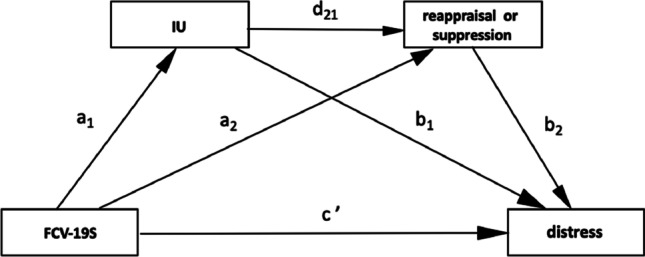
The COVID-19 pandemic is increasing negative consequences on mental health around the globe. To date, research on what psychological factors could influence individuals’ distress is still scarce. The current study aims to test a multiple mediation model to examine the role of Intolerance of Uncertainty (IU) and emotional regulation (i.e., expressive suppression and cognitive reappraisal) as joint factors, which can increase understanding of psychological distress due to the COVID-19 outbreak. An online survey measuring fear of COVID-19, IU, emotional regulation, and psychological distress was administered to 3863 Italian adults (females 73.3%; Mage = 36.44; SD = 14.74) during lockdown. Results showed that IU partially mediated the effect of fear of COVID-19 on depression, anxiety and stress. Moreover, individuals with difficulties in managing the uncertainties due to their fear of COVID-19 may be at risk for heightened use of expressive suppression and depression. However, individuals with both higher IU and expressive suppression showed lower level of stress. High cognitive reappraisal has a mediational effect on the relationship between fear of COVID-19, IU, and lower psychological distress. Findings suggest that IU and emotional regulation should be targeted for informing the development of tailored treatments to reduce the negative consequences of the outbreak.
Overview
The claims and statistics of this paper haven’t been checked yet.
Free: it reads the open-access text and checks the first 5 claims that cite a source we can check. Create a free account to check every claim.
Integrity signals
Registry
Cites
Statistics
Figures
Verification
Claims the paper makes
The claims and statistics of this paper haven’t been checked yet.
Free: it reads the open-access text and checks the first 5 claims that cite a source we can check. Create a free account to check every claim.
Self-check
Percentages, sums and reported differences re-computed from the paper’s own numbers.
The self-check needs the paper’s full text.
Citations
Cites
Lovibond, P. F., & Lovibond, S. H. (1995) · Behaviour Research and Therapy · doi:10.1016/0005-7967(94)00075-u · Cited by 14,523
Gross, J. J., & John, O. P. (2003) · Journal of Personality and Social Psychology · doi:10.1037/0022-3514.85.2.348 · Cited by 11,929
SPSS for Windows Step by Step: A Simple Guide and Reference
Mallery, P., & George, D. (1998) · Cited by 10,394
Wang, C., Pan, R., Wan, X., Tan, Y., Xu, L., Ho, C. S., & Ho, R. C. (2020) · International Journal of Environmental Research and Public Health · doi:10.3390/ijerph17051729 · Cited by 9,923
Emotion-regulation strategies across psychopathology: A meta-analytic review
Aldao, A., Nolen-Hoeksema, S., & Schweizer, S. (2010) · Clinical Psychology Review · doi:10.1016/j.cpr.2009.11.004 · Cited by 6,686
The psychological impact of the COVID-19 epidemic on college students in China
Cao, W., Fang, Z., Hou, G., Han, M., Xu, X., Dong, J., & Zheng, J. (2020) · Psychiatry Research · doi:10.1016/j.psychres.2020.112934 · Cited by 5,843
Holmes, E. A., O'Connor, R. C., Perry, V. H., Tracey, I., Wessely, S., Arseneault, L., Ballard, C., Christensen, H., Cohen Silver, R., Everall, I., et al. (2020) · The Lancet Psychiatry · doi:10.1016/s2215-0366(20)30168-1 · Cited by 5,715
Impact of COVID-19 pandemic on mental health in the general population: a systematic review
Xiong, J., Lipsitz, O., Nasri, F., Lui, L. M. W., Gill, H., Phan, L., Chen-Li, D., Iacobucci, M., Ho, R., Majeed, A., et al. (2020) · Journal of Affective Disorders · doi:10.1016/j.jad.2020.08.001 · Cited by 5,204
The Fear of COVID-19 Scale: Development and Initial Validation
Ahorsu, D. K., Lin, C.-Y., Imani, V., Saffari, M., Griffiths, M. D., & Pakpour, A. H. (2022) · International Journal of Mental Health and Addiction · doi:10.1007/s11469-020-00270-8 · Cited by 4,332 · cited 4×
“, 2020), by providing information about the negative impact that emergency alert and restriction measures had on the individual’s psychosocial well-being (Ahorsu et al., 2020).”
BackgroundInfluentialFearing the unknown: A short version of the Intolerance of Uncertainty Scale
Carleton, R. N., Norton, M. A. P. J., & Asmundson, G. J. G. (2007) · Journal of Anxiety Disorders · doi:10.1016/j.janxdis.2006.03.014 · Cited by 2,288
Research works printed but not linked: 2
- Gross, J. J. (Ed.). (2014). Handbook of emotion regulation (2nd ed.). Guilford Publications.
- Hayes, A. F. (2013). Methodology in the social sciences. Introduction to mediation, moderation, and conditional process analysis: A regression-based approach. Guilford Publications.
Cited by
Intolerance of uncertainty and emotion regulation: A meta-analytic and systematic review
Sahib, A., Chen, J., Cárdenas, D., & Calear, A. L. (2023) · Clinical Psychology Review · doi:10.1016/j.cpr.2023.102270 · Cited by 102
Gender Differences in Coping and Psychological Adaptation during the COVID-19 Pandemic
Cholankeril, R., Xiang, E., & Badr, H. (2023) · International Journal of Environmental Research and Public Health · doi:10.3390/ijerph20020993 · Cited by 91
“Indeed, in previous studies, the use of acceptance under circumstances involving acute stress (such as the pandemic) has been shown to be significantly related to lower levels of psychological distress [60,61].”
BackgroundEmotion regulation and mental health across cultures: a systematic review and meta-analysis
Chen, S., Cai, Q., Omari, D. I., Sanghvi, D. E., Lyu, S., & Bonanno, G. A. (2025) · Nature Human Behaviour · doi:10.1038/s41562-025-02168-8 · Cited by 73
Godara, M., Everaert, J., Sánchez-López, Á., Joormann, J., & Raedt, R. D. (2023) · Scientific Reports · doi:10.1038/s41598-023-36211-3 · Cited by 39
Regnoli, G. M., Tiano, G., & Rosa, B. D. (2024) · European Journal of Investigation in Health Psychology and Education · doi:10.3390/ejihpe14060121 · Cited by 37
Regnoli, G. M., Tiano, G., & De Rosa, B. (2024) · European Journal of Investigation in Health, Psychology and Education · doi:10.3390/ejihpe14040054 · Cited by 33
“Gullo et al. [61] recently investigated this construct in relation to the pandemic trauma, highlighting that Intolerance of Uncertainty partially mediated between fear of contagion and anxiety, depression, and stress, resulting in a vulnerability factor in coping with the pandemic.”
BackgroundResultRegnoli, G. M., Tiano, G., & Rosa, B. D. (2024) · Climate · doi:10.3390/cli12080118 · Cited by 32
“…revealing the association between climate change, feelings of uncertainty, fear, and anxiety about the future in other cultural contexts [35,47,48,65,67] and from theoretical models and studies reporting the impact of Uncertainty of Intolerance and Future Anxiety on mental health [40,44,50,69,70].”
BackgroundRuan, Q.-N., Chen, C.-M., Yang, J.-S., Yan, W., & Huang, Z. (2023) · Frontiers in Psychiatry · doi:10.3389/fpsyt.2023.1230807 · Cited by 34
Ran, M., Wang, C., Cai, J., Deng, Z.-Y., Mu, Y.-F., Huang, Y., Zhang, W., Song, H.-J., Deng, A.-P., Qiu, C., et al. (2023) · Journal of Affective Disorders · doi:10.1016/j.jad.2023.12.009 · Cited by 27
Haver, A., Krampe, H., Danbolt, L. J., Stålsett, G., & Schnell, T. (2023) · Frontiers in Psychology · doi:10.3389/fpsyg.2023.1121986 · Cited by 21
“, 2022), as well as emotion regulation abilities (Xu et al., 2020; Liang et al., 2021; Ye et al., 2021; Gullo et al., 2022; Vertsberger et al., 2022).”
BackgroundResultWang, D., Cao, D., & Kiani, A. (2024) · Current Psychology · doi:10.1007/s12144-023-04331-8 · Cited by 19
“…with the well-documented research on the protective role of cognitive reap-praisal (Boyes et al., 2016), but also add to the extant literature on how cognitive reappraisal helps mitigate the effects of the ongoing pandemic on psychological well-being (Gullo et al., 2022; Ye et al., 2022b).”
InfluentialKestler‐Peleg, M., Stenger, V., Lavenda, O., Bendett, H., Alhalel-Lederman, S., Maayan‐Metzger, A., & Strauss, T. (2022) · Children · doi:10.3390/children9121958 · Cited by 14
“This finding is consistent with previous studies that examined the relationship between intolerance to uncertainty and psychological distress in other populations and stressful situations [51,52].”
ResultDorčić, T. M., Živčić–Bećirević, I., & Smojver‐Ažić, S. (2023) · European Journal of Psychology Open · doi:10.1024/2673-8627/a000035 · Cited by 12
Xiao, J., Liu, L., Peng, Y.-M., Lyu, X., Xing, C., Tao, Y., Zhu, S., Mai, A., Liang, L., Hu, H., et al. (2025) · BMC Nursing · doi:10.1186/s12912-025-02851-1 · Cited by 7
“The Intolerance of Uncertainty Scale (IUS) is a self-assessment instrument designed to measure intolerance of uncertainty using 12 items with a 5-point Likert scale [27].”
Almeida, B., Silva, S., & Cunha, C. A. C. (2025) · Counselling and Psychotherapy Research · doi:10.1002/capr.70014 · Cited by 6
Influencing Factors and Impact of Emotion Regulation
Shi, B. (2024) · Lecture Notes in Education Psychology and Public Media · doi:10.54254/2753-7048/50/20240932 · Cited by 5
Sammer-Schreckenthaler, S., Lagetto, G., Unterrainer, H., & Gelo, O. C. G. (2025) · Frontiers in Psychology · doi:10.3389/fpsyg.2025.1525849 · Cited by 4
Self-citationGelo, O. C. G., & Podolan, M. (2025) · European Psychologist · doi:10.1027/1016-9040/a000574 · Cited by 3
Self-citationTølbøll, M., Østergaard, T., Nogueira, D., Cunha, C., Soares, J., Venuleo, C., Gelo, O., Marinaci, T., Anchía, R. J., Larripa, J. G., et al. (2022) · Comillas Repository (Comillas Pontifical University) · Cited by 3
AĞIR, B. (2025) · The Journal of Social Sciences · doi:10.29228/sobider.79874 · Cited by 2
The role of uncertainty in earthquake fear and well-being among seafarers
Toygar, A. (2025) · Work · doi:10.1177/10519815251346460 · Cited by 2
“30 Gullo et al. 31 reported a mediating role of IoU in depression, anxiety, and stress induced by EFs.”
Giordano, F., Guidotti, S., Salerno, C., Pruneti, C. A., & Gelo, O. C. G. (2025) · Research in Psychotherapy Psychopathology Process and Outcome · doi:10.4081/ripppo.2025.867 · Cited by 2
Self-citationKaya, B., Sarpkaya, A., & Önder, F. C. (2025) · Türk Psikolojik Danışma ve Rehberlik Dergisi · doi:10.17066/tpdrd.1533628 · Cited by 2
“Existing studies reported the mediating role of IU in the association between the fear of COVID-19 and psychological distress (Gullo et al., 2022; He et al., 2021).”
Du, F., Tan, M., Luo, L., Li, S., & Wei, X. (2026) · Frontiers in Public Health · doi:10.3389/fpubh.2026.1805252 · Cited by 2
“Under extreme stress situations, it may serve a short-term protective function by temporarily blocking emotional expression and helping individuals focus cognitive resources on urgent tasks (50).”
Albushoke, M., & Sepehrianazar, F. (2023) · Nursing and Midwifery Journal · doi:10.61186/unmf.21.5.343 · Cited by 2
Pan, C., & Wang, D. (2024) · Asia Pacific Journal of Education · doi:10.1080/02188791.2024.2379500 · Cited by 1
“In the context of the spread of the COVID-19 pandemic, proper emotional regulation is critical to individuals ‘s physical and mental health (Gullo et al., 2022; Morelli et al., 2021).”
Ego depletion increases risk-taking: evidence from the COVID-19 pandemic context
Wang, K., Zhao, P., & Liu, C. (2025) · The Journal of Social Psychology · doi:10.1080/00224545.2025.2591070 · Cited by 1
“The multifaceted nature of the COVID-19 pandemic contributes to a high level of uncertainty among individuals, including concerns about the severity of the disease, fear of infection, worries about lockdowns, as well as mistrust in government interventions (Gullo et al., 2022).”
Akyıl, Y., Sarı, N., & Erdinç, B. (2025) · Sinop Üniversitesi Sosyal Bilimler Dergisi · doi:10.30561/sinopusd.1628217 · Cited by 1
Baltacı, U. B., Teke, E., & Avşaroğlu, S. (2026) · Erzincan Üniversitesi Eğitim Fakültesi Dergisi · doi:10.17556/erziefd.1713192 · Cited by 1
Passeggia, R., & Esposito, G. (2026) · Current Psychology · doi:10.1007/s12144-026-09117-2 · Cited by 1
“Research on the general population (Gullo et al., 2023) underlined that lockdown represented a catalyst for psychological distress, that reached clinical cutoffs.”
Self-citationBais, S. S. (2026) · International Journal of Interdisciplinary Approaches in Psychology · doi:10.61113/ijiap.v4i3.1317 · Cited by 1
“Other studies indicate that adaptive emotion regulation strategies can reduce psychological distress associated with uncertainty (Godara et al., 2023; Gullo et al., 2023).”
Predicting and Moderating COVID-Fear and Stress among College Students in Argentina and the USA
Rice, K. G., Arana, F., Wetstone, H., Aiello, M., & Durán, B. (2023) · International Journal of Environmental Research and Public Health · doi:10.3390/ijerph20156510 · Cited by 1
“found that Intolerance of Uncertainty (IU) partially mediated the effect of COVID-fear on depression, stress, and anxiety, and individuals with high IU and expressive suppression showed lower levels of stress [28].”
BackgroundNazlıgül, M. D., & Yılmaz, A. E. (2023) · International Journal of Sport and Exercise Psychology · doi:10.1080/1612197x.2023.2247001 · Cited by 1
Medo da covid-19 e sofrimento psicológico: o efeito mediador da “infoxicação” durante a pandemia
da Cunha, L. R. L., Santos, L. B., dos Santos, Z. C., Couto, R. N., da Silva, P. G. N., de Medeiros, É. D., Labap-Laboratório de Avaliação Psicológica e Psicometria do Piauí, P., Labap-Laboratório de Avaliação Psicológica e Psicometria do Piauí, P., Labap-Laboratório de Avaliação Psicológica e Psicometria do Piauí, P., Labap-Laboratório de Avaliação Psicológica e Psicometria do Piauí, P., et al. (2023) · Suma Psicológica · doi:10.14349/sumapsi.2023.v30.n1.6
Coping with Life Stress, volume II
Libin, A. V., Libin, E. V., Penk, W. E., & Shara, N. (2024) · Frontiers research topics · doi:10.3389/978-2-8325-4462-4
ÖZDEMİR, H. D. (2024) · Turkiye Klinikleri Journal of Health Sciences · doi:10.5336/healthsci.2023-99015
Denson, N., Dunn, K. M., Kamp, A., Ben, J., Pitman, D., Sharples, R., Lim, G., Paradies, Y., & McGarty, C. (2024) · Journal of Clinical Medicine · doi:10.3390/jcm13247495 · Cited by 1
Siddique, M., Shinde, S., & Inamke, R. (2024) · Springer eBooks · doi:10.1007/978-3-658-39493-6_1
Palmieri, A., Picone, V. C., Gennaro, A., Ruffin, D., Capuani, V., & Kleinbub, J. R. (2025) · Clinical Psychology & Psychotherapy · doi:10.1002/cpp.70073
“…of the use of the PIRS and other coding systems based on verbal transcripts could utilise a method of analysis that has already been used in Colli, Gagliardini, and Gullo (2022) and is increasingly adopted in clinical psychology (e.g., Gullo et al. 2023), that is, multiple mediation analysis.”
Tuna, E., Koçak, H., Sayınta, S., & Gürül, B. (2023) · Nesne Psikoloji Dergisi · doi:10.7816/nesne-11-30-02
Hosseini, S. K., Fard, R. J., & Talebzadeh, M. (2024) · Quarterly of Experimental and Cognitive Psychology · doi:10.61838/qecp.90
Intolerance of Uncertainty in the Relationship between Self-regulation and Social Media Addiction
Kocabıyık, O. O. (2025) · Addicta The Turkish Journal on Addictions · doi:10.5152/addicta.2025.25448
Morbach, A. C. B., Lagetto, G., & Gelo, O. C. G. (2025) · Psychotherapy Research · doi:10.1080/10503307.2025.2592953
“Moreover, such studies should employ longitudinal and multiple mediation designs (e.g., Gelo & Manzo, 2015; Gullo et al., 2022; Salvatore et al., 2009).”
Self-citationZhang, T., Wu, D., Tang, Y., Zhao, G., Lu, Y., & Wang, S. (2025) · Frontiers in Psychiatry · doi:10.3389/fpsyt.2025.1643375
“The fear of COVID-19 might exert its impact on distress through external factors, such as disruptions in lifestyle and leisure restrictions (42), and through psychological characteristics such as expressive suppression, cognitive reappraisal, and intolerance of uncertainty (43).”
The Role of Emotion Regulation in the Context of Intolerance Uncertainty
Sahib, A. (2025) · ANU Open Research (Australian National University) · doi:10.25911/j5r3-vq11
Huamani Blas, A. J., & Robles Arguedas, M. C. (2024) · Repositorio Académico UPC (Universidad Peruana de Ciencias Aplicadas) · doi:10.19083/tesis/673441
El Ghetany, H. H. (2023) · Brunel University Research Archive (BURA) (Brunel University London)
Fear of covid-19 in the Chilean population: predictors and future direction
Figueroa, I., Landa, C., Pardo, L., Martin, M. C. S., Míguez, G., Laborda, M. A., & Scholz, V. Q. (2024) · Cuadernos de neuropsicología
Prediction of Scrupulosity from Impulsivity, Religiosity, and Other Personal Characteristics
Chahine, J. K. (2025) · Deep Blue (University of Michigan) · doi:10.7302/28300
Marinić, I., Skorić, L., Buljan, T., Milošević, D., & Marinić, L. M. (2025) · Archives of Psychiatry Research · doi:10.20471/dec.2025.61.03.02
Sizorina, A. (2026) · ScholarWorks (Walden University)
Kırıkkanat, B., & Vapurlu, S. (2026) · International Journal of Applied Positive Psychology · doi:10.1007/s41042-025-00270-w
“Most studies (Freeston & Komes, 2023; Gullo et al., 2022; Holaway et al., 2006; Ladouceur et al., 2000; Wilson et al.,(Wilson, et al., 2023)) indicate that high IOU levels are related to low MWB levels.”
Lei, J., Huang, Z., & Deng, Y. (2026) · Science & Education · doi:10.1007/s11191-026-00737-5
Esposito, G., Passeggia, R., Cannata, A., & Freda, M. F. (2026) · Healthcare · doi:10.3390/healthcare14121776
“…is not necessarily a sign of dysfunction in emotion regulation, but a useful strategy that could act as a protective factor against severe distress; thus, it could help to manage the distress, especially in specific situations and notwithstanding the predominant use of cognitive reappraisal [75].”
Self-citationÖzdemir, H. D., Karaca, S. N., & Özbay, A. (2026) · Journal of Health Psychology · doi:10.1177/13591053261502618
Metadata
- Authors
- Gullo, S., Gelo, O. C. G., Bassi, G., Lo Coco, G., Lagetto, G., Esposito, G., Pazzagli, C., Salcuni, S., Freda, M. F., Mazzeschi, C., Giordano, C., & Di Blasi, M.
- Affiliations
- University of Palermo (IT)
- Sigmund Freud Privatuniversität Wien (AT)
- University of Padua (IT)
- University of Salento (IT)
- University of Naples Federico II (IT)
- University of Perugia (IT)
- Corresponding author
- Gullo, Salvatore
- ORCID
- Venue
- Current Psychology
- Published
- 2022-04-25
- Volume
- 42
- Issue
- 23
- Pages
- 19658-19669
- ISSN
- 1046-1310 (ISSN-L)
- 1936-4733
- PMC
- PMC9037968
- OpenAlex
- W4224309832
- Cited by
- 38
- References
- 48
- Citations by year
- 2026: 6 · 2025: 13 · 2024: 7 · 2023: 11 · 2022: 1
- FWCI
- 7.31
- Type
- journal article
- Language
- en
- Open access
- hybrid
- doi.org
- Licence
- cc-by
- creativecommons.org/licenses/by/4.0 (tdm)
- creativecommons.org/licenses/by/4.0 (vor)
- Locations
- Current Psychology (publishedVersion, cc-by)
- PubMed Central (publishedVersion, cc-by)
- PubMed (publishedVersion)
- Nova Science Publishers (Nova Science Publishers, Inc.) (submittedVersion, cc-by)
- AIRUS (submittedVersion, cc-by)
- IRIS Research product catalog (Sapienza University of Rome) (submittedVersion)
- Padua Research Archive (University of Padova) (submittedVersion, cc-by)
- Funders
- Università degli Studi di Palermo
- Topics
- Social Sciences › Psychology › Clinical Psychology › COVID-19 and Mental Health
- Social Sciences › Psychology › Experimental and Cognitive Psychology › Anxiety, Depression, Psychometrics, Treatment, Cognitive Processes
- Social Sciences › Psychology › Clinical Psychology › Child and Adolescent Psychosocial and Emotional Development
- Keywords
- COVID-19 pandemic, fear of COVID-19, intolerance of uncertainty, emotion regulation, expressive suppression, cognitive reappraisal, psychological distress, depression, anxiety, stress, lockdown, mediation
About these checks
Registry, retraction, Cites and statistics results are computed, not judged, with one exception: a printed reference that no index lists is read once by a model before it counts as a citation error. Claims are extracted by a model and kept only when their quote appears verbatim in the text; each cited source is then checked, with a model’s help, for whether it says what the claim relies on. Those verdicts can be wrong — read the claim’s quote and the cited source before relying on one.
Statistics and arithmetic are recomputed, not judged.
Confidence bands are shown only for fields calibrated on our annotated test set. None is calibrated yet, so no band is shown.
What counts as a claim ›How we measure confidence ›How we check this ›
Are you an author, or do you see a problem with this page? Request a review
Data sources
Bibliographic data: Semantic Scholar, OpenAlex, Crossref.
Contains information from the Semantic Scholar Academic Graph Datasets, made available under the ODC Attribution License (ODC-BY 1.0).
Semantic Scholar’s data is described in: Kinney, R., et al. (2023). The Semantic Scholar Open Data Platform. arXiv:2301.10140.
