

The DOI matches its Crossref record; 44 of the 44 references it cites were found in a registry or an index.
Social media: a digital social mirror for identity development during adolescence
Open accessAbstract
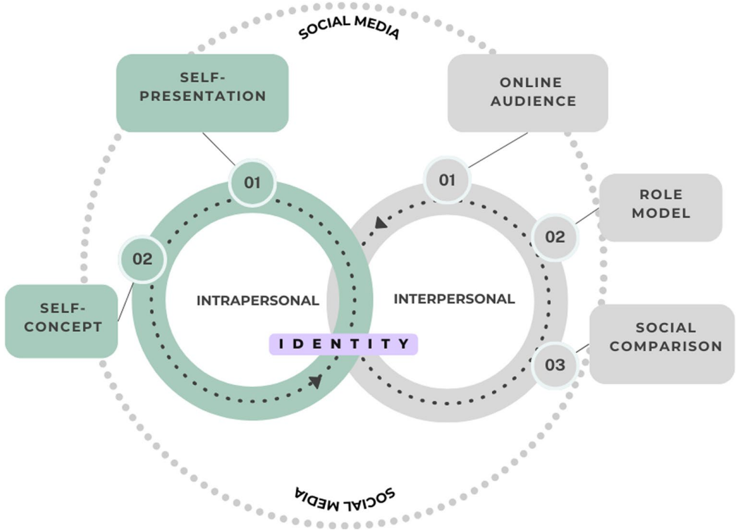
Abstract According to recent studies, social media are settings where adolescents construct their identities while engaging in social interactions. In digital spaces, adolescents can interact with, display, and receive feedback about themselves, contributing to the development of a clear and integrated sense of self. This paper reviews the available empirical evidence and discusses four overarching themes related to identity construction in social media: self-presentation (attempting to control images of self to others), social comparison (compare themselves with others, especially evaluating the self), role model (media figures that are social references for behavior), and online audience (friends, peers, unknow/know referents with whom users may interact online). Moreover, it proposes a new contextual perspective on identity development on social media. Informed by research on these themes that social media features allow adolescents to perform self-presentations, offering the opportunity to express interests, ideas, and beliefs about themselves (identification and role exploration). The image presented on social media exposes them to feedback, online audiences, and social comparison with peers or social models. Audiences have an impact on how adolescents think about themselves (self-concept validation). Role models can facilitate the learning of behaviors through imitation and identification (exploration and commitment). Thus, the digital world provides a context for the development of adolescents’ personal identity. This proposal aims to contribute to the construction of future theories on identity in social media and advance this area of research.
Overview
The claims and statistics of this paper haven’t been checked yet.
Run the check — free, no account needed. It reads the open-access text and checks the sources it cites.
Integrity signals
Registry
Cites
Statistics
Figures

Verification
Claims the paper makes
The claims and statistics of this paper haven’t been checked yet.
Run the check — free, no account needed. It reads the open-access text and checks the sources it cites.
Claims other papers make about this one
Each is checked against this paper’s own text: does it say what the citing paper says it does?
The check wasn’t confident either way, so it gives no verdict — never disputed.
In the citing paper
“The way that SI involves social roles enhances undergraduate students’ PU within the context of using technology [66].”
From Advancing Undergraduate Student Mental Healthcare of Social Anxiety Disorder: Evaluating the Acceptance of AR-Assisted Cognitive Behavioral Therapy Through TAM-Based Constructs. (2026) · cites this paper as [66]
Experimental — accuracy not yet measured
Self-check
Percentages, sums and reported differences re-computed from the paper’s own numbers.
The self-check needs the paper’s full text.
Citations
Cites
A theory of social comparison processes
Festinger, L. (1954) · Human Relations · doi:10.1177/001872675400700202 · Cited by 20,926 · cited 3×
“Social comparison can be upward when others are considered better or in better condition, or downward when the people we compare ourselves to are seen as worse (Festinger, 1954 ).”
Influential(1968) · Medical Entomology and Zoology · Cited by 15,136
I tweet honestly, I tweet passionately: Twitter users, context collapse, and the imagined audience
Marwick, A. E., & boyd, D. (2011) · New Media & Society · doi:10.1177/1461444810365313 · Cited by 4,612
Social Cognitive Theory of Mass Communication
Bandura, A. (2001) · Media Psychology · doi:10.1207/s1532785xmep0303_03 · Cited by 3,942
Elkind, D. (1967) · Child Development · doi:10.2307/1127100 · Cited by 1,551 · cited 2×
“In early adolescence, there is an increase focus on the self (Elkind, 1967), and adolescents are highly sensitive to peer feedback.”
Self-esteem and clarity of the self-concept.
Campbell, J. D. (1990) · Journal of Personality and Social Psychology · doi:10.1037/0022-3514.59.3.538 · Cited by 1,381 · cited 2×
“An indicator that identity develops properly is the presence of self-con - cept clarity, a coherent and consistent description of one - self (Campbell, 1990), which in social networks involves exploring and experimenting with different ways of being until achieving this integrated self-concept.”
Crocetti, E., Rubini, M., & Meeus, W. (2007) · Journal of Adolescence · doi:10.1016/j.adolescence.2007.09.002 · Cited by 834
Dynamics of Identity Development in Adolescence: A Decade in Review
Branje, S., de Moor, E. L., Spitzer, J., & Becht, A. I. (2021) · Journal of Research on Adolescence · doi:10.1111/jora.12678 · Cited by 584 · cited 5×
“…on how social media influences the dynamics of identity construction, especially how it relates to the processes of commitment, in-depth exploration, and the maintenance or reconsideration of those commitments (Branje et al., 2021 ; Crocetti, 2017 ; Crocetti et al., 2008 ; Noon et al., 2023).”
InfluentialSocial comparison on social networking sites
Verduyn, P., Gugushvili, N., Massar, K., Täht, K., & Kross, E. (2020) · Current Opinion in Psychology · doi:10.1016/j.copsyc.2020.04.002 · Cited by 500 · cited 2×
“Social comparison in social networks is a relevant and frequent process because of the characteristics of these media, in which more importance is given to idealized publications about themselves (Verduyn et al., 2020 ).”
Harter, S. (1999) · Cited by 477
Research works printed but not linked: 3
- Marcia, J. (1980). Identity in adolescence. In J. Adelson (Ed.), Handbook of adolescent psychology (pp. 159–187). Wiley.
- Schlenker, B. (2003). Self-presentation. In M. R. Leary, & J. P. Tangney (Eds.), Handbook of self and identity (pp. 492–518). Guilford.
- Swann, W. B. Jr. (1983). Self-verification: Bringing social reality into harmony with the self. Social psychological perspectives on the self. In J. Suls, & A. G. Greenwald (Eds.), Psychological perspectives on the self (Vol. 2, pp. 33–66). Erlbaum.
Cited by
Sorted by citations
Roberts, J. A., & David, M. E. (2025) · Cyberpsychology Behavior and Social Networking · doi:10.1089/cyber.2024.0338 · Cited by 57
AI companions and adolescent social relationships: Benefits, risks, and bidirectional influences
Sun, X., Wang, Y., & McDaniel, B. T. (2026) · Child Development Perspectives · doi:10.1093/cdpers/aadaf009 · Cited by 47
Phubbing and its impact on the individual's psychological well-being
Garrido, E. C., Delgado, S. C., & Esteban, P. G. (2024) · Acta Psychologica · doi:10.1016/j.actpsy.2024.104388 · Cited by 43
Guo, J., & Chai, R. (2024) · Frontiers in Psychology · doi:10.3389/fpsyg.2024.1509636 · Cited by 31
Fayyaz, M. S., Abbasi, A. Z., Kumar, S., Qureshi, A., Hussain, K., & Muhammad, L. (2025) · Journal of Retailing and Consumer Services · doi:10.1016/j.jretconser.2025.104309 · Cited by 36
Metadata
- Authors
- Pérez-Torres, V.
- Affiliations
- Universidad Rey Juan Carlos (ES)
- Corresponding author
- Pérez-Torres, Vanesa
- ORCID
- Pérez-Torres, Vanesa
- Venue
- Current Psychology
- Published
- 2024-04-24
- Volume
- 43
- Issue
- 26
- Pages
- 22170-22180
- ISSN
- 1046-1310 (ISSN-L)
- 1936-4733
- OpenAlex
- W4395075462
- Semantic Scholar
- df9ff32304ed9305d259c81fe3790757d1ae6719
- Cited by
- 147
- References
- 44
- Citations by year
- 2026: 89 · 2025: 50 · 2024: 8
- FWCI
- 105.88
- Type
- journal article
- Language
- en
- Open access
- hybrid
- doi.org
- Locations
- Current Psychology (publishedVersion, cc-by)
- BURJC Digital (King Juan Carlos University) (submittedVersion, cc-by)
- Hispana (submittedVersion, cc-by)
- Funders
- Universidad Rey Juan Carlos
- Topics
- Social Sciences › Sociology and Political Science › Impact of Technology on Adolescents
- Social Sciences › Communication › Media and Digital Communication
- Social Sciences › Psychology › Developmental and Educational Psychology › Identity, Memory, and Therapy
- Keywords
- social media, identity construction, adolescence, self-presentation, social comparison, role models, online audiences, identification, imitation
About these checks
Registry, retraction, Cites and statistics results are computed, not judged, with one exception: a printed reference that no index lists is read once by a model before it counts as a citation error. Claims are extracted by a model and kept only when their quote appears verbatim in the text; each cited source is then checked, with a model’s help, for whether it says what the claim relies on. Those verdicts can be wrong — read the claim’s quote and the cited source before relying on one.
Statistics and arithmetic are recomputed, not judged.
Confidence bands are shown only for fields calibrated on our annotated test set. None is calibrated yet, so no band is shown.
What counts as a claim ›How we measure confidence ›How we check this ›
Are you an author, or do you see a problem with this page? Request a review
