

The DOI matches its Crossref record; 44 of the 44 references it cites were found in a registry or an index.
Social media: a digital social mirror for identity development during adolescence
Open accessAbstract
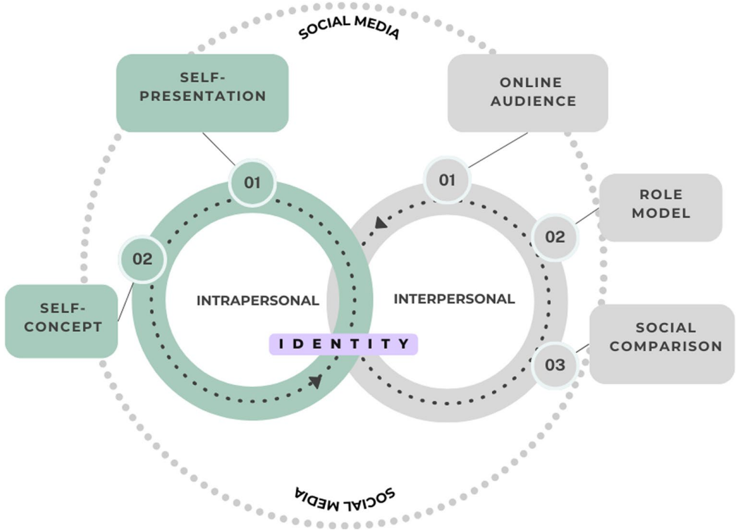
Abstract According to recent studies, social media are settings where adolescents construct their identities while engaging in social interactions. In digital spaces, adolescents can interact with, display, and receive feedback about themselves, contributing to the development of a clear and integrated sense of self. This paper reviews the available empirical evidence and discusses four overarching themes related to identity construction in social media: self-presentation (attempting to control images of self to others), social comparison (compare themselves with others, especially evaluating the self), role model (media figures that are social references for behavior), and online audience (friends, peers, unknow/know referents with whom users may interact online). Moreover, it proposes a new contextual perspective on identity development on social media. Informed by research on these themes that social media features allow adolescents to perform self-presentations, offering the opportunity to express interests, ideas, and beliefs about themselves (identification and role exploration). The image presented on social media exposes them to feedback, online audiences, and social comparison with peers or social models. Audiences have an impact on how adolescents think about themselves (self-concept validation). Role models can facilitate the learning of behaviors through imitation and identification (exploration and commitment). Thus, the digital world provides a context for the development of adolescents’ personal identity. This proposal aims to contribute to the construction of future theories on identity in social media and advance this area of research.
Overview
The claims and statistics of this paper haven’t been checked yet.
Run the check — free, no account needed. It reads the open-access text and checks the sources it cites.
Integrity signals
Registry
Cites
Statistics
Figures

Verification
Claims the paper makes
The claims and statistics of this paper haven’t been checked yet.
Run the check — free, no account needed. It reads the open-access text and checks the sources it cites.
Claims other papers make about this one
Each is checked against this paper’s own text: does it say what the citing paper says it does?
The check wasn’t confident either way, so it gives no verdict — never disputed.
In the citing paper
“The way that SI involves social roles enhances undergraduate students’ PU within the context of using technology [66].”
From Advancing Undergraduate Student Mental Healthcare of Social Anxiety Disorder: Evaluating the Acceptance of AR-Assisted Cognitive Behavioral Therapy Through TAM-Based Constructs. (2026) · cites this paper as [66]
Experimental — accuracy not yet measured
Self-check
Percentages, sums and reported differences re-computed from the paper’s own numbers.
The self-check needs the paper’s full text.
Citations
Cites
A theory of social comparison processes
Festinger, L. (1954) · Human Relations · doi:10.1177/001872675400700202 · Cited by 20,926 · cited 3×
“Social comparison can be upward when others are considered better or in better condition, or downward when the people we compare ourselves to are seen as worse (Festinger, 1954 ).”
Influential(1968) · Medical Entomology and Zoology · Cited by 15,136
I tweet honestly, I tweet passionately: Twitter users, context collapse, and the imagined audience
Marwick, A. E., & boyd, D. (2011) · New Media & Society · doi:10.1177/1461444810365313 · Cited by 4,612
Social Cognitive Theory of Mass Communication
Bandura, A. (2001) · Media Psychology · doi:10.1207/s1532785xmep0303_03 · Cited by 3,942
Elkind, D. (1967) · Child Development · doi:10.2307/1127100 · Cited by 1,551 · cited 2×
“In early adolescence, there is an increase focus on the self (Elkind, 1967), and adolescents are highly sensitive to peer feedback.”
Self-esteem and clarity of the self-concept.
Campbell, J. D. (1990) · Journal of Personality and Social Psychology · doi:10.1037/0022-3514.59.3.538 · Cited by 1,381 · cited 2×
“An indicator that identity develops properly is the presence of self-con - cept clarity, a coherent and consistent description of one - self (Campbell, 1990), which in social networks involves exploring and experimenting with different ways of being until achieving this integrated self-concept.”
Crocetti, E., Rubini, M., & Meeus, W. (2007) · Journal of Adolescence · doi:10.1016/j.adolescence.2007.09.002 · Cited by 834
Dynamics of Identity Development in Adolescence: A Decade in Review
Branje, S., de Moor, E. L., Spitzer, J., & Becht, A. I. (2021) · Journal of Research on Adolescence · doi:10.1111/jora.12678 · Cited by 584 · cited 5×
“…on how social media influences the dynamics of identity construction, especially how it relates to the processes of commitment, in-depth exploration, and the maintenance or reconsideration of those commitments (Branje et al., 2021 ; Crocetti, 2017 ; Crocetti et al., 2008 ; Noon et al., 2023).”
InfluentialSocial comparison on social networking sites
Verduyn, P., Gugushvili, N., Massar, K., Täht, K., & Kross, E. (2020) · Current Opinion in Psychology · doi:10.1016/j.copsyc.2020.04.002 · Cited by 500 · cited 2×
“Social comparison in social networks is a relevant and frequent process because of the characteristics of these media, in which more importance is given to idealized publications about themselves (Verduyn et al., 2020 ).”
Harter, S. (1999) · Cited by 477
Fardouly, J., Willburger, B. K., & Vartanian, L. R. (2018) · New Media & Society · doi:10.1177/1461444817694499 · Cited by 421 · cited 2×
“In ideal identification, influencers have some attributes that the person would like to have or aspire to have, related to the (Fardouly et al., 2018 ).”
Social Media and Body Image: Recent Trends and Future Directions
Vandenbosch, L., Fardouly, J., & Tiggemann, M. (2022) · Current Opinion in Psychology · doi:10.1016/j.copsyc.2021.12.002 · Cited by 403 · cited 3×
“Social networks usually offer unrealistic skinny or mus - cular models or celebrities with an ideal body image that is virtually unattainable and may result in a negative self– image (de Lenne et al., 2020 ; Vandenbosch et al., 2022).”
Social media use and well-being: What we know and what we need to know
Valkenburg, P. M. (2022) · Current Opinion in Psychology · doi:10.1016/j.copsyc.2021.12.006 · Cited by 373
Identity formation in adolescence: the dynamic of forming and consolidating identity commitments
Crocetti, E. (2017) · Child Development Perspectives · doi:10.1111/cdep.12226 · Cited by 331 · cited 3×
“Ado-lescents in the identity formation period consider various alternatives (exploration process), maintain, and reinforce their chosen commitments (maintenance stage), or revise their decisions in a dynamic cycle (Crocetti, 2017 ; Crocetti et al., 2008 ; Crocetti & Meeus, 2015 ).”
Parasocial relationships, social media, & well-being
Hoffner, C. A., & Bond, B. J. (2022) · Current Opinion in Psychology · doi:10.1016/j.copsyc.2022.101306 · Cited by 254 · cited 20×
“Therefore, parasocial relationships with these influencers are based on virtual rela - tionships, considered «real» by viewers though one-sided (Hoffner & Bond, 2022 ).”
InfluentialSchreurs, L., & Vandenbosch, L. (2020) · Journal of Children and Media · doi:10.1080/17482798.2020.1809481 · Cited by 230 · cited 3×
“…types of self-presentation and strive to create a positive image of themselves on social media (positivity bias) because they have a strong tendency to compare themselves with their peers and need peer acceptance (Schreurs & Vandenbosch, 2021 ), which is essential in the construction of identity.”
Feltman, C. E., & Szymanski, D. M. (2017) · Sex Roles · doi:10.1007/s11199-017-0796-1 · Cited by 226
Berger, M. N., Taba, M., Marino, J. L., Lim, M. S. C., & Skinner, S. R. (2022) · Journal of Medical Internet Research · doi:10.2196/38449 · Cited by 226 · cited 3×
“Both macro and micro influencers on social media repre - sent a social model of behavior, especially in the adolescent stage (Berger et al., 2022).”
InfluentialSelf-Presentation Theory: Self-Construction and Audience Pleasing
Baumeister, R. F., & Hutton, D. G. (1987) · Springer eBooks · doi:10.1007/978-1-4612-4634-3_4 · Cited by 211 · cited 1×
“Self-presentation is a behavior that attempts to transmit information about oneself or an image of oneself to other people, is activated by the evaluative presence of other peo - ple (Baumeister & Hutton, 1987 ), and plays a relevant role in identity development (Yang et al., 2018).”
Self-Presentation in Social Media: Review and Research Opportunities
Erin E., H., & Kent State University, U. (2021) · Review of Communication Research · doi:10.12840/issn.2255-4165.027 · Cited by 193 · cited 8×
“Additionally, audience feedback about self-presentation on social media contributes to shaping self-concept and identity through multiple social interactions (Hollenbaugh, 2021 ; Meier & Johnson, 2022).”
InfluentialSocial comparison and envy on social media: a critical review
Meier, A., & Johnson, B. K. (2022) · Current Opinion in Psychology · doi:10.1016/j.copsyc.2022.101302 · Cited by 176
Cingel, D. P., Carter, M. C., & Krause, H.-V. (2022) · Current Opinion in Psychology · doi:10.1016/j.copsyc.2022.101304 · Cited by 174 · cited 5×
“In digital spaces, adolescents can interact, display, and receive feedback about themselves, immedi - ately contributing to the formation of their self-concept and exploration of their identity (Cingel et al., 2022 ; Shankl - eman et al., 2021).”
InfluentialLajnef, K. (2023) · Current Psychology · doi:10.1007/s12144-023-04273-1 · Cited by 174 · cited 19×
“Recent studies have suggested that social media is a scenario of identity construction in which adolescents socialize (Lajnef, 2023 ; Meier & Johnson, 2022 ; Shankleman et al., 2021 ;Valken - burg, 2022).”
InfluentialWhen every day is a high school reunion: Social media comparisons and self-esteem.
Midgley, C., Thai, S., Lockwood, P., Kovacheff, C., & Page-Gould, E. (2021) · Journal of Personality and Social Psychology · doi:10.1037/pspi0000336 · Cited by 164 · cited 4×
“For example, it can reduce self-esteem (Cingel et al., 2022 ; Midgley et al., 2021).”
InfluentialKoutamanis, M., Vossen, H. G. M., & Valkenburg, P. M. (2015) · Computers in Human Behavior · doi:10.1016/j.chb.2015.07.016 · Cited by 144 · cited 3×
“This feedback is more public, persistent, and visible to others (online audiences); therefore, negative feedback can influence self-esteem and the subjective evaluation of one’s worth as a person (Koutamanis et al., 2015).”
The extended ‘chilling’ effect of Facebook: The cold reality of ubiquitous social networking
Marder, B. L., Joinson, A., Shankar, A., & Houghton, D. (2016) · Computers in Human Behavior · doi:10.1016/j.chb.2016.02.097 · Cited by 116 · cited 3×
“Online audiences can impact behavior by stimulating different outcomes: warning (when new behaviors are favored by online audiences) and chilling effects, when behaviors are restricted by the online audi - ences (Marder et al., 2016 ; Lavertu et al., 2020).”
A Qualitative Study Exploring Female College Students’ Instagram Use and Body Image.
Baker, N., Ferszt, G., & Breines, J. G. (2019) · Cyberpsychology Behavior and Social Networking · doi:10.1089/cyber.2018.0420 · Cited by 112 · cited 1×
“…and receiving comments, and pictures that are retouched with filters to make them more attractive to their observers, normally represent - ing ideals of beauty that are shared socially, such as being thin and in shape (Baker et al., 2019 ; Fardouly et al., 2018 ; Feltman & Szymanski, 2018).”
An Ecological Perspective on the Media and Youth Development
McHale, S. M., Dotterer, A. M., & Kim, J.-Y. (2009) · American Behavioral Scientist · doi:10.1177/0002764209331541 · Cited by 98 · cited 2×
“However, it is also important to know where adolescents explore their identity and the context (person-in-context) in which they are developing (McHale et al., 2009).”
Separation-Individuation and the "New Look" at the Imaginary Audience and Personal Fable
Lapsley, D. K., Fitzgerald, D. P., Rice, K. G., & Jackson, S. C. (1989) · Journal of Adolescent Research · doi:10.1177/074355488944006 · Cited by 94 · cited 1×
“In the construction of identity, the imaginary audi - ence allows, on the one hand, to express one’s identity and, on the other, it relates to the need to belong, mainly to those who are not linked to the closest social ties, such as the family (Lapsley et al., 1989).”
Social media social comparison and identity distress at the college transition: A dual‐path model
Yang, C., Holden, S. M., Carter, M. D. K., & Webb, J. J. (2018) · Journal of Adolescence · doi:10.1016/j.adolescence.2018.09.007 · Cited by 94 · cited 1×
“Self-presentation is a behavior that attempts to transmit information about oneself or an image of oneself to other people, is activated by the evaluative presence of other peo - ple (Baumeister & Hutton, 1987 ), and plays a relevant role in identity development (Yang et al., 2018).”
Parasocial Interactions and Relationships in Early Adolescence
Gleason, T. R., Theran, S. A., & Newberg, E. M. (2017) · Frontiers in Psychology · doi:10.3389/fpsyg.2017.00255 · Cited by 87 · cited 6×
“…different ways of being through models that can be considered as their peers, in which they are reflected (like a mirror), and in which they can share similar experiences and interact in relation to their doubts or identity experiences (Gleason et al., 2017 ; Hoffner & Bond, 2022 ; Lajnef, 2023).”
InfluentialTo you who (I think) are listening: Imaginary audience and impression management on Facebook
Ranzini, G., & Hoek, E. (2017) · Computers in Human Behavior · doi:10.1016/j.chb.2017.04.047 · Cited by 75 · cited 4×
“Intensified self-consciousness due to an imaginary audience becomes a broad online audience on social media, and users can feel surveillance and constantly observed (Ranzini & Hoek, 2017 ).”
Influentialde Lenne, O., Vandenbosch, L., Eggermont, S., Karsay, K., & Trekels, J. (2018) · Media Psychology · doi:10.1080/15213269.2018.1554494 · Cited by 61 · cited 10×
“In internalization, individuals incorporate the ideals of beauty or other media ideals (e.g., academic or professional success) established by society into their own beliefs (de Lenne et al., 2020 ; Felt - man & Szymanski, 2018), although not to the same degree.”
InfluentialAdolescent social media use and well-being: a systematic review and thematic meta-synthesis
Shankleman, M., Hammond, L., & Jones, F. W. (2021) · Adolescent Research Review · doi:10.1007/s40894-021-00154-5 · Cited by 61 · cited 12×
“Recent studies have suggested that social media is a scenario of identity construction in which adolescents socialize (Lajnef, 2023 ; Meier & Johnson, 2022 ; Shankleman et al., 2021 ;Valken - burg, 2022).”
InfluentialLavertu, L., Marder, B. L., Erz, A., & Angell, R. J. (2020) · Computers in Human Behavior · doi:10.1016/j.chb.2020.106389 · Cited by 47 · cited 3×
“Moreover, Lavertu et al. (2020) proposed that public self-awareness (based on imaginary and real audiences online) can also be a positive self-referent (warning effect), for an individual’s behavior (e.g. participating in prosocial behavior offline).”
The identity statuses: Strengths of a person-centered approach
Crocetti, E., & Meeus, W. (2014) · Archivio istituzionale della ricerca (Alma Mater Studiorum Università di Bologna) · Cited by 42
Popovac, M., & Hadlington, L. (2019) · International Journal of Adolescence and Youth · doi:10.1080/02673843.2019.1617171 · Cited by 41
Peters, S., van der Cruijsen, R., van der Aar, L. P. E., Spaans, J., Becht, A., & Crone, E. A. (2021) · Developmental Cognitive Neuroscience · doi:10.1016/j.dcn.2021.100921 · Cited by 38 · cited 2×
“…craft profile) one’s identity to a wider audience (real, proximal, or distal), and the feed-back (positive or negative) can strengthen or diminish self-esteem, validate or no self-concept, and provide a sense of acceptance or rejection by peers (Koutamanis et al., 2015 ; Peters et al., 2021 ).”
Understanding the Experience of Imaginary Audience in a Social Media Environment
Cingel, D. P., & Krcmar, M. (2014) · Journal of Media Psychology Theories Methods and Applications · doi:10.1027/1864-1105/a000124 · Cited by 33 · cited 3×
“In addition, the number of followers and likes on social media could intensify the imaginary audience: «a larger online audience may serve to increase social status among peers but also likely contributes further to the Imaginary Audience ideation itself» (Popovac & Had - lington, 2020, p. 286).”
Introduction to Special Issue: Adolescent and Emerging Adult Development in an Age of Social Media
Davis, K. S., Charmaraman, L., & Weinstein, E. (2019) · Journal of Adolescent Research · doi:10.1177/0743558419886392 · Cited by 28 · cited 2×
“Four central themes were analyzed in accordance with recent literature (Davis et al., 2020 ; Hollenbaugh, 2021 ; Meier & Johnson, 2022 ; Shankleman et al., 2021): self-presentation, social media audience, social comparison, and the role of models in an online context.”
Identity Formation Patterns and Online Activities in Adolescence
Raiziene, S., Erentaite, R., Pakalniskiene, V., Grigutyte, N., & Crocetti, E. (2022) · Identity · doi:10.1080/15283488.2021.1960839 · Cited by 25 · cited 1×
“Different statuses of identity development (diffu - sion, moratorium, foreclosure, and achievement), based on the degree of exploration and commitment, are expressed in digital spaces (Cingel et al., 2022 ; Raiziene et al., 2022 ; Shankleman et al., 2021).”
Eyal, K., Te’eni-Harari, T., & Katz, K. (2020) · Cyberpsychology Journal of Psychosocial Research on Cyberspace · doi:10.5817/cp2020-2-7 · Cited by 24 · cited 2×
“…frequently because they experience changes in their relationships with peers and family (Gleason et al., 2017), which covers the social needs of attachment, similarity with those who consider their peers, in addition to being associated with the perception of their social world (Eyal et al., 2020).”
Me, myself, and my mediated ties: Parasocial experiences as an ego-driven process
Riles, J. M., & Adams, K. L. (2020) · Media Psychology · doi:10.1080/15213269.2020.1811124 · Cited by 23
Noon, E. J., Vranken, I., & Schreurs, L. (2022) · Emerging Adulthood · doi:10.1177/21676968221098293 · Cited by 15 · cited 5×
“…on how social media influences the dynamics of identity construction, especially how it relates to the processes of commitment, in-depth exploration, and the maintenance or reconsideration of those commitments (Branje et al., 2021 ; Crocetti, 2017 ; Crocetti et al., 2008 ; Noon et al., 2023).”
Influential
Research works printed but not linked: 3
- Marcia, J. (1980). Identity in adolescence. In J. Adelson (Ed.), Handbook of adolescent psychology (pp. 159–187). Wiley.
- Schlenker, B. (2003). Self-presentation. In M. R. Leary, & J. P. Tangney (Eds.), Handbook of self and identity (pp. 492–518). Guilford.
- Swann, W. B. Jr. (1983). Self-verification: Bringing social reality into harmony with the self. Social psychological perspectives on the self. In J. Suls, & A. G. Greenwald (Eds.), Psychological perspectives on the self (Vol. 2, pp. 33–66). Erlbaum.
Cited by
Sorted by citations
Roberts, J. A., & David, M. E. (2025) · Cyberpsychology Behavior and Social Networking · doi:10.1089/cyber.2024.0338 · Cited by 57
AI companions and adolescent social relationships: Benefits, risks, and bidirectional influences
Sun, X., Wang, Y., & McDaniel, B. T. (2026) · Child Development Perspectives · doi:10.1093/cdpers/aadaf009 · Cited by 47
Phubbing and its impact on the individual's psychological well-being
Garrido, E. C., Delgado, S. C., & Esteban, P. G. (2024) · Acta Psychologica · doi:10.1016/j.actpsy.2024.104388 · Cited by 43
Guo, J., & Chai, R. (2024) · Frontiers in Psychology · doi:10.3389/fpsyg.2024.1509636 · Cited by 31
Fayyaz, M. S., Abbasi, A. Z., Kumar, S., Qureshi, A., Hussain, K., & Muhammad, L. (2025) · Journal of Retailing and Consumer Services · doi:10.1016/j.jretconser.2025.104309 · Cited by 36
Metadata
- Authors
- Pérez-Torres, V.
- Affiliations
- Universidad Rey Juan Carlos (ES)
- Corresponding author
- Pérez-Torres, Vanesa
- ORCID
- Pérez-Torres, Vanesa
- Venue
- Current Psychology
- Published
- 2024-04-24
- Volume
- 43
- Issue
- 26
- Pages
- 22170-22180
- ISSN
- 1046-1310 (ISSN-L)
- 1936-4733
- OpenAlex
- W4395075462
- Semantic Scholar
- df9ff32304ed9305d259c81fe3790757d1ae6719
- Cited by
- 147
- References
- 44
- Citations by year
- 2026: 89 · 2025: 50 · 2024: 8
- FWCI
- 105.88
- Type
- journal article
- Language
- en
- Open access
- hybrid
- doi.org
- Locations
- Current Psychology (publishedVersion, cc-by)
- BURJC Digital (King Juan Carlos University) (submittedVersion, cc-by)
- Hispana (submittedVersion, cc-by)
- Funders
- Universidad Rey Juan Carlos
- Topics
- Social Sciences › Sociology and Political Science › Impact of Technology on Adolescents
- Social Sciences › Communication › Media and Digital Communication
- Social Sciences › Psychology › Developmental and Educational Psychology › Identity, Memory, and Therapy
- Keywords
- social media, identity construction, adolescence, self-presentation, social comparison, role models, online audiences, identification, imitation
About these checks
Registry, retraction, Cites and statistics results are computed, not judged, with one exception: a printed reference that no index lists is read once by a model before it counts as a citation error. Claims are extracted by a model and kept only when their quote appears verbatim in the text; each cited source is then checked, with a model’s help, for whether it says what the claim relies on. Those verdicts can be wrong — read the claim’s quote and the cited source before relying on one.
Statistics and arithmetic are recomputed, not judged.
Confidence bands are shown only for fields calibrated on our annotated test set. None is calibrated yet, so no band is shown.
What counts as a claim ›How we measure confidence ›How we check this ›
Are you an author, or do you see a problem with this page? Request a review
