

Soil Carbon Storage by Switchgrass Grown for Bioenergy
Open accessThe DOI matches its Crossref record; 46 of the 46 references it cites were found in a registry or an index; 6 of the 45 sources its claims cite were checked for support.
Abstract
Life-cycle assessments (LCAs) of switchgrass ( Panicum virgatum L.) grown for bioenergy production require data on soil organic carbon (SOC) change and harvested C yields to accurately estimate net greenhouse gas (GHG) emissions. To date, nearly all information on SOC change under switchgrass has been based on modeled assumptions or small plot research, both of which do not take into account spatial variability within or across sites for an agro-ecoregion. To address this need, we measured change in SOC and harvested C yield for switchgrass fields on ten farms in the central and northern Great Plains, USA (930 km latitudinal range). Change in SOC was determined by collecting multiple soil samples in transects across the fields prior to planting switchgrass and again 5 years later after switchgrass had been grown and managed as a bioenergy crop. Harvested aboveground C averaged 2.5 ± 0.7 Mg C ha −1 over the 5 year study. Across sites, SOC increased significantly at 0–30 cm ( P = 0.03) and 0–120 cm ( P = 0.07), with accrual rates of 1.1 and 2.9 Mg C ha −1 year −1 (4.0 and 10.6 Mg CO 2 ha −1 year −1 ), respectively. Change in SOC across sites varied considerably, however, ranging from −0.6 to 4.3 Mg C ha −1 year −1 for the 0–30 cm depth. Such variation in SOC change must be taken into consideration in LCAs. Net GHG emissions from bioenergy crops vary in space and time. Such variation, coupled with an increased reliance on agriculture for energy production, underscores the need for long-term environmental monitoring sites in major agro-ecoregions.
Overview
CoChat Summary
TL;DR
This study measured soil organic carbon (SOC) change and harvested carbon in switchgrass fields on ten working farms across the central and northern Great Plains over five years. It found significant average SOC accrual at 0–30 and 0–120 cm, but large site-to-site variation that the authors argue must be included in life-cycle assessments.
Key findings
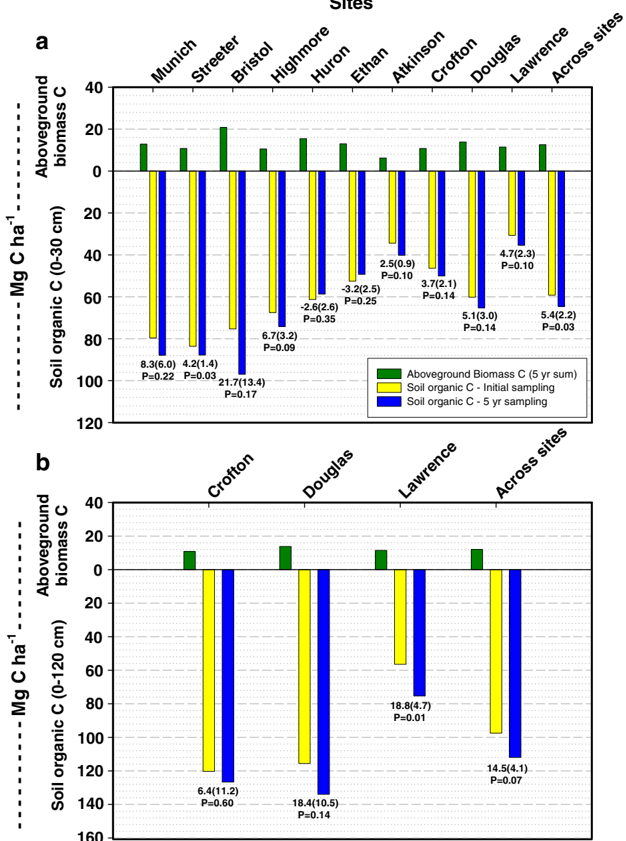
- Across sites, SOC increased significantly at 0–30 cm (P=0.03) and 0–120 cm (P=0.07), with accrual rates of 1.1 and 2.9 Mg C ha⁻¹ year⁻¹ (4.0 and 10.6 Mg CO₂ ha⁻¹ year⁻¹), respectively.
- Site-level SOC change varied widely, from −0.6 to 4.3 Mg C ha⁻¹ year⁻¹ at 0–30 cm; significant decreases occurred at Huron and Ethan, while responsive sites accrued 0.8–1.2 Mg C ha⁻¹ year⁻¹ at 0–30 cm, and Lawrence accrued 3.8 Mg C ha⁻¹ year⁻¹ at 0–120 cm.
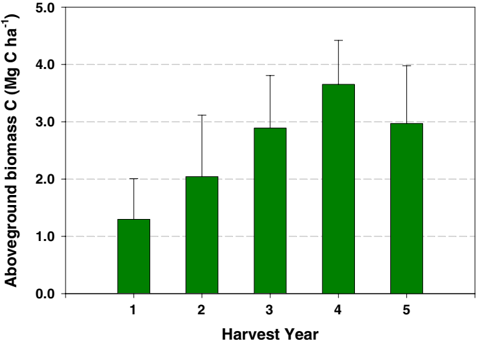
- Harvested aboveground C averaged 2.5±0.7 Mg C ha⁻¹ over 5 years, peaking in year 4 at 3.7±0.8 Mg C ha⁻¹; biomass C concentration averaged 444.1±6.1 g C kg⁻¹.
- The authors state SOC accrual appears large enough to offset N₂O emissions; cited N₂O emission from fertilized crested wheatgrass was 3.4 kg N ha⁻¹ year⁻¹ (1.6 Mg CO₂e ha⁻¹ year⁻¹), about 40% of the 0–30 cm C sequestration rate, and previous LCAs used C offset rates 4- to 11-fold lower than observed here.
Methods
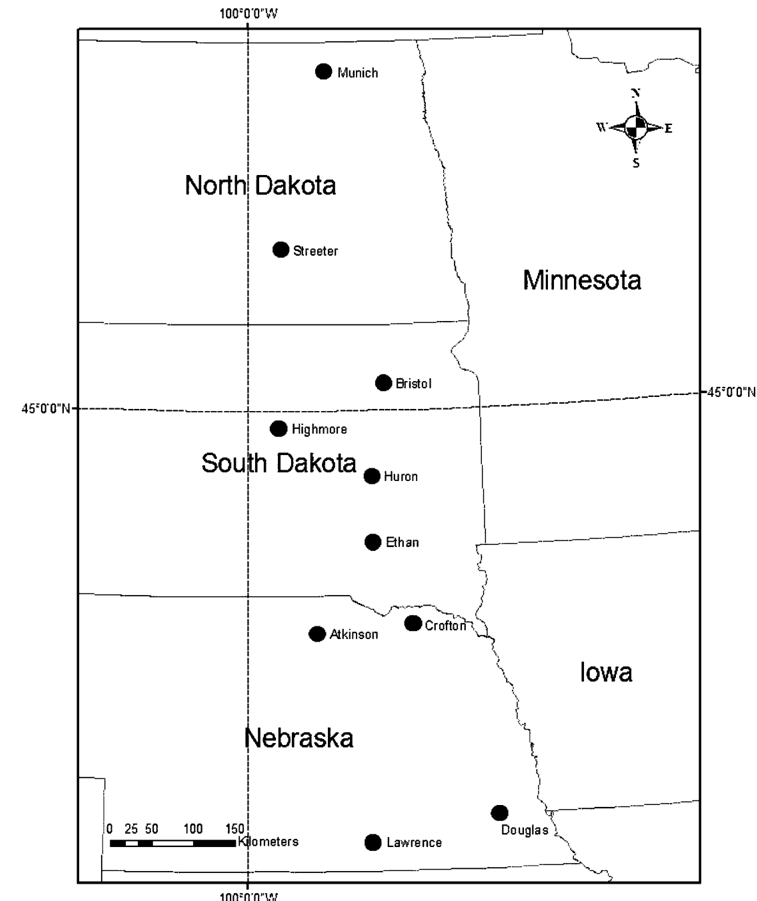
- Measured SOC change and harvested C on ten switchgrass fields on working farms in Nebraska, South Dakota, and North Dakota, spanning 930 km north–south and 230 km east–west; fields averaged 6.7 ha (range 3.0–9.5 ha) and were seeded in 2000–2001.
- Soil was sampled in transects before planting and 5 years later: two transects with three locations each (six per site; Atkinson had only two per transect). Depths were 0–5, 5–10, 10–20, and 20–30 cm at all sites, plus 30–60, 60–90, and 90–120 cm at three Nebraska sites. SOC was determined by dry combustion minus inorganic C, with bulk density used for volumetric C.
- Changes in SOC were calculated within sampling location and evaluated by paired t-test in PROC MIXED by depth and cumulative depths; harvested C was determined from baled biomass and hand-clipped quadrats.
Limitations
- Paper-stated: farmers participated via 5-year contracts that could not feasibly be extended, so SOC change beyond 5 years remains a critical research need; field-based N₂O and CH₄ flux assessments are urgently needed; LCAs generally calculate sequestration over 30 or 100 years, when accrual would be expected to plateau.
- Paper-stated: working-farm research has drawbacks, and variability in SOC change across sites was significant; the authors recommend LCAs include confidence intervals, not just means.
- Evident from the text: only ten farms were studied, sampling locations were treated as pseudoreplicates, only three sites were sampled to 120 cm, and Atkinson results were based on a 4-year switchgrass stand; no significant associations were found between annual SOC change at 0–30 cm and edaphic or climatic attributes.
Model-written summary. Check it against the paper before relying on it.
Integrity signals
Registry
Cites
Statistics
Figures
Verification
Claims the paper makes
4 Valid · 0 Not valid · 28 Not checked · 30 Own results and interpretations
The cited sources support only part of this claim — read each source’s verdict below.
In the paper
“Results from life-cycle assessments (LCAs) of switchgrass grown for bioenergy, however, have been mixed [1,8,32,33], due in large part to the assigned net GHG emissions associated with switchgrass production and assumptions made in indirect land conversion costs.”
§ Soil Carbon Storage by Switchgrass Grown for Bioenergy > Introduction
What the sources say
- Partly supportedcites [1] 1. Adler PR, Del Grosso SJ, Parton WJ (2007) Life-cycle assessment of net greenhouse-gas flux for bioenergy cropping systems. Ecol Appl 17(3):675-691 sourceExperimental — accuracy not yet measured
Adler et al. (2007) is indeed a life-cycle assessment of net GHG flux that assigns switchgrass a quantitative net GHG balance, and its Introduction (p. 1) notes that several studies have evaluated GHG fluxes of specific bioenergy crops with 'limited information comparing a range of crops' and 'a need to integrate factors contributing to the impact of land-use change on GHG fluxes' — so the multi-study framing is partly echoed. However, the paper's own result is not mixed: switchgrass (with hybrid poplar) gave the largest net GHG sink, <200 g CO2e-C m^-2 yr^-1 for ethanol and ~115-145% reduction versus gasoline/diesel, and all systems remained sinks even in the long term (Abstract p. 1; Net greenhouse-gas flux p. 8). Crucially, the accounting contains no indirect land-conversion (iLUC) term — land-use change is flagged only as a future need — so the claim's attribution of mixed results to 'assumptions made in indirect land conversion costs' is not supported by this source. (LLM, conf=0.72)
- Not checked yetcites [8] 8. Fargione J, Hill J, Tilman D, Polasky S, Hawthorne P (2008) Land clearing and the biofuel carbon debt. Science 319:1235-1238 source
- Partly supportedcites [32] 31. Schmer MR, Vogel KP, Mitchell RB, Perrin RK (2008) Net energy of cellulosic ethanol from switchgrass. Proc Natl Acad Sci USA 105(2):464-469 sourceExperimental — accuracy not yet measured
Our copy of Schmer et al. (2008) does support the 'mixed results' half of the claim at the level of assigned net GHG emissions: the GHG Emissions section reports that 'Switchgrass fields were GHG-positive, -neutral, or -negative, depending on agriculture input amounts (mainly N fertilization) and subsequent biomass yields,' that earlier studies differed in how they estimated GHG displaced (by material converted to ethanol vs. by soil C sequestration), and the Discussion highlights 'discrepancies that can occur when analyses are based on small-scale research plots and misassumptions' (cf. Fig. 3 on Farrell, Wang, and Pimentel & Patzek). However, the second driver the claim attributes to this source — assumptions about indirect land conversion costs — is not addressed anywhere in our copy: the paper only treats direct conversion of existing cropland/CRP land to perennial grasses and credits CO2 sequestered in soil on converted cropland, with no indirect land-use-change accounting. Searches for 'indirect land use change / iLUC / emission debt' returned no supporting passage. (LLM, conf=0.72)
- Not checked yetcites [33] 32. Searchinger T et al (2008) Use of U.S. croplands for biofuels increases greenhouse gases through emissions from land use change. Science 319:1238-1240 source
plainstates a cause- Asserted: passes — The authors put it forward as true.
- Checkable: passes — It can be checked against evidence.
- Load-bearing: unclear — It is unclear whether the paper’s conclusions depend on it.
- Based: passes — The paper gives a reason why it holds.
- Partly supported
The cited sources support only part of this claim — read each source’s verdict below.
In the paper
“This finding, coupled with observations that prairie grass roots regenerate by replacing dying roots with new, live roots [43] indicates the potential for significant C input to the soil under switchgrass.”
§ Soil Carbon Storage by Switchgrass Grown for Bioenergy > Discussion
What the sources say
- Partly supportedcites [43] 41. Weaver JE, Zink E (1946) Length of life of roots of ten species of perennial range and pasture grasses. Plant Physiol 21:201-217 sourceExperimental — accuracy not yet measured
Our copy of Weaver & Zink (1946) does document annual renewal growth in prairie grasses: the Discussion states that 'there was a gradual loss of the older roots year by year' which is 'small if not entirely negligible when the great abundance of new roots produced annually is considered', and the Results/Introduction note hundreds of individual roots produced per plant over three seasons. But the same Discussion explicitly denies the strong replacement reading the claim carries — 'No losses and replacements of root systems similar to those reported by SPRAGUE (3) and STUCKEY (5) occurred' — i.e. wholesale dying-and-replacement of the root system is the pattern those authors found in pasture/cultivated species (Kentucky bluegrass, orchard grass, perennial ryegrass, etc.), not in the prairie grasses this paper studied, whose roots are instead characterized as long-lived with 'great permanency of occupation'. So the source supports gradual loss of old roots plus abundant new-root production, but not prairie grass roots 'regenerating by replacing dying roots' in the replacement-cycle sense the citing sentence implies. (LLM, conf=0.70)
plainstates a cause- Asserted: passes — The authors put it forward as true.
- Checkable: passes — It can be checked against evidence.
- Load-bearing: passes — The paper’s conclusions depend on it.
- Based: passes — The paper gives a reason why it holds.
- Partly supported
The cited sources support only part of this claim — read each source’s verdict below.
In the paper
“Previous LCAs including switchgrass production for biomass energy have utilized C offset rates four-to 11-fold lower than the C sequestration rates observed in this study [1,32,33].”
§ Soil Carbon Storage by Switchgrass Grown for Bioenergy > Discussion
What the sources say
- Partly supportedcites [1] 1. Adler PR, Del Grosso SJ, Parton WJ (2007) Life-cycle assessment of net greenhouse-gas flux for bioenergy cropping systems. Ecol Appl 17(3):675-691 sourceExperimental — accuracy not yet measured
Our copy confirms the identifying half of the claim: Adler et al. (2007) is a life-cycle assessment of net GHG flux that includes switchgrass grown for biomass energy (ethanol conversion and gasification for electricity), and it does assign carbon offsets — displaced fossil fuel and soil C sequestration (ΔCsys) — with numeric sink rates (Abstract p. 1; Net greenhouse-gas flux p. 8, e.g. switchgrass net sinks < −200 g CO2e-C m⁻² yr⁻¹ near term, −400 g for gasification). What it does not support is the comparative magnitude: nowhere does the paper state or imply that its C offset rates are four- to 11-fold lower than any other study's observed sequestration rates — that fold-difference is the citing authors' own calculation against their data. Indeed the paper's offset accounting runs the other way in framing (ΔCsys is the second-largest sink in the near term and is set to zero in the long-term scenario; pp. 8, 12–14), so the specific 4–11-fold figure attributed here is not in the source. (LLM, conf=0.68)
- Partly supportedcites [32] 31. Schmer MR, Vogel KP, Mitchell RB, Perrin RK (2008) Net energy of cellulosic ethanol from switchgrass. Proc Natl Acad Sci USA 105(2):464-469 sourceExperimental — accuracy not yet measured
Our copy of Schmer et al. (2008) supplies only one half of the comparison: the GHG Emissions section states the soil-C credit used in their analysis (CO2 sequestered as soil C for 100 yr on converted cropland, 'estimated to be 138.1 kg of CO2 Mg−1 of aboveground biomass yr−1' per ref. 28, Fig. 5; also the cited 4.42 Mg C ha−1 y−1 from ref. 27), and the Life Cycle Bioenergy Analysis section notes they updated EBAMM by 'crediting carbon sequestered by switchgrass to GHG emissions based on field-scale yields.' Nothing in our copy compares previous LCAs' carbon offset rates with theirs, and no 'four- to 11-fold' figure appears; the paper's comparisons with earlier analyses (refs. 8, 10, 14, 19; Discussion) concern energy inputs, small-plot yields and net energy, not C offsets. Moreover, the rate is not 'observed in this study' — it is a previously published constant (ref. 28) applied to their measured yields, and the paper explicitly notes 'In this study, we used a constant previously published conversion rate.' (LLM, conf=0.65)
- Not checked yetcites [33] 32. Searchinger T et al (2008) Use of U.S. croplands for biofuels increases greenhouse gases through emissions from land use change. Science 319:1238-1240 source
plain- Asserted: passes — The authors put it forward as true.
- Checkable: passes — It can be checked against evidence.
- Load-bearing: passes — The paper’s conclusions depend on it.
- Based: passes — The paper gives a reason why it holds.
- Partly supported
The cited sources support only part of this claim — read each source’s verdict below.
In the paper
“Accrual rates of SOC under switchgrass contribute significantly to its potential to provide a favorable net GHG balance [8,32].”
§ Soil Carbon Storage by Switchgrass Grown for Bioenergy > Discussion
What the sources say
- Not checked yetcites [8] 8. Fargione J, Hill J, Tilman D, Polasky S, Hawthorne P (2008) Land clearing and the biofuel carbon debt. Science 319:1235-1238 source
- Partly supportedcites [32] 31. Schmer MR, Vogel KP, Mitchell RB, Perrin RK (2008) Net energy of cellulosic ethanol from switchgrass. Proc Natl Acad Sci USA 105(2):464-469 sourceExperimental — accuracy not yet measured
The GHG Emissions section supports the substance: Schmer et al. state that their estimate of GHG displaced by switchgrass ethanol over gasoline was based on biomass yields 'by both fossil fuel displacement (9) and the estimated carbon dioxide sequestered as soil C for 100 yr by switchgrass on converted cropland (28)', and Fig. 5 confirms 'Estimated GHG values include the amount of CO2 sequestered in the soil (100 yr)'. What the source does not support is the magnitude qualifier 'significantly': the paper never quantifies or characterises the soil-C share of the 94% GHG reduction, it takes the accrual figures themselves from other works (4.42 Mg C ha-1 y-1 from ref. 27; 138.1 kg CO2 per Mg biomass from ref. 28), and it names lignocellulosic residue energy use as 'the main reason' switchgrass has lower GHG emissions than annual-crop biofuels. It also notes switchgrass fields were GHG-positive, -neutral or -negative depending on N inputs, with 3 of 5 harvest years near neutral. (LLM, conf=0.70)
plainstates a cause- Asserted: passes — The authors put it forward as true.
- Checkable: passes — It can be checked against evidence.
- Load-bearing: passes — The paper’s conclusions depend on it.
- Based: passes — The paper gives a reason why it holds.
- Rests on an assumption not shown here.
A result the paper reports from its own data — it cites no other source for it, so there is none to check. The quote shows it is in the paper.
In the paper
“No significant associations were observed between annual change in SOC at 0-30 cm and relevant edaphic and climatic attributes (data not shown).”
§ Soil Carbon Storage by Switchgrass Grown for Bioenergy > Results
plain- Asserted: passes — The authors put it forward as true.
- Checkable: passes — It can be checked against evidence.
- Load-bearing: unclear — It is unclear whether the paper’s conclusions depend on it.
- Based: passes — The paper gives a reason why it holds.
30 more claims
Create a free account to see all 62 claims and to verify the 39 references still open.
- It may state two separate claims as one. 15
- Probably not a substantial claim. 11
- The quote only partly states this claim. 1
Claims other papers make about this one
Each is checked against this paper’s own text: does it say what the citing paper says it does?
The cited source says what the claim attributes to it.
In the citing paper
“According to Liebig et al. (2008), switchgrass decreases SOC at two of ten experimental sites due to a significant decrease in soil bulk density near the surface depth, which contributes to decreased SOC, whereas switchgrass increases SOC at the remaining experimental sites.”
From Global warming intensity of biofuel derived from switchgrass grown on marginal land in Michigan (2023) · cites this paper as Liebig et al. (2008)
The cited source says what the claim attributes to it.
In the citing paper
“Although the potential of switchgrass for SOC sequestration was highlighted in several studies (Ma, 2000;Liebig et al., 2008;Schmer et al., 2011), the different cropping managements (in terms of fertilization and irrigation) and analytical approaches to estimate the SOC stock variations limit the possibility to compare data across studies.”
From Carbon sequestration potential in perennial bioenergy crops: the importance of organic matter inputs and its physical protection (2016) · cites this paper as Liebig et al., 2008
The cited source says what the claim attributes to it.
In the citing paper
“Cultivation of temperate-zone perennial grasses -Miscanthus, switchgrass, or native mixes -increased SOC by an average of $ 0.1-1 Mg ha À1 yr À1 in the top 30 cm (Figs 234; see also e.g., Potter et al., 1999;Ma et al., 2000;Kahle et al., 2001;Lemus & Lal, 2005;Liebig et al., 2008).”
From Changes in soil organic carbon under biofuel crops (2009) · cites this paper as Liebig et al., 2008
In the citing paper
“Equivalent mass SOC trends were similar to volumetric SOC trends reported earlier (Liebig et al., 2008).”
From Field-scale soil property changes under switchgrass managed for bioenergy (2011) · cites this paper as Liebig et al., 2008
Self-check
Percentages, sums and reported differences re-computed from the paper’s own numbers.
Each contradiction between two passages listed here was confirmed by an independent check.
Rated minor: it would not touch a result — a value no result rests on, a p-value that stays on the same side of the significance level, or a conflict that is clerical, resolved elsewhere in the paper, or outside its own findings.
In the paper
§ Soil Carbon Storage by Switchgrass Grown for Bioenergy > Results
“Soil organic C accrual rates for responsive sites ranged from 0.8-1.2Mg C ha -1 year -1 for the 0-30 cm depth.”
§ Soil Carbon Storage by Switchgrass Grown for Bioenergy > Discussion
“| Highmore, SD | 0.55 | -0.76 | 1.69 | 5.23** | - | - | - |”
Rated minor: it would not touch a result — a value no result rests on, a p-value that stays on the same side of the significance level, or a conflict that is clerical, resolved elsewhere in the paper, or outside its own findings.
In the paper
§ Soil Carbon Storage by Switchgrass Grown for Bioenergy > Discussion
“Table 2 Change in soil bulk density and soil organic C at each site after 5 years under switchgrass”
§ Soil Carbon Storage by Switchgrass Grown for Bioenergy > Discussion
“Results from Atkinson site based on 4 year switchgrass stand.”
Citations
Cites
Statistical Procedures for Agricultural Research.
Cox, D. F., Gomez, K. A., & Gomez, A. A. (1985) · Journal of the American Statistical Association · doi:10.2307/2287932 · Cited by 18,086
Littell, R. C. (1996) · Medical Entomology and Zoology · Cited by 10,550
Soil taxonomy—a basic system of soil classification for making and interpreting soil surveys
Nachtergaele, F. (2001) · Geoderma · doi:10.1016/s0016-7061(00)00097-5 · Cited by 5,434
Use of U.S. Croplands for Biofuels Increases Greenhouse Gases Through Emissions from Land-Use Change
Searchinger, T., Heimlich, R., Houghton, R. A., Dong, F., Elobeid, A., Fabiosa, J., Tokgoz, S., Hayes, D., & Yu, T.-H. (2008) · Science · doi:10.1126/science.1151861 · Cited by 4,888 · cited 3×
“Previous LCAs including switchgrass production for biomass energy have utilized C offset rates four- to 11-fold lower than the C sequestration rates observed in this study [1, 32, 33].”
Land Clearing and the Biofuel Carbon Debt
Fargione, J., Hill, J., Tilman, D., Polasky, S., & Hawthorne, P. (2008) · Science · doi:10.1126/science.1152747 · Cited by 3,902
Environmental, economic, and energetic costs and benefits of biodiesel and ethanol biofuels
Hill, J., Nelson, E., Tilman, D., Polasky, S., & Tiffany, D. (2006) · Proceedings of the National Academy of Sciences · doi:10.1073/pnas.0604600103 · Cited by 2,871 · cited 2×
“Utilization of perennial herbaceous crops as biofuel sources has been purported to mitigate negative consequences due mainly to their lower requirements of fertilizers and pesticides relative to annual crops and their ability to be grown on marginal land [16, 36].”
BackgroundCarbon-Negative Biofuels from Low-Input High-Diversity Grassland Biomass
Tilman, D., Hill, J., & Lehman, C. (2006) · Science · doi:10.1126/science.1133306 · Cited by 1,813 · cited 2×
“Utilization of perennial herbaceous crops as biofuel sources has been purported to mitigate negative consequences due mainly to their lower requirements of fertilizers and pesticides relative to annual crops and their ability to be grown on marginal land [16, 36].”
BackgroundSoil Testing and Plant Analysis
(1990) · SSSA Book Series · doi:10.2136/sssabookser3.3ed · Cited by 1,674
Bhattacharyya, T. (2009) · Cited by 1,223
Soil Testing and Plant Analysis: Part I Soil Testing
(1967) · SSSA Special Publications · doi:10.2136/sssaspecpub2 · Cited by 1,083
Research works printed but not linked: 2
- 5. Blake GR, Hartge KH (1986) Bulk density. In: Klute A (ed) Methods of soil analysis. Soil Science Society of America, Madison, WI, pp 363-382
- 34. Shively SB, Weaver JE (1939) Amount of underground plant material in different grassland climates. Neb Conserv Bull 21:1- 68, Conservation and Survey Division, University of Nebraska, Lincoln, NE 36.
Cited by
Items 101–200 of 203
Earthworm communities are supported by perennial bioenergy cropping systems
Emmerling, C., Ruf, T., Audu, V., Werner, W., & Udelhoven, T. (2021) · European Journal of Soil Biology · doi:10.1016/j.ejsobi.2021.103331 · Cited by 20
Quantifying soil organic carbon stocks in herbaceous biomass crops grown in Ontario, Canada
Graham, J., Voroney, P. R., Coleman, B., Deen, B., Gordon, A., Thimmanagari, M., & Thevathasan, N. V. (2018) · Agroforestry Systems · doi:10.1007/s10457-018-0272-0 · Cited by 19
AGRONOMIC ASPECTS OF SWITCHGRASS CULTIVATION AND USE FOR ENERGY PURPOSES
Brodowska, M. S., Muszyński, P., Haliniarz, M., Brodowski, R., Kowalczyk-Juśko, A., Sekutowski, T., & Kurzyna-Szklarek, M. (2018) · Applied Ecology and Environmental Research · doi:10.15666/aeer/1605_57155743 · Cited by 18
“The capacity of switchgrass for significant soil carbon sequestration contributes to a reduction in total environmental CO2 balance (Liebig et al., 2008; Adkins et al., 2016).”
BackgroundBuffer Green Patches around Urban Road Network as a Tool for Sustainable Soil Management
Petrova, S. T., Nikolov, B. N., Velcheva, I. G., Angelov, N., Valcheva, E. G., Katova, A., Голубинова, И., & Маринов-Серафимов, П. (2022) · Land · doi:10.3390/land11030343 · Cited by 22
Manure increases soil organic carbon most when allocated to annual cropping
Joona, J., Liski, E., & Kahiluoto, H. (2024) · CATENA · doi:10.1016/j.catena.2024.107844 · Cited by 18
Franzluebbers, A. J. (2021) · Soil Science Society of America Journal · doi:10.1002/saj2.20346 · Cited by 14
Quantifying Global Potential Marginal Land Resources for Switchgrass
Fan, P., Hao, M., Ding, F., Jiang, D., & Dong, D. (2020) · Energies · doi:10.3390/en13236197 · Cited by 15
“It suggested that the stability in the costs of switchgrass biomass production from 2004 to 2030 makes switchgrass-based fuel ethanol more competitive with natural gas and fossil oil, despite the potential influence of carbon storage in planting switchgrass [13,14].”
BackgroundGollany, H. T., Grosso, S. J. D., Dell, C. J., Adler, P. R., & Polumsky, R. W. (2021) · Soil Science Society of America Journal · doi:10.1002/saj2.20232 · Cited by 15
Goemann, H., Gay, J. D., Mueller, R., Brookshire, E. N. J., Miller, P. R., Poulter, B., & Peyton, B. (2021) · GCB Bioenergy · doi:10.1111/gcbb.12892 · Cited by 15
“…to match crop needs (Ruan et al., 2016), perennial systems have a greater potential for N retention in comparison to annual crops via reduced loss of nutrients through leaching, runoff, and greenhouse gas flux coupled with increased N use efficiency (Culman et al., 2013; Liebig et al., 2008).”
BackgroundGu, Y., & Wylie, B. K. (2016) · GCB Bioenergy · doi:10.1111/gcbb.12388 · Cited by 14
“Previ- ous studies indicate that planting switchgrass can lead to a carbon sink and can improve ecosystem function (Bransby et al., 1998; Ma et al., 2000; Frank et al., 2004; Liebig et al., 2005, 2008; Dwivedi et al., 2015).”
BackgroundEfficient Methods of Estimating Switchgrass Biomass Supplies
Schmer, M. R., Mitchell, R. B., Vogel, K. P., Schacht, W. H., & Marx, D. B. (2010) · BioEnergy Research · doi:10.1007/s12155-009-9070-x · Cited by 16
“Soil type, cropping history, cultivars, and agronomic practices have been previously described for the on-farm switchgrass study [ 8 , 15, 17].”
BackgroundSelf-citationMbonimpa, E. G., Kumar, S., Owens, V. N., Chintala, R., Sieverding, H. L., & Stone, J. J. (2015) · GCB Bioenergy · doi:10.1111/gcbb.12296 · Cited by 14
Bilandžija, D., Bilandžija, N., & Zgorelec, Ž. (2021) · Journal of Central European Agriculture · doi:10.5513/jcea01/22.1.2776 · Cited by 13
The climate benefit of Swedish ethanol: present and prospective performance
Börjesson, P., Ahlgren, S., & Berndes, G. (2012) · Wiley Interdisciplinary Reviews Energy and Environment · doi:10.1002/wene.17 · Cited by 16
Biomass feedstock: diversity as a solution
Yuan, J. S., Wang, X., & Stewart, C. N. (2011) · Biofuels · doi:10.4155/bfs.11.135 · Cited by 15
Perry, S., Falvo, G., Mosier, S. L., & Robertson, G. P. (2023) · Soil Science Society of America Journal · doi:10.1002/saj2.20575 · Cited by 12
“In shorter term studies, others (e.g., Schmer et al., 2011) have reported lower accrual rates in the Great Plains, including C loss attributed to landscape variability.”
BackgroundInfluentialDell, C. J., Gollany, H. T., Adler, P. R., Skinner, R. H., & Polumsky, R. W. (2018) · Journal of Environmental Quality · doi:10.2134/jeq2017.07.0298 · Cited by 15
Switchgrass Genetics and Breeding Challenges
Bartley, L., Wu, Y. Q., Saathoff, A. J., & Sarath, G. (2013) · Wiley eBooks · doi:10.1002/9781118609477.ch2 · Cited by 13
Net primary production in three bioenergy crop systems following land conversion
DEAL, M. W., Xu, J., John, R., Zenone, T., Chen, J., Chu, H., Jasrotia, P., Kahmark, K., Bossenbroek, J. M., & Mayer, C. (2013) · Journal of Plant Ecology · doi:10.1093/jpe/rtt057 · Cited by 10
Gu, Y., Wylie, B. K., & Howard, D. M. (2014) · Ecological Indicators · doi:10.1016/j.ecolind.2014.09.013 · Cited by 10
“Cultivating switchgrass for biofuel is more economically and environmentally sustainable than using corn for producing ethanol and can improve ecosystem goods and services (Bransby et al., 1998; Liebig et al., 2008; Liebig, 2006; McLaughlin and Kszos, 2005; Perrin et al., 2008).”
BackgroundTo, J. P. C., Zhu, J., Benfey, P. N., & Elich, T. D. (2010) · F1000 Biology Reports · doi:10.3410/b2-65 · Cited by 12
“A large-scale switchgrass field study recently reported net energy gains of cellulosic ethanol and increase in SOC [16,17].”
BackgroundInfluentialIntercropping switchgrass with hybrid poplar increased carbon sequestration on a sand soil
Collins, H. P., Kimura, E., Polley, W., Fay, P. A., & Fransen, S. (2020) · Biomass and Bioenergy · doi:10.1016/j.biombioe.2020.105558 · Cited by 9
Sesmero, J., Trull, N. U., & Gramig, B. M. (2021) · GCB Bioenergy · doi:10.1111/gcbb.12843 · Cited by 10
“A higher prevalence of switchgrass in the mix reduces emissions because planting switchgrass on marginal land provides substantial carbon sequestration benefits relative to the baseline land use (e.g., Follett et al., 2012; Liebig et al., 2008; Monti et al., 2012).”
BackgroundTiwari, P., Poudel, K. P., Yang, J., da Silva, B. K., Yang, Y., & McConnell, M. D. (2023) · International Journal of Applied Earth Observation and Geoinformation · doi:10.1016/j.jag.2023.103568 · Cited by 20
Reciprocal Effects for Biomass Yield in Lowland Switchgrass
Bhandari, H. S., Webb, S. L., Bouton, J. H., & Saha, M. C. (2014) · Crop Science · doi:10.2135/cropsci2013.08.0532 · Cited by 8
Perennial grasses in phytoremediation—challenges and opportunities
Pandey, V. C., & Maiti, D. (2020) · Elsevier eBooks · doi:10.1016/b978-0-12-817732-7.00001-8 · Cited by 9
Lee, J., Pedroso, G. M., van Kessel, C., & Six, J. (2015) · Agriculture Ecosystems & Environment · doi:10.1016/j.agee.2015.06.015 · Cited by 8
Bhandari, H. S., Fasoula, V. A., & Bouton, J. H. (2013) · Crop Science · doi:10.2135/cropsci2012.06.0363 · Cited by 8
“Its roots grow several meters deep in the soil profile and are capable of sequestering a large quantity of atmospheric CO2 into organic C each year (Anderson-Teixeira et al., 2009; Blanco-Canqui, 2010; Liebig et al., 2008).”
BackgroundAgricultural Management and Soil Carbon Dynamics
Collins, H. P., Mikha, M. M., Brown, T. T., Smith, J. L., Huggins, D. R., & Sainju, U. M. (2012) · Elsevier eBooks · doi:10.1016/b978-0-12-386897-8.00005-x · Cited by 11
Supply costs, energy use, and GHG emissions of biomass from marginal lands in Brittany, France
Djomo, S. N., Staritsky, I. G., Elbersen, B. S., Annevelink, B., & Gabrielle, B. (2023) · Renewable and Sustainable Energy Reviews · doi:10.1016/j.rser.2023.113244 · Cited by 14
Gay, J. D., Goemann, H., Currey, B., Stoy, P. C., Christiansen, J. R., Miller, P. R., Poulter, B., Peyton, B., & Brookshire, E. N. J. (2022) · GCB Bioenergy · doi:10.1111/gcbb.13001 · Cited by 11
“The rate of SOC accumulation across 0– 30 cm depth under tall wheatgrass (0.25 Mg SOC ha−1 year−1) in this study is similar to SOC changes under perennial grasses in North Dakota (0.28 Mg SOC ha−1 year−1; Liebig et al., 2008).”
MethodInfluentialSustainable Bioenergy Feedstock Production Systems
Johnson, J. M. F., & Novak, J. M. (2012) · Elsevier eBooks · doi:10.1016/b978-0-12-386897-8.00008-5 · Cited by 8
Long-term bioenergy sorghum harvest strategy and soil quality
Shahandeh, H., Hons, F. M., Storlien, J. O., & Wight, J. P. (2016) · AIMS energy · doi:10.3934/energy.2016.4.633 · Cited by 8
“Liebig et al. [43] showed that SOC storage by bioenergy crops varied from −0.6 to 4.3 Mg C ha −1 yr −1 and varied both spatially and temporally.”
InfluentialAlexopoulou, E., Monti, A., Elbersen, H. W., Zegada‐Lizarazu, W., Millioni, D., Scordia, D., Zanetti, F., Papazoglou, E. G., & Christou, M. (2018) · Elsevier eBooks · doi:10.1016/b978-0-12-812900-5.00003-5 · Cited by 8
Energy Issues Affecting Corn/Soybean Systems: Challenges for Sustainable Production
CAST (2012) · doi:10.62300/6vb9t3qw · Cited by 8
Ramírez, S. V., Schmer, M. R., Jin, V. L., Mitchell, R. B., Stewart, C. E., Parsons, J., Redfearn, D. D., Quinn, J. J., Varvel, G. E., Vogel, K. P., et al. (2024) · Frontiers in Energy Research · doi:10.3389/fenrg.2023.1272877 · Cited by 7
Self-citationBhattarai, M. D., Secchi, S., & Schoof, J. T. (2016) · Environmental Management · doi:10.1007/s00267-016-0771-6 · Cited by 6
“In absolute terms, planting switchgrass increases SOC levels by 15.3 tons per hectare (Liebig et al. 2008).”
BackgroundInfluentialParenti, A., Lambertini, C., & Monti, A. (2018) · Springer eBooks · doi:10.1007/978-3-319-74536-7_3 · Cited by 8
Gautam, S., Mishra, U., & Scown, C. D. (2025) · Carbon Capture Science & Technology · doi:10.1016/j.ccst.2025.100440 · Cited by 8
Genetic Analysis of Yield and Quality Traits in Switchgrass Based on Population Crosses
Edmé, S. J., & Mitchell, R. B. (2021) · Agronomy · doi:10.3390/agronomy11112220 · Cited by 6
“The interest in breeding switchgrass for bioenergy increased markedly in the 1990s with the realization that (1) it is indigenous to the USA, (2) it has high yield potential, (3) it yields particularly better than field crops in marginal environments [2], (4) it has great potential for carbon sequestration due to its…”
BackgroundSelf-citationMosier, S. L., Kelly, L. J., Ozlu, E., & Robertson, G. P. (2024) · GCB Bioenergy · doi:10.1111/gcbb.13125 · Cited by 6
“Rates of C accretion under switchgrass can vary widely; rates from −0.6 to 4.3 Mg C ha −1 year −1 have been documented (Frank et al., 2004; Garten & Wullschleger, 2000; Lai et al., 2018; Liebig et al., 2008).”
BackgroundInfluentialTilhou, N. W., Bonnette, J. E., Boe, A. R., Fay, P. A., Fritschi, F., Mitchell, R. B., Rouquette, F. M., Jr., Wu, Y. Q., JASTROW, J. D., Ricketts, M. P., et al. (2024) · G3 Genes Genomes Genetics · doi:10.1093/g3journal/jkae159 · Cited by 9
Self-citationZhao, C., Yue, Y., Wu, J., Scullion, J., Guo, Q., Wang, Q., Li, C., Wan, X., Hou, X., & Fan, X. (2023) · Biomass and Bioenergy · doi:10.1016/j.biombioe.2023.106809 · Cited by 6
Jaggard, E. L. S. (2012) · QSpace (Queen's University Library) · Cited by 7
Gu, Y., & Wylie, B. K. (2017) · GCB Bioenergy · doi:10.1111/gcbb.12468 · Cited by 5
“…(Panicum virgatum) has been recommended as one potential source for cellulosic biofuel feedstocks (Sanderson et al., 1996, 2006; Mclaughlin & Kszos, 2005; Liebig, 2006; Schmer et al., 2008, 2010; Vadas et al., 2008; Bracmort, 2010; Bracmort et al., 2010; Guretzky et al., 2010; Monti et al., 2012).”
BackgroundCarbon footprint of four bioethanol cropping systems in a temperate region
Bustamante−Silveira, M., Siri−Prieto, G., Mazzilli, S. R., & Carrasco‐Letelier, L. (2024) · Biofuels · doi:10.1080/17597269.2024.2327154 · Cited by 4
Energy Return on Investment (EROI), Liquid Fuel Production, and Consequences for Wildlife
Townsend, J. M., Hall, C. A. S., Volk, T. A., Murphy, D. J., Ofezu, G. J., Powers, B., Quaye, A. K., & Serapiglia, M. J. (2014) · Springer eBooks · doi:10.1007/978-1-4939-1954-3_2 · Cited by 4
“are at least carbon neutral, and long-term sequestering of below-ground carbon would make them carbon negative [58, 63, 101].”
BackgroundSacks, A. D., Teague, R., Provenza, F. D., Itzkan, S., & Laurie, J. (2014) · Cited by 6
Larson, A. A. D., RENZ, M. J., & Stoltenberg, D. E. (2016) · Weed Science · doi:10.1614/ws-d-14-00160.1 · Cited by 5
“…a promising bioenergy feedstock because of its ability to grow in a range of environments (Vogel 1996, 2004) and the environmental benefits it offers over annual cropping systems (Blanco-Canqui 2010; Fletcher et al. 2011; Lee et al. 2007; Liebig et al. 2008; Robertson et al. 2011; Wu et al. 2012).”
BackgroundAmeen, A., Han, L., & Xie, H. (2019) · Communications in Soil Science and Plant Analysis · doi:10.1080/00103624.2019.1594883 · Cited by 5
“An increase in SOC was shown within the 5-year establishment of switchgrass (Liebig et al. 2008).”
BackgroundA method of production carbon footprint analysis in a supply chain based on life cycle assessment
Song, J., Li, R., Xinli, W., & Li, R. (2016) · International Journal of Wireless and Mobile Computing · doi:10.1504/ijwmc.2016.082290 · Cited by 4
Determining Switchgrass Breakeven Prices in a Landscape Design System
Soldavini, S., & Tyner, W. E. (2017) · BioEnergy Research · doi:10.1007/s12155-017-9888-6 · Cited by 4
Routhier, M., Lafleur, B., & Bélanger, N. (2014) · VertigO · doi:10.4000/vertigo.15076 · Cited by 5
Changes in soil organic carbon under biofuel crops
Arah, S., & Elucia, H. D. (2009) · Cited by 4
Biofuel Crops and Soil Quality and Erosion
Chatskikh, D., Овчинникова, А. М., Seshadri, B., & Bolan, N. S. (2013) · Wiley eBooks · doi:10.1002/9781118635797.ch8 · Cited by 8
Soil Management Implications of Producing Biofuel Feedstock
Johnson, J. M. F., Archer, D. W., Karlen, D. L., Weyers, S. L., & Wilhelm, W. W. (2011) · ASSA, CSSA and SSSA · doi:10.2136/2011.soilmanagement.c24 · Cited by 5
“Herbaceous perennials typically have extensive root systems, which can increase SOC while helping protect the soil from erosive forces (McLaughlin and Walsh, 1998; Frank et al., 2004; Liebig et al., 2005; Lee et al., 2007; Liebig et al., 2008).”
BackgroundGreenhouse Gas Balance in Disturbed Peatlands
Alm, J., Byrne, K. A., Hayes, C., Leifeld, J., & Shurpali, N. (2011) · Wiley eBooks · doi:10.1002/9781119970255.ch7 · Cited by 4
Gu, Y., Wylie, B. K., Boyte, S. P., & Phuyal, K. P. (2013) · GCB Bioenergy · doi:10.1111/gcbb.12059 · Cited by 3
“Many studies show that cultivating switchgrass can lead to a carbon sink (especially 2 years after its establishment) and increases ecosystem goods and services (Bransby et al., 1998; Frank et al., 2004; Guretzky et al., 2011; Liebig, 2006, Liebig et al., 2008; Ma et al., 2000; Zeri et al., 2011).”
BackgroundBiomass Yield of Warm‐Season Grasses Affected by Nitrogen and Harvest Management
Weerasekara, C. S., Kitchen, N. R., Jose, S., Motavalli, P. P., Bardhan, S., & Mitchell, R. B. (2018) · Agronomy Journal · doi:10.2134/agronj2017.04.0196 · Cited by 4
“For example, belowground C inputs by deep, extensive root systems of switchgrass and reduced erosion led to increased soil organic C levels when managed as a bioenergy feedstock (Lee et al., 2007; Liebig et al., 2008).”
BackgroundSelf-citationNorkevičienė, E., Lemežienė, N., Cesevičienė, J., & Butkutė, B. (2016) · Communications in Soil Science and Plant Analysis · doi:10.1080/00103624.2016.1232098 · Cited by 3
“…of C4 grasses over other energy plants have been highlighted; they have higher use efficiencies of nitrogen (N), water and light energy (Taylor et al. 2010), higher tolerance to abiotic stresses (Mitchell, Lee, and Casler 2014), and higher soil carbon storage potential (Liebig et al. 2008).”
BackgroundCost-benefit analysis of native warm season grasses for transmission line right-of way revegetation
Turk, J. R., Alp, N., Dattilo, A. J., & Boyd, J. N. (2017) · Ecological Engineering · doi:10.1016/j.ecoleng.2017.08.013 · Cited by 3
Bouton, J. H. (2009) · Springer eBooks · doi:10.1007/978-1-4419-0760-8_9 · Cited by 3
“In this regard, a significant, but variable soil carbon increase was reported when monitored across large acreage switchgrass (Panicum virgatum L.) fields ( Liebig et al. 2008 ).”
BackgroundCan Carbon in Bioenergy Crops Mitigate Global Climate Change?
Jaradat, A. A. (2013) · Wiley eBooks · doi:10.1002/9783527675265.ch14 · Cited by 4
THE ROLE OF THE PHYTOMICROBIOME IN MAINTAINING BIOFUEL CROP PRODUCTION IN A CHANGING CLIMATE
Ilangumaran, G., Lamont, J. R., & Smith, D. L. (2017) · Wiley eBooks · doi:10.1002/9781119276050.ch1 · Cited by 5
“Cultivating biofuel crops on these lands would reclaim degraded soils, sequester soil carbon, improve water quality (remediation) and benefit the environment (Johnson, 2007; Lal, 2004; Liebig et al., 2008; Mensah et al., 2003; Lal, 2009; Fisher, 2010).”
BackgroundAçıkbaş, S. (2024) · PeerJ · doi:10.7717/peerj.18570 · Cited by 2
US–China collaborative biofuel research: towards a global solution for petroleum replacement
Yuan, J. S., Qu, Y., Li, S., & Stewart, C. N. (2011) · Biofuels · doi:10.4155/bfs.11.130 · Cited by 2
Near-Term Effects of Perennial Grasses on Soil Carbon and Nitrogen in Eastern Nebraska
Ramirez, S., Schmer, M. R., Jin, V. L., Mitchell, R. B., & Eskridge, K. M. (2023) · Environments · doi:10.3390/environments10050080 · Cited by 4
“Compared to the two southeastern NE sites—Douglas and Lawrence, NE—in Liebig, Schmer, Vogel and Mitchell [21], this study contained 107, 118, and 123% as well as 210, 255, and 264% more SOC in the 0–30, 0–60, and 0–90 cm cumulative soil depths, respectively.”
BackgroundResultSelf-citationAhlschwede, C. M. (2013) · Lincoln (University of Nebraska) · Cited by 3
Caffrey, K. R., Chinn, M. S., & Veal, M. W. (2016) · AIMS energy · doi:10.3934/energy.2016.2.256 · Cited by 2
“…are positive benefits of converting to a biomass feedstock including guaranteed annual contracts reducing land manager risk, increases in soil carbon from perennial crop [55], diversification of crop production, and some land managers may wish to contribute to advancing an emerging bio-economy.”
Topsoil Thickness and Harvest Management Influence Switchgrass Production and Profitability
Yost, M. A., Kitchen, N. R., Sudduth, K. A., Thompson, A. L., & Allphin, E. (2017) · Agronomy Journal · doi:10.2134/agronj2016.09.0561 · Cited by 2
Wang, L., Qian, Y., Brummer, J. E., Wilhelm, S., & Leach, J. E. (2019) · Agronomy Journal · doi:10.2134/agronj2018.09.0568 · Cited by 2
Gu, Y., Wylie, B. K., Zhang, L., & Gilmanov, T. G. (2012) · Biomass and Bioenergy · doi:10.1016/j.biombioe.2012.09.048 · Cited by 2
“[49] Liebig M, Schmer M, Vogel K, Mitchell R.”
BackgroundOlanrele, I. A., Lawal, A. I., Osen, E., Adekunle, A. O., Lawal-Adedoyin, B. B., Elleke, C. O., Ojeka-John, R. O., & Nweke-Love, H. (2020) · International Journal of Energy Economics and Policy · doi:10.32479/ijeep.10169 · Cited by 5
“The Brazilian sugarcane ethanol, as shown by Macedo et al. (2008), is the largest reduction in GHG emissions due to high yields and the use of plant energy sugarcane waste, as well as electricity cogeneration.”
BackgroundEstimating Carbon Efficiency of Bioenergy Systems in the Mississippi Alluvial Valley
Masum, F. H., Mehmood, S. R., Pelkki, M. H., & Liechty, H. O. (2020) · Forests · doi:10.3390/f11090899 · Cited by 1
“1 t ha−1 year−1 (43%) lower than the sequestration reported by [30].”
BackgroundDangol, S., Zhang, X.-S., Sun, C., Liang, K., & Liang, X.-Z. (2025) · Water Resources Research · doi:10.1029/2024wr037782 · Cited by 1
“Therefore, concerns have been raised about the environmental impacts of large‐scale land use change for bioenergy crop production, particularly under a warming climate (Gelfand et al., 2013; He et al., 2022; Liebig et al., 2008; McLaughlin & Walsh, 1998; Schmer et al., 2011).”
Agricultural Management Legacy Effects on Switchgrass Growth and Soil Carbon Gains
Chakraborty, P., Falvo, G., Robertson, G. P., & Kravchenko, A. (2025) · GCB Bioenergy · doi:10.1111/gcbb.70051 · Cited by 1
“For example, Liebig et al. (2008) assessed differences in C stocks between established switchgrass stands and nearby cultivated cropland at multiple paired sites across the northern Great Plains.”
Molatudi, R. L., Steinberger, Y., Meng, F. Y., & Xie, G. H. (2016) · Journal of Soil and Water Conservation · doi:10.2489/jswc.71.4.335 · Cited by 2
“Schmer et al. (2011) and Liebig et al. (2008) also reported an increase in SOC five years after the establishment of switchgrass.”
BackgroundProductivity of switchgrass (Panicum virgatum L.) agrophytocenoses for long-term use
Mandrovska, S. M. (2021) · Scientific Papers of the Institute of Bioenergy Crops and Sugar Beet · doi:10.47414/np.29.2021.244460 · Cited by 1
Lai, L., Kumar, S., Rastogi, D., & Ashfaq, M. (2022) · The Journal of Agricultural Science · doi:10.1017/s0021859622000132 · Cited by 1
The Sustainable Future of Carbon Farming with Virginia Fanpetals, a Carbon-Negative Species
Molas, R., Borkowska, H., Skiba, D., SAWICKA, B. H., & Skulimowska, E. (2022) · Crops · doi:10.3390/crops2030019 · Cited by 1
“It is therefore difficult to compare the results of our work on dicotyledonous perennial with monocotyledon [18] perennials (another type of photosynthesis), measured with different methods and even at different depths, or even less with trees [19], or annual plants [20].”
ResultHutchinson, J. T. (2023) · River Research and Applications · doi:10.1002/rra.4226 · Cited by 1
“2 of carbon (Liebig et al., 2008).”
Opportunities and challenges of transitioning to sustainable next-generation transportation biofuels
Hill, J. (2009) · International Journal of Biotechnology · doi:10.1504/ijbt.2009.028098 · Cited by 1
“fuel use, lower nutrient run-off into surface waters and leaching into groundwaters, and improve soil quality by building soil organic matter (Cowie et al., 2006; Johnson et al., 2007a; Liebig et al., 2008).”
BackgroundGrowing Switchgrass in the Corn Belt: Barriers and Drivers from an Iowa Survey
Varble, S., & Secchi, S. (2018) · Springer eBooks · doi:10.1007/978-3-319-74536-7_7 · Cited by 1
The Influence of Switchgrass Establishment on Soil Organic Matter Pools in an Agricultural Landscape
Pryatel, M. J. (2015) · VTechWorks (Virginia Tech) · Cited by 1
Influence of herbaceous biomass crops on soil organic carbon in southern Ontario soils
Graham, J. (2018) · The Atrium (University of Guelph) · Cited by 3
The Climate Benefit of Swedish Ethanol: Present and Prospective Performance
Börjesson, P., Ahlgren, S., & Berndes, G. (2015) · Wiley eBooks · doi:10.1002/9781118957844.ch25 · Cited by 1
Turk, J. R. (2015) · UTC Scholar (University of Tennessee at Chattanooga) · Cited by 2
Minick, K. J., Strahm, B. D., Fox, T. R., Surce, E. B., & Leggett, Z. H. (2015)
Soil organic carbon dynamics under perennial energy crops
Zatta, A. (2013) · AMS Dottorato Institutional Doctoral Theses Repository (University of Bologna) · doi:10.6092/unibo/amsdottorato/5921 · Cited by 1
“................................................................................................................................................... 59 SOC quantification by coring ................................................................................................................... 59 Evidence for microbi…”
BackgroundInfluentialSWITCHGRASS AND INTERMEDIATE WHEATGRASS ABOVEGROUND AND BELOWGROUND RESPONSE TO NITROGEN AND CALCIUM
Schmer, M. R., Hanson, J. D., & Johnson, H. A. (2012) · Journal of Plant Nutrition · doi:10.1080/01904167.2012.671409
“Switchgrass is being developed as a bioenergy crop in the Great Plains (Vogel and Mitchell, 2008) because of favorable feedstock costs (Perrin et al., 2008), soil carbon sequestration (Liebig et al., 2008), and significant net energy benefits when grown on marginal lands (Schmer et al., 2008).”
BackgroundSelf-citationJi, D.-H., Kim, B.-W., Sargolzehi, M. M., Kang, S.-G., Lee, B. H., Peng, J., Nejad, J. G., Min, D., & Sung, K. (2014) · Han-guk choji josaryo hakoeji · doi:10.5333/kgfs.2014.34.3.179
“Tolerance to biotic and abiotic stress agents (McLaughlin, 1992), great potential to protect the environment through carbon sequestration and erosion control (Dewald et - -180 al., 1996; Liebig et al., 2008) are some of advantages of switchgrass.”
BackgroundChapter 5Switchgrass Harvest and Storage
Mitchell, R. B., & Schmer, M. R. (2012) · Lincoln (University of Nebraska)
Self-citationWREF 2012: BIOFUEL-INDUCED GLOBAL LAND USE CHANGE - SOME STRATEGIES FOR MANAGING THE RISK
Chum, H. L., & Warner, E. (2012)
The Fight Against Global Warming: A Failure and A Fix
Sacks, A. D. (2013)
Schmer, M. R., Vogel, K. P., Varvel, G. E., Follett, R. F., Mitchell, R. B., & Jin, V. L. (2015) · Apple Academic Press eBooks · doi:10.1201/b18466-4
Self-citationEmpirical Evidence of Soil Carbon Changes in Bioenergy Cropping Systems
Schmer, M. R., Stewart, C. E., & Jin, V. L. (2017) · Geophysical monograph · doi:10.1002/9781119297376.ch7
Self-citationScagline-Mellor, S. (2016) · The Research Repository @ WVU (West Virginia University) · doi:10.33915/etd.6577 · Cited by 1
“Another benefit of switchgrass’ extensive root system is the potential to sequester significant amounts of carbon (C) in the soil profile (Garten and Wullschleger, 2000; Liebig et al., 2008).”
Background(2021) · Phytobiomes Journal · doi:10.1094/pbiomes-5-1
Ground-Active Arthropod Diversity Under Energycane and Biomass Sorghum Production
Yang, Y., Bera, T., Araji, H. A., Dou, F., Wilson, L. T., Rooney, W. L., Morrison, J. I., Baldwin, B. S., Knoll, J. E., Jifon, J. L., et al. (2025) · Insects · doi:10.3390/insects16050442
“Most studies on these energy crops have focused on biomass production potentials [16–18], economics [19–21], carbon sequestration [22], and life cycle assessment [23,24].”
A Spatial Analysis of Carbon Sequestration on Reclaimed Mine Lands
Morris, J. (2025) · The Research Repository @ WVU (West Virginia University) · doi:10.33915/etd.12733
Metadata
- Authors
- Liebig, M. A., Schmer, M. R., Vogel, K. P., & Mitchell, R. B.
- Affiliations
- Northern Great Plains Research Laboratory (US)
- University of Nebraska–Lincoln (US)
- Corresponding author
- Liebig, M. A.
- Venue
- BioEnergy Research
- Published
- 2008-09-26
- Volume
- 1
- Issue
- 3-4
- Pages
- 215-222
- ISSN
- 1939-1234 (ISSN-L)
- 1939-1242
- OpenAlex
- W2054500605
- Cited by
- 203
- References
- 46
- Citations by year
- 2026: 2 · 2025: 6 · 2024: 7 · 2023: 9 · 2022: 5 · 2021: 12 · 2020: 9 · 2019: 5 · 2018: 9 · 2017: 18 · 2016: 16 · 2015: 18 · 2014: 16 · 2013: 13 · 2012: 22
- FWCI
- 21.18
- Type
- journal article
- Language
- en
- Open access
- hybrid
- doi.org
- Licence
- cc-by-nc
- creativecommons.org/licenses/by-nc/2.0 (tdm)
- Locations
- BioEnergy Research (publishedVersion, cc-by-nc)
- Lincoln (University of Nebraska) (submittedVersion)
- Funders
- U.S. Department of Energy
- U.S. Department of Agriculture
- Agricultural Research Service
- Oak Ridge National Laboratory
- Topics
- Life Sciences › Agricultural and Biological Sciences › Agronomy and Crop Science › Bioenergy crop production and management
- Life Sciences › Agricultural and Biological Sciences › Soil Science › Soil Carbon and Nitrogen Dynamics
- Physical Sciences › Engineering › Biomedical Engineering › Biofuel production and bioconversion
- Keywords
- switchgrass, soil organic carbon, energy crops, soil carbon sequestration, greenhouse gas emissions, life cycle assessment, spatial variability, Great Plains, long-term environmental monitoring
About these checks
Registry, retraction, Cites and statistics results are computed, not judged, with one exception: a printed reference that no index lists is read once by a model before it counts as a citation error. Claims are extracted by a model and kept only when their quote appears verbatim in the text; each cited source is then checked, with a model’s help, for whether it says what the claim relies on. Those verdicts can be wrong — read the claim’s quote and the cited source before relying on one.
The claim verdicts this report counts are experimental: their accuracy is not yet measured.
A language model drew the claims from the paper on 2026-09-28, under version 3 of the claim definition (prompt extract-v3).
A second model labelled each claim on 2026-09-28 (model jev-1.13-20260917, definition revision gold-guideline-v0.2).
Cited sources are checked with a language model’s help (qwen3.8-omni-flash).
Statistics and arithmetic are recomputed, not judged.
Confidence bands are shown only for fields calibrated on our annotated test set. None is calibrated yet, so no band is shown.
What counts as a claim ›How we measure confidence ›How we check this ›
Are you an author, or do you see a problem with this page? Request a review
Data sources
Bibliographic data: Semantic Scholar, OpenAlex, Crossref.
Contains information from the Semantic Scholar Academic Graph Datasets, made available under the ODC Attribution License (ODC-BY 1.0).
Semantic Scholar’s data is described in: Kinney, R., et al. (2023). The Semantic Scholar Open Data Platform. arXiv:2301.10140.
