

Impact of Different Lignin Fractions on Saccharification Efficiency in Diverse Species of the Bioenergy Crop Miscanthus
Open accessThe DOI matches its Crossref record; 55 of the 55 references it cites were found in a registry or an index.
Abstract
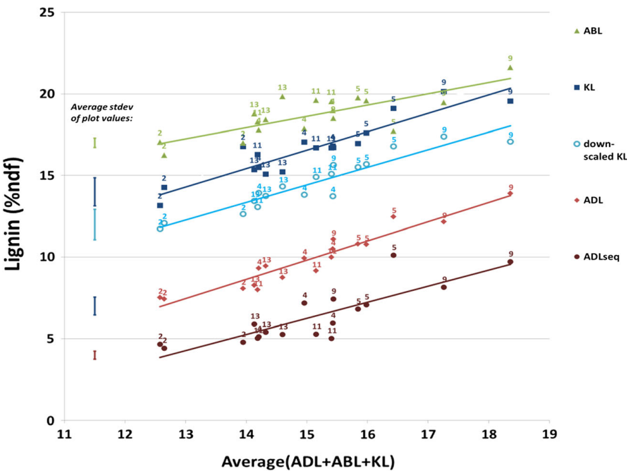
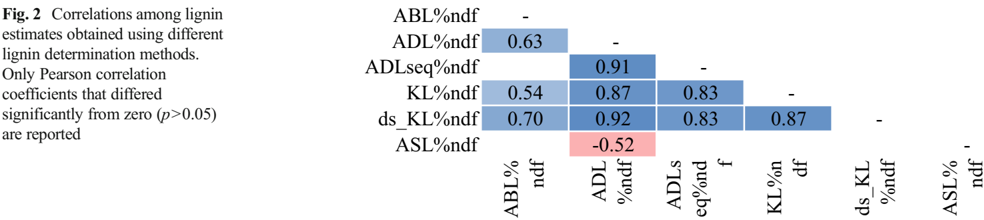
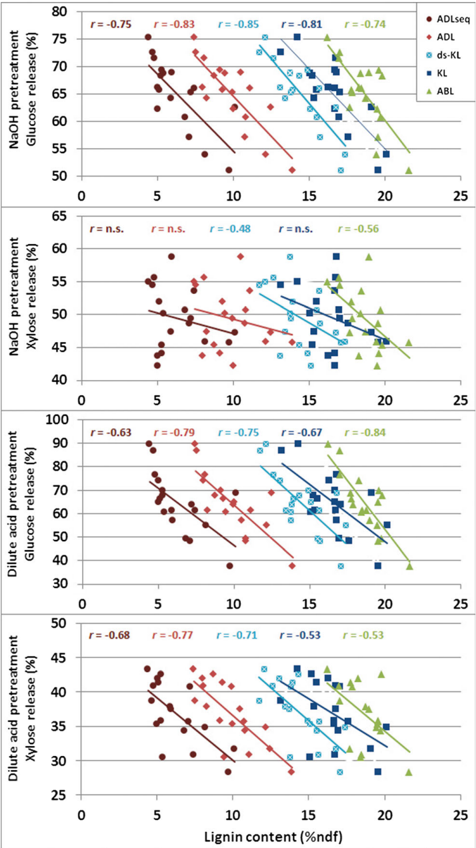
Lignin is a key factor limiting saccharification of lignocellulosic feedstocks. In this comparative study, various lignin methods—including acetyl bromide lignin (ABL), acid detergent lignin (ADL), Klason lignin (KL), and modified ADL and KL determination methods—were evaluated for their potential to assess saccharification efficiency. Six diverse accessions of the bioenergy crop miscanthus were used for this analysis, which included accessions of Miscanthus sinensis , Miscanthus sacchariflorus , and hybrid species. Accessions showed large variation in lignin content. Lignin estimates were different between methods, but (highly) correlated to each other (0.54 ≤ r ≤ 0.94). The strength of negative correlations to saccharification efficiency following either alkaline or dilute acid pretreatment differed between lignin estimates. The strongest and most consistent correlations (−0.48 ≤ r ≤ −0.85) were obtained with a modified Klason lignin method. This method is suitable for high throughput analysis and was the most effective in detecting differences in lignin content ( p < 0.001 ) between accessions.
Overview
The claims and statistics of this paper haven’t been checked yet.
Free: it reads the open-access text and checks the first 5 claims that cite a source we can check. Create a free account to check every claim.
Integrity signals
Registry
Cites
Statistics
Figures
Verification
Claims the paper makes
The claims and statistics of this paper haven’t been checked yet.
Free: it reads the open-access text and checks the first 5 claims that cite a source we can check. Create a free account to check every claim.
Claims other papers make about this one
Each is checked against this paper’s own text: does it say what the citing paper says it does?
The cited source says what the claim attributes to it.
In the citing paper
“While both are Klason lignin procedures, LIG determination involves an additional acid hydrolysis step in an autoclave and the ADL procedure may not retain all lignin components [63].”
From Switchgrass and Giant Miscanthus Biomass and Theoretical Ethanol Production from Reclaimed Mine Lands (2018) · cites this paper as [63]
Self-check
Percentages, sums and reported differences re-computed from the paper’s own numbers.
The self-check needs the paper’s full text.
Citations
Cites
Forage Fiber Analysis (Apparatus, reagents, procedures and some applications)
Goering, H. K. (1970) · Medical Entomology and Zoology · Cited by 5,738
Determination of Structural Carbohydrates and Lignin in Biomass
Sluiter, A. D., Hames, B. R., Ruiz, R. O., Scarlata, C. J., Sluiter, J. B., Templeton, D. W., & Crocker, D. P. (2012) · Cited by 5,261
Lignin Biosynthesis and Structure
Vanholme, R., Demedts, B., Morreel, K., Ralph, J., & Boerjan, W. (2010) · Plant Physiology · doi:10.1104/pp.110.155119 · Cited by 2,664 · cited 1×
“Lignin is chemically described as a heteropolymer of phenylpropanoids, primarily p-coumaryl alcohol, coniferyl alcohol, and sinapyl alcohol, although a variety of other compounds are incorporated in smaller quantities [6, 12, 13].”
Soest, P. J. V. (1963) · Journal of AOAC INTERNATIONAL · doi:10.1093/jaoac/46.5.829 · Cited by 2,566
Soest, P. J. V., & Wine, R. H. (1967) · Journal of AOAC INTERNATIONAL · doi:10.1093/jaoac/50.1.50 · Cited by 2,419
Lignins: Natural polymers from oxidative coupling of 4-hydroxyphenyl- propanoids
Ralph, J., Lundquist, K., Brunow, G., Lu, F., Kim, H., Schatz, P. F., Marita, J. M., Hatfield, R. D., Ralph, S. A., Christensen, J. H., et al. (2004) · Phytochemistry Reviews · doi:10.1023/b:phyt.0000047809.65444.a4 · Cited by 1,660 · cited 1×
“Lignin is chemically described as a heteropolymer of phenylpropanoids, primarily p-coumaryl alcohol, coniferyl alcohol, and sinapyl alcohol, although a variety of other compounds are incorporated in smaller quantities [6, 12, 13].”
Pretreatment: the key to unlocking low‐cost cellulosic ethanol
Yang, B., & Wyman, C. E. (2008) · Biofuels, Bioproducts and Biorefining · doi:10.1002/bbb.49 · Cited by 1,524 · cited 1×
“During dilute acid pretreatment, however, the solubilization of lignin is onlyminimal [49].”
Chlorogenic acids and other cinnamates - nature, occurrence and dietary burden
Clifford, M. N. (1999) · Journal of the Science of Food and Agriculture · doi:10.1002/(sici)1097-0010(19990301)79:3<362::aid-jsfa256>3.0.co;2-d · Cited by 1,335
Enzymatic conversion of lignocellulose into fermentable sugars: challenges and opportunities
Jørgensen, H., Kristensen, J. B., & Felby, C. (2007) · Biofuels, Bioproducts and Biorefining · doi:10.1002/bbb.4 · Cited by 1,143 · cited 2×
“Such a difference between pretreatment types in the amount of lignin remaining in pretreated sample is likely to affect the efficiency of enzymatic saccharification as lignin can irreversibly adsorb hydrolytic enzymes [9, 7].”
Browning, B. L. (1967) · Medical Entomology and Zoology · Cited by 1,139
Research works printed but not linked: 2
- Rose JKC (2003) The plant cell wall. Annual Plant Reviews, vol 8. CRC Press and WileyBlackwell, Oxford
- Heaton EA, Dohleman FG, Miguez AF, Juvik JA, Lozovaya V, Widholm J, Zabotina OA, McIsaac GF, David MB, Voigt TB, Boersma NN, Long SP (2010) Miscanthus. A promising biomass crop. Adv Bot Res 56:76-137
Cited by
Lewandowski, I., Clifton-Brown, J., Trindade, L. M., van der Linden, G. C., Schwarz, K.-U., Müller-Sämann, K., Anisimov, A., Chen, C.-L., Dolstra, O., Donnison, I. S., et al. (2016) · Frontiers in Plant Science · doi:10.3389/fpls.2016.01620 · Cited by 214
Self-citationImpact of drought stress on growth and quality of miscanthus for biofuel production
van der Weijde, T., Huxley, L. M., Hawkins, S., Sembiring, E. H., Farrar, K., Dolstra, O., Visser, R. G. F., & Trindade, L. M. (2017) · GCB Bioenergy · doi:10.1111/gcbb.12382 · Cited by 114
“A consistent and predictable supply of high-quality lignocellulosic feedstocks is crucial to the success of cellulosic biorefineries (Perlack et al., 2005; Van Der Weijde et al., 2013).”
BackgroundSelf-citationPetit, J., Salentijn, E. M. J., Paulo, M., Thouminot, C., van Dinter, B., Magagnini, G., Gusovius, H., Tang, K., Amaducci, S., Wang, S., et al. (2020) · Frontiers in Plant Science · doi:10.3389/fpls.2020.00102 · Cited by 122
Self-citationLignin engineering to improve saccharification and digestibility in grasses
Halpin, C. (2019) · Current Opinion in Biotechnology · doi:10.1016/j.copbio.2019.02.013 · Cited by 105
van der Weijde, T., Kiesel, A., Iqbal, Y., Muylle, H., Dolstra, O., Visser, R. G. F., Lewandowski, I., & Trindade, L. M. (2017) · GCB Bioenergy · doi:10.1111/gcbb.12355 · Cited by 94
“Global Change Biology Bioenergy Published by John Wiley & Sons Ltd., 9, 176–190 Hem and ADL, which are the key factors determining lignocellulose recalcitrance (Xu et al., 2012; Torres et al., 2014; Van Der Weijde et al., 2016).”
BackgroundMethodInfluentialSelf-citationLask, J., Wagner, M., Trindade, L. M., & Lewandowski, I. (2019) · GCB Bioenergy · doi:10.1111/gcbb.12551 · Cited by 86
Self-citationLignin plays a key role in determining biomass recalcitrance in forage grasses
de Oliveira, D. M., Mota, T. R., Grandis, A., de Morais, G. R., de Lucas, R. C., Polizeli, M. D. L. T. D. M., Marchiosi, R., Buckeridge, M. S., Ferrarese‐Filho, O., & dos Santos, W. D. (2019) · Renewable Energy · doi:10.1016/j.renene.2019.10.020 · Cited by 77
Composition and growth of sorghum biomass genotypes for ethanol production
de Almeida, L. G. F., Parrella, R. A. D. C., Simeone, M. L. F., Ribeiro, P. C. D. O., dos Santos, A. S., da Costa, A. S. V., Guimarães, A. G., & Schaffert, R. E. (2019) · Biomass and Bioenergy · doi:10.1016/j.biombioe.2019.01.030 · Cited by 72
“However, lignin, which is a polyphenolic compound, interferes with the saccharification process [43], since it gets in the way of the action of the enzymes to the cellulosic complex, besides being a potential release medium of inhibitors to the fermentation process [44].”
BackgroundWang, B., Shen, X., Wen, J., Xiao, L., & Sun, R. (2017) · International Journal of Biological Macromolecules · doi:10.1016/j.ijbiomac.2017.01.069 · Cited by 53
Scagline-Mellor, S., Griggs, T., Skousen, J., Wolfrum, E., & Holásková, I. (2018) · BioEnergy Research · doi:10.1007/s12155-018-9915-2 · Cited by 52
“While both are Klason lignin procedures, LIG determination involves an additional acid hydrolysis step in an autoclave and the ADL procedure may not retain all lignin components [63].”
MethodBreeding Targets to Improve Biomass Quality in Miscanthus
van der Cruijsen, K., Hassan, M. A., van Erven, G., Dolstra, O., & Trindade, L. M. (2021) · Molecules · doi:10.3390/molecules26020254 · Cited by 48
“Another study reported minor differences in terms of output between these two pretreatment methods, with some genotypes releasing slightly more glucose upon dilute acid treatment and others upon alkaline pretreatment, hence suggesting key differences in their cell wall composition and/or architectures [97].”
BackgroundResultSelf-citationLai, G., Cui, Y., Granato, D., Wen, M., Han, Z., & Zhang, L. (2022) · Food Research International · doi:10.1016/j.foodres.2022.111041 · Cited by 48
Haberzettl, J., Hilgert, P., & von Cossel, M. (2021) · Agronomy · doi:10.3390/agronomy11122397 · Cited by 43
Genetic complexity of miscanthus cell wall composition and biomass quality for biofuels
van der Weijde, T., Kamei, C. L. A., Severing, E. I., Torres, A. F., Gomez, L. D., Dolstra, O., Maliepaard, C. A., McQueen‐Mason, S. J., Visser, R. G. F., & Trindade, L. M. (2017) · BMC Genomics · doi:10.1186/s12864-017-3802-7 · Cited by 42
“These trait associations are consistent with other reports on miscanthus biomass composition and quality for biofuel production [36, 45, 47].”
Self-citationRojas, C. F., Willekens, P., Petit, J., Thouminot, C., Müssig, J., Trindade, L. M., & Vuure, A. W. V. (2017) · Composites Part A Applied Science and Manufacturing · doi:10.1016/j.compositesa.2017.07.017 · Cited by 41
Self-citationLiu, X., Acker, R. V., Voorend, W., Pallidis, A., Goeminne, G., Pollier, J., Morreel, K., Kim, H., Muylle, H., Bosio, M., et al. (2020) · The Plant Journal · doi:10.1111/tpj.15108 · Cited by 37
Damm, T., Grande, P. M., Jablonowski, N. D., Thiele, B., Disko, U., Mann, U., Schurr, U., Leitner, W., Usadel, B., de María, P. D., et al. (2017) · Bioresource Technology · doi:10.1016/j.biortech.2017.08.027 · Cited by 36
van der Weijde, T., Dolstra, O., Visser, R. G. F., & Trindade, L. M. (2017) · Frontiers in Plant Science · doi:10.3389/fpls.2016.02004 · Cited by 35
Self-citationPetit, J., Gulisano, A., Dechesne, A. C., & Trindade, L. M. (2019) · Frontiers in Plant Science · doi:10.3389/fpls.2019.00959 · Cited by 32
Self-citationvon Cossel, M. (2020) · Advanced Sustainable Systems · doi:10.1002/adsu.202000037 · Cited by 31
Pu, Y., Zhou, Q., Yu, L., Chao, L., Dong, Y., Yu, N., & Chen, X. (2020) · Food Packaging and Shelf Life · doi:10.1016/j.fpsl.2020.100536 · Cited by 24
Naz, A. A., Reinert, S., Bostanci, C., Seperi, B., Léon, J., Böttger, C., Südekum, K., & Frei, M. (2017) · GCB Bioenergy · doi:10.1111/gcbb.12433 · Cited by 21
“Gravimetric methods such as Klason lignin and acid detergent lignin (ADL) are widespread, and their correlations with bioenergy yield are well established (Van Der Weijde et al., 2016).”
MethodMapping the genomic regions encoding biomass-related traits in Cynara cardunculus L
Portis, E., Acquadro, A., Tirone, M., Pesce, G. R., Mauromicale, G., & Lanteri, S. (2018) · Molecular Breeding · doi:10.1007/s11032-018-0826-x · Cited by 17
“Producing sufficient plant biomass to satisfy this demand requires the development of high-yield biomass crops (Van der Weijde et al. 2016).”
Grabber, J. H. (2019) · Crop Science · doi:10.2135/cropsci2018.09.0563 · Cited by 14
A large-scale forward genetic screen for maize mutants with altered lignocellulosic properties
Wang, S., Robertz, S., Seven, M., Kraemer, F., Kuhn, B. M., Liu, L., Lunde, C. F., Pauly, M., & Ramírez, V. (2023) · Frontiers in Plant Science · doi:10.3389/fpls.2023.1099009 · Cited by 12
Stochastic model of lignocellulosic material saccharification
Behle, E., & Raguin, A. (2021) · PLoS Computational Biology · doi:10.1371/journal.pcbi.1009262 · Cited by 11
“Lignin acts as an adhesive towards both cellulases and xylanases, and is thought to negatively affect their action [25, 26].”
BackgroundSalt stress alters the cell wall components and structure in Miscanthus sinensis stems
van der Cruijsen, K., Hassan, M. A., van Erven, G., Kollerie, N., van Lent, B., Dechesne, A. C., Dolstra, O., Paulo, M., & Trindade, L. M. (2024) · Physiologia Plantarum · doi:10.1111/ppl.14430 · Cited by 12
Self-citationBeneficial microbes in agriculture under abiotic stress conditions: An overview
Rana, S., Chauhan, R., Walia, A., Sharma, G., & Datt, N. (2021) · The Pharma Innovation · doi:10.22271/tpi.2021.v10.i1e.5542 · Cited by 10
“Drought stress limits crop growth, yield and changes plant chemistry, particularly in arid and semi-arid regions (Emerson et al., 2014; van der Weijde et al., 2016) [23, 62, 90].”
BackgroundZhang, L., Fu, J., Meng, C., Dai, L. Y., Baek, N., Gao, W., & Fan, X. (2023) · Textile Research Journal · doi:10.1177/00405175221145633 · Cited by 8
Rapid Determination of Thioglycolic Acid Lignin for Various Biomass Samples
Shimada, N., Tsuyama, T., & Kamei, I. (2019) · 木材学会誌 · doi:10.2488/jwrs.65.25 · Cited by 8
Jung, W., Sharma-Shivappa, R. R., & Kolar, P. (2019) · Processes · doi:10.3390/pr7100755 · Cited by 7
Malinowska, E., & Torma, S. (2024) · Energies · doi:10.3390/en17225598 · Cited by 6
Bioethanol Production from Olive Solid Residues by Using Rhodotorula Minuta
Al-Rubaie, S. K., & Abdulhay, H. S. (2022) · Iraqi Journal of Science · doi:10.24996/ijs.2022.63.1.6 · Cited by 6
Construction of the SHP-GLOX lignin regulation system and its application in rice straw
Wang, Q., Zhang, J., Li, Y., & Wang, R. (2022) · Plant Methods · doi:10.1186/s13007-022-00917-8 · Cited by 6
Daniel, J. S. V., Silvânia, S. D. S. P., Karen, P. F. D., David, L. N., Lílian, D. A. P., Nísia, A. V. D. P., Valter, C. D. A. J., & Alexandre, S. D. S. (2017) · AFRICAN JOURNAL OF BIOTECHNOLOGY · doi:10.5897/ajb2017.16083 · Cited by 6
“Lignin is a key limiting factor in the saccharification of lignocellulosic feedstocks (Van der Weijde et al., 2016).”
BackgroundDecryption of superior allele and candidate genes for total lignin contents of rapeseed
Yu, W.-K., Yang, Y., Liu, L., Li, Z., Zhu, C., Hu, Q., & Liu, J. (2024) · Industrial Crops and Products · doi:10.1016/j.indcrop.2024.118483 · Cited by 5
Targets and tools for optimizing lignocellulosic biomass quality of miscanthus
van der Weijde, R. T. (2016) · doi:10.18174/384361 · Cited by 7
Lu, T., Zhu, P., Li, H., Liang, R., Li, Y., Liang, X., & Wan, B. (2024) · Journal of Phytopathology · doi:10.1111/jph.13369 · Cited by 3
van der Cruijsen, K., Hassan, M. A., Dolstra, O., Magenau, E., Kontek, M., Ashman, C., Awty‐Carroll, D., Ferrarini, A., Martani, E., van der Pluijm, P., et al. (2025) · GCB Bioenergy · doi:10.1111/gcbb.70059 · Cited by 2
“The analytical procedure for saccharification efficiency was essentially performed as described by van der Weijde et al. (2016).”
Self-citationLignin Stability and Properties
Hossaın, M. T., & Reza, S. (2025) · Springer eBooks · doi:10.1007/978-981-96-7633-0_21 · Cited by 2
Khalekuzzaman, M., Chowdhury, D. R., Nasim, K. M., Pantho, N. A., & Islam, M. R. (2025) · Fuel · doi:10.1016/j.fuel.2025.137798 · Cited by 2
Transcriptome Analysis Provides Insights into Lignin Biosynthesis in Styrax tonkinensis Branches
Han, C., Xu, Q., Chen, H., Peng, H., & Yu, F. (2024) · Forests · doi:10.3390/f15040601 · Cited by 2
Lignin Stability and Properties
Hossaın, M. T., & Reza, S. (2025) · Springer eBooks · doi:10.1007/978-981-97-2664-6_21-1 · Cited by 1
Genetic diversity and mechanisms of salt tolerance of Miscanthus
Chen, C. (2018) · doi:10.18174/456351 · Cited by 1
Novel molecular tools to uncover the genetic architecture of hemp fibre quality
Pedró, J. P. (2020) · doi:10.18174/510653 · Cited by 3
Perrier, L. (2017) · theses.fr (ABES) · doi:10.70675/51e5968fz355dz4969z8572zf6eead14e13f · Cited by 1
Fang, G., Chen, K., Li, Y., Gu, C., Zheng, Z., Liu, G., Yu, Q., Yang, C., Wei, H., Zhang, Q., et al. (2024) · Industrial Crops and Products · doi:10.1016/j.indcrop.2024.119708
Lombardi, G. M. R., Fagundes, T. G., Parrella, R. A. D. C., & Nunes, J. A. R. (2024) · Euphytica · doi:10.1007/s10681-024-03423-1
Kasirajan, L., Vargheese, R. L., Sankararaj, I. Y., & Venkatachalam, A. D. (2025) · Sugar Tech · doi:10.1007/s12355-025-01659-2
“Functionally, lignin reinforces the plant cell wall and acts as a protective barrier, shielding cellulose and hemicellulose from enzymatic and chemical hydrolysis (Weijde et al. 2016).”
Maize breeding for dual-purpose
Gesteiro, N. (2024) · Investigo Institutional repository of UVigo (Universidade de Vigo)
Raverdy, R. (2021) · theses.fr (ABES) · doi:10.70675/bc8e17f0z9beaz4722z9e38zfb84f2cae25b
Wang, S., Robertz, S., Seven, M., Kraemer, F., Kuhn, B. M., Liu, L., Lunde, C., Pauly, M., & Ramírez, V. (2023) · doi:10.3389/fpls.2023.1099009.s003
Metadata
- Authors
- van der Weijde, T., Torres, A. F., Dolstra, O., Dechesne, A., Visser, R. G. F., & Trindade, L. M.
- Affiliations
- Wageningen University & Research (NL)
- Corresponding author
- Trindade, Luisa M.
- Venue
- BioEnergy Research
- Published
- 2015-09-14
- Volume
- 9
- Issue
- 1
- Pages
- 146-156
- ISSN
- 1939-1234 (ISSN-L)
- 1939-1242
- OpenAlex
- W2098087323
- Cited by
- 49
- References
- 55
- Citations by year
- 2025: 5 · 2024: 7 · 2023: 2 · 2022: 3 · 2021: 5 · 2020: 5 · 2019: 7 · 2018: 4 · 2017: 7 · 2016: 4
- FWCI
- 2.49
- Type
- journal article
- Language
- en
- Open access
- hybrid
- doi.org
- Locations
- BioEnergy Research (publishedVersion, cc-by)
- Socio-Environmental Systems Modeling (acceptedVersion, cc-by)
- Data Archiving and Networked Services (DANS) (submittedVersion, cc-by)
- Funders
- Aberystwyth University
- European Commission (2007–2013, 289159)
- Wageningen University and Research
- Topics
- Physical Sciences › Engineering › Biomedical Engineering › Biofuel production and bioconversion
- Life Sciences › Agricultural and Biological Sciences › Agronomy and Crop Science › Bioenergy crop production and management
- Physical Sciences › Chemical Engineering › Process Chemistry and Technology › Lignin and Wood Chemistry
- Keywords
- lignin fractions, saccharification efficiency, Miscanthus, lignocellulosic biomass, Klason lignin, acid detergent lignin, lignin content, acid pretreatment, alkaline pretreatment, Miscanthus sinensis, Miscanthus sacchariflorus, energy crops, accession variation
About these checks
Registry, retraction, Cites and statistics results are computed, not judged, with one exception: a printed reference that no index lists is read once by a model before it counts as a citation error. Claims are extracted by a model and kept only when their quote appears verbatim in the text; each cited source is then checked, with a model’s help, for whether it says what the claim relies on. Those verdicts can be wrong — read the claim’s quote and the cited source before relying on one.
Statistics and arithmetic are recomputed, not judged.
Confidence bands are shown only for fields calibrated on our annotated test set. None is calibrated yet, so no band is shown.
What counts as a claim ›How we measure confidence ›How we check this ›
Are you an author, or do you see a problem with this page? Request a review
Data sources
Bibliographic data: Semantic Scholar, OpenAlex, Crossref.
Contains information from the Semantic Scholar Academic Graph Datasets, made available under the ODC Attribution License (ODC-BY 1.0).
Semantic Scholar’s data is described in: Kinney, R., et al. (2023). The Semantic Scholar Open Data Platform. arXiv:2301.10140.
