

Impact of Different Lignin Fractions on Saccharification Efficiency in Diverse Species of the Bioenergy Crop Miscanthus
Open accessThe DOI matches its Crossref record; 55 of the 55 references it cites were found in a registry or an index.
Abstract
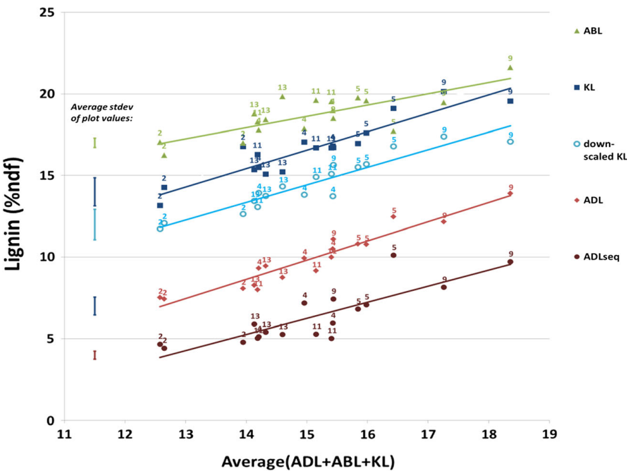
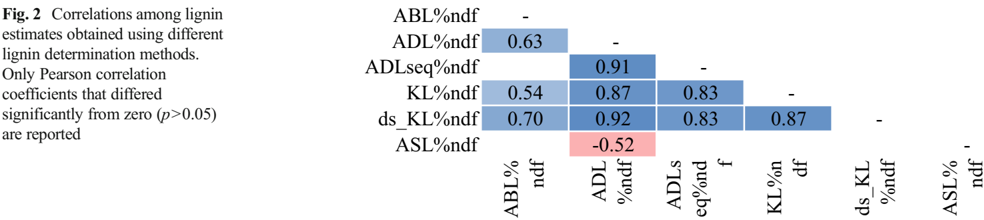
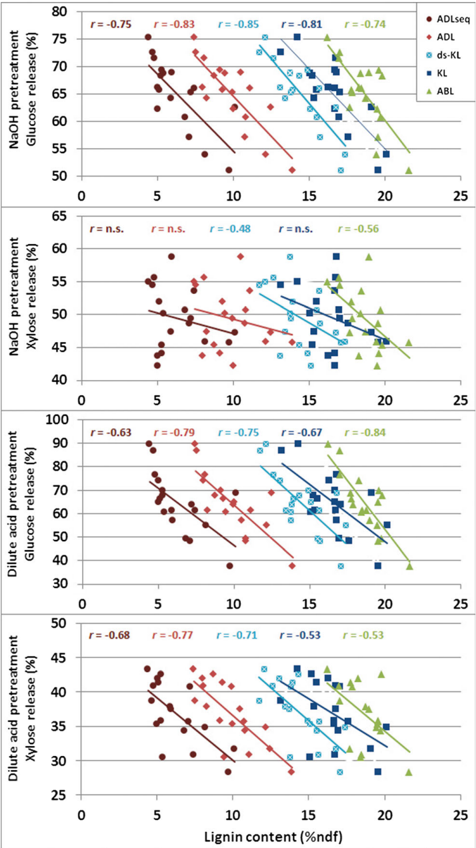
Lignin is a key factor limiting saccharification of lignocellulosic feedstocks. In this comparative study, various lignin methods—including acetyl bromide lignin (ABL), acid detergent lignin (ADL), Klason lignin (KL), and modified ADL and KL determination methods—were evaluated for their potential to assess saccharification efficiency. Six diverse accessions of the bioenergy crop miscanthus were used for this analysis, which included accessions of Miscanthus sinensis , Miscanthus sacchariflorus , and hybrid species. Accessions showed large variation in lignin content. Lignin estimates were different between methods, but (highly) correlated to each other (0.54 ≤ r ≤ 0.94). The strength of negative correlations to saccharification efficiency following either alkaline or dilute acid pretreatment differed between lignin estimates. The strongest and most consistent correlations (−0.48 ≤ r ≤ −0.85) were obtained with a modified Klason lignin method. This method is suitable for high throughput analysis and was the most effective in detecting differences in lignin content ( p < 0.001 ) between accessions.
Overview
The claims and statistics of this paper haven’t been checked yet.
Free: it reads the open-access text and checks the first 5 claims that cite a source we can check. Create a free account to check every claim.
Integrity signals
Registry
Cites
Statistics
Figures
Verification
Claims the paper makes
The claims and statistics of this paper haven’t been checked yet.
Free: it reads the open-access text and checks the first 5 claims that cite a source we can check. Create a free account to check every claim.
Claims other papers make about this one
Each is checked against this paper’s own text: does it say what the citing paper says it does?
The cited source says what the claim attributes to it.
In the citing paper
“While both are Klason lignin procedures, LIG determination involves an additional acid hydrolysis step in an autoclave and the ADL procedure may not retain all lignin components [63].”
From Switchgrass and Giant Miscanthus Biomass and Theoretical Ethanol Production from Reclaimed Mine Lands (2018) · cites this paper as [63]
Self-check
Percentages, sums and reported differences re-computed from the paper’s own numbers.
The self-check needs the paper’s full text.
Citations
Cites
Forage Fiber Analysis (Apparatus, reagents, procedures and some applications)
Goering, H. K. (1970) · Medical Entomology and Zoology · Cited by 5,738
Determination of Structural Carbohydrates and Lignin in Biomass
Sluiter, A. D., Hames, B. R., Ruiz, R. O., Scarlata, C. J., Sluiter, J. B., Templeton, D. W., & Crocker, D. P. (2012) · Cited by 5,261
Lignin Biosynthesis and Structure
Vanholme, R., Demedts, B., Morreel, K., Ralph, J., & Boerjan, W. (2010) · Plant Physiology · doi:10.1104/pp.110.155119 · Cited by 2,664 · cited 1×
“Lignin is chemically described as a heteropolymer of phenylpropanoids, primarily p-coumaryl alcohol, coniferyl alcohol, and sinapyl alcohol, although a variety of other compounds are incorporated in smaller quantities [6, 12, 13].”
Soest, P. J. V. (1963) · Journal of AOAC INTERNATIONAL · doi:10.1093/jaoac/46.5.829 · Cited by 2,566
Soest, P. J. V., & Wine, R. H. (1967) · Journal of AOAC INTERNATIONAL · doi:10.1093/jaoac/50.1.50 · Cited by 2,419
Lignins: Natural polymers from oxidative coupling of 4-hydroxyphenyl- propanoids
Ralph, J., Lundquist, K., Brunow, G., Lu, F., Kim, H., Schatz, P. F., Marita, J. M., Hatfield, R. D., Ralph, S. A., Christensen, J. H., et al. (2004) · Phytochemistry Reviews · doi:10.1023/b:phyt.0000047809.65444.a4 · Cited by 1,660 · cited 1×
“Lignin is chemically described as a heteropolymer of phenylpropanoids, primarily p-coumaryl alcohol, coniferyl alcohol, and sinapyl alcohol, although a variety of other compounds are incorporated in smaller quantities [6, 12, 13].”
Pretreatment: the key to unlocking low‐cost cellulosic ethanol
Yang, B., & Wyman, C. E. (2008) · Biofuels, Bioproducts and Biorefining · doi:10.1002/bbb.49 · Cited by 1,524 · cited 1×
“During dilute acid pretreatment, however, the solubilization of lignin is onlyminimal [49].”
Chlorogenic acids and other cinnamates - nature, occurrence and dietary burden
Clifford, M. N. (1999) · Journal of the Science of Food and Agriculture · doi:10.1002/(sici)1097-0010(19990301)79:3<362::aid-jsfa256>3.0.co;2-d · Cited by 1,335
Enzymatic conversion of lignocellulose into fermentable sugars: challenges and opportunities
Jørgensen, H., Kristensen, J. B., & Felby, C. (2007) · Biofuels, Bioproducts and Biorefining · doi:10.1002/bbb.4 · Cited by 1,143 · cited 2×
“Such a difference between pretreatment types in the amount of lignin remaining in pretreated sample is likely to affect the efficiency of enzymatic saccharification as lignin can irreversibly adsorb hydrolytic enzymes [9, 7].”
Browning, B. L. (1967) · Medical Entomology and Zoology · Cited by 1,139
(1993) · International Journal of Biochemistry · doi:10.1016/0020-711x(93)90263-e · Cited by 1,084
Zhao, X., Zhang, L., & Liu, D. (2012) · Biofuels, Bioproducts and Biorefining · doi:10.1002/bbb.1331 · Cited by 986 · cited 2×
“Such a difference between pretreatment types in the amount of lignin remaining in pretreated sample is likely to affect the efficiency of enzymatic saccharification as lignin can irreversibly adsorb hydrolytic enzymes [9, 7].”
Development of a Comprehensive System of Feed Analyses and its Application to Forages
Van Soest, P. J. (1967) · Journal of Animal Science · doi:10.2527/jas1967.261119x · Cited by 930
STRUCTURE AND BIOGENESIS OF THE CELL WALLS OF GRASSES
Carpita, N. C. (1996) · Annual Review of Plant Physiology and Plant Molecular Biology · doi:10.1146/annurev.arplant.47.1.445 · Cited by 881
A comparison of chemical pretreatment methods for improving saccharification of cotton stalks
Silverstein, R. A., Chen, Y., Sharma-Shivappa, R. R., Boyette, M. D., & Osborne, J. (2007) · Bioresource Technology · doi:10.1016/j.biortech.2006.10.022 · Cited by 851 · cited 2×
“At the alkaline pretreatment conditions evaluated in this study approximately 50 % of the lignin is likely to be removed, as predicted by a formula developed to estimate lignin removal during NaOH pretreatment [42].”
Dence, C. W. (1992) · Springer Series in Wood Science · doi:10.1007/978-3-642-74065-7_3 · Cited by 688
What is (and is not) vital to advancing cellulosic ethanol
Wyman, C. E. (2007) · Trends in Biotechnology · doi:10.1016/j.tibtech.2007.02.009 · Cited by 642
Grabber, J. H. (2005) · Crop Science · doi:10.2135/cropsci2004.0191 · Cited by 574
Can Lignin Be Accurately Measured?
Hatfield, R., & Fukushima, R. S. (2005) · Crop Science · doi:10.2135/cropsci2004.0238 · Cited by 449 · cited 20×
“due to its aromatic nature and has a high tendency to selfassociate [15, 16].”
InfluentialEnzymatic Saccharification of Lignocellulosic Biomass
Ayyachamy, M., Gupta, V. K., Cliffe, F. E., & Tuohy, M. G. (2013) · Laboratory Protocols in Fungal Biology · doi:10.1007/978-1-4614-2356-0_44 · Cited by 409
Lignocellulose pretreatment severity – relating pH to biomatrix opening
Pedersen, M., & Meyer, A. S. (2010) · New Biotechnology · doi:10.1016/j.nbt.2010.05.003 · Cited by 375 · cited 1×
“90 for sodium hydroxide and sulfuric acid, respectively, [41, 42]; and T is the reaction temperature in °C.”
Phenolic compound biochemistry
(2007) · Choice Reviews Online · doi:10.5860/choice.45-0882 · Cited by 373
Moreira-Vilar, F. C., Siqueira-Soares, R. D. C., Finger-Teixeira, A., Oliveira, D. M. D., Ferro, A. P., da Rocha, G. J., Ferrarese, M. D. L. L., dos Santos, W. D., & Ferrarese-Filho, O. (2014) · PLoS ONE · doi:10.1371/journal.pone.0110000 · Cited by 328 · cited 2×
“Such striking differences were anticipated and are consistent with the results of previously published comparisons of these lignin methods [23, 26, 27, 29, 32, 47].”
Hatfield, R. D., Jung, H. G., Ralph, J., Buxton, D. R., & Weimer, P. J. (1994) · Journal of the Science of Food and Agriculture · doi:10.1002/jsfa.2740650109 · Cited by 313 · cited 3×
“loss of lignin during the acid detergent extraction of the method [23, 32].”
Xu, N., Zhang, W., Ren, S., Liu, F., Zhao, C., Liao, H., Xu, Z., Huang, J., Li, Q., Tu, Y., et al. (2012) · Biotechnology for Biofuels · doi:10.1186/1754-6834-5-58 · Cited by 303 · cited 1×
“[38]; and Sample is the amount of NDF material in mg.”
Cell wall cross-linking by ferulates and diferulates in grasses
Hatfield, R. D., Ralph, J., & Grabber, J. H. (1999) · Journal of the Science of Food and Agriculture · doi:10.1002/(sici)1097-0010(19990301)79:3<403::aid-jsfa263>3.0.co;2-0 · Cited by 303 · cited 1×
“since lignin and hemicellulosic polysaccharides are extensively cross-linked by ferulate bridges [4, 6, 50], the large difference in the amount of lignin that remains in the pretreated”
Grabber, J. H., Ralph, J., Lapierre, C., & Barrière, Y. (2004) · Comptes Rendus. Biologies · doi:10.1016/j.crvi.2004.02.009 · Cited by 284
Fukushima, R. S., & Hatfield, R. D. (2001) · Journal of Agricultural and Food Chemistry · doi:10.1021/jf010449r · Cited by 271 · cited 1×
“Furthermore, these methods require a well-defined lignin standard to calibrate the estimation of lignin concentration from optical density measurements [16, 25].”
Heaton, E. A., Dohleman, F. G., Miguez, A. F., Juvik, J. A., Lozovaya, V., Widholm, J., Zabotina, O. A., McIsaac, G. F., David, M. B., Voigt, T. B., et al. (2010) · Advances in Botanical Research · doi:10.1016/b978-0-12-381518-7.00003-0 · Cited by 258
Advances in modifying lignin for enhanced biofuel production
Simmons, B. A., Loqué, D., & Ralph, J. (2010) · Current Opinion in Plant Biology · doi:10.1016/j.pbi.2010.03.001 · Cited by 250 · cited 1×
“As lignin is one of the most important barriers in the conversion of biomass into biofuels, reducing lignin content (or altering its composition) in bioenergy crops is critical to reduce processing costs and increase the cost-competitiveness of cellulosic biofuels [10, 11].”
Chen, M., Zhao, J., & Xia, L. (2009) · Biomass and Bioenergy · doi:10.1016/j.biombioe.2009.05.025 · Cited by 239
Jung, H. G., Mertens, D. R., & Payne, A. J. (1997) · Journal of Dairy Science · doi:10.3168/jds.s0022-0302(97)76093-4 · Cited by 236 · cited 1×
“Such striking differences were anticipated and are consistent with the results of previously published comparisons of these lignin methods [23, 26, 27, 29, 32, 47].”
Fukushima, R. S., & Hatfield, R. D. (2004) · Journal of Agricultural and Food Chemistry · doi:10.1021/jf035497l · Cited by 231 · cited 4×
“mance of some lignin methods on a number of different plant samples and reported on average a twofold difference in lignin content between the ABL method and the ADL method [29].”
InfluentialPlant cell walls: the skeleton of the plant world
Doblin, M. S., Pettolino, F., & Bacic, A. (2010) · Functional Plant Biology · doi:10.1071/fp09279 · Cited by 216
Brinkmann, K., Blaschke, L., & Polle, A. (2002) · Journal of Chemical Ecology · doi:10.1023/a:1021484002582 · Cited by 180
Lignin: Characterization of a Multifaceted Crop Component
Frei, M. (2013) · The Scientific World Journal · doi:10.1155/2013/436517 · Cited by 176
The spectrophotometric determination of lignin in small wood samples
Johnson, D. B., Moore, W. E., & Zank, L. C. (1961) · TAPPI Journal · Cited by 170
Chemistry and Molecular Organization of Plant Cell Walls
Harris, P. J., & Stone, B. (2008) · Wiley eBooks · doi:10.1002/9781444305418.ch4 · Cited by 148
Hodgson, E., Lister, S. J., Bridgwater, A. V., Brown, J. C., & Donnison, I. S. (2010) · Biomass and Bioenergy · doi:10.1016/j.biombioe.2010.01.008 · Cited by 134
Fukushima, R. S., & Kerley, M. S. (2011) · Journal of Agricultural and Food Chemistry · doi:10.1021/jf104826n · Cited by 130 · cited 3×
“[34]; DF is the dilution factor, 100×; 17.”
InfluentialAccuracy of Klason Lignin and Acid Detergent Lignin Methods As Assessed by Bomb Calorimetry
Jung, H.-J. G., Varel, V. H., Weimer, P. J., & Ralph, J. (1999) · Journal of Agricultural and Food Chemistry · doi:10.1021/jf981250q · Cited by 120 · cited 3×
“loss of lignin during the acid detergent extraction of the method [23, 32].”
Isolation and Identification of Phenolic Compounds
Vermerris, W., & Nicholson, R. L. (2007) · Springer eBooks · doi:10.1007/978-1-4020-5164-7_4 · Cited by 96 · cited 1×
“It is based on the hydrolysis of cell wall polysaccharides using sulphuric acid and gravimetric determination of the acid insoluble residue as Klason lignin (KL) [17, 18].”
LYGIN, A. V., UPTON, J., DOHLEMAN, F. G., JUVIK, J., ZABOTINA, O. A., WIDHOLM, J. M., & LOZOVAYA, V. V. (2011) · GCB Bioenergy · doi:10.1111/j.1757-1707.2011.01091.x · Cited by 95 · cited 1×
“[35]; and Sample is the amount of NDF material in mg.”
Phenotypic Variation in Senescence in Miscanthus: Towards Optimising Biomass Quality and Quantity
Robson, P. R. H., Mos, M., Brown, J. C., & Donnison, I. S. (2011) · BioEnergy Research · doi:10.1007/s12155-011-9118-6 · Cited by 88
Ibáñez, A. B., & Bauer, Š. (2014) · Biomass and Bioenergy · doi:10.1016/j.biombioe.2014.06.013 · Cited by 75 · cited 3×
“(2014) upon down-scaling the Klasonmethod, so it is unlikely to be due to a technical error [48].”
InfluentialOur Challenge is to Acquire Deeper Understanding of Biomass Recalcitrance and Conversion
Himmel, M. E., & Picataggio, S. K. (2008) · Wiley eBooks · doi:10.1002/9781444305418.ch1 · Cited by 46
Torres, A. F., van der Weijde, T., Dolstra, O., Visser, R. G. F., & Trindade, L. M. (2013) · BioEnergy Research · doi:10.1007/s12155-013-9337-0 · Cited by 40
Self-citationLignins: A Twenty‐First Century Challenge
Davin, L. B., Patten, A. M., Jourdes, M., & Lewis, N. (2008) · Wiley eBooks · doi:10.1002/9781444305418.ch7 · Cited by 37
Cell Wall Diversity in Forage Maize: Genetic Complexity and Bioenergy Potential
Torres, A. F., Noordam-Boot, C. M. M., Dolstra, O., van der Weijde, T., Combes, E., Dufour, P., Vlaswinkel, L., Visser, R. G. F., & Trindade, L. M. (2014) · BioEnergy Research · doi:10.1007/s12155-014-9507-8 · Cited by 35 · cited 1×
“The ratio of arabinose to xylose was also determined, which constitutes an estimate of the degree of hemicellulose substitution (DHS) [39].”
Self-citationTakahashi, T., Fujii, T., & Yasuoka, Y. (2004) · International Journal of Remote Sensing · doi:10.1080/01431160410001735102 · Cited by 32
Goff, B. M., Murphy, P. T., & Moore, K. J. (2011) · Journal of the Science of Food and Agriculture · doi:10.1002/jsfa.4637 · Cited by 29 · cited 2×
“Such striking differences were anticipated and are consistent with the results of previously published comparisons of these lignin methods [23, 26, 27, 29, 32, 47].”
Some Characteristics of Forage Plant Lignin
Kondo, T., 水野, 和., & Kato, T. (1987) · Japan Agricultural Research Quarterly JARQ · Cited by 26
Methods of wood chemistry. Volumes I & II.
Browning, B. L. (1967) · Cited by 13
Lacerda, R. S., Gomide, C. A., Fukushima, R. S., Schmidt, R. J., & Herling, V. R. (2006) · Brazilian Journal of Veterinary Research and Animal Science · doi:10.11606/issn.1678-4456.bjvras.2006.26489 · Cited by 9
Lignin concentration in oat (Avena byzantina L.) aerial part as measured by four analytical methods
Lacerda, R. S., Gomide, C. A., Shigueo, R., et al. (2006) · Cited by 5
Research works printed but not linked: 2
- Rose JKC (2003) The plant cell wall. Annual Plant Reviews, vol 8. CRC Press and WileyBlackwell, Oxford
- Heaton EA, Dohleman FG, Miguez AF, Juvik JA, Lozovaya V, Widholm J, Zabotina OA, McIsaac GF, David MB, Voigt TB, Boersma NN, Long SP (2010) Miscanthus. A promising biomass crop. Adv Bot Res 56:76-137
Cited by
Lewandowski, I., Clifton-Brown, J., Trindade, L. M., van der Linden, G. C., Schwarz, K.-U., Müller-Sämann, K., Anisimov, A., Chen, C.-L., Dolstra, O., Donnison, I. S., et al. (2016) · Frontiers in Plant Science · doi:10.3389/fpls.2016.01620 · Cited by 214
Self-citationImpact of drought stress on growth and quality of miscanthus for biofuel production
van der Weijde, T., Huxley, L. M., Hawkins, S., Sembiring, E. H., Farrar, K., Dolstra, O., Visser, R. G. F., & Trindade, L. M. (2017) · GCB Bioenergy · doi:10.1111/gcbb.12382 · Cited by 114
“A consistent and predictable supply of high-quality lignocellulosic feedstocks is crucial to the success of cellulosic biorefineries (Perlack et al., 2005; Van Der Weijde et al., 2013).”
BackgroundSelf-citationPetit, J., Salentijn, E. M. J., Paulo, M., Thouminot, C., van Dinter, B., Magagnini, G., Gusovius, H., Tang, K., Amaducci, S., Wang, S., et al. (2020) · Frontiers in Plant Science · doi:10.3389/fpls.2020.00102 · Cited by 122
Self-citationLignin engineering to improve saccharification and digestibility in grasses
Halpin, C. (2019) · Current Opinion in Biotechnology · doi:10.1016/j.copbio.2019.02.013 · Cited by 105
van der Weijde, T., Kiesel, A., Iqbal, Y., Muylle, H., Dolstra, O., Visser, R. G. F., Lewandowski, I., & Trindade, L. M. (2017) · GCB Bioenergy · doi:10.1111/gcbb.12355 · Cited by 94
“Global Change Biology Bioenergy Published by John Wiley & Sons Ltd., 9, 176–190 Hem and ADL, which are the key factors determining lignocellulose recalcitrance (Xu et al., 2012; Torres et al., 2014; Van Der Weijde et al., 2016).”
BackgroundMethodInfluentialSelf-citation
Metadata
- Authors
- van der Weijde, T., Torres, A. F., Dolstra, O., Dechesne, A., Visser, R. G. F., & Trindade, L. M.
- Affiliations
- Wageningen University & Research (NL)
- Corresponding author
- Trindade, Luisa M.
- Venue
- BioEnergy Research
- Published
- 2015-09-14
- Volume
- 9
- Issue
- 1
- Pages
- 146-156
- ISSN
- 1939-1234 (ISSN-L)
- 1939-1242
- OpenAlex
- W2098087323
- Cited by
- 49
- References
- 55
- Citations by year
- 2025: 5 · 2024: 7 · 2023: 2 · 2022: 3 · 2021: 5 · 2020: 5 · 2019: 7 · 2018: 4 · 2017: 7 · 2016: 4
- FWCI
- 2.49
- Type
- journal article
- Language
- en
- Open access
- hybrid
- doi.org
- Locations
- BioEnergy Research (publishedVersion, cc-by)
- Socio-Environmental Systems Modeling (acceptedVersion, cc-by)
- Data Archiving and Networked Services (DANS) (submittedVersion, cc-by)
- Funders
- Aberystwyth University
- European Commission (2007–2013, 289159)
- Wageningen University and Research
- Topics
- Physical Sciences › Engineering › Biomedical Engineering › Biofuel production and bioconversion
- Life Sciences › Agricultural and Biological Sciences › Agronomy and Crop Science › Bioenergy crop production and management
- Physical Sciences › Chemical Engineering › Process Chemistry and Technology › Lignin and Wood Chemistry
- Keywords
- lignin fractions, saccharification efficiency, Miscanthus, lignocellulosic biomass, Klason lignin, acid detergent lignin, lignin content, acid pretreatment, alkaline pretreatment, Miscanthus sinensis, Miscanthus sacchariflorus, energy crops, accession variation
About these checks
Registry, retraction, Cites and statistics results are computed, not judged, with one exception: a printed reference that no index lists is read once by a model before it counts as a citation error. Claims are extracted by a model and kept only when their quote appears verbatim in the text; each cited source is then checked, with a model’s help, for whether it says what the claim relies on. Those verdicts can be wrong — read the claim’s quote and the cited source before relying on one.
Statistics and arithmetic are recomputed, not judged.
Confidence bands are shown only for fields calibrated on our annotated test set. None is calibrated yet, so no band is shown.
What counts as a claim ›How we measure confidence ›How we check this ›
Are you an author, or do you see a problem with this page? Request a review
Data sources
Bibliographic data: Semantic Scholar, OpenAlex, Crossref.
Contains information from the Semantic Scholar Academic Graph Datasets, made available under the ODC Attribution License (ODC-BY 1.0).
Semantic Scholar’s data is described in: Kinney, R., et al. (2023). The Semantic Scholar Open Data Platform. arXiv:2301.10140.
