

Non-linear Characterization of Commercial and Decellularized Hydrogels: Statistical Framework Enhanced by Bayesian Optimization
Open accessThe DOI matches its Crossref record; 63 of the 63 references it cites were found in a registry or an index.
Abstract
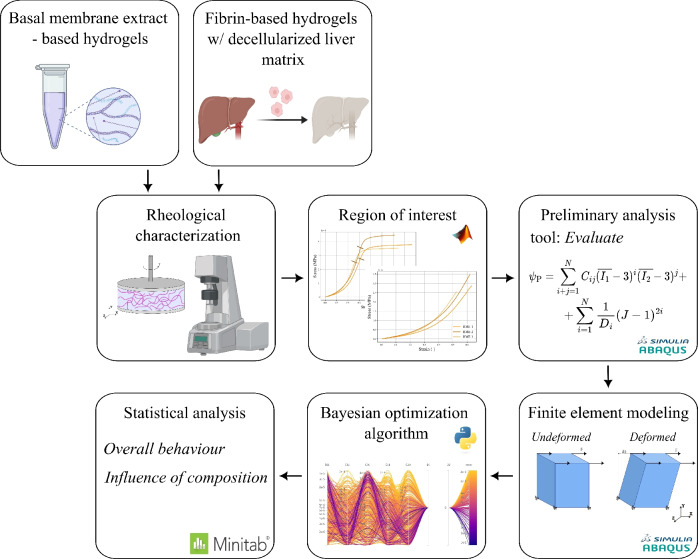
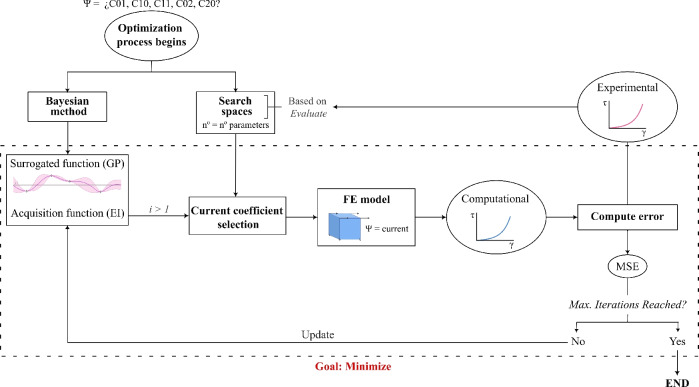
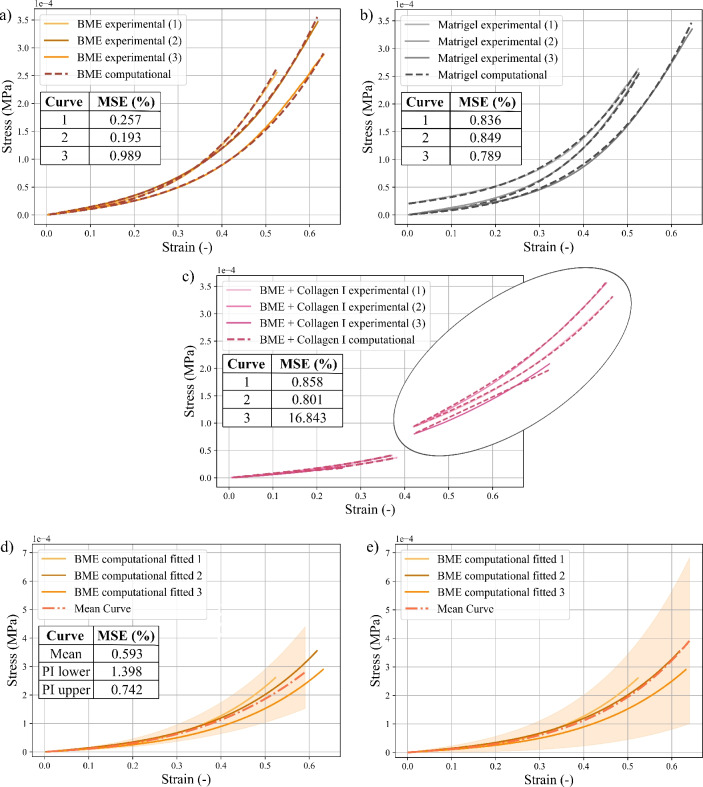
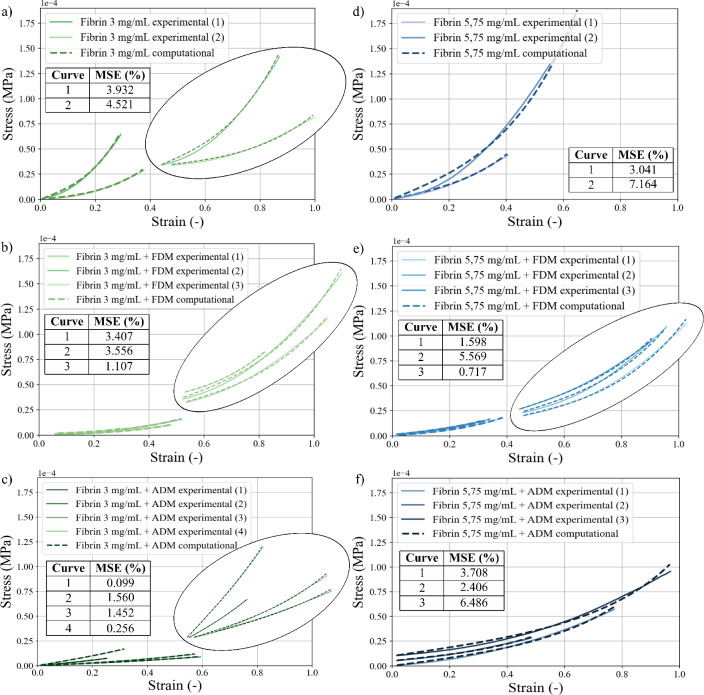
Scope: Hydrogels are widely used in the design of tissue substitutes because of their ability to mimic the extracellular matrix (ECM). Their mechanical cues critically influence the cellular response, making accurate characterization essential. However, it remains challenging due to their intricate nature. This study computationally evaluates the hyperelastic properties of next-generation hydrogels of high biomedical interest, including basal membrane extract and decellularized liver matrices, as well as structural proteins. Methods: We present a combined framework based on Bayesian optimization and statistical analyses that go beyond classical least-squares fitting, leveraging rheological experimental data. It defines each hyperelastic strain-energy density function, and addresses both intra- and inter-sample variability. This approach quantifies uncertainty and reveals the natural variability that deterministic models overlook, and it also enables quantification of coefficient variation with composition. Results: Validation against experimental data shows computational fits of 5% error in most cases, and low calculation time. Analyses reveal that composition—collagen addition, fibrin concentration, and decellularized extracellular matrix (dECM) age—modulate initial stiffness, nonlinearity, and overall mechanical resistance of the hydrogels. Conclusion: Hydrogels derived from basal membrane extracts exhibit comparable non-linear mechanics, while collagen addition reduces stiffness and nonlinearity. In fibrin-based hydrogels with decellularized liver matrix, mechanical behavior is concentration and age-dependent. Such insights are highly relevant for mechanobiology, enabling prediction of how cells sense mechanical cues and scaffold composition influences in vivo interactions.
Overview
The claims and statistics of this paper haven’t been checked yet.
Free: it reads the open-access text and checks the first 5 claims that cite a source we can check. Create a free account to check every claim.
Integrity signals
Registry
Cites
Statistics
Figures
Verification
Claims the paper makes
The claims and statistics of this paper haven’t been checked yet.
Free: it reads the open-access text and checks the first 5 claims that cite a source we can check. Create a free account to check every claim.
Self-check
Percentages, sums and reported differences re-computed from the paper’s own numbers.
The self-check needs the paper’s full text.
Citations
Cites
Matrix elasticity directs stem cell lineage specification
Engler, A. J., Sen, S., Sweeney, H. L., & Discher, D. E. (2006) · Cell · doi:10.1016/j.cell.2006.06.044 · Cited by 13,915
Gaussian Processes in Machine Learning
Rasmussen, C. E. (2004) · Lecture Notes in Computer Science · doi:10.1007/978-3-540-28650-9_4 · Cited by 5,397
Normality Tests for Statistical Analysis: A Guide for Non-Statisticians
Ghasemi, A., & Zahediasl, S. (2012) · International Journal of Endocrinology and Metabolism · doi:10.5812/ijem.3505 · Cited by 4,368 · cited 1×
“Normality is verified using probability plots [45].”
Hydrogels as extracellular matrix mimics for 3D cell culture
Tibbitt, M. W., & Anseth, K. S. (2009) · Biotechnology and Bioengineering · doi:10.1002/bit.22361 · Cited by 2,727 · cited 1×
“They are characterized by an aqueous microenvironment and a nonlinear viscoelastic behavior [15].”
Hydrogels in regenerative medicine
Slaughter, B. V., Khurshid, S. S., Fisher, O. Z., Khademhosseini, A., & Peppas, N. A. (2009) · Advanced Materials · doi:10.1002/adma.200802106 · Cited by 2,703
Vacanti, J. P., & Langer, R. (1999) · The Lancet · doi:10.1016/s0140-6736(99)90247-7 · Cited by 1,323
Acerbi, I., Cassereau, L., Dean, I., Shi, Q., Au, A., Park, C., Chen, Y. Y., Liphardt, J., Hwang, E. S., & Weaver, V. M. (2015) · Integrative Biology · doi:10.1039/c5ib00040h · Cited by 1,059
Extracellular matrix dynamics in development and regenerative medicine
Daley, W. P., Peters, S. B., & Larsen, M. (2008) · Journal of Cell Science · doi:10.1242/jcs.006064 · Cited by 971
Differentiation of human embryonic stem cells on three-dimensional polymer scaffolds
Levenberg, S., Huang, N. F., Lavik, E., Rogers, A. B., Itskovitz-Eldor, J., & Langer, R. (2003) · Proceedings of the National Academy of Sciences · doi:10.1073/pnas.1735463100 · Cited by 692
Cell Mechanics: Integrating Cell Responses to Mechanical Stimuli
Janmey, P. A., & McCulloch, C. A. (2007) · Annual Review of Biomedical Engineering · doi:10.1146/annurev.bioeng.9.060906.151927 · Cited by 630
Cushing, M. C., & Anseth, K. S. (2007) · Science · doi:10.1126/science.1140171 · Cited by 517
Differentiation of human embryonic stem cells into hepatocytes in 2D and 3D culture systems in vitro
Baharvand, H., Hashemi, S. M., Kazemi Ashtiani, S., & Farrokhi, A. (2006) · The International Journal of Developmental Biology · doi:10.1387/ijdb.052072hb · Cited by 429 · cited 1×
“This 3D context has been shown to promote embryonic stem cell differentiation [10, 11], for example, Kaur et al. [12] demonstrated that intrahepatic cholangiocyte organoids (ICOs) encapsulated in dECM liver hydrogels engrafted and differentiated into hepatocytes, while reducing fibrosis.”
Mechanical properties of whole-body soft human tissues: a review
Singh, G., & Chanda, A. (2021) · Biomedical Materials · doi:10.1088/1748-605x/ac2b7a · Cited by 364
Hydrogels with time-dependent material properties enhance cardiomyocyte differentiation in vitro
Young, J. L., & Engler, A. J. (2011) · Biomaterials · doi:10.1016/j.biomaterials.2010.10.020 · Cited by 358
D'Agostino, R. (2017) · Routledge eBooks · doi:10.1201/9780203753064 · Cited by 335
Three-dimensional force microscopy of cells in biopolymer networks
Steinwachs, J., Metzner, C., Skodzek, K., Lang, N., Thievessen, I., Mark, C., Münster, S., Aifantis, K. E., & Fabry, B. (2016) · Nature Methods · doi:10.1038/nmeth.3685 · Cited by 334
Tissue mechanics regulate brain development, homeostasis and disease
Barnes, J. M., Przybyla, L., & Weaver, V. M. (2017) · Journal of Cell Science · doi:10.1242/jcs.191742 · Cited by 316
Tissue Engineering Approaches in the Design of Healthy and Pathological In Vitro Tissue Models
Caddeo, S., Boffito, M., & Sartori, S. (2017) · Frontiers in Bioengineering and Biotechnology · doi:10.3389/fbioe.2017.00040 · Cited by 285 · cited 1×
“However, replicating the mechanical properties of biological tissues remains a significant challenge, largely due to their inherent variability and complexity resulting from bidirectional interactions with cells [16].”
Caccavo, D., Cascone, S., Lamberti, G., & Barba, A. A. (2018) · Chemical Society Reviews · doi:10.1039/c7cs00638a · Cited by 262
Mawazi, S. M., Kumar, M., Ahmad, N., Ge, Y., & Mahmood, S. (2024) · Polymers · doi:10.3390/polym16101351 · Cited by 262
Wang, L., Wang, C., Wu, S., Fan, Y., & Li, X. (2020) · Biomaterials Science · doi:10.1039/d0bm00269k · Cited by 233
Rationally designed synthetic protein hydrogels with predictable mechanical properties
Wu, J., Li, P., Dong, C., Jiang, H., Xue, B., Gao, X., Qin, M., Wang, W., Chen, B., & Cao, Y. (2018) · Nature Communications · doi:10.1038/s41467-018-02917-6 · Cited by 230
Maul, T. M., Chew, D. W., Nieponice, A., & Vorp, D. A. (2011) · Biomechanics and Modeling in Mechanobiology · doi:10.1007/s10237-010-0285-8 · Cited by 224
Intrinsic stiffness of extracellular matrix increases with age in skeletal muscles of mice
Wood, L. K., Kayupov, E., Gumucio, J. P., Mendias, C. L., Claflin, D. R., & Brooks, S. V. (2014) · Journal of Applied Physiology · doi:10.1152/japplphysiol.00256.2014 · Cited by 216
Resistance to Fluid Shear Stress Is a Conserved Biophysical Property of Malignant Cells
Barnes, J. M., Nauseef, J. T., & Henry, M. D. (2012) · PLoS ONE · doi:10.1371/journal.pone.0050973 · Cited by 203 · cited 1×
“Moreover, the ability of malignant cells to withstand shear stress appears to be a conserved biophysical trait, suggesting adaptive mechanical mechanisms that support their survival and dissemination [69].”
Advances in hydrogel-based vascularized tissues for tissue repair and drug screening
Wang, Y., Kankala, R. K., Ou, C., Chen, A., & Yang, Z. (2021) · Bioactive Materials · doi:10.1016/j.bioactmat.2021.07.005 · Cited by 191
Xie, W., Wei, X., Kang, H., Jiang, H., Chu, Z., Lin, Y., Hou, Y., & Wei, Q. (2023) · Advanced Science · doi:10.1002/advs.202204594 · Cited by 175
The physical and chemical properties of hydrogels based on natural polymers
Kaczmarek, B., Nadolna, K., & Owczarek, A. (2019) · Elsevier eBooks · doi:10.1016/b978-0-12-816421-1.00006-9 · Cited by 167
Constitutive modeling of the stress–strain behavior of F-actin filament networks
Palmer, J. S., & Boyce, M. C. (2008) · Acta Biomaterialia · doi:10.1016/j.actbio.2007.12.007 · Cited by 164
Ghoreishy, M. H. R. (2011) · Materials & Design (1980-2015) · doi:10.1016/j.matdes.2011.05.057 · Cited by 162
McGlothlin, A. E., & Viele, K. (2018) · JAMA · doi:10.1001/jama.2018.17977 · Cited by 151
A review on the nonlinear dynamics of hyperelastic structures
Khaniki, H. B., Ghayesh, M. H., Chin, R. C., & Amabili, M. (2022) · Nonlinear Dynamics · doi:10.1007/s11071-022-07700-3 · Cited by 148
Sunyer, R., & Trepat, X. (2020) · Current Biology · doi:10.1016/j.cub.2020.03.051 · Cited by 147
Characterization of Fibrin and Collagen Gels for Engineering Wound Healing Models
Moreno-Arotzena, O., Meier, J. G., Amo, C. D., & García‐Aznar, J. M. (2015) · Materials · doi:10.3390/ma8041636 · Cited by 145
Self-citationA Visual Exploration of Gaussian Processes
Görtler, J., Kehlbeck, R., & Deußen, O. (2019) · Distill · doi:10.23915/distill.00017 · Cited by 144
Anguiano, M., Castilla, C., Maška, M., Ederra, C., Peláez, R., Morales, X., Muñoz-Arrieta, G., Mujika, M., Kozubek, M., Muñoz-Barrutia, A., et al. (2017) · PLOS ONE · doi:10.1371/journal.pone.0171417 · Cited by 143
Self-citationWang, B., Jakus, A. E., Baptista, P. M., Soker, S., Soto-Gutierrez, A., Abecassis, M. M., Shah, R. N., & Wertheim, J. A. (2016) · Stem Cells Translational Medicine · doi:10.5966/sctm.2015-0235 · Cited by 113
Self-citationRecent advances of hydrogel network models for studies on mechanical behaviors
Lei, J., Li, Z., Xu, S., & Liu, Z. (2021) · Acta Mechanica Sinica · doi:10.1007/s10409-021-01058-2 · Cited by 102
Rheology of Heterotypic Collagen Networks
Piechocka, I. K., van Oosten, A. S. G., Breuls, R. G. M., & Koenderink, G. H. (2011) · Biomacromolecules · doi:10.1021/bm200553x · Cited by 95
Combined experimental and computational characterization of crosslinked collagen-based hydrogels
Valero, C., Amaveda, H., Mora, M., & García-Aznar, J. M. (2018) · PLOS ONE · doi:10.1371/journal.pone.0195820 · Cited by 90
Self-citationBasement Membrane Matrix (BME) has Multiple Uses with Stem Cells
Arnaoutova, I., George, J., Kleinman, H. K., & Benton, G. (2011) · Stem Cell Reviews and Reports · doi:10.1007/s12015-011-9278-y · Cited by 49
Wu, W., Daneker, M., Turner, K. T., Jolley, M. A., & Lu, L. (2024) · Small Methods · doi:10.1002/smtd.202400620 · Cited by 49
Hewawasam, R. S., Blomberg, R., Šerbedžija, P., & Magin, C. M. (2023) · ACS Applied Materials & Interfaces · doi:10.1021/acsami.2c18330 · Cited by 48
Linking microvascular collapse to tissue hypoxia in a multiscale model of pressure ulcer initiation
Sree, V. D., Rausch, M. K., & Tepole, A. B. (2019) · Biomechanics and Modeling in Mechanobiology · doi:10.1007/s10237-019-01187-5 · Cited by 47
Ghosh, S., & Pati, F. (2023) · International Journal of Biological Macromolecules · doi:10.1016/j.ijbiomac.2023.127410 · Cited by 45
Ghorbanoghli, A., & Narooei, K. (2019) · International Journal of Mechanical Sciences · doi:10.1016/j.ijmecsci.2019.06.019 · Cited by 38
Narooei, K., & Arman, M. (2017) · Journal of the mechanical behavior of biomedical materials/Journal of mechanical behavior of biomedical materials · doi:10.1016/j.jmbbm.2017.12.019 · Cited by 34
Multifunctional Cell-Instructive Materials for Tissue Regeneration
Leach, J. K. (2006) · Regenerative Medicine · doi:10.2217/17460751.1.4.447 · Cited by 33
Image-based Characterization of 3D Collagen Networks and the Effect of Embedded Cells
Olivares, V., Cóndor, M., Amo, C. D., Asín, J., Borau, C., & García‐Aznar, J. M. (2019) · Microscopy and Microanalysis · doi:10.1017/s1431927619014570 · Cited by 29
Self-citationCollagen-Laponite Nanoclay Hydrogels for Tumor Spheroid Growth
Alamán‐Díez, P., Borau, C., Guerrero, P. E., Amaveda, H., Mora, M., Fraile, J. M., García‐Gareta, E., García‐Aznar, J. M., & Pérez, M. Á. (2023) · Biomacromolecules · doi:10.1021/acs.biomac.3c00257 · Cited by 26
Self-citationDrug Delivery From Hydrogels: A General Framework for the Release Modeling
Caccavo, D., Cascone, S., Lamberti, G., Barba, A. A., & Larsson, A. (2016) · Current Drug Delivery · doi:10.2174/1567201813666160808102106 · Cited by 24
Bayesian regression versus application of least squares—an example
Elster, C., & Wübbeler, G. (2015) · Metrologia · doi:10.1088/0026-1394/53/1/s10 · Cited by 23
Castro, A. P. G., Jiang, Y. D., Battisti, T., & Lacroix, D. (2018) · Frontiers in Bioengineering and Biotechnology · doi:10.3389/fbioe.2018.00142 · Cited by 23
The role of nonlinear mechanical properties of biomimetic hydrogels for organoid growth
Buchmann, B., Fernández, P., & Bausch, A. R. (2021) · Biophysics Reviews · doi:10.1063/5.0044653 · Cited by 23
The Utilisation of Hydrogels for iPSC-Cardiomyocyte Research
Patel, L., Worch, J. C., Dove, A. P., & Gehmlich, K. (2023) · International Journal of Molecular Sciences · doi:10.3390/ijms24129995 · Cited by 22
Bayesian Optimization for Design of Multi-Actuator Soft Catheter Robots
Ghoreishi, S. F., Sochol, R. D., Gandhi, D., Krieger, A., & Fuge, M. (2021) · IEEE Transactions on Medical Robotics and Bionics · doi:10.1109/tmrb.2021.3098119 · Cited by 21
Computational modelling of the mechanical behaviour of protein-based hydrogels
Pérez-Benito, Á., Huerta-López, C., Alegre‐Cebollada, J., García‐Aznar, J. M., & Hervás-Raluy, S. (2023) · Journal of the mechanical behavior of biomedical materials/Journal of mechanical behavior of biomedical materials · doi:10.1016/j.jmbbm.2023.105661 · Cited by 21
Self-citationLin, R., Xu, S., & Liu, Z. (2024) · International Journal of Solids and Structures · doi:10.1016/j.ijsolstr.2024.112761 · Cited by 21
A finite element based optimization algorithm to include diffusion into the analysis of DCE-MRI
Sainz‐DeMena, D., Ye, W., Pérez, M. Á., & García‐Aznar, J. M. (2022) · Engineering With Computers · doi:10.1007/s00366-022-01667-w · Cited by 16
Self-citationBayesian Optimization-Based Inverse Finite Element Analysis for Atrioventricular Heart Valves
Ross, C. J., Laurence, D. W., Aggarwal, A., Hsu, M., Mir, A. M., Burkhart, H. M., & Lee, C. (2023) · Annals of Biomedical Engineering · doi:10.1007/s10439-023-03408-6 · Cited by 15
Editorial: Mechanical behavior of hydrogels for soft tissue replacement and regeneration
Todros, S., Castilho, M. D., Espino, D. M., & Pavan, P. G. (2023) · Frontiers in Bioengineering and Biotechnology · doi:10.3389/fbioe.2023.1254076 · Cited by 12
Kaur, I., Vasudevan, A., Sánchez‐Romero, N., Sanyal, A., Sharma, A., Hemati, H., Juneja, P., Sharma, A., Plá-Palacín, I., Rastogi, A., et al. (2025) · Journal of Materials Chemistry B · doi:10.1039/d4tb01503g · Cited by 11
Self-citationUnderstanding High-Dimensional Bayesian OptimizationPreprint
Papenmeier, L., Poloczek, M., & Nardi, L. (2025) · arXiv (Cornell University) · doi:10.48550/arxiv.2502.09198
Research works printed but not linked: 8
- Lanza, R., R. Langer, J. P. Vacanti, and A. Atala. Principles of Tissue Engineering. New York: Academic, 2020.
- Drew, D. A., and S. L. Passman. Theory of Multicomponent Fluids, Vol. 135, Berlin: Springer, 2006.
- Abaqus Scripting User’s Manual. Abaqus 6.11. http://130.149.890(2080):0v.6, 2012.
- Martínez, F. M.. Determining the Biomechanical Behavior of the Liver Using Medical Image Analysis and Evolutionary Computation. PhD Thesis, Universitat Politècnica de València, 2014.
- Snoek, J., H. Larochelle, and R. P. Adams. Practical Bayesian optimization of machine learning algorithms. In: Advances in Neural Information Processing Systems, 2012, p. 25.
- Montgomery, D. C., E. A. Peck, and G. G. Vining. Introduction to Linear Regression Analysis. Hoboken: Wiley, 2021.
- Abdi, H., and L. J. Williams. Newman–Keuls test and Tukey test. Encyclop. Res. Des. 2:897–902, 2010.
- Tapia-Romero, M. A., M. Dehonor-Gómez, and L. E. Lugo-Uribe. Prony series calculation for viscoelastic behavior modeling of structural adhesives from DMA data. Ingen. invest. tecnol. 21(2):1–10, 2020.
Cited by
Still being checked.
Metadata
- Authors
- García-García, D. E., Marques, D., Amaveda, H., Mora, M., Asín, J., Villaoslada, I., Baptista, P. M., Pérez, M. A., & García-Aznar, J. M.
- Affiliations
- Universidad de Zaragoza (ES)
- Fundacion Agencia Aragonesa para la Investigacion y el Desarrollo (ES)
- Venue
- Cellular and Molecular Bioengineering
- Published
- 2026-06
- Volume
- 19
- Issue
- 3
- Pages
- 327-344
- ISSN
- 1865-5025 (ISSN-L)
- 1865-5033
- PMC
- PMC13365100
- OpenAlex
- W7166655945
- Cited by
- 0
- References
- 61
- FWCI
- 0.00
- Type
- journal article
- Language
- en
- Open access
- hybrid
- doi.org
- Licence
- cc-by
- creativecommons.org/licenses/by/4.0 (tdm)
- creativecommons.org/licenses/by/4.0 (vor, 29 d)
- Locations
- Cellular and Molecular Bioengineering (publishedVersion, cc-by)
- PubMed (publishedVersion)
- PubMed Central (publishedVersion, cc-by)
- Zaguan (University of Zaragoza Repository) (submittedVersion, cc-by)
- DIGITAL.CSIC (Spanish National Research Council (CSIC)) (submittedVersion, other-oa)
- Topics
- Physical Sciences › Materials Science › Biomaterials › Hydrogels: synthesis, properties, applications
- Physical Sciences › Engineering › Biomedical Engineering › Elasticity and Material Modeling
- Life Sciences › Biochemistry, Genetics and Molecular Biology › Cell Biology › Cellular Mechanics and Interactions
- Keywords
- hydrogels, hyperelasticity, strain energy function, Bayesian optimization, decellularized extracellular matrix, fibrin gel, hydrogel stiffness, nonlinearity, uncertainty quantification, tissue substitutes, mechanobiology
About these checks
Registry, retraction, Cites and statistics results are computed, not judged, with one exception: a printed reference that no index lists is read once by a model before it counts as a citation error. Claims are extracted by a model and kept only when their quote appears verbatim in the text; each cited source is then checked, with a model’s help, for whether it says what the claim relies on. Those verdicts can be wrong — read the claim’s quote and the cited source before relying on one.
Statistics and arithmetic are recomputed, not judged.
Confidence bands are shown only for fields calibrated on our annotated test set. None is calibrated yet, so no band is shown.
What counts as a claim ›How we measure confidence ›How we check this ›
Are you an author, or do you see a problem with this page? Request a review
Data sources
Bibliographic data: Semantic Scholar, OpenAlex, Crossref.
Contains information from the Semantic Scholar Academic Graph Datasets, made available under the ODC Attribution License (ODC-BY 1.0).
Semantic Scholar’s data is described in: Kinney, R., et al. (2023). The Semantic Scholar Open Data Platform. arXiv:2301.10140.
