

Translocation of particles deposited in the respiratory system: a systematic review and statistical analysis
Open accessThe DOI matches its Crossref record; 82 of the 82 references it cites were found in a registry or an index.
Abstract
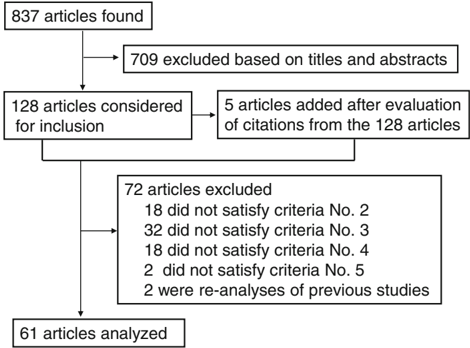
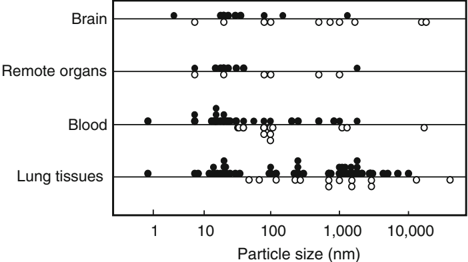
Many epidemiological studies have demonstrated that ambient particulate matter poses consistent risks for respiratory and cardiovascular disorders. The translocation of inhaled particles is one hypothesis that could explain such systemic effects. The objectives of this study were to conduct a systematic review of previous reports on particle translocation from the respiratory system and to discuss factors important for translocation. A PubMed search was conducted in August 2011 for the period from 1967 with four main keyword domains (particle, translocation, detection site, and exposure route). The systematic review identified 61 original articles written in English that met the specified criteria (i.e., information on experiment and particle detection). Categorical regression analysis was performed with the site of particle detection as the objective variable, and particle size, particle material, animal species, and exposure route as the explanatory variables. All explanatory variables showed statistically significant effects. The effects for particle size and particle material were large, while the effects for animal species and exposure route were relatively small. There was a broad relationship between particle size and detection site: ≤50 nm for brain and remote organs; ≤1 μm for blood; and ≤10 μm for lung tissues. However, these results should be considered within the context of several limitations, such as deficiency of information.
Overview
The claims and statistics of this paper haven’t been checked yet.
Free: it reads the open-access text and checks the first 5 claims that cite a source we can check. Create a free account to check every claim.
Integrity signals
Registry
Cites
Statistics
Figures
Verification
Claims the paper makes
The claims and statistics of this paper haven’t been checked yet.
Free: it reads the open-access text and checks the first 5 claims that cite a source we can check. Create a free account to check every claim.
Self-check
Percentages, sums and reported differences re-computed from the paper’s own numbers.
The self-check needs the paper’s full text.
Citations
Cites
Nanotoxicology: An Emerging Discipline Evolving from Studies of Ultrafine Particles
Oberdörster, G., Oberdörster, E., & Oberdörster, J. (2005) · Environmental Health Perspectives · doi:10.1289/ehp.7339 · Cited by 7,891 · cited 2×
“[9] advocated a mechanism in which particles deposited in the olfactory mucosa of the nasal cavity are subsequently taken into axons of the olfactory nerve and migrate into the olfactory bulb of the brain ventricle.”
BackgroundHealth Effects of Fine Particulate Air Pollution: Lines that Connect
Pope, C. A., & Dockery, D. W. (2006) · Journal of the Air & Waste Management Association · doi:10.1080/10473289.2006.10464485 · Cited by 6,583
Translocation of inhaled ultrafine particles to the brain
Oberdörster, G., Sharp, Z., Atudorei, V., Elder, A., Gelein, R., Kreyling, W., & Cox, C. (2004) · Inhalation Toxicology · doi:10.1080/08958370490439597 · Cited by 2,606 · cited 1×
“16 mg/m(3) Detected in olfactory bulb, cerebrum, cerebellum [B] [37]”
BackgroundBrook, R. D., Franklin, B., Cascio, W., Hong, Y., Howard, G., Lipsett, M., Luepker, R., Mittleman, M., Samet, J., Smith, S. C., et al. (2004) · Circulation · doi:10.1161/01.cir.0000128587.30041.c8 · Cited by 2,380
Particulate air pollution and acute health effects
Seaton, A., Godden, D., MacNee, W., & Donaldson, K. (1995) · The Lancet · doi:10.1016/s0140-6736(95)90173-6 · Cited by 2,138 · cited 1×
“, ultrafine particles; UFPs) could explain, at least in part, the effects of airborne PM on the cardiovascular system [4, 5].”
BackgroundHuman Respiratory Tract Model for Radiological Protection
Icrp (1994) · Annals of the ICRP · Cited by 1,767
Geiser, M., Rothen-Rutishauser, B., Kapp, N., Schürch, S., Kreyling, W., Schulz, H., Semmler, M., Hof, V. I., Heyder, J., & Gehr, P. (2005) · Environmental Health Perspectives · doi:10.1289/ehp.8006 · Cited by 1,407 · cited 1×
“11 mg/m 3 Detected in capillary lumen [D], interstitium [A, D], alveolar epithelial cells [D] [35]”
BackgroundTranslocation of Inhaled Ultrafine Manganese Oxide Particles to the CentralNervous System
Elder, A., Gelein, R., Silva, V., Feikert, T., Opanashuk, L., Carter, J., Potter, R., Maynard, A., Ito, Y., Finkelstein, J., et al. (2006) · Environmental Health Perspectives · doi:10.1289/ehp.9030 · Cited by 1,180 · cited 1×
“5 mg/m 3 Detected in olfactory bulb, striatum, frontal cortex, cerebellum [B] [29]”
Delfino, R. J., Sioutas, C., & Malik, S. (2005) · Environmental Health Perspectives · doi:10.1289/ehp.7938 · Cited by 931 · cited 2×
“This, in turn, can lead to various changes in the cardiovascular system, such as an increase in blood coagulability and the progression of atherosclerotic lesions [1, 4].”
BackgroundOberdörster, G., Sharp, Z., Atudorei, V., Elder, A., Gelein, R., Lunts, A., Kreyling, W., & Cox, C. (2002) · Journal of Toxicology and Environmental Health, Part A · doi:10.1080/00984100290071658 · Cited by 846 · cited 1×
“18 mg/m(3), 6 h Detected in liver [B] [45]”
Background
Research works printed but not linked: 1
- Elder A, Oberdo ¨rster G. Translocation and effects of ultrafine particles outside of the lung. Clin Occup Environ Med. 2006;5: 785-96.
Cited by
Inhaled Nanoparticles Accumulate at Sites of Vascular Disease
Miller, M. R., Raftis, J. B., Langrish, J. P., McLean, S. G., Samutrtai, P., Connell, S. P., Wilson, S., Vesey, A. T., Fokkens, P. H. B., Boere, A. J. F., et al. (2017) · ACS Nano · doi:10.1021/acsnano.6b08551 · Cited by 609
“38,39 Here we demonstrate in man that there is less translocation of gold particles with a primary diameter of 34 nm in comparison to that of 4 nm particles ( ∼ 55 nm and ∼ 18 nm aerodynamic diameter of agglomerates, respectively).”
Sun, K., Song, Y., He, F., Jing, M., Tang, J., & Liu, R. (2021) · Science of The Total Environment · doi:10.1016/j.scitotenv.2021.145403 · Cited by 435
Effect of Particulate Matter Air Pollution on Cardiovascular Oxidative Stress Pathways
Rao, X., Zhong, J., Brook, R. D., & Rajagopalan, S. (2018) · Antioxidants & Redox Signaling · doi:10.1089/ars.2017.7394 · Cited by 359
“In addition, PM particles may directly permeate via the olfactory nerve into the central nervous system (13, 112).”
BackgroundThe impact of environmental metals in young urbanites’ brains
Calderón-Garcidueñas, L., Serrano-Sierra, A., Torres-Jardón, R., Zhu, H., Yuan, Y., Smith, D., Delgado-Chávez, R., Cross, J. V., Medina-Cortina, H., Kavanaugh, M., et al. (2013) · Experimental and Toxicologic Pathology · doi:10.1016/j.etp.2012.02.006 · Cited by 156
“Particulate matter is indeed an effective vehicle for brain access (Calderón-Garcidueñas et al., 2001b, 2002,2003b, 2004, 2010; Terzano et al., 2010; Nakane 2011; Morgan et al., 2011) and evidence that the nasal-brain connection pathway is important, is the fact that metals such as Ni and V are present in a gradient f…”
Chemical multi-fingerprinting of exogenous ultrafine particles in human serum and pleural effusion
Lu, D., Luo, Q., Chen, R., Zhuansun, Y., Jiang, J., Wang, W., Yang, X., Zhang, L., Liu, X., Li, F., et al. (2020) · Nature Communications · doi:10.1038/s41467-020-16427-x · Cited by 171
Metadata
- Authors
- Nakane, H.
- Affiliations
- Toyota Central Research and Development Laboratories (Japan) (JP)
- Corresponding author
- Nakane, Hideo
- Venue
- Environmental Health and Preventive Medicine
- Published
- 2011-11-20
- Volume
- 17
- Issue
- 4
- Pages
- 263-274
- ISSN
- 1342-078X (ISSN-L)
- 1347-4715
- PMC
- PMC3390561
- OpenAlex
- W2030022793
- Cited by
- 101
- References
- 82
- Citations by year
- 2026: 9 · 2025: 10 · 2024: 8 · 2023: 8 · 2022: 11 · 2021: 8 · 2020: 11 · 2019: 5 · 2018: 7 · 2017: 8 · 2016: 4 · 2015: 6 · 2014: 3 · 2013: 1 · 2012: 2
- FWCI
- 0.19
- Type
- journal article
- Language
- en
- Open access
- gold
- doi.org
- Licence
- cc-by
- www.springer.com/tdm (tdm)
- Locations
- Environmental Health and Preventive Medicine (publishedVersion, cc-by)
- Europe PMC (PubMed Central) (publishedVersion)
- PubMed Central (publishedVersion)
- PubMed (publishedVersion)
- Topics
- Physical Sciences › Environmental Science › Health, Toxicology and Mutagenesis › Air Quality and Health Impacts
- Health Sciences › Medicine › Pulmonary and Respiratory Medicine › Inhalation and Respiratory Drug Delivery
- Physical Sciences › Environmental Science › Health, Toxicology and Mutagenesis › Indoor Air Quality and Microbial Exposure
- Keywords
- particle translocation, inhaled particles, respiratory system, particle size, particle material, exposure routes, brain, blood, lung tissue, animal species differences
- MeSH terms
- Air Pollutants, Animals, Biological Transport, Humans, Lung, Particle Size, Regression Analysis, Respiratory System, Respiratory Tract Diseases, Tissue Distribution, Inhalation Exposure, Particulate Matter
About these checks
Registry, retraction, Cites and statistics results are computed, not judged, with one exception: a printed reference that no index lists is read once by a model before it counts as a citation error. Claims are extracted by a model and kept only when their quote appears verbatim in the text; each cited source is then checked, with a model’s help, for whether it says what the claim relies on. Those verdicts can be wrong — read the claim’s quote and the cited source before relying on one.
Statistics and arithmetic are recomputed, not judged.
Confidence bands are shown only for fields calibrated on our annotated test set. None is calibrated yet, so no band is shown.
What counts as a claim ›How we measure confidence ›How we check this ›
Are you an author, or do you see a problem with this page? Request a review
How to cite
Cite CoChat for the checks on this page, and the paper for its own findings.
- This page
- CoChat. (2026). Citation check: Translocation of particles deposited in the respiratory system: a systematic review and statistical analysis. https://app.cochat.ai/papers/10.1007/s12199-011-0252-8
- The paper
- Nakane, H. (2012). Translocation of particles deposited in the respiratory system: a systematic review and statistical analysis. Environmental Health and Preventive Medicine. https://doi.org/10.1007/s12199-011-0252-8
Data sources
Bibliographic data: Semantic Scholar, OpenAlex, Crossref.
Contains information from the Semantic Scholar Academic Graph Datasets, made available under the ODC Attribution License (ODC-BY 1.0).
Semantic Scholar’s data is described in: Kinney, R., et al. (2023). The Semantic Scholar Open Data Platform. arXiv:2301.10140.
