

A low-cost automatic people-counting system at bus stops using Wi-Fi probe requests and deep learning
Open accessThe DOI matches its Crossref record; 59 of the 59 references it cites were found in a registry or an index; 7 of the 27 sources its claims cite were checked for support.
Abstract
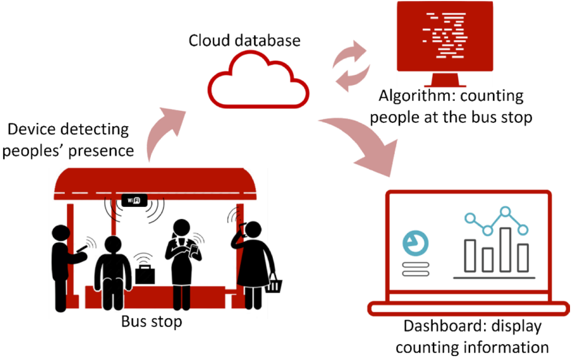
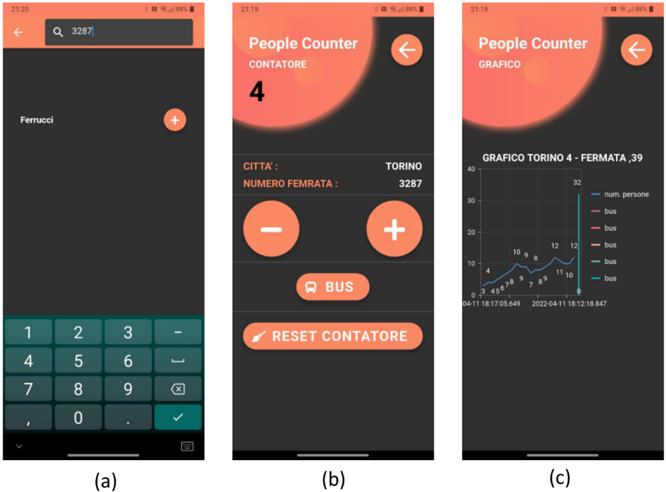
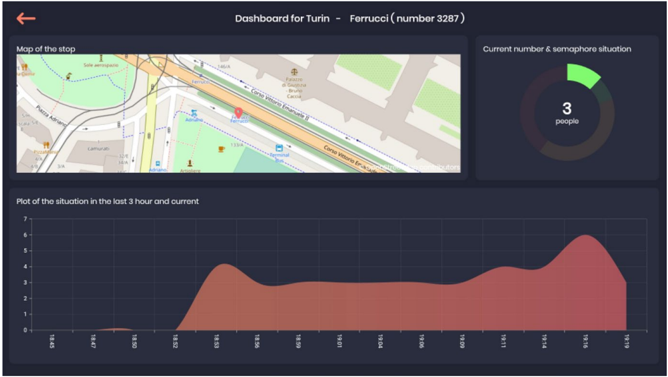
Abstract Counting people is an important part of people-centric applications, and the increase in the number of IoT devices has allowed the collection of huge amounts of data to facilitate people counting. The present study seeks to provide a novel, low-cost, automatic people-counting system for the use at bus stops, featuring a sniffing device that can capture Wi-Fi probe requests, and overcoming the problem of Media Access Control (MAC) randomization using deep learning. To make manual data collection considerably easier, a “People Counter” app was designed to collect ground truth data in order to train the model with higher accuracy. A user-friendly, operating system-independent dashboard was created to display the most relevant metrics. A two-step methodological approach was followed comprising device choice and data collection; data analysis and algorithm development. For the data analysis, three different approaches were tested, and among these a deep-learning approach using Convolutional Recurrent Neural Network (CRNN) with Long Short-term Memory (LSTM) architecture produced the best results. The optimal deep learning model predicted the number of people at the stop with a mean absolute error of ~ 1.2 persons, which can be considered a good preliminary result, considering that the experiment was done in a very complex open environment. People-counting systems at bus stops can support better bus scheduling, improve the boarding and alighting time of passengers, and aid the planning of integrated multi-modal transport system networks.
Overview
CoChat Summary
TL;DR
The paper presents a low-cost Wi-Fi probe-request sniffing system for counting people waiting at bus stops, using a CRNN with LSTM to handle MAC randomization and estimate occupancy. The best tuned model achieved a mean absolute error of 1.14 persons (~1.2) on the testing set in an open bus-stop environment.
Key findings
- The CRNN with LSTM outperformed the other tested approaches: preliminary MAE was 1.25 for CRNN, versus 1.78 for the matched filter and 1.82 for the sequential algorithm (Table 7).
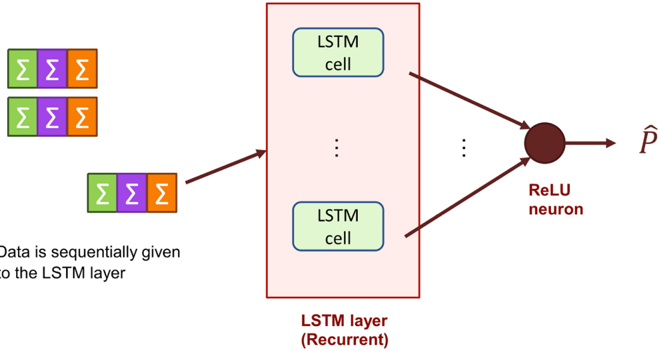
- The final tuned CRNN model reached an MAE of 1.14 persons on the testing set, with a 5-min visibility period based on Δt = 30 s and NΔt = 10, 60 convolutional filters, and 5 LSTM neurons (Table 8).
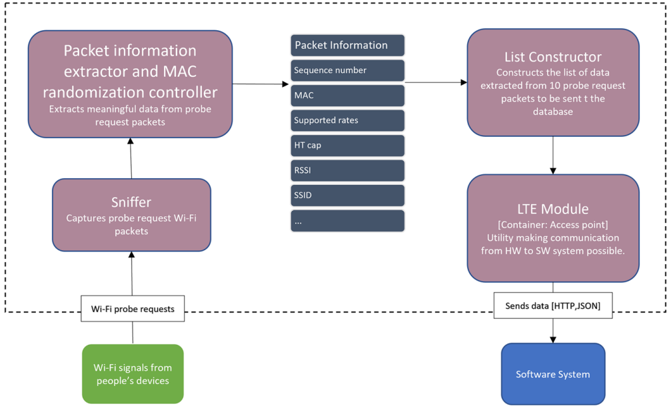
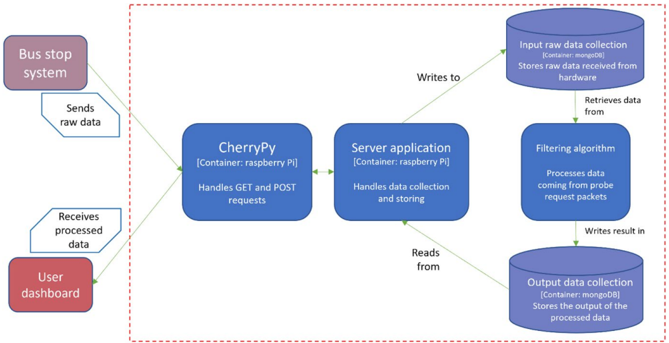
- The system used a WiPy 3.0 module with PyTrack 2.0 X board for sniffing, a Raspberry Pi 3 Model B cloud backend, MongoDB storage, and a Flutter dashboard; data collection yielded more than 22,700 sniffed packet records and more than 1,700 ground-truth labels.
- The error distribution showed a positive bias, meaning the model tended to overestimate the number of people; the system was tested in an open environment with up to 30 people.
Methods
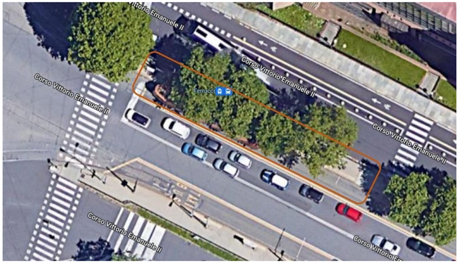
- The methodology had two steps: device choice and data collection, then data analysis and algorithm development. Manual ground truth was collected with a custom “People Counter” app, counting people within 11 m of the device.
- Data were collected over 9 days in three time slots (morning, midday, and evening peak hours) at Turin bus stops, mainly Ferrucci stop 3287, with additional data from stops 624 and 39.
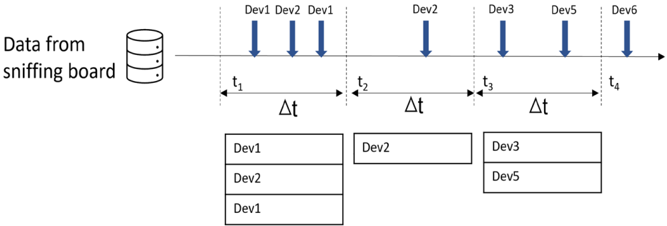
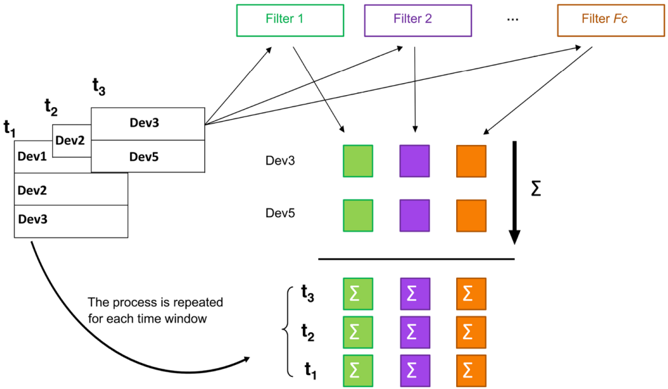
- Three approaches were compared using MAE: a packet-content-independent matched digital filter, a packet-content-dependent sequential algorithm using RSSI > -78 dB and MAC de-randomization via supported rates and RSSI ±4, and a CRNN combining CNN, LSTM, and ReLU layers. More than 40 model configurations were trained.
Limitations
- The paper states that not everyone owns a Wi-Fi-capable device, the Wi-Fi interface may not be enabled, users may carry multiple Wi-Fi devices, transmissions may be undetected when devices pass quickly, and environmental noise can degrade performance. It also notes that most data collection occurred at a single location, which may limit generalizability, and that the model showed a positive bias and may need a larger training dataset.
- The text also makes evident that manual ground truth was counted only within an 11-m radius while some people waited beyond that distance, and that the datasets are not publicly available due to sensitive business information.
Model-written summary. Check it against the paper before relying on it.
Integrity signals
Registry
Cites
Statistics
Figures
Verification
Claims the paper makes
4 Valid · 2 Not valid · 11 Not checked · 39 Own results and interpretations
Every source the paper cites for this claim was checked and supports it.
In the paper
“a limited data collection can create an imbalanced data distribution for different count classes, which limits the availability of large amounts of training data for deep learning models (Ibrahim etal. 2019).”
What the sources say
- Supportedcites Ibrahim et al. 2019 matched to “CrossCount: A Deep Learning System for Device-Free Human Counting Using WiFi” (2019) source
The SYSTEM OVERVIEW (II, p. 2) states that the typical collection approach of trying all combinations of people counts is labor intensive and limits the system's ability to detect large numbers of people, and that the resulting data 'suffers from the imbalanced data distribution for the different count classes' while 'deep learning models require large amounts of training data.' Table I and Section III-A3 (p. 4) quantify this: from m = 15 original single-person samples the 0-5 count classes hold 1, 15, 105, 455, 1365, 3003 samples — 'not uniform and severely skewed,' biasing the classifier toward classes with large training data. Both halves of the citing sentence (limited collection → imbalanced count-class distribution → shortage of training data for deep models) are stated in our copy. (LLM, conf=0.85)
plainstates a cause- Asserted: passes — The authors put it forward as true.
- Checkable: passes — It can be checked against evidence.
- Load-bearing: passes — The paper’s conclusions depend on it.
- Based: passes — The paper gives a reason why it holds.
- Supported
The cited sources support only part of this claim — read each source’s verdict below.
In the paper
“To the best of our knowledge, most validation of these Wi-Fi-based counting systems has been done either in controlled environments or only over short periods (Nitti et al. 2020; Oransirikul et al. 2014).”
What the sources say
- Partly supportedcites Nitti et al. 2020 matched to “iABACUS: A Wi-Fi-Based Automatic Bus Passenger Counting System” (2020) sourceExperimental — accuracy not yet measured
Section 4.2 (page unavailable) describes this paper’s own validation using a car to simulate a bus, with three tests on a route taking about 15 minutes. That supports an example of controlled, short-duration validation, but the paper does not establish that most Wi-Fi-based counting systems have been validated this way. (LLM, conf=0.84)
- Partly supportedcites Oransirikul et al. 2014 matched to “Measuring Bus Passenger Load by Monitoring Wi-Fi Transmissions from Mobile Devices” (2014) sourceExperimental — accuracy not yet measured
Our copy of Oransirikul et al. (2014) contains no statement about how Wi-Fi-based counting systems have been validated as a group: the Related Work (Sec. 2) characterises prior WiFi MAC methods only by data source ('they gather information from WiFi hot-spots rather than directly from the mobile stations') and by Nakano's router-based train approach, never by validation setting or duration, so the 'most validation ... in controlled environments' half of the claim is absent. The one part the source does bear out is the 'short periods' branch, and only as an instance of itself: the Abstract calls the work 'a feasibility study', Sec. 3 describes a single site (the Ritsumeikan University bus terminal), and Sec. 4 reports 'The experiment ran for approximately 70 minutes' (60 min at the terminal, 10 min aboard a shuttle). Moreover the setting is explicitly real-world and uncontrolled rather than laboratory-controlled — Sec. 6 lists the complicating factors (multiple closely-spaced stops, passengers gathering and boarding randomly, signal blocking) and calls for 'further experiments, especially in a less complex environment'. Thus the citation supports the claim only as an example of a brief, single-session field test, not as evidence for the sweeping characterisation of the field that the citing sentence attributes to it. (LLM, conf=0.72)
hedged- Asserted: passes — The authors put it forward as true.
- Checkable: passes — It can be checked against evidence.
- Load-bearing: passes — The paper’s conclusions depend on it.
- Based: passes — The paper gives a reason why it holds.
- Partly supported
The cited sources support only part of this claim — read each source’s verdict below.
In the paper
“Some authors have, nevertheless, proposed ways of overcoming the problem of address randomization. These include the iABACUS system proposed by Nitti etal. (2020), which uses a de-randomization algorithm. Other solutions involve machine learning models, such as those proposed by Guillen-Perez and Cano (2019) and Uras etal. (2020), but these have not been tested in scenarios with a large number of”
What the sources say
- Not matchedcites Nitti etal. 2020
An author–year citation the paper’s reference list doesn’t settle. We don’t search these by name.
- Partly supportedcites Guillen-Perez and Cano 2019 matched to “Counting and locating people in outdoor environments: a comparative experimental study using WiFi-based passive methods” (2019) sourceExperimental — accuracy not yet measured
Sections 1 and 4.2 describe comparisons with machine-learning classifiers, and the Experimental Setup (Section 3) describes a limited outdoor test using the phones listed in Table 1, supporting the point that these models were not tested with a large crowd. But Section 4.1 differentiates pedestrians using anonymized MAC addresses; it does not present the machine-learning models as solutions to MAC-address randomization. Anonymizing a captured address is not the same as overcoming address randomization. (LLM, conf=0.86)
- Not matchedcites Uras etal. 2020
An author–year citation the paper’s reference list doesn’t settle. We don’t search these by name.
plain- Asserted: passes — The authors put it forward as true.
- Checkable: passes — It can be checked against evidence.
- Load-bearing: unclear — It is unclear whether the paper’s conclusions depend on it.
- Based: passes — The paper gives a reason why it holds.
- Not matched
A result the paper reports from its own data — it cites no other source for it, so there is none to check. The quote shows it is in the paper.
In the paper
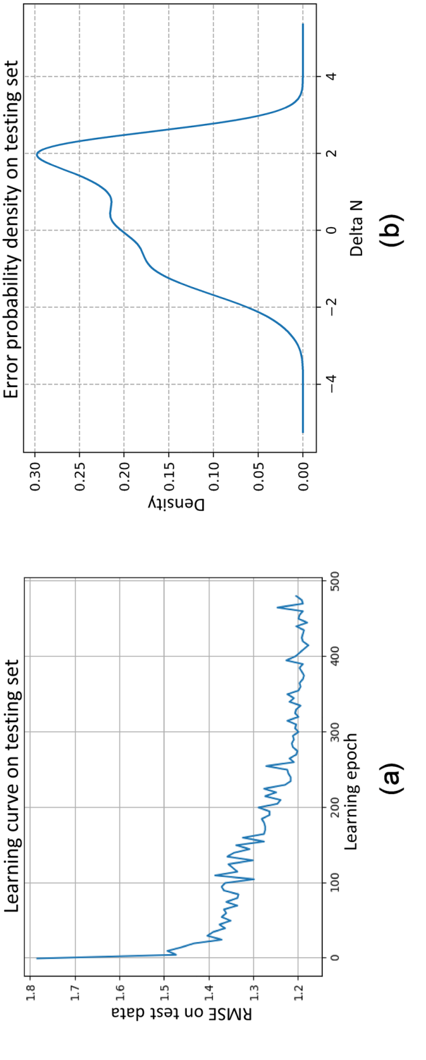
“The learning curve on the testing set for the best model with mean absolute error of 1.14 (Fig. 9a) shows that the algorithm improves its performance during the training by avoiding overfitting.”
plainstates a cause- Asserted: passes — The authors put it forward as true.
- Checkable: passes — It can be checked against evidence.
- Load-bearing: unclear — It is unclear whether the paper’s conclusions depend on it.
- Based: passes — The paper gives a reason why it holds.
- Rests on an assumption not shown here.
A result the paper reports from its own data — it cites no other source for it, so there is none to check. The quote shows it is in the paper.
In the paper
“For the data analysis, three different approaches were tested, and among these a deep-learning approach using Convolutional Recurrent Neural Network (CRNN) with Long Short-term Memory (LSTM) architecture produced the best results.”
plain- Asserted: passes — The authors put it forward as true.
- Checkable: passes — It can be checked against evidence.
- Load-bearing: passes — The paper’s conclusions depend on it.
- Based: passes — The paper gives a reason why it holds.
15 more claims
Create a free account to see all 56 claims and to verify the 3 references still open.
- It may state two separate claims as one. 21
- Probably not a substantial claim. 23
Self-check
Percentages, sums and reported differences re-computed from the paper’s own numbers.
Each contradiction between two passages listed here was confirmed by an independent check.
Rated minor: it would not touch a result — a value no result rests on, a p-value that stays on the same side of the significance level, or a conflict that is clerical, resolved elsewhere in the paper, or outside its own findings.
In the paper
§ 4 Results
“The data for March 12th, 2022 and April 22nd, 2022 were collected, respectively, at the bus stops 624 and 39”
§ 4 Results
“| 2022-04-11 15:17 | 2022-04-11 16:15 | 39 | Monday |”
Rated minor: it would not touch a result — a value no result rests on, a p-value that stays on the same side of the significance level, or a conflict that is clerical, resolved elsewhere in the paper, or outside its own findings.
In the paper
§ 5 Discussion andconclusions
“the system evaluated in the present study was tested in an open environment with up to 30 people.”
§ 4 Results
“| 11 April 2022 | 39 | 11.95 | 2 | 32 |”
Rated minor: it would not touch a result — a value no result rests on, a p-value that stays on the same side of the significance level, or a conflict that is clerical, resolved elsewhere in the paper, or outside its own findings.
In the paper
§ (a) Choice of bus stops. These were selected using two criteria:
“Data collection took place for 9days from March 1st to April 10th 2022”
§ 4 Results
“| 2022-04-20 10:31 | 2022-04-20 12:15 | 3287 | Wednesday |”
Citations
Cites
Hochreiter, S., & Schmidhuber, J. (1997) · Neural Computation · doi:10.1162/neco.1997.9.8.1735 · Cited by 102,318
Gradient-based learning applied to document recognition
Lecun, Y., Bottou, L., Bengio, Y., & Haffner, P. (1998) · Proceedings of the IEEE · doi:10.1109/5.726791 · Cited by 58,805
Learning representations by back-propagating errors
Rumelhart, D. E., Hinton, G. E., & Williams, R. J. (1986) · Nature · doi:10.1038/323533a0 · Cited by 31,892 · cited 1×
“For more information on RNNs see Rumelhart et al. (1986).”
Speech recognition with deep recurrent neural networks
Graves, A., Mohamed, A.-R., & Hinton, G. (2013) · 2013 IEEE International Conference on Acoustics, Speech and Signal Processing · doi:10.1109/icassp.2013.6638947 · Cited by 8,893 · cited 1×
“RNN models are particularly suitable for applications that involve sequence data, such as speech recognition (Graves et al. 2013) and handwriting alignment (Raue et al. 2015).”
Willmott, C., & Matsuura, K. (2005) · Climate Research · doi:10.3354/cr030079 · Cited by 7,958 · cited 1×
“Based on the literature review, some studies have suggested the use of the Mean Absolute Error (MAE) the Root Mean Square Error (RMSE) (Brassington 2017; Willmott and Matsuura 2005) especially for datasets with errors of varying magnitude and potential outliers.”
A Review of Recurrent Neural Networks: LSTM Cells and Network Architectures
Yu, Y., Si, X., Hu, C., & Zhang, J. (2019) · Neural Computation · doi:10.1162/neco_a_01199 · Cited by 5,591
Speech Recognition with Deep Recurrent Neural NetworksPreprint
Graves, A., Mohamed, A., & Hinton, G. E. (2013) · arXiv (Cornell University) · doi:10.48550/arxiv.1303.5778 · Cited by 509
Electricity Theft Detection in Smart Grid Systems: A CNN-LSTM Based Approach
Hasan, M. N., Toma, R. N., Nahid, A.-A., Islam, M. M. M., & Kim, J.-M. (2019) · Energies · doi:10.3390/en12173310 · Cited by 379
DiPietro, R., & Hager, G. D. (2020) · Handbook of Medical Image Computing and Computer Assisted Intervention · doi:10.1016/b978-0-12-816176-0.00026-0 · Cited by 293
Why MAC Address Randomization is not Enough: An Analysis of Wi-Fi Network Discovery Mechanisms
Vanhoef, M., Matte, C., Cunche, M., Cardoso, L. S., & Piessens, F. (2016) · Proceedings of the 11th ACM on Asia Conference on Computer and Communications Security · doi:10.1145/2897845.2897883 · Cited by 203
A comparative study: MongoDB vs. MySQL
Gyorodi, C., Gyorodi, R., Pecherle, G., & Olah, A. (2015) · 2015 13th International Conference on Engineering of Modern Electric Systems (EMES) · doi:10.1109/emes.2015.7158433 · Cited by 186
Estimating Crowd Densities and Pedestrian Flows Using Wi-Fi and Bluetooth
Schauer, L., Werner, M., & Marcus, P. (2014) · Proceedings of the 11th International Conference on Mobile and Ubiquitous Systems: Computing, Networking and Services · doi:10.4108/icst.mobiquitous.2014.257870 · Cited by 180 · cited 2×
“Wi-Fi based detection has become popular owing to its lower energy usage, shorter discovery time, and a higher likelihood of devices having an active Wi-Fi interface (Kurkcu and Ozbay 2017; Lee et al. 2012; Schauer et al. 2014; Singh et al. 2021).”
Convolutional Recurrent Neural Networks for Text Classification
Wang, R., Li, Z., Cao, J., Chen, T., & Wang, L. (2019) · 2019 International Joint Conference on Neural Networks (IJCNN) · doi:10.1109/ijcnn.2019.8852406 · Cited by 177
Rankin, D., Black, M., Bond, R., Wallace, J., Mulvenna, M., & Epelde, G. (2020) · JMIR Medical Informatics · doi:10.2196/18910 · Cited by 169 · cited 1×
“Real data versus synthetic data is also an advantage to balance the training phase during model building, allowing an increase in accuracy, precision, recall, and F1 as well as a lower rate of false positive and false negative predictions (Rankin et al. 2020).”
DeepCount: Crowd Counting with WiFi via Deep Learning
Liu, S., Zhao, Y., Xue, F., Chen, B., & Chen, X. (2019) · arXiv · doi:10.48550/arxiv.1903.05316 · Cited by 105 · cited 5×
“Infrared sensors or cameras have been proposed as alternatives, but these have a number of limitations, such as blind spots, weak performance in poor visibility (Bernini et al. 2014; Liu et al. 2019; Saponara et al. 2016; Yahiaoui et al. 2010), and a high cost (Liu et al. 2019).”
InfluentialWi-CaL: WiFi Sensing and Machine Learning Based Device-Free Crowd Counting and Localization
Choi, H., Fujimoto, M., Matsui, T., Misaki, S., & Yasumoto, K. (2022) · IEEE Access · doi:10.1109/access.2022.3155812 · Cited by 100
Crowd Forecasting Based on WiFi Sensors and LSTM Neural Networks
Singh, U., Determe, J., Horlin, F., & Doncker, P. D. (2020) · IEEE Transactions on Instrumentation and Measurement · doi:10.1109/tim.2020.2969588 · Cited by 90
Three Years Later: A Study of MAC Address Randomization In Mobile Devices And When It Succeeds
Fenske, E., Brown, D., Martin, J., Mayberry, T., Ryan, P., & Rye, E. C. (2021) · Proceedings on Privacy Enhancing Technologies · doi:10.2478/popets-2021-0042 · Cited by 90
Estimating Pedestrian Densities, Wait Times, and Flows with Wi-Fi and Bluetooth Sensors
Kurkcu, A., & Ozbay, K. (2017) · Transportation Research Record: Journal of the Transportation Research Board · doi:10.3141/2644-09 · Cited by 75 · cited 1×
“Wi-Fi based detection has become popular owing to its lower energy usage, shorter discovery time, and a higher likelihood of devices having an active Wi-Fi interface (Kurkcu and Ozbay 2017; Lee et al. 2012; Schauer et al. 2014; Singh et al. 2021).”
Oberli, C., Torres-Torriti, M., & Landau, D. (2010) · IEEE Transactions on Intelligent Transportation Systems · doi:10.1109/tits.2010.2048429 · Cited by 73
iABACUS: A Wi-Fi-Based Automatic Bus Passenger Counting System
Nitti, M., Pinna, F., Pintor, L., Pilloni, V., & Barabino, B. (2020) · Energies · doi:10.3390/en13061446 · Cited by 72 · cited 5×
“…studies involving people counting have largely been limited to automatic onboard passenger counting (Fihn and Finndahl 2011; Mccarthy et al. 2021; Mehmood et al. 2019; Nitti et al. 2020), and little attention has been given to the importance of bus stops in improving transport infrastructure.”
InfluentialCrowd Monitoring: State-of-the-Art and Future Directions
Singh, U., Determe, J., Horlin, F., & Doncker, P. D. (2020) · IETE Technical Review · doi:10.1080/02564602.2020.1803152 · Cited by 65
A Case Study of WiFi Sniffing Performance Evaluation
Li, Y., Barthélemy, J., Sun, S., Perez, P., & Moran, B. (2020) · IEEE Access · doi:10.1109/access.2020.3008533 · Cited by 61
CrossCount: A Deep Learning System for Device-Free Human Counting Using WiFi
Ibrahim, O. T., Gomaa, W., & Youssef, M. (2019) · IEEE Sensors Journal · doi:10.1109/jsen.2019.2928502 · Cited by 61 · cited 3×
“Previous studies on automatic people counting evaluated their systems with limited numbers of people, such as up to 10 people (Choi et al. 2022; Ibrahim et al. 2019), or up to 5 people in an indoor environment (Liu et al. 2019).”
Counting public transport passenger using WiFi signatures of mobile devices
Myrvoll, T. A., Hakegard, J. E., Matsui, T., & Septier, F. (2017) · 2017 IEEE 20th International Conference on Intelligent Transportation Systems (ITSC) · doi:10.1109/itsc.2017.8317687 · Cited by 60
Convolutional Recurrent Neural Network for Fault Diagnosis of High‐Speed Train Bogie
Liang, K., Qin, N., Huang, D., & Fu, Y. (2018) · Complexity · doi:10.1155/2018/4501952 · Cited by 59
Sensing the Crowds Using Bluetooth Low Energy Tags
Basalamah, A. (2016) · IEEE Access · doi:10.1109/access.2016.2594210 · Cited by 49 · cited 1×
“Traditionally, mat sensors have been used to count passengers by measuring their weight when boarding the bus (Basalamah 2016).”
Smartphone-based real time vehicle tracking in indoor parking structures
Gao, R., Zhao, M., Ye, T., Ye, F., Wang, Y., & Luo, G. (2017) · IEEE Transactions on Mobile Computing · doi:10.1109/tmc.2017.2684167 · Cited by 48 · cited 1×
“Collaborative applications have been proposed as another option, but they require access to mobile device functions like GPS or microphones (Carrel et al. 2015; Gao et al. 2017).”
Carrel, A., Lau, P. S. C., Mishalani, R. G., Sengupta, R., & Walker, J. L. (2015) · Transportation Research Part C: Emerging Technologies · doi:10.1016/j.trc.2015.03.021 · Cited by 48 · cited 1×
“Collaborative applications have been proposed as another option, but they require access to mobile device functions like GPS or microphones (Carrel et al. 2015; Gao et al. 2017).”
WiFi Probes sniffing: an Artificial Intelligence based approach for MAC addresses de-randomization
Uras, M., Cossu, R., Ferrara, E., Bagdasar, O. D., Liotta, A., & Atzori, L. (2020) · IEEE International Workshop on Computer Aided Modeling and Design of Communication Links and Networks (CAMAD) · doi:10.1109/camad50429.2020.9209257 · Cited by 47
Measuring Bus Passenger Load by Monitoring Wi-Fi Transmissions from Mobile Devices
Oransirikul, T., Nishide, R., Piumarta, I., & Takada, H. (2014) · Procedia Technology · doi:10.1016/j.protcy.2014.11.023 · Cited by 40 · cited 4×
“Another step forward as regards previous studies, to not compromise the reliability of DL models, was the extended duration of the data collection if compared, for example, to Oransirikul et al. (2014), who collected data for only 70 min, with 60 min for counting people at the bus stop.”
InfluentialOccupancy Estimation using WiFi: A Case Study for Counting Passengers on Busses
Mehmood, U., Moser, I., Jayaraman, P. P., & Banerjee, A. (2019) · 2019 IEEE 5th World Forum on Internet of Things (WF-IoT) · doi:10.1109/wf-iot.2019.8767350 · Cited by 39 · cited 2×
“Transport companies can benefit from reliable real-time people-counting systems to estimate travel demand, improve customer satisfaction, and optimize routes (Mehmood et al. 2019; Reichl et al. 2018).”
A Field Study of Internet of Things-Based Solutions for Automatic Passenger Counting
McCarthy, C. D., Moser, I., Jayaraman, P. P., Ghaderi, ., Tan, A. M., Yavari, A., Mehmood, U., Simmons, M., Weizman, Y., Georgakopoulos, D., et al. (2021) · IEEE Open Journal of Intelligent Transportation Systems · doi:10.1109/ojits.2021.3111052 · Cited by 39
Public transport occupancy estimation using WLAN probing
Mikkelsen, L., Buchakchiev, R., Madsen, T., & Schwefel, H. P. (2016) · 2016 8th International Workshop on Resilient Networks Design and Modeling (RNDM) · doi:10.1109/rndm.2016.7608302 · Cited by 38
Hidayat, A., Terabe, S., & Yaginuma, H. (2018) · Transportation Research Record Journal of the Transportation Research Board · doi:10.1177/0361198118776153 · Cited by 37
Real-time passenger counting in buses using dense stereovision
Yahiaoui, T., Khoudour, L., & Meurie, C. (2010) · Journal of Electronic Imaging · doi:10.1117/1.3455989 · Cited by 37
Olivo, A., Maternini, G., & Barabino, B. (2019) · The Open Transportation Journal · doi:10.2174/1874447801913010250 · Cited by 34 · cited 1×
“This could facilitate long-term planning, route scheduling, and the optimization of headways and timetables (Olivo et al. 2019).”
An embedded system for counting passengers in public transportation vehicles
Bernini, N., Bombini, L., Buzzoni, M., Cerri, P., & Grisleri, P. (2014) · 2014 IEEE/ASME 10th International Conference on Mechatronic and Embedded Systems and Applications (MESA) · doi:10.1109/mesa.2014.6935562 · Cited by 32
A dataset of labelled device Wi-Fi probe requests for MAC address de-randomization
Pintor, L., & Atzori, L. (2022) · Computer Networks · doi:10.1016/j.comnet.2022.108783 · Cited by 29
ViFi-MobiScanner: Observe Human Mobility via Vehicular Internet Service
Tu, L., Wang, S., Zhang, D., Zhang, F., & He, T. (2021) · IEEE Transactions on Intelligent Transportation Systems · doi:10.1109/tits.2019.2956744 · Cited by 21 · cited 2×
“Tu et al. (2021) also take a different path, encompassing network events beyond probe request packets and involving different data collection methods.”
A Review of Overfitting Solutions in Smart Depression Detection Models
Gupta, G. K., & Sharma, D. K. (2022) · International Conference on Computing for Sustainable Global Development · doi:10.23919/indiacom54597.2022.9763147 · Cited by 20
Smart scanning for mobile devices in WLANs
Lee, S., Kim, M., Kang, S., Lee, K., & Jung, I. (2012) · International Conference on Communications · doi:10.1109/icc.2012.6364601 · Cited by 16
Yang, H. J., Özbay, K. M. A., & Bartin, B. (2011) · Transportation Research Record Journal of the Transportation Research Board · doi:10.3141/2264-02 · Cited by 15
1D Convolutional Neural Networks For Fault Diagnosis of High-speed Train Bogie
Liang, K., Qin, N., Huang, D., Ma, L., Fu, Y., & Chen, C. (2018) · IEEE International Conference on Digital Signal Processing (DSP) · doi:10.1109/icdsp.2018.8631651 · Cited by 12
Guillen-Perez, A., & Cano, M.-D. (2019) · ITM Web of Conferences · doi:10.1051/itmconf/20192401010 · Cited by 10 · cited 1×
“Other solutions involve machine learning models, such as those proposed by Guillen-Perez and Cano (2019) and Uras et al. (2020), but these have not been tested in scenarios with a large number of people.”
Parallel sequence classification using recurrent neural networks and alignment
Raue, F., Byeon, W., Breuel, T. M., & Liwicki, M. (2015) · IAPR International Conference on Document Analysis and Recognition (ICDAR) · doi:10.1109/icdar.2015.7333828 · Cited by 7
Use of Deep Learning Methods for People Counting in Public Transport
Baumann, D., Sommer, M., Schrempp, Y., & Sax, E. (2022) · International Conference on Connected Vehicles and Expo · doi:10.1109/iccve52871.2022.9742924 · Cited by 6
Smartphone-Based Real-Time Vehicle Tracking in Indoor Parking Structures
Gao, R., Ye, F., Luo, G., & Cong, J. (2018) · SpringerBriefs in computer science · doi:10.1007/978-981-10-8378-5_5 · Cited by 6
Demonstrating the feasibility of using Wi-Fi sensors for dynamic bus-stop queue length estimation
Jee, H., Sun, W., Schmöcker, J., & Nakamura, T. (2023) · Public Transport · doi:10.1007/s12469-023-00336-5 · Cited by 5
A dataset of labelled device Wi-Fi probe requests for MAC address de-randomization - 2021
Pintor, L., & Atzori, L. (2021) · Data Archiving and Networked Services (DANS) · doi:10.17632/j64btzdsdy · Cited by 5
Spatial analysis of bus rapid transit actual operating conditions: the case of Hangzhou City, China
Liu, D., Zhao, C., Dong, H., & Huang, Z. (2022) · Public Transport · doi:10.1007/s12469-022-00299-z · Cited by 4
Kos-Łabędowicz, J. (2019) · Prace Naukowe Uniwersytetu Ekonomicznego we Wrocławiu · doi:10.15611/pn.2019.7.05
Rankin, D., Black, M., Bond, R., et al. (2020) · doi:10.2196/preprints.18910
Research works printed but not linked: 5
- Brassington G (2017) Mean absolute error and root mean square error: which is the better metric for assessing model performance? Presented at the EGU General Assembly Conference, p 3574
- Charansonney L (2018) New ways to collect traffic data, new challenges for road network authorities (PhD thesis). Université Paris-Est
- Hardt M, Recht B, Singer Y (2016) Train faster, generalize better: stability of stochastic gradient descent. In: Proceedings of the 33rd International Conference on Machine Learning, pp 1225-1234
- Nishide R, Takada H (2013) Detecting pedestrian flows on a mobile ad hoc network and issues with trends and feasible applications. Int J Adv Netw Serv 6(1 & 2):108-117
- Schauer L, Werner M, Marcus P (2014) Estimating crowd densities and pedestrian flows using Wi-Fi and Bluetooth. In: MobiQuitous 2014 - 11th International Conference on Mobile and Ubiquitous <!-- image --> 1 3
Cited by
Accuracy of Automatic Passenger Counting in Open Mass Transit Systems: Insights from Italy
Barabino, B., Raccagni, L., & Ventura, R. (2025) · The Open Transportation Journal · doi:10.2174/0126671212383074250407062430 · Cited by 7
XRL-TO: An explainable reinforcement learning-based approach for bus timetable dynamic optimization
Ai, G., Zuo, X., Chen, G., Zhou, M., Wu, B., & Zhao, X. (2025) · Expert Systems with Applications · doi:10.1016/j.eswa.2025.129271 · Cited by 7
Vahan Samvedak: a comprehensive real-time college bus tracking and safety system
Chauhan, Y., Dhiman, S., Negi, S., Bamola, J., Pandey, K., Tripathi, N., Goyal, S., Gupta, S., & Kumar, M. (2026) · Scientific Reports · doi:10.1038/s41598-026-48862-z · Cited by 2
Li, Z., & Guo, Q. (2025) · Journal of Intelligent Transportation Systems · doi:10.1080/15472450.2025.2499590 · Cited by 2
Metadata
- Authors
- Pronello, C., Anbarasan, D., Spoturno, F., & Terzolo, G.
- Affiliations
- Politecnico di Torino (IT)
- Corresponding author
- Pronello, Cristina
- Anbarasan, Deepan
- Venue
- Public Transport
- Published
- 2024-02-24
- Volume
- 17
- Issue
- 1
- Pages
- 71-100
- ISSN
- 1613-7159 (ISSN-L)
- 1866-749X
- OpenAlex
- W4392126269
- Cited by
- 13
- References
- 51
- Citations by year
- 2026: 4 · 2025: 8 · 2024: 1
- FWCI
- 4.06
- Type
- journal article
- Language
- en
- Open access
- hybrid
- doi.org
- Licence
- cc-by
- creativecommons.org/licenses/by/4.0 (tdm)
- creativecommons.org/licenses/by/4.0 (vor)
- Locations
- Public Transport (publishedVersion, cc-by)
- PORTO@Iris (submittedVersion, cc-by)
- RePEc: Research Papers in Economics (submittedVersion)
- Funders
- Politecnico di Torino
- Topics
- Social Sciences › Transportation › Human Mobility and Location-Based Analysis
- Physical Sciences › Engineering › Electrical and Electronic Engineering › Indoor and Outdoor Localization Technologies
- Physical Sciences › Computer Science › Computer Vision and Pattern Recognition › Video Surveillance and Tracking Methods
- Keywords
- bus stops, convolutional recurrent neural network, LSTM, low-cost sensors, ground truth data collection, passenger boarding and alighting
About these checks
Registry, retraction, Cites and statistics results are computed, not judged, with one exception: a printed reference that no index lists is read once by a model before it counts as a citation error. Claims are extracted by a model and kept only when their quote appears verbatim in the text; each cited source is then checked, with a model’s help, for whether it says what the claim relies on. Those verdicts can be wrong — read the claim’s quote and the cited source before relying on one.
The claim verdicts this report counts are experimental: their accuracy is not yet measured.
A language model drew the claims from the paper on 2026-10-10, under version 3 of the claim definition (model deepseek-v4.1-flash, prompt extract-v3).
A second model labelled each claim on 2026-10-10 (model jev-1.13-20260917, definition revision gold-guideline-v0.2).
Cited sources are checked with a language model’s help (qwen3.8-omni-flash and gpt-6-sol).
Statistics and arithmetic are recomputed, not judged.
Confidence bands are shown only for fields calibrated on our annotated test set. None is calibrated yet, so no band is shown.
What counts as a claim ›How we measure confidence ›How we check this ›
Are you an author, or do you see a problem with this page? Request a review
Data sources
Bibliographic data: Semantic Scholar, OpenAlex, Crossref.
Contains information from the Semantic Scholar Academic Graph Datasets, made available under the ODC Attribution License (ODC-BY 1.0).
Semantic Scholar’s data is described in: Kinney, R., et al. (2023). The Semantic Scholar Open Data Platform. arXiv:2301.10140.
