

Acceptance as a Mediator for Change in Acceptance and Commitment Therapy for Persons with Chronic Pain?
Open accessThe DOI matches its Crossref record; 69 of the 75 references it cites were found in a registry or an index; 11 of the 51 sources its claims cite were checked for support.
Abstract
Background: Cognitive behavior therapy (CBT) is considered effective for chronic pain, but little is known about active treatment components. Although acceptance correlates with better health outcomes in chronic pain patients, no study has examined its mediating effect in an experimental design. Purpose: The aim of the present study is to investigate acceptance as a mediator in acceptance and commitment therapy (ACT), a third wave CBT intervention, for chronic pain. Method: A bootstrapped cross product of coefficients approach was used on data from a previously published RCT evaluating ACT for chronic pain. To address the specificity of acceptance as a mediator, anxiety and depression were also tested as mediators. Outcome variables were satisfaction with life and physical functioning. Two change scores, pre-assessment to 6-month follow-up ( n = 53) and pre-assessment to 12-month follow-up ( n = 32), were used. Results: Acceptance was found to mediate the effect of treatment on change in physical functioning from pre-assessment to follow-up at 6 months. Further, a trend was shown from pre-assessment to follow-up at 12 months. No indirect effect of treatment via acceptance was found for change in satisfaction with life. Conclusion: This study adds to a small but growing body of research using mediation analysis to investigate mediating factors in the treatment of chronic pain. In summary, the results suggest that acceptance may have a mediating effect on change in physical functioning in ACT for persons with chronic pain. However, given the small sample size of the study, these findings need to be replicated.
Overview
CoChat Summary
## TL;DR
In a secondary mediation analysis of an RCT of ACT for chronic pain, acceptance emerged as the mediator for improvement in physical functioning, but not for satisfaction with life. The evidence was tentative because the sample was small and attrition was substantial.
## Key findings
- Using bootstrapped mediation analyses on RCT data, acceptance mediated treatment effects on physical functioning from pre-assessment to 6-month follow-up; a trend was found at 12 months.
- No indirect effect of treatment via acceptance was found for satisfaction with life at either follow-up.
- In supplementary analyses controlling for change in pain intensity, acceptance explained an additional 17% of the variance in change in physical functioning for the ACT group at follow-up 1 (ΔF = 4.21, p = 0.05) and 26% at follow-up 2 (ΔF = 3.58, p = 0.09).
- When controlling for earlier change in physical functioning, acceptance contributed an additional 35% of explained variance at follow-up 2 (ΔF = 5.43, p = 0.04).
## Methods
- Secondary mediation analysis of data from a previously published randomized controlled trial comparing ACT with applied relaxation (AR) for chronic pain.
- Sample: adults with chronic pain excluding malignancies recruited from Uppsala University Hospital; 115 were randomized, 90 started treatment, 53 completed 6-month follow-up, and 32 completed 12-month follow-up.
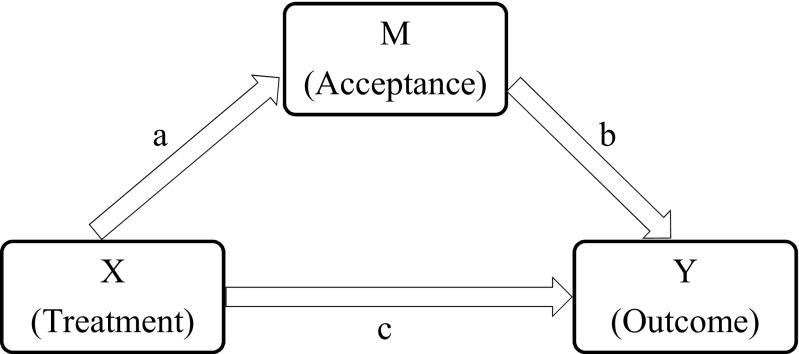
- Main analysis: bootstrapped product-of-coefficients mediation in SPSS/PROCESS with 10,000 samples; treatment was the independent variable, post-treatment acceptance the mediator, and change in satisfaction with life / physical functioning the outcomes. Anxiety and depression were also tested as alternative mediators.
## Limitations
- The paper explicitly states that the small sample size means the findings “need to be replicated,” and notes that the study had relatively low power for mediation analysis.
- The amount of attrition is identified as a limitation because it reduces power; only 53 participants remained at 6 months and 32 at 12 months.
- As evident from the text: the mediation analysis used post-assessment mediator scores and change scores, so the temporal ordering of mediator and outcome is not fully resolved; the authors note that continuous assessments during treatment would have helped.
Model-written summary. Check it against the paper before relying on it.
Integrity signals
Registry
Cites
Statistics
Figures

Verification
Claims the paper makes
10 Valid · 0 Not valid · 22 Not checked · 23 Own results and interpretations
The sources with a verdict support this claim; the rest weren’t checked yet, have no full text we could read, or their verdicts aren’t rated yet.
In the paper
“Altogether, these results are in line with previous research [31, 32] suggesting that acceptance mediates the effect of ACT on change in physical functioning”
§ Acceptance as a Mediator for Change in Acceptance and Commitment Therapy for Persons with Chronic Pain? > Discussion
What the sources say
- Not checked — no full text of the sourcecites [31] McCracken LM Gutiérrez-Martínez O Processes of change in psychological flexibility in an interdisciplinary group-based treatment for chronic pain based on acceptance and commitment therapy Behav Res Ther 2011 49 267 274 10.1016/j.brat.2011.02.004 21377652 source
- Supportedcites [32] Vowles KE Witkiewitz K Sowden G Ashworth J Acceptance and commitment therapy for chronic pain: evidence of mediation and clinically significant change following an abbreviated interdisciplinary rehabilitation program J Pain 2014 15 101 113 10.1016/j.jpain.2013.10.002 24373572 source
The Results report that, in the multiple-mediator model, change in pain acceptance was the only significant mediator of change in physical disability, supporting the claim about physical functioning. The finding concerns self-reported physical disability; the Results also say mediation was not significant for the sit-to-stand task. (LLM, conf=0.88)
hedgedstates a cause- Asserted: passes — The authors put it forward as true.
- Checkable: passes — It can be checked against evidence.
- Load-bearing: passes — The paper’s conclusions depend on it.
- Based: passes — The paper gives a reason why it holds.
The sources with a verdict support this claim; the rest weren’t checked yet, have no full text we could read, or their verdicts aren’t rated yet.
In the paper
“In two studies by McCracken and Gutiérrez-Martínez [31] and Vowles and colleagues [32], acceptance was shown to correlate with positive changes in disability, depression, and pain-related anxiety.”
§ Acceptance as a Mediator for Change in Acceptance and Commitment Therapy for Persons with Chronic Pain? > Introduction According to the World Health Organization (WHO), chronic pain is one of the most underestimated challenges for health care worldwide [1]. In chronic pain, comorbidity with depression and anxiety is common [2–4], social life is negatively affected [5], daily functioning impaired [6–8], and general level of activity reduced [3, 9]. On the whole, chronic pain reduces quality of life for the patient [10–13] and imposes high expenses on health care systems [1]. Cognitive behavior therapy (CBT) has been applied for chronic pain for decades with positive outcomes [14]. The definition of CBT is, however, broad, and the strategies applied within CBT for chronic pain may include a wide range of therapeutic tools [15]. This lack of specificity creates uncertainty as to the processes at work in CBT treatment [16]. A recent Cochrane review concludes that CBT is useful for chronic pain and that there is no need for further RCTs focusing on the reporting of group mean values [17]. Instead, studies identifying effective components of treatment are requested. Acceptance and commitment therapy (ACT), developed within the third wave of CBT, shares important features with CBT but is derived from functional contextualism and relational frame theory and thus has distinct philosophical and theoretical assumptions [18]. ACT has been shown to improve mental and physical health [19] and has been listed by the American Psychological Association (APA) as having strong research support for chronic pain [20]. In ACT, the aim is to create psychological flexibility around impairing life experiences, such as chronic pain, to enable moving forward and engaging in a vital valued life [21]. Psychological flexibility includes several processes, of which acceptance is one. Acceptance of chronic pain is defined as living with pain without reacting to, judging or attempting to reduce or avoid it [22]. It is not resignation to or ignoring pain but rather an active willingness to engage in meaningful activities in the presence of pain. Psychological acceptance has been shown to be beneficial in chronic pain [23–28] although most of the data is cross-sectional and/or correlational, which may establish covariation between variables but does not allow causal inferences [29, 30]. In two studies by McCracken and Gutiérrez-Martínez [31] and Vowles and colleagues [32], acceptance was shown to correlate with positive changes in disability, depression, and pain-related anxiety. Both of these studies, however, lacked experimental design. Randomized controlled trials (RCTs) testing the mediating effect in treatments for chronic pain are very sparse. In two RCTs by Wicksell and colleagues [33, 34], psychological flexibility was shown to mediate the effect of ACT on depression, pain-related functioning, and life satisfaction. Psychological flexibility is, however, comprised in the ACT model by acceptance as well as other therapeutic processes. In summary, research on the mechanisms of change in ACT for chronic pain is scarce. Acceptance is a key concept in the theoretical model, but there is no experimental study investigating its mediating effect. The aim of this study is to investigate whether acceptance mediates the effect of treatment on satisfaction with life and physical functioning using data from a previously published RCT evaluating ACT for chronic pain [35].
What the sources say
- Not checked — no full text of the sourcecites [31] McCracken LM Gutiérrez-Martínez O Processes of change in psychological flexibility in an interdisciplinary group-based treatment for chronic pain based on acceptance and commitment therapy Behav Res Ther 2011 49 267 274 10.1016/j.brat.2011.02.004 21377652 source
- Supportedcites [32] Vowles KE Witkiewitz K Sowden G Ashworth J Acceptance and commitment therapy for chronic pain: evidence of mediation and clinically significant change following an abbreviated interdisciplinary rehabilitation program J Pain 2014 15 101 113 10.1016/j.jpain.2013.10.002 24373572 source
The Results (page unavailable) report that changes in pain acceptance significantly mediated changes in disability, depression, and pain-related anxiety following the chronic-pain rehabilitation program. This supports the attributed association between acceptance and positive changes in all three outcomes. (LLM, conf=0.93)
plainstates an association- Asserted: passes — The authors put it forward as true.
- Checkable: passes — It can be checked against evidence.
- Load-bearing: passes — The paper’s conclusions depend on it.
- Based: passes — The paper gives a reason why it holds.
A result the paper reports from its own data — it cites no other source for it, so there is none to check. The quote shows it is in the paper.
In the paper
“Acceptance was found to mediate the effect of treatment on change in physical functioning from pre-assessment to follow-up at 6 months.”
- Also stated in: § Physical Functioning · plain
“A statistically significant indirect effect of treatment via acceptance was found on change in physical functioning from pre-assessment to follow-up 1.”
- Also stated in: § Discussion · plain
“There was, however, a statistically significant indirect effect on change in physical functioning from pre-assessment to follow-up 1”
§ Acceptance as a Mediator for Change in Acceptance and Commitment Therapy for Persons with Chronic Pain? > Abstract > Results
plainstates a cause- Asserted: passes — The authors put it forward as true.
- Checkable: passes — It can be checked against evidence.
- Load-bearing: passes — The paper’s conclusions depend on it.
- Based: passes — The paper gives a reason why it holds.
- Also stated in: § Physical Functioning · plain
A result the paper reports from its own data — it cites no other source for it, so there is none to check. The quote shows it is in the paper.
In the paper
“the addition of acceptance in explained variance in change from pre-assessment to follow-up 1 was 17 % (∆F = 4.21, p = 0.05) for the ACT group.”
§ Acceptance as a Mediator for Change in Acceptance and Commitment Therapy for Persons with Chronic Pain? > Results > Supplementary Analyses
plainstates an association- Asserted: passes — The authors put it forward as true.
- Checkable: passes — It can be checked against evidence.
- Load-bearing: passes — The paper’s conclusions depend on it.
- Based: passes — The paper gives a reason why it holds.
A result the paper reports from its own data — it cites no other source for it, so there is none to check. The quote shows it is in the paper.
In the paper
“The HMR showed that acceptance made a significant contribution of 35 % to follow-up 2 (∆F = 5.43, p = 0.04).”
- Also stated in: § Discussion · plain
“acceptance made a significant additional contribution of 35 % in explained variance at follow-up 2 after adjusting for earlier change in physical functioning.”
§ Acceptance as a Mediator for Change in Acceptance and Commitment Therapy for Persons with Chronic Pain? > Results > Supplementary Analyses
plainstates an association- Asserted: passes — The authors put it forward as true.
- Checkable: passes — It can be checked against evidence.
- Load-bearing: passes — The paper’s conclusions depend on it.
- Based: passes — The paper gives a reason why it holds.
- Also stated in: § Discussion · plain
20 more claims
Create a free account to see all 55 claims and every source verdict.
- Probably not a substantial claim. 21
- It may state two separate claims as one. 16
- The quote only partly states this claim. 1
Claims other papers make about this one
Each is checked against this paper’s own text: does it say what the citing paper says it does?
The source backs part of the claim, not all of it — or backs it for a different population, condition or comparison.
In the citing paper
“Data from other ACT studies also support the mediating role of hypothesized processes of change, including psychological flexibility, valued action, and aspects of mindfulness, on various outcomes (e.g., symptom severity, functioning, quality of life; Cederberg et al., 2016; Hayes et al., 2010; Pots et al., 2016; Twohig et al., 2015).”
From The role of psychological flexibility in acceptance-enhanced behavior therapy for trichotillomania: Moderation and mediation findings (2023) · cites this paper as Cederberg et al., 2016
Experimental — accuracy not yet measuredThe source backs part of the claim, not all of it — or backs it for a different population, condition or comparison.
In the citing paper
“Psychotherapists dealing with chronic pain tell us that “radical acceptance” of the condition is a way of transferring the treatment effect to bodily functioning [24, 25].”
From Endometriosis: patient–doctor communication and psychological counselling (2023) · cites this paper as [25]
Experimental — accuracy not yet measuredThe source backs part of the claim, not all of it — or backs it for a different population, condition or comparison.
In the citing paper
“PF has repeatedly been shown to be a potential treatment mechanism in ACT, with increased PF being associated with decreased pain interference and increased functioning (Cederberg et al., 2016;Lin et al., 2018;McCracken & Gutiérrez-Martínez, 2011;Stockton et al., 2018;Trompetter et al., 2015;Vowles et al., 2008Vowles et al., , 2014;;Wicksell et al., 2011).”
From Internet-delivered acceptance and commitment therapy as microlearning for chronic pain: A randomized controlled trial with 1-year follow-up (2021) · cites this paper as Cederberg et al., 2016
Experimental — accuracy not yet measuredThe cited source says what the claim attributes to it.
In the citing paper
“Thus, acceptance seems to be the mediating component of change in patients with chronic pain (Baranoff et al., 2016; Cederberg et al., 2016; Vowles et al, 2008; Yu et al., 2022).”
From Group Acceptance and Commitment Therapy (ACT) for Fibromyalgia Patients (2024) · cites this paper as Cederberg et al., 2016
Citations
Cites
Baron, R. M., & Kenny, D. A. (1986) · Journal of Personality and Social Psychology · doi:10.1037/0022-3514.51.6.1173 · Cited by 91,532 · cited 2×
“The most widely used is the causal stepsmethod [29, 57], which focuses on the individual paths of the model.”
BackgroundThe Hospital Anxiety and Depression Scale
Zigmond, A. S., & Snaith, R. P. (1983) · Acta Psychiatrica Scandinavica · doi:10.1111/j.1600-0447.1983.tb09716.x · Cited by 47,139
(2013) · Cited by 44,563
Preacher, K. J., & Hayes, A. F. (2008) · Behavior Research Methods · doi:10.3758/brm.40.3.879 · Cited by 34,117 · cited 2×
“Bootstrapping is a nonparametric procedure that acknowledges this fact [61, 62].”
BackgroundThe satisfaction with life scale
Diener, E., Emmons, R. A., Larsen, R. J., & Griffin, S. (1985) · Journal of Personality Assessment · doi:10.1207/s15327752jpa4901_13 · Cited by 31,768 · cited 2×
“The SWLS contains five statements, e.g., BIn most ways my life is close to ideal,^ that the respondents are asked to agree or disagree with on a scale from 1 to 7.”
MethodSPSS and SAS procedures for estimating indirect effects in simple mediation models
Preacher, K. J., & Hayes, A. F. (2004) · Behavior Research Methods, Instruments, & Computers · doi:10.3758/bf03206553 · Cited by 17,383 · cited 2×
“Bootstrapping is a nonparametric procedure that acknowledges this fact [61, 62].”
BackgroundDepression and quality of life in older persons: A review
Sivertsen, H., Bjørkløf, G. H., Engedal, K., Selbæk, G., & Helvik, A.-S. (2015) · Dementia and Geriatric Cognitive Disorders · doi:10.1159/000437299 · Cited by 14,152
Reconsidering Baron and Kenny: myths and truths about mediation analysis
Zhao, X., Lynch, J. G., & Chen, Q. (2010) · Journal of Consumer Research · doi:10.1086/651257 · Cited by 12,583 · cited 1×
“Note that a statistically significant total effect of X on Y is not necessary for mediation to occur and that mediation analysis does not require evidence of a total effect prior to investigating direct and indirect effects [63–66].”
BackgroundMediation in experimental and nonexperimental studies: New procedures and recommendations.
Shrout, P. E., & Bolger, N. (2002) · Psychological Methods · doi:10.1037/1082-989x.7.4.422 · Cited by 11,335 · cited 1×
“Note that a statistically significant total effect of X on Y is not necessary for mediation to occur and that mediation analysis does not require evidence of a total effect prior to investigating direct and indirect effects [63–66].”
BackgroundA comparison of methods to test mediation and other intervening variable effects
MacKinnon, D. P., Lockwood, C. M., Hoffman, J. M., West, S. G., & Sheets, V. (2002) · Psychological Methods · doi:10.1037/1082-989x.7.1.83 · Cited by 9,406 · cited 1×
“There are a number of different methods to test mediation [59, 60].”
Method
Research works printed but not linked: 4
- Dahl J Lundgren T Living beyond your pain: using acceptance and commitment therapy to ease chronic pain 2006 Oakland New Harbinger Publications
- Öst LG Tillämpad avslappning: manual till en beteendeterapeutisk coping-teknik 2006 Uppsala Universitetstryckeriet
- Linton SJ Manual for the Örebro musculoskeletal pain screening questionnaire: the early identification of patients at risk for chronic pain 1999 Närke Tryck Örebro
- IBM SPSS Statistics Version 20.0.0 2011 Armonk IBM Corporation
Cited by
Kashdan, T. B., Disabato, D. J., Goodman, F. R., Doorley, J. D., & McKnight, P. E. (2020) · Psychological Assessment · doi:10.1037/pas0000834 · Cited by 240
Current status of acceptance and commitment therapy for chronic pain: A narrative review
Feliu Soler, A., Montesinos, F., Gutiérrez-Martínez, O., Scott, W., McCracken, L., & Luciano, J. (2018) · Journal of Pain Research · doi:10.2147/jpr.s144631 · Cited by 198
“9,30,58,59 Concerning the interactions between these two processes, it seems that the relative time course of changes is an important question.”
Acceptance and Commitment Therapy for Chronic Pain: (674542012-001)
(2012) · PsycEXTRA Dataset · doi:10.1037/e674542012-001 · Cited by 148
New generation psychological treatments in chronic pain
McCracken, L. M., Yu, L., & Vowles, K. E. (2022) · BMJ · doi:10.1136/bmj-2021-057212 · Cited by 123
Ma, T.-W., Yuen, A. S.-K., & Yang, Z. (2023) · The Clinical Journal of Pain · doi:10.1097/ajp.0000000000001096 · Cited by 88
“Johnston et al44 Adults with all types of chronic pain (n = 24) Waikato Hospital Pain Clinic Age median (range): 43 (20-84) 62.”
BackgroundMethodACT Processes in Group Intervention for Mothers of Children with Autism Spectrum Disorder
Fung, K., Lake, J., Steel, L., Bryce, K., & Lunsky, Y. (2018) · Journal of Autism and Developmental Disorders · doi:10.1007/s10803-018-3525-x · Cited by 85
“Further, while there have been other ACT studies that performed mediational analysis on similarly small samples (Cederberg et al. 2015), our sample size may be too small for reliable mediational analysis (MacKinnon et al.”
BackgroundMurillo, C., Vo, T.-T., Vansteelandt, S., Harrison, L. E., Cagnie, B., Coppieters, I., Chys, M., Timmers, I., & Meeus, M. (2022) · Clinical Psychology Review · doi:10.1016/j.cpr.2022.102160 · Cited by 80
Lin, J., Klatt, L.-I., McCracken, L. M., & Baumeister, H. (2018) · PAIN · doi:10.1097/j.pain.0000000000001134 · Cited by 76
“Our findings are in line with previous investigatio ns of change processes in the course of ACT for chronic pain [16,60,84,91,92].”
ResultMartinez-Calderon, J., García-Muñoz, C., Rufo-Barbero, C., Matias-Soto, J., & Cano-García, F. J. (2024) · The Journal of Pain · doi:10.1016/j.jpain.2023.09.013 · Cited by 79
Acceptance and Commitment Therapy for Chronic Pain
Edwards, K. A., & Vowles, K. E. (2022) · The Oxford Handbook of Acceptance and Commitment Therapy · doi:10.1093/oxfordhb/9780197550076.013.33 · Cited by 67
Rickardsson, J., Gentili, C., Holmström, L., Zetterqvist, V., Andersson, E., Persson, J., Lekander, M., Ljótsson, B., & Wicksell, R. K. (2021) · European Journal of Pain · doi:10.1002/ejp.1723 · Cited by 64
“PF has repeatedly been shown to be a potential treatment mechanism in ACT, with increased PF being associated with decreased pain interference and increased functioning (Cederberg et al., 2016; Lin et al., 2018; McCracken & Gutiérrez-Martínez, 2011; Stockton et al., 2018; Trompetter et al., 2015; Vowles et al., 2008,…”
BackgroundXu, X., Ou, M., Xie, C., Cheng, Q., & Chen, Y. (2019) · Pain Research and Management · doi:10.1155/2019/9458683 · Cited by 63
“An ACT cross-sectional study on participants with chronic pain found that acceptance may have a mediating effect on change in physical functioning [17].”
BackgroundMindfulness, selfcompassion, and depressive symptoms in chronic pain: the role of pain acceptance
Carvalho, S. A., Gillanders, D., Palmeira, L., Pinto‐Gouveia, J., & Castilho, P. (2018) · Journal of Clinical Psychology · doi:10.1002/jclp.22689 · Cited by 49
The evidence base of Acceptance and Commitment Therapy (ACT) in psychosis: A systematic review
Wakefield, S., Roebuck, S., & Boyden, P. (2018) · Journal of Contextual Behavioral Science · doi:10.1016/j.jcbs.2018.07.001 · Cited by 48
Aytur, S. A., Ray, K. L., Meier, S. K., Campbell, J., Gendron, B., Waller, N., & Robin, D. A. (2020) · doi:10.1101/2020.08.10.20144063 · Cited by 49
“A growing body of literature has begun to employ mediation analysis to assess the mechanisms underlying behavioral and clinical outcomes (Atlas et al., 2014; DasMahapatra et al., 2015; Gu et al., 2015; Lee et al., 2015; Cederberg et al., 2016; Sanders et al., 2017; Mischkowski et al., 2019; Whibley et al., 2019).”
BackgroundJuarascio, A. S., Parker, M. N., Manasse, S. M., Barney, J. L., Wyckoff, E. P., & Dochat, C. (2020) · Appetite · doi:10.1016/j.appet.2020.104634 · Cited by 38
Görg, N., Priebe, K., Boehnke, J. R., Steil, R., Dyer, A., & Kleindienst, N. (2017) · Borderline Personality Disorder and Emotion Dysregulation · doi:10.1186/s40479-017-0065-5 · Cited by 55
“ACT for patients with chronic pain where acceptance of pain mediated the treatment effect on physical functioning [52].”
BackgroundJensen, M. P., Hakimian, S., Ehde, D. M., Day, M. A., Pettet, M. W., Yoshino, A., & Ciol, M. A. (2021) · Pain · doi:10.1097/j.pain.0000000000002201 · Cited by 35
“Depression has been tested in 2 studies of Acceptance and Commitment Therapy but was not found to mediate treatment outcome in either.(8,84) Although inconsistent support exists for therapeutic alliance as a mediator in psychotherapy research (eg, see Refs.”
BackgroundResultLin, J., Scott, W., Carpenter, L., Norton, S., Domhardt, M., Baumeister, H., & McCracken, L. M. (2019) · Systematic Reviews · doi:10.1186/s13643-019-1044-2 · Cited by 30
Allen, T. M., Struemph, K. L., Toledo‐Tamula, M. A., Wolters, P. L., Baldwin, A. M., Widemann, B. C., & Martin, S. C. (2018) · Pain Practice · doi:10.1111/papr.12695 · Cited by 33
The role of pain acceptance on function in individuals with disabilities: a longitudinal study
Jensen, M. P., Smith, A. E., Alschuler, K. N., Gillanders, D. T., Amtmann, D., & Molton, I. R. (2016) · Pain · doi:10.1097/j.pain.0000000000000361 · Cited by 29
“provides even more support for the importance of the construct and the idea that pain acceptance may indeed be a shared mechanism of a number of psychosocial pain treatments.(1,6,11,40,52,54) The findings pointing to larger effects of activity engagement acceptance also suggest that it may be more useful to focus on t…”
BackgroundPersonal Transformation Process of Mental Health Relief Workers in Sichuan Earthquake
Ren, Z., Gao, M., Yang, M. C. K., & Qu, W. (2018) · Journal of Religion and Health · doi:10.1007/s10943-018-0584-4 · Cited by 31
Flujas-Contreras, J. M., García-Palacios, A., & Gómez, I. (2021) · International Journal of Environmental Research and Public Health · doi:10.3390/ijerph18062958 · Cited by 23
“ACT online intervention has explored acceptance skills as a mediator of change in chronic diseases in adults [90,91].”
BackgroundA Network Analysis Approach on the Psychological Flexibility/Inflexibility Model
Christodoulou, A., Karekla, M., Costantini, G., & Michaelides, M. P. (2023) · Behavior Therapy · doi:10.1016/j.beth.2023.01.002 · Cited by 22
Miró, J., Castarlenas, E., de la Vega, R., Galán, S., Sánchez‐Rodríguez, E., Jensen, M. P., & Cane, D. B. (2018) · Journal of Behavioral Medicine · doi:10.1007/s10865-018-9927-6 · Cited by 27
Valente, M. J., Georgeson, A. R., & González, O. (2021) · Frontiers in Psychology · doi:10.3389/fpsyg.2021.709198 · Cited by 22
Ong, C. W., Woods, D. W., Franklin, M. E., Saunders, S. M., Neal-Barnett, A. M., Compton, S. N., & Twohig, M. P. (2023) · Behaviour Research and Therapy · doi:10.1016/j.brat.2023.104302 · Cited by 18
“…the mediating role of hypothesized processes of change, including psychological flexibility, valued action, and aspects of mindfulness, on various outcomes (e.g., symptom severity, functioning, quality of life; Cederberg et al., 2016; Hayes et al., 2010; Pots et al., 2016; Twohig et al., 2015).”
Trainor, H., Baranoff, J., Henke, M., & Winefield, H. (2019) · Australian Psychologist · doi:10.1111/ap.12363 · Cited by 18
Acceptance and Commitment Therapy: Enhancing Psychological Flexibility in Serious Illness
Moore, K. (2022) · The Oxford Textbook of Palliative Social Work · doi:10.1093/med/9780197537855.003.0067 · Cited by 18
Pérez-Aranda, A., Barceló-Soler, A., Andrés-Rodríguez, L., Peñarrubia-María, M. T., Tuccillo, R., Borraz-Estruch, G., García-Campayo, J., Feliu-Soler, A., & Luciano, J. V. (2017) · Mindfulness & Compassion · doi:10.1016/j.mincom.2017.10.002 · Cited by 17
Duarte, J., Björkstrand, F. K., McCracken, L. M., & Perrin, S. G. (2022) · European Journal of Pain · doi:10.1002/ejp.2067 · Cited by 21
“…pain (Hann & McCracken, 2014; Hughes et al., 2017; Veehof et al., 2016) with treatment outcomes partially mediated by changes in the processes specified within the PF model (Åkerblom et al., 2016, 2021; Cederberg et al., 2016; Scott et al., 2016; Vowles et al., 2014; Wicksell et al., 2010).”
MethodAn examination of the role of psychological inflexibility in hoarding using multiple mediator models
Ong, C. W., Krafft, J., Levin, M. E., & Twohig, M. P. (2018) · Journal of Cognitive Psychotherapy · doi:10.1891/0889-8391.32.2.97 · Cited by 15
Pester, B., Yoon, J., Yamin, J. B., Papianou, L., Edwards, R. R., & Meints, S. M. (2023) · Journal of Clinical Medicine · doi:10.3390/jcm12072608 · Cited by 18
“Studies have indeed found that pain acceptance is related to improved physical functioning [66].”
BackgroundProbst, T., Jank, R., Dreyer, N., Seel, S., Wagner, R., Hanshans, K., Reyersbach, R., Mühlberger, A., Lahmann, C., & Pieh, C. (2019) · Journal of Clinical Medicine · doi:10.3390/jcm8091373 · Cited by 16
Richardson, P. A., Birnie, K. A., Harrison, L. E., Rajagopalan, A. V., & Bhandari, R. P. (2019) · Journal of Pain · doi:10.1016/j.jpain.2019.08.015 · Cited by 17
Martínez-Calderón, J., Flores-Cortés, M., Clavero-Cano, S., Morales‐Asencio, J. M., Jensen, M. P., Rondón-Ramos, A., Díaz-Cerrillo, J. L., Ariza-Hurtado, G. R., & Luque-Suárez, A. (2020) · Journal of Clinical Medicine · doi:10.3390/jcm9103252 · Cited by 22
Initial evaluation of the Chronic Pain Acceptance Questionnaire – 2
Vowles, K. E., Kruger, E. S., Bailey, R. W., Sowden, G., Ashworth, J., Hickman, J., & McCracken, L. M. (2020) · European Journal of Pain · doi:10.1002/ejp.1650 · Cited by 14
Södermark, M., Linton, S. J., Hesser, H., Flink, I. K., Gerdle, B. U. C., & Boersma, K. (2020) · Clinical Journal of Pain · doi:10.1097/ajp.0000000000000851 · Cited by 14
“Indicators for the latent variable pain-related dysregulation TSK-11 (11-44) Hybrid 24.”
BackgroundRavn, S. L., Vang, M. L., Vægter, H. B., & Andersen, T. E. (2017) · Pain Medicine · doi:10.1093/pm/pnx223 · Cited by 18
Juarascio, A. S., Felonis, C. R., Manasse, S. M., Srivastava, P., Boyajian, L. E., Forman, E. M., & Zhang, F. (2020) · International Journal of Eating Disorders · doi:10.1002/eat.23426 · Cited by 17
Gender differences in multidisciplinary pain rehabilitation: the mediating role of pain acceptance
Pester, B. D., Crouch, T. B., Christon, L., Rodes, J., Wedin, S., Kilpatrick, R., Pester, M. S., Borckardt, J., & Barth, K. (2022) · Journal of Contextual Behavioral Science · doi:10.1016/j.jcbs.2022.01.002 · Cited by 12
Hamzah, S. R., Musa, S. N. S., Muda, Z., & Ismail, M. (2020) · European journal of training and development · doi:10.1108/ejtd-02-2020-0015 · Cited by 16
Endometriosis: patient–doctor communication and psychological counselling
Wischmann, T., & Ditzen, B. (2023) · Archives of Gynecology and Obstetrics · doi:10.1007/s00404-023-07292-2 · Cited by 11
Zhao, Z., Zhao, C., Ren, Z., Shi, C., & Lai, L. (2022) · Internet Interventions · doi:10.1016/j.invent.2022.100585 · Cited by 11
“Researchers have found that specific components of psychological flexibility, such as acceptance (Cederberg et al., 2016; Hesser et al., 2014; Vasiliou et al., 2022), cognitive defusion (Vasiliou et al., 2022; Pakenham et al., 2018; Ø stergaard et al., 2020), and values and committed action ( Ø…”
BackgroundCederberg, J. T., Weineland, S., Dahl, J. C., & Ljungman, G. (2017) · Journal of Pain Research · doi:10.2147/jpr.s127019 · Cited by 11
Self-citationMartin, S., Allen, T., Toledo-Tamula, M. A., Struemph, K., Reda, S., Wolters, P. L., Baldwin, A., Quinn, M., & Widemann, B. C. (2021) · Journal of Contextual Behavioral Science · doi:10.1016/j.jcbs.2021.10.003 · Cited by 10
Yu, L., McCracken, L. M., & Scott, W. (2022) · European Journal of Pain · doi:10.1002/ejp.1972 · Cited by 12
“…outcomes, compared with other PF processes (McCracken & Gutiérrez- Martínez, 2011; Scott et al., 2016; Yu, Norton, Almarzooqi, & McCracken, 2017; Yu, Norton, & McCracken, 2017), and to mediate the effect of ACT on a range of outcomes (Cederberg et al., 2016; Lin et al., 2018) in chronic pain.”
ResultCederberg, J. T., Weineland, S., Dahl, J. C., & Ljungman, G. (2017) · Journal of Pain Research · doi:10.2147/jpr.s137871 · Cited by 11
Self-citationDepping, M. K., Uhlenbusch, N., & Löwe, B. (2021) · BMJ Open · doi:10.1136/bmjopen-2020-042856 · Cited by 13
Berkout, O. V., Cathey, A. J., & Kellum, K. K. (2018) · Journal of Contextual Behavioral Science · doi:10.1016/j.jcbs.2018.06.007 · Cited by 8
Cederberg, J. T., Dahl, J. C., von Essén, L., & Ljungman, G. (2017) · Journal of Pain Research · doi:10.2147/jpr.s139087 · Cited by 12
Self-citationPirbaglou, M., El Morr, C., Ahmad, F., & Ritvo, P. (2025) · JMIR Mental Health · doi:10.2196/65853 · Cited by 6
“…include: mindfulness [16-26], self-compassion [16,18,20,23,27], decentering [19,24,28], psychological flexibility [25,29], and acceptance [24,29,30], in addition to reduced rumination [21,26,31], worry [17,21,31], experiential avoidance [28,32], cognitive defusion [33], anxiety sensitivity…”
Pain acceptance and illness intrusiveness in low-back pain: A longitudinal study
Simoncsics, E., Thege, B. K., & Stauder, A. (2022) · Frontiers in Psychiatry · doi:10.3389/fpsyt.2022.925251 · Cited by 6
“The theoretical basis for the mechanism of active pain acceptance is psychological flexibility (6), which captures how effectively an individual can mobilize his or her own internal resources in a complex way for the sake of a valuable goal (18).”
BackgroundSanduvete-Chaves, S., Chacón-Moscoso, S., & Cano-García, F. J. (2024) · Journal of Psychosomatic Research · doi:10.1016/j.jpsychores.2024.111888 · Cited by 4
Gerdle, B. U. C., Dragioti, E., Fischer, M. R., & Ringqvist, Å. (2024) · Journal of Pain Research · doi:10.2147/jpr.s438260 · Cited by 9
Profiles of Pain Acceptance and Values-Based Action in the Assessment and Treatment of Chronic Pain
Kruger, E., Ashworth, J., Sowden, G., Hickman, J., & Vowles, K. E. (2022) · The Journal of Pain · doi:10.1016/j.jpain.2022.06.005 · Cited by 5
Ohse, L., Burian, R., Hahn, E., Burian, H., Ta, T. M. T., Diefenbacher, A., & Böge, K. (2021) · Pain Medicine · doi:10.1093/pm/pnab102 · Cited by 4
Gentili, C., Rickardsson, J., Holmström, L., Wicksell, R. K., Hesser, H., & Zetterqvist, V. (2024) · Journal of Contextual Behavioral Science · doi:10.1016/j.jcbs.2024.100725 · Cited by 9
“In another randomised trial, comparing the effects of ACT to those of applied relaxation for mixed chronic pain, acceptance was a stronger mediator of treatment effects on physical functioning, than anxiety or depression (Cederberg, Cernvall, Dahl, von Essen, & Ljungman, 2016).”
Vowles, K. E., Johnson, L. E., Gertz, K. J., & Jensen, M. P. (2016) · Clinical Journal of Pain · doi:10.1097/ajp.0000000000000384 · Cited by 3
Ghatreh Samani, M., Najafi, M., & Rahimian Bouger, I. (2019) · Journal of Shahrekord University of Medical Sciences · doi:10.34172/jsums.2019.47 · Cited by 3
“Patients with chronic pain, in order to cure their pain, may spend a lot of time in health care systems (7).”
BackgroundGroup Acceptance and Commitment Therapy (ACT) for Fibromyalgia Patients
Ramos, C., Ríos, F. L., Muñante, G. P., & Ordóñez-Carrasco, J. (2024) · Clinica y Salud · doi:10.5093/clysa2024a1 · Cited by 5
Hapidou, E. G., Markarov, A., & Li, C. (2018) · Psychology and Cognitive Sciences - Open Journal · doi:10.17140/pcsoj-4-139 · Cited by 2
Vandermost, M., Bagraith, K. S., Kennedy, H., Doherty, D., Kilner, S., Sterling, M. M., Henry, D. A., & Jones, M. (2021) · European Journal of Pain · doi:10.1002/ejp.1836 · Cited by 2
Salamon, K. S., Dutta, R. A., & Hildenbrand, A. K. (2022) · Psychology and Health · doi:10.1080/08870446.2021.2024540 · Cited by 4
“Moreover, some research suggests that pain acceptance mediates functional improvements (Akerblom et al., 2015; Cederberg et al., 2016; Day & Thorn, 2016; Vowles et al., 2008).”
BackgroundSödermark, M. (2023) · Linköping University medical dissertations · doi:10.3384/9789180753692 · Cited by 3
Zuhury, S., Mason-Robbie, V., & Walklet, E. (2021) · Health Psychology Update · doi:10.53841/bpshpu.2021.30.1.14 · Cited by 1
Ärztliche Gesprächsführung und psychologische Beratung bei Endometriose
Wischmann, T. H., & Ditzen, B. (2024) · Die Gynäkologie · doi:10.1007/s00129-024-05201-5 · Cited by 1
Herbert, M. S., Tynan, M. E., Higdon, A., Backhaus, A., Chu, G. M., & Afari, N. (2025) · Journal of Contextual Behavioral Science · doi:10.1016/j.jcbs.2025.100885 · Cited by 2
Graham, C. J., Brown, S. L., & Horne, A. W. (2019) · Springer eBooks · doi:10.1007/978-3-030-24154-4_7 · Cited by 4
Calimag, M. M. P. (2020) · Journal of Medicine University of Santo Tomas · doi:10.35460/2546-1621.2020-0008 · Cited by 2
“Acceptance of chronic pain is typically centered on the concepts of activity engagement (the pursuit of life activities regardless of pain) and pain willingness (recognition that avoidance and control are often unworkable methods of adapting to chronic pain).[34,35] Authors further aver that acceptance of pain can be…”
BackgroundGerty, L. (2018) · eSource (Dublin Business School)
Park, Y., Kim, J.-H., & Kim, M. (2019) · Korean Journal of Stress Research · doi:10.17547/kjsr.2019.27.4.412
“이 외에도 만성 통증 환자들 에 대한 개입으로 수용을 강조한 연구가 많다(McCracken, 2006; Ljótsson et al., 2014; Cederberg et al., 2015).”
Hyväksymis- ja omistautumisterapian työkalujen hyödyntäminen terveyssosiaalityössä
Kauravaara, K. (2020) · Janus Sosiaalipolitiikan ja sosiaalityön tutkimuksen aikakauslehti · doi:10.30668/janus.83399 · Cited by 2
Intervenciones psicológicas para el tratamiento de la fibromialgia: una revisión narrativa
Peña-Muñante, G. S. (2023) · Psicoespacios · doi:10.25057/21452776.1519 · Cited by 2
Darling, L. N., Lee, K., & Otis, J. D. (2025) · Cambridge University Press eBooks · doi:10.1017/9781009086264.009
Jensen, M. P., Ciol, M. A., Gertz, K. J., Ehde, D. M., Hakimian, S., Day, M. A., Pettet, M. W., Turner, A. P., Sarabosing, C. G., & Williams, R. M. (2026) · Journal of Pain · doi:10.1016/j.jpain.2025.106176 · Cited by 2
Gkofa, V., Godfrey, E. L., & Scott, W. (2026) · Journal of Contextual Behavioral Science · doi:10.1016/j.jcbs.2026.100994
Marchesi, G., Rapelli, G., Roselli, G., Spina, G., Semonella, M., Andersson, G., Simpson, S., & Pietrabissa, G. (2026) · doi:10.2196/preprints.95227
Zhang, Q.-Q., Liang, L., Chen, K.-P., & Zhu, W.-J. (2026) · World Journal of Psychiatry · doi:10.5498/wjp.117682
Metadata
- Authors
- Cederberg, J. T., Cernvall, M., Dahl, J., von Essen, L., & Ljungman, G.
- Affiliations
- Uppsala University (SE)
- Corresponding author
- Cederberg, Jenny Thorsell
- Venue
- International Journal of Behavioral Medicine
- Published
- 2015-06-04
- Volume
- 23
- Issue
- 1
- Pages
- 21-29
- ISSN
- 1070-5503 (ISSN-L)
- 1532-7558
- PMC
- PMC4748004
- OpenAlex
- W622700105
- Cited by
- 79
- References
- 75
- Citations by year
- 2026: 4 · 2025: 3 · 2024: 5 · 2023: 8 · 2022: 11 · 2021: 10 · 2020: 9 · 2019: 7 · 2018: 13 · 2017: 7 · 2016: 1 · 2015: 1
- FWCI
- 9.09
- Type
- journal article
- Language
- en
- Open access
- hybrid
- doi.org
- Locations
- International Journal of Behavioral Medicine (publishedVersion, cc-by)
- Europe PMC (PubMed Central) (publishedVersion, cc-by)
- PubMed Central (publishedVersion, cc-by)
- PubMed (publishedVersion)
- KTH Publication Database DiVA (KTH Royal Institute of Technology) (submittedVersion, other-oa)
- Topics
- Social Sciences › Psychology › Clinical Psychology › Mindfulness and Compassion Interventions
- Health Sciences › Health Professions › Physical Therapy, Sports Therapy and Rehabilitation › Musculoskeletal pain and rehabilitation
- Social Sciences › Psychology › Experimental and Cognitive Psychology › Anxiety, Depression, Psychometrics, Treatment, Cognitive Processes
- Keywords
- acceptance and commitment therapy, chronic pain, acceptance, mediation, physical function, life satisfaction, anxiety, depression
- MeSH terms
- Activities of Daily Living, Adult, Anxiety, Behavior, Depression, Female, Humans, Male, Middle Aged, Treatment Outcome, Patient Satisfaction, Chronic Pain, Acceptance and Commitment Therapy
About these checks
Registry, retraction, Cites and statistics results are computed, not judged, with one exception: a printed reference that no index lists is read once by a model before it counts as a citation error. Claims are extracted by a model and kept only when their quote appears verbatim in the text; each cited source is then checked, with a model’s help, for whether it says what the claim relies on. Those verdicts can be wrong — read the claim’s quote and the cited source before relying on one.
The claim verdicts this report counts are experimental: their accuracy is not yet measured.
A language model drew the claims from the paper on 2026-10-11, under version 3 of the claim definition (model deepseek-v4.1-flash, prompt extract-v3).
A second model labelled each claim on 2026-10-11 (model jev-1.13-20260917, definition revision gold-guideline-v0.2).
Cited sources are checked with a language model’s help (gpt-6-sol).
Statistics and arithmetic are recomputed, not judged.
Confidence bands are shown only for fields calibrated on our annotated test set. None is calibrated yet, so no band is shown.
What counts as a claim ›How we measure confidence ›How we check this ›
Are you an author, or do you see a problem with this page? Request a review
Data sources
Bibliographic data: Semantic Scholar, OpenAlex, Crossref.
Contains information from the Semantic Scholar Academic Graph Datasets, made available under the ODC Attribution License (ODC-BY 1.0).
Semantic Scholar’s data is described in: Kinney, R., et al. (2023). The Semantic Scholar Open Data Platform. arXiv:2301.10140.
