

Acceptance as a Mediator for Change in Acceptance and Commitment Therapy for Persons with Chronic Pain?
Open accessThe DOI matches its Crossref record; 69 of the 75 references it cites were found in a registry or an index; 11 of the 51 sources its claims cite were checked for support.
Abstract
Background: Cognitive behavior therapy (CBT) is considered effective for chronic pain, but little is known about active treatment components. Although acceptance correlates with better health outcomes in chronic pain patients, no study has examined its mediating effect in an experimental design. Purpose: The aim of the present study is to investigate acceptance as a mediator in acceptance and commitment therapy (ACT), a third wave CBT intervention, for chronic pain. Method: A bootstrapped cross product of coefficients approach was used on data from a previously published RCT evaluating ACT for chronic pain. To address the specificity of acceptance as a mediator, anxiety and depression were also tested as mediators. Outcome variables were satisfaction with life and physical functioning. Two change scores, pre-assessment to 6-month follow-up ( n = 53) and pre-assessment to 12-month follow-up ( n = 32), were used. Results: Acceptance was found to mediate the effect of treatment on change in physical functioning from pre-assessment to follow-up at 6 months. Further, a trend was shown from pre-assessment to follow-up at 12 months. No indirect effect of treatment via acceptance was found for change in satisfaction with life. Conclusion: This study adds to a small but growing body of research using mediation analysis to investigate mediating factors in the treatment of chronic pain. In summary, the results suggest that acceptance may have a mediating effect on change in physical functioning in ACT for persons with chronic pain. However, given the small sample size of the study, these findings need to be replicated.
Overview
CoChat Summary
## TL;DR
In a secondary mediation analysis of an RCT of ACT for chronic pain, acceptance emerged as the mediator for improvement in physical functioning, but not for satisfaction with life. The evidence was tentative because the sample was small and attrition was substantial.
## Key findings
- Using bootstrapped mediation analyses on RCT data, acceptance mediated treatment effects on physical functioning from pre-assessment to 6-month follow-up; a trend was found at 12 months.
- No indirect effect of treatment via acceptance was found for satisfaction with life at either follow-up.
- In supplementary analyses controlling for change in pain intensity, acceptance explained an additional 17% of the variance in change in physical functioning for the ACT group at follow-up 1 (ΔF = 4.21, p = 0.05) and 26% at follow-up 2 (ΔF = 3.58, p = 0.09).
- When controlling for earlier change in physical functioning, acceptance contributed an additional 35% of explained variance at follow-up 2 (ΔF = 5.43, p = 0.04).
## Methods
- Secondary mediation analysis of data from a previously published randomized controlled trial comparing ACT with applied relaxation (AR) for chronic pain.
- Sample: adults with chronic pain excluding malignancies recruited from Uppsala University Hospital; 115 were randomized, 90 started treatment, 53 completed 6-month follow-up, and 32 completed 12-month follow-up.
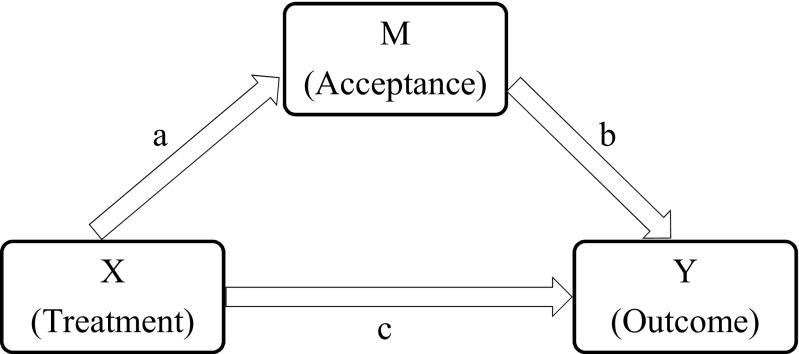
- Main analysis: bootstrapped product-of-coefficients mediation in SPSS/PROCESS with 10,000 samples; treatment was the independent variable, post-treatment acceptance the mediator, and change in satisfaction with life / physical functioning the outcomes. Anxiety and depression were also tested as alternative mediators.
## Limitations
- The paper explicitly states that the small sample size means the findings “need to be replicated,” and notes that the study had relatively low power for mediation analysis.
- The amount of attrition is identified as a limitation because it reduces power; only 53 participants remained at 6 months and 32 at 12 months.
- As evident from the text: the mediation analysis used post-assessment mediator scores and change scores, so the temporal ordering of mediator and outcome is not fully resolved; the authors note that continuous assessments during treatment would have helped.
Model-written summary. Check it against the paper before relying on it.
Integrity signals
Registry
Cites
Statistics
Figures

Verification
Claims the paper makes
10 Valid · 0 Not valid · 22 Not checked · 23 Own results and interpretations
The sources with a verdict support this claim; the rest weren’t checked yet, have no full text we could read, or their verdicts aren’t rated yet.
In the paper
“Altogether, these results are in line with previous research [31, 32] suggesting that acceptance mediates the effect of ACT on change in physical functioning”
§ Acceptance as a Mediator for Change in Acceptance and Commitment Therapy for Persons with Chronic Pain? > Discussion
What the sources say
- Not checked — no full text of the sourcecites [31] McCracken LM Gutiérrez-Martínez O Processes of change in psychological flexibility in an interdisciplinary group-based treatment for chronic pain based on acceptance and commitment therapy Behav Res Ther 2011 49 267 274 10.1016/j.brat.2011.02.004 21377652 source
- Supportedcites [32] Vowles KE Witkiewitz K Sowden G Ashworth J Acceptance and commitment therapy for chronic pain: evidence of mediation and clinically significant change following an abbreviated interdisciplinary rehabilitation program J Pain 2014 15 101 113 10.1016/j.jpain.2013.10.002 24373572 source
The Results report that, in the multiple-mediator model, change in pain acceptance was the only significant mediator of change in physical disability, supporting the claim about physical functioning. The finding concerns self-reported physical disability; the Results also say mediation was not significant for the sit-to-stand task. (LLM, conf=0.88)
hedgedstates a cause- Asserted: passes — The authors put it forward as true.
- Checkable: passes — It can be checked against evidence.
- Load-bearing: passes — The paper’s conclusions depend on it.
- Based: passes — The paper gives a reason why it holds.
The sources with a verdict support this claim; the rest weren’t checked yet, have no full text we could read, or their verdicts aren’t rated yet.
In the paper
“In two studies by McCracken and Gutiérrez-Martínez [31] and Vowles and colleagues [32], acceptance was shown to correlate with positive changes in disability, depression, and pain-related anxiety.”
§ Acceptance as a Mediator for Change in Acceptance and Commitment Therapy for Persons with Chronic Pain? > Introduction According to the World Health Organization (WHO), chronic pain is one of the most underestimated challenges for health care worldwide [1]. In chronic pain, comorbidity with depression and anxiety is common [2–4], social life is negatively affected [5], daily functioning impaired [6–8], and general level of activity reduced [3, 9]. On the whole, chronic pain reduces quality of life for the patient [10–13] and imposes high expenses on health care systems [1]. Cognitive behavior therapy (CBT) has been applied for chronic pain for decades with positive outcomes [14]. The definition of CBT is, however, broad, and the strategies applied within CBT for chronic pain may include a wide range of therapeutic tools [15]. This lack of specificity creates uncertainty as to the processes at work in CBT treatment [16]. A recent Cochrane review concludes that CBT is useful for chronic pain and that there is no need for further RCTs focusing on the reporting of group mean values [17]. Instead, studies identifying effective components of treatment are requested. Acceptance and commitment therapy (ACT), developed within the third wave of CBT, shares important features with CBT but is derived from functional contextualism and relational frame theory and thus has distinct philosophical and theoretical assumptions [18]. ACT has been shown to improve mental and physical health [19] and has been listed by the American Psychological Association (APA) as having strong research support for chronic pain [20]. In ACT, the aim is to create psychological flexibility around impairing life experiences, such as chronic pain, to enable moving forward and engaging in a vital valued life [21]. Psychological flexibility includes several processes, of which acceptance is one. Acceptance of chronic pain is defined as living with pain without reacting to, judging or attempting to reduce or avoid it [22]. It is not resignation to or ignoring pain but rather an active willingness to engage in meaningful activities in the presence of pain. Psychological acceptance has been shown to be beneficial in chronic pain [23–28] although most of the data is cross-sectional and/or correlational, which may establish covariation between variables but does not allow causal inferences [29, 30]. In two studies by McCracken and Gutiérrez-Martínez [31] and Vowles and colleagues [32], acceptance was shown to correlate with positive changes in disability, depression, and pain-related anxiety. Both of these studies, however, lacked experimental design. Randomized controlled trials (RCTs) testing the mediating effect in treatments for chronic pain are very sparse. In two RCTs by Wicksell and colleagues [33, 34], psychological flexibility was shown to mediate the effect of ACT on depression, pain-related functioning, and life satisfaction. Psychological flexibility is, however, comprised in the ACT model by acceptance as well as other therapeutic processes. In summary, research on the mechanisms of change in ACT for chronic pain is scarce. Acceptance is a key concept in the theoretical model, but there is no experimental study investigating its mediating effect. The aim of this study is to investigate whether acceptance mediates the effect of treatment on satisfaction with life and physical functioning using data from a previously published RCT evaluating ACT for chronic pain [35].
What the sources say
- Not checked — no full text of the sourcecites [31] McCracken LM Gutiérrez-Martínez O Processes of change in psychological flexibility in an interdisciplinary group-based treatment for chronic pain based on acceptance and commitment therapy Behav Res Ther 2011 49 267 274 10.1016/j.brat.2011.02.004 21377652 source
- Supportedcites [32] Vowles KE Witkiewitz K Sowden G Ashworth J Acceptance and commitment therapy for chronic pain: evidence of mediation and clinically significant change following an abbreviated interdisciplinary rehabilitation program J Pain 2014 15 101 113 10.1016/j.jpain.2013.10.002 24373572 source
The Results (page unavailable) report that changes in pain acceptance significantly mediated changes in disability, depression, and pain-related anxiety following the chronic-pain rehabilitation program. This supports the attributed association between acceptance and positive changes in all three outcomes. (LLM, conf=0.93)
plainstates an association- Asserted: passes — The authors put it forward as true.
- Checkable: passes — It can be checked against evidence.
- Load-bearing: passes — The paper’s conclusions depend on it.
- Based: passes — The paper gives a reason why it holds.
A result the paper reports from its own data — it cites no other source for it, so there is none to check. The quote shows it is in the paper.
In the paper
“Acceptance was found to mediate the effect of treatment on change in physical functioning from pre-assessment to follow-up at 6 months.”
- Also stated in: § Physical Functioning · plain
“A statistically significant indirect effect of treatment via acceptance was found on change in physical functioning from pre-assessment to follow-up 1.”
- Also stated in: § Discussion · plain
“There was, however, a statistically significant indirect effect on change in physical functioning from pre-assessment to follow-up 1”
§ Acceptance as a Mediator for Change in Acceptance and Commitment Therapy for Persons with Chronic Pain? > Abstract > Results
plainstates a cause- Asserted: passes — The authors put it forward as true.
- Checkable: passes — It can be checked against evidence.
- Load-bearing: passes — The paper’s conclusions depend on it.
- Based: passes — The paper gives a reason why it holds.
- Also stated in: § Physical Functioning · plain
A result the paper reports from its own data — it cites no other source for it, so there is none to check. The quote shows it is in the paper.
In the paper
“the addition of acceptance in explained variance in change from pre-assessment to follow-up 1 was 17 % (∆F = 4.21, p = 0.05) for the ACT group.”
§ Acceptance as a Mediator for Change in Acceptance and Commitment Therapy for Persons with Chronic Pain? > Results > Supplementary Analyses
plainstates an association- Asserted: passes — The authors put it forward as true.
- Checkable: passes — It can be checked against evidence.
- Load-bearing: passes — The paper’s conclusions depend on it.
- Based: passes — The paper gives a reason why it holds.
A result the paper reports from its own data — it cites no other source for it, so there is none to check. The quote shows it is in the paper.
In the paper
“The HMR showed that acceptance made a significant contribution of 35 % to follow-up 2 (∆F = 5.43, p = 0.04).”
- Also stated in: § Discussion · plain
“acceptance made a significant additional contribution of 35 % in explained variance at follow-up 2 after adjusting for earlier change in physical functioning.”
§ Acceptance as a Mediator for Change in Acceptance and Commitment Therapy for Persons with Chronic Pain? > Results > Supplementary Analyses
plainstates an association- Asserted: passes — The authors put it forward as true.
- Checkable: passes — It can be checked against evidence.
- Load-bearing: passes — The paper’s conclusions depend on it.
- Based: passes — The paper gives a reason why it holds.
- Also stated in: § Discussion · plain
20 more claims
Create a free account to see all 55 claims and every source verdict.
- Probably not a substantial claim. 21
- It may state two separate claims as one. 16
- The quote only partly states this claim. 1
Claims other papers make about this one
Each is checked against this paper’s own text: does it say what the citing paper says it does?
The source backs part of the claim, not all of it — or backs it for a different population, condition or comparison.
In the citing paper
“Data from other ACT studies also support the mediating role of hypothesized processes of change, including psychological flexibility, valued action, and aspects of mindfulness, on various outcomes (e.g., symptom severity, functioning, quality of life; Cederberg et al., 2016; Hayes et al., 2010; Pots et al., 2016; Twohig et al., 2015).”
From The role of psychological flexibility in acceptance-enhanced behavior therapy for trichotillomania: Moderation and mediation findings (2023) · cites this paper as Cederberg et al., 2016
Experimental — accuracy not yet measuredThe source backs part of the claim, not all of it — or backs it for a different population, condition or comparison.
In the citing paper
“Psychotherapists dealing with chronic pain tell us that “radical acceptance” of the condition is a way of transferring the treatment effect to bodily functioning [24, 25].”
From Endometriosis: patient–doctor communication and psychological counselling (2023) · cites this paper as [25]
Experimental — accuracy not yet measuredThe source backs part of the claim, not all of it — or backs it for a different population, condition or comparison.
In the citing paper
“PF has repeatedly been shown to be a potential treatment mechanism in ACT, with increased PF being associated with decreased pain interference and increased functioning (Cederberg et al., 2016;Lin et al., 2018;McCracken & Gutiérrez-Martínez, 2011;Stockton et al., 2018;Trompetter et al., 2015;Vowles et al., 2008Vowles et al., , 2014;;Wicksell et al., 2011).”
From Internet-delivered acceptance and commitment therapy as microlearning for chronic pain: A randomized controlled trial with 1-year follow-up (2021) · cites this paper as Cederberg et al., 2016
Experimental — accuracy not yet measuredThe cited source says what the claim attributes to it.
In the citing paper
“Thus, acceptance seems to be the mediating component of change in patients with chronic pain (Baranoff et al., 2016; Cederberg et al., 2016; Vowles et al, 2008; Yu et al., 2022).”
From Group Acceptance and Commitment Therapy (ACT) for Fibromyalgia Patients (2024) · cites this paper as Cederberg et al., 2016
Citations
Cites
Baron, R. M., & Kenny, D. A. (1986) · Journal of Personality and Social Psychology · doi:10.1037/0022-3514.51.6.1173 · Cited by 91,532 · cited 2×
“The most widely used is the causal stepsmethod [29, 57], which focuses on the individual paths of the model.”
BackgroundThe Hospital Anxiety and Depression Scale
Zigmond, A. S., & Snaith, R. P. (1983) · Acta Psychiatrica Scandinavica · doi:10.1111/j.1600-0447.1983.tb09716.x · Cited by 47,139
(2013) · Cited by 44,563
Preacher, K. J., & Hayes, A. F. (2008) · Behavior Research Methods · doi:10.3758/brm.40.3.879 · Cited by 34,117 · cited 2×
“Bootstrapping is a nonparametric procedure that acknowledges this fact [61, 62].”
BackgroundThe satisfaction with life scale
Diener, E., Emmons, R. A., Larsen, R. J., & Griffin, S. (1985) · Journal of Personality Assessment · doi:10.1207/s15327752jpa4901_13 · Cited by 31,768 · cited 2×
“The SWLS contains five statements, e.g., BIn most ways my life is close to ideal,^ that the respondents are asked to agree or disagree with on a scale from 1 to 7.”
MethodSPSS and SAS procedures for estimating indirect effects in simple mediation models
Preacher, K. J., & Hayes, A. F. (2004) · Behavior Research Methods, Instruments, & Computers · doi:10.3758/bf03206553 · Cited by 17,383 · cited 2×
“Bootstrapping is a nonparametric procedure that acknowledges this fact [61, 62].”
BackgroundDepression and quality of life in older persons: A review
Sivertsen, H., Bjørkløf, G. H., Engedal, K., Selbæk, G., & Helvik, A.-S. (2015) · Dementia and Geriatric Cognitive Disorders · doi:10.1159/000437299 · Cited by 14,152
Reconsidering Baron and Kenny: myths and truths about mediation analysis
Zhao, X., Lynch, J. G., & Chen, Q. (2010) · Journal of Consumer Research · doi:10.1086/651257 · Cited by 12,583 · cited 1×
“Note that a statistically significant total effect of X on Y is not necessary for mediation to occur and that mediation analysis does not require evidence of a total effect prior to investigating direct and indirect effects [63–66].”
BackgroundMediation in experimental and nonexperimental studies: New procedures and recommendations.
Shrout, P. E., & Bolger, N. (2002) · Psychological Methods · doi:10.1037/1082-989x.7.4.422 · Cited by 11,335 · cited 1×
“Note that a statistically significant total effect of X on Y is not necessary for mediation to occur and that mediation analysis does not require evidence of a total effect prior to investigating direct and indirect effects [63–66].”
BackgroundA comparison of methods to test mediation and other intervening variable effects
MacKinnon, D. P., Lockwood, C. M., Hoffman, J. M., West, S. G., & Sheets, V. (2002) · Psychological Methods · doi:10.1037/1082-989x.7.1.83 · Cited by 9,406 · cited 1×
“There are a number of different methods to test mediation [59, 60].”
MethodAcceptance and commitment therapy: model, processes and outcomes
Hayes, S. C., Luoma, J. B., Bond, F. W., Masuda, A., & Lillis, J. (2006) · Behaviour Research and Therapy · doi:10.1016/j.brat.2005.06.006 · Cited by 6,587 · cited 1×
“Acceptance and commitment therapy (ACT), developed within the third wave of CBT, shares important features with CBT but is derived from functional contextualism and relational frame theory and thus has distinct philosophical and theoretical assumptions [18].”
BackgroundMacKinnon, D. P., Fairchild, A. J., & Fritz, M. S. (2007) · Annual Review of Psychology · doi:10.1146/annurev.psych.58.110405.085542 · Cited by 5,688 · cited 1×
“There are a number of different methods to test mediation [59, 60].”
MethodSurvey of chronic pain in Europe: Prevalence, impact on daily life, and treatment
Breivik, H., Collett, B., Ventafridda, V., Cohen, R., & Gallacher, D. (2006) · European Journal of Pain · doi:10.1016/j.ejpain.2005.06.009 · Cited by 5,486 · cited 1×
“In chronic pain, comorbidity with depression and anxiety is common [2–4], social life is negatively affected [5], daily functioning impaired [6–8], and general level of activity reduced [3, 9].”
BackgroundRequired sample size to detect the mediated effect
Fritz, M. S., & MacKinnon, D. P. (2007) · Psychological Science · doi:10.1111/j.1467-9280.2007.01882.x · Cited by 4,810
Testing moderator and mediator effects in counseling psychology research.
Frazier, P. A., Tix, A. P., & Barron, K. E. (2004) · Journal of Counseling Psychology · doi:10.1037/0022-0167.51.1.115 · Cited by 4,037 · cited 2×
“Psychological acceptance has been shown to be beneficial in chronic pain [23–28] although most of the data is cross-sectional and/or correlational, which may establish covariation between variables but does not allow causal inferences [29, 30].”
BackgroundReview of the Satisfaction With Life Scale.
Pavot, W., & Diener, E. (1993) · Psychological Assessment · doi:10.1037/1040-3590.5.2.164 · Cited by 3,611
Review of the Satisfaction With Life Scale
Pavot, W., & Diener, E. (2009) · Social Indicators Research Series · doi:10.1007/978-90-481-2354-4_5 · Cited by 3,460 · cited 1×
“88 in a Swedish trial [45]) and validity and has been shown to be sensitive to change [46, 47].”
BackgroundThe biopsychosocial approach to chronic pain: Scientific advances and future directions.
Gatchel, R. J., Peng, Y. B., Peters, M. L., Fuchs, P. N., & Turk, D. C. (2007) · Psychological Bulletin · doi:10.1037/0033-2909.133.4.581 · Cited by 3,392 · cited 1×
“The definition of CBT is, however, broad, and the strategies applied within CBT for chronic pain may include a wide range of therapeutic tools [15].”
BackgroundPain: a review of three commonly used pain rating scales
Williamson, A., & Hoggart, B. (2005) · Journal of Clinical Nursing · doi:10.1111/j.1365-2702.2005.01121.x · Cited by 3,083 · cited 1×
“The NRS scale for measuring pain has good reliability and validity and has been shown to be sensitive to change [54, 55].”
BackgroundMediators and Mechanisms of Change in Psychotherapy Research
Kazdin, A. E. (2007) · Annual Review of Clinical Psychology · doi:10.1146/annurev.clinpsy.3.022806.091432 · Cited by 2,504 · cited 1×
“The fact that the indirect effects were not significant at the 95 % CI raises questions regarding the temporal relation between the variables [68].”
BackgroundProcess Analysis: Estimating Mediation in Treatment Evaluations
Judd, C. M., & Kenny, D. A. (1981) · Evaluation Review · doi:10.1177/0193841x8100500502 · Cited by 2,442
Mediation Analysis in Social Psychology: Current Practices and New Recommendations
Rucker, D. D., Preacher, K. J., Tormala, Z. L., & Petty, R. E. (2011) · Social and Personality Psychology Compass · doi:10.1111/j.1751-9004.2011.00355.x · Cited by 2,430 · cited 1×
“Note that a statistically significant total effect of X on Y is not necessary for mediation to occur and that mediation analysis does not require evidence of a total effect prior to investigating direct and indirect effects [63–66].”
BackgroundValidity of four pain intensity rating scales
Ferreira-Valente, M. A., Pais-Ribeiro, J. L., & Jensen, M. P. (2011) · Pain · doi:10.1016/j.pain.2011.07.005 · Cited by 1,872 · cited 1×
“The NRS scale for measuring pain has good reliability and validity and has been shown to be sensitive to change [54, 55].”
BackgroundPavot, W., Diener, E., Colvin, C. R., & Sandvik, E. (1991) · Journal of Personality Assessment · doi:10.1207/s15327752jpa5701_17 · Cited by 1,866 · cited 1×
“88 in a Swedish trial [45]) and validity and has been shown to be sensitive to change [46, 47].”
BackgroundPsychological therapies for the management of chronic pain (excluding headache) in adults
Williams, A. C. D. C., Eccleston, C., & Morley, S. (2012) · Cochrane Database of Systematic Reviews · doi:10.1002/14651858.cd007407.pub3 · Cited by 1,634 · cited 1×
“A recent Cochrane review concludes that CBT is useful for chronic pain and that there is no need for further RCTs focusing on the reporting of group mean values [17].”
BackgroundAcceptance and commitment therapy.
Hayes, S. C., & Lillis, J. (2012) · American Psychological Association eBooks · doi:10.1037/17335-000 · Cited by 1,543
Persistent Pain and Well-being: A World Health Organization Study in Primary Care
Gureje, O., Von Korff, M., Simon, G. E., & Gater, R. (1998) · JAMA · doi:10.1001/jama.280.2.147 · Cited by 1,496 · cited 1×
“In chronic pain, comorbidity with depression and anxiety is common [2–4], social life is negatively affected [5], daily functioning impaired [6–8], and general level of activity reduced [3, 9].”
BackgroundAcceptance of chronic pain: component analysis and a revised assessment method
McCracken, L. M., Vowles, K. E., & Eccleston, C. (2004) · Pain · doi:10.1016/j.pain.2003.10.012 · Cited by 1,101 · cited 2×
“Acceptance was measured by the Chronic Pain Acceptance Questionnaire (CPAQ) [43], entailing two subscales.”
BackgroundMethodChronic pain in Australia: a prevalence study.
Blyth, F. M., March, L. M., Brnabic, A. J. M., Jorm, L. R., Williamson, M., & Cousins, M. J. (2001) · Pain · doi:10.1016/s0304-3959(00)00355-9 · Cited by 1,096 · cited 1×
“In chronic pain, comorbidity with depression and anxiety is common [2–4], social life is negatively affected [5], daily functioning impaired [6–8], and general level of activity reduced [3, 9].”
BackgroundMeta-analysis of psychological interventions for chronic low back pain
Hoffman, B. M., Papas, R. K., Chatkoff, D. K., & Kerns, R. D. (2007) · Health Psychology · doi:10.1037/0278-6133.26.1.1 · Cited by 844 · cited 1×
“Cognitive behavior therapy (CBT) has been applied for chronic pain for decades with positive outcomes [14].”
BackgroundCuijpers, P., Donker, T., van Straten, A., Li, J., & Andersson, G. (2010) · Psychological Medicine · doi:10.1017/s0033291710000772 · Cited by 832 · cited 1×
“Guided self-help has been shown to be equally effective as face-to-face treatment for depression and anxiety [36].”
BackgroundVeehof, M. M., Oskam, M.-J., Schreurs, K. M. G., & Bohlmeijer, E. T. (2011) · PAIN · doi:10.1016/j.pain.2010.11.002 · Cited by 792 · cited 1×
“has been shown to improve mental and physical health [19] and has been listed by the American Psychological Association (APA) as having strong research support for chronic pain [20].”
BackgroundHospital anxiety and depression scale (had): Some psychometric data for a swedish sample
Lisspers, J., Nygren, A., & Söderman, E. (1997) · Acta Psychiatrica Scandinavica · doi:10.1111/j.1600-0447.1997.tb10164.x · Cited by 706
Learning to live with the pain: acceptance of pain predicts adjustment in persons with chronic pain
McCracken, L. M. (1998) · Pain · doi:10.1016/s0304-3959(97)00146-2 · Cited by 685 · cited 1×
“Acceptance of chronic pain is defined as living with pain without reacting to, judging or attempting to reduce or avoid it [22].”
BackgroundAmerican Psychological Association (APA)
Kaslow, N. J., & Doran, J. M. (2017) · Encyclopedia of Clinical Neuropsychology · doi:10.1007/978-3-319-56782-2_593-3 · Cited by 585
Linton, S. J., & Boersma, K. (2003) · The Clinical Journal of Pain · doi:10.1097/00002508-200303000-00002 · Cited by 523
Becker, N., Thomsen, A. B., Olsen, A. K., Sjøgren, P., Bech, P., & Eriksen, J. (1997) · Pain · doi:10.1016/s0304-3959(97)00126-7 · Cited by 426
A prospective study of acceptance of pain and patient functioning with chronic pain
McCracken, L. M., & Eccleston, C. (2005) · Pain · doi:10.1016/j.pain.2005.08.015 · Cited by 341
Bibliotherapy in unipolar depression: A meta-analysis
Cuijpers, P. (1997) · Journal of Behavior Therapy and Experimental Psychiatry · doi:10.1016/s0005-7916(97)00005-0 · Cited by 339 · cited 1×
“High rates of attrition are to be expected in bibliotherapy [69] and it could be argued that this does not have the same implications in mediation studies as in studies evaluating the effectiveness of an intervention.”
Mohr, D. C., Ho, J., Duffecy, J., Reifler, D., Sokol, L., Burns, M. N., Jin, L., & Siddique, J. (2012) · JAMA · doi:10.1001/jama.2012.5588 · Cited by 330 · cited 1×
“Furthermore, telephone administered CBT has shown comparable clinical efficacy compared to face-to-face treatment for depression among primary care patients [37] and in multiple sclerosis [38].”
BackgroundAcceptance and change in the context of chronic pain
McCracken, L. M., Carson, J. W., Eccleston, C., & Keefe, F. J. (2004) · Pain · doi:10.1016/j.pain.2004.02.006 · Cited by 322 · cited 1×
“Psychological acceptance has been shown to be beneficial in chronic pain [23–28] although most of the data is cross-sectional and/or correlational, which may establish covariation between variables but does not allow causal inferences [29, 30].”
BackgroundComorbid Chronic Pain and Depression: Who Is at Risk?
Miller, L. R., & Cano, A. (2009) · The Journal of Pain · doi:10.1016/j.jpain.2008.12.007 · Cited by 321 · cited 1×
“In chronic pain, comorbidity with depression and anxiety is common [2–4], social life is negatively affected [5], daily functioning impaired [6–8], and general level of activity reduced [3, 9].”
BackgroundMcCracken, L. M., & Gutiérrez-Martínez, O. (2011) · Behaviour Research and Therapy · doi:10.1016/j.brat.2011.02.004 · Cited by 283 · cited 2×
“Altogether, these results are in line with previous research [31, 32] suggesting that acceptance mediates the effect of ACT on change in physical functioning, and thus is a relevant treatment component, for people suffering from chronic pain.”
BackgroundResultViane, I., Crombez, G., Eccleston, C., Poppe, C., Devulder, J., Van Houdenhove, B., & De Corte, W. (2003) · Pain · doi:10.1016/s0304-3959(03)00291-4 · Cited by 282 · cited 1×
“Psychological acceptance has been shown to be beneficial in chronic pain [23–28] although most of the data is cross-sectional and/or correlational, which may establish covariation between variables but does not allow causal inferences [29, 30].”
BackgroundA controlled trial of self-help treatment of recurrent headache conducted via the Internet.
Ström, L., Pettersson, R., & Andersson, G. (2000) · Journal of Consulting and Clinical Psychology · doi:10.1037/0022-006x.68.4.722 · Cited by 267 · cited 1×
“AR has previously been evaluated for chronic pain [39, 40] and functions in this case as an active treatment control group.”
BackgroundAmerican Psychological Association (APA)
Hsu, K. J., & Davison, G. C. (2015) · The Encyclopedia of Clinical Psychology · doi:10.1002/9781118625392.wbecp359 · Cited by 264
World Health Organization (WHO)
(2012) · SpringerReference · doi:10.1007/springerreference_70205 · Cited by 261
Wicksell, R. K., Olsson, G. L., & Hayes, S. C. (2010) · European Journal of Pain · doi:10.1016/j.ejpain.2010.05.001 · Cited by 259 · cited 1×
“In two RCTs by Wicksell and colleagues [33, 34], psychological flexibility was shown to mediate the effect of ACTon depression, pain-related functioning, and life satisfaction.”
BackgroundMohr, D. C., Likosky, W., Bertagnolli, A., Goodkin, D. E., Van Der Wende, J., Dwyer, P., & Dick, L. P. (2000) · Journal of Consulting and Clinical Psychology · doi:10.1037/0022-006x.68.2.356 · Cited by 240 · cited 1×
“Furthermore, telephone administered CBT has shown comparable clinical efficacy compared to face-to-face treatment for depression among primary care patients [37] and in multiple sclerosis [38].”
BackgroundCerin, E., & MacKinnon, D. P. (2009) · Public Health Nutrition · doi:10.1017/s1368980008003649 · Cited by 210
Vowles, K. E., Witkiewitz, K., Sowden, G., & Ashworth, J. (2014) · The Journal of Pain · doi:10.1016/j.jpain.2013.10.002 · Cited by 201
Patient Functioning and Catastrophizing in Chronic Pain: The Mediating Effects of Acceptance
Vowles, K. E., McCracken, L. M., & Eccleston, C. (2008) · Health Psychology · doi:10.1037/0278-6133.27.2(suppl.).s136 · Cited by 179 · cited 1×
“Psychological acceptance has been shown to be beneficial in chronic pain [23–28] although most of the data is cross-sectional and/or correlational, which may establish covariation between variables but does not allow causal inferences [29, 30].”
BackgroundZanocchi, M., Maero, B., Nicola, E., Martinelli, E., Luppino, A. F., Gonella, M., Gariglio, F., Fissore, L., Bardelli, B., Obialero, R., et al. (2007) · Archives of Gerontology and Geriatrics · doi:10.1016/j.archger.2007.07.003 · Cited by 169 · cited 1×
“On the whole, chronic pain reduces quality of life for the patient [10–13] and imposes high expenses on health care systems [1].”
BackgroundQuality‐of‐Life Differences Between Patients With Episodic and Transformed Migraine
Meletiche, D. M., Lofland, J. H., & Young, W. B. (2001) · Headache: The Journal of Head and Face Pain · doi:10.1046/j.1526-4610.2001.041006573.x · Cited by 165 · cited 1×
“affected [5], daily functioning impaired [6–8], and general”
BackgroundMediators of change in Acceptance and Commitment Therapy for pediatric chronic pain
Wicksell, R. K., Olsson, G. L., & Hayes, S. C. (2011) · Pain · doi:10.1016/j.pain.2011.09.003 · Cited by 160 · cited 1×
“In two RCTs by Wicksell and colleagues [33, 34], psychological flexibility was shown to mediate the effect of ACTon depression, pain-related functioning, and life satisfaction.”
BackgroundHultell, D., & Petter Gustavsson, J. (2008) · Personality and Individual Differences · doi:10.1016/j.paid.2007.10.030 · Cited by 153 · cited 1×
“88 in a Swedish trial [45]) and validity and has been shown to be sensitive to change [46, 47].”
BackgroundViane, I., Crombez, G., Eccleston, C., Devulder, J., & De Corte, W. (2004) · Pain · doi:10.1016/j.pain.2004.09.008 · Cited by 140 · cited 1×
“Psychological acceptance has been shown to be beneficial in chronic pain [23–28] although most of the data is cross-sectional and/or correlational, which may establish covariation between variables but does not allow causal inferences [29, 30].”
BackgroundThorsell, J., Finnes, A., Dahl, J., Lundgren, T., Gybrant, M., Gordh, T., & Buhrman, M. (2011) · The Clinical Journal of Pain · doi:10.1097/ajp.0b013e318219a933 · Cited by 136 · cited 3×
“1 The participants’ flow in the main study [35] Int.”
BackgroundMethodInfluentialSelf-citationWestman, A., Linton, S. J., Öhrvik, J., Wahlén, P., & Leppert, J. (2008) · European Journal of Pain · doi:10.1016/j.ejpain.2007.10.007 · Cited by 107 · cited 1×
“Physical functioning was measured by five items of the Örebro Musculoskeletal Pain Questionnaire (ÖMPQ) [48], for which factor structure and psychometric properties have been supported [49–51].”
Methodvan Koppenhagen, C. F., Post, M. W. M., van der Woude, L. H. V., de Witte, L., van Asbeck, F. W., de Groot, S., van den Heuvel, W. J., & Lindeman, E. (2008) · Archives of Physical Medicine and Rehabilitation · doi:10.1016/j.apmr.2007.12.042 · Cited by 89 · cited 1×
“On the whole, chronic pain reduces quality of life for the patient [10–13] and imposes high expenses on health care systems [1].”
BackgroundLinton, S. J., & Götestam, K. G. (1984) · British Journal of Clinical Psychology · doi:10.1111/j.2044-8260.1984.tb01303.x · Cited by 86 · cited 1×
“AR has previously been evaluated for chronic pain [39, 40] and functions in this case as an active treatment control group.”
BackgroundThe role of pain behaviors in the modulation of marital conflict in chronic pain couples
Schwartz, L., Slater, M. A., & Birchler, G. R. (1996) · Pain · doi:10.1016/0304-3959(95)00211-1 · Cited by 85 · cited 1×
“affected [5], daily functioning impaired [6–8], and general”
BackgroundAccepting Low Back Pain: Is It Related to a Good Quality of Life?
Mason, V. L., Mathias, B., & Skevington, S. M. (2008) · The Clinical Journal of Pain · doi:10.1097/ajp.0b013e318156d94f · Cited by 76 · cited 1×
“Psychological acceptance has been shown to be beneficial in chronic pain [23–28] although most of the data is cross-sectional and/or correlational, which may establish covariation between variables but does not allow causal inferences [29, 30].”
BackgroundPsychosocial experiences among primary care patients with and without musculoskeletal pain
Soares, J. J. F., & Jablonska, B. (2004) · European Journal of Pain · doi:10.1016/s1090-3801(03)00083-1 · Cited by 76 · cited 1×
“affected [5], daily functioning impaired [6–8], and general”
BackgroundGabel, C. P., Melloh, M., Yelland, M., Burkett, B., & Roiko, A. (2011) · European Spine Journal · doi:10.1007/s00586-010-1509-4 · Cited by 50 · cited 1×
“Physical functioning was measured by five items of the Örebro Musculoskeletal Pain Questionnaire (ÖMPQ) [48], for which factor structure and psychometric properties have been supported [49–51].”
MethodQuality of life in subgroups of individuals with whiplash associated disorders
Wallin, M. K. M., & Raak, R. I. (2008) · European Journal of Pain · doi:10.1016/j.ejpain.2007.12.008 · Cited by 37
World Health Organization supports global effort to relieve chronic pain.
(2004) · PubMed · Cited by 34
Process and change in cognitive behaviour therapy for chronic pain
Morley, S. (2004) · Pain · doi:10.1016/j.pain.2004.02.008 · Cited by 29 · cited 1×
“This lack of specificity creates uncertainty as to the processes at work in CBT treatment [16].”
BackgroundTenhunen, K., & Elander, J. (2005) · Journal of Health Psychology · doi:10.1177/1359105305051425 · Cited by 21 · cited 1×
“affected [5], daily functioning impaired [6–8], and general”
BackgroundAcknowledgement to Reviewers 2009
(2010) · European Journal of Pain · doi:10.1016/s1090-3801(10)00018-2 · Cited by 5
Research works printed but not linked: 4
- Dahl J Lundgren T Living beyond your pain: using acceptance and commitment therapy to ease chronic pain 2006 Oakland New Harbinger Publications
- Öst LG Tillämpad avslappning: manual till en beteendeterapeutisk coping-teknik 2006 Uppsala Universitetstryckeriet
- Linton SJ Manual for the Örebro musculoskeletal pain screening questionnaire: the early identification of patients at risk for chronic pain 1999 Närke Tryck Örebro
- IBM SPSS Statistics Version 20.0.0 2011 Armonk IBM Corporation
Cited by
Kashdan, T. B., Disabato, D. J., Goodman, F. R., Doorley, J. D., & McKnight, P. E. (2020) · Psychological Assessment · doi:10.1037/pas0000834 · Cited by 240
Current status of acceptance and commitment therapy for chronic pain: A narrative review
Feliu Soler, A., Montesinos, F., Gutiérrez-Martínez, O., Scott, W., McCracken, L., & Luciano, J. (2018) · Journal of Pain Research · doi:10.2147/jpr.s144631 · Cited by 198
“9,30,58,59 Concerning the interactions between these two processes, it seems that the relative time course of changes is an important question.”
Acceptance and Commitment Therapy for Chronic Pain: (674542012-001)
(2012) · PsycEXTRA Dataset · doi:10.1037/e674542012-001 · Cited by 148
New generation psychological treatments in chronic pain
McCracken, L. M., Yu, L., & Vowles, K. E. (2022) · BMJ · doi:10.1136/bmj-2021-057212 · Cited by 123
Ma, T.-W., Yuen, A. S.-K., & Yang, Z. (2023) · The Clinical Journal of Pain · doi:10.1097/ajp.0000000000001096 · Cited by 88
“Johnston et al44 Adults with all types of chronic pain (n = 24) Waikato Hospital Pain Clinic Age median (range): 43 (20-84) 62.”
BackgroundMethod
Metadata
- Authors
- Cederberg, J. T., Cernvall, M., Dahl, J., von Essen, L., & Ljungman, G.
- Affiliations
- Uppsala University (SE)
- Corresponding author
- Cederberg, Jenny Thorsell
- Venue
- International Journal of Behavioral Medicine
- Published
- 2015-06-04
- Volume
- 23
- Issue
- 1
- Pages
- 21-29
- ISSN
- 1070-5503 (ISSN-L)
- 1532-7558
- PMC
- PMC4748004
- OpenAlex
- W622700105
- Cited by
- 79
- References
- 75
- Citations by year
- 2026: 4 · 2025: 3 · 2024: 5 · 2023: 8 · 2022: 11 · 2021: 10 · 2020: 9 · 2019: 7 · 2018: 13 · 2017: 7 · 2016: 1 · 2015: 1
- FWCI
- 9.09
- Type
- journal article
- Language
- en
- Open access
- hybrid
- doi.org
- Locations
- International Journal of Behavioral Medicine (publishedVersion, cc-by)
- Europe PMC (PubMed Central) (publishedVersion, cc-by)
- PubMed Central (publishedVersion, cc-by)
- PubMed (publishedVersion)
- KTH Publication Database DiVA (KTH Royal Institute of Technology) (submittedVersion, other-oa)
- Topics
- Social Sciences › Psychology › Clinical Psychology › Mindfulness and Compassion Interventions
- Health Sciences › Health Professions › Physical Therapy, Sports Therapy and Rehabilitation › Musculoskeletal pain and rehabilitation
- Social Sciences › Psychology › Experimental and Cognitive Psychology › Anxiety, Depression, Psychometrics, Treatment, Cognitive Processes
- Keywords
- acceptance and commitment therapy, chronic pain, acceptance, mediation, physical function, life satisfaction, anxiety, depression
- MeSH terms
- Activities of Daily Living, Adult, Anxiety, Behavior, Depression, Female, Humans, Male, Middle Aged, Treatment Outcome, Patient Satisfaction, Chronic Pain, Acceptance and Commitment Therapy
About these checks
Registry, retraction, Cites and statistics results are computed, not judged, with one exception: a printed reference that no index lists is read once by a model before it counts as a citation error. Claims are extracted by a model and kept only when their quote appears verbatim in the text; each cited source is then checked, with a model’s help, for whether it says what the claim relies on. Those verdicts can be wrong — read the claim’s quote and the cited source before relying on one.
The claim verdicts this report counts are experimental: their accuracy is not yet measured.
A language model drew the claims from the paper on 2026-10-11, under version 3 of the claim definition (model deepseek-v4.1-flash, prompt extract-v3).
A second model labelled each claim on 2026-10-11 (model jev-1.13-20260917, definition revision gold-guideline-v0.2).
Cited sources are checked with a language model’s help (gpt-6-sol).
Statistics and arithmetic are recomputed, not judged.
Confidence bands are shown only for fields calibrated on our annotated test set. None is calibrated yet, so no band is shown.
What counts as a claim ›How we measure confidence ›How we check this ›
Are you an author, or do you see a problem with this page? Request a review
Data sources
Bibliographic data: Semantic Scholar, OpenAlex, Crossref.
Contains information from the Semantic Scholar Academic Graph Datasets, made available under the ODC Attribution License (ODC-BY 1.0).
Semantic Scholar’s data is described in: Kinney, R., et al. (2023). The Semantic Scholar Open Data Platform. arXiv:2301.10140.
