

Using socially assistive robots for monitoring and preventing frailty among older adults: a study on usability and user experience challenges
Open accessThe DOI matches its Crossref record; 48 of the 48 references it cites were found in a registry or an index.
Abstract
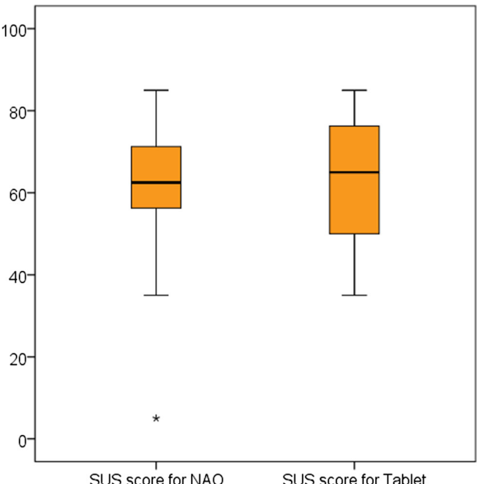
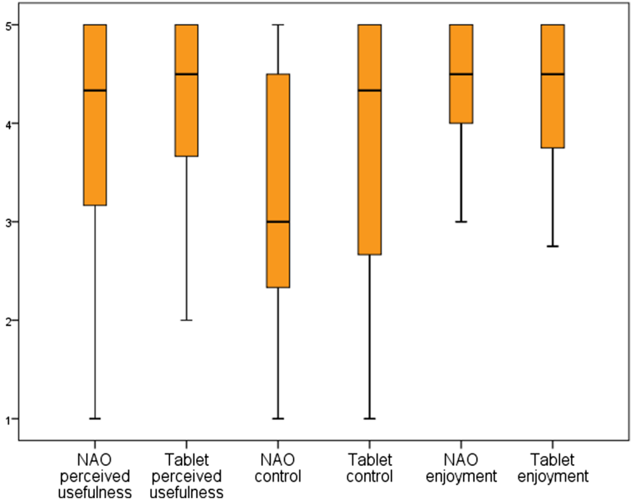
Socially assistive robots can play an important role in the monitoring and training of health of older adults. But before their benefits can be reaped, proper usability and a positive user experience need to be ensured. In this study, we tested the usability and user experience of a socially assistive robot (the NAO humanoid robot) to monitor and train the health of frail older adults. They were asked to complete a set of health monitoring and physical training tasks, once provided by the NAO robot, and once provided by a Tablet PC application (as a reference technology). After using each technology, they completed the System Usability Scale for usability, and a set of rating scales for perceived usefulness, enjoyment, and control. Finally, we questioned the participants’ preference for one of the technologies. All interactions were recorded on video and scrutinized for usability issues. Twenty older adults participated. They awarded both technologies ‘average’ usability scores. Perceived usefulness and enjoyment were rated as very positive for both modalities; control was scored positively. Main usability issues for NAO for these tasks were related to speech interaction (e.g., NAO’s limited speech library, NAO’s difficulty to cope with Dutch dialect), older adults’ difficulties with taking their proper role in human-robot interaction, and a lack of affordances of NAO. Seven participants preferred NAO: it was easier to use and more personal. Social robots have the potential to monitor and train the health of frail older adults, but some critical usability challenges need to be overcome first.
Overview
The claims and statistics of this paper haven’t been checked yet.
Free: it reads the open-access text and checks the first 5 claims that cite a source we can check. Create a free account to check every claim.
Integrity signals
Registry
Cites
Statistics
Figures

Verification
Claims the paper makes
The claims and statistics of this paper haven’t been checked yet.
Free: it reads the open-access text and checks the first 5 claims that cite a source we can check. Create a free account to check every claim.
Claims other papers make about this one
Each is checked against this paper’s own text: does it say what the citing paper says it does?
The source backs part of the claim, not all of it — or backs it for a different population, condition or comparison.
In the citing paper
“The poor speech recognition system hasbeen listed as the main usability issue in most research on social robots with speech capabilities [7,8,20,21].”
From Evaluating the User Experience and Usability of the MINI Robot for Elderly Adults with Mild Dementia and Mild Cognitive Impairment: Insights and Recommendations (2024) · cites this paper as [20]
Experimental — accuracy not yet measuredThe cited source says what the claim attributes to it.
In the citing paper
“Issues regarding the microphones, touch sensors, and tablet interface emerged in similar studies with social robots [8,20].”
Self-check
Percentages, sums and reported differences re-computed from the paper’s own numbers.
The self-check needs the paper’s full text.
Citations
Cites
SUS: A 'Quick and Dirty' Usability Scale
(1996) · Usability Evaluation In Industry · doi:10.1201/9781498710411-35 · Cited by 8,989
Extrinsic and Intrinsic Motivation to Use Computers in the Workplace 1
Davis, F. D., Bagozzi, R. P., & Warshaw, P. R. (1992) · Journal of Applied Social Psychology · doi:10.1111/j.1559-1816.1992.tb00945.x · Cited by 6,231
An Empirical Evaluation of the System Usability Scale
Bangor, A., Kortum, P. T., & Miller, J. T. (2008) · International Journal of Human–Computer Interaction · doi:10.1080/10447310802205776 · Cited by 5,181
Usability Evaluation In Industry
(1996) · CRC Press eBooks · doi:10.1201/9781498710411 · Cited by 4,354
User Acceptance of Hedonic Information Systems1
van der Heijden, H. (2004) · MIS Quarterly · doi:10.2307/25148660 · Cited by 3,850
Heuristic evaluation of user interfaces
Nielsen, J., & Molich, R. (1990) · Proceedings of the SIGCHI conference on Human factors in computing systems Empowering people - CHI '90 · doi:10.1145/97243.97281 · Cited by 3,533 · cited 1×
“aid of a set of design guidelines) [17], and cognitive walkthroughs (in which experts are asked to ‘walk through’ a computer system or website as a normal user and report any”
BackgroundGaver, W. W. (1991) · Proceedings of the SIGCHI conference on Human factors in computing systems Reaching through technology - CHI '91 · doi:10.1145/108844.108856 · Cited by 1,536
Re-Examining Perceived Ease of Use and Usefulness: A Confirmatory Factor Analysis
Segars, A. H., & Grover, V. (1993) · MIS Quarterly · doi:10.2307/249590 · Cited by 1,515
The Factor Structure of the System Usability Scale
Lewis, J. R., & Sauro, J. (2009) · Lecture Notes in Computer Science · doi:10.1007/978-3-642-02806-9_12 · Cited by 1,278
Assessing Acceptance of Assistive Social Agent Technology by Older Adults: the Almere Model
Heerink, M., Kröse, B., Evers, V., & Wielinga, B. (2010) · International Journal of Social Robotics · doi:10.1007/s12369-010-0068-5 · Cited by 1,229
Research works printed but not linked: 4
- 1. Asimov I. I, robot. New York: Gnome Press; 1950.
- 8. European Innovation Partnership on Active and Healthy Ageing. Action plan on prevention and early diagnosis of frailty and func- tional decline, both physical and cognitive in older people. Brussels: European Union; 2012.
- 9. Gomez MI, García-Sánchez I, Carta A, Antunes JP. A collection of good practices that support the prevention and early diagnosis of frailty and functional decline, both physically and cognitive, in older people. Brussels: European Commission; 2013.
- 43. Central Committee on Research involving Human Subjects Manual for the review of medical research involving human subjects. http:// www.ccmo-online.nl.
Cited by
10 Years of Human-NAO Interaction Research: A Scoping Review
Amirova, A., Rakhymbayeva, N., Yadollahi, E., Sandygulova, A., & Johal, W. (2021) · Frontiers in Robotics and AI · doi:10.3389/frobt.2021.744526 · Cited by 134
Guemghar, I., Padilha, P. P. D. O., Abdel‐Baki, A., Jutras‐Aswad, D., Paquette, J., & Pomey, M. (2022) · JMIR Mental Health · doi:10.2196/36094 · Cited by 128
“With this population, it has been determined that SARs could be used to improve physical exercise and monitor health status [28,29].”
BackgroundVandemeulebroucke, T., Dzi, K. T. J., & Gastmans, C. (2021) · Archives of Gerontology and Geriatrics · doi:10.1016/j.archger.2021.104399 · Cited by 122
Between fear and trust: Older adults’ evaluation of socially assistive robots
Zafrani, O., Nimrod, G., & Edan, Y. (2022) · International Journal of Human-Computer Studies · doi:10.1016/j.ijhcs.2022.102981 · Cited by 97
Fields, N., Xu, L., Greer, J., & Murphy, E. (2021) · Aging & Mental Health · doi:10.1080/13607863.2019.1699016 · Cited by 65
Broekhuis, M., van Velsen, L., Peute, L., Halim, M., & Hermens, H. J. (2021) · JMIR Formative Research · doi:10.2196/18198 · Cited by 61
“The following eHealth applications were included in this study: (1) Stranded, a web-based gamification application in which users can progress in the game by regularly performing physiotherapeutic exercises that are scheduled by a physiotherapist [14]; (2) a web-based screening module provided by a tablet and a care r…”
Self-citationMahmoudi Asl, A., Molinari Ulate, M., Franco Martin, M., & van der Roest, H. (2022) · Journal of Medical Internet Research · doi:10.2196/37434 · Cited by 50
“1%) qualitative studies performed conversation and video analysis [27,28] to extract statements on acceptability and usability.”
BackgroundMethodInfluentialTime to act mature—Gearing eHealth evaluations towards technology readiness levels
Jansen-Kosterink, S. M., Broekhuis, M., & van Velsen, L. (2022) · Digital Health · doi:10.1177/20552076221113396 · Cited by 39
“…in a controlled setting should be conducted to identify usability issues and to assess use, acceptance, and potential health benefits (e.g. as in Olde Keizer et al., 2019).25 The outcomes of the technology-oriented evaluations (e.g. usability tests) should feed an iterative redesign process, in…”
BackgroundGómez, M. M., Marqués-Villarroya, S., Castillo, J. C., Castro‐González, Á., & Malfáz, M. (2022) · Engineering Applications of Artificial Intelligence · doi:10.1016/j.engappai.2022.105631 · Cited by 39
Blavette, L., Dacunha, S., Alameda-Pineda, X., García, D. H., Gannot, S., Gras, F., Gunson, N., Lemaignan, S., Polic, M., Tandeitnik, P., et al. (2025) · JMIR Human Factors · doi:10.2196/76496 · Cited by 35
Blavette, L., Rigaud, A., Anzalone, S. M., Kergueris, C., Isabet, B., Dacunha, S., & Pino, M. (2022) · International Journal of Environmental Research and Public Health · doi:10.3390/ijerph19095222 · Cited by 33
Promoting Cognitive Health in Elder Care with Large Language Model-Powered Socially Assistive Robots
Lima, M. R. D., O'Connell, A., Zhou, F. B., Nagahara, A., Hulyalkar, A., Deshpande, A., Thomason, J., Vaidyanathan, R., & Matarić, M. J. (2025) · CHI Conference on Human Factors in Computing Systems · doi:10.1145/3706598.3713582 · Cited by 33
Internet of robotic things for independent living: Critical analysis and future directions
Sandhu, M. M., Silvera‐Tawil, D., Borges, P., Zhang, Q., & Kusý, B. (2024) · Internet of Things · doi:10.1016/j.iot.2024.101120 · Cited by 31
Boumans, R., van Meulen, F., van Aalst, W., Albers, J., Janssen, M., Peters-Kop, M., Waal, G. H., van de Poll, A., Hindriks, K. V., Neerincx, M. A., et al. (2020) · Journal of Medical Internet Research · doi:10.2196/18787 · Cited by 31
Naseer, F., Khan, M. N., Tahir, M., Addas, A., & Kashif, H. (2025) · IEEE Access · doi:10.1109/access.2025.3567331 · Cited by 30
“Both technologies got positive responses, but the main issue with the NAO robot included limited speech, human-robot interaction, and affordance [28].”
Creating Personalized Verbal Human-Robot Interactions Using LLM with the Robot Mini
Onorati, T., Castro‐González, Á., del Valle, J. C., Díaz, P., & Castillo, J. C. (2023) · Lecture notes in networks and systems · doi:10.1007/978-3-031-48306-6_15 · Cited by 27
Towards long term acceptance of Socially Assistive Robots in retirement houses: use case definition
Iglesias, A. M., Viciana-Abad, R., Pérez-Lorenzo, J. M., Ting, K. L. H., Tudela, A., Marfil, R., Dueñas, A., & Bandera, J. P. (2020) · IEEE International Conference on Autonomous Robot Systems and Competitions · doi:10.1109/icarsc49921.2020.9096080 · Cited by 26
“applications as a record of activities [12], or larger-scale social robots [13].”
BackgroundPande, A., & Mishra, D. (2024) · Behaviour and Information Technology · doi:10.1080/0144929x.2024.2344726 · Cited by 22
“Research studies found that social robot Nao faced problems in comprehending the voice of children (Kennedy et al. 2017; So and Lee 2023) and older adults (Keizer et al. 2019).”
Interactive Human–Robot Skill Transfer: A Review of Learning Methods and User Experience
Cansev, M. E., Xue, H., Rottmann, N., Bliek, A., Miller, L. E., Rueckert, E., & Beckerle, P. (2021) · Advanced Intelligent Systems · doi:10.1002/aisy.202000247 · Cited by 16
A Review on Usability and User Experience of Assistive Social Robots for Older Persons
Melaka, U. T. M., Halim, I., Saptari, A., Perumal, P. A., Melaka, U. T. M., Abdullah, Z., Melaka, U. T. M., Abdullah, S., Melaka, U. T. M., Muhammad, M. N., et al. (2022) · International Journal of Integrated Engineering · doi:10.30880/ijie.2022.14.06.010 · Cited by 17
An User-Centered Evaluation of Two Socially Assistive Robots Integrated in a Retirement Home
Jerez, A., Iglesias, A. M., Pérez-Lorenzo, J. M., Tudela, A., Cruces, A. S., & Bandera, J. P. (2024) · International Journal of Social Robotics · doi:10.1007/s12369-024-01175-5 · Cited by 15
A biologically inspired decision-making system for the autonomous adaptive behavior of social robots
Maroto-Gómez, M., Castro-González, Á., Malfaz, M., & Salichs, M. Á. (2023) · Complex & Intelligent Systems · doi:10.1007/s40747-023-01077-5 · Cited by 14
Introducing Social Robots to Assess Frailty in Older Adults
Civit, A., Andriella, A., Barruè, C., Antonio, M., Boqué, C., & Alenyà, G. (2024) · ACM/IEEE International Conference on Human-Robot Interaction (HRI) · doi:10.1145/3610978.3640660 · Cited by 14
“Despite the significance of frailty assessments, only a limited number of studies have tackled the challenge of autonomously administering these tests using computer vision techniques [14, 18, 19, 33] or physical sensors [29, 31] and even fewer studies involved robots.”
BackgroundMahmoudi Asl, A., Toribio-Guzmán, J. M., Castro-González, Á., Malfaz, M., Salichs, M. A., & Franco Martín, M. (2024) · Sensors · doi:10.3390/s24227180 · Cited by 13
Iglesias, A. M., Viciana-Abad, R., Pérez-Lorenzo, J. M., Ting, K. L. H., Tudela, A., Marfil, R., Qbilat, M., Hurtado, A., Jerez, A., & Bandera, J. P. (2024) · Robotics · doi:10.3390/robotics13040061 · Cited by 12
Exploring the Role of Empathy in Designing Social Robots for Elderly People
Carolis, B. N. D., Palestra, G., & Castellano, G. (2024) · ACM Conference on User Modeling, Adaptation and Personalization (UMAP) · doi:10.1145/3631700.3664887 · Cited by 12
A Systematic Literature Review of User Experience Evaluation Scales for Human-Robot Collaboration
Prati, E., Borsci, S., Peruzzini, M., & Pellicciari, M. (2022) · Advances in transdisciplinary engineering · doi:10.3233/atde220627 · Cited by 11
Che, R., Ruan, Y., Kodate, N., Shi, Y., Liu, X., Donnelly, S., Suwa, S., Yu, W., Kong, D., & Cheung, M. (2025) · Digital Health · doi:10.1177/20552076251370058 · Cited by 10
“43,46 One plausible explanation for this fi nding is that frail older individuals often require more personalized and comprehensive support when engaging with assistive technologies.”
InfluentialAssessment of Pepper Robot’s Speech Recognition System through the Lens of Machine Learning
Pande, A., & Mishra, D. (2024) · Biomimetics · doi:10.3390/biomimetics9070391 · Cited by 10
Real-time Engagement Detection from Facial Features
Marqués-Villarroya, S., Gamboa‐Montero, J. J., Bernardino, A. J. M., Gómez, M. M., Castillo, J. C., & Salichs, M. A. (2022) · IEEE International Conference on Development and Learning (ICDL) · doi:10.1109/icdl53763.2022.9962228 · Cited by 11
Mahajan, K., Groechel, T. R., Pakkar, R., Cordero, J., Lee, H., & Matarić, M. J. (2020) · Lecture notes in computer science · doi:10.1007/978-3-030-62056-1_32 · Cited by 10
Allan, D. D., Vonasch, A. J., & Bartneck, C. (2022) · International Journal of Social Robotics · doi:10.1007/s12369-021-00848-9 · Cited by 10
“However, it might be mentioned that some, such as Keizer et al. [57], have argued that the NAO does not differ meaningfully from current-day humanoid robots in terms of features, capabilities, and intended use.”
BackgroundHuman-robot interactions with an autonomous health screening robot in long-term care settings
Getson, C., & Nejat, G. (2023) · Advanced Robotics · doi:10.1080/01691864.2023.2293133 · Cited by 8
“The success rate of speech recognition was 64%; this is similar to other HRI studies conducted in noisy environments [26,51,52].”
MethodResultDevelopment of a Hospital-at-Home Digital Twin for Patients With Frailty: Scoping Review
Yahya, F., Cooper, M., Saif, W., Kassem, M., & Nazar, H. (2025) · Journal of Medical Internet Research · doi:10.2196/81510 · Cited by 7
Assistive Robotics for Healthy Aging: A Foundational Phenomenological Co-Design Exercise
Potter, S., Hawley, M., Higgins, A. L., Amirabdollahian, F., Dragone, M., Nuovo, A. G. D., & Caleb-Solly, P. (2025) · Journal of Medical Internet Research · doi:10.2196/77179 · Cited by 6
“…support [9,10], exercise training [11] and help with eating [12]) or, on the other hand, of socially (or clinically) assistive robots—recent contributions have focused on stimulation [13], companionship [14,15], assessment tasks [16,17], monitoring [18-21], and remote visits or consultations [22].”
Nakamura, M., Okajima, K., Matsumoto, Y., Tanaka, T., Iijima, K., & Nihei, M. (2021) · Journal of Robotics and Mechatronics · doi:10.20965/jrm.2021.p0719 · Cited by 6
Nicora, G., Santangelo, G., Marzero, G., Dagliati, A., Aprile, I. G., & Quaglini, S. (2025) · International Conference on Rehabilitation Robotics · doi:10.1109/icorr66766.2025.11063026 · Cited by 5
Guided Learning from Demonstration for Robust Transferability
Sukkar, F., Moreno, V. H., Vidal‐Calleja, T., & Deuse, J. (2023) · Proceedings - IEEE International Conference on Robotics and Automation/Proceedings · doi:10.1109/icra48891.2023.10160291 · Cited by 5
“To assess usability we chose subjective metrics based on a previous usability study on socially assistive robots [26].”
MethodShakespeare and Robots: Participatory Performance Art for Older Adults
Greer, J., Doelling, K., Xu, L., & Fields, N. L. (2019) · IEEE RO-MAN · doi:10.1109/ro-man46459.2019.8956469 · Cited by 5
Robotic Music Therapy Assistant: A Cognitive Game Playing Robot
Hussain, J., Mangiacotti, A. M. A., Franco, F., & Chinellato, E. (2023) · Lecture notes in computer science · doi:10.1007/978-981-99-8718-4_8 · Cited by 5
NAO vs. Pepper: Speech Recognition Performance Assessment
Pande, A., Mishra, D., & Bhuthegowda, B. N. (2024) · Lecture notes in computer science · doi:10.1007/978-3-031-60412-6_12 · Cited by 5
Socially Assistive Robots for Storytelling and Other Activities to Support Aging in Place
Miller, J., & McDaniel, T. L. (2021) · Springer eBooks · doi:10.1007/978-3-030-70716-3_6 · Cited by 5
Sezgisel bulanık çok uzmanlı & çok ölçütlü karar verme metodolojisi: sağlık sektöründe bir uygulama
Otay, İ. (2022) · Gazi Üniversitesi Mühendislik-Mimarlık Fakültesi Dergisi · doi:10.17341/gazimmfd.833468 · Cited by 5
Exploring the Potential of a Robot-Assisted Frailty Assessment System for Elderly Care
Civit, A., Andriella, A., Antonio, M., Javierre, C. F., Boqué, C., & Alenyà, G. (2024) · IEEE RO-MAN · doi:10.1109/ro-man60168.2024.10731327 · Cited by 4
“In [25], authors demonstrated the potential of social robots to provide information on how to perform frailty tests.”
Background(Un)Intended Consequences of Social Robot Adoption in Aged Care: A Hybrid Literature Review
Khaksar, S. M. S., Maghsoudi, T., Soleimani, M., Nawaser, K., Saki, A., & Jahani, H. (2025) · International Journal of Social Robotics · doi:10.1007/s12369-024-01200-7 · Cited by 4
“This could lead to psychological distress and diminish trust in care providing models [7, 16, 88, 111].”
Felzmann, H. (2020) · Springer eBooks · doi:10.1007/978-3-030-60697-8_3 · Cited by 4
Biagi, F., Iani, C., & Biagiotti, L. (2025) · Frontiers in Psychiatry · doi:10.3389/fpsyt.2025.1675098 · Cited by 3
Fan, B., LOU, V. W. Q., & Huang, Y. (2026) · International Journal of Social Robotics · doi:10.1007/s12369-026-01396-w · Cited by 3
The NAO Robot in Healthcare and Education: A Scoping Review
Kushniruk, A. W., Kuang, W., & Borycki, E. M. (2025) · Studies in health technology and informatics · doi:10.3233/shti250115 · Cited by 3
Improvement of the Sensor Capability of the NAO Robot by the Integration of a Laser Rangefinder
Bonaiuto, V., & Zanela, A. (2022) · Applied System Innovation · doi:10.3390/asi5060105 · Cited by 3
Evidence for rehabilitation and socially assistive robotics
Krebs, H. I., & Hamilton, T. (2023) · Elsevier eBooks · doi:10.1016/b978-0-323-91931-9.00023-2 · Cited by 4
Meet my HUBBI : he's an expert on eHealth usability
Broekhuis, M. (2022) · doi:10.3990/1.9789036554435 · Cited by 3
Humanidades y conocimiento como ejes del pensamiento crítico
Vargas, J. J. T., & Solano, M. U. (2025) · doi:10.36006/16451-1 · Cited by 2
Embodied Intelligence Applications in Health Care Populations: Scoping Review
Shu, W., Ying, Z., Sun, E., Deng, L., & Ye, X. (2026) · Journal of Medical Internet Research · doi:10.2196/83871 · Cited by 2
Kellenaers, M., Tetteroo, D., & Barakova, E. I. (2023) · Springer proceedings in advanced robotics · doi:10.1007/978-3-031-22731-8_11 · Cited by 2
Lachaux, K., Gagnon, É., Thullier, F., Maltais, C., Maítre, J., Bouchard, K., Gagnon, C., Duchesne, É., & Gaboury, S. (2024) · International Conference on Information Technology for Social Good (GoodIT) · doi:10.1145/3677525.3678657 · Cited by 3
Karayaneva, Y., Sharifzadeh, S., Szczepura, A. K., Jing, Y., & Tan, B. (2024) · Advances in medical technologies and clinical practice book series · doi:10.4018/979-8-3693-5237-3.ch001 · Cited by 2
Clinical Deployment of Socially Assistive Robot for Physical Health Assessment
Lachaux, K., Gagnon, É., Thullier, F., Maítre, J., Bouchard, K., Gagnon, C., Duchesne, É., & Gaboury, S. (2025) · IEEE RO-MAN · doi:10.1109/ro-man63969.2025.11217564 · Cited by 1
Living with a robot at home: the complexity of living with assistive robots in everyday life
Hung, L., Case, D., Velazquez, N., Wong, K. L. Y., Petrovskaya, O., Ren, L. H., & Jang, K. (2026) · Frontiers in Dementia · doi:10.3389/frdem.2026.1843555 · Cited by 1
Next Steps for Social Robotics in an Aging World
Miller, J., Bernstein, M. J., & McDaniel, T. L. (2021) · IEEE Technology and Society Magazine · doi:10.1109/mts.2021.3101931 · Cited by 1
Ahmadpour, M. (2025) · KMAN Counseling and Psychology Nexus · doi:10.61838/kman.hp.psynexus.3.2 · Cited by 1
Human-Robot Interaction(HRI)の社会実装の取り組みと課題
Ota, K., Yokosuka, S., & 滝沢, 龍. (2022) · Institutional Repositories DataBase (IRDB) · doi:10.15083/0002003502 · Cited by 1
Human-Machine Interaction Assisted Autism Identification based on RepNet
Guo, Y., Ho, Y. K., Zhou, J., Zhang, X., Wu, Y., Liao, J., Xie, J., Wen, X., & Zhang, C. (2023) · International Conference on Sensing, Measurement & Data Analytics in the era of Artificial Intelligence (ICSMD) · doi:10.1109/icsmd60522.2023.10490602
Kim, S.-M., Eum, Y., Park, S.-H., Park, C., Park, J., Song, K., Jo, Y. S., Kim, D., Kim, T., & Chun, J. (2025) · SSRN Electronic Journal · doi:10.2139/ssrn.5376822
Personal Robot Technologies to Support Older People Living Independently
Petrie, H., Samaddar, S., & Chen, Y. (2024) · Technische Universität Dortmund Eldorado (Technische Universität Dortmund) · doi:10.17877/de290r-24363
Exploring How Robots can Help Older Adults Live by Their Values
Nogueira, B. C. (2023) · Portuguese National Funding Agency for Science, Research and Technology (RCAAP Project by FCT)
Lau, T. W. (n.d.) · PolyU Institutional Research Archive (Hong Kong Polytechnic University)
When Robots Feel Gentle: Co-Designing Tactile Interfaces for Social Robots in Older Adult Care
Zhang, R., Xiao, C., Wei, S., Lee, C., Pai, Y. S., & Jiao, Y. (2026) · CHI Conference Extended Abstracts on Human Factors in Computing Systems (CHI EA) · doi:10.1145/3772363.3798785
Civit, A., Andriella, A., Martínez, A., Ars, J., Ribera, A., Barruè, C., & Alenyà, G. (2026) · arXiv (Cornell University) · doi:10.48550/arxiv.2607.15156
“Previous studies have investigated the use of robots to guide frailty-related evaluations et al. [14], [30].”
Social Robot Behaviors and Strategies in Human-Robot Interactions with Vulnerable Populations
Getson, C. (2026) · TSpace (University of Toronto)
Selonen, S., & Ovaskainen, S.-M. (2025) · UEF eRepo (University of Eastern Finland)
Shirvankar, C. M., Emami, E., Rodrigues, A., Ritch, E., & Rahimi, S. A. (2026) · Journal of Medical Internet Research · doi:10.2196/98576
Chrysikou, E. G., Savvopoulou, E., Jones, N., Loizides, F., & Biddulph, J. P. (2026) · Journal of Aging and Environment · doi:10.1080/26892618.2026.2753177
Metadata
- Authors
- Olde Keizer, R. A. C. M., van Velsen, L., Moncharmont, M., Riche, B., Ammour, N., Del Signore, S., Zia, G., Hermens, H., & N’Dja, A.
- Affiliations
- Sanofi (France) (FR)
- Roessingh Research and Development (NL)
- Venue
- Health and Technology
- Published
- 2019-04-09
- Volume
- 9
- Issue
- 4
- Pages
- 595-605
- ISSN
- 2190-7188 (ISSN-L)
- 2190-7196
- OpenAlex
- W2939831007
- Cited by
- 57
- References
- 47
- Citations by year
- 2026: 4 · 2025: 11 · 2024: 10 · 2023: 7 · 2022: 12 · 2021: 7 · 2020: 4 · 2019: 2
- FWCI
- 7.86
- Type
- journal article
- Language
- en
- Open access
- hybrid
- doi.org
- Licence
- cc-by
- creativecommons.org/licenses/by/4.0 (tdm)
- Locations
- Health and Technology (publishedVersion, cc-by)
- University of Twente Research Information (publishedVersion, cc-by)
- University of Twente Research Information (submittedVersion, cc-by)
- Funders
- Innovative Medicines Initiative (115621)
- Topics
- Social Sciences › Psychology › Social Psychology › Social Robot Interaction and HRI
- Health Sciences › Medicine › Geriatrics and Gerontology › Technology Use by Older Adults
- Physical Sciences › Computer Science › Human-Computer Interaction › Innovative Human-Technology Interaction
- Keywords
- socially assistive robots, older adults, NAO robot, usability, user experience, human-robot interaction, voice interaction, exercise training, perceived usefulness, affordances
About these checks
Registry, retraction, Cites and statistics results are computed, not judged, with one exception: a printed reference that no index lists is read once by a model before it counts as a citation error. Claims are extracted by a model and kept only when their quote appears verbatim in the text; each cited source is then checked, with a model’s help, for whether it says what the claim relies on. Those verdicts can be wrong — read the claim’s quote and the cited source before relying on one.
Statistics and arithmetic are recomputed, not judged.
Confidence bands are shown only for fields calibrated on our annotated test set. None is calibrated yet, so no band is shown.
What counts as a claim ›How we measure confidence ›How we check this ›
Are you an author, or do you see a problem with this page? Request a review
Data sources
Bibliographic data: Semantic Scholar, OpenAlex, Crossref.
Contains information from the Semantic Scholar Academic Graph Datasets, made available under the ODC Attribution License (ODC-BY 1.0).
Semantic Scholar’s data is described in: Kinney, R., et al. (2023). The Semantic Scholar Open Data Platform. arXiv:2301.10140.
