

Using socially assistive robots for monitoring and preventing frailty among older adults: a study on usability and user experience challenges
Open accessThe DOI matches its Crossref record; 48 of the 48 references it cites were found in a registry or an index.
Abstract
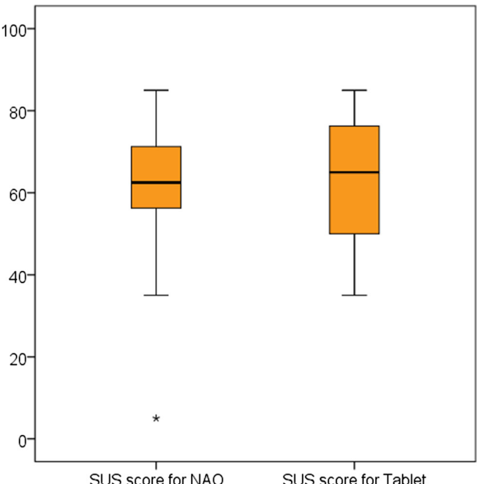
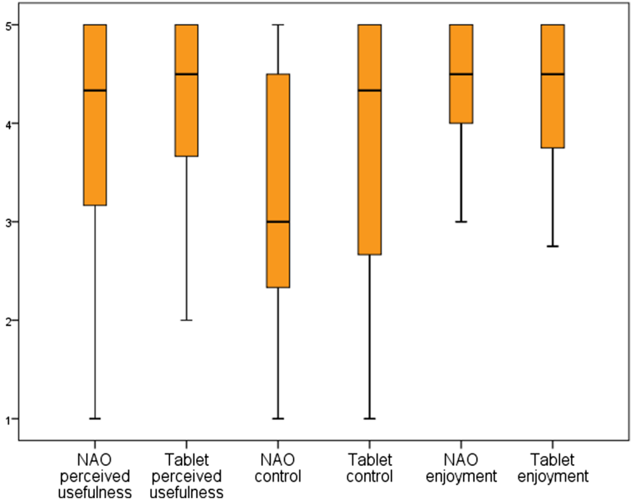
Socially assistive robots can play an important role in the monitoring and training of health of older adults. But before their benefits can be reaped, proper usability and a positive user experience need to be ensured. In this study, we tested the usability and user experience of a socially assistive robot (the NAO humanoid robot) to monitor and train the health of frail older adults. They were asked to complete a set of health monitoring and physical training tasks, once provided by the NAO robot, and once provided by a Tablet PC application (as a reference technology). After using each technology, they completed the System Usability Scale for usability, and a set of rating scales for perceived usefulness, enjoyment, and control. Finally, we questioned the participants’ preference for one of the technologies. All interactions were recorded on video and scrutinized for usability issues. Twenty older adults participated. They awarded both technologies ‘average’ usability scores. Perceived usefulness and enjoyment were rated as very positive for both modalities; control was scored positively. Main usability issues for NAO for these tasks were related to speech interaction (e.g., NAO’s limited speech library, NAO’s difficulty to cope with Dutch dialect), older adults’ difficulties with taking their proper role in human-robot interaction, and a lack of affordances of NAO. Seven participants preferred NAO: it was easier to use and more personal. Social robots have the potential to monitor and train the health of frail older adults, but some critical usability challenges need to be overcome first.
Overview
The claims and statistics of this paper haven’t been checked yet.
Free: it reads the open-access text and checks the first 5 claims that cite a source we can check. Create a free account to check every claim.
Integrity signals
Registry
Cites
Statistics
Figures

Verification
Claims the paper makes
The claims and statistics of this paper haven’t been checked yet.
Free: it reads the open-access text and checks the first 5 claims that cite a source we can check. Create a free account to check every claim.
Claims other papers make about this one
Each is checked against this paper’s own text: does it say what the citing paper says it does?
The source backs part of the claim, not all of it — or backs it for a different population, condition or comparison.
In the citing paper
“The poor speech recognition system hasbeen listed as the main usability issue in most research on social robots with speech capabilities [7,8,20,21].”
From Evaluating the User Experience and Usability of the MINI Robot for Elderly Adults with Mild Dementia and Mild Cognitive Impairment: Insights and Recommendations (2024) · cites this paper as [20]
Experimental — accuracy not yet measuredThe cited source says what the claim attributes to it.
In the citing paper
“Issues regarding the microphones, touch sensors, and tablet interface emerged in similar studies with social robots [8,20].”
Self-check
Percentages, sums and reported differences re-computed from the paper’s own numbers.
The self-check needs the paper’s full text.
Citations
Cites
SUS: A 'Quick and Dirty' Usability Scale
(1996) · Usability Evaluation In Industry · doi:10.1201/9781498710411-35 · Cited by 8,989
Extrinsic and Intrinsic Motivation to Use Computers in the Workplace 1
Davis, F. D., Bagozzi, R. P., & Warshaw, P. R. (1992) · Journal of Applied Social Psychology · doi:10.1111/j.1559-1816.1992.tb00945.x · Cited by 6,231
An Empirical Evaluation of the System Usability Scale
Bangor, A., Kortum, P. T., & Miller, J. T. (2008) · International Journal of Human–Computer Interaction · doi:10.1080/10447310802205776 · Cited by 5,181
Usability Evaluation In Industry
(1996) · CRC Press eBooks · doi:10.1201/9781498710411 · Cited by 4,354
User Acceptance of Hedonic Information Systems1
van der Heijden, H. (2004) · MIS Quarterly · doi:10.2307/25148660 · Cited by 3,850
Heuristic evaluation of user interfaces
Nielsen, J., & Molich, R. (1990) · Proceedings of the SIGCHI conference on Human factors in computing systems Empowering people - CHI '90 · doi:10.1145/97243.97281 · Cited by 3,533 · cited 1×
“aid of a set of design guidelines) [17], and cognitive walkthroughs (in which experts are asked to ‘walk through’ a computer system or website as a normal user and report any”
BackgroundGaver, W. W. (1991) · Proceedings of the SIGCHI conference on Human factors in computing systems Reaching through technology - CHI '91 · doi:10.1145/108844.108856 · Cited by 1,536
Re-Examining Perceived Ease of Use and Usefulness: A Confirmatory Factor Analysis
Segars, A. H., & Grover, V. (1993) · MIS Quarterly · doi:10.2307/249590 · Cited by 1,515
The Factor Structure of the System Usability Scale
Lewis, J. R., & Sauro, J. (2009) · Lecture Notes in Computer Science · doi:10.1007/978-3-642-02806-9_12 · Cited by 1,278
Assessing Acceptance of Assistive Social Agent Technology by Older Adults: the Almere Model
Heerink, M., Kröse, B., Evers, V., & Wielinga, B. (2010) · International Journal of Social Robotics · doi:10.1007/s12369-010-0068-5 · Cited by 1,229
Socially intelligent robots: Dimensions of human-robot interaction
Dautenhahn, K. (2007) · Philosophical Transactions of the Royal Society B: Biological Sciences · doi:10.1098/rstb.2006.2004 · Cited by 1,210
Campbell, A. J., Robertson, M. C., Gardner, M. M., Norton, R. N., Tilyard, M. W., & Buchner, D. M. (1997) · BMJ · doi:10.1136/bmj.315.7115.1065 · Cited by 1,199
SARC-F: a symptom score to predict persons with sarcopenia at risk for poor functional outcomes
Malmstrom, T. K., Miller, D. K., Simonsick, E. M., Ferrucci, L., & Morley, J. E. (2016) · Journal of Cachexia, Sarcopenia and Muscle · doi:10.1002/jcsm.12048 · Cited by 1,155
The Interplay of Beauty, Goodness, and Usability in Interactive Products
Hassenzahl, M. (2004) · Human-Computer Interaction · doi:10.1207/s15327051hci1904_2 · Cited by 1,083
(2012) · Cited by 1,032
Feil-Seifer, D., & Mataric, M. J. (2005) · 9th International Conference on Rehabilitation Robotics, 2005. ICORR 2005. · doi:10.1109/icorr.2005.1501143 · Cited by 972
Prevalence of Frailty in Middle-Aged and Older Community-Dwelling Europeans Living in 10 Countries
Santos-Eggimann, B., Cuenoud, P., Spagnoli, J., & Junod, J. (2009) · The Journals of Gerontology Series A: Biological Sciences and Medical Sciences · doi:10.1093/gerona/glp012 · Cited by 963
Cognitive walkthroughs: a method for theory-based evaluation of user interfaces
Polson, P. G., Lewis, C., Rieman, J., & Wharton, C. (1992) · International Journal of Man-Machine Studies · doi:10.1016/0020-7373(92)90039-n · Cited by 797
Common metrics for human-robot interaction
Steinfeld, A., Fong, T., Kaber, D., Lewis, M., Scholtz, J., Schultz, A., & Goodrich, M. (2006) · Proceedings of the 1st ACM SIGCHI/SIGART conference on Human-robot interaction · doi:10.1145/1121241.1121249 · Cited by 756 · cited 1×
“However, it has been stated that it is difficult to define a set of common metrics and instruments to assess the quality of human-robot interaction, as the range of robots with which people can interact is incredibly diverse [22, 23].”
BackgroundLee, K. M., Peng, W., Jin, S.-A., & Yan, C. (2006) · Journal of Communication · doi:10.1111/j.1460-2466.2006.00318.x · Cited by 605
Socially Assistive Robots in Elderly Care: A Systematic Review into Effects and Effectiveness
Bemelmans, R., Gelderblom, G. J., Jonker, P., & de Witte, L. (2012) · Journal of the American Medical Directors Association · doi:10.1016/j.jamda.2010.10.002 · Cited by 585
The think aloud method: a guide to user interface design
JASPERS, M., STEEN, T., BOS, C., & GEENEN, M. (2004) · International Journal of Medical Informatics · doi:10.1016/j.ijmedinf.2004.08.003 · Cited by 544
Prevalence of Frailty in Nursing Homes: A Systematic Review and Meta-Analysis
Kojima, G. (2015) · Journal of the American Medical Directors Association · doi:10.1016/j.jamda.2015.06.025 · Cited by 517
Exploring influencing variables for the acceptance of social robots
de Graaf, M. M. A., & Ben Allouch, S. (2013) · Robotics and Autonomous Systems · doi:10.1016/j.robot.2013.07.007 · Cited by 499
The Role of Healthcare Robots for Older People at Home: A Review
Robinson, H., MacDonald, B., & Broadbent, E. (2014) · International Journal of Social Robotics · doi:10.1007/s12369-014-0242-2 · Cited by 459
Number of people required for usability evaluation: the 10±2 rule
Hwang, W., & Salvendy, G. (2010) · Communications of the ACM · doi:10.1145/1735223.1735255 · Cited by 410
Socially Assistive Robots in Elderly Care: A Mixed-Method Systematic Literature Review
Kachouie, R., Sedighadeli, S., Khosla, R., & Chu, M.-T. (2014) · International Journal of Human–Computer Interaction · doi:10.1080/10447318.2013.873278 · Cited by 409
Hobbit, a care robot supporting independent living at home: First prototype and lessons learned
Fischinger, D., Einramhof, P., Papoutsakis, K., Wohlkinger, W., Mayer, P., Panek, P., Hofmann, S., Koertner, T., Weiss, A., Argyros, A., et al. (2016) · Robotics and Autonomous Systems · doi:10.1016/j.robot.2014.09.029 · Cited by 347
Benefits of Physical Exercise Training on Cognition and Quality of Life in Frail Older Adults
Langlois, F., Vu, T. T. M., Chasse, K., Dupuis, G., Kergoat, M.-J., & Bherer, L. (2013) · The Journals of Gerontology Series B: Psychological Sciences and Social Sciences · doi:10.1093/geronb/gbs069 · Cited by 323
ADAPTIVE INTERFACES AND AGENTS
(2007) · The Human-Computer Interaction Handbook · doi:10.1201/9781410615862-33 · Cited by 298
On the dimensionality of the System Usability Scale: a test of alternative measurement models
Borsci, S., Federici, S., & Lauriola, M. (2009) · Cognitive Processing · doi:10.1007/s10339-009-0268-9 · Cited by 275
Measuring acceptance of an assistive social robot: a suggested toolkit
Heerink, M., Krose, B., Evers, V., & Wielinga, B. (2009) · RO-MAN 2009 - The 18th IEEE International Symposium on Robot and Human Interactive Communication · doi:10.1109/roman.2009.5326320 · Cited by 268
Modelling user experience – An agenda for research and practice
Law, E. L.-C., & van Schaik, P. (2010) · Interacting with Computers · doi:10.1016/j.intcom.2010.04.006 · Cited by 261
Designing robots for the elderly: Appearance issue and beyond
Wu, Y.-H., Fassert, C., & Rigaud, A.-S. (2012) · Archives of Gerontology and Geriatrics · doi:10.1016/j.archger.2011.02.003 · Cited by 257
Borsci, S., Federici, S., Bacci, S., Gnaldi, M., & Bartolucci, F. (2015) · International Journal of Human-Computer Interaction · doi:10.1080/10447318.2015.1064648 · Cited by 180
Hebesberger, D., Koertner, T., Gisinger, C., & Pripfl, J. (2017) · International Journal of Social Robotics · doi:10.1007/s12369-016-0391-6 · Cited by 163
Effects of (in)accurate empathy and situational valence on attitudes towards robots
Cramer, H. S. M., Goddijn, J., Wielinga, B. J., & Evers, V. (2010) · ACM/IEEE International Conference on Human-Robot Interaction (HRI) · doi:10.1109/hri.2010.5453224 · Cited by 158
Attitudinal and Intentional Acceptance of Domestic Robots by Younger and Older Adults
Ezer, N., Fisk, A. D., & Rogers, W. A. (2009) · Lecture Notes in Computer Science · doi:10.1007/978-3-642-02710-9_5 · Cited by 134
Performance of daily activities by older adults with dementia: The role of an assistive robot
Begum, M., Wang, R., Huq, R., & Mihailidis, A. (2013) · 2013 IEEE 13th International Conference on Rehabilitation Robotics (ICORR) · doi:10.1109/icorr.2013.6650405 · Cited by 84 · cited 1×
“However, it has been stated that it is difficult to define a set of common metrics and instruments to assess the quality of human-robot interaction, as the range of robots with which people can interact is incredibly diverse [22, 23].”
BackgroundAddressing user experience and societal impact in a user study with a humanoid robot
Weiss, A., Bernhaupt, R., Tscheligi, M., & Yoshida, E. (2009) · Artificial Intelligence and the Simulation of Behaviour · Cited by 70
Adaptive Interfaces and Agents
Jameson, A. (2007) · Human factors and ergonomics · doi:10.1201/9781410615862.ch22 · Cited by 66
Quantifying the User Experience, Second Edition: Practical Statistics for User Research
Sauro, J., & Lewis, J. R. (2016) · Morgan Kaufmann Publishers Inc. eBooks · Cited by 61
Effects of (in)accurate empathy and situational valence on attitudes towards robots
Cramer, H. S. M., Goddijn, J., Wielinga, B. J., & Evers, V. (2010) · Cited by 60
Robot services for elderly with cognitive impairment: Testing usability of graphical user interfaces
Granata, C., Pino, M., Legouverneur, G., Vidal, J.-S., Bidaud, P., & Rigaud, A.-S. (2013) · Technology and Health Care · doi:10.3233/thc-130718 · Cited by 58
van Velsen, L., van der Geest, T., van de Wijngaert, L., van den Berg, S., & Steehouder, M. (2015) · Journal of Organizational Computing and Electronic Commerce · doi:10.1080/10919392.2015.990782 · Cited by 32
You just do not understand me! Speech Recognition in Human Robot Interaction
Mubin, O., Henderson, J., & Bartneck, C. (2014) · IEEE RO-MAN · doi:10.1109/roman.2014.6926324 · Cited by 28
van Velsen, L., van der Geest, T., & Klaassen, R. (2011) · International Journal of Human-Computer Interaction · doi:10.1080/10447318.2011.555304 · Cited by 25
Research works printed but not linked: 4
- 1. Asimov I. I, robot. New York: Gnome Press; 1950.
- 8. European Innovation Partnership on Active and Healthy Ageing. Action plan on prevention and early diagnosis of frailty and func- tional decline, both physical and cognitive in older people. Brussels: European Union; 2012.
- 9. Gomez MI, García-Sánchez I, Carta A, Antunes JP. A collection of good practices that support the prevention and early diagnosis of frailty and functional decline, both physically and cognitive, in older people. Brussels: European Commission; 2013.
- 43. Central Committee on Research involving Human Subjects Manual for the review of medical research involving human subjects. http:// www.ccmo-online.nl.
Cited by
10 Years of Human-NAO Interaction Research: A Scoping Review
Amirova, A., Rakhymbayeva, N., Yadollahi, E., Sandygulova, A., & Johal, W. (2021) · Frontiers in Robotics and AI · doi:10.3389/frobt.2021.744526 · Cited by 134
Guemghar, I., Padilha, P. P. D. O., Abdel‐Baki, A., Jutras‐Aswad, D., Paquette, J., & Pomey, M. (2022) · JMIR Mental Health · doi:10.2196/36094 · Cited by 128
“With this population, it has been determined that SARs could be used to improve physical exercise and monitor health status [28,29].”
BackgroundVandemeulebroucke, T., Dzi, K. T. J., & Gastmans, C. (2021) · Archives of Gerontology and Geriatrics · doi:10.1016/j.archger.2021.104399 · Cited by 122
Between fear and trust: Older adults’ evaluation of socially assistive robots
Zafrani, O., Nimrod, G., & Edan, Y. (2022) · International Journal of Human-Computer Studies · doi:10.1016/j.ijhcs.2022.102981 · Cited by 97
Fields, N., Xu, L., Greer, J., & Murphy, E. (2021) · Aging & Mental Health · doi:10.1080/13607863.2019.1699016 · Cited by 65
Metadata
- Authors
- Olde Keizer, R. A. C. M., van Velsen, L., Moncharmont, M., Riche, B., Ammour, N., Del Signore, S., Zia, G., Hermens, H., & N’Dja, A.
- Affiliations
- Sanofi (France) (FR)
- Roessingh Research and Development (NL)
- Venue
- Health and Technology
- Published
- 2019-04-09
- Volume
- 9
- Issue
- 4
- Pages
- 595-605
- ISSN
- 2190-7188 (ISSN-L)
- 2190-7196
- OpenAlex
- W2939831007
- Cited by
- 57
- References
- 47
- Citations by year
- 2026: 4 · 2025: 11 · 2024: 10 · 2023: 7 · 2022: 12 · 2021: 7 · 2020: 4 · 2019: 2
- FWCI
- 7.86
- Type
- journal article
- Language
- en
- Open access
- hybrid
- doi.org
- Licence
- cc-by
- creativecommons.org/licenses/by/4.0 (tdm)
- Locations
- Health and Technology (publishedVersion, cc-by)
- University of Twente Research Information (publishedVersion, cc-by)
- University of Twente Research Information (submittedVersion, cc-by)
- Funders
- Innovative Medicines Initiative (115621)
- Topics
- Social Sciences › Psychology › Social Psychology › Social Robot Interaction and HRI
- Health Sciences › Medicine › Geriatrics and Gerontology › Technology Use by Older Adults
- Physical Sciences › Computer Science › Human-Computer Interaction › Innovative Human-Technology Interaction
- Keywords
- socially assistive robots, older adults, NAO robot, usability, user experience, human-robot interaction, voice interaction, exercise training, perceived usefulness, affordances
About these checks
Registry, retraction, Cites and statistics results are computed, not judged, with one exception: a printed reference that no index lists is read once by a model before it counts as a citation error. Claims are extracted by a model and kept only when their quote appears verbatim in the text; each cited source is then checked, with a model’s help, for whether it says what the claim relies on. Those verdicts can be wrong — read the claim’s quote and the cited source before relying on one.
Statistics and arithmetic are recomputed, not judged.
Confidence bands are shown only for fields calibrated on our annotated test set. None is calibrated yet, so no band is shown.
What counts as a claim ›How we measure confidence ›How we check this ›
Are you an author, or do you see a problem with this page? Request a review
Data sources
Bibliographic data: Semantic Scholar, OpenAlex, Crossref.
Contains information from the Semantic Scholar Academic Graph Datasets, made available under the ODC Attribution License (ODC-BY 1.0).
Semantic Scholar’s data is described in: Kinney, R., et al. (2023). The Semantic Scholar Open Data Platform. arXiv:2301.10140.
