

The DOI matches its Crossref record; 30 of the 30 references it cites were found in a registry or an index.
Intrinsic Capacity as a Determinant of Physical Resilience in Older Adults
Open accessAbstract
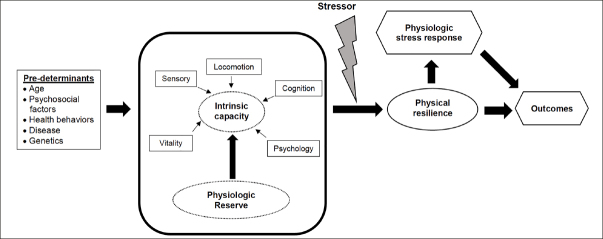
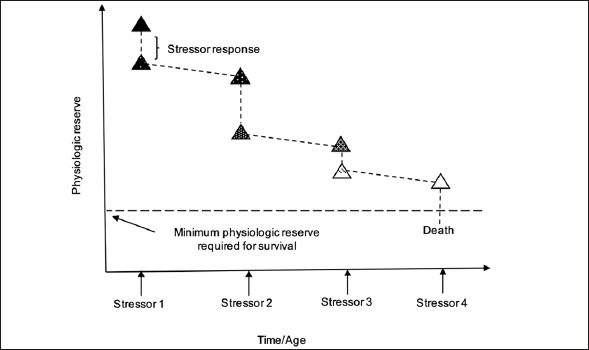
The traditional disease-oriented model of healthcare is inadequate to address the needs of the older population. Greater attention should be given to strategies that promote healthy aging. Recently proposed constructs of intrinsic capacity (IC) and physical resilience (PR) hold great potential to reshape geriatric medicine and aging research. These constructs accentuate the positive health attributes of older people in contrast to the popular frailty construct that is centered on functional deficits. IC was introduced by the World Health Organization (WHO) as a composite of all the physical and mental capacities. WHO has emphasized enhancement of IC throughout the life course so as to maintain functional ability in old age. PR, recently highlighted by the National Institute on Aging, is the ability to successfully cope with stressors. High levels of resilience can result in desirable clinical and functional outcomes after stressors. Therefore, it is important to understand the underlying physiology of PR and the risk factors contributing to diminished PR. The main goal of this article is to explore the potential relationship between IC and PR. Based on a classical theory of aging, we postulate that IC is a determinant of PR and is also a high-level integrative measure of physiologic reserve which is the fundamental factor underlying one's ability to withstand stressors. A major implication of our postulates is that even though IC is only one of the many determinants of PR, it could serve as an important intervenable target for enhancing resilience in older adults.
Overview
The claims and statistics of this paper haven’t been checked yet.
Run the check — free, no account needed. It reads the open-access text and checks the sources it cites.
Integrity signals
Registry
Cites
Statistics
Figures
Verification
Claims the paper makes
The claims and statistics of this paper haven’t been checked yet.
Run the check — free, no account needed. It reads the open-access text and checks the sources it cites.
Claims other papers make about this one
Each is checked against this paper’s own text: does it say what the citing paper says it does?
In the citing paper
“homeostatic capacities providing resilience to stressors may diminish with age [25]”
From Global consensus on optimal exercise recommendations for enhancing healthy longevity in older adults (ICFSR) (2025) · cites this paper as [25]
Self-check
Percentages, sums and reported differences re-computed from the paper’s own numbers.
The self-check needs the paper’s full text.
Citations
Cites
Frailty in Older Adults: Evidence for a Phenotype
Fried, L. P., Tangen, C. M., Walston, J., Newman, A. B., Hirsch, C., Gottdiener, J., Seeman, T., Tracy, R., Kop, W. J., Burke, G., et al. (2001) · The Journals of Gerontology Series A: Biological Sciences and Medical Sciences · doi:10.1093/gerona/56.3.m146 · Cited by 24,907
Conventional wisdom on measurement: A structural equation perspective.
Bollen, K., & Lennox, R. (1991) · Psychological Bulletin · doi:10.1037/0033-2909.110.2.305 · Cited by 3,618
Midlife Hand Grip Strength as a Predictor of Old Age Disability
Rantanen, T. (1999) · JAMA · doi:10.1001/jama.281.6.558 · Cited by 1,505
Fried, L. P. (2001) · Journals of Gerontology Series A-biological Sciences and Medical Sciences · Cited by 1,103
Evidence for the Domains Supporting the Construct of Intrinsic Capacity
Cesari, M., Araujo de Carvalho, I., Amuthavalli Thiyagarajan, J., Cooper, C., Martin, F. C., Reginster, J.-Y., Vellas, B., & Beard, J. R. (2018) · The Journals of Gerontology: Series A · doi:10.1093/gerona/gly011 · Cited by 745
Boyd, C. M., Landefeld, C. S., Counsell, S. R., Palmer, R. M., Fortinsky, R. H., Kresevic, D. M., Burant, C. J., & Covinsky, K. E. (2008) · Journal of the American Geriatrics Society · doi:10.1111/j.1532-5415.2008.02023.x · Cited by 738
Psychological resilience in young and older adults
Gooding, P. A., Hurst, A., Johnson, J., & Tarrier, N. (2011) · International Journal of Geriatric Psychiatry · doi:10.1002/gps.2712 · Cited by 552
Strehler, B. L., & Mildvan, A. S. (1960) · Science · doi:10.1126/science.132.3418.14 · Cited by 498
The concept of symmorphosis: a testable hypothesis of structure-function relationship.
Weibel, E. R., Taylor, C. R., & Hoppeler, H. (1991) · Proceedings of the National Academy of Sciences · doi:10.1073/pnas.88.22.10357 · Cited by 488
The structure and predictive value of intrinsic capacity in a longitudinal study of ageing
Beard, J., Thiyagarajan, J. A., Cesari, M., & de Carvalho, I. A. (2019) · BMJ Open · doi:10.1136/bmjopen-2018-026119 · Cited by 430
Cited by
Sorted by citations
Items 101–118 of 118
Su, H., Wang, Y., Zhang, Y., & Qi, X. (2026) · Frontiers in Public Health · doi:10.3389/fpubh.2026.1755509
“Existing research has identified factors such as age, nutritional status, educational attainment, physical activity levels, handgrip strength, history of falls, activities of daily living, and multimorbidity as significant determinants influencing the trajectory of intrinsic capacity (9, 10).”
Zhao, Y., Zhang, W., Yang, J., Fang, Y., Yan, Y., & Zhai, G. (2026) · Frontiers in Cardiovascular Medicine · doi:10.3389/fcvm.2026.1763248
Research Progress on Physical Resilience in Elderly Patients with Chronic Disease
樊, 荣. (2026) · Nursing Science · doi:10.12677/ns.2026.154133
Building an ontology of resilience: Insights from the physical resilience literature
Manning, J., Morales, B., & Yentes, J. M. (2026) · Ageing Research Reviews · doi:10.1016/j.arr.2026.103155
Intrinsic capacity and quality of life trajectories in older Europeans by sex and regionPreprint
Llorens-Ortega, R., Bertran-Noguer, C., Juvinyà-Canal, D., Garre‐Olmo, J., & Bosch‐Farré, C. (2026) · Research Square · doi:10.21203/rs.3.rs-9407485/v1
Zhang, Y., Ji, X., Yu, Y., Hu, M., Sun, L., Wang, L., Zhao, L., & 杨秀木 (2026) · BMC Geriatrics · doi:10.1186/s12877-026-07415-9
“PR serves as an intermediate carrier for IC to exert its protective effect [34].”
InfluentialHacıyeva, Y., & Əhmədova, C. (2026) · İctimai sağlamlıq · doi:10.33864/3105-7020.2026.n1.23-33
Zeng, Z., Fusong, P., & Liang, P. (2026) · Frontiers in Pharmacology · doi:10.3389/fphar.2026.1813958
Chew, J., Chia, J. Q., Lim, J. P., Yeo, A., Tan, C. N., Chan, S. P., Lim, C. L., & Lim, W. S. (2026) · The journal of nutrition health & aging · doi:10.1016/j.jnha.2026.100894
“…foundational domain reflecting physiological reserve and the integrity of systems that underpin the expression of locomotor, cognitive, sensory and psychological capacities [6,7], with impairments preceding declines in IC domains and capturing inter-individual differences in underlying reserve [8].”
Comparing two methods to quantify physical resilience
Whitson, H. E., Ashner, M. C., Kraus, V. B., Peskoe, S., Huebner, J. L., Simon, C. B., Hall, K., & Colon-Emeric, C. S. (2026) · The Journal of Frailty & Aging · doi:10.1016/j.tjfa.2026.100179
“It has been suggested that physical resilience is necessarily defined by the system (e.g., whole person vs. organ-based), the state (e.g., measure that defines recovery), and the stressor [23].”
Applying Digital Technology to Promote Smart Healthy Aging
Yao, F.-Z., Chen, C. H., Lien, W. C., & Chen, M.-L. (2026) · Smart innovation, systems and technologies · doi:10.1007/978-3-032-23104-8_14
Evidence map of Tai Chi interventions for older adults
Fogaça, L. Z., Schveitzer, M. C., Ferreira, A., Feitosa, A. D. C., Pratt, M., Portella, C. F. S., Ghelman, R., & Ramos, L. R. (2026) · Frontiers in Public Health · doi:10.3389/fpubh.2026.1820294
“…of Healthy Aging 2020–2030 that urges countries to take action to ensure that all individuals can live long and healthy lives, and emphasizes the importance of action to support healthy aging improved three basics components functional ability, intrinsic capacity (IC) and environments (3, 4).”
Ziukov, O. L., & Horlach, T. M. (2026) · Clinical and Preventive Medicine · doi:10.31612/2616-4868.4.2026.13
Huang, S., Liu, H., Liu, Q., Luo, L., Chen, W., Zhou, Z. M., Hu, X., Xu, Q., Xing, C., Tao, X., et al. (2026) · Frontiers in Public Health · doi:10.3389/fpubh.2026.1815512
“Physical resilience emphasizes the positive attributes that promote health in older adults (30).”
Lungu, I.-D., Ilie, A. C., Ștefăniu, R., Albişteanu, S.-M., Turcu, A.-M., Grigoraș, G., Constantinescu, D.-G., Pîslaru, A. I., & Alexa, I. D. (2026) · Journal of Clinical Medicine · doi:10.3390/jcm15156101
“…are reflected early on in the vitality domain, which is often one of the first components of intrinsic capacity to be affected in this context [29]. https://doi.org/10.3390/jcm15156101 Insulin resistance is also associated with impairment of the psychosocial domain of intrinsic capacity,…”
InfluentialLi, C., Wang, X., Li, J., Wang, Y., & Song, W. (2026) · Research Square · doi:10.21203/rs.3.rs-10341769/v1
Cultivating agricultural career intentions through behavioral drivers among students
Chaurasiya, C., Priya, A. P., Mansingh, J. P., Ihou, A. F. Y., & Mathew, M. (2026) · Discover Education · doi:10.1007/s44217-026-02286-z
“This supports recent research, who argue that language competence is becoming a critical skill in agri-business and market access, especially in a globalized and tech-integrated agricultural sector [31].”
Moreno, V. M., Mateos, A. G., Fernández, A. M., Busto, L. F., Serna, B. A., Alay, A. L. V., Sobrados, M. D. C. C., Gallar, J. H., Guerra, J. M., Sanz, M. I. M., et al. (2026) · Frontiers in Aging · doi:10.3389/fragi.2026.1868924
Metadata
- Authors
- Chhetri, J. K., Xue, Q.-L., Ma, L., Chan, P., & Varadhan, R.
- Affiliations
- Johns Hopkins University (US)
- Capital Medical University (CN)
- Corresponding author
- Chhetri, Jagadish K.
- Varadhan, Ravi
- Venue
- The Journal of nutrition, health and aging
- Publisher
- Elsevier BV
- Published
- 2021-09
- Volume
- 25
- Issue
- 8
- Pages
- 1006-1011
- ISSN
- 1279-7707 (ISSN-L)
- PMC
- PMC8035602
- OpenAlex
- W3154807171
- Cited by
- 118
- References
- 30
- Citations by year
- 2026: 28 · 2025: 35 · 2024: 20 · 2023: 17 · 2022: 14 · 2021: 4
- FWCI
- 7.52
- Type
- journal article
- Language
- en
- Open access
- hybrid
- doi.org
- Licence
- Locations
- The journal of nutrition health & aging (publishedVersion, cc-by-nc-nd)
- PubMed (publishedVersion)
- PubMed Central (publishedVersion, cc-by-nc-nd)
- Funders
- National Institutes of Health
- National Institute on Aging (UH3AG056933, UH2AG056933, P30AG021334)
- Topics
- Health Sciences › Medicine › Geriatrics and Gerontology › Frailty in Older Adults
- Health Sciences › Medicine › Public Health, Environmental and Occupational Health › Aging, Health, and Disability
- Social Sciences › Psychology › Developmental and Educational Psychology › Aging and Gerontology Research
- Keywords
- intrinsic capacity, physical resilience, older adults, healthy aging, frailty, physiological reserve, stress coping, theories of aging, geriatrics, resilience interventions
- MeSH terms
- Frailty, Healthy Aging, Activities of Daily Living, Adaptation, Psychological, Aged, Aging, Humans
About these checks
Registry, retraction, Cites and statistics results are computed, not judged, with one exception: a printed reference that no index lists is read once by a model before it counts as a citation error. Claims are extracted by a model and kept only when their quote appears verbatim in the text; each cited source is then checked, with a model’s help, for whether it says what the claim relies on. Those verdicts can be wrong — read the claim’s quote and the cited source before relying on one.
Statistics and arithmetic are recomputed, not judged.
Confidence bands are shown only for fields calibrated on our annotated test set. None is calibrated yet, so no band is shown.
What counts as a claim ›How we measure confidence ›How we check this ›
Are you an author, or do you see a problem with this page? Request a review
