

The DOI matches its Crossref record; 30 of the 30 references it cites were found in a registry or an index.
Intrinsic Capacity as a Determinant of Physical Resilience in Older Adults
Open accessAbstract
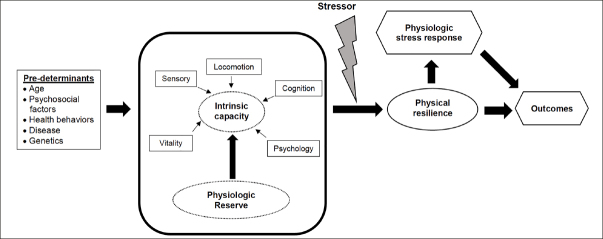
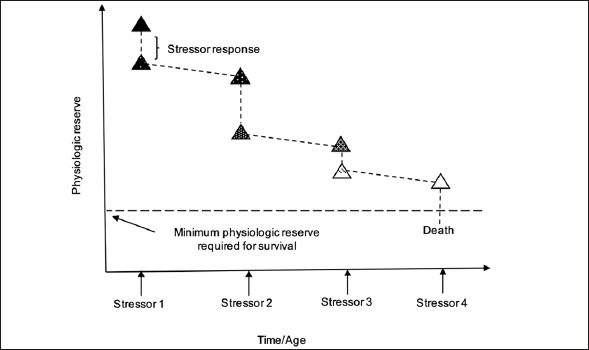
The traditional disease-oriented model of healthcare is inadequate to address the needs of the older population. Greater attention should be given to strategies that promote healthy aging. Recently proposed constructs of intrinsic capacity (IC) and physical resilience (PR) hold great potential to reshape geriatric medicine and aging research. These constructs accentuate the positive health attributes of older people in contrast to the popular frailty construct that is centered on functional deficits. IC was introduced by the World Health Organization (WHO) as a composite of all the physical and mental capacities. WHO has emphasized enhancement of IC throughout the life course so as to maintain functional ability in old age. PR, recently highlighted by the National Institute on Aging, is the ability to successfully cope with stressors. High levels of resilience can result in desirable clinical and functional outcomes after stressors. Therefore, it is important to understand the underlying physiology of PR and the risk factors contributing to diminished PR. The main goal of this article is to explore the potential relationship between IC and PR. Based on a classical theory of aging, we postulate that IC is a determinant of PR and is also a high-level integrative measure of physiologic reserve which is the fundamental factor underlying one's ability to withstand stressors. A major implication of our postulates is that even though IC is only one of the many determinants of PR, it could serve as an important intervenable target for enhancing resilience in older adults.
Overview
The claims and statistics of this paper haven’t been checked yet.
Run the check — free, no account needed. It reads the open-access text and checks the sources it cites.
Integrity signals
Registry
Cites
Statistics
Figures
Verification
Claims the paper makes
The claims and statistics of this paper haven’t been checked yet.
Run the check — free, no account needed. It reads the open-access text and checks the sources it cites.
Claims other papers make about this one
Each is checked against this paper’s own text: does it say what the citing paper says it does?
In the citing paper
“homeostatic capacities providing resilience to stressors may diminish with age [25]”
From Global consensus on optimal exercise recommendations for enhancing healthy longevity in older adults (ICFSR) (2025) · cites this paper as [25]
Self-check
Percentages, sums and reported differences re-computed from the paper’s own numbers.
The self-check needs the paper’s full text.
Citations
Cites
Frailty in Older Adults: Evidence for a Phenotype
Fried, L. P., Tangen, C. M., Walston, J., Newman, A. B., Hirsch, C., Gottdiener, J., Seeman, T., Tracy, R., Kop, W. J., Burke, G., et al. (2001) · The Journals of Gerontology Series A: Biological Sciences and Medical Sciences · doi:10.1093/gerona/56.3.m146 · Cited by 24,907
Conventional wisdom on measurement: A structural equation perspective.
Bollen, K., & Lennox, R. (1991) · Psychological Bulletin · doi:10.1037/0033-2909.110.2.305 · Cited by 3,618
Midlife Hand Grip Strength as a Predictor of Old Age Disability
Rantanen, T. (1999) · JAMA · doi:10.1001/jama.281.6.558 · Cited by 1,505
Fried, L. P. (2001) · Journals of Gerontology Series A-biological Sciences and Medical Sciences · Cited by 1,103
Evidence for the Domains Supporting the Construct of Intrinsic Capacity
Cesari, M., Araujo de Carvalho, I., Amuthavalli Thiyagarajan, J., Cooper, C., Martin, F. C., Reginster, J.-Y., Vellas, B., & Beard, J. R. (2018) · The Journals of Gerontology: Series A · doi:10.1093/gerona/gly011 · Cited by 745
Boyd, C. M., Landefeld, C. S., Counsell, S. R., Palmer, R. M., Fortinsky, R. H., Kresevic, D. M., Burant, C. J., & Covinsky, K. E. (2008) · Journal of the American Geriatrics Society · doi:10.1111/j.1532-5415.2008.02023.x · Cited by 738
Psychological resilience in young and older adults
Gooding, P. A., Hurst, A., Johnson, J., & Tarrier, N. (2011) · International Journal of Geriatric Psychiatry · doi:10.1002/gps.2712 · Cited by 552
Strehler, B. L., & Mildvan, A. S. (1960) · Science · doi:10.1126/science.132.3418.14 · Cited by 498
The concept of symmorphosis: a testable hypothesis of structure-function relationship.
Weibel, E. R., Taylor, C. R., & Hoppeler, H. (1991) · Proceedings of the National Academy of Sciences · doi:10.1073/pnas.88.22.10357 · Cited by 488
The structure and predictive value of intrinsic capacity in a longitudinal study of ageing
Beard, J., Thiyagarajan, J. A., Cesari, M., & de Carvalho, I. A. (2019) · BMJ Open · doi:10.1136/bmjopen-2018-026119 · Cited by 430
Physical Resilience in Older Adults: Systematic Review and Development of an Emerging Construct
Whitson, H. E., Duan-Porter, W., Schmader, K. E., Morey, M. C., Cohen, H. J., & Colón-Emeric, C. S. (2016) · The Journals of Gerontology Series A: Biological Sciences and Medical Sciences · doi:10.1093/gerona/glv202 · Cited by 371
Frailty and Intrinsic Capacity: Two Distinct but Related Constructs
Belloni, G., & Cesari, M. (2019) · Frontiers in Medicine · doi:10.3389/fmed.2019.00133 · Cited by 247
Kinetics of Human Aging: I. Rates of Senescence Between Ages 30 and 70 Years in Healthy People
Sehl, M. E., & Yates, F. E. (2001) · The Journals of Gerontology Series A · doi:10.1093/gerona/56.5.b198 · Cited by 206
Report: NIA Workshop on Measures of Physiologic Resiliencies in Human Aging
Hadley, E. C., Kuchel, G. A., Newman, A. B., Allore, H. G., Bartley, J. M., Bergeman, C. S., Blinov, M. L., Colon-Emeric, C. S., Dabhar, F. S., Dugan, L. L., et al. (2017) · The Journals of Gerontology: Series A · doi:10.1093/gerona/glx015 · Cited by 173
Self-citationVaradhan, R., Seplaki, C. L., Xue, Q., Bandeen‐Roche, K., & Fried, L. P. (2008) · Mechanisms of Ageing and Development · doi:10.1016/j.mad.2008.09.013 · Cited by 150
Self-citationCharles, A., Buckinx, F., Locquet, M., Reginster, J., Pétermans, J., Gruslin, B., & Bruyère, O. (2019) · The Journals of Gerontology Series A · doi:10.1093/gerona/glz218 · Cited by 140 · cited 1×
“Besides, not only functional limitation but other negative outcomes including falls and mortality (possible trajectory for poor resilience) have been shown to be associated with poor IC in nursing home residents (21).”
Ramírez‐Vélez, R., Correa‐Bautista, J. E., García‐Hermoso, A., Cano, C. A., & Izquierdo, M. (2019) · Journal of Cachexia, Sarcopenia and Muscle · doi:10.1002/jcsm.12373 · Cited by 137
Jotheeswaran, A. T., Bryce, R., Prina, M. A., Acosta, D. M., Ferri, C. P., Guerra, M., Huang, Y., Rodríguez, J. J. L., Salas, A., Sosa, A. L., et al. (2015) · BMC Medicine · doi:10.1186/s12916-015-0378-4 · Cited by 136
Physical Resilience: Not Simply the Opposite of Frailty
Whitson, H. E., Cohen, H. J., Schmader, K. E., Morey, M. C., Kuchel, G. A., & Colon-Emeric, C. S. (2018) · Journal of the American Geriatrics Society · doi:10.1111/jgs.15233 · Cited by 133
Gill, T. M., Robison, J. T., & Tinetti, M. E. (1997) · Journal of General Internal Medicine · doi:10.1046/j.1525-1497.1997.07161.x · Cited by 126
Varadhan, R., Walston, J. D., & Bandeen‐Roche, K. (2018) · Journal of the American Geriatrics Society · doi:10.1111/jgs.15409 · Cited by 91
Self-citationPredicting late-life disability and death by the rate of decline in physical performance measures
Hirsch, C. H., Bůžková, P., Robbins, J. A., Patel, K. V., & Newman, A. B. (2011) · Age and Ageing · doi:10.1093/ageing/afr151 · Cited by 81
Barreto, P. D. S., Guyonnet, S., Ader, I., Andrieu, S., Casteilla, L., Davezac, N., Dray, C., Fazilleau, N., Gourdy, P., Liblau, R., et al. (2021) · The Journal of Frailty & Aging · doi:10.14283/jfa.2020.18 · Cited by 66
Gijzel, S. M. W., Rector, J. L., van Meulen, F., van der Loeff, R. S., van de Leemput, I. A., Scheffer, M., Rikkert, M. G. M. O., & Melis, R. J. F. (2019) · Journal of the American Medical Directors Association · doi:10.1016/j.jamda.2019.10.011 · Cited by 58 · cited 2×
“Handgrip strength which is also a strong measure of vitality has been shown to represent higher IC (16) and to predict functional recovery in multiple scenarios (13, 17).”
Two Approaches to Classifying and Quantifying Physical Resilience in Longitudinal Data
Colon-Emeric, C. S., Pieper, C. F., Schmader, K. E., Sloane, R. J., Bloom, A., McClain, M. T., Magaziner, J., Huffman, K. M., Orwig, D., Crabtree, D., et al. (2019) · The Journals of Gerontology Series A · doi:10.1093/gerona/glz097 · Cited by 53 · cited 1×
“This approach requires assessment of different measures of health at two or more times and requires a well-defined stressor (12).”
Resiliency Groups Following Hip Fracture in Older Adults
Colon-Emeric, C. S., Whitson, H. E., Pieper, C. F., Sloane, R. J., Orwig, D., Huffman, K. M., Bettger, J. P., Parker, D., Crabtree, D., Gruber‐Baldini, A. L., et al. (2019) · Journal of the American Geriatrics Society · doi:10.1111/jgs.16152 · Cited by 41 · cited 3×
“investigated resiliency following hip fracture in older adults, self-reported pre-fracture functions (described as pre-stressors status) were the most predictive of high resiliency (22).”
InfluentialAge changes in some physiologic processes.
Nw, S. (1957) · PubMed · Cited by 32
Integrated Care For Older People (ICOPE): From Guidelines To Demonstrating Feasibility
Banerjee, A., & Sadana, R. (2021) · The Journal of Frailty & Aging · doi:10.14283/jfa.2020.40 · Cited by 26
AGE CHANGES IN SOME PHYSIOLOGIC PROCESSES
Shock, N. W. (1957) · Survey of Anesthesiology · doi:10.1097/00132586-195712000-00022 · Cited by 10 · cited 1×
“Nathan Shock studied the physiological processes of various organ systems across different ages between 30 to 70 years and found that their capacities generally declined at a linear rate (24).”
Medina‐Mirapeix, F., Bernabéu-Mora, R., Sánchez-Martínez, M. P., Gacto‐Sánchez, M., Agustín, R. M., & Montilla‐Herrador, J. (2019) · Journal of Clinical Medicine · doi:10.3390/jcm8070946 · Cited by 7
Cited by
Sorted by citations
Bao, H., Cao, J., Chen, M., Min, C., Chen, W., Chen, X., Chen, Y., Chen, Y., Chen, Y., Chen, Z., et al. (2023) · Science China Life Sciences · doi:10.1007/s11427-023-2305-0 · Cited by 402
Self-citationIzquierdo, M., de Souto Barreto, P., Arai, H., Bischoff-Ferrari, H. A., Cadore, E. L., Cesari, M., Chen, L.-K., Coen, P. M., Courneya, K. S., Duque, G., et al. (2025) · The Journal of nutrition, health and aging · doi:10.1016/j.jnha.2024.100401 · Cited by 273
Intrinsic Capacity in Older Adults: Recent Advances
Zhou, Y., & Ma, L. (2022) · Aging and Disease · doi:10.14336/ad.2021.0818 · Cited by 148
“Consistent with IC, physical resilience also focuses on positive health attributes, and it targets function instead of diseases [20].”
BackgroundSelf-citationUsability evaluation of mHealth apps for elderly individuals: a scoping review
Wang, Q., Liu, J., Zhou, L., Tian, J., Chen, X., Zhang, W., Wang, H., Zhou, W., & Gao, Y. (2022) · BMC Medical Informatics and Decision Making · doi:10.1186/s12911-022-02064-5 · Cited by 113
“As individuals age, their intrinsic capacities decline, and the risk of multimorbidity increases, resulting in the need for ongoing monitoring or treatment [3].”
BackgroundZhao, J., Chhetri, J. K., Chang, Y., Zheng, Z., Ma, L., & Chan, P. (2021) · Frontiers in Medicine · doi:10.3389/fmed.2021.753295 · Cited by 85
“Individuals with lower physiologic reserve or with impairments in IC (22) could experience poor recovery once exposed to stressors and as a result of the continuum of the aging process and diseases and may be vulnerable to being”
BackgroundSelf-citation
Metadata
- Authors
- Chhetri, J. K., Xue, Q.-L., Ma, L., Chan, P., & Varadhan, R.
- Affiliations
- Johns Hopkins University (US)
- Capital Medical University (CN)
- Corresponding author
- Chhetri, Jagadish K.
- Varadhan, Ravi
- Venue
- The Journal of nutrition, health and aging
- Publisher
- Elsevier BV
- Published
- 2021-09
- Volume
- 25
- Issue
- 8
- Pages
- 1006-1011
- ISSN
- 1279-7707 (ISSN-L)
- PMC
- PMC8035602
- OpenAlex
- W3154807171
- Cited by
- 118
- References
- 30
- Citations by year
- 2026: 28 · 2025: 35 · 2024: 20 · 2023: 17 · 2022: 14 · 2021: 4
- FWCI
- 7.52
- Type
- journal article
- Language
- en
- Open access
- hybrid
- doi.org
- Licence
- Locations
- The journal of nutrition health & aging (publishedVersion, cc-by-nc-nd)
- PubMed (publishedVersion)
- PubMed Central (publishedVersion, cc-by-nc-nd)
- Funders
- National Institutes of Health
- National Institute on Aging (UH3AG056933, UH2AG056933, P30AG021334)
- Topics
- Health Sciences › Medicine › Geriatrics and Gerontology › Frailty in Older Adults
- Health Sciences › Medicine › Public Health, Environmental and Occupational Health › Aging, Health, and Disability
- Social Sciences › Psychology › Developmental and Educational Psychology › Aging and Gerontology Research
- Keywords
- intrinsic capacity, physical resilience, older adults, healthy aging, frailty, physiological reserve, stress coping, theories of aging, geriatrics, resilience interventions
- MeSH terms
- Frailty, Healthy Aging, Activities of Daily Living, Adaptation, Psychological, Aged, Aging, Humans
About these checks
Registry, retraction, Cites and statistics results are computed, not judged, with one exception: a printed reference that no index lists is read once by a model before it counts as a citation error. Claims are extracted by a model and kept only when their quote appears verbatim in the text; each cited source is then checked, with a model’s help, for whether it says what the claim relies on. Those verdicts can be wrong — read the claim’s quote and the cited source before relying on one.
Statistics and arithmetic are recomputed, not judged.
Confidence bands are shown only for fields calibrated on our annotated test set. None is calibrated yet, so no band is shown.
What counts as a claim ›How we measure confidence ›How we check this ›
Are you an author, or do you see a problem with this page? Request a review
