

The DOI matches its Crossref record; 66 of the 67 references it cites were found in a registry or an index.
Trait Self-Compassion Reflects Emotional Flexibility Through an Association with High Vagally Mediated Heart Rate Variability
Open accessAbstract
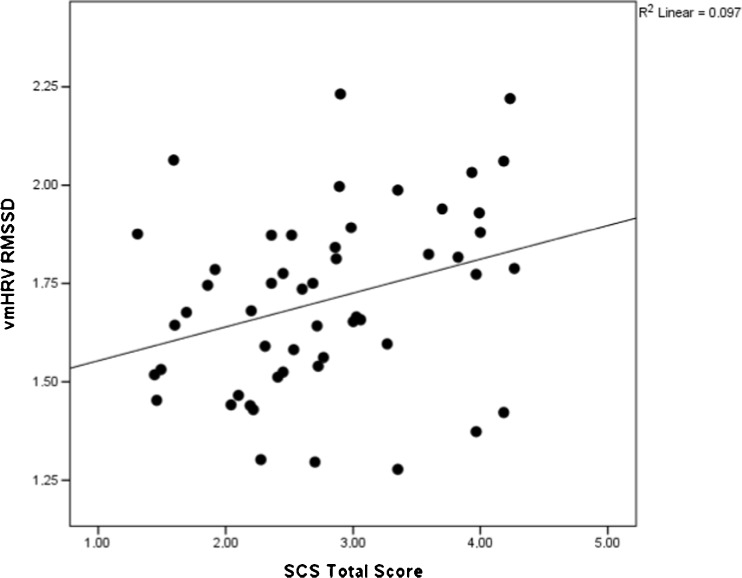
Converging evidence shows a positive effect of self-compassion on self-reported well-being and mental health. However, few studies have examined the relation between self-compassion and psychophysiological measures. In the present study, we therefore examined the relation between trait self-compassion and vagally mediated heart rate variability (vmHRV) in 53 students (39 female, mean age = 23.63). Trait self-compassion was assessed using the Self-Compassion Scale, and resting vmHRV was measured during a 5-min ECG baseline period. We hypothesized that higher levels of trait self-compassion would predict higher levels of resting vmHRV. Controlling for potential covariates (including age, gender, and BMI), the results confirmed our hypotheses, showing that higher levels of trait self-compassion predicted higher vmHRV. These results were validated with a 24-h measure of vmHRV, acquired from a subsample of the participants ( n = 26, 16 female, mean age = 23.85), confirming the positive correlation between high trait self-compassion and higher vmHRV. The relation between trait self-compassion, vmHRV, self-reported trait anxiety (the trait scale of the State-Trait Anxiety Inventory; STAI) and self-reported rumination (the Rumination subscale of the Rumination-Reflection Questionnaire; RRQ-Rum) was also investigated. Higher levels of trait anxiety and rumination were highly correlated with low levels of trait self-compassion. Trait anxiety, but not rumination, correlated marginally significantly with the level of vmHRV. The findings of the present study indicate that trait self-compassion predicts a better ability to physiologically and psychologically adapt emotional responses. Possible implications and limitations of the study are discussed.
Overview
The claims and statistics of this paper haven’t been checked yet.
Run the check — free, no account needed. It reads the open-access text and checks the sources it cites.
Integrity signals
Registry
Cites
Statistics
Figures
Verification
Claims the paper makes
The claims and statistics of this paper haven’t been checked yet.
Run the check — free, no account needed. It reads the open-access text and checks the sources it cites.
Claims other papers make about this one
Each is checked against this paper’s own text: does it say what the citing paper says it does?
The cited source says what the claim attributes to it.
In the citing paper
“Recent studies on compassion using alternate forms of measurement, for example physiological measures such as heart-rate variability, provide important additional data to this debate [124–129].”
From Validation of the compassionate engagement and action scales, compassion scale, and Sussex-Oxford compassion scales in a French-Canadian sample (2024) · cites this paper as [125]
The cited source says what the claim attributes to it.
In the citing paper
“A mindful stance is also often characterized by a sense of care, warmth and kindness (self-compassion) towards oneself (Neff, 2003), which can also be seen as an emotion regulation strategy (Svendsen et al., 2016).”
From Participant experiences of change in mindfulness-based stress reduction for anxiety disorders. (2020) · cites this paper as Svendsen et al., 2016
Self-check
Percentages, sums and reported differences re-computed from the paper’s own numbers.
The self-check needs the paper’s full text.
Citations
Cites
(1970) · Cited by 24,983
The emerging field of emotion regulation: an integrative review
Gross, J. J. (1998) · Review of General Psychology · doi:10.1037/1089-2680.2.3.271 · Cited by 9,916
The Development and Validation of a Scale to Measure Self-Compassion
NEFF, K. D. (2003) · Self and Identity · doi:10.1080/15298860309027 · Cited by 6,436 · cited 8×
“…of mindfulness-based cognitive therapy (MBCT; Kuyken et al. 2010), and high self-compassion is found to associate with happiness and optimism (Neff et al. 2007b), higher psychological well-being (Hollis-Walker and Colosimo 2011), and greater life satisfaction (Neff 2003b; Neff and Faso 2015).”
BackgroundMethodInfluentialSelf-Compassion: An Alternative Conceptualization of a Healthy Attitude Toward Oneself
NEFF, K. (2003) · Self and Identity · doi:10.1080/15298860309032 · Cited by 5,440
Porges, S. W. (2007) · Biological Psychology · doi:10.1016/j.biopsycho.2006.06.009 · Cited by 3,415
A model of neurovisceral integration in emotion regulation and dysregulation
Thayer, J. F., & Lane, R. D. (2000) · Journal of Affective Disorders · doi:10.1016/s0165-0327(00)00338-4 · Cited by 3,092
Kubios HRV–heart rate variability analysis software.
Tarvainen, M. P., Niskanen, J.-P., Lipponen, J. A., Ranta-aho, P. O., & Karjalainen, P. A. (2014) · Computer Methods and Programs in Biomedicine · doi:10.1016/j.cmpb.2013.07.024 · Cited by 2,720 · cited 3×
“0 (Tarvainen et al. 2014) from which root mean square of successive differences in R-R in-”
BackgroundMethodInfluentialA pilot study and randomized controlled trial of the mindful self-compassion program
Neff, K. D., & Germer, C. K. (2013) · Journal of Clinical Psychology · doi:10.1002/jclp.21923 · Cited by 2,253
Heart rate variability as an index of regulated emotional responding
Appelhans, B. M., & Luecken, L. J. (2006) · Review of General Psychology · doi:10.1037/1089-2680.10.3.229 · Cited by 1,893
Exploring compassion: A meta-analysis of the association between self-compassion and psychopathology
MacBeth, A., & Gumley, A. (2012) · Clinical Psychology Review · doi:10.1016/j.cpr.2012.06.003 · Cited by 1,838 · cited 1×
“Self-compassion correlates strongly with lower levels of such stress responses (e.g., Krieger et al. 2013; MacBeth and Gumley 2012) and therefore self-compassion is like-”
Background
Research works printed but not linked: 2
- Corp, I. B. M. (2011). IBM SPSS Statistics for Windows, Version 22.0.. Armon, NY: IBM Corp.
- Gross, JJ (2014). Handbook of Emotion Regulation (2nd ed) (pp. xviii, 669). New York, NY: Guilford Press; US.
Cited by
Sorted by citations
Items 101–128 of 128
Ogawa, S., & Kojima, M. (2025) · Advances in Mental Health · doi:10.1080/18387357.2025.2489478 · Cited by 1
A biopsychosocial safeness model: New directions for psychotherapy research and practice
Paucsik, M., & Sonia Pellissier, A. (2026) · Acta Psychologica · doi:10.1016/j.actpsy.2026.106797 · Cited by 2
Sørensen, L., Kvadsheim, E., Koenig, J., Thayer, J., Williams, D. P., MacDonald, H. J., McCardle, R. D., Wollschlaeger, D., Fasmer, O. B., & Osnes, B. (2026) · Biology of Sex Differences · doi:10.1186/s13293-026-00904-x · Cited by 1
O'Toole, C. (2026) · Journal of Child and Adolescent Trauma · doi:10.1007/s40653-026-00912-4
Hu, Y., Wu, X. C., Yang, Y., Su, F., Li, M., & Wang, D. (2026) · Psychotherapy Research · doi:10.1080/10503307.2026.2689626 · Cited by 1
Mistretta, E. G., Davis, M. C., Clifford, S., Olah, M. S., Doane, L. D., & Lemery‐Chalfant, K. (2026) · Mindfulness · doi:10.1007/s12671-026-02829-3 · Cited by 1
Effect of process recording and self-compassion on self-focus: A pre-post interventional pilot study
Kurebayashi, Y., & Harada, Y. (2020) · Journal of Human Sciences · doi:10.14687/jhs.v17i1.5753 · Cited by 1
Adherence to Masculine Norms and Perceived Paternal Nurturance as Predictors of SelfCompassion
Craig, S. J. (2018) · The Research Repository @ WVU (West Virginia University) · doi:10.33915/etd.7170 · Cited by 1
A multidimensional approach to perfectionism and self-compassionPreprint
Linnett, R. J., & Kibowski, F. (2018) · PsyArXiv (OSF Preprints) · doi:10.31234/osf.io/bcu37 · Cited by 1
Gedminas, M., Neimanas, L., Vaitkaitis, D., Jasinskas, N., Šaferis, V., Stašaitis, K., Dobožinskas, P., & Mačiukas, A. (2018) · Sveikatos mokslai · doi:10.5200/sm-hs.2018.005
Measuring feelings of self-compassion and stress in daily life : an experience sampling study
Wallisch-Prinz, L. (2020)
Self-compassion and psycho-physiological reactivity and recovery from recalled sport failure
Ceccarelli, L. A. (2018) · Mspace (University of Manitoba)
Introducing the Heartfulness Project
Campbell, M., Bendijk, A., & Russell, T. A. (2019) · Transpersonal Psychology Review · doi:10.53841/bpstran.2019.21.1.47
طاحون, ر. س. ع. ا. (2023) · مجلة جامعة الفيوم للعلوم التربوية والنفسية · doi:10.21608/jfust.2023.292723
Lee, K. A., Beranbaum, S., Khedari-DePierro, V., Yates, E. H., Yacevich, I., Shankar, A., Enosa, C. E., & D'Andrea, W. M. (2023) · Research Square · doi:10.21203/rs.3.rs-2728427/v1
Shahverdi, A., Omidi, M., & Nik, M. M. (2023) · Iranian Journal of Psychiatry and Clinical Psychology · doi:10.32598/ijpcp.29.1.4414.1
Петрик, Р., & Кравченко, В. (2024) · Перспективи та інновації науки · doi:10.52058/2786-4952-2024-7(41)-836-847
Butterworth, J. W., Sedikides, C., Wildschut, T., & Kelley, N. J. (2025) · Self and Identity · doi:10.1080/15298868.2025.2550615 · Cited by 1
Self-Compassion and Health Behaviours
Biskas, M., Sirois, F. M., & Webb, T. L. (2025) · Springer eBooks · doi:10.1007/978-3-031-89095-6_19
Bahtişen, G. (2026) · SSRN Electronic Journal · doi:10.2139/ssrn.6276259
Juneau, C. (2020) · theses.fr (ABES) · doi:10.70675/c8becf9fzcd49z4708z9b23z6fc71bc2b0e9
Saki, H., Nazem, F., Matin, H., Fariba, F., Alizadehkhaiyat, O., & Siavoshy, H. (2026) · Therapeutic Advances in Endocrinology and Metabolism · doi:10.1177/20420188261433153
Altieri, V., Cordova, S., Diehl, R., McCarthy, J., & Rooney, M. (2026) · Journal of Physical Education Recreation & Dance · doi:10.1080/07303084.2026.2625078
Gooren, M. (2021) · Bohn Stafleu van Loghum eBooks · doi:10.1007/978-90-368-2602-0_3
Sun, L., Shen, Y., Wang, Y., Che, X., Lei, Y., & Luo, X. (2026) · Frontiers in Psychiatry · doi:10.3389/fpsyt.2026.1795990
Metadata
- Authors
- Svendsen, J. L., Osnes, B., Binder, P.-E., Dundas, I., Visted, E., Nordby, H., Schanche, E., & Sørensen, L.
- Affiliations
- Haukeland University Hospital (NO)
- University of Bergen (NO)
- Corresponding author
- Svendsen, Julie Lillebostad
- Venue
- Mindfulness
- Published
- 2016-06-02
- Volume
- 7
- Issue
- 5
- Pages
- 1103-1113
- ISSN
- 1868-8527 (ISSN-L)
- 1868-8535
- PMC
- PMC5010618
- OpenAlex
- W2414252837
- Cited by
- 129
- References
- 67
- Citations by year
- 2026: 10 · 2025: 9 · 2024: 9 · 2023: 21 · 2022: 9 · 2021: 15 · 2020: 22 · 2019: 12 · 2018: 14 · 2017: 8
- FWCI
- 15.17
- Type
- journal article
- Language
- en
- Update notices
- correction (2018-08-04)
- Open access
- hybrid
- doi.org
- Locations
- Mindfulness (publishedVersion, cc-by)
- PubMed Central (publishedVersion, cc-by)
- PubMed (publishedVersion)
- NORA - Norwegian Open Research Archives (submittedVersion, cc-by)
- Funders
- Meltzer Research Fund (5/2015/LMH/42)
- Topics
- Social Sciences › Psychology › Clinical Psychology › Mindfulness and Compassion Interventions
- Health Sciences › Medicine › Cardiology and Cardiovascular Medicine › Heart Rate Variability and Autonomic Control
- Life Sciences › Neuroscience › Neurology › Vagus Nerve Stimulation Research
- Keywords
- trait self-compassion, vagally mediated heart rate variability, emotional flexibility, trait anxiety, rumination, autonomic nervous system, psychophysiology, well-being, university students
About these checks
Registry, retraction, Cites and statistics results are computed, not judged, with one exception: a printed reference that no index lists is read once by a model before it counts as a citation error. Claims are extracted by a model and kept only when their quote appears verbatim in the text; each cited source is then checked, with a model’s help, for whether it says what the claim relies on. Those verdicts can be wrong — read the claim’s quote and the cited source before relying on one.
Statistics and arithmetic are recomputed, not judged.
Confidence bands are shown only for fields calibrated on our annotated test set. None is calibrated yet, so no band is shown.
What counts as a claim ›How we measure confidence ›How we check this ›
Are you an author, or do you see a problem with this page? Request a review
