

The DOI matches its Crossref record; 66 of the 67 references it cites were found in a registry or an index.
Trait Self-Compassion Reflects Emotional Flexibility Through an Association with High Vagally Mediated Heart Rate Variability
Open accessAbstract
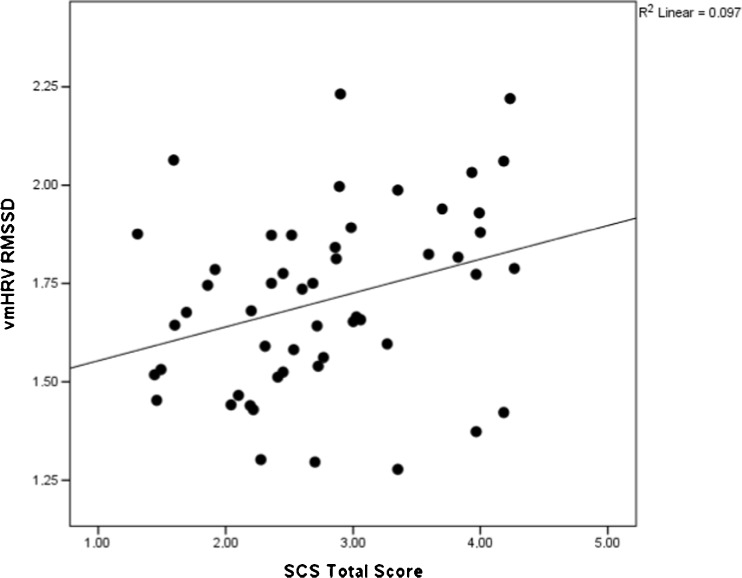
Converging evidence shows a positive effect of self-compassion on self-reported well-being and mental health. However, few studies have examined the relation between self-compassion and psychophysiological measures. In the present study, we therefore examined the relation between trait self-compassion and vagally mediated heart rate variability (vmHRV) in 53 students (39 female, mean age = 23.63). Trait self-compassion was assessed using the Self-Compassion Scale, and resting vmHRV was measured during a 5-min ECG baseline period. We hypothesized that higher levels of trait self-compassion would predict higher levels of resting vmHRV. Controlling for potential covariates (including age, gender, and BMI), the results confirmed our hypotheses, showing that higher levels of trait self-compassion predicted higher vmHRV. These results were validated with a 24-h measure of vmHRV, acquired from a subsample of the participants ( n = 26, 16 female, mean age = 23.85), confirming the positive correlation between high trait self-compassion and higher vmHRV. The relation between trait self-compassion, vmHRV, self-reported trait anxiety (the trait scale of the State-Trait Anxiety Inventory; STAI) and self-reported rumination (the Rumination subscale of the Rumination-Reflection Questionnaire; RRQ-Rum) was also investigated. Higher levels of trait anxiety and rumination were highly correlated with low levels of trait self-compassion. Trait anxiety, but not rumination, correlated marginally significantly with the level of vmHRV. The findings of the present study indicate that trait self-compassion predicts a better ability to physiologically and psychologically adapt emotional responses. Possible implications and limitations of the study are discussed.
Overview
The claims and statistics of this paper haven’t been checked yet.
Run the check — free, no account needed. It reads the open-access text and checks the sources it cites.
Integrity signals
Registry
Cites
Statistics
Figures
Verification
Claims the paper makes
The claims and statistics of this paper haven’t been checked yet.
Run the check — free, no account needed. It reads the open-access text and checks the sources it cites.
Claims other papers make about this one
Each is checked against this paper’s own text: does it say what the citing paper says it does?
The cited source says what the claim attributes to it.
In the citing paper
“Recent studies on compassion using alternate forms of measurement, for example physiological measures such as heart-rate variability, provide important additional data to this debate [124–129].”
From Validation of the compassionate engagement and action scales, compassion scale, and Sussex-Oxford compassion scales in a French-Canadian sample (2024) · cites this paper as [125]
The cited source says what the claim attributes to it.
In the citing paper
“A mindful stance is also often characterized by a sense of care, warmth and kindness (self-compassion) towards oneself (Neff, 2003), which can also be seen as an emotion regulation strategy (Svendsen et al., 2016).”
From Participant experiences of change in mindfulness-based stress reduction for anxiety disorders. (2020) · cites this paper as Svendsen et al., 2016
Self-check
Percentages, sums and reported differences re-computed from the paper’s own numbers.
The self-check needs the paper’s full text.
Citations
Cites
(1970) · Cited by 24,983
The emerging field of emotion regulation: an integrative review
Gross, J. J. (1998) · Review of General Psychology · doi:10.1037/1089-2680.2.3.271 · Cited by 9,916
The Development and Validation of a Scale to Measure Self-Compassion
NEFF, K. D. (2003) · Self and Identity · doi:10.1080/15298860309027 · Cited by 6,436 · cited 8×
“…of mindfulness-based cognitive therapy (MBCT; Kuyken et al. 2010), and high self-compassion is found to associate with happiness and optimism (Neff et al. 2007b), higher psychological well-being (Hollis-Walker and Colosimo 2011), and greater life satisfaction (Neff 2003b; Neff and Faso 2015).”
BackgroundMethodInfluentialSelf-Compassion: An Alternative Conceptualization of a Healthy Attitude Toward Oneself
NEFF, K. (2003) · Self and Identity · doi:10.1080/15298860309032 · Cited by 5,440
Porges, S. W. (2007) · Biological Psychology · doi:10.1016/j.biopsycho.2006.06.009 · Cited by 3,415
A model of neurovisceral integration in emotion regulation and dysregulation
Thayer, J. F., & Lane, R. D. (2000) · Journal of Affective Disorders · doi:10.1016/s0165-0327(00)00338-4 · Cited by 3,092
Kubios HRV–heart rate variability analysis software.
Tarvainen, M. P., Niskanen, J.-P., Lipponen, J. A., Ranta-aho, P. O., & Karjalainen, P. A. (2014) · Computer Methods and Programs in Biomedicine · doi:10.1016/j.cmpb.2013.07.024 · Cited by 2,720 · cited 3×
“0 (Tarvainen et al. 2014) from which root mean square of successive differences in R-R in-”
BackgroundMethodInfluentialA pilot study and randomized controlled trial of the mindful self-compassion program
Neff, K. D., & Germer, C. K. (2013) · Journal of Clinical Psychology · doi:10.1002/jclp.21923 · Cited by 2,253
Heart rate variability as an index of regulated emotional responding
Appelhans, B. M., & Luecken, L. J. (2006) · Review of General Psychology · doi:10.1037/1089-2680.10.3.229 · Cited by 1,893
Exploring compassion: A meta-analysis of the association between self-compassion and psychopathology
MacBeth, A., & Gumley, A. (2012) · Clinical Psychology Review · doi:10.1016/j.cpr.2012.06.003 · Cited by 1,838 · cited 1×
“Self-compassion correlates strongly with lower levels of such stress responses (e.g., Krieger et al. 2013; MacBeth and Gumley 2012) and therefore self-compassion is like-”
Background
Research works printed but not linked: 2
- Corp, I. B. M. (2011). IBM SPSS Statistics for Windows, Version 22.0.. Armon, NY: IBM Corp.
- Gross, JJ (2014). Handbook of Emotion Regulation (2nd ed) (pp. xviii, 669). New York, NY: Guilford Press; US.
Cited by
Sorted by citations
Inwood, E., & Ferrari, M. (2018) · Applied Psychology: Health and Well-Being · doi:10.1111/aphw.12127 · Cited by 483
Holzman, J. B., & Bridgett, D. J. (2017) · Neuroscience & Biobehavioral Reviews · doi:10.1016/j.neubiorev.2016.12.032 · Cited by 449
Neff, K. D., Tóth-Király, I., Yarnell, L. M., Arimitsu, K., Castilho, P., Ghorbani, N., Guo, H. X., Hirsch, J. K., Hupfeld, J., Hutz, C. S., et al. (2019) · Psychological Assessment · doi:10.1037/pas0000629 · Cited by 397
Self-citationDi Bello, M., Carnevali, L., Petrocchi, N., Thayer, J. F., Gilbert, P., & Ottaviani, C. (2020) · Neuroscience & Biobehavioral Reviews · doi:10.1016/j.neubiorev.2020.06.016 · Cited by 154
The Current and Future Role of Heart Rate Variability for Assessing and Training Compassion
Kirby, J. N., Doty, J. R., Petrocchi, N., & Gilbert, P. (2017) · Frontiers in Public Health · doi:10.3389/fpubh.2017.00040 · Cited by 152
“For example, trait self-compassion, measured by the Self-Compassion Scale (37) was found to be correlated to resting HRV and an increase in parasympathetic nervous system tone (43).”
MethodFinlay‐jones, A. L. (2017) · Clinical Psychologist · doi:10.1111/cp.12131 · Cited by 159
Homan, K. J., & Sirois, F. M. (2017) · Health Psychology Open · doi:10.1177/2055102917729542 · Cited by 160
Self-Compassion and Bedtime Procrastination: an Emotion Regulation Perspective
Sirois, F. M., Nauts, S., & Molnar, D. S. (2018) · Mindfulness · doi:10.1007/s12671-018-0983-3 · Cited by 144
Autonomic and Brain Morphological Predictors of Stress Resilience
Carnevali, L., Koenig, J., Sgoifo, A., & Ottaviani, C. (2018) · Frontiers in Neuroscience · doi:10.3389/fnins.2018.00228 · Cited by 117
Chio, F. H. N., Mak, W. W. S., & Yu, B. C. L. (2021) · Clinical Psychology Review · doi:10.1016/j.cpr.2021.101986 · Cited by 135
Visted, E., Sørensen, L., Osnes, B., Svendsen, J. L., Binder, P., & Schanche, E. (2017) · Frontiers in Psychology · doi:10.3389/fpsyg.2017.00328 · Cited by 105
Self-citationSelf‐compassion in organizations: A review and future research agenda
Dodson, S. J., & Heng, Y. T. (2021) · Journal of Organizational Behavior · doi:10.1002/job.2556 · Cited by 112
Commentary on Muris and Otgaar (2020): Let the Empirical Evidence Speak on the Self-Compassion Scale
Neff, K. D. (2020) · Mindfulness · doi:10.1007/s12671-020-01411-9 · Cited by 101
Luo, X., Qiao, L., & Che, X. (2018) · Mindfulness · doi:10.1007/s12671-018-0900-9 · Cited by 77
Compassion: Embodied and Embedded
Khoury, B. (2019) · Mindfulness · doi:10.1007/s12671-019-01211-w · Cited by 86
Matos, M., Albuquerque, I., Galhardo, A. B., Cunha, M. I. V. A., de Lima, M. P., Palmeira, L., Petrocchi, N., McEwan, K., Maratos, F. A., & Gilbert, P. (2022) · PLoS ONE · doi:10.1371/journal.pone.0263480 · Cited by 93
Self-Compassion and Psycho-Physiological Recovery From Recalled Sport Failure
Ceccarelli, L. A., Giuliano, R. J., Glazebrook, C. M., & Strachan, S. M. (2019) · Frontiers in Psychology · doi:10.3389/fpsyg.2019.01564 · Cited by 85
Roles of Anger and Rumination in the Relationship Between Self-Compassion and Forgiveness
Wu, Q., Chi, P., Zeng, X., Lin, X., & Du, H. (2018) · Mindfulness · doi:10.1007/s12671-018-0971-7 · Cited by 79
Mindfulness-based programs and school adjustment: A systematic review and meta-analysis
Mettler, J., Khoury, B., Zito, S., Sadowski, I., & Heath, N. L. (2023) · Journal of School Psychology · doi:10.1016/j.jsp.2022.10.007 · Cited by 95
Moreira, H., & Canavarro, M. C. (2019) · Journal of Youth and Adolescence · doi:10.1007/s10964-019-01133-9 · Cited by 85
Integrating Breathing Techniques Into Psychotherapy to Improve HRV: Which Approach Is Best?
Steffen, P. R., Bartlett, D., Channell, R., Jackman, K. N., Cressman, M., Bills, J., & Pescatello, M. S. (2021) · Frontiers in Psychology · doi:10.3389/fpsyg.2021.624254 · Cited by 62
Neff, K. D., & Tóth‐Király, I. (2022) · Springer eBooks · doi:10.1007/978-3-030-77644-2_36-1 · Cited by 73
Di Bello, M., Ottaviani, C., & Petrocchi, N. (2021) · Frontiers in Neuroscience · doi:10.3389/fnins.2021.617443 · Cited by 54
Sørensen, L., Osnes, B., Visted, E., Svendsen, J. L., Adólfsdóttir, S., Binder, P., & Schanche, E. (2018) · Frontiers in Psychology · doi:10.3389/fpsyg.2018.02359 · Cited by 50
Self-citationSmith, L. K., & Wissel, E. F. (2019) · Perspectives on Psychological Science · doi:10.1177/1745691618809379 · Cited by 46
Impact of a 12-Week Group-Based Compassion Focused Therapy Intervention on Heart Rate Variability
Steffen, P. R., Foxx, J., Cattani, K., Alldredge, C. T., Austin, T. A., & Burlingame, G. M. (2020) · Applied Psychophysiology and Biofeedback · doi:10.1007/s10484-020-09487-8 · Cited by 44
Matos, M., Duarte, C., Duarte, J., Pinto‐Gouveia, J., Petrocchi, N., & Gilbert, P. (2021) · Mindfulness · doi:10.1007/s12671-021-01717-2 · Cited by 46
The association between self-compassion and self-rated health in 26 samples
Sirois, F. M. (2020) · BMC Public Health · doi:10.1186/s12889-020-8183-1 · Cited by 41
Paucsik, M., Leys, C., Marais, G. A. B., Baeyens, C., & Shankland, R. (2022) · Stress and Health · doi:10.1002/smi.3142 · Cited by 37
Pohl, S., Steuwe, C., Mainz, V., Drießen, M., & Beblo, T. (2020) · Journal of Clinical Psychology · doi:10.1002/jclp.23070 · Cited by 39
Benefits of yoga in the treatment of eating disorders: Results of a randomized controlled trial
Brennan, M. A., Whelton, W. J., & Sharpe, D. (2020) · Eating Disorders · doi:10.1080/10640266.2020.1731921 · Cited by 36
Medvedev, O. N., Dailianis, A. T., Hwang, Y., Krägeloh, C. U., & Singh, N. N. (2020) · Mindfulness · doi:10.1007/s12671-020-01522-3 · Cited by 33
Wouters-Soomers, L., Ruysseveldt, J. V., Bos, A. E. R., & Jacobs, N. (2022) · Frontiers in Psychology · doi:10.3389/fpsyg.2022.920908 · Cited by 40
Morais‐Silva, G., Ferreira, W. C., Gomes‐de‐Souza, L., Pavan, J. C., Crestani, C. C., & Marin, M. T. (2019) · Neurobiology of Stress · doi:10.1016/j.ynstr.2019.100181 · Cited by 30
Luo, X., Liu, J., & Che, X. (2019) · Journal of Pain · doi:10.1016/j.jpain.2019.11.006 · Cited by 29
Prentice, K., Rees, C. S., & Finlay‐jones, A. L. (2021) · Mindfulness · doi:10.1007/s12671-021-01685-7 · Cited by 38
Halamová, J., Koróniová, J., Kanovský, M., Túniyová, M. K., & Kupeli, N. (2019) · Research in Psychotherapy Psychopathology Process and Outcome · doi:10.4081/ripppo.2019.358 · Cited by 29
Lathren, C., Bluth, K., & Zvara, B. J. (2020) · Journal of Family Theory & Review · doi:10.1111/jftr.12388 · Cited by 27
Sørensen, L., Wass, S. V., Osnes, B., Schanche, E., Adólfsdóttir, S., Svendsen, J. L., Visted, E., Eilertsen, T., Jensen, D. A., Nordby, H., et al. (2019) · Physiology & Behavior · doi:10.1016/j.physbeh.2019.112657 · Cited by 25
Self-citationParticipant experiences of change in mindfulness-based stress reduction for anxiety disorders.
Schanche, E., Vøllestad, J., Binder, P.-E., Hjeltnes, A., Dundas, I., & Nielsen, G. H. (2020) · International Journal of Qualitative Studies on Health and Well-Being · doi:10.1080/17482631.2020.1776094 · Cited by 24
“A mindful stance is also often characterized by a sense of care, warmth and kindness (selfcompassion) towards oneself (Neff, 2003), which can also be seen as an emotion regulation strategy (Svendsen et al., 2016).”
BackgroundHuang, L., Chi, P., Wang, E., Bu, H., & Chi, X. (2023) · Child Abuse & Neglect · doi:10.1016/j.chiabu.2023.106138 · Cited by 24
Bergunde, L., & Dritschel, B. (2020) · PLoS ONE · doi:10.1371/journal.pone.0227564 · Cited by 33
Zhu, L., Wang, J., Liu, S., Xie, H., Hu, Y., Yao, J., Ranchor, A. V., Schroevers, M. J., & Fleer, J. (2020) · Mindfulness · doi:10.1007/s12671-020-01455-x · Cited by 22
Les dimensions incarnée et interpersonnelle de la compassion
Khoury, B., & Dionne, F. (2020) · Annales Médico-psychologiques revue psychiatrique · doi:10.1016/j.amp.2020.11.018 · Cited by 25
Makovac, E., Carnevali, L., Medina, S., Sgoifo, A., Petrocchi, N., & Ottaviani, C. (2021) · Stress · doi:10.1080/10253890.2021.1999408 · Cited by 21
Muttaqin, D., Yunanto, T. A. R., Fitria, A. Z. N., Ramadhanty, A. M., & Lempang, G. F. (2020) · Persona Jurnal Psikologi Indonesia · doi:10.30996/persona.v9i2.3944 · Cited by 33
The Brain That Longs to Care for Itself: The Current Neuroscience of Self-Compassion
Stevens, L. C., Gauthier-Braham, M., & Bush, B. F. (2018) · Elsevier eBooks · doi:10.1016/b978-0-12-809837-0.00004-0 · Cited by 20
Czamanski-Cohen, J., Wiley, J., & Weihs, K. (2020) · BMJ Open · doi:10.1136/bmjopen-2020-037521 · Cited by 19
Compassion Mediates Poor Sleep Quality and Mental Health Outcomes
Kim, J. J., Oldham, M., Fernando, A. T., & Kirby, J. N. (2021) · Mindfulness · doi:10.1007/s12671-021-01595-8 · Cited by 19
Self‐compassion moderates the predictive effects of implicit cognitions on subjective well‐being
Phillips, W. J., Hine, D. W., & Marks, A. D. G. (2017) · Stress and Health · doi:10.1002/smi.2773 · Cited by 18
Cultivating Self-Compassion to Improve Mental Health in Autistic Adults
Cai, R. Y., & Brown, L. (2020) · Autism in Adulthood · doi:10.1089/aut.2020.0034 · Cited by 19
Self-compassion and subclinical cardiovascular disease among midlife women.
Thurston, R. C., Fritz, M. M., Chang, Y., Barinas‐Mitchell, E., & Maki, P. M. (2021) · Health Psychology · doi:10.1037/hea0001137 · Cited by 16
Çayır, E., Cunningham, T., Ackard, R., Haizlip, J. A., Logan, J. G., & Yan, G. (2021) · Western Journal of Nursing Research · doi:10.1177/01939459211027657 · Cited by 16
Loseby, P., Schache, K., Cavadino, A., Young, S., Hofman, P. L., & Serlachius, A. S. (2021) · Pediatric Diabetes · doi:10.1111/pedi.13306 · Cited by 20
Nguyen, T. M., An, N. H., Tran, P. T. T., & Vo, H. T. P. (2022) · Personal Relationships · doi:10.1111/pere.12464 · Cited by 14
Can clinical psychology students benefit from brief and intensive mindfulness training?
Schanche, E., Vøllestad, J., Binder, P. E., Osnes, B., Visted, E., Svendsen, J. L., & Sørensen, L. (2019) · Counselling and Psychotherapy Research · doi:10.1002/capr.12273 · Cited by 13
Self-citationSvendsen, J. L., Schanche, E., Osnes, B., Vøllestad, J., Visted, E., Dundas, I., Nordby, H., Binder, P., & Sørensen, L. (2020) · Frontiers in Psychology · doi:10.3389/fpsyg.2020.00614 · Cited by 13
Self-citationSelf-Compassion in Psychotherapy: Clinical Integration, Evidence Base, and Mechanisms of Change
Germer, C. K. (2023) · Mindfulness in behavioral health · doi:10.1007/978-3-031-22348-8_22 · Cited by 16
Zhang, N., Huang, J., & Yao, J. (2023) · Frontiers in Psychology · doi:10.3389/fpsyg.2023.1192265 · Cited by 15
Rehman, S., Rehman, E., & Liu, B. (2023) · Psychology Research and Behavior Management · doi:10.2147/prbm.s431922 · Cited by 14
Stevens, L. C., & Woodruff, C. C. (2018) · Elsevier eBooks · doi:10.1016/b978-0-12-809837-0.00001-5 · Cited by 11
Brophy, K., Emery, M., MacDonald, C., Côté, C. I., & Körner, A. (2024) · PLoS ONE · doi:10.1371/journal.pone.0305776 · Cited by 10
Mousavi, S. Z., Mousavi, S., & Shahsavari, M. R. (2023) · Journal of Clinical Research in Paramedical Sciences · doi:10.5812/jcrps-139058 · Cited by 12
Halamová, J., Kanovský, M., & Koróniová, J. (2019) · Adaptive Human Behavior and Physiology · doi:10.1007/s40750-019-00122-3 · Cited by 10
dos Santos, F. R. M., Bazán, P. R., Balardin, J. B., Aratanha, M. A., Rodrigues, M., Lacerda, S. S., Negi, L. T., & Kozasa, E. H. (2021) · Mindfulness · doi:10.1007/s12671-021-01789-0 · Cited by 11
Neyestani, M. M., Sales, S. G. N., Khodakarami, M., Salehi, S., Ahmadi, S., Javaheri, Z., & Bagherzadeh, A. (2023) · Caspian Journal of Health Research · doi:10.32598/cjhr.8.1.463.1 · Cited by 10
Moreira, H. (2023) · Mindfulness in behavioral health · doi:10.1007/978-3-031-22348-8_16 · Cited by 13
Heart Rate Variability Predicts Older Adults’ Avoidance of Negativity
Mantantzis, K., Schlaghecken, F., & Maylor, E. A. (2020) · The Journals of Gerontology: Series B · doi:10.1093/geronb/gby148 · Cited by 11
Compassion Focused Therapy and Heart Rate Variability
Sherwell, C. S., & Kirby, J. N. (2024) · Oxford University Press eBooks · doi:10.1093/oso/9780198888727.003.0018 · Cited by 9
Guomin, J. I. N., Liu, X., & Li, D. (2020) · Advances in Psychological Science · doi:10.3724/sp.j.1042.2020.00824 · Cited by 9
Compassion as the Highest Ethic
Kirby, J. N., Steindl, S. R., & Doty, J. R. (2017) · Mindfulness in behavioral health · doi:10.1007/978-3-319-64924-5_10 · Cited by 9
Reed, K. M. P., Cameron, A., & Ameral, V. (2017) · Behavior Modification · doi:10.1177/0145445517730830 · Cited by 7
Peng, Y., & Ishak, Z. (2024) · Discover Mental Health · doi:10.1007/s44192-024-00114-0 · Cited by 6
Neff, K. D., & Tóth‐Király, I. (2025) · Springer eBooks · doi:10.1007/978-3-031-47219-0_36 · Cited by 9
The Psychophysiology of Self-Compassion
Slivjak, E. T., Kirk, A., & Arch, J. J. (2023) · Mindfulness in behavioral health · doi:10.1007/978-3-031-22348-8_17 · Cited by 6
Analysis of the Predictive Role of Self-Compassion on Emotional Distress during COVID-19 Lockdown
Gutiérrez-Hernández, M. E., Fanjul, L. F., Díaz, A., Oyanadel, C., & Castro, W. P. (2022) · Social Sciences · doi:10.3390/socsci11040151 · Cited by 7
İme, Y. (2025) · Current Psychology · doi:10.1007/s12144-025-07378-x · Cited by 9
Svendsen, J. L., Schanche, E., Vøllestad, J., Visted, E., Jentschke, S., Karl, A., Binder, P., Osnes, B., & Sørensen, L. (2022) · Frontiers in Psychology · doi:10.3389/fpsyg.2022.798914 · Cited by 8
Self-citationWilson, C., Misajon, R., & Brooker, J. (2023) · Australian Journal of Psychology · doi:10.1080/00049530.2023.2257362 · Cited by 7
Mernagh, M., Baird, K., & Guérin, S. (2020) · Mindfulness · doi:10.1007/s12671-020-01417-3 · Cited by 4
Koróniová, J., Halamová, J., & Džongová, Z. (2020) · Studia Psychologica · doi:10.31577/sp.2020.04.810 · Cited by 4
A House with Many Doors – Toward a More Nuanced Self-Compassion Intervention Science
Finlay‐jones, A. L. (2023) · Mindfulness in behavioral health · doi:10.1007/978-3-031-22348-8_24 · Cited by 5
Breathing, Heart Rate Variability, and Their Application in Psychotherapy
Khazan, I. (2024) · doi:10.1093/oso/9780198888727.003.0016 · Cited by 3
Akdağ, R., Kret, M. E., Aktar, E., & Nikolić, M. (2025) · Scientific Reports · doi:10.1038/s41598-025-96602-6 · Cited by 4
Trait self-compassion, daily stress and eating behaviours: a daily diary study
Liu, J., Conner, M. T., & O'Connor, D. B. (2025) · Psychology and Health · doi:10.1080/08870446.2025.2575070 · Cited by 5
Yaghoobi, H., Toozandehjani, H., & Zendedel, A. (2021) · Journal of North Khorasan University of Medical Sciences · doi:10.52547/nkums.13.3.113 · Cited by 6
Puah, S., Pua, C. Y., Shi, J. C., & Lim, S. M. (2024) · Journal of Medical Internet Research · doi:10.2196/49505 · Cited by 6
Guo, T., Guo, H., Fu, L., Chen, X., Ma, Y., Pang, B., Shi, J., Yu, H., Shan, A., Li, Y., et al. (2022) · International Journal of Hygiene and Environmental Health · doi:10.1016/j.ijheh.2022.113933 · Cited by 4
Self-Compassion in Adolescence
Bluth, K., & Clepper-Faith, M. (2023) · Mindfulness in behavioral health · doi:10.1007/978-3-031-22348-8_6 · Cited by 4
A Triadic Pathway Model of Self-Compassion and Health
Sirois, F. M. (2023) · Mindfulness in behavioral health · doi:10.1007/978-3-031-22348-8_18 · Cited by 3
Chen, T., Mei, Y., Zhou, S., Dou, H., & Lei, Y. (2024) · International Journal of Clinical and Health Psychology · doi:10.1016/j.ijchp.2024.100516 · Cited by 3
Sun, L., Qi, X., Luo, X., Wang, Y., Che, X., & Shen, Y. (2025) · Frontiers in Psychiatry · doi:10.3389/fpsyt.2025.1461758 · Cited by 2
Exposure to virtual nature enhances heart rate variability: A randomized controlled trial
Szitás, D., & Halamová, J. (2026) · Computers in Human Behavior Reports · doi:10.1016/j.chbr.2026.100957 · Cited by 2
Wong, T. K. Y., & Hamza, C. A. (2024) · Emerging Adulthood · doi:10.1177/21676968241273184 · Cited by 4
Self-Compassion and Positive Aging
Brown, L. (2023) · Mindfulness in behavioral health · doi:10.1007/978-3-031-22348-8_7 · Cited by 3
Self-Care for Palliative Care Staff
Mills, J. (2024) · Springer eBooks · doi:10.1007/978-3-031-50864-6_29 · Cited by 2
Mistretta, E. G. (2019) · Arizona State University Library Digital Repository (Arizona State University) · Cited by 2
Yeshua, M., & Zohar, A. H. (2023) · Counselling and Psychotherapy Research · doi:10.1002/capr.12676 · Cited by 1
Victor-Aigbodion, V. (2023) · Konselor · doi:10.24036/020231219-0-86 · Cited by 1
Lee, K. A., Beranbaum, S., Khedari-DePierro, V., Yates, E. H., Yacevich, I., Shankar, A., Enosa, C. E., Son, T. H., Norman, G. J., & D'Andrea, W. M. (2025) · Chronic Stress · doi:10.1177/24705470251324783 · Cited by 1
Metadata
- Authors
- Svendsen, J. L., Osnes, B., Binder, P.-E., Dundas, I., Visted, E., Nordby, H., Schanche, E., & Sørensen, L.
- Affiliations
- Haukeland University Hospital (NO)
- University of Bergen (NO)
- Corresponding author
- Svendsen, Julie Lillebostad
- Venue
- Mindfulness
- Published
- 2016-06-02
- Volume
- 7
- Issue
- 5
- Pages
- 1103-1113
- ISSN
- 1868-8527 (ISSN-L)
- 1868-8535
- PMC
- PMC5010618
- OpenAlex
- W2414252837
- Cited by
- 129
- References
- 67
- Citations by year
- 2026: 10 · 2025: 9 · 2024: 9 · 2023: 21 · 2022: 9 · 2021: 15 · 2020: 22 · 2019: 12 · 2018: 14 · 2017: 8
- FWCI
- 15.17
- Type
- journal article
- Language
- en
- Update notices
- correction (2018-08-04)
- Open access
- hybrid
- doi.org
- Locations
- Mindfulness (publishedVersion, cc-by)
- PubMed Central (publishedVersion, cc-by)
- PubMed (publishedVersion)
- NORA - Norwegian Open Research Archives (submittedVersion, cc-by)
- Funders
- Meltzer Research Fund (5/2015/LMH/42)
- Topics
- Social Sciences › Psychology › Clinical Psychology › Mindfulness and Compassion Interventions
- Health Sciences › Medicine › Cardiology and Cardiovascular Medicine › Heart Rate Variability and Autonomic Control
- Life Sciences › Neuroscience › Neurology › Vagus Nerve Stimulation Research
- Keywords
- trait self-compassion, vagally mediated heart rate variability, emotional flexibility, trait anxiety, rumination, autonomic nervous system, psychophysiology, well-being, university students
About these checks
Registry, retraction, Cites and statistics results are computed, not judged, with one exception: a printed reference that no index lists is read once by a model before it counts as a citation error. Claims are extracted by a model and kept only when their quote appears verbatim in the text; each cited source is then checked, with a model’s help, for whether it says what the claim relies on. Those verdicts can be wrong — read the claim’s quote and the cited source before relying on one.
Statistics and arithmetic are recomputed, not judged.
Confidence bands are shown only for fields calibrated on our annotated test set. None is calibrated yet, so no band is shown.
What counts as a claim ›How we measure confidence ›How we check this ›
Are you an author, or do you see a problem with this page? Request a review
