

The DOI matches its Crossref record; 66 of the 67 references it cites were found in a registry or an index.
Trait Self-Compassion Reflects Emotional Flexibility Through an Association with High Vagally Mediated Heart Rate Variability
Open accessAbstract
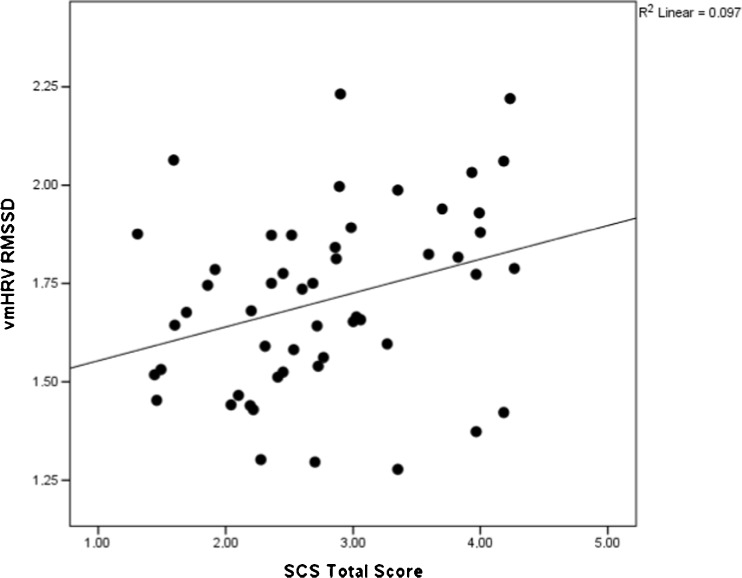
Converging evidence shows a positive effect of self-compassion on self-reported well-being and mental health. However, few studies have examined the relation between self-compassion and psychophysiological measures. In the present study, we therefore examined the relation between trait self-compassion and vagally mediated heart rate variability (vmHRV) in 53 students (39 female, mean age = 23.63). Trait self-compassion was assessed using the Self-Compassion Scale, and resting vmHRV was measured during a 5-min ECG baseline period. We hypothesized that higher levels of trait self-compassion would predict higher levels of resting vmHRV. Controlling for potential covariates (including age, gender, and BMI), the results confirmed our hypotheses, showing that higher levels of trait self-compassion predicted higher vmHRV. These results were validated with a 24-h measure of vmHRV, acquired from a subsample of the participants ( n = 26, 16 female, mean age = 23.85), confirming the positive correlation between high trait self-compassion and higher vmHRV. The relation between trait self-compassion, vmHRV, self-reported trait anxiety (the trait scale of the State-Trait Anxiety Inventory; STAI) and self-reported rumination (the Rumination subscale of the Rumination-Reflection Questionnaire; RRQ-Rum) was also investigated. Higher levels of trait anxiety and rumination were highly correlated with low levels of trait self-compassion. Trait anxiety, but not rumination, correlated marginally significantly with the level of vmHRV. The findings of the present study indicate that trait self-compassion predicts a better ability to physiologically and psychologically adapt emotional responses. Possible implications and limitations of the study are discussed.
Overview
The claims and statistics of this paper haven’t been checked yet.
Run the check — free, no account needed. It reads the open-access text and checks the sources it cites.
Integrity signals
Registry
Cites
Statistics
Figures
Verification
Claims the paper makes
The claims and statistics of this paper haven’t been checked yet.
Run the check — free, no account needed. It reads the open-access text and checks the sources it cites.
Claims other papers make about this one
Each is checked against this paper’s own text: does it say what the citing paper says it does?
The cited source says what the claim attributes to it.
In the citing paper
“Recent studies on compassion using alternate forms of measurement, for example physiological measures such as heart-rate variability, provide important additional data to this debate [124–129].”
From Validation of the compassionate engagement and action scales, compassion scale, and Sussex-Oxford compassion scales in a French-Canadian sample (2024) · cites this paper as [125]
The cited source says what the claim attributes to it.
In the citing paper
“A mindful stance is also often characterized by a sense of care, warmth and kindness (self-compassion) towards oneself (Neff, 2003), which can also be seen as an emotion regulation strategy (Svendsen et al., 2016).”
From Participant experiences of change in mindfulness-based stress reduction for anxiety disorders. (2020) · cites this paper as Svendsen et al., 2016
Self-check
Percentages, sums and reported differences re-computed from the paper’s own numbers.
The self-check needs the paper’s full text.
Citations
Cites
(1970) · Cited by 24,983
The emerging field of emotion regulation: an integrative review
Gross, J. J. (1998) · Review of General Psychology · doi:10.1037/1089-2680.2.3.271 · Cited by 9,916
The Development and Validation of a Scale to Measure Self-Compassion
NEFF, K. D. (2003) · Self and Identity · doi:10.1080/15298860309027 · Cited by 6,436 · cited 8×
“…of mindfulness-based cognitive therapy (MBCT; Kuyken et al. 2010), and high self-compassion is found to associate with happiness and optimism (Neff et al. 2007b), higher psychological well-being (Hollis-Walker and Colosimo 2011), and greater life satisfaction (Neff 2003b; Neff and Faso 2015).”
BackgroundMethodInfluentialSelf-Compassion: An Alternative Conceptualization of a Healthy Attitude Toward Oneself
NEFF, K. (2003) · Self and Identity · doi:10.1080/15298860309032 · Cited by 5,440
Porges, S. W. (2007) · Biological Psychology · doi:10.1016/j.biopsycho.2006.06.009 · Cited by 3,415
A model of neurovisceral integration in emotion regulation and dysregulation
Thayer, J. F., & Lane, R. D. (2000) · Journal of Affective Disorders · doi:10.1016/s0165-0327(00)00338-4 · Cited by 3,092
Kubios HRV–heart rate variability analysis software.
Tarvainen, M. P., Niskanen, J.-P., Lipponen, J. A., Ranta-aho, P. O., & Karjalainen, P. A. (2014) · Computer Methods and Programs in Biomedicine · doi:10.1016/j.cmpb.2013.07.024 · Cited by 2,720 · cited 3×
“0 (Tarvainen et al. 2014) from which root mean square of successive differences in R-R in-”
BackgroundMethodInfluentialA pilot study and randomized controlled trial of the mindful self-compassion program
Neff, K. D., & Germer, C. K. (2013) · Journal of Clinical Psychology · doi:10.1002/jclp.21923 · Cited by 2,253
Heart rate variability as an index of regulated emotional responding
Appelhans, B. M., & Luecken, L. J. (2006) · Review of General Psychology · doi:10.1037/1089-2680.10.3.229 · Cited by 1,893
Exploring compassion: A meta-analysis of the association between self-compassion and psychopathology
MacBeth, A., & Gumley, A. (2012) · Clinical Psychology Review · doi:10.1016/j.cpr.2012.06.003 · Cited by 1,838 · cited 1×
“Self-compassion correlates strongly with lower levels of such stress responses (e.g., Krieger et al. 2013; MacBeth and Gumley 2012) and therefore self-compassion is like-”
BackgroundGilbert, P., & Procter, S. (2006) · Clinical Psychology & Psychotherapy · doi:10.1002/cpp.507 · Cited by 1,822 · cited 1×
“This is interesting since isolation has been subject to much less research attention than self-criticism and over-identification (Neff 2016), which have long been recognized as important vulnerability factors in psychopathology (Blatt et al. 1982; Germer 2009; Gilbert and Procter 2006).”
BackgroundLeary, M. R., Tate, E. B., Adams, C. E., Batts Allen, A., & Hancock, J. (2007) · Journal of Personality and Social Psychology · doi:10.1037/0022-3514.92.5.887 · Cited by 1,728
Trapnell, P. D., & Campbell, J. D. (1999) · Journal of Personality and Social Psychology · doi:10.1037/0022-3514.76.2.284 · Cited by 1,646
Self-compassion and adaptive psychological functioning.
Neff, K. D., Kirkpatrick, K. L., & Rude, S. S. (2007) · Journal of Research in Personality · doi:10.1016/j.jrp.2006.03.004 · Cited by 1,627
Self‐Compassion Versus Global Self‐Esteem: Two Different Ways of Relating to Oneself
Neff, K. D., & Vonk, R. (2008) · Journal of Personality · doi:10.1111/j.1467-6494.2008.00537.x · Cited by 1,258
Neff, K. D., Rude, S. S., & Kirkpatrick, K. L. (2007) · Journal of Research in Personality · doi:10.1016/j.jrp.2006.08.002 · Cited by 1,224
Self-compassion, Achievement Goals, and Coping with Academic Failure
Neff, K. D., Hsieh, Y.-P., & Dejitterat, K. (2005) · Self and Identity · doi:10.1080/13576500444000317 · Cited by 1,221
Anxiety Disorders are Associated with Reduced Heart Rate Variability: A Meta-Analysis
Chalmers, J. A., Quintana, D. S., Abbott, M. J.-A., & Kemp, A. H. (2014) · Frontiers in Psychiatry · doi:10.3389/fpsyt.2014.00080 · Cited by 1,067 · cited 1×
“First, emotional stress responses such as anxiety (Chalmers et al. 2014; Thayer et al. 1996), depression (Beevers et al. 2011; Yeh et al. 2016), and rumination (Brosschot et al. 2007; Woody et al. 2014) are consistently shown to associate with lower vmHRV. Self-compassion correlates strongly with…”
Background(2005) · doi:10.4324/9780203003459 · Cited by 1,041
The role of vagal function in the risk for cardiovascular disease and mortality
Thayer, J. F., & Lane, R. D. (2007) · Biological Psychology · doi:10.1016/j.biopsycho.2005.11.013 · Cited by 1,033
Gilbert, P. (2010) · Routledge eBooks · doi:10.4324/9780203851197 · Cited by 957
Reliability Generalization of Scores on the Spielberger State-Trait Anxiety Inventory
Barnes, L. L. B., Harp, D., & Jung, W. S. (2002) · Educational and Psychological Measurement · doi:10.1177/0013164402062004005 · Cited by 947 · cited 1×
“The Trait scale of the STAI has shown excellent internal consistency (average α< .89) and test-retest reliability (average r= .88; Barnes et al. 2002).”
BackgroundCriticizing and reassuring oneself: an exploration of forms, styles and reasons in female students
Gilbert, P., Clarke, M., Hempel, S., Miles, J. N. V., & Irons, C. (2004) · British Journal of Clinical Psychology · doi:10.1348/014466504772812959 · Cited by 877
Autonomic characteristics of generalized anxiety disorder and worry
Thayer, J. F., Friedman, B. H., & Borkovec, T. D. (1996) · Biological Psychiatry · doi:10.1016/0006-3223(95)00136-0 · Cited by 857 · cited 2×
“First, emotional stress responses such as anxiety (Chalmers et al. 2014; Thayer et al. 1996),”
BackgroundThe Polyvagal Theory: phylogenetic contributions to social behavior
Porges, S. W. (2003) · Physiology & Behavior · doi:10.1016/s0031-9384(03)00156-2 · Cited by 848
Self-Compassion: Conceptualizations, Correlates, & Interventions
Barnard, L. K., & Curry, J. F. (2011) · Review of General Psychology · doi:10.1037/a0025754 · Cited by 835
How does mindfulness-based cognitive therapy work?
Kuyken, W., Watkins, E., Holden, E., White, K., Taylor, R. S., Byford, S., Evans, A., Radford, S., Teasdale, J. D., & Dalgleish, T. (2010) · Behaviour Research and Therapy · doi:10.1016/j.brat.2010.08.003 · Cited by 809 · cited 5×
“Self-compassion has been proposed as a key mechanism of change in the positive effects of mindfulness-based cognitive therapy (MBCT; Kuyken et al. 2010), and high self-compassion is found to associate with happiness and optimism (Neff et al. 2007b), higher psychological well-being (Hollis-Walker…”
BackgroundInfluentialThe Self-Compassion Scale is a Valid and Theoretically Coherent Measure of Self-Compassion
Neff, K. D. (2016) · Mindfulness · doi:10.1007/s12671-015-0479-3 · Cited by 805
Kok, B. E., Coffey, K. A., Cohn, M. A., Catalino, L. I., Vacharkulksemsuk, T., Algoe, S. B., Brantley, M., & Fredrickson, B. L. (2013) · Psychological Science · doi:10.1177/0956797612470827 · Cited by 755
Pace, T. W. W., Negi, L. T., Adame, D. D., Cole, S. P., Sivilli, T. I., Brown, T. D., Issa, M. J., & Raison, C. L. (2009) · Psychoneuroendocrinology · doi:10.1016/j.psyneuen.2008.08.011 · Cited by 748 · cited 3×
“2008), and previous studies showing higher induced (Pace et al. 2009) and trait self-compassion (Breines et al.”
BackgroundResultBeyond Heart Rate Variability: Vagal Regulation of Allostatic Systems
THAYER, J. F., & STERNBERG, E. (2006) · Annals of the New York Academy of Sciences · doi:10.1196/annals.1366.014 · Cited by 703
Reliability and validity of the combined heart rate and movement sensor Actiheart
Brage, S., Brage, N., Franks, P. W., Ekelund, U., & Wareham, N. J. (2005) · European Journal of Clinical Nutrition · doi:10.1038/sj.ejcn.1602118 · Cited by 690
Van Dam, N. T., Sheppard, S. C., Forsyth, J. P., & Earleywine, M. (2011) · Journal of Anxiety Disorders · doi:10.1016/j.janxdis.2010.08.011 · Cited by 592
Dependency and self-criticism: Psychological dimensions of depression
Blatt, S. J., Quinlan, D. M., Chevron, E. S., McDonald, C., & Zuroff, D. (1982) · Journal of Consulting and Clinical Psychology · doi:10.1037/0022-006x.50.1.113 · Cited by 589 · cited 1×
“This is interesting since isolation has been subject to much less research attention than self-criticism and over-identification (Neff 2016), which have long been recognized as important vulnerability factors in psychopathology (Blatt et al. 1982; Germer 2009; Gilbert and Procter 2006).”
BackgroundPenttilä, J., Helminen, A., Jartti, T., Kuusela, T., Huikuri, H. V., Tulppo, M. P., Coffeng, R., & Scheinin, H. (2001) · Clinical Physiology · doi:10.1046/j.1365-2281.2001.00337.x · Cited by 567
Self-Compassion and Self-Construal in the United States, Thailand, and Taiwan
Neff, K. D., Pisitsungkagarn, K., & Hsieh, Y.-P. (2008) · Journal of Cross-Cultural Psychology · doi:10.1177/0022022108314544 · Cited by 531
Dependency and self-criticism: Psychological dimensions of depression.
Blatt, S. J., & al., E. (1982) · Journal of Consulting and Clinical Psychology · doi:10.1037//0022-006x.50.1.113 · Cited by 520
ROHLEDER, N., NATER, U. M., WOLF, J. M., EHLERT, U., & KIRSCHBAUM, C. (2004) · Annals of the New York Academy of Sciences · doi:10.1196/annals.1314.033 · Cited by 520
Heart rate variability in depressive and anxiety disorders
Gorman, J. M., & Sloan, R. P. (2000) · American Heart Journal · doi:10.1067/mhj.2000.109981 · Cited by 510
Hollis-Walker, L., & Colosimo, K. (2011) · Personality and Individual Differences · doi:10.1016/j.paid.2010.09.033 · Cited by 498 · cited 3×
“2007b), higher psychological well-being (Hollis-Walker and Colosimo 2011), and”
BackgroundBrosschot, J. F., Van Dijk, E., & Thayer, J. F. (2007) · International Journal of Psychophysiology · doi:10.1016/j.ijpsycho.2006.07.016 · Cited by 474
The Mindful Path to Self-Compassion: Freeing Yourself from Destructive Thoughts and Emotions
Germer, C. K., & Salzberg, S. (2009) · Medical Entomology and Zoology · Cited by 441
Williams, D. P., Cash, C. S. E., Rankin, C., Bernardi, A., Koenig, J., & Thayer, J. F. (2015) · Frontiers in Psychology · doi:10.3389/fpsyg.2015.00261 · Cited by 392
Krieger, T., Altenstein, D., Baettig, I., Doerig, N., & Holtforth, M. G. (2013) · Behavior Therapy · doi:10.1016/j.beth.2013.04.004 · Cited by 374
Compassion-focused therapy distinctive features
Gilbert, P. (2010) · Cited by 326
Self-compassion and well-being in parents of children with autism
Neff, K. D., & Faso, D. J. (2015) · Mindfulness · doi:10.1007/s12671-014-0359-2 · Cited by 291 · cited 1×
“…of mindfulness-based cognitive therapy (MBCT; Kuyken et al. 2010), and high self-compassion is found to associate with happiness and optimism (Neff et al. 2007b), higher psychological well-being (Hollis-Walker and Colosimo 2011), and greater life satisfaction (Neff 2003b; Neff and Faso 2015).”
BackgroundArch, J. J., Brown, K. W., Dean, D. J., Landy, L. N., Brown, K. D., & Laudenslager, M. L. (2014) · Psychoneuroendocrinology · doi:10.1016/j.psyneuen.2013.12.018 · Cited by 290
Worthington, E. L., O’Connor, L. E., Berry, J. W., Sharp, C., Murray, R., & Yi, E. (2005) · Routledge eBooks · doi:10.4324/9780203003459-6 · Cited by 241
Rockliff, H., Gilbert, P., McEwan, K., Lightman, S. L., & Glover, D. G. (2008) · University of Derby Online Research Archive. (University of Derby) · Cited by 234
The Effect of Self-Compassion on the Development of Depression Symptoms in a Non-clinical Sample
Raes, F. (2011) · Mindfulness · doi:10.1007/s12671-011-0040-y · Cited by 227
Mental habits: metacognitive reflection on negative self-thinking.
Verplanken, B., Friborg, O., Wang, C. E., Trafimow, D., & Woolf, K. (2007) · Journal of Personality and Social Psychology · doi:10.1037/0022-3514.92.3.526 · Cited by 213
Andrade, L. H., Gorenstein, C., Filho, A. H. V., Tung, T. C., & Artes, R. (2001) · Brazilian Journal of Medical and Biological Research · doi:10.1590/s0100-879x2001000300011 · Cited by 186
Stability of heart rate variability indices reflecting parasympathetic activity.
Bertsch, K., Hagemann, D., Naumann, E., Schächinger, H., & Schulz, A. (2012) · Psychophysiology · doi:10.1111/j.1469-8986.2011.01341.x · Cited by 185
Self-compassion as a predictor of interleukin-6 response to acute psychosocial stress
Breines, J. G., Thoma, M. V., Gianferante, D., Hanlin, L., Chen, X., & Rohleder, N. (2014) · Brain, Behavior, and Immunity · doi:10.1016/j.bbi.2013.11.006 · Cited by 181
A longitudinal study in youth of heart rate variability at rest and in response to stress
Li, Z., Snieder, H., Su, S., Ding, X., Thayer, J. F., Treiber, F. A., & Wang, X. (2009) · International Journal of Psychophysiology · doi:10.1016/j.ijpsycho.2009.03.002 · Cited by 173
The Spielberger trait anxiety inventory measures more than anxiety
Caci, H., Baylé, F. J., Dossios, C., Robert, P., & Boyer, P. (2003) · European Psychiatry · doi:10.1016/j.eurpsy.2003.05.003 · Cited by 93
Breines, J. G., McInnis, C. M., Kuras, Y. I., Thoma, M. V., Gianferante, D., Hanlin, L., Chen, X., & Rohleder, N. (2015) · Self and Identity · doi:10.1080/15298868.2015.1005659 · Cited by 92
Yeh, T., Kao, L.-C., Tzeng, N., Kuo, T. B. J., Huang, S., Chang, C.-C., & Chang, H. (2015) · Progress in Neuro-Psychopharmacology and Biological Psychiatry · doi:10.1016/j.pnpbp.2015.07.007 · Cited by 72
Biobehavioral Stress Response: Protective And Damaging Effects
Yehuda, R., & McEwen, B. S. (2004) · Medical Entomology and Zoology · Cited by 59
Luecken, L. J., Rodriguez, A. P., & Appelhans, B. M. (2005) · Psychosomatic Medicine · doi:10.1097/01.psy.0000160466.10397.18 · Cited by 59
Self-compassion and depressive symptoms in a Norwegian student sample
Dundas, I., Svendsen, J. L., Wiker, A. S., Granli, K., & Schanche, E. (2016) · Nordic Psychology · doi:10.1080/19012276.2015.1071203 · Cited by 58
Self-citationImagery and the Threatened Self: Perspectives on Mental Imagery and the Self in Cognitive Therapy
Sibrava, N. J. (2010) · Cognitive Behaviour Therapy · doi:10.1080/16506070903523312 · Cited by 50
Woody, M. L., McGeary, J. E., & Gibb, B. E. (2014) · Journal of Abnormal Psychology · doi:10.1037/a0035450 · Cited by 49
Heart Rate Variability Predicts Cognitive Reactivity to a Sad Mood Provocation
Beevers, C. G., Ellis, A. J., & Reid, R. M. (2010) · Cognitive Therapy and Research · doi:10.1007/s10608-010-9324-0 · Cited by 25
Evolved minds and compassion-focused imagery in depression
Gilbert, P. (2009) · Routledge eBooks · doi:10.4324/9780203878644-14 · Cited by 14
Neuroendocrine and Immune Crosstalk
Chrousos, G. P., Kaltsas, G., & Mastorakos, G. P. (2006) · Cited by 6
Research works printed but not linked: 2
- Corp, I. B. M. (2011). IBM SPSS Statistics for Windows, Version 22.0.. Armon, NY: IBM Corp.
- Gross, JJ (2014). Handbook of Emotion Regulation (2nd ed) (pp. xviii, 669). New York, NY: Guilford Press; US.
Cited by
Sorted by citations
Inwood, E., & Ferrari, M. (2018) · Applied Psychology: Health and Well-Being · doi:10.1111/aphw.12127 · Cited by 483
Holzman, J. B., & Bridgett, D. J. (2017) · Neuroscience & Biobehavioral Reviews · doi:10.1016/j.neubiorev.2016.12.032 · Cited by 449
Neff, K. D., Tóth-Király, I., Yarnell, L. M., Arimitsu, K., Castilho, P., Ghorbani, N., Guo, H. X., Hirsch, J. K., Hupfeld, J., Hutz, C. S., et al. (2019) · Psychological Assessment · doi:10.1037/pas0000629 · Cited by 397
Self-citationDi Bello, M., Carnevali, L., Petrocchi, N., Thayer, J. F., Gilbert, P., & Ottaviani, C. (2020) · Neuroscience & Biobehavioral Reviews · doi:10.1016/j.neubiorev.2020.06.016 · Cited by 154
The Current and Future Role of Heart Rate Variability for Assessing and Training Compassion
Kirby, J. N., Doty, J. R., Petrocchi, N., & Gilbert, P. (2017) · Frontiers in Public Health · doi:10.3389/fpubh.2017.00040 · Cited by 152
“For example, trait self-compassion, measured by the Self-Compassion Scale (37) was found to be correlated to resting HRV and an increase in parasympathetic nervous system tone (43).”
Method
Metadata
- Authors
- Svendsen, J. L., Osnes, B., Binder, P.-E., Dundas, I., Visted, E., Nordby, H., Schanche, E., & Sørensen, L.
- Affiliations
- Haukeland University Hospital (NO)
- University of Bergen (NO)
- Corresponding author
- Svendsen, Julie Lillebostad
- Venue
- Mindfulness
- Published
- 2016-06-02
- Volume
- 7
- Issue
- 5
- Pages
- 1103-1113
- ISSN
- 1868-8527 (ISSN-L)
- 1868-8535
- PMC
- PMC5010618
- OpenAlex
- W2414252837
- Cited by
- 129
- References
- 67
- Citations by year
- 2026: 10 · 2025: 9 · 2024: 9 · 2023: 21 · 2022: 9 · 2021: 15 · 2020: 22 · 2019: 12 · 2018: 14 · 2017: 8
- FWCI
- 15.17
- Type
- journal article
- Language
- en
- Update notices
- correction (2018-08-04)
- Open access
- hybrid
- doi.org
- Locations
- Mindfulness (publishedVersion, cc-by)
- PubMed Central (publishedVersion, cc-by)
- PubMed (publishedVersion)
- NORA - Norwegian Open Research Archives (submittedVersion, cc-by)
- Funders
- Meltzer Research Fund (5/2015/LMH/42)
- Topics
- Social Sciences › Psychology › Clinical Psychology › Mindfulness and Compassion Interventions
- Health Sciences › Medicine › Cardiology and Cardiovascular Medicine › Heart Rate Variability and Autonomic Control
- Life Sciences › Neuroscience › Neurology › Vagus Nerve Stimulation Research
- Keywords
- trait self-compassion, vagally mediated heart rate variability, emotional flexibility, trait anxiety, rumination, autonomic nervous system, psychophysiology, well-being, university students
About these checks
Registry, retraction, Cites and statistics results are computed, not judged, with one exception: a printed reference that no index lists is read once by a model before it counts as a citation error. Claims are extracted by a model and kept only when their quote appears verbatim in the text; each cited source is then checked, with a model’s help, for whether it says what the claim relies on. Those verdicts can be wrong — read the claim’s quote and the cited source before relying on one.
Statistics and arithmetic are recomputed, not judged.
Confidence bands are shown only for fields calibrated on our annotated test set. None is calibrated yet, so no band is shown.
What counts as a claim ›How we measure confidence ›How we check this ›
Are you an author, or do you see a problem with this page? Request a review
