

Impact of Mindfulness Training on Spanish Police Officers’ Mental and Emotional Health: a Non-Randomized Pilot Study
Open accessThe DOI matches its Crossref record; 86 of the 86 references it cites were found in a registry or an index; 8 of the 25 sources its claims cite were checked for support.
Abstract
Objectives: The purpose of this exploratory non-randomized controlled study was to determine the acceptance and effectiveness of an 8-week mindfulness-based intervention (MBI) co-designed by a police officer. Methods: A pretest-posttest control group design was followed. Participants (MBI group = 20; control group = 18) answered baseline and post-training self-reported measures. In addition, the weekly emotional state of the MBI group was collected. Paired-samples t-test and analysis of covariance were performed for pre-post within-group and between-group differences, respectively, as well as linear mixed effects analysis of repeated measures for week-by-week data. Results: High acceptance and attendance rates, as well as significant pre-post within-group differences in the MBI group in mindfulness (η2 = 0.43), self-compassion (η2 = 0.43), depression (η2 = 0.54), anxiety (η2 = 0.46), stress (η2 = 0.51), difficulties in emotion regulation, sleep quality (η2 = 0.57), and burnout (η2 = 0.31–0.47), were identified. Moreover, police officers who underwent the MBI experienced a week by week decrease of anger, disgust, anxiety, sadness, and desire. Finally, after adjusting for pre-test scores, significant between-group differences were found in the way of attending to internal and external experiences (observing mindfulness facet; ηp2 = 0.21), depression symptoms (ηp2 = 0.23), general distress (ηp2 = 0.24), and the degree of physical and psychological exhaustion (personal burnout; ηp2 = 0.20). Conclusions: The preliminary effectiveness of this MBI on psychopathology and quality of life outcomes in Spanish police officers was discussed. Previous evidence regarding the promising use of MBIs in this population was supported. © 2022, The Author(s).
Overview
CoChat Summary
TL;DR
This non-randomized pilot study found that an 8-week mindfulness-based intervention for Spanish police officers was well accepted and was associated with improvements in mindfulness, self-compassion, sleep quality, depression, anxiety, stress, burnout, and emotion regulation. The study also found week-by-week decreases in several negative emotions, but not in frequency of suicidal ideation.
Key findings
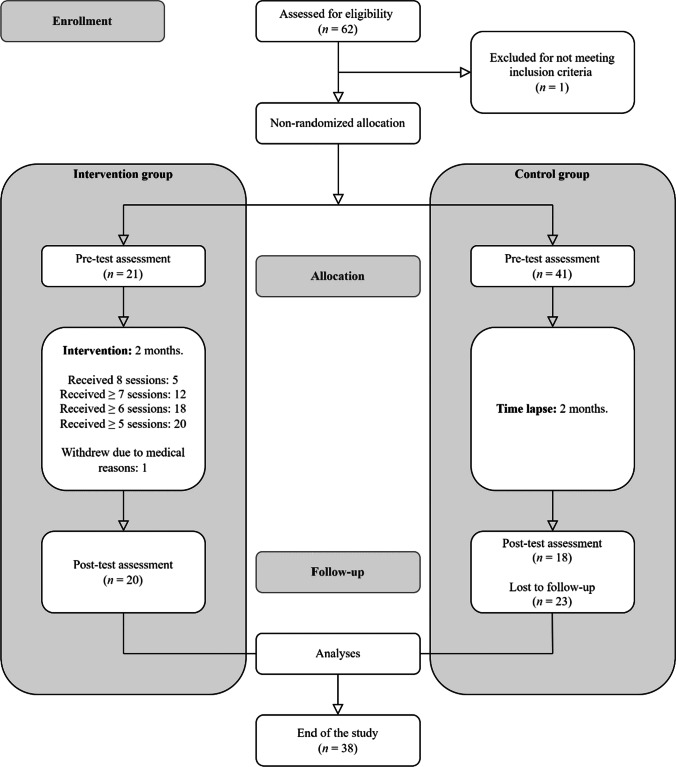
- Acceptability was high: 86% of participants attended at least 6/8 sessions (2 participants attended 5), and home practice averaged 27/42 days with 23 min/day.
- In the MBI group, pre-post improvements were reported for mindfulness (η² = 0.43), self-compassion (η² = 0.43), depression (η² = 0.54), anxiety (η² = 0.46), stress (η² = 0.51), sleep quality (η² = 0.57), and burnout (η² = 0.31–0.47); emotion regulation difficulties also decreased.
- After adjusting for pre-test scores, between-group differences favored the MBI for observing mindfulness (ηp² = 0.21), depression symptoms (ηp² = 0.23), general distress (ηp² = 0.24), and personal burnout (ηp² = 0.20).
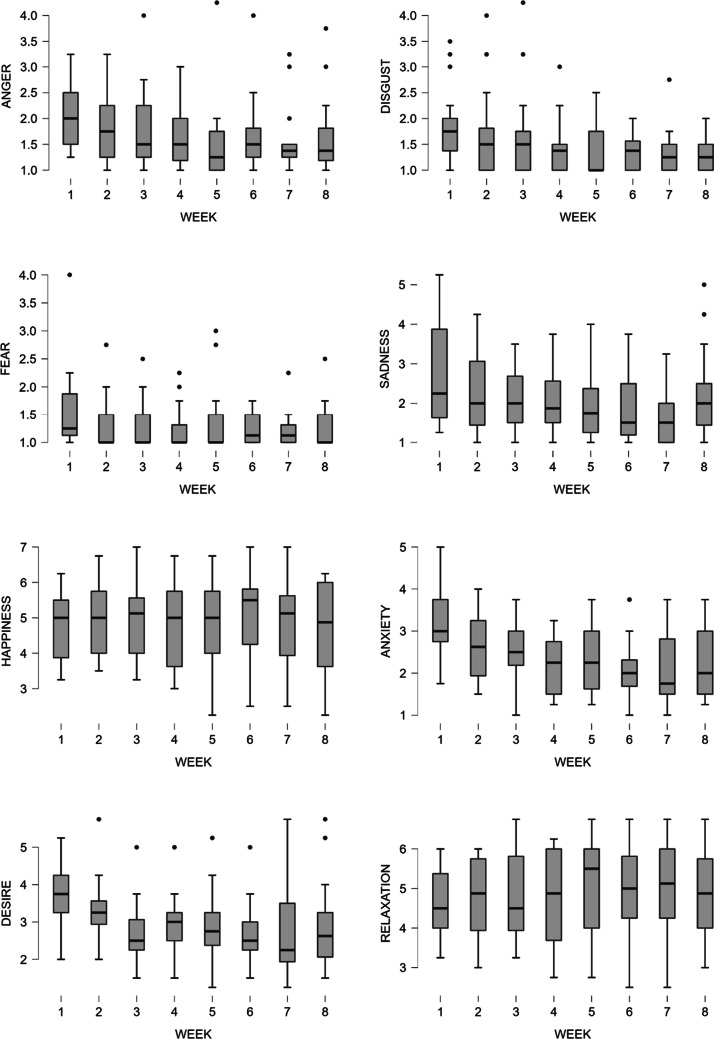
- Weekly emotion ratings in the MBI group decreased for anger, disgust, anxiety, sadness, and desire; there were main effects of week for anger (p = .005), disgust (p = .009), anxiety (p < .001), sadness (p < .001), and desire (p < .001). Frequency of suicidal ideation decreased in the MBI group but was not statistically significant (p = .031) and was not different between groups (p = .455).
Methods
- Exploratory non-randomized controlled pretest-posttest pilot study with a waiting-list control group; the intervention was an 8-week mindfulness-based intervention co-designed with a police officer and a psychologist.
- Final sample: 20 officers in the MBI group and 18 in the control group, drawn from police officers in the province of Valencia, Spain; baseline and post-training self-report measures were collected, plus weekly emotion ratings in the MBI group.
- Main analyses included paired-samples t-tests, ANCOVA adjusting for pre-test scores (and prior meditation experience as a moderator), and linear mixed-effects models for week-by-week emotion data.
Limitations
- The paper states that the sample size was small, limiting statistical power and generalizability, and that participants were not randomly assigned, so causality is not guaranteed.
- The paper states potential self-selection bias, possible COVID safety measure effects on group dynamics, lack of state emotion measurement in the control group, different assessment methods (in-person vs online), and that the study protocol was not publicly available or preregistered.
- Evident from the text: this is a pilot study with only short-term pre/post assessment and no follow-up, so long-term effects are not tested.
Model-written summary. Check it against the paper before relying on it.
Integrity signals
Registry
Cites
Statistics
Figures
Verification
Claims the paper makes
8 Valid · 0 Not valid · 10 Not checked · 29 Own results and interpretations
The cited sources support only part of this claim — read each source’s verdict below.
In the paper
“Nevertheless, they refuse to seek mental health support (Jetelina et al., 2020).”
§ Impact of Mindfulness Training on Spanish Police Officers’ Mental and Emotional Health: a Non-Randomized Pilot Study > Abstract > Conclusions
What the sources say
- Partly supportedcites Jetelina et al., 2020 matched to “Prevalence of Mental Illness and Mental Health Care Use Among Police Officers” (2020) sourceExperimental — accuracy not yet measured
The Discussion reports low use of mental health services and identifies reasons some officers did not seek them. But it also reports that 17% of officers screening positive for mental illness symptoms sought services, and the Conclusions say some officers were interested in help. The blanket statement that police officers refuse support overstates the finding. (LLM, conf=0.88)
plain- Asserted: passes — The authors put it forward as true.
- Checkable: passes — It can be checked against evidence.
- Load-bearing: passes — The paper’s conclusions depend on it.
- Based: passes — The paper gives a reason why it holds.
- Partly supported
The cited sources support only part of this claim — read each source’s verdict below.
In the paper
“For instance, reduced decision making, low social support at work, and low rewards are risk factors of depression, anxiety, and burnout for police officers (Chan & Andersen, 2020; Sherwood et al., 2019).”
§ Impact of Mindfulness Training on Spanish Police Officers’ Mental and Emotional Health: a Non-Randomized Pilot Study > Abstract > Conclusions
What the sources say
- Not checked — no full text of the sourcecites Chan & Andersen, 2020 matched to “Influence of organizational stress on reported depressive symptoms among police” (2020) source
- Partly supportedcites Sherwood et al., 2019 matched to “Identifying the key risk factors for adverse psychological outcomes among police officers: A systematic literature review” (2019) sourceExperimental — accuracy not yet measured
The review’s Discussion links low workplace social support and low reward to adverse outcomes, including depression, anxiety, and burnout. Its risk-factor table lists reduced decision making for depression, however, and the Discussion links lower decision latitude to PTSD; it does not establish reduced decision making as a risk factor for all three outcomes named in the claim. Page numbers are unavailable in our copy. (LLM, conf=0.87)
plainstates a cause- Asserted: passes — The authors put it forward as true.
- Checkable: passes — It can be checked against evidence.
- Load-bearing: unclear — It is unclear whether the paper’s conclusions depend on it.
- Based: passes — The paper gives a reason why it holds.
A result the paper reports from its own data — it cites no other source for it, so there is none to check. The quote shows it is in the paper.
In the paper
“High acceptance and attendance rates, as well as significant pre-post within-group differences in the MBI group in mindfulness (η2 = 0.43), self-compassion (η2 = 0.43), depression (η2 = 0.54), anxiety (η2 = 0.46), stress (η2 = 0.51), difficulties in emotion regulation, sleep quality (η2 = 0.57), and burnout (η2 = 0.31–0.47), were identified.”
§ Impact of Mindfulness Training on Spanish Police Officers’ Mental and Emotional Health: a Non-Randomized Pilot Study > Abstract > Results
plain- Asserted: passes — The authors put it forward as true.
- Checkable: passes — It can be checked against evidence.
- Load-bearing: passes — The paper’s conclusions depend on it.
- Based: passes — The paper gives a reason why it holds.
A result the paper reports from its own data — it cites no other source for it, so there is none to check. The quote shows it is in the paper.
In the paper
“High acceptance and attendance rates, as well as significant pre-post within-group differences in the MBI group in mindfulness (η2 = 0.43), self-compassion (η2 = 0.43), depression (η2 = 0.54), anxiety (η2 = 0.46), stress (η2 = 0.51), difficulties in emotion regulation, sleep quality (η2 = 0.57), and burnout (η2 = 0.31–0.47), were identified.”
§ Impact of Mindfulness Training on Spanish Police Officers’ Mental and Emotional Health: a Non-Randomized Pilot Study > Abstract > Results
plain- Asserted: passes — The authors put it forward as true.
- Checkable: passes — It can be checked against evidence.
- Load-bearing: unclear — It is unclear whether the paper’s conclusions depend on it.
- Based: passes — The paper gives a reason why it holds.
A result the paper reports from its own data — it cites no other source for it, so there is none to check. The quote shows it is in the paper.
In the paper
“High acceptance and attendance rates, as well as significant pre-post within-group differences in the MBI group in mindfulness (η2 = 0.43), self-compassion (η2 = 0.43), depression (η2 = 0.54), anxiety (η2 = 0.46), stress (η2 = 0.51), difficulties in emotion regulation, sleep quality (η2 = 0.57), and burnout (η2 = 0.31–0.47), were identified.”
§ Impact of Mindfulness Training on Spanish Police Officers’ Mental and Emotional Health: a Non-Randomized Pilot Study > Abstract > Results
plain- Asserted: passes — The authors put it forward as true.
- Checkable: passes — It can be checked against evidence.
- Load-bearing: passes — The paper’s conclusions depend on it.
- Based: passes — The paper gives a reason why it holds.
17 more claims
Create a free account to see all 47 claims and every source verdict.
- Probably not a substantial claim. 13
- It may state two separate claims as one. 20
Citations
Cites
Statistical Power Analysis for the Behavioral Sciences
Muller, K. (1989) · Technometrics · doi:10.1080/00401706.1989.10488618 · Cited by 99,167
Podsakoff, P. M., MacKenzie, S. B., Lee, J.-Y., & Podsakoff, N. P. (2003) · Journal of Applied Psychology · doi:10.1037/0021-9010.88.5.879 · Cited by 82,194 · cited 1×
“In addition, the groups were evaluated using different methods (in-person versus online assessment), which might have implied a method bias related to measurement context effects (Podsakoff et al., 2003).”
MethodStatistical Power Analysis for the Behavioral Sciences (2nd ed.).
Lachenbruch, P. A., & Cohen, J. (1989) · Journal of the American Statistical Association · doi:10.2307/2290095 · Cited by 37,395 · cited 2×
“The eta squared effect size was used, with cutoff values of 0.01, 0.06, and 0.14 for small, medium, and large effect sizes, respectively (Cohen, 1988).”
BackgroundMethodInfluentialLovibond, P. F., & Lovibond, S. H. (1995) · Behaviour Research and Therapy · doi:10.1016/0005-7967(94)00075-u · Cited by 14,523 · cited 5×
“The DASS-21 (Henry & Crawford, 2005) is the shorter version of the DASS (Lovibond & Lovibond, 1995).”
BackgroundInfluentialGratz, K. L., & Roemer, L. (2004) · Journal of Psychopathology and Behavioral Assessment · doi:10.1023/b:joba.0000007455.08539.94 · Cited by 8,942 · cited 1×
“Difficulties in Emotion Regulation Scale‑Short Form (DERS‑SF) The DERS-SF (Kaufman et al., 2016) is the 18-item version of the DERS (Gratz & Roemer, 2004) consisting of six subscales measuring limited access to emotion regulation strategies (3 items; e.g., “When I’m upset, I believe there is…”
MethodUsing Self-Report Assessment Methods to Explore Facets of Mindfulness
Baer, R. A., Smith, G. T., Hopkins, J., Krietemeyer, J., & Toney, L. (2006) · Assessment · doi:10.1177/1073191105283504 · Cited by 7,511 · cited 3×
“Five Facets of Mindfulness Questionnaire‑Short Form (FFMQ‑SF) Bohlmeijer et al.”
BackgroundInfluential(2008) · Medical Entomology and Zoology · Cited by 7,477
Emotion-regulation strategies across psychopathology: A meta-analytic review
Aldao, A., Nolen-Hoeksema, S., & Schweizer, S. (2010) · Clinical Psychology Review · doi:10.1016/j.cpr.2009.11.004 · Cited by 6,686
Ecological momentary assessment
Shiffman, S., Stone, A. A., & Hufford, M. R. (2008) · Annual Review of Clinical Psychology · doi:10.1146/annurev.clinpsy.3.022806.091415 · Cited by 6,454
Henry, J. D., & Crawford, J. R. (2005) · British Journal of Clinical Psychology · doi:10.1348/014466505x29657 · Cited by 5,801 · cited 5×
“The DASS-21 (Henry & Crawford, 2005) is the shorter version of the DASS (Lovibond & Lovibond, 1995).”
BackgroundInfluential
Research works printed but not linked: 1
- DeVellis, R. F. (2016). Scale development: Theory and applications (Vol. 26). Sage publications.
Cited by
Serrat, M., Albajes, K., Navarrete, J., Almirall, M., Girbés, E. L., Neblett, R., Luciano, J. V., Queraltó, J. M., & Feliu‐Soler, A. (2022) · Behaviour Research and Therapy · doi:10.1016/j.brat.2022.104188 · Cited by 53
Self-citationResilience Training Programs with Police Forces: A Systematic Review
Moreno, A. F., Karanika‐Murray, M., Batista, P., Hill, R., Vilalta, S. R., & Oliveira‐Silva, P. (2024) · Journal of Police and Criminal Psychology · doi:10.1007/s11896-023-09633-y · Cited by 74
“MBRT programs have shown significant results among officers and outcomes specific to stress, depression, anxiety, burnout, and alcohol consumption (Grupe et al. 2021a; Khatib et al. 2022; Navarrete et al. 2022; Rehder et al. 2021; Trombka et al. 2021).”
BackgroundVadvilavičius, T., Varnagirytė, E., Jarašiūnaitė–Fedosejeva, G., & Gustainienė, L. (2023) · Journal of Police and Criminal Psychology · doi:10.1007/s11896-022-09570-2 · Cited by 50
Withrow, A., Russell, K. N., & Gillani, B. (2023) · The Police Journal Theory Practice and Principles · doi:10.1177/0032258x231156710 · Cited by 17
“…and social media (Christopher et al., 2018; Grupe et al., 2021; Navarrete et al., 2022; Trombka et al., 2021), posters or fl yers (Christopher et al., 2018; Grupe et al., 2021; Navarrete et al., 2022; Trombka et al., 2021), and in person announcements (Christopher et al., 2018; Grupe et al., 2021).”
BackgroundMethodInfluentialEffectiveness of psychological skills training for police personnel: a meta-analysis
Lu, Y.-F., & Petersen, K. (2023) · Occupational and Environmental Medicine · doi:10.1136/oemed-2023-109117 · Cited by 35
Christopher, M., Bowen, S. W., Witkiewitz, K. A., Grupe, D. W., Goerling, R. J., Hunsinger, M., Oken, B., Korecki, J. R., & Rosenbaum, N. A. (2024) · BMC Complementary Medicine and Therapies · doi:10.1186/s12906-024-04452-y · Cited by 19
Navarrete, J., Fontana-McNally, M., Colomer‐Carbonell, A., Sanabria‐Mazo, J. P., Pinazo, D., Silvestre-López, A.-J., Lau, M. A., Tanay, G., García‐Campayo, J., Demarzo, M., et al. (2023) · Frontiers in Psychology · doi:10.3389/fpsyg.2023.1212036 · Cited by 14
“As repeated measures of key state variables during MBIs contribute to a better understanding of the trajectory of mindfulness training (Navarrete et al., 2022), the need for researchers and clinicians to have access to reliable measures is growing.”
BackgroundSelf-citationPolice Resilience as a Multilevel Balance: Needs and Resources for Victim Support Officers
Ruiz, I. E. D., Rué, A., & Jubany, O. (2022) · Police Quarterly · doi:10.1177/10986111221111322 · Cited by 9
“…and offenders (Losung et al., 2021; Schaible & Gecas, 2010), risk assessment and on-the-spot decisions in tension- and violence-laden situations (Foley & Massey, 2021; Navarrete et al., 2022), and feelings of unsafety and of lack of control may be easily linked to burnout and compassion fatigue.”
Backgroundvan der Schans, K. L., Holland, R. W., Damme, J. V., de Snoo, T.-P., & Karremans, J. C. (2024) · International Journal of Applied Positive Psychology · doi:10.1007/s41042-024-00175-0 · Cited by 6
“Previous research shows that mind-fulness training may help police employees deal with work stress (Christopher et al., 2018; Hoeve et al., 2021; Krick & Felfe, 2020; Márquez et al., 2021; Navarrete et al., 2022).”
InfluentialGaskin, J., Li, W. W., van Eijk, L., & Sarnyai, Z. (2025) · Police Practice and Research · doi:10.1080/15614263.2025.2506647 · Cited by 11
“…a low-dose MBSR protocol (Krick & Felfe, 2020; Márquez et al., 2021), and the remaining delivered other MBI variants (Christopher et al., 2024; Grupe, McGehee, et al., 2021; Grupe, Stoller, et al., 2021; Hoeve et al., 2021; Khatib et al., 2022; Navarrete et al., 2022; Trombka et al., 2021).”
InfluentialDrawing a line: boundary work in victim support police work
Ruiz, I. E. D., Rué, A., & Jubany, O. (2023) · Policing & Society · doi:10.1080/10439463.2023.2213803 · Cited by 4
“This form of policing may seem rather innocuous as compared to high-stakes patrolling, but it may trigger long-lasting negative effects on a police officer’s psychological wellbeing (Foley and Massey 2021, Navarrete et al. 2022).”
BackgroundChristopher, M., Bowen, S. W., Witkiewitz, K. A., et al. (2023) · doi:10.31234/osf.io/wm6ch · Cited by 3
Frequency of suicidal ideation inventory: A reliability generalization meta-analysis
Hidalgo-Fuentes, S., Caro‐Cañizares, I., & Izquierdo-Sotorrío, E. (2024) · Death Studies · doi:10.1080/07481187.2024.2390904 · Cited by 3
A pilot study on the efficacy of an online mindfulness intervention for Canadian police officers
Fleischmann, M. H., Boudreau, A., Vincent, M., Charman, M., Collie, E., Johnston, R., & Khoury, B. (2024) · Journal of Community Safety and Well-Being · doi:10.35502/jcswb.364 · Cited by 3
Mindful Non-Judging and Posttraumatic Reactions in Police Academy Cadets: A Path Analysis
Chopko, B. A., Adams, R. E., Davis, J., Pelger, T. L., & Palmieri, P. A. (2024) · Mindfulness · doi:10.1007/s12671-024-02402-w · Cited by 3
“…symptoms, sleep problems, anger, anxiety, depression, emotion regulation difficulties, and burnout while improving variables such as positive affect, happiness, and heart rate variability (Grupe et al., 2021; Hoeve et al., 2021; Khatib et al., 2022; Krick & Felfe, 2020; Navarrete et al., 2022).”
Díaz‐Silveira, C., Burgos-Julián, F. A., Ruiz‐Íñiguez, R., de la Hera, C. M. A., & Germán, M. Á. S. (2025) · Mindfulness · doi:10.1007/s12671-025-02658-w · Cited by 1
“In this context, the non-randomized exploratory study by Navarrete et al. (2022) aimed to evaluate the acceptability and efficacy of an 8-week mindfulness-based intervention (MBI) for police officers in Spain.”
Sullins, V. F., Gonzales, P. A., Malotte, M., & Lebares, C. C. (2025) · Otolaryngologic Clinics of North America · doi:10.1016/j.otc.2025.08.004 · Cited by 1
Morley, R. H., Fulton, C. L., Bowman, S. W., & Trujillo, L. T. (2023) · Journal of Police and Criminal Psychology · doi:10.1007/s11896-023-09612-3 · Cited by 3
Lanchares, S. G., Garrido‐Hernansaiz, H., Guerra, N. B., & Rodríguez‐Rey, R. (2024) · Journal of Occupational and Environmental Medicine · doi:10.1097/jom.0000000000003104 · Cited by 1
“55 Another example involves an online positive psychology intervention with Greek police officers, also aimed at mitigating the impact of the COVID-19 pandemic, where participants reported increases in empathy, resilience, and positive emotions, and decreases negative emotions, loneliness, anxiety,…”
BackgroundMindfulness for the Mental Resilience of Police Officers: A systematic Review and Meta-AnalysisPreprint
Reitsema, M., de Hoog, N., & de Snoo, T.-P. (2023) · PsyArXiv (OSF Preprints) · doi:10.31234/osf.io/69k75 · Cited by 2
INTERVENÇÕES EM PROMOÇÃO E PREVENÇÃO EM SAÚDE MENTAL ENTRE PROFISSIONAIS DE SEGURANÇA PÚBLICA
da Costa, L. F., Madalozzo, M. M., Cioato, A. C., & Horn, É. L. D. V. (2025) · Revista Brasileira de Segurança Pública · doi:10.31060/rbsp.2025.v19.n2.2163 · Cited by 4
Mansor, M. B., Chong, M.-C., LEI, C. P., Hamdan, M., Roslim, N. A., & Isa, R. M. (2026) · Journal of Reproductive and Infant Psychology · doi:10.1080/02646838.2026.2622923 · Cited by 3
Exploring psychological symptom associations among people living with HIV using an apriori algorithm
Hu, J., Zhou, J., Han, S., Li, Y., Xie, X., Wu, D., Wang, X., Guo, H., & Zhang, L. (2026) · BMC Infectious Diseases · doi:10.1186/s12879-026-12807-8 · Cited by 2
“For example, If PLWH experience sadness, strategies such as mind-fulness training, acceptance and commitment therapy (ACT), and internet-based cognitive behavioral therapy (iCBT) can be adopted [46–48].”
Non-pharmacological mental health interventions for law enforcement officers: A systematic review
Delgado, H. N., & Wu, Y. (2026) · Archives of Psychiatric Nursing · doi:10.1016/j.apnu.2026.152098 · Cited by 1
A review of interventions for distressed public safety personnel not engaged in formal services
Palachi, A., Habib, M., & Ellis, J. (2026) · FACETS · doi:10.1139/facets-2025-0218
Feasibility of Mindfulness Training for Police Officers at the Spanish National Police Academy
Navarrete, J., García-Salvador, M. Á., Rodríguez‐Freire, C., Feliu‐Soler, A., & Luciano, J. V. (2026) · Journal of Police and Criminal Psychology · doi:10.1007/s11896-026-09818-1
Self-citationHoeve, M., van Rooij, F. B., Bögels, S. M., & de Bruin, E. I. (2026) · Journal of Police and Criminal Psychology · doi:10.1007/s11896-026-09860-z
Between the uniform and the toll: burnout and mental health among Brazilian Military Police
Evangelista, C. S., Furtado, K. F., da Rosa, V. S., Viana, A. C. W., Borges, E. M. D. N., & Paz, A. A. (2026) · Revista Brasileira de Enfermagem · doi:10.1590/0034-7167-2025-0429 · Cited by 1
Entre a farda e o desgaste: estudo sobre burnout e saúde mental na polícia brasileira
Evangelista, C. S., Furtado, K. F., da Rosa, V. S., Viana, A. C. W., Borges, E. M. D. N., & Paz, A. A. (2026) · Revista Brasileira de Enfermagem · doi:10.1590/0034-7167-2025-0429pt
Metadata
- Authors
- Navarrete, J., García-Salvador, M. Á., Cebolla, A., & Baños, R.
- Affiliations
- Universitat de València (ES)
- Corresponding author
- Navarrete, Jaime
- Venue
- Mindfulness
- Published
- 2022-01-14
- Volume
- 13
- Issue
- 3
- Pages
- 695-711
- ISSN
- 1868-8527 (ISSN-L)
- 1868-8535
- PMC
- PMC8758924
- OpenAlex
- W4206247024
- Cited by
- 29
- References
- 85
- Citations by year
- 2026: 9 · 2025: 4 · 2024: 7 · 2023: 7 · 2022: 2
- FWCI
- 4.56
- Type
- journal article
- Language
- en
- Open access
- hybrid
- doi.org
- Licence
- cc-by
- creativecommons.org/licenses/by/4.0 (tdm)
- creativecommons.org/licenses/by/4.0 (vor)
- Locations
- Mindfulness (publishedVersion, cc-by)
- PubMed Central (publishedVersion, cc-by)
- PubMed (publishedVersion)
- Funders
- Universitat de Valencia
- Topics
- Social Sciences › Psychology › Clinical Psychology › Mindfulness and Compassion Interventions
- Social Sciences › Psychology › Social Psychology › Stress and Burnout Research
- Social Sciences › Psychology › Social Psychology › Psychological Well-being and Life Satisfaction
- Keywords
- mindfulness-based interventions, police officers, occupational stress, burnout, self-compassion, depression, anxiety, emotion regulation, sleep quality, co-designed intervention, emotional well-being, quality of life
About these checks
Registry, retraction, Cites and statistics results are computed, not judged, with one exception: a printed reference that no index lists is read once by a model before it counts as a citation error. Claims are extracted by a model and kept only when their quote appears verbatim in the text; each cited source is then checked, with a model’s help, for whether it says what the claim relies on. Those verdicts can be wrong — read the claim’s quote and the cited source before relying on one.
The claim verdicts this report counts are experimental: their accuracy is not yet measured.
A language model drew the claims from the paper on 2026-10-11, under version 3 of the claim definition (model deepseek-v4.1-flash, prompt extract-v3).
A second model labelled each claim on 2026-10-11 (model jev-1.13-20260917, definition revision gold-guideline-v0.2).
Cited sources are checked with a language model’s help (gpt-6-sol).
Statistics and arithmetic are recomputed, not judged.
Confidence bands are shown only for fields calibrated on our annotated test set. None is calibrated yet, so no band is shown.
What counts as a claim ›How we measure confidence ›How we check this ›
Are you an author, or do you see a problem with this page? Request a review
Data sources
Bibliographic data: Semantic Scholar, OpenAlex, Crossref.
Contains information from the Semantic Scholar Academic Graph Datasets, made available under the ODC Attribution License (ODC-BY 1.0).
Semantic Scholar’s data is described in: Kinney, R., et al. (2023). The Semantic Scholar Open Data Platform. arXiv:2301.10140.
