

The DOI matches its Crossref record; 75 of the 75 references it cites were found in a registry or an index.
Futuristic biosensors for cardiac health care: an artificial intelligence approach
Open accessAbstract
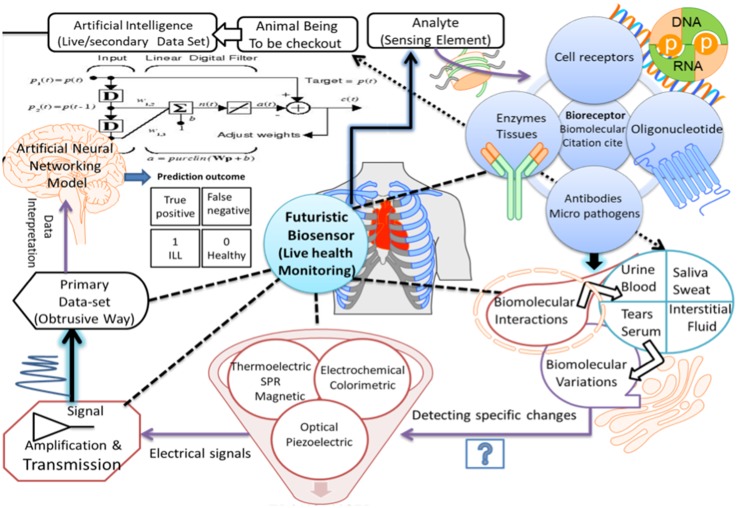
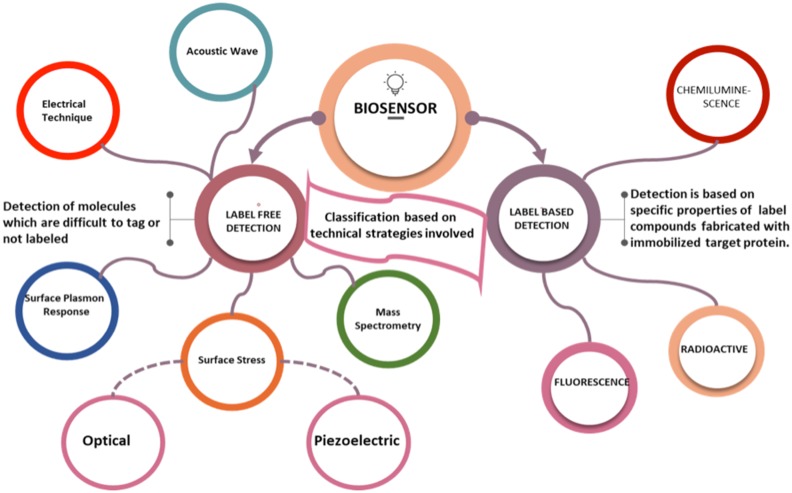
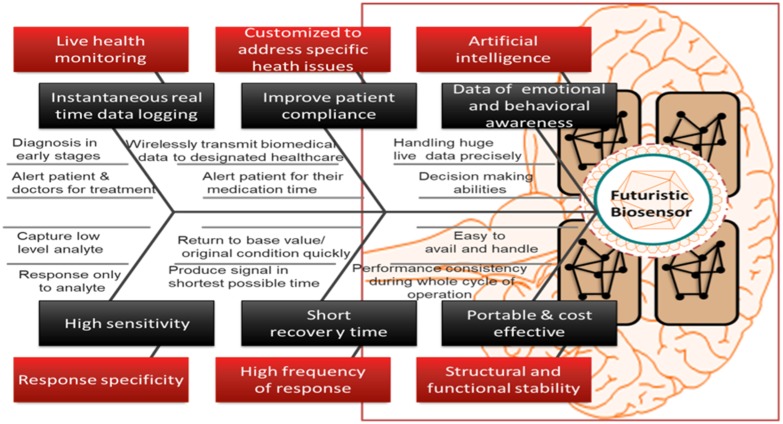
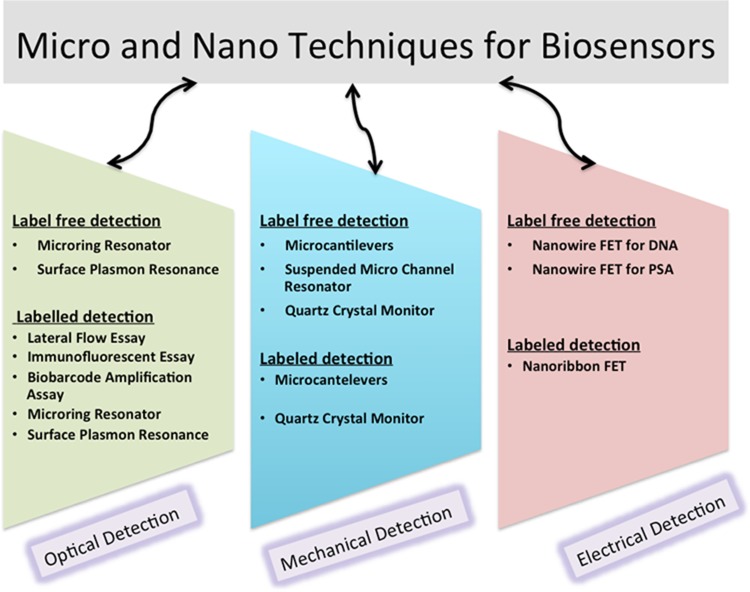
Biosensor-based devices are pioneering in the modern biomedical applications and will be the future of cardiac health care. The coupling of artificial intelligence (AI) for cardiac monitoring-based biosensors for the point of care (POC) diagnostics is prominently reviewed here. This review deciphers the most significant machine-learning algorithms for the futuristic biosensors along with the internet of things, computational techniques and microchip-based essential cardiac biomarkers for real-time health monitoring and improving patient compliance. The present review also discusses the recently developed cardiac biosensors along with technical strategies involved in their mechanism of working and their applications in healthcare. Additionally, it provides a key for the ontogeny of an effective and supportive hierarchical protocol for clinical decision-making about personalized medicine through combinatory information analysis, and integrated multidisciplinary AI approaches.
Overview
The claims and statistics of this paper haven’t been checked yet.
Run the check — free, no account needed. It reads the open-access text and checks the sources it cites.
Integrity signals
Registry
Cites
Statistics
Figures
Verification
Claims the paper makes
The claims and statistics of this paper haven’t been checked yet.
Run the check — free, no account needed. It reads the open-access text and checks the sources it cites.
Claims other papers make about this one
Each is checked against this paper’s own text: does it say what the citing paper says it does?
In the citing paper
“As the biosensors are still in the development stage in monitoring biochemical signals, the technology is yet to sense biological biomarkers continuously, and they need to achieve higher sensitivity, selectivity, and accuracy towards specific biomolecule sensing [14,17].”
From The emergence of AI-based wearable sensors for digital health technology: a review (2023) · cites this paper as [17]
In the citing paper
“DL algorithms have been proven effective in the early detection and preventing of chronic diseases, like diabetes and cardiovascular disease [17,195].”
From The emergence of AI-based wearable sensors for digital health technology: a review (2023) · cites this paper as [17]
In the citing paper
“Integration with smartphones and mobile devices enhances the accessibility of wearable ECG monitors for real-time monitoring, data storage, and cloud-based analytics, enabling seamless integration into telemedicine and remote patient monitoring systems [4,16,17].”
From The emergence of AI-based wearable sensors for digital health technology: a review (2023) · cites this paper as [17]
Self-check
Percentages, sums and reported differences re-computed from the paper’s own numbers.
The self-check needs the paper’s full text.
Citations
Cites
A Real-Time QRS Detection Algorithm
Pan, J., & Tompkins, W. J. (1985) · IEEE Transactions on Biomedical Engineering · doi:10.1109/tbme.1985.325532 · Cited by 7,855
Opportunities and obstacles for deep learning in biology and medicine
Ching, T., Himmelstein, D. S., Beaulieu-Jones, B. K., Kalinin, A. A., Do, B. T., Way, G. P., Ferrero, E., Agapow, P.-M., Zietz, M., Hoffman, M. M., et al. (2018) · Journal of The Royal Society Interface · doi:10.1098/rsif.2017.0387 · Cited by 2,310
Electrochemical biosensors: recommended definitions and classification
Thévenot, D. R., Tóth, K., Durst, R. A., & Wilson, G. S. (2001) · Biosensors and Bioelectronics · doi:10.1016/s0956-5663(01)00115-4 · Cited by 1,858
Machine learning and data mining methods in diabetes research
Kavakiotis, I., Tsave, O., Salifoglou, A., Maglaveras, N., Vlahavas, I., & Chouvarda, I. (2017) · Computational and Structural Biotechnology Journal · doi:10.1016/j.csbj.2016.12.005 · Cited by 1,445
Wearable Chemical Sensors: Present Challenges and Future Prospects
Bandodkar, A. J., Jeerapan, I., & Wang, J. (2016) · ACS Sensors · doi:10.1021/acssensors.6b00250 · Cited by 778 · cited 1×
“These days, scientists are quite interested and engaged in developing of the novel, smart and advanced devices such that more specific, sensitive and stable biosensors for theranostics purposes can be invented (Bandodkar et al. 2016).”
BackgroundEvolving support vector machines using fruit fly optimization for medical data classification
Shen, L., Chen, H., Yu, Z., Kang, W., Zhang, B., Li, H., Yang, B., & Liu, D. (2016) · Knowledge-Based Systems · doi:10.1016/j.knosys.2016.01.002 · Cited by 539
Multiplexed Point-of-Care Testing – xPOCT
Dincer, C., Bruch, R. C., Kling, A., Dittrich, P. S., & Urban, G. A. (2017) · Trends in biotechnology · doi:10.1016/j.tibtech.2017.03.013 · Cited by 508
Machine Learning and Decision Support in Critical Care
Johnson, A. E. W., Ghassemi, M. M., Nemati, S., Niehaus, K. E., Clifton, D. A., & Clifford, G. D. (2016) · Proceedings of the IEEE · doi:10.1109/jproc.2015.2501978 · Cited by 459
Biosensors for cardiac biomarkers detection: A review
Qureshi, A., Gürbüz, Y., & Niazi, J. H. (2012) · Sensors and Actuators B Chemical · doi:10.1016/j.snb.2012.05.077 · Cited by 412
Nanomaterial-based devices for point-of-care diagnostic applications
Quesada-González, D., & Merkoçi, A. (2018) · Chemical Society Reviews · doi:10.1039/c7cs00837f · Cited by 407
Cited by
Sorted by citations
Artificial Intelligence in Healthcare: Review and Prediction Case Studies
Rong, G., Mendez, A., Assi, E. B., Zhao, B., & Sawan, M. (2020) · Engineering · doi:10.1016/j.eng.2019.08.015 · Cited by 590
“With integrated AI, biosensors and related point-of-care testing (POCT) systems can diagnose cardiovascular diseases in the early stage [75].”
BackgroundThe emergence of AI-based wearable sensors for digital health technology: a review
Shajari, S., Kuruvinashetti, K., Komeili, A., & Sundararaj, U. (2023) · Sensors · doi:10.3390/s23239498 · Cited by 535
Artificial Intelligence and Personalized Medicine
Schork, N. J. (2019) · Cancer treatment and research · doi:10.1007/978-3-030-16391-4_11 · Cited by 531
“[83] In addition to exploiting greater speed and computational efficiency, AI-based health products and tools will likely incorporate greater understanding of biology in their formulations in the future.”
BackgroundArtificial intelligence: a survey on evolution, models, applications and future trends
Lu, Y. (2019) · Journal of Management Analytics · doi:10.1080/23270012.2019.1570365 · Cited by 641
Recent developments in biosensors for healthcare and biomedical applications: A review
Mohankumar, P., Ajayan, J., Mohanraj, T., & Yasodharan, R. (2020) · Measurement · doi:10.1016/j.measurement.2020.108293 · Cited by 277
Metadata
- Authors
- Vashistha, R., Dangi, A. K., Kumar, A., Chhabra, D., & Shukla, P.
- Affiliations
- Maharshi Dayanand University (IN)
- Corresponding author
- Shukla, Pratyoosh
- Venue
- 3 Biotech
- Published
- 2018-08
- Volume
- 8
- Issue
- 8
- Pages
- 358-358
- ISSN
- 2190-572X (ISSN-L)
- 2190-5738
- PMC
- PMC6081842
- OpenAlex
- W2885820762
- Cited by
- 113
- References
- 74
- Citations by year
- 2026: 6 · 2025: 15 · 2024: 18 · 2023: 17 · 2022: 19 · 2021: 12 · 2020: 18 · 2019: 8
- FWCI
- 0.77
- Type
- journal article
- Language
- en
- Open access
- hybrid
- doi.org
- Licence
- Locations
- 3 Biotech (publishedVersion, cc-by)
- Europe PMC (PubMed Central) (publishedVersion, cc-by)
- PubMed Central (publishedVersion, cc-by)
- PubMed (publishedVersion)
- Topics
- Physical Sciences › Engineering › Biomedical Engineering › Non-Invasive Vital Sign Monitoring
- Health Sciences › Medicine › Cardiology and Cardiovascular Medicine › ECG Monitoring and Analysis
- Physical Sciences › Computer Science › Information Systems › Internet of Things and AI
- Keywords
- artificial intelligence, machine learning, point-of-care testing, cardiac monitoring, Internet of Things, cardiac biomarkers, real-time health monitoring, medication adherence, personalized medicine, clinical decision-making, wearable sensors
About these checks
Registry, retraction, Cites and statistics results are computed, not judged, with one exception: a printed reference that no index lists is read once by a model before it counts as a citation error. Claims are extracted by a model and kept only when their quote appears verbatim in the text; each cited source is then checked, with a model’s help, for whether it says what the claim relies on. Those verdicts can be wrong — read the claim’s quote and the cited source before relying on one.
Statistics and arithmetic are recomputed, not judged.
Confidence bands are shown only for fields calibrated on our annotated test set. None is calibrated yet, so no band is shown.
What counts as a claim ›How we measure confidence ›How we check this ›
Are you an author, or do you see a problem with this page? Request a review
