

Designing out barriers to student access and participation in secondary school assessment
Open accessThe DOI matches its Crossref record; 58 of the 59 references it cites were found in a registry or an index; 3 of the 32 sources its claims cite were checked for support.
Abstract
In an effort to support student agency in assessment, teachers seek to provide detailed instructions and advice in associated assessment task sheets. In this paper, we analyse a sample English assessment task to consider how such assessment design practices might inadvertently create barriers to access and participation.
Overview
CoChat Summary
TL;DR
The paper analyses a Year 8 English assessment task sheet to show how detailed assessment design can create visual, procedural, and linguistic barriers that disadvantage students with ADHD and DLD. It argues for proactive accessible assessment design and offers recommendations/checklist to improve access and equity.
Key findings
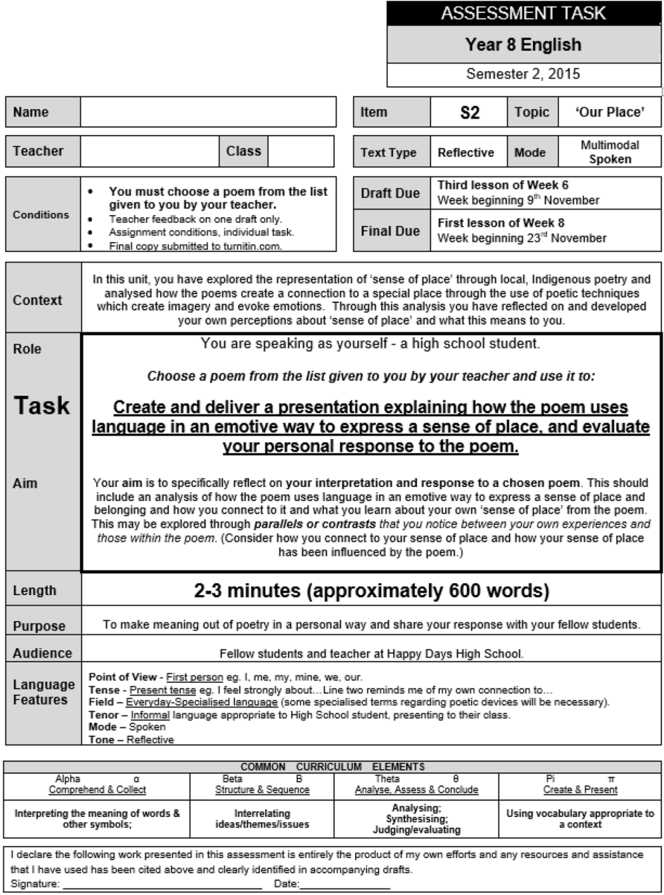
- The sample Year 8 task sheet was two pages, totalling 1,110 words, with 45 text boxes on page 1 and 25 text boxes on page 2; the analysis identifies visual complexity from inconsistent fonts, justification, and unclear salience of information.
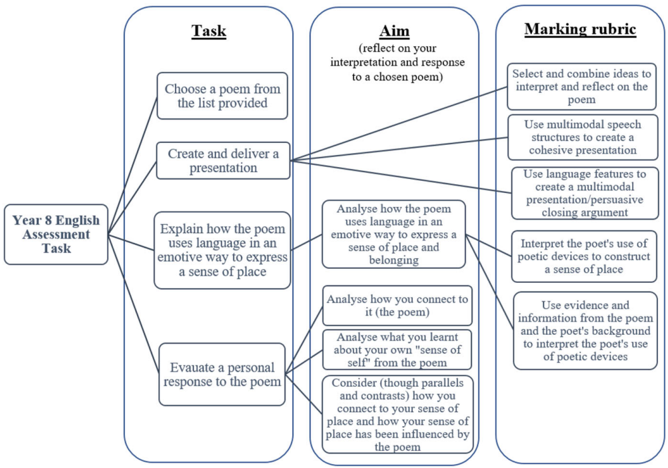
- Procedural complexity arose from conflicting information across three sections: the task statement presented four ideas, the Aim added another four elements, requiring students to complete eight elements; the 600-word speech and 2–3 minute time limit were also incompatible, since average spoken words per minute is 130, suggesting 4–5 minutes for 600 words or 250–400 words for 2–3 minutes.
- Linguistic complexity included a 40-word Context sentence with four verb phrases and five prepositional phrases, and a 42-word Aim sentence with six verb phrases and five prepositional phrases; the paper also notes low-frequency vocabulary such as “evoke” and inconsistent specialist terminology across A versus B–E rubric standards.
- The paper focuses on ADHD and DLD as highly prevalent disability groups: ADHD had an estimated prevalence of 7.4% in the second Australian Child and Adolescent Survey of Mental Health, and DLD affects at least 7% of students at school entry, translating to around two students in an average-sized classroom.
Methods
- The paper uses a conceptual equity framework from Burbules et al. (1982) distinguishing “conditions of access” from “criteria of access,” and applies it to assessment design.
- It analyses a de-identified sample Year 8 English assessment task sheet from “Happy Days High School,” with written permission from the English Head of Department, as part of a research project investigating how secondary English teachers design assessment to support student agency and equity.
- The analysis uses three layers: visual complexity, procedural complexity, and linguistic complexity; the work also involved collaborative assessment re-design with Senior English teachers from two participating schools and used a preliminary “accessibility checklist” to support teachers’ design work.
Limitations
- The paper states further research is needed to test the contribution of accessible assessment design to engagement and achievement of all students, including students with ADHD and DLD, and to determine effects on teacher assessment literacy and workload.
- The paper states it does not have space to analyse the effect of “competing logics” (Wall 2017) on the task sheet’s complexity and contradictions.
- Evident from the text: the analysis centres on a single de-identified task sheet from one school, and the paper reports no student performance or outcome data from the redesigned assessment.
Model-written summary. Check it against the paper before relying on it.
Integrity signals
Registry
Cites
Statistics
Figures

Verification
Claims the paper makes
3 Valid · 1 Not valid · 23 Not checked · 51 Own results and interpretations
The cited sources support only part of this claim — read each source’s verdict below.
In the paper
“Clinically significant DLD-that is, DLD with functional impact-is indicated by two or more composite scores on standardised language assessment that are at least 1.25 standard deviations (SD) below the mean (Tomblin et al. 1997).”
§ Designing out barriers to student access and participation in secondary school assessment > ADHD and DLD
What the sources say
- Partly supportedcites Tomblin et al. 1997 matched to “Prevalence of Specific Language Impairment in Kindergarten Children” (1997) sourceExperimental — accuracy not yet measured
The Methods section defines the study’s language-impairment cutoff as two or more of five composite scores at least 1.25 SD below the age-group mean. The paper applies this criterion to SLI in kindergarten children; it does not establish that the cutoff, by itself, indicates functional impact or clinically significant DLD generally. (LLM, conf=0.85)
plainstates an association- Asserted: passes — The authors put it forward as true.
- Checkable: passes — It can be checked against evidence.
- Load-bearing: passes — The paper’s conclusions depend on it.
- Based: passes — The paper gives a reason why it holds.
- Partly supported
A result the paper reports from its own data — it cites no other source for it, so there is none to check. The quote shows it is in the paper.
In the paper
“Importantly, participating teachers reported that students who had not previously found success were able to demonstrate their learning with new levels of confidence.”
§ Designing out barriers to student access and participation in secondary school assessment > Conclusion and recommendations
plain- Asserted: passes — The authors put it forward as true.
- Checkable: passes — It can be checked against evidence.
- Load-bearing: passes — The paper’s conclusions depend on it.
- Based: passes — The paper gives a reason why it holds.
In the paper
“In Australia, it is a federally legislated requirement for reasonable adjustment to be made to support all students with disability to access their education on the same basis as students without disability, as described in the Disability Standards for Education (Australian Government 2005).”
§ Designing out barriers to student access and participation in secondary school assessment > Educators' obligations under Australian legislation
What the sources say
- Not matchedcites Australian Government 2005
An author–year citation the paper’s reference list doesn’t settle. We don’t search these by name.
plain- Asserted: passes — The authors put it forward as true.
- Checkable: passes — It can be checked against evidence.
- Load-bearing: passes — The paper’s conclusions depend on it.
- Based: passes — The paper gives a reason why it holds.
- Not matched
A conclusion the paper draws from its own results — it cites no other source for it, so there is none to check. The quote shows it is in the paper.
In the paper
“The incompatibility of the requirements in the assessment task may negatively affect the achievement of students who attempt to present their whole speech verbally within the prescribed time limits.”
§ Designing out barriers to student access and participation in secondary school assessment > Layer 2: procedural complexity
hedgedstates a possible cause- Asserted: passes — The authors put it forward as true.
- Checkable: passes — It can be checked against evidence.
- Load-bearing: passes — The paper’s conclusions depend on it.
- Based: passes — The paper gives a reason why it holds.
In the paper
“However, there remains significant resistance to the provision of adjustments to students with cognitive or language disabilities because of enduring beliefs that these adjustments make the assessment ''easier'', advantaging students with disability in the process (Poed 2016).”
§ Designing out barriers to student access and participation in secondary school assessment > Determining relevance
What the sources say
- Not matchedcites Poed 2016
An author–year citation the paper’s reference list doesn’t settle. We don’t search these by name.
plainstates a cause- Asserted: passes — The authors put it forward as true.
- Checkable: passes — It can be checked against evidence.
- Load-bearing: passes — The paper’s conclusions depend on it.
- Based: passes — The paper gives a reason why it holds.
- Not matched
21 more claims
Create a free account to see all 78 claims and to verify the 2 references still open.
- Probably not a substantial claim. 39
- It may state two separate claims as one. 27
- The quote only partly states this claim. 1
Self-check
Percentages, sums and reported differences re-computed from the paper’s own numbers.
Each contradiction between two passages listed here was confirmed by an independent check.
Rated minor: it would not touch a result — a value no result rests on, a p-value that stays on the same side of the significance level, or a conflict that is clerical, resolved elsewhere in the paper, or outside its own findings.
In the paper
§ Designing out barriers to student access and participation in secondary school assessment > Introduction
“This capacity to evaluate options in order to make choices and have greater personal control over quality outcomes is at the heart of the definition of student agency (Bandura 2006).”
§ Designing out barriers to student access and participation in secondary school assessment > References
“5. Bandura, A. (2016). Toward a psychology of human agency. Perspectives on Psychological Science, 1(2), 164-180.”
Rated minor: it would not touch a result — a value no result rests on, a p-value that stays on the same side of the significance level, or a conflict that is clerical, resolved elsewhere in the paper, or outside its own findings.
In the paper
§ Designing out barriers to student access and participation in secondary school assessment > Educators' obligations under Australian legislation
“Within Queensland state schools, there are five eligibility categories: Intellectual Disability (ID), Speech-Language Impairment (SLI), Autism Spectrum Disorder (ASD), Physical Impairment (PI), Vision Impairment (VI) or Hearing Impairment (HI).”
§ Designing out barriers to student access and participation in secondary school assessment > Educators' obligations under Australian legislation
“five eligibility categories: Intellectual Disability (ID), Speech-Language Impairment (SLI), Autism Spectrum Disorder (ASD), Physical Impairment (PI), Vision Impairment (VI) or Hearing Impairment (HI)”
Citations
Cites
Diagnostic and Statistical Manual of Mental Disorders
American Psychiatric Association (2013) · doi:10.1176/appi.books.9780890425596 · Cited by 116,369
Diagnostic and Statistical Manual of Mental Disorders(DSM)
(2008) · Encyclopedia of Counseling · doi:10.4135/9781412963978.n182 · Cited by 10,830
Emirbayer, M., & Mische, A. (1998) · American Journal of Sociology · doi:10.1086/231294 · Cited by 6,165
Toward a Psychology of Human Agency
Bandura, A. (2006) · Perspectives on Psychological Science · doi:10.1111/j.1745-6916.2006.00011.x · Cited by 3,459
Children with Specific Language Impairment
Leonard, L. B. (2014) · doi:10.7551/mitpress/9152.001.0001 · Cited by 2,619
Discourse: studies in the cultural politics of education
Weiler, K. (2008) · Cited by 2,316
Prevalence of Specific Language Impairment in Kindergarten Children
Tomblin, J. B., Records, N. L., Buckwalter, P., Zhang, X., Smith, E., & O’Brien, M. (1997) · Journal of Speech, Language, and Hearing Research · doi:10.1044/jslhr.4006.1245 · Cited by 2,288 · cited 2×
“…for students with DLD. Clinically significant DLD—that is, DLD with functional impact—is indicated by two or more composite scores on standardised language assessment that are at Designing out barriers to student access… 109 least 1.25 standard deviations (SD) below the mean (Tomblin et al. 1997).”
BackgroundInfluentialThe Role of Assessment in a Learning Culture
Shepard, L. A. (2000) · Educational Researcher · doi:10.3102/0013189x029007004 · Cited by 2,161 · cited 1×
“Despite recent advances, the underpinning values from a century ago remain deeply embedded in most classroom assessment traditions (Shepard 2000).”
BackgroundTeaching every student in the digital age: universal design for learning
(2003) · Choice Reviews Online · doi:10.5860/choice.40-3555 · Cited by 1,528
Norbury, C. F., Gooch, D., Wray, C., Baird, G., Charman, T., Simonoff, E., Vamvakas, G., & Pickles, A. (2016) · Journal of Child Psychology and Psychiatry · doi:10.1111/jcpp.12573 · Cited by 1,088 · cited 1×
“This translates to around two students in an average sized classroom (Norbury et al. 2016).”
BackgroundBishop, D. V. M., Snowling, M. J., Thompson, P. A., Greenhalgh, T., & CATALISE consortium (2016) · PLOS ONE · doi:10.1371/journal.pone.0158753 · Cited by 831
Russell, A. E., Ford, T., Williams, R., & Russell, G. (2016) · Child Psychiatry & Human Development · doi:10.1007/s10578-015-0578-3 · Cited by 473 · cited 1×
“…be much higher if the school is in a disadvantaged community given the higher 108 L. J. Graham et al. prevalence of ADHD in low socioeconomic areas (Russell et al. 2016), or if the school streams lower-achieving students and students with disability into separate ‘support’ classes (Graham 2015b).”
BackgroundSpecifying and Promulgating Achievement Standards
Sadler, D. R. (1987) · Oxford Review of Education · doi:10.1080/0305498870130207 · Cited by 350
Key findings from the second Australian Child and Adolescent Survey of Mental Health and Wellbeing
Lawrence, D., Hafekost, J., Johnson, S. E., Saw, S., Buckingham, W. J., Sawyer, M. G., Ainley, J., & Zubrick, S. R. (2016) · Australian & New Zealand Journal of Psychiatry · doi:10.1177/0004867415617836 · Cited by 296 · cited 1×
“Of the seven mental disorders assessed by the second Australian Child and Adolescent Survey of Mental Health, ADHD was the most common with an estimated prevalence of 7.4% (Lawrence et al. 2016).”
BackgroundInfluentialA Sociocultural Perspective on Opportunity to Learn
Gee, J. P. (2008) · Assessment, Equity, and Opportunity to Learn · doi:10.1017/cbo9780511802157.006 · Cited by 212 · cited 1×
“Assessment task sheets are invitations to students to demonstrate their mastery of new understandings; however, these invitations must be evaluated in terms of the affordances they provide for different learners and whether learners can transform those affordances into action (Gee 2008).”
BackgroundChapter 10: Socio-Cultural Aspects of Assessment
GIPPS, C. (1999) · Review of Research in Education · doi:10.3102/0091732x024001355 · Cited by 208
Contextualising Authentic Assessment
JOY CUMMING, J., & MAXWELL, G. S. (1999) · Assessment in Education: Principles, Policy & Practice · doi:10.1080/09695949992865 · Cited by 197 · cited 2×
“This is what is meant by the first- and second-order purposes of assessment and this is a useful distinction to apply when considering relevance because the first-order purposes of an assessment task that relate to the core concepts being assessed can easily be overwhelmed by second-order priorities (Cumming and Maxwe…”
BackgroundDuPaul, G. J., & Weyandt, L. L. (2006) · International Journal of Disability, Development and Education · doi:10.1080/10349120600716141 · Cited by 175
Assessment, Equity, and Opportunity to Learn
(2008) · Cambridge University Press eBooks · doi:10.1017/cbo9780511802157 · Cited by 167
Graham, L. J., & Jahnukainen, M. (2011) · Journal of Education Policy · doi:10.1080/02680939.2010.493230 · Cited by 161
Self-citationOhan, J. L., Cormier, N., Hepp, S. L., Visser, T. A. W., & Strain, M. C. (2008) · School Psychology Quarterly · doi:10.1037/1045-3830.23.3.436 · Cited by 152 · cited 1×
“Teachers with 30 students are likely to encounter at least two students with ADHD in their class (Ohan et al. 2008).”
BackgroundDoes neurocognitive functioning predict future or persistence of ADHD? A systematic review
van Lieshout, M., Luman, M., Buitelaar, J., Rommelse, N. N. J., & Oosterlaan, J. (2013) · Clinical Psychology Review · doi:10.1016/j.cpr.2013.02.003 · Cited by 133
Assessment, Equity, and Opportunity to Learn
Pullin, D. C. (2008) · Cambridge University Press eBooks · doi:10.1017/cbo9780511802157.014 · Cited by 123
Torrance, H. (2017) · Discourse: Studies in the Cultural Politics of Education · doi:10.1080/01596306.2015.1104854 · Cited by 99
ASSESSMENT, EQUITY, AND OPPORTUNITY TO LEARN
Moss, P., Pullin, D. C., Gee, J. P., et al. (2008) · Cambridge University Press eBooks · doi:10.1017/cbo9780511802157.002 · Cited by 75
Sociocultural Implications for Assessment I
Moss, P. (2008) · Cambridge University Press eBooks · doi:10.1017/cbo9780511802157.011 · Cited by 72
Self-assessment as a process for inclusion
Bourke, R., & Mentis, M. (2011) · International Journal of Inclusive Education · doi:10.1080/13603116.2011.602288 · Cited by 71
What counts as a reasonable adjustment? Dyslexic students and the concept of fair assessment
Riddell, S., & Weedon, E. (2006) · International Studies in Sociology of Education · doi:10.1080/19620210600804301 · Cited by 69
From complexity to category: Responding to diagnostic uncertainties of autistic spectrum disorders
Skellern, C., Schluter, P., & McDowell, M. (2005) · Journal of Paediatrics and Child Health · doi:10.1111/j.1440-1754.2005.00634.x · Cited by 59 · cited 1×
“…funding to diagnoses is known to drive diagnosis in eligible categories and to encourage substitution of diagnoses from unfunded to funded categories, e.g. substituting a diagnosis of Attention Deficit Hyperactivity Disorder with Autism Spectrum Disorder (Graham 2015a; Skellern et al. 2005).”
BackgroundProsser, B. J. (2008) · International Journal of Inclusive Education · doi:10.1080/13603110701683147 · Cited by 54
Thurlow, M. L., & Kopriva, R. (2015) · Review of Research in Education · doi:10.3102/0091732x14556076 · Cited by 50
Teacher Attitudes Towards Students Who Exhibit ADHD-Type Behaviours
Mulholland, S. M., Cumming, T. M., & Jung, J. Y. (2015) · Australasian Journal of Special Education · doi:10.1017/jse.2014.18 · Cited by 50 · cited 10×
“The Standards are informed by the understanding that disability is socially mediated by barriers to access and 1 Other contributing factors are the knowledge and attitudes of teachers towards students with certain disabilities, especially ADHD and DLD (Mulholland et al. 2015; Marshall et al. 2002), and the perceived t…”
BackgroundInfluentialKlenowski, V. (2014) · The Australian Educational Researcher · doi:10.1007/s13384-013-0132-x · Cited by 46 · cited 1×
“Recommendations for designing accessible assessment therefore need to consider not only accessible design elements, but also the experiences of learners, which is central to the definition of fair assessment (Klenowski 2014).”
BackgroundEquity, Equal Opportunity, and Education
Burbules, N. C., Lord, B. T., & Sherman, A. L. (1982) · Educational Evaluation and Policy Analysis · doi:10.3102/01623737004002169 · Cited by 33 · cited 5×
“Agency and equity depend on access When considering the concept of equal educational opportunity almost four decades ago, Burbules et al. (1982) drew on Aristotelean principles of equity and fairness to re-define equal educational opportunity as ‘‘access’’, which they then split into two domains.”
BackgroundInfluentialEquity, Equal Opportunity, and Education
Burbules, N. C., Lord, B. T., & Sherman, A. L. (1982) · Educational Evaluation and Policy Analysis · doi:10.2307/1164011 · Cited by 33
Engaging Learner Diversity through Learning by Design
van Haren, R. (2010) · E-Learning and Digital Media · doi:10.2304/elea.2010.7.3.258 · Cited by 32
Graham, L. J. (2015) · International Journal of Disability, Development and Education · doi:10.1080/1034912x.2014.955791 · Cited by 28 · cited 10×
“A related misconception is that all adjustments require individually targeted funding and a teacher’s aide or other staff to provide them (Graham 2015a).”
BackgroundMethodInfluentialSelf-citationReconceptualising inclusion as participation: Neoliberal buck-passing or strategic by-passing?
Graham, L. J. (2015) · Discourse Studies in the Cultural Politics of Education · doi:10.1080/01596306.2015.1073021 · Cited by 25
Self-citationReasonable Adjustments in Assessment: Putting Law and Policy into Practice in Australia
Cumming, J., Dickson, E., & Webster, A. (2013) · International Journal of Disability, Development and Education · doi:10.1080/1034912x.2013.846467 · Cited by 25 · cited 3×
“While many teachers adjust classroom teaching to support students who experience difficulties in learning, including those with ADHD and DLD, adjustments are less common when it comes to assessment, especially in the secondary years of school (Cumming et al. 2013).”
BackgroundInfluentialMarshall, J., Stojanovik, V., & Ralph, S. (2002) · International Journal of Language & Communication Disorders · doi:10.1080/1368282021000008892 · Cited by 20 · cited 12×
“The Standards are informed by the understanding that disability is socially mediated by barriers to access and 1 Other contributing factors are the knowledge and attitudes of teachers towards students with certain disabilities, especially ADHD and DLD (Mulholland et al. 2015; Marshall et al. 2002), and the perceived t…”
BackgroundInfluentialEngaging Learner Diversity through Learning by Design
van Haren, R. (2015) · Palgrave Macmillan UK eBooks · doi:10.1057/9781137539724_15 · Cited by 19
Special Education Funding Reform: A Review of Impact Studies
Sigafoos, J., Moore, D. W., Brown, D., Green, V. A., O’Reilly, M. F., & Lancioni, G. E. (2010) · Australasian Journal of Special Education · doi:10.1375/ajse.34.1.17 · Cited by 18
ADHD: The Untold Truths of the ADEP (Australian Deficit in Educational Policy)
Mulholland, S. M. (2017) · International Journal of Disability, Development and Education · doi:10.1080/1034912x.2016.1164835 · Cited by 10
The Testing and Learning Revolution: The Future of Assessment in Education
(2015) · Cited by 10
Guidelines for Assessment Quality and Equity
(1995) · Cited by 8
‘Schoolwork’ and ‘Teachers’: Disaffected Boys Talk About Their Problems with School
Graham, L. J. (2016) · Springer eBooks · doi:10.1007/978-981-10-0628-9_8 · Cited by 7
Self-citationDickson, E. A. (2011) · QUT ePrints (Queensland University of Technology) · Cited by 4
A contemporary review of the assessment, diagnosis and treatment of ADHD
Wright, C., Shelton, D., & Wright, M. (2009) · Australian Journal of Learning Difficulties · doi:10.1080/19404150903264336 · Cited by 4
The way schools cope with learning difficulties is doing more harm than good
(2015) · doi:10.64628/aa.t5ftnmxg6 · Cited by 2
Self-citationAutism’s hidden older brother – Specific Language Impairment
(2012) · doi:10.64628/aa.97ksnhwv4 · Cited by 2
(2003) · doi:10.1044/0161-1461(2003/024
Identifying Children with Specific Language Impairment
Leonard, L. B. (2013) · the Clinical Research Education Library · doi:10.1044/cred-dsa-bts-001
Bishop, D. V., Snowling, M. J., Thompson, P. A., et al. (2016) · doi:10.7287/peerj.preprints.1986v1
Explainer: what is differentiation and why is it poorly understood?
Graham, L., & Cologon, K. (2016) · doi:10.64628/aa.t7nuaywvw
Self-citation
Research works printed but not linked: 3
- 9. Capp, M. (2016). Is your planning inclusive? Australian Educational Leader, 38(4), 44-46.
- 12. Department of Education and Training. (2015). Education Adjustment Program (EAP) Handbook. Brisbane, Australia: Department of Education and Training.
- 32. Nippold, M. A. (2016). Later language development: The school-age and adolescent years (4th ed.). Austin, TX: Pro-Ed.
Cited by
Graham, L. J., de Bruin, K., Lassig, C. J., & Spandagou, I. (2020) · Review of Education · doi:10.1002/rev3.3238 · Cited by 146
Self-citationDiverse perspectives on student agency in classroom assessment
Adie, L. E., Willis, J., & der Kleij, F. M. V. (2018) · The Australian Educational Researcher · doi:10.1007/s13384-018-0262-2 · Cited by 127
Self-citationGibbs, K., & McKay, L. (2021) · International Journal of Educational Research · doi:10.1016/j.ijer.2021.101799 · Cited by 92
Towards inclusive education: a necessary process of transformation
Cologon, K. (2019) · Cited by 41
Wyatt‐Smith, C., & Adie, L. E. (2019) · Journal of Curriculum Studies · doi:10.1080/00220272.2019.1624831 · Cited by 53
Metadata
- Authors
- Graham, L. J., Tancredi, H., Willis, J., & McGraw, K.
- Affiliations
- Queensland University of Technology (AU)
- Corresponding author
- Graham, Linda J.
- Venue
- The Australian Educational Researcher
- Published
- 2018-02-14
- Volume
- 45
- Issue
- 1
- Pages
- 103-124
- ISSN
- 0311-6999 (ISSN-L)
- 2210-5328
- OpenAlex
- W2785430130
- Semantic Scholar
- b9f53f661ce8c1ebbb37305e8e0eb71617e7246d
- Cited by
- 47
- References
- 56
- Citations by year
- 2026: 2 · 2025: 11 · 2024: 7 · 2023: 7 · 2022: 5 · 2021: 5 · 2020: 3 · 2019: 5 · 2018: 2
- FWCI
- 12.16
- Type
- journal article
- Language
- en
- Open access
- hybrid
- doi.org
- Licence
- cc-by
- creativecommons.org/licenses/by/4.0 (tdm)
- Locations
- The Australian Educational Researcher (publishedVersion, cc-by)
- QUT ePrints (Queensland University of Technology) (submittedVersion, cc-by)
- QUT ePrints (Queensland University of Technology) (submittedVersion)
- Funders
- Queensland Government Education Horizon
- Topics
- Social Sciences › Education › Student Assessment and Feedback
- Social Sciences › Psychology › Developmental and Educational Psychology › Educational and Psychological Assessments
- Social Sciences › Education › Educational Assessment and Pedagogy
- Keywords
- assessment design, student agency, access barriers, student participation, secondary school assessment, English language assessment, attention deficit hyperactivity disorder, specific language impairment, disability, educational equity
About these checks
Registry, retraction, Cites and statistics results are computed, not judged, with one exception: a printed reference that no index lists is read once by a model before it counts as a citation error. Claims are extracted by a model and kept only when their quote appears verbatim in the text; each cited source is then checked, with a model’s help, for whether it says what the claim relies on. Those verdicts can be wrong — read the claim’s quote and the cited source before relying on one.
The claim verdicts this report counts are experimental: their accuracy is not yet measured.
A language model drew the claims from the paper on 2026-10-10, under version 3 of the claim definition (model deepseek-v4.1-flash, prompt extract-v3).
A second model labelled each claim on 2026-10-10 (model jev-1.13-20260917, definition revision gold-guideline-v0.2).
Cited sources are checked with a language model’s help (gpt-6-sol).
Statistics and arithmetic are recomputed, not judged.
Confidence bands are shown only for fields calibrated on our annotated test set. None is calibrated yet, so no band is shown.
What counts as a claim ›How we measure confidence ›How we check this ›
Are you an author, or do you see a problem with this page? Request a review
Data sources
Bibliographic data: Semantic Scholar, OpenAlex, Crossref.
Contains information from the Semantic Scholar Academic Graph Datasets, made available under the ODC Attribution License (ODC-BY 1.0).
Semantic Scholar’s data is described in: Kinney, R., et al. (2023). The Semantic Scholar Open Data Platform. arXiv:2301.10140.
