

CATALISE: A Multinational and Multidisciplinary Delphi Consensus Study. Identifying Language Impairments in Children
Open accessThe DOI matches its Crossref record; 127 of the 129 references it cites were found in a registry or an index.
Abstract
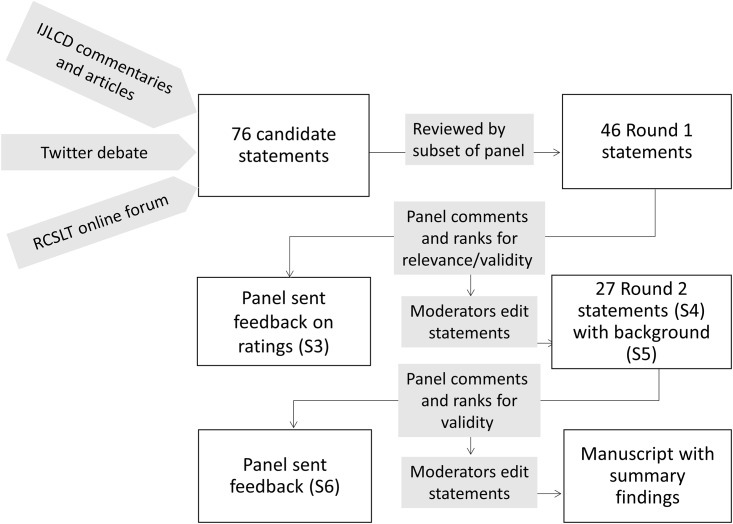
Delayed or impaired language development is a common developmental concern, yet there is little agreement about the criteria used to identify and classify language impairments in children. Children's language difficulties are at the interface between education, medicine and the allied professions, who may all adopt different approaches to conceptualising them. Our goal in this study was to use an online Delphi technique to see whether it was possible to achieve consensus among professionals on appropriate criteria for identifying children who might benefit from specialist services. We recruited a panel of 59 experts representing ten disciplines (including education, psychology, speech-language therapy/pathology, paediatrics and child psychiatry) from English-speaking countries (Australia, Canada, Ireland, New Zealand, United Kingdom and USA). The starting point for round 1 was a set of 46 statements based on articles and commentaries in a special issue of a journal focusing on this topic. Panel members rated each statement for both relevance and validity on a seven-point scale, and added free text comments. These responses were synthesised by the first two authors, who then removed, combined or modified items with a view to improving consensus. The resulting set of statements was returned to the panel for a second evaluation (round 2). Consensus (percentage reporting 'agree' or 'strongly agree') was at least 80 percent for 24 of 27 round 2 statements, though many respondents qualified their response with written comments. These were again synthesised by the first two authors. The resulting consensus statement is reported here, with additional summary of relevant evidence, and a concluding commentary on residual disagreements and gaps in the evidence base.
Overview
The claims and statistics of this paper haven’t been checked yet.
Free: it reads the open-access text and checks the first 5 claims that cite a source we can check. Create a free account to check every claim.
Integrity signals
Registry
Cites
Statistics
Figures
Verification
Claims the paper makes
The claims and statistics of this paper haven’t been checked yet.
Free: it reads the open-access text and checks the first 5 claims that cite a source we can check. Create a free account to check every claim.
Self-check
Percentages, sums and reported differences re-computed from the paper’s own numbers.
The self-check needs the paper’s full text.
Citations
Cites
R: A Language and Environment for Statistical Computing
R Core Team (2025) · doi:10.32614/r.manuals · Cited by 352,181
Diagnostic and Statistical Manual of Mental Disorders
Williams, J. B. W., & First, M. (2013) · Encyclopedia of Social Work · doi:10.1093/acrefore/9780199975839.013.104 · Cited by 109,519
Research guidelines for the Delphi survey technique
Hasson, F. (2000) · Journal of Advanced Nursing · doi:10.1046/j.1365-2648.2000.01567.x · Cited by 5,951 · cited 2×
“The issues we focused on are equally challenging in other countries, but manifestations of language difficulty, and terminology used to describe these, differ across languages [21].”
BackgroundMethodThe Delphi method as a research tool: an example, design considerations and applications
Okoli, C., & Pawlowski, S. D. (2004) · Information & Management · doi:10.1016/j.im.2003.11.002 · Cited by 4,771 · cited 1×
“The advantage of a larger panel is more representative coverage of experts, but a corresponding disadvantage is that the group discussion that is an inherent part of the process gets harder to achieve when more than 40 or 50 participants are involved [27].”
BackgroundThe Delphi Technique: Making Sense of Consensus
Hsu, C.-C., & Sandford, B. A. (2007) · University of Massachusetts Amherst · doi:10.7275/pdz9-th90 · Cited by 4,500
Principles and Practice of Screening for Disease.
(1968) · Annals of Internal Medicine · doi:10.7326/0003-4819-69-5-1085_2 · Cited by 3,066 · cited 1×
“However, as emphasised in the classic text by Wilson and Jungner [33], any screening program must beware of over-identification of problems, which can lead to resources being diverted to cases that do not need them.”
BackgroundPvclust: an R package for assessing the uncertainty in hierarchical clustering
Suzuki, R., & Shimodaira, H. (2006) · Bioinformatics · doi:10.1093/bioinformatics/btl117 · Cited by 2,451 · cited 1×
“The analysis was performed using the R statistical software [31] using the pvclust package [32], which performs hypothesis tests, via bootstrapping, to determine whether a cluster truly exists.”
MethodBoulkedid, R., Abdoul, H., Loustau, M., Sibony, O., & Alberti, C. (2011) · PLoS ONE · doi:10.1371/journal.pone.0020476 · Cited by 2,045 · cited 1×
“Selection of an expert panel is a key part of any Delphi exercise, and has been a topic of some debate in the literature [23].”
BackgroundCurrent validity of the Delphi method in social sciences
Landeta, J. (2006) · Technological Forecasting and Social Change · doi:10.1016/j.techfore.2005.09.002 · Cited by 1,353 · cited 1×
“Although we have noted the advantages of the Delphi technique over in-person consensus meetings, it is important also to recognise its limitations [120].”
BackgroundAn investigation of language impairment in autism: Implications for genetic subgroups
Kjelgaard, M. M., & Tager-Flusberg, H. (2001) · Language and Cognitive Processes · doi:10.1080/01690960042000058 · Cited by 1,130 · cited 1×
“On the other hand, a high proportion of verbal children with ASD have language difficulties similar to those seen in non-autistic children, especially with grammar or phonology [107], though there is debate as to whether the similarities are merely superficial [108].”
Background
Research works printed but not linked: 5
- G Baird, 2014, Lumping, splitting, drawing lines, statistical cutoffs and impairment. Commentary on Bishop, D.V.M., 2014, Ten questions about terminology for children with unexplained language problems, Int J Lang Comm Disord, 49, 381
- K Hansson, 2014, Changing labels for a concept in change. Commentary on Bishop, D.V.M., 2014, Ten questions about terminology for children with unexplained language problems, Int J Lang Comm Disord, 49, 381
- M Rice, 2014, Advocating for SLI. Commentary on Bishop, D.V.M., 2014, Ten questions about terminology for children with unexplained language problems, Int J Lang Comm Disord, 49, 381
- M Rutter, 2014, Specific language impairment: a convenient label for whom?, Int J Lang Comm Disord, 49, 416, 10.1111/1460-6984.12102 · DOI · Paper page
- MJ Snowling, 2014, Specific language impairment: a convenient label for whom?, Int J Lang Comm Disord, 49, 416, 10.1111/1460-6984.12102 · DOI · Paper page
Cited by
Bishop, D. V. M., Snowling, M. J., Thompson, P. A., Greenhalgh, T., & and the CATALISE‐2 consortium (2017) · Journal of Child Psychology and Psychiatry · doi:10.1111/jcpp.12721 · Cited by 1,641
“This interpretation has been widely adopted in some circles, but is discredited and is not part of our definition (Bishop et al., 2016) (see also Statement 8).”
InfluentialSelf-citationThe Lancet Commission on the future of care and clinical research in autism
Lord, C., Charman, T., Havdahl, A., Carbone, P., Anagnostou, E., Boyd, B., Carr, T., de Vries, P. J., Dissanayake, C., Divan, G., et al. (2022) · The Lancet · doi:10.1016/s0140-6736(21)01541-5 · Cited by 924
Bishop, D. V. M. (2017) · International Journal of Language & Communication Disorders · doi:10.1111/1460-6984.12335 · Cited by 294
Self-citationChildren’s reading difficulties, language, and reflections on the simple view of reading
Nation, K. (2019) · Australian Journal of Learning Difficulties · doi:10.1080/19404158.2019.1609272 · Cited by 159
Education and employment outcomes of young adults with a history of developmental language disorder
Conti‐Ramsden, G., Durkin, K., Toseeb, U., Botting, N., & Pickles, A. (2018) · International Journal of Language & Communication Disorders · doi:10.1111/1460-6984.12338 · Cited by 256
Metadata
- Authors
- Bishop, D. V. M., Snowling, M. J., Thompson, P. A., Greenhalgh, T., & CATALISE consortium
- Affiliations
- University of Oxford (GB)
- Corresponding author
- Bishop, D. V. M.
- Venue
- PLOS ONE
- Publisher
- Public Library of Science (PLoS)
- Published
- 2016-07-08
- Volume
- 11
- Issue
- 7
- Pages
- e0158753
- ISSN
- 1932-6203 (ISSN-L)
- PMC
- PMC4938414
- OpenAlex
- W2336526731
- Cited by
- 831
- References
- 129
- Citations by year
- 2026: 73 · 2025: 105 · 2024: 89 · 2023: 85 · 2022: 99 · 2021: 104 · 2020: 118 · 2019: 67 · 2018: 55 · 2017: 30 · 2016: 4
- FWCI
- 121.75
- Type
- journal article
- Language
- en
- Update notices
- correction (2016-12-09)
- Open access
- gold
- doi.org
- Licence
- Locations
- PLoS ONE (publishedVersion, cc-by)
- PubMed Central (publishedVersion, cc-by)
- PubMed (publishedVersion)
- OpenBU (Boston University) (publishedVersion, cc-by)
- University of Birmingham Research Portal (University of Birmingham) (publishedVersion, other-oa)
- White Rose Research Online (University of Leeds, The University of Sheffield, University of York) (acceptedVersion)
- Strathprints: The University of Strathclyde institutional repository (University of Strathclyde) (acceptedVersion)
- Arrow@dit (Dublin Institute of Technology) (acceptedVersion)
- Griffith Research Online (submittedVersion, cc-by)
- UTUPub (University of Turku) (submittedVersion)
- UWA Profiles and Research Repository (UWA) (submittedVersion, cc-by)
- Cork Open Research Archive (University College Cork, Ireland) (submittedVersion, cc-by)
- DOAJ (DOAJ: Directory of Open Access Journals) (submittedVersion, cc-by-sa)
- Stirling Online Research Repository (University of Stirling) (submittedVersion, cc-by)
- UCL Discovery (University College London) (submittedVersion)
- Figshare (submittedVersion, cc-by-nc-sa)
- Figshare (submittedVersion)
- Figshare (submittedVersion, cc-by)
- The HKU Scholars Hub (University of Hong Kong) (submittedVersion, cc-by-nc-nd)
- Scholarship@Western (Western University) (submittedVersion, cc-by)
- Minerva Access (University of Melbourne) (submittedVersion, cc-by)
- Open Research Exeter (University of Exeter) (submittedVersion)
- Research Explorer (The University of Manchester) (submittedVersion, cc-by)
- Edinburgh Research Explorer (University of Edinburgh) (submittedVersion, cc-by)
- ResearchSpace (University of Auckland) (submittedVersion, cc-by)
- University of Limerick Institutional Repository (University of Limerick) (submittedVersion, cc-by-nc-sa)
- Scholarship@Western (Western University) (submittedVersion)
- Warwick Research Archive Portal (University of Warwick) (submittedVersion)
- Funders
- Wellcome Trust (082498/Z/07/Z)
- Topics
- Social Sciences › Psychology › Developmental and Educational Psychology › Language Development and Disorders
- Social Sciences › Psychology › Neuropsychology and Physiological Psychology › Developmental and Educational Neuropsychology
- Health Sciences › Health Professions › Speech and Hearing › Voice and Speech Disorders
- Keywords
- language impairment, children, diagnostic criteria, multidisciplinary consensus, language delay, speech-language pathology, child psychiatry
- MeSH terms
- Australia, Canada, Delphi Technique, United Kingdom, Humans, Ireland, Language Disorders, New Zealand, Interdisciplinary Studies
About these checks
Registry, retraction, Cites and statistics results are computed, not judged, with one exception: a printed reference that no index lists is read once by a model before it counts as a citation error. Claims are extracted by a model and kept only when their quote appears verbatim in the text; each cited source is then checked, with a model’s help, for whether it says what the claim relies on. Those verdicts can be wrong — read the claim’s quote and the cited source before relying on one.
Statistics and arithmetic are recomputed, not judged.
Confidence bands are shown only for fields calibrated on our annotated test set. None is calibrated yet, so no band is shown.
What counts as a claim ›How we measure confidence ›How we check this ›
Are you an author, or do you see a problem with this page? Request a review
How to cite
Cite CoChat for the checks on this page, and the paper for its own findings.
- This page
- CoChat. (2026). Citation check: CATALISE: A Multinational and Multidisciplinary Delphi Consensus Study. Identifying Language Impairments in Children. https://app.cochat.ai/papers/10.1371/journal.pone.0158753
- The paper
- Bishop, D. V. M., Snowling, M. J., Thompson, P. A., Greenhalgh, T., & CATALISE consortium. (2016). CATALISE: A Multinational and Multidisciplinary Delphi Consensus Study. Identifying Language Impairments in Children. PLOS ONE. https://doi.org/10.1371/journal.pone.0158753
Data sources
Bibliographic data: Semantic Scholar, OpenAlex, Crossref.
Contains information from the Semantic Scholar Academic Graph Datasets, made available under the ODC Attribution License (ODC-BY 1.0).
Semantic Scholar’s data is described in: Kinney, R., et al. (2023). The Semantic Scholar Open Data Platform. arXiv:2301.10140.
