

Evaluation of the performance and usability of a novel continuous glucose monitoring system
Open accessThe DOI matches its Crossref record; 27 of the 27 references it cites were found in a registry or an index.
Abstract
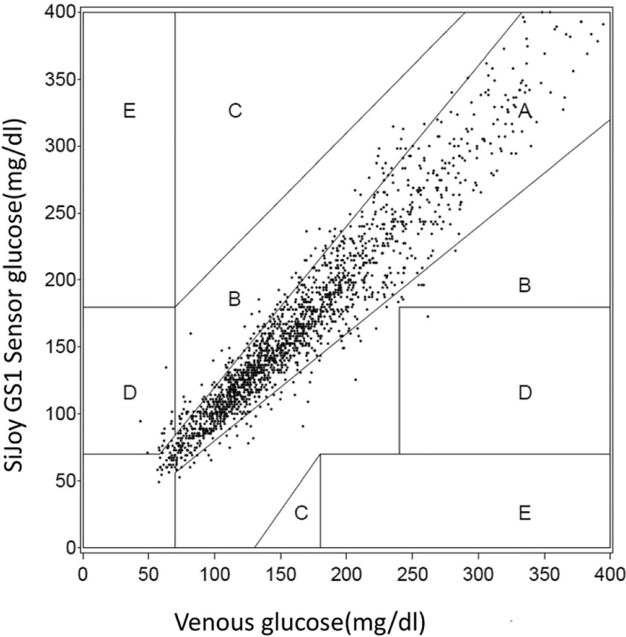
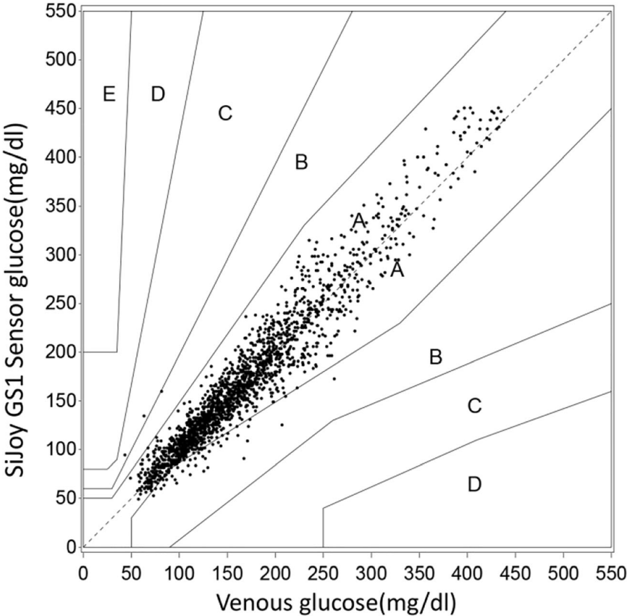
Background: Continuous glucose monitoring (CGM) can help manage diabetes mellitus (DM) and prevent hypoglycemia. This study aimed to evaluate the performance and usability of a novel SiJoy GS1 CGM system. Methods: This multicenter trial enrolled participants with DM. Based on the comparison of glucose values measured by SiJoy GS1 CGM and venous blood glucose test, the 20/20% consistency and mean absolute relative difference (MARD%) were calculated, as well as Clarke and consensus error grid analysis. Product usability was evaluated by questionnaire completed by participants. Any occurrence of adverse events (AE) was documented. Results: Seventy participants were included in the study. The mean age of participants was 41.5 ± 13.2 years, among which 29 (42.0%) were male, with the DM course of 8.6 ± 7.5 years. A total of 39 (56.5%) of them had type 1 DM, 24 (34.8%) had type 2 DM, and 6 (8.7%) were others for DM. The 20/20% consistency achieved 91.82%, which was higher than the target 65%. The percentage of A + B zones of Clarke and consensus error grid was 99.22% and 99.90%, respectively. The MARD value was 8.83% ± 4.03%. The mean score of usability questionnaire was 86.59 ± 5.17 out of 90. AE were observed in only one participant (mild fever), and no severe AEs occurred. Conclusions: The SiJoy GS1 CGM system achieved satisfactory performance and usability. No severe AEs occurred and mild AE was reported in only one case.
Overview
The claims and statistics of this paper haven’t been checked yet.
Free: it reads the open-access text and checks the first 5 claims that cite a source we can check. Create a free account to check every claim.
Integrity signals
Registry
Cites
Statistics
Figures
Verification
Claims the paper makes
The claims and statistics of this paper haven’t been checked yet.
Free: it reads the open-access text and checks the first 5 claims that cite a source we can check. Create a free account to check every claim.
Claims other papers make about this one
Each is checked against this paper’s own text: does it say what the citing paper says it does?
The source backs part of the claim, not all of it — or backs it for a different population, condition or comparison.
In the citing paper
“For example, publicly available accuracy data from both observational and randomized clinical trials supporting some non-iCGM-approved entrants include small sample sizes and/or very few data points in the critical range of <70 mg/dL, more stable patients, and no glucose and insulin challenges, and data may not have been published in peer-reviewed journals.8,11,20-24,35,36,39-48”
From Importance of FDA-integrated continuous glucose monitors to ensure accuracy of continuous glucose monitoring (2025) · cites this paper as [23]
Experimental — accuracy not yet measuredThe source backs part of the claim, not all of it — or backs it for a different population, condition or comparison.
In the citing paper
“Furthermore, the body of evidence is scarce, insufficient, or even lacking for many non-iCGM-approved entrants, in terms not only of accuracy, but also of glycemic outcomes (i.e., time in range, time above range, time below range, coefficient of variation).20-23,29”
From Importance of FDA-integrated continuous glucose monitors to ensure accuracy of continuous glucose monitoring (2025) · cites this paper as [23]
Experimental — accuracy not yet measuredThe check wasn’t confident either way, so it gives no verdict — never disputed.
In the citing paper
“In contrast, the manufacturers of non-iCGM devices have not published accuracy data in these important settings or have not shown a documented probability of adequate sensor survival until the end of the claimed sensor life.20-23,36”
From Importance of FDA-integrated continuous glucose monitors to ensure accuracy of continuous glucose monitoring (2025) · cites this paper as [23]
Experimental — accuracy not yet measuredThe check wasn’t confident either way, so it gives no verdict — never disputed.
In the citing paper
“By contrast, the manufacturers of many non-iCGM-approved devices sold outside the United States have not published robust accuracy data or randomized controlled trial data to support their use.”
From Importance of FDA-integrated continuous glucose monitors to ensure accuracy of continuous glucose monitoring (2025) · cites this paper as [23]
Experimental — accuracy not yet measuredIn the citing paper
“In recent years, a number of non-iCGM-approved CGM devices have entered the market outside the United States worldwide.”
From Importance of FDA-integrated continuous glucose monitors to ensure accuracy of continuous glucose monitoring (2025) · cites this paper as [23]
Self-check
Percentages, sums and reported differences re-computed from the paper’s own numbers.
The self-check needs the paper’s full text.
Citations
Cites
Diagnosis and classification of diabetes mellitus
American Diabetes Association (2010) · Diabetes Care · doi:10.2337/dc10-s062 · Cited by 5,491
Battelino, T., Danne, T., Bergenstal, R. M., Amiel, S. A., Beck, R., Biester, T., Bosi, E., Buckingham, B. A., Cefalu, W. T., Close, K. L., et al. (2019) · Diabetes Care · doi:10.2337/dci19-0028 · Cited by 4,237 · cited 1×
“According to two recent international consensuses, the performances of GS1 CGMmeet the needs of clinical applications [18, 19].”
BackgroundInternational consensus on use of continuous glucose monitoring
Danne, T., Nimri, R., Battelino, T., Bergenstal, R. M., Close, K. L., DeVries, J. H., Garg, S., Heinemann, L., Hirsch, I., Amiel, S. A., et al. (2017) · Diabetes Care · doi:10.2337/dc17-1600 · Cited by 2,069 · cited 1×
“According to two recent international consensuses, the performances of GS1 CGMmeet the needs of clinical applications [18, 19].”
BackgroundCappon, G., Vettoretti, M., Sparacino, G., & Facchinetti, A. (2019) · Diabetes & Metabolism Journal · doi:10.4093/dmj.2019.0121 · Cited by 477
A Tale of Two Compartments: Interstitial Versus Blood Glucose Monitoring
Cengiz, E., & Tamborlane, W. V. (2009) · Diabetes Technology & Therapeutics · doi:10.1089/dia.2009.0002 · Cited by 390
Standards of care for type 2 diabetes in China
Weng, J., Ji, L., Jia, W., Lu, J., Zhou, Z., Zou, D., Zhu, D., Chen, L., Chen, L., Guo, L., et al. (2016) · Diabetes/Metabolism Research and Reviews · doi:10.1002/dmrr.2827 · Cited by 315 · cited 2×
“In patients with diabetes mellitus (DM), daily glucose monitoring assists in evaluating the therapeutic effect, allowing patients to adapt their diet and clinicians to adjust the medications [1, 2], especially to prevent hypoglycemia, one of the known complications of hypoglycemic medications [3, 4].”
BackgroundMethodSelf-citationCurrent and Emerging Technology for Continuous Glucose Monitoring
Chen, C., Zhao, X.-L., Li, Z.-H., Zhu, Z.-G., Qian, S.-H., & Flewitt, A. (2017) · Sensors · doi:10.3390/s17010182 · Cited by 291
Advances in technology for management of type 1 diabetes
Beck, R. W., Bergenstal, R. M., Laffel, L. M., & Pickup, J. C. (2019) · The Lancet · doi:10.1016/s0140-6736(19)31142-0 · Cited by 242 · cited 1×
“CGM utilizes a disposable glucose sensor that can be inserted (7–14 days) or implanted (up to 180 days) subcutaneously for continuous glucose measurement in the interstitial fluid [10].”
MethodA history of continuous glucose monitors (CGMs) in self-monitoring of diabetes mellitus
Olczuk, D., & Priefer, R. (2018) · Diabetes & Metabolic Syndrome: Clinical Research & Reviews · doi:10.1016/j.dsx.2017.09.005 · Cited by 194 · cited 1×
“Regarding safety, previously reported AEs related to sensor implantation were bruising, erythema, allergic reaction, or pain/ discomfort [28].”
BackgroundGalindo, R. J., Migdal, A. L., Davis, G. M., Urrutia, M. A., Albury, B., Zambrano, C., Vellanki, P., Pasquel, F. J., Fayfman, M., Peng, L., et al. (2020) · Diabetes Care · doi:10.2337/dc19-2073 · Cited by 181 · cited 5×
“Our subgroup analysis suggested that 20/20% consistency rates were 82.91% for blood glucose 4.4 mmol/L, with lower limit of the 95%CI of 74.84%,which is acceptable in clinical practice and comparable to the results of FreeStyle Libre.”
BackgroundInfluential
Research works printed but not linked: 4
- Heller SR, Peyrot M, Oates SK, Taylor AD. Hypoglycemia in pa- tient with type 2 diabetes treated with insulin: it can happen. BMJ Open Diabetes Res Care. 2020;8(1). · DOI · Paper page
- Funtanilla VD, Candidate P, Caliendo T, Hilas O. Continuous glu- cose monitoring: a review of available systems. P T. 2019;44(9): 550-3.
- Malandrucco I, Russo B, Picconi F, Menduni M, Frontoni S. Glycemic status assessment by the latest glucose monitoring tech- nologies. Int J Mol Sci. 2020;21(21):8243. · DOI
- Chen C, Zhao XL, Li ZH, Zhu ZG, Qian SH, Flewitt AJ. Current and emerging technology for continuous glucose monitoring. Sensors (Basel). 2017;17(1):182. · DOI · Paper page
Cited by
Klonoff, D. C., Gabbay, M., Moon, S. J., & Wilmot, E. G. (2025) · Journal of Diabetes Science and Technology · doi:10.1177/19322968241250357 · Cited by 36
“16 17-23 Importance of an iCGM G7.”
Dávila-Rúales, V., Córdoba, L. F. G., Medina, A. M. G., Múñoz, Ó., Serrano, M. N., & Henao, D. C. (2024) · Therapeutic Advances in Endocrinology and Metabolism · doi:10.1177/20420188241304459 · Cited by 22
Prediction of personalised postprandial glycaemic response in type 1 diabetes mellitus
Xiong, X., Xue, Y., Cai, Y., He, J., & Su, H. (2024) · Frontiers in Endocrinology · doi:10.3389/fendo.2024.1423303 · Cited by 15
Ji, X., Yin, M., Deng, C., Li, F., Xie, Y., Huang, F., Chen, Y., & Li, X. (2025) · World Journal of Diabetes · doi:10.4239/wjd.v16.i4.100917 · Cited by 6
Tang, R., Shi, M., Ji, X., Zhang, Y., Fan, L., Huang, F., & Li, X. (2025) · Cardiovascular Diabetology · doi:10.1186/s12933-025-03012-z · Cited by 5
“Continuous glucose monitoring (CGM) was performed over a 14-day sensor wear period for all participants with T1D using the SiJoy GS1 CGM system (Shenzhen Sibionics Technology Co. Ltd.), which has demonstrated satisfactory accuracy and usability [14].”
Wang, Y., Chen, Y., Li, C., Duan, J., Guo, Y., Zhu, S., Li, B.-M., Ma, D., & Zhu, J. (2025) · Current Developments in Nutrition · doi:10.1016/j.cdnut.2025.107575 · Cited by 1
“Although the CGM devices used in this study showed slightly reduced accuracy in the hypoglycemic range, their reliability in the hyperglycemic range remained robust, ensuring dependable detection of primary end points in patients with T2DM [38].”
Zhang, P., Gu, Z., Xu, K., Zhao, Y., Chen, G., & Dai, J. (2026) · Frontiers in Physiology · doi:10.3389/fphys.2026.1746392 · Cited by 1
“The test-retest reliability of the Continuous Glucose Monitoring (CGM) device, specifically the Silicon Sensing Dynamic Glucose Monitoring 10.3389/fphys.2026.1746392 System, utilized in this study has been validated within the diabetic patient population (Yan et al., 2023).”
InfluentialSelf-citationPal, A. W., Chong, W. L., Huri, H. Z., & Ratnasingam, J. (2026) · Diabetic Medicine · doi:10.1111/dme.70360 · Cited by 1
“The DTA designs 51,52 were considered low risk, whereas the study 53 was considered a moderate risk.”
Risk factors for corneal nerve fiber loss in Chinese patients with type 2 diabetes mellitus
Huang, L., Chen, X., Xiao, Z., Wu, K., Wang, L., & Liu, L. (2025) · Diabetes Research and Clinical Practice · doi:10.1016/j.diabres.2025.112304 · Cited by 1
Wang, W., Zhou, R., He, G., Si, Y., Cao, Y., Zheng, P., & Zi, W. (2026) · Frontiers in Physiology · doi:10.3389/fphys.2026.1807399
“The clinical performance of this CGM system has been validated in multiple independent evaluations, demonstrating a mean absolute relative difference (MARD) within accepted standards for clinical CGM applications (Yan et al., 2023; Zhao et al., 2025).”
Cao, B., Su, Z., Wang, Y., Chen, Y., Hu, Z., Han, M., Gong, C., & Mo, Y. (2026) · Journal of Diabetes Investigation · doi:10.1111/jdi.70415
Self-citationZhang, X., Huang, C., Wang, X., Zhang, J., Ling, X., Xu, J., Ma, J., Zhong, F., & Shu, H. (2026) · Frontiers in Medicine · doi:10.3389/fmed.2026.1880028
“In the current study, CGM achieved 20/20% consistency of 88.4% and a MARD% of 11.5%, while slightly lower than previously reported values (91.82% and 8.83 ± 4.03%, respectively) (12), still represent acceptable accuracy.”
InfluentialNING, C., Zhang, R., Liu, W., Zhou, X., Sun, Y., Han, X., Ji, L., & Ren, Q. (2026) · Endocrine Connections · doi:10.1530/ec-26-0304
Physiological Aspects of Marathon Running, volume II
(2026) · Frontiers research topics · doi:10.3389/978-2-8325-8994-6
Metadata
- Authors
- Yan, L., Li, Q., Guan, Q., Han, M., Zhao, Y., Fang, J., & Zhao, J.
- Affiliations
- Sun Yat-sen University (CN)
- Shenzhen University (CN)
- Shandong Provincial Hospital (CN)
- Corresponding author
- Zhao, Jiajun
- Venue
- International Journal of Diabetes in Developing Countries
- Published
- 2022-08-24
- Volume
- 43
- Issue
- 4
- Pages
- 551-558
- ISSN
- 0973-3930 (ISSN-L)
- 1998-3832
- OpenAlex
- W4293171013
- Cited by
- 13
- References
- 27
- Citations by year
- 2026: 6 · 2025: 4 · 2024: 3
- FWCI
- 1.30
- Type
- journal article
- Language
- en
- Open access
- hybrid
- doi.org
- Licence
- cc-by
- creativecommons.org/licenses/by/4.0 (tdm)
- creativecommons.org/licenses/by/4.0 (vor)
- Locations
- International Journal of Diabetes in Developing Countries (publishedVersion, cc-by)
- Funders
- National Core Development Program (2019YFB1404805)
- Shenzhen Sibionics Technology Co. LTD.
- Topics
- Health Sciences › Medicine › Endocrinology, Diabetes and Metabolism › Diabetes Management and Research
- Health Sciences › Medicine › Endocrinology, Diabetes and Metabolism › Diabetes Management and Education
- Health Sciences › Medicine › Endocrinology, Diabetes and Metabolism › Diabetes Treatment and Management
- Keywords
- continuous glucose monitoring, diabetes mellitus, type 1 diabetes, type 2 diabetes, CGM accuracy, error grid analysis, mean absolute relative difference, usability, hypoglycemia prevention, adverse events
About these checks
Registry, retraction, Cites and statistics results are computed, not judged, with one exception: a printed reference that no index lists is read once by a model before it counts as a citation error. Claims are extracted by a model and kept only when their quote appears verbatim in the text; each cited source is then checked, with a model’s help, for whether it says what the claim relies on. Those verdicts can be wrong — read the claim’s quote and the cited source before relying on one.
Statistics and arithmetic are recomputed, not judged.
Confidence bands are shown only for fields calibrated on our annotated test set. None is calibrated yet, so no band is shown.
What counts as a claim ›How we measure confidence ›How we check this ›
Are you an author, or do you see a problem with this page? Request a review
Data sources
Bibliographic data: Semantic Scholar, OpenAlex, Crossref.
Contains information from the Semantic Scholar Academic Graph Datasets, made available under the ODC Attribution License (ODC-BY 1.0).
Semantic Scholar’s data is described in: Kinney, R., et al. (2023). The Semantic Scholar Open Data Platform. arXiv:2301.10140.
