

Natural hydroxyanthraquinoid pigments as potent food grade colorants: an overview
Open accessThe DOI matches its Crossref record; 121 of the 122 references it cites were found in a registry or an index.
Abstract
Natural pigments and colorants are widely used in the world in many industries such as textile dying, food processing or cosmetic manufacturing. Among the natural products of interest are various compounds belonging to carotenoids, anthocyanins, chlorophylls, melanins, betalains… The review emphasizes pigments with anthraquinoid skeleton and gives an overview on hydroxyanthraquinoids described in Nature, the first one ever published. Trends in consumption, production and regulation of natural food grade colorants are given, in the current global market. The second part focuses on the description of the chemical structures of the main anthraquinoid colouring compounds, their properties and their biosynthetic pathways. Main natural sources of such pigments are summarized, followed by discussion about toxicity and carcinogenicity observed in some cases. As a conclusion, current industrial applications of natural hydroxyanthraquinoids are described with two examples, carminic acid from an insect and Arpink red™ from a filamentous fungus.
Overview
The claims and statistics of this paper haven’t been checked yet.
Free: it reads the open-access text and checks the first 5 claims that cite a source we can check. Create a free account to check every claim.
Integrity signals
Registry
Cites
Statistics
Figures
Verification
Claims the paper makes
The claims and statistics of this paper haven’t been checked yet.
Free: it reads the open-access text and checks the first 5 claims that cite a source we can check. Create a free account to check every claim.
Claims other papers make about this one
Each is checked against this paper’s own text: does it say what the citing paper says it does?
The source backs part of the claim, not all of it — or backs it for a different population, condition or comparison.
In the citing paper
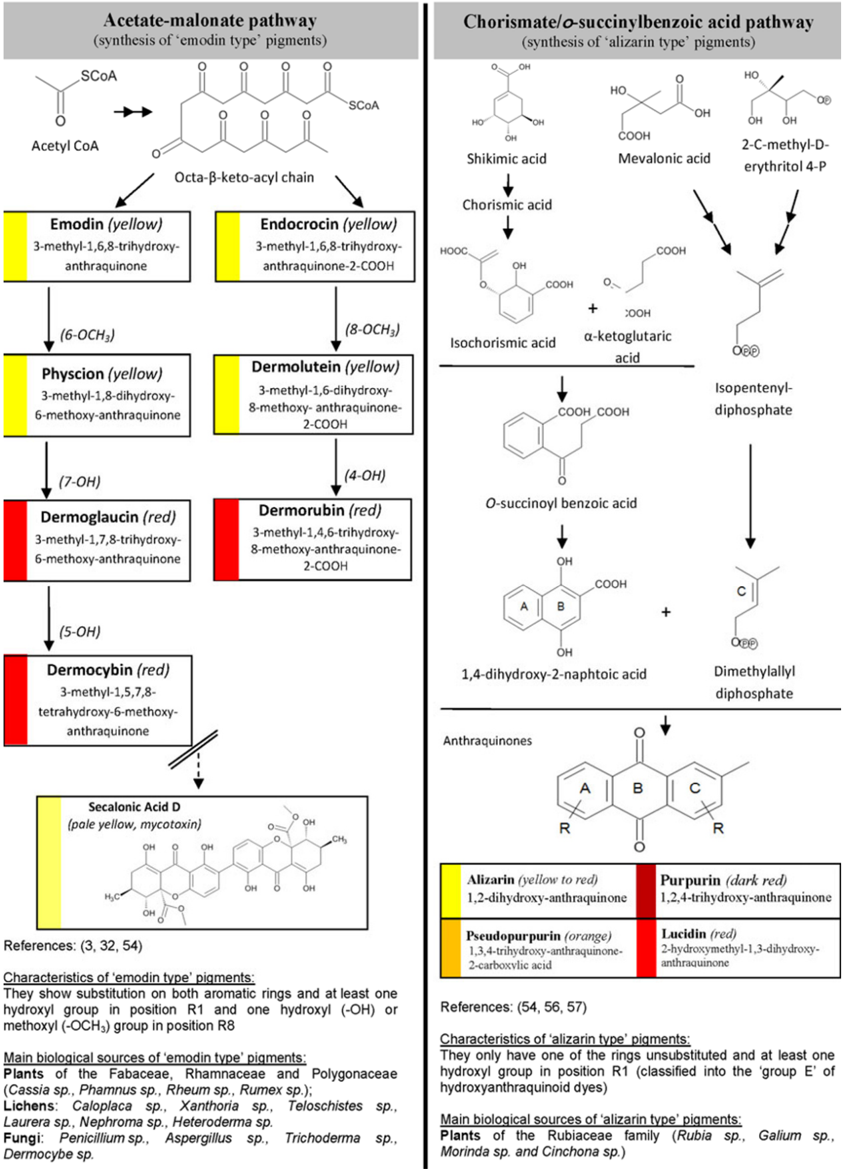
“Two different pathways have been proposed as biosynthesis routes for natural quinones in plants and other organisms (Fig. 2) [25,73].”
From Natural Quinone Dyes: A Review on Structure, Extraction Techniques, Analysis and Application Potential (2021) · cites this paper as [25]
Experimental — accuracy not yet measuredThe source backs part of the claim, not all of it — or backs it for a different population, condition or comparison.
In the citing paper
“In the food and pharmaceuticals industry, quinones are used as food and medicine colourant in either liquid or solid state for various reasons, such as improving the product's natural colour, restoring and standardising the colour and appearance of food and medicine lost during processing or cooking, and to add a novel sensory attraction [25].”
From Natural Quinone Dyes: A Review on Structure, Extraction Techniques, Analysis and Application Potential (2021) · cites this paper as [25]
Experimental — accuracy not yet measuredThe cited source says what the claim attributes to it.
In the citing paper
“Hydroxyanthraquinoids absorb visible light and are therefore coloured [25].”
From Natural Quinone Dyes: A Review on Structure, Extraction Techniques, Analysis and Application Potential (2021) · cites this paper as [25]
Self-check
Percentages, sums and reported differences re-computed from the paper’s own numbers.
The self-check needs the paper’s full text.
Citations
Cites
Progress in the Chemistry of Organic Natural Products 109
(2019) · Progress in the Chemistry of Organic Natural Products · doi:10.1007/978-3-030-12858-6 · Cited by 2,052
(1993) · Methods in Plant Biochemistry · doi:10.1016/b978-0-12-461020-0.50001-9 · Cited by 1,757
Dufossé, L., Galaup, P., Yaron, A., Arad, S. M., Blanc, P., Chidambara Murthy, K. N., & Ravishankar, G. A. (2005) · Trends in Food Science & Technology · doi:10.1016/j.tifs.2005.02.006 · Cited by 681
Self-citationColouring our foods in the last and next millennium
Downham, A., & Collins, P. (2000) · International Journal of Food Science and Technology · doi:10.1046/j.1365-2621.2000.00373.x · Cited by 616
Secondary metabolites from species of the biocontrol agent Trichoderma
Reino, J. L., Guerrero, R. F., Hernández-Galán, R., & Collado, I. G. (2007) · Phytochemistry Reviews · doi:10.1007/s11101-006-9032-2 · Cited by 603
(1989) · Methods in Plant Biochemistry · doi:10.1016/b978-0-12-461011-8.50001-9 · Cited by 569
(2009) · Wiley eBooks · doi:10.1002/9780470744970 · Cited by 535
Primary and Secondary Metabolism of Plant Cell Cultures
(1985) · Proceedings in Life Sciences · doi:10.1007/978-3-642-70717-9 · Cited by 444
Vinale, F., Marra, R., Scala, F., Ghisalberti, E. L., Lorito, M., & Sivasithamparam, K. (2006) · Letters in Applied Microbiology · doi:10.1111/j.1472-765x.2006.01939.x · Cited by 341
Microbial Production of Food Grade Pigments
Dufossé, L. (2006) · DOAJ (DOAJ: Directory of Open Access Journals) · Cited by 334
Research works printed but not linked: 15
- 2. Dufossé, L. Food Technol. Biotech. 2006, 44, 313-321.
- 7. Chattopadhyay, P.; Chatterjee, S.; Sen, S. K. Afr. J. Biotechnol. 2008, 7, 2972-2985.
- 11. Carvalho, J. C.; Pandey, A.; Batitha, S.; Soccol, C. R. Agro Food Ind Hi-tech. 2003, 14, 37-42.
- 16. Alitheen, N. B.; Mashitoh, A. R.; Yeap, S. K.; Shuhaimi, M.; Abdul-Manaf, A.; Nordin, L. Int. Food Res. J. 2010, 17, 711- 719.
- 39. Jasril; Lajis, N. H.; Mooi, L. Y.; Abdullah, M. A.; Sukari, M. A.; Ali, A. M. Asia Pacific J. Mol. Biol. Biotechnol. 2003, 11, 3-7.
- 42. Tanaka, C.; Miyagawa, H.; Kuwahara, Y.; Tsuda, M. Mycosci- ence 2002, 43, 317-320. · DOI
- 54. Van den Berg, A. J. J.; Labadie, R. P. Methods in Plant Bio- chemistry; Academic press: London, 1989; Vol. 1, pp 451-491
- 71. Arun, P.; Purushotham, K. G.; Jonhsy Jayarani, J.; Vasantha Kumari. J. Pharm. Sci. Technol. 2010, 2, 198-201.
- 73. Badr, J. M. Nat. Prod. Sci. 2008, 14, 227-232.
- 75. Li, L.; Zhang, C.; Xiao Y. Q.; Chen, D. D.; Tian, G. F.; Wang, Y. Chin. J. Nat. Med. 2011, 9, 410-413.
- 85. Mohanlall, V.; Steenkamp, P.; Odhav, B. J. Med. Plants Res. 2011, 5, 3132-3141.
- 95. Baker, R. A.; Tatum, J. H. J. Ferment. Bioeng. 1998, 85, 359- 361. · DOI
- 97. Nagia, F. A.; El-Mohamedy, R. S. R. Dyes Pigments 2007, 75, 550-555. · DOI · Paper page
- 117. Mueller, S. O.; Stopper, H.; Dekant, W. Drug Metab. Dispos. 1998, 26, 540-546.
- 121. Beaudouin, E.; Kanny, G.; Lambert, H.; Fremont, S.; Moneret- Vautrin, D. Ann. Allergy Asthma Immunol. 1995, 74, 427-430.
Cited by
Items 101–190 of 190
Effects of Abscisic Acid on Capsanthin Levels in Pepper Fruit
Tian, S.-L., Li, L., Tian, Y.-Q., Shah, S. N. M., & Gong, Z. (2016) · Journal of the American Society for Horticultural Science · doi:10.21273/jashs03898-16 · Cited by 10
“Synthetic food pigments are a serious health threat, as some of them include carcinogenic substances (Caroy et al., 2012).”
BackgroundQuraishi, S., Nudrat, S., Kumari, K., Marboh, E. W. M., Aguan, K., & Roy, A. S. (2024) · International Journal of Biological Macromolecules · doi:10.1016/j.ijbiomac.2024.131810 · Cited by 9
Microbial Biosynthesis of Health-Promoting Food Ingredients
Sorour, N. M., Tayel, A. A., Abbas, R. N., & Abonama, O. M. (2017) · Elsevier eBooks · doi:10.1016/b978-0-12-811372-1.00002-6 · Cited by 10
Pant, P. L., Sonune, R. K., & Shankarling, G. S. (2018) · ChemistrySelect · doi:10.1002/slct.201800546 · Cited by 9
Secondary metabolites of a marine-derived Penicillium ochrochloron
Eze, P. M., Gao, Y., Yang, L. I. U., van Geelen, L., Chika, E., Esimone, C. O., Okoye, F. B., Proksch, P., & Kalscheuer, R. (2021) · Notulae Scientia Biologicae · doi:10.15835/nsb13311020 · Cited by 9
“The chlorinated anthraquinone, 2-chloroemodin (8) is a known metabolite of lichens (Nakano et al., 1972; Cohen et al., 1996; Caro et al., 2012), and which has also been reported from Aspergillus fumigatus (Frisvad et al.”
BackgroundKowalski, T., Nawrot‐Chorabik, K., Grad, B., & Leszczyński, K. (2015) · Forest Pathology · doi:10.1111/efp.12243 · Cited by 9
Preet, G., Astakala, R. V., Gomez-Banderas, J., Rajakulendran, J. E., Hasan, A. H., Ebel, R., & Jaspars, M. (2023) · Molecules · doi:10.3390/molecules28030995 · Cited by 9
Research, Development, and Production of Microalgal and Microbial Biocolorants
Dufossé, L. (2019) · Wiley eBooks · doi:10.1002/9781119434436.ch4 · Cited by 7
Kazman, B. S. M. A., & Prieto, J. M. (2021) · Nutraceuticals · doi:10.3390/nutraceuticals1010004 · Cited by 7
Back to nature, microbial production of pigments and colorants for food use
Dufossé, L. (2022) · Advances in food and nutrition research · doi:10.1016/bs.afnr.2022.04.008 · Cited by 10
Towards hydrophobic carminic acid derivatives and their incorporation in polyacrylates
Gabrielli, L., Origgi, D., Zampella, G., Bertini, L., Bonetti, S., Vaccaro, G., Meinardi, F., Simonutti, R., & Cipolla, L. (2018) · Royal Society Open Science · doi:10.1098/rsos.172399 · Cited by 7
“Hydroxyanthraquinoids 1 (HAQN, figure 1) have found wide application [2] in cosmetic manufacturing, textile dyeing [3], as food biocolourants [4,5], or more recently, in coordination chemistry applications such as self-assembled systems, coordination polymers, metal-organic compounds, chemosensors [4] and dye-sensitiz…”
BackgroundNew Potential Pharmacological Targets of Plant-Derived Hydroxyanthraquinones from Rubia spp.
Alov, P., Sharif, M. A., Najdenski, H. M., Pencheva, T., Tsakovska, I., Zaharieva, M. M., & Pajeva, I. K. (2022) · Molecules · doi:10.3390/molecules27103274 · Cited by 6
“Given the fact that these hydroxyantraquinones have been known as constituents of orally applied traditional medicinal preparations [14], and even commonly consumed beverages in some regions [15,16], an in silico investigation of the potential metabolites of these compounds might be performed as a next step in this mo…”
BackgroundWerner, D., Greussing, V., Pattis, D., Gallmetzer, J. M., Schimanofsky, C., Wielend, D., Liebl, S., Stüwe, T., Cigánek, M., Krajčovič, J., et al. (2025) · Electrochimica Acta · doi:10.1016/j.electacta.2025.146346 · Cited by 6
Tsiailanis, A. D., Pateraki, C., Kyriazou, M., Chatzigiannis, C., Chatziathanasiadou, Μ. V., Parisis, N. A., Mandala, I. G., Tzakos, A. G., & Koutinas, A. (2021) · Molecules · doi:10.3390/molecules27010069 · Cited by 6
Natural Pigments from Filamentous Fungi: Production and Applications
Ashok, G., Mohan, U., Boominathan, M., Ravichandiran, V., Chandran, V., & Senthilkumar, V. (2021) · Fungal biology · doi:10.1007/978-3-030-85603-8_19 · Cited by 10
Dai, J.-M., Zhu, L.-C., Xiao, D., Xie, J., Wang, X., Mi, Q.-L., Shi, J.-Q., Yin, G.-Y., Yang, Y., Yang, G., et al. (2022) · Chemistry of Natural Compounds · doi:10.1007/s10600-022-03854-z · Cited by 6
dos Reis, B. D., Oliveira, F. E., Santos‐Ebinuma, V. C., Filletti, É. R., & Neto, Á. D. B. (2022) · Bioprocess and Biosystems Engineering · doi:10.1007/s00449-022-02819-4 · Cited by 6
“is considered a major concern in food, making toxin detection decisive for consumer safety [10, 11].”
BackgroundMICROBIAL PIGMENTS AND THE IMPORTANT FOR FOOD INDUSTRY
Yangılar, F., & Yildiz, P. O. (2016) · Erzincan Üniversitesi Fen Bilimleri Enstitüsü Dergisi · doi:10.18185/eufbed.55880 · Cited by 6
Phytochemical and Biological Investigation of Stevia rebaudiana (Bert.) Leaves Grown in Bangladesh
Sultana, C., Azad, M. A. K., Rahman, M. M., Muhit, M. A., & Rahman, S. A. (2020) · Dhaka University Journal of Pharmaceutical Sciences · doi:10.3329/dujps.v19i2.50636 · Cited by 6
Bio-based Sensing: Role of Natural Dyes in Food Freshness Indicators
Martins, V. G., Santos, L. G., Romani, V. P., & Fernandes, S. S. (2022) · Royal Society of Chemistry eBooks · doi:10.1039/9781839167966-00037 · Cited by 8
Manzano, J. A., Abanto, J. C. D., Dayo, B. A. F., Llames, L. C. J., Gonzaga, M. G. E., Brogi, S., & Macabeo, A. P. G. (2025) · Archives of Microbiology · doi:10.1007/s00203-025-04429-6 · Cited by 5
“A number of AQ drug derivatives are currently available for treatment of constipation, multiple sclerosis, and cancer (Caro et al. 2012; Shakour and Farag 2022).”
Chavan, A., Mavlankar, G. R., Kakde, U. B., Dufossé, L., & Deshmukh, S. K. (2026) · Microorganisms · doi:10.3390/microorganisms14040792 · Cited by 6
Mun, J., Lee, S., YingXing, B., & Lee, J.-S. (2023) · Fibers and Polymers · doi:10.1007/s12221-023-00172-1 · Cited by 6
Natural Colorants—Quinoid, Naphthoquinoid, and Anthraquinoid Dyes
Derksen, G. C. H., & Bechtold, T. (2023) · Wiley eBooks · doi:10.1002/9781119811749.ch13 · Cited by 5
Diel, K. A. P., Siqueira, L. M., Silveira, P. P., Labes, J. M., Koetz, M., Marinho, L. C., Cassel, E., Vargas, R. M. F., & von Poser, G. L. (2025) · The Journal of Supercritical Fluids · doi:10.1016/j.supflu.2025.106562 · Cited by 6
Application of Somatic Embryogenesis to Secondary Metabolite-Producing Plants
Vázquez‐Flota, F., Monforte‐González, M., & Miranda‐Ham, M. D. L. (2016) · Springer eBooks · doi:10.1007/978-3-319-33705-0_25 · Cited by 6
Mussagy, C. U., de Oliveira, F., & Santos‐Ebinuma, V. C. (2023) · Wiley eBooks · doi:10.1002/9781119811749.ch18 · Cited by 8
Fungi: Essential Elements in the Ecosystems
Moonjely, S. S. (2022) · Fungal biology · doi:10.1007/978-3-030-89664-5_2 · Cited by 5
Aziz, K. A., & Yousif, T. Y. (2022) · Iraqi Journal of Science · doi:10.24996/ijs.2022.63.7.5 · Cited by 5
Suematsu, T., Takama, M., Tomita, I., Asamizu, S., Bamba, T., & Hasunuma, T. (2025) · ACS Synthetic Biology · doi:10.1021/acssynbio.5c00354 · Cited by 4
Halladj, F., Amellal-Chibane, H., Lahlou, R. A., Bourai, M. A., & Tigrine, A. (2022) · Food Science and Technology International · doi:10.1177/10820132221137386 · Cited by 4
“(Caro et al., 2012).”
Tariq, B., Mansha, A., Asim, S., & Kausar, A. (2023) · Journal of Fluorescence · doi:10.1007/s10895-023-03410-0 · Cited by 4
Gupta, P. O., Patil, P. S., & Sekar, N. (2024) · Journal of Biomolecular Structure and Dynamics · doi:10.1080/07391102.2024.2439582 · Cited by 4
“(Caro et al., 2012; Dufoss � e, 2014; Garg & Yadav, 2023; Huang et al., 2007; Sendelbach, 1989) The AQ derivatives are used as laxatives, (Fairbairn, 1976; Li et al., 2023; Van Gorkom et al., 1999) anti-cancer, (Huang et al., 2007; Shrestha et al., 2014, 2015) anti-inflammatory, (Sadabal, 2020)…”
Coloring Properties Assessment of Dyes Produced by MixedAspergillusandPaecilomyces
Suciatmih, Nurfianti, & Magfirani, S. V. (2018) · IOP Conference Series Earth and Environmental Science · doi:10.1088/1755-1315/166/1/012023 · Cited by 4
Abo‐Elmagd, H. I., & Housseiny, M. M. (2019) · Journal of Cluster Science · doi:10.1007/s10876-019-01546-3 · Cited by 4
Microbial metabolites: as sources of green dye
Verma, P., Shakya, M., Kumar, S., & Sandhu, S. S. (2021) · Elsevier eBooks · doi:10.1016/b978-0-12-821734-4.00005-8 · Cited by 5
Mushroom Pigments and Their Applications
Téllez‐Téllez, M., & Díaz-Godínez, G. (2022) · Wiley eBooks · doi:10.1002/9781119769620.ch3 · Cited by 5
Garg, A., & Yadav, B. S. (2023) · Materials Today Proceedings · doi:10.1016/j.matpr.2023.04.230 · Cited by 4
Biotechnological approaches in the production of fungal pigments
Dufossé, L. (2025) · Elsevier eBooks · doi:10.1016/b978-0-443-13263-6.00017-1 · Cited by 3
Negi, A., Toukola, P., & Räisänen, R. (2025) · Coloration Technology · doi:10.1111/cote.12810 · Cited by 3
Biocompatibility Analysis of Biomass-Based Cosmetics for Human
Juliadmi, D., Nuswantoro, N. F., & Okselni, T. (2024) · Springer eBooks · doi:10.1007/978-981-97-1908-2_19 · Cited by 3
Membrane based separation and purification of fusarubins from Fusarium solani
Kristensen, S. B., Fini, M. N., Pedersen, T. B., Sørensen, J. L., & Muff, J. (2021) · Separation and Purification Technology · doi:10.1016/j.seppur.2021.119576 · Cited by 3
Asokan, K., Hussain, A. Z., & Ilangovan, A. (2023) · Organic & Biomolecular Chemistry · doi:10.1039/d3ob01774e · Cited by 2
Inspired by taxol: biosynthesis and engineering of hypericin and other phytochemicals in Hypericum
Bruňáková, K., Bálintová, M., Henzelyová, J., & Petijová, L. (2026) · Planta · doi:10.1007/s00425-025-04908-6 · Cited by 2
“In contrast, alizarin-type AQs, produced via the shikimate and mevalonate pathways, feature an unsubstituted aromatic ring and are typical of Rubiaceae species (e.g., alizarin, pur-purin, lucidin) (Caro et al. 2012).”
InfluentialAbdullah, & Hussain, Y. (2022) · Elsevier eBooks · doi:10.1016/b978-0-323-95047-3.00006-x · Cited by 2
Bektaş, N., & Onul, N. (2023) · Acta chimica slovenica · doi:10.17344/acsi.2023.8155 · Cited by 2
Manochkumar, J., Gowthami, A., Santhanam, P., & Ramamoorthy, S. (2024) · Elsevier eBooks · doi:10.1016/b978-0-443-21818-7.00003-4 · Cited by 2
Introduction to Chemistry of Microbial Colorants
Ramesh, P. V., Gowda, K. R. S., & More, S. S. (2025) · Wiley eBooks · doi:10.1002/9781394287888.ch6 · Cited by 3
Potentials of metabolites of soil fungi
Jadon, K. S., Singh, S. K., & Pathak, R. (2020) · Elsevier eBooks · doi:10.1016/b978-0-12-821007-9.00001-2 · Cited by 2
Thaher, S., Anggrahini, S., Hidayat, C., & Hariadi, H. (2022) · Advances in Food Science Sustainable Agriculture and Agroindustrial Engineering · doi:10.21776/ub.afssaae.2022.005.02.2 · Cited by 2
The “carmine problem” and potential alternatives
Gras, C. C., & Müller-Maatsch, J. (2023) · Elsevier eBooks · doi:10.1016/b978-0-323-99608-2.00011-2 · Cited by 5
Natural pigments: a sustainable approach to utilize agroindustrial waste
Deepika, Maurya, A., Soni, M., Yadav, A., Pandey, A. K., Dubey, N. K., & Dwivedy, A. K. (2024) · Elsevier eBooks · doi:10.1016/b978-0-443-23679-2.00016-1 · Cited by 1
Investigation of Halal Status and Permitted Industrial Utilization of Carmine Dye in Iran
Moslemi, M., Rastegar, H., Khaghani, L., Shahbazpour, N., & Abedi, A. (2024) · Journal of Food Quality and Hazards Control · doi:10.18502/jfqhc.11.4.17442 · Cited by 1
Pérez, J. M., Rodríguez-Criado, J., Quiñonero, F., Gutiérrez-Segura, N., López‐Vargas, M. E., Forte‐Castro, A., Ruiz‐Muelle, A. B., Salcedo‐Abraira, P., Rodriguez-Diéguez, A., Melguizo, C., et al. (2026) · Results in Chemistry · doi:10.1016/j.rechem.2026.103121 · Cited by 1
Bhatt, N., Al-Subhi, L., & Waly, M. I. (2022) · Springer eBooks · doi:10.1007/978-3-030-92174-3_3 · Cited by 2
Extraction of pigments from grouper root and their applications for functional textiles
Li, W., He, N., Suo, Q., Yin, Y., & Jiang, H. (2025) · Emerging Materials Research · doi:10.1680/jemmr.25.00139 · Cited by 1
Martínez Suárez, J. F. (2017) · El Servicio de Difusión de la Creación Intelectual (National University of La Plata) · doi:10.35537/10915/60850 · Cited by 1
Subramaniam, S., & Sivasubramanian, A. (2016) · Green Processing and Synthesis · doi:10.1515/gps-2016-0072
Avaliação ecogenotoxicológica de corante natural extraído de micro-organismo
Abe, F. R. (2018) · Digital Library of Theses and Dissertations (Universidade de São Paulo) · doi:10.11606/t.60.2018.tde-22052018-152222 · Cited by 2
Olusegun, O. A., & Martincigh, B. S. (2020) · ChemistrySelect · doi:10.1002/slct.202003310
Shahnawaz, M., Dar, R. A., Jeelani, S. M., Zargar, T. B., Azhar, M. M., Ahmed, S., Ali, S., Chouhan, R., Sheikh, G., Gupta, P., et al. (2021) · Wiley eBooks · doi:10.1002/9781119682059.ch18
Characterization of Bioactive Compounds in Foods and Plants Using Advanced Analytical Techniques
Russo, M., & Cacciola, F. (2022) · MDPI eBooks · doi:10.3390/books978-3-0365-2854-0
Fouillaud, M., Dufossé, L., & Caro, Y. (2018) · MDPI eBooks · doi:10.3390/books978-3-03842-788-9 · Cited by 1
Self-citationKristensen, S. B. (2021) · VBN Forskningsportal (Aalborg Universitet) · doi:10.54337/aau456471612 · Cited by 1
Production of bioactive pigmented compounds by filamentous fungi
Dufossé, L. (2023) · Elsevier eBooks · doi:10.1016/b978-0-323-91872-5.00011-9
Revival of Sustainable Fungal‐Based Natural Pigments
Adeel, S., Naseer, A., Bisma, Fazal‐ur‐Rehman, Habib, N., & Hassan, A. (2024) · Wiley eBooks · doi:10.1002/9783527839032.ch8
Tariq, B., Mansha, A., Asim, S., & Noreen, S. (2024) · Chemical Papers · doi:10.1007/s11696-024-03546-8
“Anthraquinones, both natural and synthetic, are frequently used in dyes for textiles, paints, cameras, food, cosmetics, and medications (Malik et al. 2016; Malik et al. 2015; Motallebi and Maghsoodi 2013; Kwon, et al. 2009; Caro et al. 2012; Kulik 2008; Shaw 2009; Dufossé 2014).”
Tariq, B., Mansha, A., Asim, S., & Noreen, S. (2024) · Chemical Papers · doi:10.1007/s11696-024-03566-4
“Anthraquinones, both natural and synthetic, are frequently used in dyes for textiles, paints, cameras, food, cosmetics and medications (Malik et al. 2016; Malik et al. 2015; Motallebi and Maghsoodi 2013; Kwon et al. 2009; Caro et al. 2012; Kulik 2008; Shaw 2009; Dufossé 2014).”
Júnior, A. M. G. (2024) · Digital Library of Theses and Dissertations (Universidade de São Paulo) · doi:10.11606/d.11.2024.tde-01072024-154759
Poorniammal, R., Prabhu, S., & Dufossé, L. (2025) · Wiley eBooks · doi:10.1002/9781394287888.ch12
Chemistry and Synthesis of Quinones and their Derivatives
Patel, D. P., Singh, S. K., & Mishra, V. (2025) · BENTHAM SCIENCE PUBLISHERS eBooks · doi:10.2174/9798898810276125010004
Microbial pigments: vibrant colors from microorganism sources
Tavassoli, M., Bangar, S. P., Majlesi, M., & Ghaderi, S. (2025) · Elsevier eBooks · doi:10.1016/b978-0-443-33345-3.00025-0
de Andrades, I. X. (2025) · Lume (Universidade Federal do Rio Grande do Sul)
Natural colorants—vibrant hues from alternative sources
Kumar, N. S., & Kumar, P. C. (2025) · Elsevier eBooks · doi:10.1016/b978-0-443-33345-3.00015-8
Diversity of Microbial Pigments: Types and Sources
Nayak, P., Thakur, U., Yadav, S., & Kumar, K. V. (2025) · CABI eBooks · doi:10.1079/9781836990505.0003
Greussing, V., Werner, D., Wielend, D., Irimia, C. V., Leeb, E., Cigánek, M., Krajčovič, J., Irimia‐Vladu, M., & Portenkirchner, E. (2026) · ACS Applied Energy Materials · doi:10.1021/acsaem.5c03498
Venkatachalam, M. (2017) · theses.fr (ABES) · doi:10.70675/eac14323z2015z44e1z8c0ez3360fdf28c73
Andriamanantena, M. (2020) · theses.fr (ABES) · doi:10.70675/f351cba3z7e26z41fcz99e7z0681a2258778 · Cited by 2
Eco-extraction de colorants issus de plantes tinctoriales
Gombert, A. (2024) · theses.fr (ABES) · doi:10.70675/ae328e80ze937z44b7z98bdz85fbb3bb5a32 · Cited by 1
Secondary Metabolites from Macroalgae: Chemistry, Classification, and Applications
Carpena, M., Silva, A., Barciela, P., Jorge, A. O. S., Perez-Vazquez, A., Pereira, A. G., Nogueira‐Marques, R., Oliveira, M. B. P. P., & Prieto, M. A. (2026) · Springer eBooks · doi:10.1007/978-3-642-36202-6_281-1
Gouzy, S. (2024) · theses.fr (ABES) · doi:10.70675/c816a1b7z2cd1z41e5zb821z2780a0855bd5 · Cited by 1
Bruňáková, K., Bálintová, M., Čmelík, R., Moravcová, D., Mati, R., Henzelyová, J., & Petijová, L. (2026) · Natural Product Research · doi:10.1080/14786419.2026.2655941
Quantifying Anthocyanins: Solving Red Solutes
Nosov, A. V., & Fomenkov, A. A. (2026) · Russian Journal of Plant Physiology · doi:10.1134/s1021443726601217
Microbial and Fungal Biocolors
Bhatia, R. K., Walia, A., & Dufossé, L. (2025) · Springer eBooks · doi:10.1007/978-981-95-1738-1_5
Sharma, A., Kundu, R., Sharma, R., & Awasthi, P. (2026) · Journal of Molecular Structure · doi:10.1016/j.molstruc.2026.146821
Gombert, A., Harscoat‐Schiavo, C., Brunet, C., Fertet, A., de la Sayette, A., & Savoire, R. (2026) · Food and Bioproducts Processing · doi:10.1016/j.fbp.2026.06.020
Solomatina, T. O., Silantieva, S. A., Grigorchuk, V. P., Tikhonova, O. A., Khopta, A. A., Brodovskaya, E. V., Bulgakov, V. P., & Veremeichik, G. N. (2026) · In Vitro Cellular & Developmental Biology - Plant · doi:10.1007/s11627-026-10685-y
Jabin, M., Nigam, V. K., & Sachan, S. G. (2026) · Archives of Microbiology · doi:10.1007/s00203-026-05136-6
“…have been used for centuries in cosmetics and personal care products; however, the wide-spread adoption of synthetic dyes during the nineteenth and twentieth centuries gradually replaced many natural colo-rants due to their low cost and ease of production (Caro et al. 2012; Venil et al. 2013).”
Genotoxicity of anthraquinone dyes and dye intermediates: a comprehensive review
Itkonen, A., Kovakoski, H., Herrala, M., & Rysä, J. (2026) · Archives of Toxicology · doi:10.1007/s00204-026-04514-9 · Cited by 1
Qiu, Z., Zhi, M., Wang, J., 賈, 来., Dong, K., 沈小英, Zhao, J., Li, T., Li, Y., & Shu, L. (2026) · Critical Reviews in Food Science and Nutrition · doi:10.1080/10408398.2026.2749337
Metadata
- Authors
- Caro, Y., Anamale, L., Fouillaud, M., Laurent, P., Petit, T., & Dufosse, L.
- Affiliations
- University of Reunion Island (RE)
- Corresponding author
- Caro, Yanis
- Venue
- Natural Products and Bioprospecting
- Published
- 2012-10
- Volume
- 2
- Issue
- 5
- Pages
- 174-193
- ISSN
- 2192-2195 (ISSN-L)
- 2192-2209
- PMC
- PMC4131637
- OpenAlex
- W2058447128
- Cited by
- 186
- References
- 122
- Citations by year
- 2026: 13 · 2025: 16 · 2024: 13 · 2023: 19 · 2022: 25 · 2021: 17 · 2020: 16 · 2019: 13 · 2018: 14 · 2017: 15 · 2016: 14 · 2015: 8 · 2014: 2 · 2013: 1
- FWCI
- 3.13
- Type
- journal article
- Language
- en
- Open access
- diamond
- doi.org
- Licence
- cc-by
- creativecommons.org/licenses/by/2.0 (tdm)
- Locations
- Natural Products and Bioprospecting (publishedVersion, cc-by)
- Europe PMC (PubMed Central) (publishedVersion)
- PubMed Central (publishedVersion)
- HAL (submittedVersion, other-oa)
- Funders
- Université de La Réunion
- Topics
- Life Sciences › Biochemistry, Genetics and Molecular Biology › Biotechnology › Microbial Metabolism and Applications
- Life Sciences › Agricultural and Biological Sciences › Food Science › Botanical Research and Applications
- Physical Sciences › Chemistry › Analytical Chemistry › Dye analysis and toxicity
- Keywords
- natural pigments, food colorants, carminic acid, fungal pigments, toxicity, carcinogenicity
About these checks
Registry, retraction, Cites and statistics results are computed, not judged, with one exception: a printed reference that no index lists is read once by a model before it counts as a citation error. Claims are extracted by a model and kept only when their quote appears verbatim in the text; each cited source is then checked, with a model’s help, for whether it says what the claim relies on. Those verdicts can be wrong — read the claim’s quote and the cited source before relying on one.
Statistics and arithmetic are recomputed, not judged.
Confidence bands are shown only for fields calibrated on our annotated test set. None is calibrated yet, so no band is shown.
What counts as a claim ›How we measure confidence ›How we check this ›
Are you an author, or do you see a problem with this page? Request a review
Data sources
Bibliographic data: Semantic Scholar, OpenAlex, Crossref.
Contains information from the Semantic Scholar Academic Graph Datasets, made available under the ODC Attribution License (ODC-BY 1.0).
Semantic Scholar’s data is described in: Kinney, R., et al. (2023). The Semantic Scholar Open Data Platform. arXiv:2301.10140.
