

Genetics of Amyotrophic Lateral Sclerosis
Open accessThe DOI matches its Crossref record; 98 of the 98 references it cites were found in a registry or an index.
Abstract
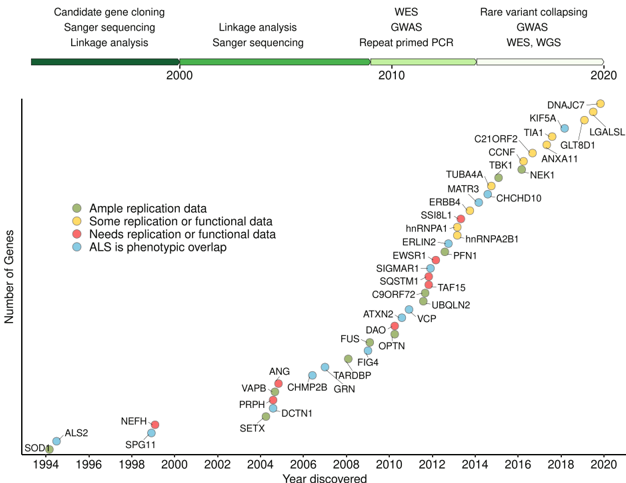
Purpose of Review: Amyotrophic lateral sclerosis and frontotemporal dementia (ALS-FTD) spectrum disorder is a rare fatal disease with strong genetic influences. The implementation of short-read sequencing methodologies in increasingly large patient cohorts has rapidly expanded our knowledge of the complex genetic architecture of the disease. We aim to convey the broad history of ALS gene discovery as context for a focused review of 11 ALS gene associations reported over the last 5 years. We also summarize the current level of genetic evidence for all previously reported genes. Recent Findings: The history of ALS gene discovery has occurred in at least four identifiable phases, each powered by different technologies and scale of investigation. The most recent epoch, benefitting from population-scale genome data, large international consortia, and low-cost sequencing, has yielded 11 new gene associations. We summarize the current level of genetic evidence supporting these ALS genes, highlighting any genotype-phenotype or genotype-pathology correlations, and discussing preliminary understanding of molecular pathogenesis. This era has also raised uncertainty around prior ALS-associated genes and clarified the role of others. Summary: Our understanding of the genetic underpinning of ALS has expanded rapidly over the last 25 years and has led directly to the clinical application of molecularly driven therapies. Ongoing sequencing efforts in ALS will identify new causative and risk factor genes while clarifying the status of genes reported in prior eras of research.
Overview
The claims and statistics of this paper haven’t been checked yet.
Free: it reads the open-access text and checks the first 5 claims that cite a source we can check. Create a free account to check every claim.
Integrity signals
Registry
Cites
Statistics
Figures

Verification
Claims the paper makes
The claims and statistics of this paper haven’t been checked yet.
Free: it reads the open-access text and checks the first 5 claims that cite a source we can check. Create a free account to check every claim.
Claims other papers make about this one
Each is checked against this paper’s own text: does it say what the citing paper says it does?
The source backs part of the claim, not all of it — or backs it for a different population, condition or comparison.
In the citing paper
“Unfortunately, modelling MND for drug discovery purposes remains challenging, partly due to the range of pathological mechanisms implicated, many of which are backed by genetic associations5–10.”
From Examining iPSC derived motor neuron variability and genome stability monitoring as a solution (2025) · cites this paper as [7]
Experimental — accuracy not yet measured
Self-check
Percentages, sums and reported differences re-computed from the paper’s own numbers.
The self-check needs the paper’s full text.
Citations
Cites
Rosen, D. R., Siddique, T., Patterson, D., Figlewicz, D. A., Sapp, P., Hentati, A., Donaldson, D., Goto, J., O'Regan, J. P., Deng, H.-X., et al. (1993) · Nature · doi:10.1038/362059a0 · Cited by 7,062
Ubiquitinated TDP-43 in Frontotemporal Lobar Degeneration and Amyotrophic Lateral Sclerosis
Neumann, M., Sampathu, D. M., Kwong, L. K., Truax, A. C., Micsenyi, M. C., Chou, T. T., Bruce, J., Schuck, T., Grossman, M., Clark, C. M., et al. (2006) · Science · doi:10.1126/science.1134108 · Cited by 6,576
DeJesus-Hernandez, M., Mackenzie, I. R., Boeve, B. F., Boxer, A. L., Baker, M., Rutherford, N. J., Nicholson, A. M., Finch, N. A., Flynn, H., Adamson, J., et al. (2011) · Neuron · doi:10.1016/j.neuron.2011.09.011 · Cited by 4,936
A Hexanucleotide Repeat Expansion in C9ORF72 Is the Cause of Chromosome 9p21-Linked ALS-FTD
Renton, A. E., Majounie, E., Waite, A., Simón-Sánchez, J., Rollinson, S., Gibbs, J. R., Schymick, J. C., Laaksovirta, H., van Swieten, J. C., Myllykangas, L., et al. (2011) · Neuron · doi:10.1016/j.neuron.2011.09.010 · Cited by 4,409
Arai, T., Hasegawa, M., Akiyama, H., Ikeda, K., Nonaka, T., Mori, H., Mann, D., Tsuchiya, K., Yoshida, M., Hashizume, Y., et al. (2006) · Biochemical and Biophysical Research Communications · doi:10.1016/j.bbrc.2006.10.093 · Cited by 2,732
Exome sequencing in amyotrophic lateral sclerosis identifies risk genes and pathways
Cirulli, E. T., Lasseigne, B. N., Petrovski, S., Sapp, P. C., Dion, P. A., Leblond, C. S., Couthouis, J., Lu, Y.-F., Wang, Q., Krueger, B. J., et al. (2015) · Science · doi:10.1126/science.aaa3650 · Cited by 966
Self-citationStrong, M. J., Abrahams, S., Goldstein, L. H., Woolley, S., Mclaughlin, P., Snowden, J., Mioshi, E., Roberts-South, A., Benatar, M., HortobáGyi, T., et al. (2017) · Amyotrophic Lateral Sclerosis and Frontotemporal Degeneration · doi:10.1080/21678421.2016.1267768 · Cited by 909
Stress granules and neurodegeneration
Wolozin, B., & Ivanov, P. (2019) · Nature Reviews Neuroscience · doi:10.1038/s41583-019-0222-5 · Cited by 810
Haploinsufficiency of TBK1 causes familial ALS and fronto-temporal dementia
Freischmidt, A., Wieland, T., Richter, B., Ruf, W., Schaeffer, V., Müller, K., Marroquin, N., Nordin, F., Hübers, A., Weydt, P., et al. (2015) · Nature Neuroscience · doi:10.1038/nn.4000 · Cited by 786
Johnson, B. S., Snead, D., Lee, J. J., McCaffery, J. M., Shorter, J., & Gitler, A. D. (2009) · Journal of Biological Chemistry · doi:10.1074/jbc.m109.010264 · Cited by 782
Research works printed but not linked: 1
- Silani V, Ludolph A, Fornai F. The emerging picture of ALS: a multisystem, not only a "motor neuron disease". Arch Ital Biol. 2017;155(4):99-109.
Cited by
Feldman, E. L., Goutman, S. A., Petri, S., Mazzini, L., Savelieff, M. G., Shaw, P. J., & Sobue, G. (2022) · The Lancet · doi:10.1016/s0140-6736(22)01272-7 · Cited by 1,129
Emerging insights into the complex genetics and pathophysiology of amyotrophic lateral sclerosis
Goutman, S. A., Hardiman, O., Al-Chalabi, A., Chió, A., Savelieff, M. G., Kiernan, M. C., & Feldman, E. L. (2022) · The Lancet Neurology · doi:10.1016/s1474-4422(21)00414-2 · Cited by 401
A cellular taxonomy of the adult human spinal cord
Yadav, A., Matson, K. J. E., Li, L., Hua, I., Petrescu, J., Kang, K., Alkaslasi, M. R., Lee, D. I., Hasan, S., Galuta, A., et al. (2023) · Neuron · doi:10.1016/j.neuron.2023.01.007 · Cited by 214
Self-citationiPSC-based disease modeling and drug discovery in cardinal neurodegenerative disorders
Okano, H., & Morimoto, S. (2022) · Cell Stem Cell · doi:10.1016/j.stem.2022.01.007 · Cited by 202
Current State and Future Directions in the Therapy of ALS
Tzeplaeff, L., Wilfling, S., Requardt, M. V., & Herdick, M. (2023) · Cells · doi:10.3390/cells12111523 · Cited by 148
“Many altered pathways and genetic mutations have been discovered and associated with ALS which makes it, up to date, impossible to find “the one” cause for the disease, and the one therapy to suit all [15,26].”
BackgroundSingle-cell dissection of the human motor and prefrontal cortices in ALS and FTLD
Pineda, S. S., Lee, H., Ulloa-Navas, M. J., Linville, R. M., Garcia, F. J., Galani, K., Engelberg-Cook, E., Castanedes, M. C., Fitzwalter, B. E., Pregent, L. J., et al. (2024) · Cell · doi:10.1016/j.cell.2024.02.031 · Cited by 144
Advances in molecular pathology, diagnosis, and treatment of amyotrophic lateral sclerosis
Ilieva, H., Vullaganti, M., & Kwan, J. (2023) · BMJ · doi:10.1136/bmj-2023-075037 · Cited by 111
Aberrant splicing prediction across human tissues
Wagner, N., Çelik, M. H., Hölzlwimmer, F. R., Mertes, C., Prokisch, H., Yépez, V. A., & Gagneur, J. (2023) · Nature Genetics · doi:10.1038/s41588-023-01373-3 · Cited by 101
“From this total, 7,060 ± 3,706 donor sites and 8,222 ± 3,740 acceptor sites were novel, with testis containing the maximum number of non-annotated donor and acceptor sites (29,673 and 29,911 respectively), in line with the unique transcriptional and splicing pattern of testis 15,16 .”
BackgroundThe Role of Cardiolipin in Mitochondrial Function and Neurodegenerative Diseases
Fuentes, J. M., & Morcillo, P. (2024) · Cells · doi:10.3390/cells13070609 · Cited by 78
Update on genetics of amyotrophic lateral sclerosis
Brenner, D., & Freischmidt, A. (2022) · Current Opinion in Neurology · doi:10.1097/wco.0000000000001093 · Cited by 58
Why Do We Care More About Disease than Health?
Picard, M. A. (2022) · Phenomics · doi:10.1007/s43657-021-00037-8 · Cited by 56
“Even for some rare disease groups, such as amyotrophic lateral sclerosis (ALS) and multiple sclerosis, > 80% of patients have no identifiable genetic cause (Gregory et al. 2020).”
BackgroundIntegrative genetic analysis illuminates ALS heritability and identifies risk genes
Megat, S., Mora, N., Sanogo, J., Roman, O., Catanese, A., Alami, N. O., Freischmidt, A., Mingaj, X., de Calbiac, H., Muratet, F., et al. (2023) · Nature Communications · doi:10.1038/s41467-022-35724-1 · Cited by 59
“All datasets used in the current study are referenced in Supplementary Data 1.”
InfluentialFernández-Beltrán, L. C., Godoy-Corchuelo, J. M., Losa-Fontangordo, M., Williams, D. J., Matías‐Guiu, J., & Corrochano, S. (2021) · International Journal of Molecular Sciences · doi:10.3390/ijms22179553 · Cited by 37
Anoar, S., Woodling, N. S., & Niccoli, T. (2021) · Frontiers in Neuroscience · doi:10.3389/fnins.2021.786076 · Cited by 39
Molecular Pathology of ALS: What We Currently Know and What Important Information Is Still Missing
Jankovská, N., & Matěj, R. (2021) · Diagnostics · doi:10.3390/diagnostics11081365 · Cited by 39
Edgar, S., Ellis, M., Aziz, N. A. A., Goh, K. J., Shahrizaila, N., Kennerson, M. L., & Ahmad‐Annuar, A. (2021) · Neurobiology of Aging · doi:10.1016/j.neurobiolaging.2021.07.008 · Cited by 32
Davidson, J. M., Chung, R. S., & Lee, A. (2022) · Neurobiology of Disease · doi:10.1016/j.nbd.2022.105653 · Cited by 34
Multiple roles for the cytoskeleton in ALS
Liu, X., & Henty-Ridilla, J. L. (2022) · Experimental Neurology · doi:10.1016/j.expneurol.2022.114143 · Cited by 32
Soustelle, L., Aimond, F., López-Andrés, C., Brugioti, V., Raoul, C., & Layalle, S. (2023) · Journal of Neuroscience · doi:10.1523/jneurosci.0562-23.2023 · Cited by 31
Nuclear pore complex and nucleocytoplasmic transport disruption in neurodegeneration
Chandía-Cristi, A., Rapuri, S., & Coyne, A. N. (2023) · FEBS Letters · doi:10.1002/1873-3468.14729 · Cited by 31
Coyne, A. N., & Rothstein, J. D. (2021) · Acta Neuropathologica Communications · doi:10.1186/s40478-021-01228-0 · Cited by 25
Rothstein, J. D., Keeley, O., Warlick, C., Miller, T. M., Ly, C. V., Glass, J. D., & Coyne, A. N. (2025) · Nature Communications · doi:10.1038/s41467-025-62482-7 · Cited by 32
“2, 4, Supplementary Data 1).”
InfluentialMilani, M., Valle, I. D., Rossi, S., Fabbrizio, P., Margotta, C., Nardo, G., Cozzolino, M., D’Ambrosi, N., & Apolloni, S. (2024) · Neurotherapeutics · doi:10.1016/j.neurot.2024.e00346 · Cited by 21
“However, in the last 15 years, several new genes associated with ALS have been discovered, including TARDBP (transactive response DNA binding protein 43 kDa), FUS (fused in sarcoma), and a hexanucleotide expansion repeat in Chromosome 9 Open Reading Frame 72 (C9ORF72) [2].”
BackgroundBiochemical characterization of actin assembly mechanisms with ALS-associated profilin variants
Liu, X., Pimm, M. L., Haarer, B. K., Brawner, A. T., & Henty-Ridilla, J. L. (2022) · European Journal of Cell Biology · doi:10.1016/j.ejcb.2022.151212 · Cited by 19
Genetic Analysis of Tryptophan Metabolism Genes in Sporadic Amyotrophic Lateral Sclerosis
Fifita, J. A., Fat, S. C. M., McCann, E. P., Williams, K. L., Twine, N. A., Bauer, D. C., Rowe, D. B., Pamphlett, R., Kiernan, M. C., Tan, V. X., et al. (2021) · Frontiers in Immunology · doi:10.3389/fimmu.2021.701550 · Cited by 22
“The genetics of ALS is heterogenous, with over 40 genes and 850 variants now implicated as causal or associated with the disease (3, 4).”
BackgroundThe role of statins in amyotrophic lateral sclerosis: protective or not?
Al-Kuraishy, H. M., Jabir, M. S., Sulaiman, G. M., Mohammed, H. A., Al-Gareeb, A. I., Albuhadily, A. K., Jawad, S. F., Swelum, A. A., & Abomughaid, M. M. (2024) · Frontiers in Neuroscience · doi:10.3389/fnins.2024.1422912 · Cited by 19
Rothstein, J. D., Warlick, C., & Coyne, A. N. (2023) · bioRxiv (Cold Spring Harbor Laboratory) · doi:10.1101/2023.12.12.571299 · Cited by 20
Keeley, O., & Coyne, A. N. (2024) · Nucleus · doi:10.1080/19491034.2024.2349085 · Cited by 16
Dou, J., Bakulski, K. M., Guo, K., Hur, J., Zhao, L., Sáez-Atiénzar, S., Stark, A. R., Chia, R., García‐Redondo, A., Rojas‐García, R., et al. (2023) · Neurology Genetics · doi:10.1212/nxg.0000000000200079 · Cited by 14
Exome analysis links kidney malformations to developmental disorders and reveals causal genes
Rasouly, H. M., Murthy, S. B. K., Vena, N., Povysil, G., Beenken, A., Verbitsky, M., Shril, S., Lekkerkerker, I., Yang, S. Y.-R., Khan, A., et al. (2025) · Nature Communications · doi:10.1038/s41467-025-62319-3 · Cited by 17
“Another successful approach is gene-burden case-control association studies, enabling the identi fi cation of genes for schizophrenia, amyotrophic lateral sclerosis 17,18 , retinal diseases 19 , epilepsy 20 , and CAKUT 21 .”
Nona, R. J., Xu, Z., Robinson, G. A., Henderson, R. D., & McCombe, P. (2022) · Neurodegenerative Diseases · doi:10.1159/000528875 · Cited by 14
Jih, K., Lai, K., Lin, K., Liao, Y., & Lee, Y. (2022) · Journal of the Chinese Medical Association · doi:10.1097/jcma.0000000000000837 · Cited by 12
CHMP2B promotes CHMP7 mediated nuclear pore complex injury in sporadic ALS
Keeley, O., Mendoza, E., Menon, D., & Coyne, A. N. (2024) · Acta Neuropathologica Communications · doi:10.1186/s40478-024-01916-7 · Cited by 11
Genetic landscape of ALS in Malta based on a quinquennial analysis
Wismayer, M. F., Wismayer, A. F., Borg, R. M., Bonavia, K., Abela, A., Chircop, C., Aquilina, J., Soler, D., Pace, A., Vella, M., et al. (2022) · Neurobiology of Aging · doi:10.1016/j.neurobiolaging.2022.11.011 · Cited by 12
Impaired ATF3 signaling involves SNAP25 in SOD1 mutant ALS patients
Yazar, V., Kühlwein, J. K., Knehr, A., Grozdanov, V., Ekici, A. B., Ludolph, A. C., & Danzer, K. M. (2023) · Scientific Reports · doi:10.1038/s41598-023-38684-8 · Cited by 11
Rare CYLD Variants in Chinese Patients With Amyotrophic Lateral Sclerosis
Gu, X., Chen, Y., Wei, Q., Hou, Y., Cao, B., Zhang, L., Ou, R., Lin, J., Liu, K., Zhao, B., et al. (2021) · Frontiers in Genetics · doi:10.3389/fgene.2021.740052 · Cited by 10
Matsuo, K., Nagamatsu, J., Nagata, K., Umeda, R., Shiota, T., Morimoto, S., Suzuki, N., Aoki, M., Okano, H., Nakamori, M., et al. (2024) · Frontiers in Cell and Developmental Biology · doi:10.3389/fcell.2024.1357204 · Cited by 9
“While most ALS cases are sporadic, 5% – 10% are familial, with nearly 30 causative or modifying genes identi fi ed, including SOD1 , C9ORF72 , FUS , and TAR DNA-binding protein gene ( TARDBP) (Gregory et al., 2020).”
BackgroundDowling, P., Swandulla, D., & Ohlendieck, K. (2023) · Expert Review of Proteomics · doi:10.1080/14789450.2023.2255743 · Cited by 7
“…and frequent form of adult-onset degeneration of motor neurons is represented by amyotrophic lateral sclerosis, a disease with risk factors such as smoking, head trauma, repeated athletic injury and exposure to neurotoxic chemicals; that can be both sporadic or of familial genetic origin [152].”
BackgroundPeradinović, J., Mohovic, N., Bulic, K., Markovinović, A., Cimbro, R., & Munitić, I. (2023) · Biology · doi:10.3390/biology12020240 · Cited by 6
Aberrant splicing prediction across human tissuesPreprint
Çelik, M. H., Wagner, N., Hölzlwimmer, F. R., Yépez, V. A., Mertes, C., Prokisch, H., & Gagneur, J. (2022) · bioRxiv (Cold Spring Harbor Laboratory) · doi:10.1101/2022.06.13.495326 · Cited by 7
Pottinger, T. D., Motelow, J. E., Povysil, G., Moreno, C. A. M., Ren, Z., Phatnani, H. P., Harms, M. B., Kwan, J., Sareen, D., Wang, H., et al. (2024) · BMC Genomics · doi:10.1186/s12864-024-10538-1 · Cited by 8
Self-citationExamining iPSC derived motor neuron variability and genome stability monitoring as a solution
Gaffey, F., McCoull, D., Vaitone, E., Hedges, E., Lovejoy, C., Yao, Z., Wright, P. D., Mead, R. J., & Stebbeds, W. (2025) · Scientific Reports · doi:10.1038/s41598-025-23378-0 · Cited by 4
Alexander, G. M., Heiman-Patterson, T. D., Bearoff, F. M., Sher, R. B., Hennessy, L., Terek, S., DeMarco, N., Cox, G. A., Philip, V. M., & Blankenhorn, E. A. (2022) · PLoS ONE · doi:10.1371/journal.pone.0274615 · Cited by 4
Autonomic function in sporadic and familial ALS type 8
Martins, M. P., González‐Salazar, C., de Lima, F. D., Leoni, T. B., Martínez, A., Gonçalves, J. P. N., Nucci, A., & França, M. C. (2023) · Clinical Neurophysiology · doi:10.1016/j.clinph.2023.08.006 · Cited by 6
Pottinger, T. D., Motelow, J. E., Povysil, G., Moreno, C. A. M., Ren, Z., Phatnani, H. P., Aitman, T. J., Santoyo‐López, J., Partnership, S. G., Mitsumoto, H., et al. (2023) · medRxiv · doi:10.1101/2023.09.30.23296353 · Cited by 4
Self-citationTARDBP variants in Taiwanese ALS patients: Genetic spectrum, clinical features, and founder effects
Jih, K., Fang, S., Tsai, Y.-S., Sytwu, H.-P., Liao, Y., & Lee, Y. (2025) · Journal of the Neurological Sciences · doi:10.1016/j.jns.2025.123531 · Cited by 4
Çelik, M. H., Gagneur, J., Lim, R. G., Wu, J., Thompson, L. M., & Xie, X. S. (2024) · Human Genetics and Genomics Advances · doi:10.1016/j.xhgg.2024.100318 · Cited by 5
Thau‐Habermann, N., Gschwendtberger, T., Bodemer, C., & Petri, S. (2025) · PLoS ONE · doi:10.1371/journal.pone.0319866 · Cited by 4
Is amyotrophic lateral sclerosis less severe in mice than in humans?
Dupuis, L., & Robertson, J. (2025) · Current Opinion in Neurology · doi:10.1097/wco.0000000000001412 · Cited by 2
Advances in ALS genetics and emerging precision therapies
Jih, K., Fang, S., & Lee, Y. (2025) · Journal of the Formosan Medical Association · doi:10.1016/j.jfma.2025.10.032 · Cited by 4
Roychowdhury, S., Joshi, D., Singh, V. K., Faruq, M., & Das, P. K. (2024) · Amyotrophic Lateral Sclerosis and Frontotemporal Degeneration · doi:10.1080/21678421.2024.2324896 · Cited by 2
“…, C9orf72 , FUS , and TARDBP being most frequently mutated (7), impact molecular pathways leading to protein misfolding, RNA processing impairment, glutamate excitotoxicity, oxidative stress, mitochondrial dysfunction, and impaired axonal transport, ultimately causing motor neuron degeneration (8).”
Burrows, D., McGown, A., Abduljabbar, O., Castelli, L. M., Shaw, P. J., Hautbergue, G. M., & Ramesh, T. (2024) · Annals of Neurology · doi:10.1002/ana.27068 · Cited by 3
Fernández‐Pombo, A., Izquierdo, A. G., Cantón-Blanco, A., García‐Sobrino, T., Hervás, D., Olmos, M. Á. M., Pardo, J., & Crujeiras, A. B. (2025) · Nutrients · doi:10.3390/nu17081295 · Cited by 4
“…nutritional interventions based on these specific epigenetic profiles. mechanisms of action in relation to nutritional status and disease outcomes, and investigate the possible e ff ects and therapeutic roles of targeted nutritional interventions based on these speci fi c epigenetic pro fi les.”
Sung, W., Kim, J.-A., Kim, Y. S., Park, J., Oh, K., Sung, J., Ki, C., Kim, Y.-E., & Kim, S. H. (2023) · Scientific Reports · doi:10.1038/s41598-023-45593-3 · Cited by 3
“The discovery of common pathological phenomena of ALS and FTD, such as transactive response DNA binding protein with a molecular weight of 43 kDa (TDP-43) proteinopathy, and the improvement of genetic analysis technology extended the knowledge of complex genetics in familial and simplex ALS 4,5 .”
Uncovering polygenic and local genetic overlap between sarcopenia and Alzheimer's disease
Ding, K., Jiang, W., Lei, M., & Gao, Y. (2026) · Journal of Alzheimer s Disease · doi:10.1177/13872877261436016 · Cited by 1
“65 We propose that FEZ2 may affect neurodegeneration by regulating synaptic homeostasis and axonal transport.”
Agarwal, S., Rehman, S. A. A., Munoz, I. M., Knebel, A., Hop, P. J., Gourlay, R., Brown, F., Macartney, T., Squires, I. J., Veldink, J. H., et al. (2026) · Open Biology · doi:10.64898/2026.06.17.733013 · Cited by 1
Targeting TDP-43 in sporadic amyotrophic lateral sclerosis
Estevez‐Fraga, C., Álvarez‐Velasco, R., Afroz, T., Costa, M. R., Jovičić, A., Yeh, F. L., McColgan, P., Malaspina, A., & McCampbell, A. (2026) · Journal of Neurology · doi:10.1007/s00415-026-14023-5 · Cited by 1
“…several other proteins genetically associated with ALS such as FUS or ATXN2 are known to be present in stress granules, affecting mRNA translation[59, 60], and indicating that preventing the translational inhibition caused by aberrant ISR activation could improve neural degeneration in ALS [57].”
Astrocyte-Neuron Interactions Contributing to Amyotrophic Lateral Sclerosis Progression
Jensen, B. K. (2024) · Advances in neurobiology · doi:10.1007/978-3-031-64839-7_12 · Cited by 2
Lymphatic dysfunction correlates with inflammation in a mouse model of amyotrophic lateral sclerosis
Narayanan, A., Seaberg, B. L., Buxton, A. W., Vernino, A. O., Williams, V. E., Matarazzo, A., Kekre, J., Subramanian, B., Wang, W. J., Rutkowski, J. M., et al. (2025) · Disease Models & Mechanisms · doi:10.1242/dmm.052148 · Cited by 1
Impaired ATF3 Signaling Involves SNAP25 in SOD1 Mutant ALS PatientsPreprint
Yazar, V., Kühlwein, J. K., Knehr, A., Grozdanov, V., Ekici, A. B., Ludoplph, A. C., & Danzer, K. M. (2023) · Research Square · doi:10.21203/rs.3.rs-2672952/v1
Genetic analysis of Indian sporadic young onset patient with Amyotrophic Lateral SclerosisPreprint
Roychowdhury, S., Joshi, D., Singh, V. K., Faruq, M., & Das, P. K. (2023) · medRxiv · doi:10.1101/2023.09.12.23295297
Pottinger, T. D., Motelow, J. E., Povysil, G., Moreno, C. A. M., Ren, Z., Phatnani, H. P., Aitman, T. J., Santoyo‐López, J., Mitsumoto, H., Goldstein, D. B., et al. (2023) · Research Square · doi:10.21203/rs.3.rs-3721598/v1
Self-citationMatsuo, K., Nagata, K., Umeda, R., Shiota, T., Morimoto, S., Suzuki, N., Aoki, M., Okano, H., Nakamori, M., & Nishihara, H. (2024) · bioRxiv (Cold Spring Harbor Laboratory) · doi:10.1101/2024.01.15.575002
Coffee and amyotrophic lateral sclerosis (ALS)
Memudu, A. E., Olukade, B. A., Adebayo, O. S., & Raza, M. L. (2024) · Progress in brain research · doi:10.1016/bs.pbr.2024.06.003
Dong, Y. J., & Lu, J. (2024) · Scientia Sinica Vitae · doi:10.1360/ssv-2024-0039
Dunakhe, S., Sharma, A., Das, A., & Kulkarni, P. (2025) · bioRxiv (Cold Spring Harbor Laboratory) · doi:10.1101/2025.03.18.643927
Karakılıç, G. D., & Arslan, G. (2025) · İstanbul Gelişim Üniversitesi Sağlık Bilimleri Dergisi · doi:10.38079/igusabder.1557180
“Family history was low like in the other studies in the literature 1,37 .”
Khorrami, F., Gupta, N., Zhou, X., Liang, Y., & Yücel, Y. H. (2025) · Eye and Brain · doi:10.2147/eb.s516163 · Cited by 2
“9,70,71, Finally, pilot clinical studies in ALS patients with SOD1 mutations may be initiated to assess the potential clinical translation.”
Saunders, N., Magnussen, C., Kang, H., Blais, M., Bhinder, H., Pfeffer, G., Genuis, S. K., Bouvier, L., Anand, T., Abou-Haidar, R., et al. (2025) · PLoS ONE · doi:10.1371/journal.pone.0332430
Pottinger, T. D., Motelow, J. E., Povysil, G., Moreno, C. A. M., Ren, Z., Phatnani, H. P., Aitman, T. J., Santoyo‐López, J., Mitsumoto, H., Goldstein, D. B., et al. (2024) · Figshare · doi:10.6084/m9.figshare.26740943
Self-citationPottinger, T. D., Motelow, J. E., Povysil, G., Moreno, C. A. M., Ren, Z., Phatnani, H. P., Aitman, T. J., Santoyo‐López, J., Mitsumoto, H., Goldstein, D. B., et al. (2024) · Figshare · doi:10.6084/m9.figshare.26143694
Self-citationPottinger, T. D., Motelow, J. E., Povysil, G., Moreno, C. A. M., Ren, Z., Phatnani, H. P., Aitman, T. J., Santoyo‐López, J., Mitsumoto, H., Goldstein, D. B., et al. (2024) · Figshare · doi:10.6084/m9.figshare.26143764
Self-citationCoyne, A. N., & Rothstein, J. D. (2021) · Figshare · doi:10.6084/m9.figshare.15020774
Jih, K., Tsai, Y. M., Fang, S., Hsu, F., Sytwu, H.-P., Liao, Y. H., Tsai, P., & Lee, Y. (2025) · Amyotrophic Lateral Sclerosis and Frontotemporal Degeneration · doi:10.1080/21678421.2025.2604236
Tzeplaeff, L. (2021) · theses.fr (ABES) · doi:10.70675/74ab85c6zb499z4f04za73az6e876ac228ba · Cited by 1
Kaur, H., Kaur, M., Sethi, G. K., Kaur, A. S., Mishra, A., & Sharma, N. (2026) · CNS & Neurological Disorders - Drug Targets · doi:10.2174/0118715273440191260226063811
Genome-wide spectrum of coding DNA variations in Indian patients with amyotrophic lateral sclerosis
Kotambail, A., Arunachal, G., Keerthipriya, M. S., Mahima, R., Sukrutha, R., Ramyashree, M. B., Deekshitha, M., Rao, B. M., Biswas, P., Polavarapu, K., et al. (2026) · Journal of Neurology · doi:10.1007/s00415-026-13819-9
“Even among these common genes, most sporadic cases remain unexplained; known ALS variants can be found in only ~ 7–10% of European sALS patients and an even smaller fraction in Asian sALS [4, 6].”
Singh, N., & Gomes, J. (2026) · Toxicology and Applied Pharmacology · doi:10.1016/j.taap.2026.117943
The centrosome-cilium-centriolar satellite axis in neurodegenerative diseases
Şahin, U., & Firat‐Karalar, E. N. (2026) · EMBO Reports · doi:10.1038/s44319-026-00877-3 · Cited by 1
“…including more than 30 implicated genes, including SOD1 , C9orf72 , FUS , TARDBP , and NEK1 , which encode structurally and functionally diverse proteins involved in RNA metabolism, protein homeostasis, cytoskeletal regulation, and organelle maintenance (Gregory et al, 2020; Nguyen et al, 2018).”
InfluentialLessons from a systematic review of family-based studies in ALS
Wang, B., van der Spek, R. A. A., Sevenaer, J. D. A. M. V. N. T., van Vugt, J. J. F. A., Munnik, F. A., Bakker, M. K., Project MinE ALS Sequencing Consortium Project MinE ALS Sequencing Consortium Philip van Damme, P. C., van Es, M. A., van den Berg, L. H., van Rheenen, W., et al. (2026) · Amyotrophic Lateral Sclerosis and Frontotemporal Degeneration · doi:10.1080/21678421.2026.2713969
Kytöharju, M., Moilanen, J. S., & Martikainen, M. H. (2026) · European Journal of Human Genetics · doi:10.1038/s41431-026-02246-z
Metadata
- Authors
- Gregory, J. M., Fagegaltier, D., Phatnani, H., & Harms, M. B.
- Affiliations
- University of Edinburgh (GB)
- New York Genome Center (US)
- Columbia University (US)
- Corresponding author
- Gregory, Jenna M.
- Phatnani, Hemali
- Harms, Matthew B.
- Venue
- Current Genetic Medicine Reports
- Published
- 2020-11-07
- Volume
- 8
- Issue
- 4
- Pages
- 121-131
- ISSN
- 2167-4876 (ISSN-L)
- OpenAlex
- W3149315539
- Cited by
- 83
- References
- 98
- Citations by year
- 2026: 9 · 2025: 14 · 2024: 18 · 2023: 20 · 2022: 13 · 2021: 9
- FWCI
- 4.54
- Type
- journal article
- Language
- en
- Open access
- hybrid
- doi.org
- Licence
- cc-by
- creativecommons.org/licenses/by/4.0 (tdm)
- creativecommons.org/licenses/by/4.0 (vor)
- Locations
- Current Genetic Medicine Reports (publishedVersion, cc-by)
- Aberdeen University Research Archive (Aberdeen University) (submittedVersion)
- Funders
- University of Edinburgh
- Topics
- Health Sciences › Medicine › Clinical Neurology › Amyotrophic Lateral Sclerosis Research
- Life Sciences › Neuroscience › Cellular and Molecular Neuroscience › Hereditary Neurological Disorders
- Life Sciences › Neuroscience › Cellular and Molecular Neuroscience › Alzheimer's disease research and treatments
- Keywords
- amyotrophic lateral sclerosis, frontotemporal dementia, genetic architecture, genetic association, genotype-phenotype correlation, molecular pathogenesis
About these checks
Registry, retraction, Cites and statistics results are computed, not judged, with one exception: a printed reference that no index lists is read once by a model before it counts as a citation error. Claims are extracted by a model and kept only when their quote appears verbatim in the text; each cited source is then checked, with a model’s help, for whether it says what the claim relies on. Those verdicts can be wrong — read the claim’s quote and the cited source before relying on one.
Statistics and arithmetic are recomputed, not judged.
Confidence bands are shown only for fields calibrated on our annotated test set. None is calibrated yet, so no band is shown.
What counts as a claim ›How we measure confidence ›How we check this ›
Are you an author, or do you see a problem with this page? Request a review
Data sources
Bibliographic data: Semantic Scholar, OpenAlex, Crossref.
Contains information from the Semantic Scholar Academic Graph Datasets, made available under the ODC Attribution License (ODC-BY 1.0).
Semantic Scholar’s data is described in: Kinney, R., et al. (2023). The Semantic Scholar Open Data Platform. arXiv:2301.10140.
