

Moderate and Severe Inflammatory Acne Vulgaris Effectively Treated with Single-Agent Therapy by a New Fixed-Dose Combination Adapalene 0.3 %/Benzoyl Peroxide 2.5 % Gel: A Randomized, Double-Blind, Parallel-Group, Controlled Study
Open accessThe DOI matches its Crossref record; 26 of the 26 references it cites were found in a registry or an index.
Abstract
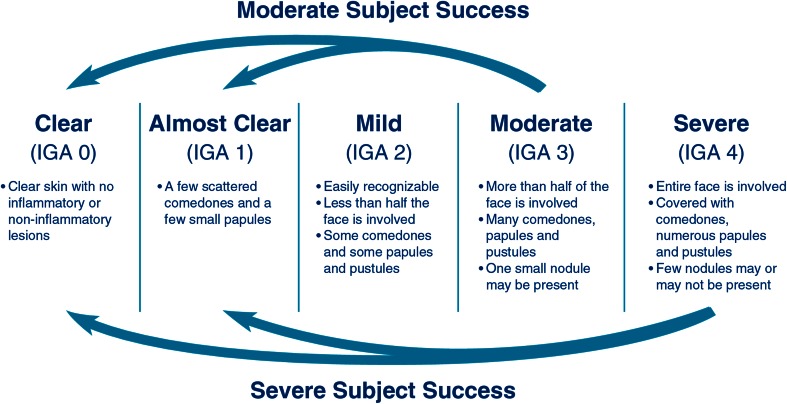
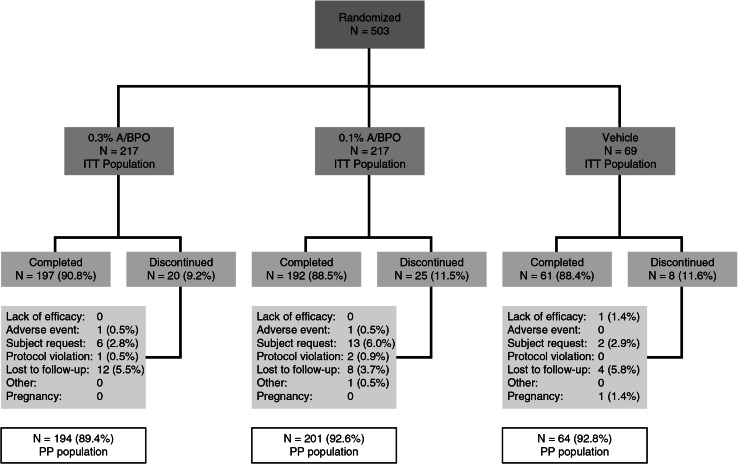
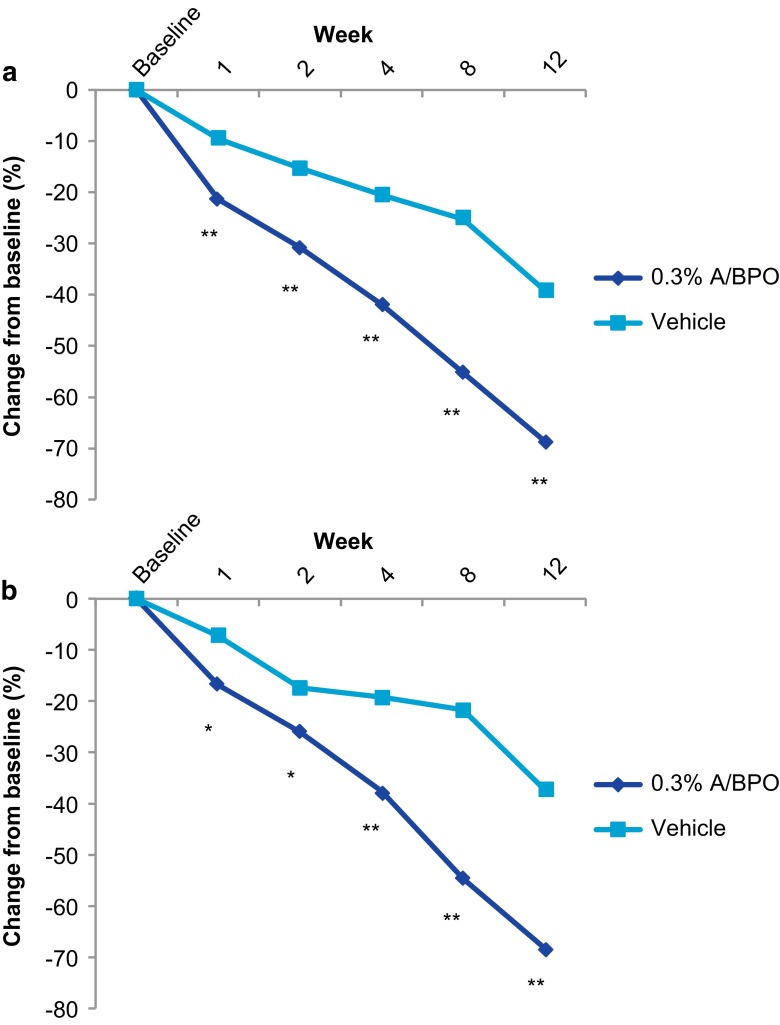
BACKGROUND: A need exists for topical treatments in managing more severe inflammatory acne. OBJECTIVES: The objectives of this study were to evaluate the efficacy and safety of adapalene 0.3 %/benzoyl peroxide 2.5 % (0.3 % A/BPO) topical gel in subjects with moderate and severe inflammatory acne. METHODS: This was a multicenter, randomized, double-blind, parallel-group study. Randomization was stratified by acne severity (50 % moderate and 50 % severe). Subjects received 0.3 % A/BPO, 0.1 % A/BPO (benchmark), or vehicle (comparator) once daily for 12 weeks. Co-primary efficacy endpoints were success rate at week 12 (the percentage of subjects rated 'clear' or 'almost clear' with at least a 2-grade improvement on Investigator's Global Assessment [IGA]) and change in inflammatory (IN) and noninflammatory (NIN) lesion counts from baseline to week 12. Secondary efficacy endpoints were percent changes in IN and NIN lesion counts. Safety endpoints were incidence of adverse events (AEs) and local tolerability signs/symptoms. RESULTS: A total of 503 subjects were randomized: 217, 217, and 69 subjects in the 0.3 % A/BPO, 0.1 % A/BPO, and vehicle groups, respectively. For success rate (subjects rated 'clear' or 'almost clear' with ≥2-grade improvement in IGA), 0.3 % A/BPO was superior to vehicle, with a treatment difference of 22.7 % (33.7 vs. 11.0 %; 95 % confidence interval [CI] 12.8-32.6, p < 0.001). At week 12, 0.3 % A/BPO was superior to vehicle for mean reduction from baseline in IN (27.0 vs. 14.4) and NIN lesion counts (40.2 vs. 18.5), as well as for percentage reduction from baseline in IN (68.7 vs. 39.2 %) and NIN lesion counts (68.3 vs. 37.4 %) (all p < 0.001). Among subjects with severe inflammatory acne (IGA = 4), 0.1 % A/BPO did not reach statistical significance for success rate compared with vehicle (p = 0.443), whereas 0.3 % A/BPO demonstrated significantly greater efficacy (p = 0.029, requiring ≥3-point IGA improvement). Additionally, 0.3 % A/BPO was safe and well-tolerated. CONCLUSIONS: Results of this clinical trial demonstrate the significantly greater efficacy of adapalene 0.3 % A/BPO topical gel compared with vehicle as well as a good safety profile in the treatment of moderate to severe inflammatory non-nodulocystic acne, which increases patients' treatment options. CLINICALTRIALS. GOV IDENTIFIER: NCT01880320.
Overview
The claims and statistics of this paper haven’t been checked yet.
Free: it reads the open-access text and checks the first 5 claims that cite a source we can check. Create a free account to check every claim.
Integrity signals
Registry
Cites
Statistics
Figures
Verification
Claims the paper makes
The claims and statistics of this paper haven’t been checked yet.
Free: it reads the open-access text and checks the first 5 claims that cite a source we can check. Create a free account to check every claim.
Claims other papers make about this one
Each is checked against this paper’s own text: does it say what the citing paper says it does?
In the citing paper
“IDP-126 treatment success rates were also numerically greater than dyads in other 12-week clinical studies (52.5% vs a range of 21.5–33.7%) [13, 26–29].”
In the citing paper
“In context with other 10-week to 12-week clinical studies that examined various combinations and dosages of commercially available dyads containing BPO and clindamycin or adapalene, IDP-126 had greater numeric percent changes in inflammatory and noninflammatory lesions (− 76.4% and − 71.0%, respectively) than the other dyads (range − 42% to − 68.7% and − 21.9% to − 68.3%) [11–13, 26–31].”
Self-check
Percentages, sums and reported differences re-computed from the paper’s own numbers.
The self-check needs the paper’s full text.
Citations
Cites
Hay, R. J., Johns, N. E., Williams, H. C., Bolliger, I. W., Dellavalle, R. P., Margolis, D. J., Marks, R., Naldi, L., Weinstock, M. A., Wulf, S. K., et al. (2014) · Journal of Investigative Dermatology · doi:10.1038/jid.2013.446 · Cited by 1,706 · cited 1×
“The Global Burden of Disease study covering 187 countries found acne to be among the top ten most prevalent diseases worldwide in 2010, and skin conditions were one of the top causes of years lived with disability [1].”
BackgroundThiboutot, D., Gollnick, H., Bettoli, V., Dréno, B., Kang, S., Leyden, J. J., Shalita, A. R., Lozada, V. T., Berson, D., Finlay, A., et al. (2009) · Journal of the American Academy of Dermatology · doi:10.1016/j.jaad.2009.01.019 · Cited by 843 · cited 3×
“A variety of topical therapies already exist for the treatment of mild to moderate acne vulgaris, and a variety of treatments are used in combination [4].”
BackgroundGollnick, H., Cunliffe, W., Berson, D., Dreno, B., Finlay, A., Leyden, J. J., Shalita, A. R., & Thiboutot, D. (2003) · Journal of the American Academy of Dermatology · doi:10.1067/mjd.2003.618 · Cited by 817 · cited 2×
“International guidelines for acne management stipulate that oral isotretinoin remains the gold standard for severe acne treatment [4, 14].”
BackgroundSkin of color: biology, structure, function, and implications for dermatologic disease
Taylor, S. C. (2002) · Journal of the American Academy of Dermatology · doi:10.1067/mjd.2002.120790 · Cited by 446 · cited 1×
“Furthermore, in darker skin phototypes, there is a potential for increased cutaneous irritation and postinflammatory hyperpigmentation (PIH) [27].”
BackgroundKligman, A. M. (1974) · Journal of Investigative Dermatology · doi:10.1111/1523-1747.ep12676801 · Cited by 275 · cited 1×
“Early, effective treatment of acne is essential and is important to avoid later complications, including scarring and psychosocial issues [3].”
BackgroundEvidence-Based Recommendations for the Diagnosis and Treatment of Pediatric Acne
Eichenfield, L. F., Krakowski, A. C., Piggott, C., Del Rosso, J., Baldwin, H., Friedlander, S. F., Levy, M., Lucky, A., Mancini, A. J., Orlow, S. J., et al. (2013) · Pediatrics · doi:10.1542/peds.2013-0490b · Cited by 260
Ethnic skin disorders overview
Halder, R. M., & Nootheti, P. K. (2003) · Journal of the American Academy of Dermatology · doi:10.1067/mjd.2003.274 · Cited by 240 · cited 1×
“This is important because Hispanics are the fastest-growing minority group in the USA, and acne is reported as the most common dermatologic diagnosis seen in over 20 % of the Hispanic population [26].”
BackgroundDraelos, Z. D., Carter, E., Maloney, J. M., Elewski, B. E., Poulin, Y. P., Lynde, C. W., & GARRETT, S. J. (2007) · Journal of the American Academy of Dermatology · doi:10.1016/j.jaad.2006.10.005 · Cited by 126
Tenaud, I., Khammari, A., & Dreno, B. (2007) · Experimental Dermatology · doi:10.1111/j.1600-0625.2007.00552.x · Cited by 111 · cited 2×
“Moreover, adapalene has been found to down-regulate the expression of toll-like receptor 2 (TLR2) [10, 12], a receptor involved in the pathogenesis of acne lesions through Propionibacterium acnes-mediated activation, which subsequently induces proinflammatory cytokines [13].”
BackgroundMichelL, Jomard, & Démarchez (1998) · British Journal of Dermatology · doi:10.1046/j.1365-2133.1998.1390s2003.x · Cited by 107
Cunliffe, W. J., Caputo, R., Dréno, B., Förström, L., Heenen, M., Orfanos, C. E., Privat, Y., Aguilar, A. R., Meynadier, J., Alirezaï, M., et al. (1997) · Journal of the American Academy of Dermatology · doi:10.1016/s0190-9622(97)70056-2 · Cited by 95
Self-citationThiboutot, D., Pariser, D. M., Egan, N., Flores, J., Herndon, J. H., Kanof, N. B., Kempers, S. E., Maddin, S., Poulin, Y. P., Wilson, D. C., et al. (2006) · Journal of the American Academy of Dermatology · doi:10.1016/j.jaad.2004.10.879 · Cited by 67
What's new in acne? An analysis of systematic reviews published in 2011-2012
Bhate, K., & Williams, H. C. (2014) · Clinical and Experimental Dermatology · doi:10.1111/ced.12270 · Cited by 54 · cited 1×
“There is growing evidence that acne negatively affects quality of life [2].”
BackgroundTan, J. K. L., Gollnick, H. P. M., Loesche, C., Ma, Y. M., & Gold, L. S. (2010) · Journal of Dermatological Treatment · doi:10.3109/09546631003681094 · Cited by 49 · cited 3×
“1 % A/BPO, demonstrated that it provided synergistic and significantly greater efficacy than its monotherapies in the treatment of acne vulgaris, with an acceptable safety profile [17].”
BackgroundInfluentialDréno, B., Bettoli, V., Ochsendorf, F. R., Layton, A., Pérez, M., Dakovic, R., & Gollnick, H. P. M. (2014) · European Journal of Dermatology · doi:10.1684/ejd.2014.2293 · Cited by 47
The efficacy of adapalene-benzoyl peroxide combination increases with number of acne lesions
Feldman, S. R., Tan, J. K. L., Poulin, Y. P., Dirschka, T., Kerrouche, N., & Manna, V. K. (2011) · Journal of the American Academy of Dermatology · doi:10.1016/j.jaad.2010.03.036 · Cited by 37 · cited 1×
“Furthermore, the benefit of A/BPO relative to vehicle has been shown to increase with higher lesion counts at baseline [18].”
Background(2014) · PubMed · Cited by 35
Jackson, J. M., Jj, F., & Almekinder, J. L. (2010) · PubMed · Cited by 34
Zuliani, T., Khammari, A., Chaussy, H., Knol, A., & Dréno, B. (2011) · Experimental Dermatology · doi:10.1111/j.1600-0625.2011.01339.x · Cited by 31 · cited 1×
“As adapalene has been found to down-regulate the expression of TLR2, b-defensin 4 and interleukin (IL)-8, as well as to increase CD1d expression [10, 12, 25], with a dose-dependent effect on inflammatory markers [12], it seems logical that a higher potency of A/BPO can demonstrate an even greater anti-inflammatory eff…”
BackgroundPariser, D. M., Thiboutot, D. M., Clark, S. D., Jones, T. M., Liu, Y., & Graeber, M. (2005) · PubMed · Cited by 28
Thiboutot, D. M., Arsonnaud, S., & Soto, P. (2008) · PubMed · Cited by 23
Long-term safety and efficacy study of adapalene 0.3% gel.
Weiss, J., Thiboutot, D. M., Hwa, J., Liu, Y., & Graeber, M. (2008) · PubMed · Cited by 20
Self-citationToll-like receptor 2 and P. acnes: do they trigger initial acne vulgaris lesions?
Bakry, O. A., Samaka, R. M., Sebika, H., & Seleit, I. (2014) · PubMed · Cited by 18
Methods report on the development of the European S3 guidelines for the treatment of acne
Nast, A., Rosumeck, S., Sammain, A., Sporbeck, B., & Rzany, B. (2012) · Journal of the European Academy of Dermatology and Venereology · doi:10.1111/j.1468-3083.2011.04375.x · Cited by 15 · cited 2×
“European guidance suggests that for moderate acne, an oral antibiotic should be initiated upon the presentation of more widespread disease [15].”
BackgroundSafety and efficacy of tazarotene foam for the treatment of acne vulgaris
Gold, L. S., & Epstein (2013) · Clinical Cosmetic and Investigational Dermatology · doi:10.2147/ccid.s34054 · Cited by 14
Research works printed but not linked: 1
- Vega B Jomard A Michel S Regulation of human monocyte toll-like receptor 2 (TLR2) expression by adapalene J Eur Acad Dermatol Venereol 2002 16 Suppl 1 123 124
Cited by
Guidelines of care for the management of acne vulgaris
Reynolds, R. V., Yeung, H., Cheng, C. E., Cook-Bolden, F., Desai, S. R., Druby, K. M., Freeman, E. E., Keri, J. E., Stein Gold, L. F., Tan, J. K. L., et al. (2024) · Journal of the American Academy of Dermatology · doi:10.1016/j.jaad.2023.12.017 · Cited by 518
Self-citationThiboutot, D. M., Dréno, B., Abanmi, A., Alexis, A. F., Araviiskaia, E., Barona Cabal, M. I., Bettoli, V., Casintahan, F., Chow, S., da Costa, A., et al. (2018) · Journal of the American Academy of Dermatology · doi:10.1016/j.jaad.2017.09.078 · Cited by 418
Management of Acne Vulgaris: A Review
Eichenfield, D. Z., Sprague, J., & Eichenfield, L. F. (2021) · JAMA · doi:10.1001/jama.2021.17633 · Cited by 389
Zaenglein, A. L. (2018) · New England Journal of Medicine · doi:10.1056/nejmcp1702493 · Cited by 225
Why Topical Retinoids Are Mainstay of Therapy for Acne
Leyden, J., Stein-Gold, L., & Weiss, J. (2017) · Dermatology and Therapy · doi:10.1007/s13555-017-0185-2 · Cited by 164
Self-citation
Metadata
- Authors
- Stein Gold, L., Weiss, J., Rueda, M. J., Liu, H., & Tanghetti, E.
- Affiliations
- Center for Dermatology and Laser Surgery (US)
- ORCID
- Tanghetti, Emil
- Venue
- American Journal of Clinical Dermatology
- Published
- 2016-03-05
- Volume
- 17
- Issue
- 3
- Pages
- 293-303
- ISSN
- 1175-0561 (ISSN-L)
- 1179-1888
- PMC
- PMC4863916
- OpenAlex
- W2289204262
- Cited by
- 61
- References
- 26
- Citations by year
- 2025: 8 · 2024: 10 · 2023: 7 · 2022: 4 · 2021: 7 · 2020: 7 · 2019: 7 · 2018: 5 · 2017: 4 · 2016: 2
- FWCI
- 7.21
- Type
- journal article
- Language
- en
- Open access
- hybrid
- doi.org
- Licence
- Locations
- American Journal of Clinical Dermatology (publishedVersion, cc-by-nc)
- Europe PMC (PubMed Central) (publishedVersion, cc-by-nc)
- PubMed Central (publishedVersion, cc-by-nc)
- PubMed (publishedVersion)
- Funders
- Galderma
- Topics
- Health Sciences › Medicine › Dermatology › Acne and Rosacea Treatments and Effects
- Health Sciences › Medicine › Dermatology › Dermatology and Skin Diseases
- Health Sciences › Medicine › Dermatology › Dermatologic Treatments and Research
- Keywords
- fixed-dose combination, adapalene, benzoyl peroxide, topical gel, acne lesion count, Investigator's Global Assessment, treatment efficacy, local tolerance, adverse events, monotherapy, vehicle comparison, dose comparison
- MeSH terms
- Adapalene, Acne Vulgaris, Administration, Cutaneous, Adolescent, Adult, Anti-Inflammatory Agents, Non-Steroidal, Benzoyl Peroxide, Child, Dermatologic Agents, Double-Blind Method, Drug Combinations, Female, Gels, Humans, Male, Middle Aged, Naphthalenes, Treatment Outcome, Young Adult
About these checks
Registry, retraction, Cites and statistics results are computed, not judged, with one exception: a printed reference that no index lists is read once by a model before it counts as a citation error. Claims are extracted by a model and kept only when their quote appears verbatim in the text; each cited source is then checked, with a model’s help, for whether it says what the claim relies on. Those verdicts can be wrong — read the claim’s quote and the cited source before relying on one.
Statistics and arithmetic are recomputed, not judged.
Confidence bands are shown only for fields calibrated on our annotated test set. None is calibrated yet, so no band is shown.
What counts as a claim ›How we measure confidence ›How we check this ›
Are you an author, or do you see a problem with this page? Request a review
Data sources
Bibliographic data: Semantic Scholar, OpenAlex, Crossref.
Contains information from the Semantic Scholar Academic Graph Datasets, made available under the ODC Attribution License (ODC-BY 1.0).
Semantic Scholar’s data is described in: Kinney, R., et al. (2023). The Semantic Scholar Open Data Platform. arXiv:2301.10140.
