

Glucose-Lowering Effect of Insulin Degludec is Independent of Subcutaneous Injection Region
Open accessThe DOI matches its Crossref record; 20 of the 20 references it cites were found in a registry or an index.
Abstract
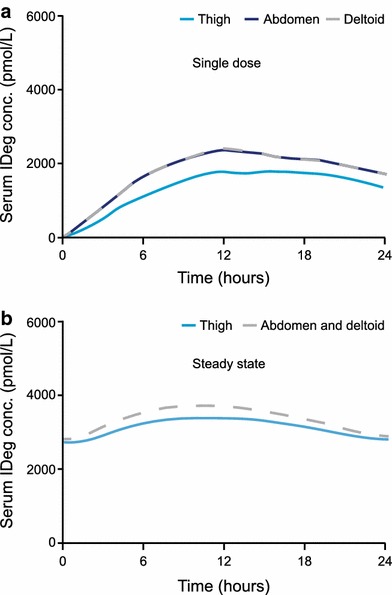
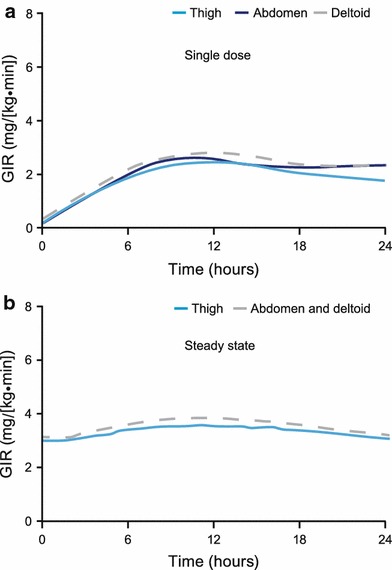
BACKGROUND AND OBJECTIVES: Patients with diabetes mellitus inject insulin in different regions of the body. This study investigated the pharmacokinetic and pharmacodynamic properties of insulin degludec (IDeg), a new-generation once-daily basal insulin with an ultra-long duration of action, after subcutaneous (SC) administration in different injection regions. METHODS: In this study, 20 healthy subjects received single SC doses of IDeg (0.4 U/kg; separated by 13-21 days) in the thigh, abdomen and deltoid in a randomised, open-label, single-centre, single-dose, complete crossover trial. Each dose was followed by a 24-h euglycaemic clamp and 120-h pharmacokinetic blood sampling. The obtained pharmacokinetic/pharmacodynamic profiles were extrapolated to steady state by simulation using a pharmacokinetic/pharmacodynamic model. RESULTS: Total IDeg exposure [area under the IDeg serum concentration-time curve 0-120 h after a single dose (AUCIDeg,0-120h,SD)] and maximum serum concentration [maximum IDeg serum concentration after a single dose (C max,IDeg,SD)] were higher (6-7 and 23-27 %, respectively) following a single SC dose in the deltoid or abdomen, compared with the thigh, as also observed with other insulin preparations. No statistical difference was observed in these measures between deltoid and abdominal administration. No pronounced differences were observed in the glucose-lowering effect of IDeg [area under the glucose infusion rate (GIR) curve 0-24 h after a single dose (AUCGIR,0-24h,SD) and maximum GIR after a single dose (GIRmax,SD)] when injected in the thigh, abdomen or deltoid (AUCGIR,0-24h,SD 2,572, 2,833 and 2,960 mg/kg, respectively). Simulated mean steady-state pharmacokinetic and pharmacodynamic profiles supported a flat and stable IDeg exposure and effect regardless of injection region, with comparable total glucose-lowering effects [area under the GIR curve at steady state (AUCGIR,τ,SS)] between the thigh, abdomen and deltoid. CONCLUSIONS: These findings support administering IDeg SC in the thigh, upper arm or abdominal wall without affecting IDeg absorption or effect at steady state.
Overview
The claims and statistics of this paper haven’t been checked yet.
Free: it reads the open-access text and checks the first 5 claims that cite a source we can check. Create a free account to check every claim.
Integrity signals
Registry
Cites
Statistics
Figures
Verification
Claims the paper makes
The claims and statistics of this paper haven’t been checked yet.
Free: it reads the open-access text and checks the first 5 claims that cite a source we can check. Create a free account to check every claim.
Claims other papers make about this one
Each is checked against this paper’s own text: does it say what the citing paper says it does?
The cited source says what the claim attributes to it.
In the citing paper
“Overarching exclusion criteria across all trials also included smoking [24, 26] and subjects with a history of recurrent severe hypoglycaemia or hypoglycaemic unawareness [21, 22, 24, 25], again to minimise potential variables that might have a confounding influence on data interpretation.”
From A Review of the Pharmacological Properties of Insulin Degludec and Their Clinical Relevance (2014) · cites this paper as [26]
The cited source says what the claim attributes to it.
In the citing paper
“at simulated SS conditions, AUCIDeg,τ,SS and C max,IDeg at SS (C max,IDeg,SS) were estimated to be only ~8 and 10 % higher, respectively, following injection in the deltoid or abdomen, compared with the thigh.”
From A Review of the Pharmacological Properties of Insulin Degludec and Their Clinical Relevance (2014) · cites this paper as [26]
The cited source says what the claim attributes to it.
In the citing paper
“A randomised, open-label, five-period, single-centre, SD crossover trial found that there were no major differences in IDeg exposure following a single SC injection of IDeg in the deltoid, abdomen or thigh [26].”
From A Review of the Pharmacological Properties of Insulin Degludec and Their Clinical Relevance (2014) · cites this paper as [26]
The cited source says what the claim attributes to it.
In the citing paper
“no pronounced differences were observed in the glucose-lowering effect of IDeg [AUCGIR,0–24h,SD and maximum GIR after a SD (GIRmax,SD)] when injected in the thigh, abdomen or deltoid (AUCGIR,0–24h,SD 2,572, 2,833 and 2,960 mg/kg, respectively).”
From A Review of the Pharmacological Properties of Insulin Degludec and Their Clinical Relevance (2014) · cites this paper as [26]
The cited source says what the claim attributes to it.
In the citing paper
“No difference in exposure was observed between administration in the deltoid or abdomen.”
From A Review of the Pharmacological Properties of Insulin Degludec and Their Clinical Relevance (2014) · cites this paper as [26]
3 more claims about this paper
Create a free account to see every claim other papers make about this one.
Self-check
Percentages, sums and reported differences re-computed from the paper’s own numbers.
The self-check needs the paper’s full text.
Citations
Cites
Design of the Novel Protraction Mechanism of Insulin Degludec, an Ultra-long-Acting Basal Insulin
Jonassen, I., Havelund, S., Hoeg-Jensen, T., Steensgaard, D. B., Wahlund, P.-O., & Ribel, U. (2012) · Pharmaceutical Research · doi:10.1007/s11095-012-0739-z · Cited by 448 · cited 3×
“In contrast to other basal insulin preparations, which form crystals or precipitate upon SC injection [12– 15], IDeg stays in solution and forms stable multi-hexamers in the SC tissue from which IDeg monomers gradually separate, producing a slow absorption into the circulation with low day-to-day variability [11, 16,…”
BackgroundResultHeise, T., Hermanski, L., Nosek, L., Feldman, A., Rasmussen, S., & Haahr, H. (2012) · Diabetes, Obesity and Metabolism · doi:10.1111/j.1463-1326.2012.01627.x · Cited by 397 · cited 1×
“In contrast to other basal insulin preparations, which form crystals or precipitate upon SC injection [12– 15], IDeg stays in solution and forms stable multi-hexamers in the SC tissue from which IDeg monomers gradually separate, producing a slow absorption into the circulation with low day-to-day variability [11, 16,…”
ResultSelf-citationUltra‐long‐acting insulin degludec has a flat and stable glucose‐lowering effect in type 2 diabetes
Heise, T., Nosek, L., Bøttcher, S. G., Hastrup, H., & Haahr, H. (2012) · Diabetes, Obesity and Metabolism · doi:10.1111/j.1463-1326.2012.01638.x · Cited by 331
Self-citationGalloway, J. A., Spradlin, C. T., Nelson, R. L., Wentworth, S. M., Davidson, J. A., & Swarner, J. L. (1981) · Diabetes Care · doi:10.2337/diacare.4.3.366 · Cited by 226 · cited 1×
“For example, some studies have reported slower insulin absorption and decreased glucose-lowering effects of short-acting insulins when injected SC in the thigh than in the abdomen [4–8] or deltoid [4, 5].”
BackgroundOwens, D. R., Coates, P. A., Luzio, S. D., Tinbergen, J. P., & Kurzhals, R. (2000) · Diabetes Care · doi:10.2337/diacare.23.6.813 · Cited by 200 · cited 1×
“Existing data with radio-labelled insulin demonstrate that the absorption characteristics of insulin glargine are similar regardless of whether SC injection is conducted in the arm, abdomen or leg and no differences were seen in plasma exogenous insulin concentration or blood glucose levels between injection regions […”
BackgroundKOIVISTO, V. A., & FELIG, P. (1980) · Annals of Internal Medicine · doi:10.7326/0003-4819-92-1-59 · Cited by 153
Evans, M., Schumm‐Draeger, P. M., Vora, J., & King, A. B. (2011) · Diabetes, Obesity and Metabolism · doi:10.1111/j.1463-1326.2011.01395.x · Cited by 146
Peyrot, M., Barnett, A. H., Meneghini, L. F., & Schumm‐Draeger, P. ‐. (2012) · Diabetes, Obesity and Metabolism · doi:10.1111/j.1463-1326.2012.01636.x · Cited by 143 · cited 1×
“Diabetes mellitus patients inject insulin in different regions of the body according to personal preference and activity pattern [1–3].”
BackgroundBiotransformation of insulin glargine after subcutaneous injection in healthy subjects
Kuerzel, G. U., Shukla, U., Scholtz, H. E., Pretorius, S. G., Wessels, D. H., Venter, C., Potgieter, M. A., Lang, A. M., Koose, T., & Bernhardt, E. (2003) · Current Medical Research and Opinion · doi:10.1185/030079902125001416 · Cited by 130
Insulin Preparations with Prolonged Effect
Owens, D. R. (2011) · Diabetes Technology & Therapeutics · doi:10.1089/dia.2011.0068 · Cited by 119
Research works printed but not linked: 2
- Kurtzhals P Heise T Strauss HM Bøttcher SG Granhall C Haahr H Jonassen I Multi-hexamer formation is the underlying basis for the ultra-long glucose-lowering effect of insulin degludec Diabetologia. 2011 54 S426
- Heise T Hövelmann U Nosek L Bøttcher SG Granhall C Haahr H Insulin degludec: twofold longer half-life and a more consistent pharmacokinetic profile than insulin glargine Diabetologia. 2011 54 S425
Cited by
A Review of the Pharmacological Properties of Insulin Degludec and Their Clinical Relevance
Haahr, H., & Heise, T. (2014) · Clinical Pharmacokinetics · doi:10.1007/s40262-014-0165-y · Cited by 226
“Overarching exclusion criteria across all trials also included smoking [24, 26] and subjects with a history of recurrent severe hypoglycaemia or hypoglycaemic”
BackgroundMethodInfluentialSelf-citationFactors Affecting the Absorption of Subcutaneously Administered Insulin: Effect on Variability
Gradel, A. K. J., Porsgaard, T., Lykkesfeldt, J., Seested, T., Gram-Nielsen, S., Kristensen, N. R., & Refsgaard, H. H. F. (2018) · Journal of Diabetes Research · doi:10.1155/2018/1205121 · Cited by 202
“preparations has been reported to be less susceptible to changes in absorption rate associated with injection site rotation [84, 133].”
BackgroundSelf-citationCengiz, E., Danne, T., Ahmad, T., Ayyavoo, A., Beran, D., Ehtisham, S., Fairchild, J., Jarosz‐Chobot, P., Ng, S. M., Paterson, M., et al. (2022) · Pediatric Diabetes · doi:10.1111/pedi.13442 · Cited by 93
“The absorption of glargine(128) and degludec are not significantly influenced by the injection site.(129) • Intramuscular (IM) injection.”
BackgroundClinical use of insulin degludec
Vora, J., Cariou, B., Evans, M., Gross, J. L., Harris, S., Landstedt-Hallin, L., Mithal, A., Rodriguez, M. R., & Meneghini, L. (2015) · Diabetes Research and Clinical Practice · doi:10.1016/j.diabres.2015.04.002 · Cited by 73
“Simulated pharmacokinetic and pharmacodynamic profiles at steady state indicate a similar exposure and glucose-lowering effect of IDeg over a 24-h period regardless of the site of injection [25].”
BackgroundInfluentialInsulin degludec: overview of a novel ultra long‐acting basal insulin
Gough, S. C. L., Harris, S., Woo, V., & Davies, M. (2013) · Diabetes, Obesity and Metabolism · doi:10.1111/dom.12052 · Cited by 74
“Finally, the region of injection has been shown to have little effect on the overall PD effect of degludec, with overall PK exposure slightly reduced (by ∼6%) with administration into the thigh versus the abdomen or deltoid [34].”
BackgroundChallenges and recent advances in the subcutaneous delivery of insulin
Guo, X., & Wang, W. (2016) · Expert Opinion on Drug Delivery · doi:10.1080/17425247.2016.1232247 · Cited by 67
Insulin – Pharmacology, Therapeutic Regimens and Principles of Intensive Insulin Therapy
Donner, T. W., & Sarkar, S. (2015) · Europe PMC (PubMed Central) · Cited by 86
Concentrated insulins: the new basal insulins
Davis, S. N., Lamos, E. M., & Younk, L. M. (2016) · Therapeutics and Clinical Risk Management · doi:10.2147/tcrm.s99855 · Cited by 61
“The glucoselowering effect of degludec U100 was not statistically affected by injection site (thigh, upper arm, or abdominal wall), although slightly reduced in the thigh.(18) Dose adjustment of insulin degludec U100 in renal impairment (down to an estimated glomerular filtration rate ,30 mL/min per 1.”
Zou, P., Wang, F., Wang, J., Lu, Y., Tran, D. C., & Seo, S. K. (2021) · Journal of Controlled Release · doi:10.1016/j.jconrel.2021.06.038 · Cited by 59
Keating, G. M. (2013) · Drugs · doi:10.1007/s40265-013-0051-1 · Cited by 46
“Insulin degludec exposure was slightly greater when injected subcutaneously into the abdomen or deltoid than when injected subcutaneously into the thigh [14].”
BackgroundPlum‐Mörschel, L., Andersen, L. R., Hansen, S. L., Hövelmann, U., KRAWIETZ, P., Kristensen, N. R., Lehrskov, L. L., & Haahr, H. L. (2023) · Clinical Drug Investigation · doi:10.1007/s40261-022-01243-6 · Cited by 43
“The observation in the current trial of a greater maximum concentration of icodec after a single dose when administered in the abdomen and upper arm compared with the thigh was expected, since such a difference between injection regions has been shown in previous studies with the basal insulin products, insulin detemi…”
BackgroundResultSelf-citationHaak, T., Fritsche, A., Füchtenbusch, M., Gehr, B., Gölz, S., Kröger, J., Siegmund, T., Ziegler, R., Droßel, D., Fuchs, S., et al. (2019) · Experimental and Clinical Endocrinology & Diabetes · doi:10.1055/a-0984-5696 · Cited by 29
Kapitza, C., Bode, B. W., Ingwersen, S. H., Jacobsen, L. V., & Poulsen, P. (2015) · The Journal of Clinical Pharmacology · doi:10.1002/jcph.549 · Cited by 30
Haak, T., Gölz, S., Fritsche, A., Füchtenbusch, M., Siegmund, T., Schnellbächer, E., Klein, H. H., Uebel, T., & Droßel, D. (2019) · Der Diabetologe · doi:10.1007/s11428-019-0458-8 · Cited by 18
Cengiz, E., Danne, T., Ahmad, T., Ayyavoo, A., Beran, D., Codner, E., Ehtisham, S., Jarosz-Chobot, P., Mungai, L. N. W., Ng, S. M., et al. (2025) · Hormone Research in Paediatrics · doi:10.1159/000543169 · Cited by 17
“The absorption of glargine [146] and degludec are not signi fi cantly in fl uenced by the injection site [147].”
Pedersen, K., Gradel, A. K. J., Ludvigsen, T. P., Christoffersen, B. Ø., Fuglsang-Damgaard, C. A., Bendtsen, K. M., Madsen, S. H., Manfé, V., & Refsgaard, H. H. F. (2021) · Translational research · doi:10.1016/j.trsl.2021.08.005 · Cited by 16
“hexamer or dodecamer, and the following dissociation to monomers/dimers (insulin aspart) or further self-association into multihexamers leading to a slow release of monomers/dimers (insulin degludec).(39,41,42) Variations in the composition of s.”
BackgroundResultPieber, T. R., Leohr, J. K., Bue‐Valleskey, J. M., Juneja, R., Chien, J. Y., Syring, K. E., & Buse, J. B. (2024) · Endocrine Practice · doi:10.1016/j.eprac.2024.06.007 · Cited by 12
Haak, T., Gölz, S., Fritsche, A., Füchtenbusch, M., Siegmund, T., Schnellbächer, E., Klein, H. H., Uebel, T., & Droßel, D. (2019) · Diabetologie und Stoffwechsel · doi:10.1055/a-0898-7429 · Cited by 11
Safety of Degludec versus Glargine in Type 2 Diabetes.
Marso, S. P., & Buse, J. B. (2017) · PubMed · doi:10.1056/nejmc1712575 · Cited by 3
Liu, H., Li, T., Yu, H., Chen, X., Li, J., Tan, H., Jia, D., & Yu, Y. (2023) · Expert Opinion on Investigational Drugs · doi:10.1080/13543784.2023.2254690 · Cited by 9
“Nearly 22% higher IDeg max was observed compared with that of Nosek reported (17.8 ng/mL (≈2916 pmol/L) vs 2388 pmol/L) [42] with an identical single dose, and this might be due to the different PK assay method (LCMS vs ELISA).”
InfluentialHaak, T., Gölz, S., Fritsche, A., Füchtenbusch, M., Siegmund, T., Schnellbächer, E., Klein, H. H., Uebel, T., & Droßel, D. (2020) · Diabetologie und Stoffwechsel · doi:10.1055/a-1193-3724 · Cited by 10
Haak, T., Gölz, S., Fritsche, A., Füchtenbusch, M., Siegmund, T., Schnellbächer, E., Klein, H. H., Uebel, T., & Droßel, D. (2023) · Diabetologie und Stoffwechsel · doi:10.1055/a-2075-9984 · Cited by 7
Therapie des Typ-1-Diabetes: Kurzfassung der S3-Leitlinie. Version 5.0, AWMF-Registernummer: 057-013
Haak, T., Fritsche, A., Füchtenbusch, M., Gehr, B., Gölz, S., Kröger, J., Siegmund, T., Ziegler, R., Droßel, D., Fuchs, S., et al. (2024) · Diabetologie und Stoffwechsel · doi:10.1055/a-2312-0276 · Cited by 6
Haak, T., Gölz, S., Fritsche, A., Füchtenbusch, M., Siegmund, T., Schnellbächer, E., Klein, H. H., Uebel, T., & Droßel, D. (2022) · Diabetologie und Stoffwechsel · doi:10.1055/a-1916-2101 · Cited by 3
Haak, T., Gölz, S., Fritsche, A., Füchtenbusch, M., Siegmund, T., Schnellbächer, E., Klein, H. H., Uebel, T., & Droßel, D. (2024) · Experimental and Clinical Endocrinology & Diabetes · doi:10.1055/a-2166-6695 · Cited by 3
Haak, T., Gölz, S., Fritsche, A., Füchtenbusch, M., Siegmund, T., Schnellbächer, E., Klein, H. H., Uebel, T., & Droßel, D. (2022) · Experimental and Clinical Endocrinology & Diabetes · doi:10.1055/a-1624-3340 · Cited by 3
Haak, T., Gölz, S., Fritsche, A., Füchtenbusch, M., Siegmund, T., Schnellbächer, E., Klein, H. H., Uebel, T., & Droßel, D. (2023) · Diabetes aktuell · doi:10.1055/a-2012-3827 · Cited by 4
Therapie des Typ-1-Diabetes: Kurzfassung der S3-Leitlinie. Version 5.0, AWMF-Registernummer: 057-013
Haak, T., Fritsche, A., Füchtenbusch, M., Gehr, B., Gölz, S., Kröger, J., Siegmund, T., Ziegler, R., Droßel, D., Fuchs, S., et al. (2025) · Diabetologie und Stoffwechsel · doi:10.1055/a-2592-7826 · Cited by 2
Haak, T., Gölz, S., Fritsche, A., Füchtenbusch, M., Siegmund, T., Schnellbächer, E., Klein, H. H., Uebel, T., & Droßel, D. (2021) · Diabetologie und Stoffwechsel · doi:10.1055/a-1515-8682 · Cited by 3
Haak, T., Gölz, S., Fritsche, A., Füchtenbusch, M., Siegmund, T., Schnellbächer, E., Klein, H. H., Uebel, T., & Droßel, D. (2021) · Der Diabetologe · doi:10.1007/s11428-021-00764-6 · Cited by 1
Heise, T., Hövelmann, U., Nosek, L., Sassenfeld, B., Thomsen, K. M. D., & Haahr, H. L. (2017) · Clinical Drug Investigation · doi:10.1007/s40261-017-0539-7 · Cited by 1
“A slightly slower onset of action will therefore have little impact on the pharmacodynamic profile at steady-state conditions as simulations show [6].”
BackgroundSelf-citationSrinivas, N. R. (2017) · Clinical Drug Investigation · doi:10.1007/s40261-017-0538-8 · Cited by 1
“The absorption of insulin was the slowest from the thigh injection site as compared to the other two sites, which explained the lower peak concentration and somewhat lower extent of absorption of insulin when Degludec was administered via thigh injection site [3].”
BackgroundResultInfluentialPuglisi, S. C., Mackiewicz, A. L., Ardeshir, A., Garzel, L. M., & Christe, K. L. (2021) · Comparative Medicine · doi:10.30802/aalas-cm-20-000075 · Cited by 1
Haak, T., Gölz, S., Fritsche, A., Füchtenbusch, M., Siegmund, T., Schnellbächer, E., Klein, H. H., Uebel, T., & Droßel, D. (2023) · Die Diabetologie · doi:10.1007/s11428-023-01046-z · Cited by 1
“[24] Nosek L, Coester HV, Roepstorff C et al.”
BackgroundHaak, T., Gölz, S., Fritsche, A., Füchtenbusch, M., Siegmund, T., Schnellbächer, E., Klein, H. H., Uebel, T., & Droßel, D. (2020) · Der Diabetologe · doi:10.1007/s11428-020-00607-w · Cited by 1
Clinical Use of New Insulins and New Insulin Delivery Systems
Lim, T., & Ko, S. (2015) · Journal of Korean Diabetes · doi:10.4093/jkd.2015.16.4.242
“피하주사 후 반감기는 약 25시간이 며[15] 작용 지속시간도 글라르진(란투스[Lantus]; Sanofi,”
The Possible Role of New Basal Insulin Analogues in Pediatric Population
Amaro, F., & Tumini, S. (2018) · Journal of Endocrinology and Diabetes · doi:10.15226/2374-6890/5/5/001105
Haak, T., Gölz, S., Fritsche, A., Füchtenbusch, M., Siegmund, T., Schnellbächer, E., Klein, H. H., Uebel, T., & Droßel, D. (2022) · Die Diabetologie · doi:10.1007/s11428-022-00920-6
Haak, T., Fritsche, A., Füchtenbusch, M., Gehr, B., Gölz, S., Kröger, J., Siegmund, T., Ziegler, R., Droßel, D., Fuchs, S., et al. (2025) · Die Diabetologie · doi:10.1007/s11428-024-01280-z
Liu, L., Dong, J., Tong, Y., Li, P., Liu, X., Cheng, X., Zhang, Y., Lei, C., Cheng, F., Zhao, J., et al. (2026) · Diabetes Obesity and Metabolism · doi:10.1111/dom.70461
“18 Therefore, this modest C max difference is unlikely to translate into clinically meaningful differences in a once-weekly dosing regimen.”
NEW FORMS AND TECHNOLOGIES OF INSULIN THERAPY IN TYPE 1 DIABETES - A SYSTEMATIC LITERATURE REVIEW
Ogorek, A., Kaniak, A., Andrzejewska, J., Wińska, A., Pietruszewska, H., Czerepak, I., Majchrzak, I., Ziemba, M., Zackiewicz, K., & Zielska, J. (2025) · International Journal of Innovative Technologies in Social Science · doi:10.31435/ijitss.4(48).2025.4479
Therapie des Typ-1-Diabetes: Kurzfassung der S3-Leitlinie. Version 5.0, AWMF-Registernummer: 057-013
Haak, T., Fritsche, A., Füchtenbusch, M., Gehr, B., Gölz, S., Kröger, J., Siegmund, T., Ziegler, R., Droßel, D., Fuchs, S., et al. (2026) · Die Diabetologie · doi:10.1007/s11428-026-01467-6
Haak, T., Fritsche, A., Füchtenbusch, M., Gehr, B., Gölz, S., Kröger, J., Siegmund, T., Ziegler, R., Droßel, D., Fuchs, S., et al. (2026) · Diabetologie und Stoffwechsel · doi:10.1055/a-2884-8129
İç Hastalıklarında Güncel Yaklaşımlar: Tanı, Tedavi ve İlaç Yönetimi
SARIKUŞ, F., KÜÇÜK, N., Eskin, F., YILDIRIM, T. T., & Gözel, N. (2026) · Bidge Yayınları eBooks · doi:10.70269/atafwhv2m4f9
Metadata
- Authors
- Nosek, L., Coester, H.-V., Roepstorff, C., Thomsen, H. F., Kristensen, N. R., Haahr, H., & Heise, T.
- Affiliations
- Profil Institute for Metabolic Research (DE)
- Novo Nordisk (Denmark) (DK)
- Corresponding author
- Nosek, Leszek
- Venue
- Clinical Drug Investigation
- Published
- 2014-08-16
- Volume
- 34
- Issue
- 9
- Pages
- 673-679
- ISSN
- 0114-2402 (ISSN-L)
- 1173-2563
- 1179-1918
- PMC
- PMC4143594
- OpenAlex
- W2099438726
- Semantic Scholar
- feffa0dfc4ac48cd2442a1bec0a9564d3636656f
- Cited by
- 42
- References
- 20
- Citations by year
- 2026: 2 · 2025: 4 · 2024: 3 · 2023: 5 · 2022: 4 · 2021: 5 · 2020: 2 · 2019: 3 · 2018: 2 · 2017: 3 · 2016: 2 · 2015: 4 · 2014: 1
- FWCI
- 2.68
- Type
- journal article
- Language
- en
- Open access
- hybrid
- doi.org
- Licence
- Locations
- Clinical Drug Investigation (publishedVersion, cc-by-nc)
- PubMed Central (publishedVersion, cc-by-nc)
- PubMed (publishedVersion)
- Funders
- Novo Nordisk
- Topics
- Health Sciences › Medicine › Endocrinology, Diabetes and Metabolism › Diabetes Management and Research
- Health Sciences › Medicine › Endocrinology, Diabetes and Metabolism › Diabetes Treatment and Management
- Health Sciences › Medicine › Emergency Medicine › Intramuscular injections and effects
- Keywords
- insulin degludec, subcutaneous injection site, basal insulin, pharmacokinetics, pharmacodynamics, glucose-lowering effect, insulin absorption, euglycaemic clamp, thigh, deltoid muscle, abdomen, diabetes mellitus, ultra-long-acting insulin
- MeSH terms
- Adult, Blood Glucose, Female, Humans, Hypoglycemic Agents, Injections, Subcutaneous, Male, Middle Aged, Models, Biological, Glucose Clamp Technique, Cross-Over Studies, Area Under Curve, Insulin, Long-Acting
About these checks
Registry, retraction, Cites and statistics results are computed, not judged, with one exception: a printed reference that no index lists is read once by a model before it counts as a citation error. Claims are extracted by a model and kept only when their quote appears verbatim in the text; each cited source is then checked, with a model’s help, for whether it says what the claim relies on. Those verdicts can be wrong — read the claim’s quote and the cited source before relying on one.
Statistics and arithmetic are recomputed, not judged.
Confidence bands are shown only for fields calibrated on our annotated test set. None is calibrated yet, so no band is shown.
What counts as a claim ›How we measure confidence ›How we check this ›
Are you an author, or do you see a problem with this page? Request a review
Data sources
Bibliographic data: Semantic Scholar, OpenAlex, Crossref.
Contains information from the Semantic Scholar Academic Graph Datasets, made available under the ODC Attribution License (ODC-BY 1.0).
Semantic Scholar’s data is described in: Kinney, R., et al. (2023). The Semantic Scholar Open Data Platform. arXiv:2301.10140.
